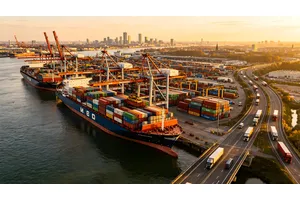
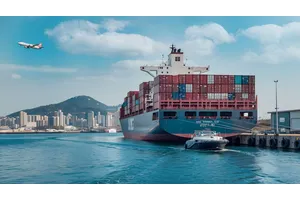
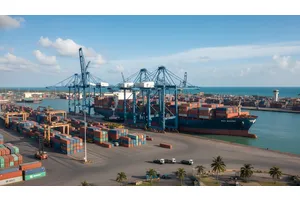
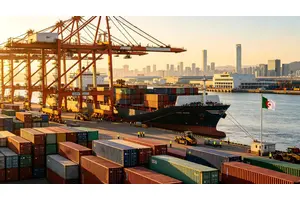
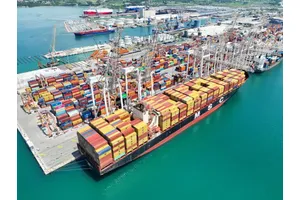
The cheapest way to ship from China to Belgium depends on two numbers your shipment already carries: cubic metres and kilograms. Running October 2026 rates against a 6 CBM, 1,200 kg consignment puts sea LCL near $1,900 door to door, rail via Liege near $2,330, a 20-foot container near $3,990 and air freight near $6,460, duty and VAT excluded. This guide works through the crossover points instead of the rate card: how density picks the mode, the four shipment sizes where the answer changes, why the "13-15 CBM" container rule only holds at the top of the LCL range (13.4 to 28.1 CBM at October 2026 rates), the Belgian fixed charges that arrive whatever you ship, the 21 percent import VAT and the ET 14.000 deferral that keeps it off your cash flow, the EUR 3 per-item duty in force since 1 July 2026, rail through Liege against sea and air, and the five ways a cheap quote turns expensive after arrival.
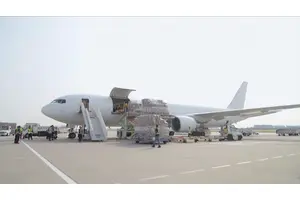
Air shipping from China to Belgium costs $8.50-$12.00 per kg at 45-99 kg, $5.00-$7.00 per kg at 300-499 kg and $3.80-$5.20 per kg above a tonne on October 2026 forwarder rates into Brussels and Liege, with airport-to-airport transit of 2-5 days and 5-12 days door to door. The lane split in two this year: since 1 July 2026 the EU charges a flat EUR 3 duty per item on parcels worth up to EUR 150, Liege Airport saw e-commerce shipments fall 24 percent year on year in July while its total tonnage still rose 7.3 percent in the first nine months, and a EUR 2 Union handling fee plus mandatory product identifiers arrive on 1 November 2026. This guide covers the per-kilogram bands by weight break, the chargeable-weight arithmetic that decides your invoice, Liege versus Brussels versus a truck feed from Amsterdam, the EUR 160-230 terminal charge most quotes omit, the import declaration through IDMS, the 21 percent VAT and the ET 14.000 deferral, and the value-density line that tells you when to
The 140th Canton Fair opened on 15 October 2026 with 220,000+ pre-registered overseas buyers, and the most expensive decision of the trip is still ahead of most of them: how everything they agreed to buy actually gets home. This guide covers shipping samples out of the Pazhou halls, consolidating orders from suppliers in Foshan, Dongguan, Shenzhen and Yiwu into one shipment, October 2026 post-Golden-Week rates (Asia–US West Coast $8,322/FEU vs North Europe $3,645), the Nansha port advantage, and the seven mistakes fair buyers repeat every session.
Sea freight from China to Tanzania costs $2,100-$3,300 for a 20GP and $3,250-$5,200 for a 40GP/40HQ port-to-port to Dar es Salaam on October 2026 forwarder rates, with LCL at $70-$145 per CBM and 25-40 days of sailing. The rate is rarely what decides the shipment. Since 1 July 2026 the customs processing fee has been 1 percent of FOB instead of 0.6 percent, the TBS conformity certificate still has to be issued in China before loading under a China-zone contract that changed operator on 1 May 2026, and Dar es Salaam doubles as the bonded gateway for Zambia, the DRC, Malawi, Rwanda, Burundi and Uganda, so the same sailing produces a 40-day delivery to Dar es Salaam and a 60-day delivery to Lubumbashi. This guide covers port-pair FCL and LCL rates and the cost per cubic meter of cargo, the inland and transit corridors with their customs regimes, transit times broken into sailing, berth waiting and clearance, the PVoC and TANCIS gates, duties of 0-35 percent with 18 percent VAT, the Septem
Sea freight from China to Ghana costs $3,000-$4,350 for a 20GP and $4,400-$5,900 for a 40GP/40HQ port-to-port to Tema on October 2026 forwarder spot rates, with LCL at $190-$290 per CBM and 30-46 days of sailing. The rate is no longer the hard part: since 1 July 2026 applicable consignments need a Ghana EASYPASS Certificate of Conformity issued before loading, and since 3 August 2026 an unregistered shipper cannot move a declaration through ICUMS at all. This guide covers port-pair FCL and LCL rates and why carrier FAK list prices read $600-$1,300 higher per box, transit times by origin port, the 13-15 CBM break-even, the Tema CFS unpacking trap, the new GH¢720 container administrative charge, choosing between Tema and Takoradi, the GS 4510 used-vehicle rules enforced from 1 October 2026, duties of 0-35 percent plus 20 percent effective VAT, GPHA storage and demurrage clocks, and the nine questions to ask before your container is loaded.
Container shipping from China to Algeria costs $3,700-$5,000 for a 20GP and $6,000-$8,000 for a 40GP/40HQ port-to-port to Algiers on October 2026 forwarder spot rates, with LCL at $180-$250 per CBM and 30-45 days of sailing. MSC's carrier FAK tariff prices the same boxes at $5,550 and $6,900, and the spread between spot and FAK is where most importers lose money. This guide covers choosing a 20GP, 40GP, 40HQ, reefer or flat-rack box for Algeria's dense import mix, the 13-15 CBM volume where LCL stops making sense, the Algiers CFS unpacking trap, transit times by port pair, the domiciliation-before-shipment rule, the 120 percent deposit, mandatory import forecasts, certificate-of-conformity requirements, the 21-day D15 declaration, duties from 0 to 60 percent plus 19 percent VAT, and the ten questions to ask before your container is loaded.
Freight rates after Golden Week 2026 have split in two: Asia–US West Coast held $8,322 per FEU and the East Coast $9,606–11,512 while Asia–North Europe fell for a 13th straight week to $3,645 (−34% since July) and the Mediterranean slipped to $4,007 (−43%). Here is what really drives Q4 costs — carriers raising surcharges instead of base rates (Maersk ECS tripled to $1,500, Durban congestion to $900 per 40ft), the Rhine at its lowest level since 1880 with €1,280+ per FEU low-water surcharges, Panama Canal capacity returning on 15 October, the tariff clock to 9 November and 10 January 2027 — plus booking cut-off dates, three scenarios and a 2027 Europe contract playbook.
Sea freight from China to Algeria in October 2026 — 20GP $3,700-$5,000 and 40GP/40HQ $6,000-$8,000 port-to-port to Algiers on forwarder spot rates, 35-44 day transit, and LCL $180-$250 per CBM with a 13-15 CBM break-even against the Algiers unpacking-fee trap. This guide covers port-pair rates and carrier FAK premiums, transit times via the Suez and Cape routings, choosing between Algiers, Oran, Bejaia, Skikda and Djen Djen, the 2026 domiciliation-before-shipment rule, PPI import forecasts, the 120 percent deposit, duties from 0 to 60 percent plus 19 percent VAT and DAPS, and the documents that keep your container out of demurrage.