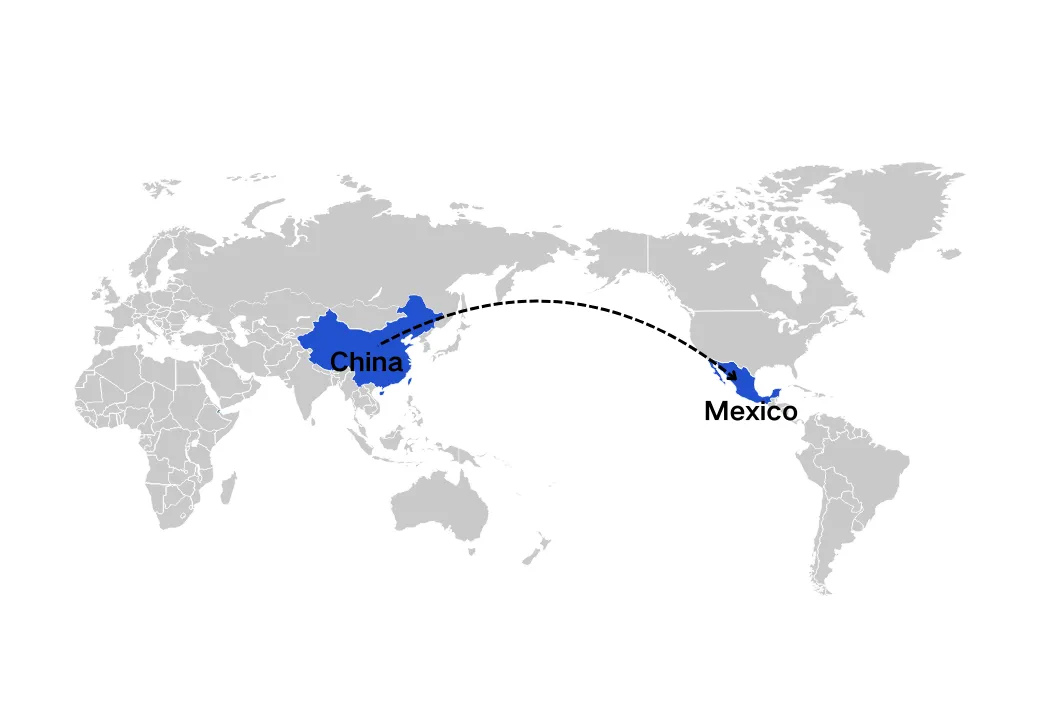
Are you navigating the booming but complex trade lane between China and Mexico? You are not alone. Nearshoring has turned Mexico into a global manufacturing hub, and imports from China keep climbing — but 2026 also brought the biggest shake-up of Mexican import rules in a decade: a brand-new Customs Law, sharply higher tariffs on Chinese goods, a mandatory electronic value declaration, and the end of cheap courier parcels.
Whether you are moving 40ft containers through Manzanillo, restocking an Amazon FBA fulfillment center, or shipping your first LCL pallet, this guide explains what actually applies to your cargo in 2026: duties, transit times, customs documents, and the routes that still work.
Last updated: September 2026. Rates, tariff lines and customs procedures on this lane changed several times during 2026. Figures below are indicative and verified against September 2026 market data — always confirm with a live quote before you commit.
What Changed on the China–Mexico Lane in 2026
If your landed-cost model was built in 2025, it is already out of date. These are the changes that reshape a China-to-Mexico shipment today:
- A new Customs Law (Ley Aduanera) took effect on January 1, 2026. It brings expanded electronic documentation, mandatory pre-arrival data, Know-Your-Customer obligations for customs brokers, 24-hour discrepancy reporting, joint broker liability for classification and valuation, and a much steeper penalty framework.
- Tariffs on Chinese goods rose sharply. The decree published in the DOF on December 29, 2025 raised the IGI (import duty) on 1,463 tariff lines — from 5% up to 50% — for goods originating in countries without a free trade agreement with Mexico. China is squarely in scope, and there was no transition period: the rates apply from January 1, 2026. A second decree, published April 23, 2026, adjusted a further 185 tariff lines at 5%–35% and modified the PROSEC sectoral promotion programs.
- The Manifestación de Valor (MVE) became electronic and mandatory. Importers must file the customs value declaration through Mexico's single window (VUCEM), signed with their own e.firma rather than the broker's. SAT extended the compliance deadline to September 30, 2026, with mandatory transmission from October 1, 2026 and relief measures running through December 31, 2026.
- Parcels are no longer the cheap back door. For covered courier and parcel shipments from origins without an applicable treaty, the simplified rate is generally 33.5%; the conditional 19% treatment applies only when every condition of RGCE rule 3.7.35 III(c) is met. Piece-by-piece restocking lost its cost advantage.
- "Agencias aduanales" now operate nationwide. Since July 1, 2026, ANAM, SAT and the Ministry of Economy have opened this new legal figure for customs agencies across the country, alongside traditional customs brokers — which changes both who can file your pedimento and how liability is shared.
- Penalties for the wrong paperwork jumped. Fines for false declarations and for non-compliance with NOM technical standards now commonly reach 250%–300% of the commercial value of the goods, and undervalued cargo is screened automatically against reference prices.
- Textiles and footwear face extra restrictions. Importers of these goods must be registered in the sectoral Padrón; since May 21, 2026 they can no longer be destined to a Recinto Fiscalizado Estratégico (RFE); and a separate, stricter de minimis applies to B2C textile shipments.
What this means for you: the channels that depended on low declared values or single parcels are exactly the ones being audited, and duty — not ocean freight — is now the largest line in many landed-cost calculations. The rest of this page shows what a compliant, cost-controlled China–Mexico shipment looks like in 2026.
Sea Freight from China to Mexico
Sea freight remains the economic backbone of this lane, carrying over 90% of China–Mexico cargo volume. Transit runs 20–30 days port-to-port depending on the port pair, and door-to-door time typically lands at 30–42 days once Mexican clearance and inland trucking are included.
FCL vs. LCL: Which Should You Choose?
- FCL (Full Container Load): You rent the entire container (20ft, 40ft or 40HQ). This is the fastest sea freight option as there is no need for consolidation. Best for: Shipments over 15 CBM.
- LCL (Less than Container Load): You share space with other shippers. Cheaper per shipment for small loads, and useful while you test a product, but it takes longer because of consolidation and deconsolidation, and destination CFS charges apply on top. Best for: Shipments of 1–15 CBM.
Key Ports and Routes (September 2026)
| Origin (China) | Destination (Mexico) | Port-to-Port | Notes |
|---|---|---|---|
| Shanghai / Ningbo | Manzanillo | 20 - 25 Days | Fastest and busiest. Direct trans-Pacific services, but landside congestion is the bottleneck in 2026. |
| Shenzhen / Yantian | Lázaro Cárdenas | 22 - 28 Days | Deep-water terminal with direct KCSM rail to Mexico City and Monterrey. Our default recommendation for rail cargo. |
| Shanghai / Qingdao | Ensenada | 18 - 24 Days | Shortest Pacific crossing. Best for Tijuana / Mexicali maquiladora deliveries with no mainland trucking leg. |
| Shanghai / Ningbo | Veracruz / Altamira | 30 - 36 Days | Via the Panama Canal — expect draft-related surcharges and weight limits while canal restrictions last. |
Insider Insight (updated for 2026): at Manzanillo, vessel waiting time is now around a day — the real problem is landside. Road construction and lane reductions near the port, terminal appointment delays and chassis shortages push truck cycle times up hard: the Manzanillo–Guadalajara corridor can stretch from 3.5–4 hours to 6.5–8 hours in bad weeks. If your warehouse is inland, Lázaro Cárdenas plus rail is often the more predictable choice — our team checks port and terminal status before every booking.
Current Market Trends & Costs
- Rates moved sharply in 2026. China–Mexico FCL levels sat around $3,000–$4,200 per 40ft in the first half of the year, then firmed hard through Q3 as Latin American services absorbed capacity: indicative China-origin FAK levels reached roughly $7,000–$8,100 per 40ft in early September 2026. Your 2025 quote reference is not a 2026 budget.
- Space, not only price, is the constraint. Typhoons in China pushed berthing delays at Shanghai and Ningbo to around 10 days in late August 2026, blank sailings tightened allocations, and late-September cargo competes with the pre-National Day (October 1–7) rush. Book 3–4 weeks before your cargo-ready date.
- Destination charges are rising with congestion. Demurrage and detention can exceed $1,500 per container when a box misses its free-time window, which is why we pre-book chassis and gate-out appointments instead of hoping for the best.
- Rates change weekly. Contact AllBestShipping for a live quote on your exact port pair and sailing.
Air Freight from China to Mexico
Air freight is the fastest freight option on this lane: 3–7 days airport-to-airport, and 5–10 days door-to-door once Mexican clearance and delivery are included. It suits high-value electronics, urgent production parts, and FBA replenishment ahead of a Mexican retail event.
Standard Air Freight vs. Express
- Standard Air Freight: Airport-to-airport or door-to-door consolidated service. Transit: 3–7 days. Cost: roughly $5.50–$8.50 / kg for consignments over 100 kg at September 2026 levels.
- Express Courier (DHL/FedEx/UPS): Door-to-door with the paperwork handled. Transit: 2–5 days. Cost: roughly $10–$17 / kg — and note that covered courier shipments from China are now generally assessed at the 33.5% simplified rate, so express is a speed choice, not a tax-saving one.
Major Airports and Hubs
- China Origin: Shanghai (PVG), Hong Kong (HKG), Shenzhen (SZX), Guangzhou (CAN).
- Mexico Destination: Mexico City (MEX) and Felipe Ángeles (NLU/AIFA), Guadalajara (GDL), Monterrey (MTY), Querétaro (QRO).
When to Choose Air Freight?
- Urgency: Production delays or a stockout that costs more than the air premium.
- High Value: Electronics or goods where security, insurance exposure and speed justify the cost.
- Low Volume: Under roughly 300 kg, air often competes with LCL once destination charges and the new duty rates are counted.
Risk Warning: Mexico City (MEX) handles enormous volumes and its customs office screens hard for undervaluation. For the Bajío and western Mexico, flying into Guadalajara (GDL) can save 1–2 days of trucking and clearance time. For urgent restocks, ask us about a US in-bond (T&E) routing through Los Angeles or a Texas gateway with a Laredo / Otay Mesa border crossing — it can beat a congested Pacific port, and we will tell you honestly whether your commodity and documentation qualify.
Why Choose AllBestShipping for Air Cargo?
We do not just book space; we build a clearance-ready shipment. Our Shenzhen and Hong Kong warehouses consolidate cargo, apply NOM labeling and Spanish manuals before departure, and pre-check HS codes against the current tariff lines so clearance is not where your timeline dies. Our DDP Air service then clears your goods under our own Mexican entity — you do not need an RFC, a Padrón registration or an e.firma in Mexico. Last updated: September 2026.
DDP & Door-to-Door Shipping from China to Mexico
Struggling with Mexico's strict importer requirements? Here is the rule most first-time importers discover too late: Mexico does not allow a foreign company to act as importer of record. Only an entity legally constituted in Mexico, holding an active RFC and registered on the Padrón de Importadores, can be named on the pedimento. A foreign seller cannot be the IOR, and a Mexican consignee who is not registered cannot clear the goods either.
That is precisely the problem our DDP (Delivered Duty Paid) service solves. AllBestShipping handles the entire supply chain and clears your cargo under our own Mexican trading entity — a compliant structure, not a grey channel. See how this works end to end in our door-to-door shipping guide.
How Our DDP Service Works (The "Hands-Off" Approach)
- Pickup: We collect goods from your supplier anywhere in China.
- Export: We handle the Chinese export declaration and origin documentation.
- Shipping: Sea or air freight to Mexico, with tracking from departure.
- Clearance: Crucial step. Our licensed broker files the pedimento A1 (formal commercial entry — the entry type Amazon Mexico needs for FBA inventory) through VUCEM, with the customs value declaration (MVE) filed under our entity's e.firma.
- Duty & tax payment: We pay the applicable IGI duty and 16% IVA on your behalf as part of the all-in price.
- Delivery: Final delivery by local carriers (Estafeta, Redpack) or dedicated trucking to your warehouse, or to Amazon FBA centers such as MEX1, MEX2, MEX3 or MEX6.
Who Needs DDP?
- E-commerce sellers: Amazon FBA and Mercado Libre sellers who need stock fast without a Mexican fiscal entity.
- Startups and first-time importers: Companies without an RFC, a Padrón registration or a customs broker relationship.
- Former parcel shippers: Sellers whose piece-by-piece courier model broke when the simplified courier rate moved to 33.5%.
- Small and mid-size shipments: Where hiring a broker and setting up compliance costs more than the shipment itself.
Cost Transparency: Our DDP quotes are "all-in" — freight, customs clearance, duty, IVA and delivery in one price per kg or CBM, with no surprise invoice when the container lands. Be cautious with any offer of "true DDP" that does not name an eligible Mexican importer: with the 2026 enforcement regime, that usually means an undeclared entry.
Main shipping routes from China to Mexico
Choosing the right route is about inland connectivity as much as the seaport. Mexico's logistics network runs on three practical corridors.
1. The Pacific Corridor (The Primary Gateway)
Ports: Manzanillo, Lázaro Cárdenas and Ensenada. Roughly 90% of Asian container traffic enters Mexico here.
Inland connection:
- Manzanillo: Road and rail links to Guadalajara and Mexico City. Warning: road freight in this corridor carries hijacking risk — use insured, secure trucking.
- Lázaro Cárdenas: Preferred hub for rail freight, connecting directly to the Kansas City Southern de México (KCSM) network for Mexico City, Monterrey and the US border at Laredo — with far less truck-gate congestion.
- Ensenada: Fastest crossing and no mainland trucking leg for the Tijuana / Mexicali maquiladora belt.
2. The Gulf Corridor (The Atlantic Route)
Ports: Veracruz and Altamira.
Route: Vessels cross the Panama Canal to reach these ports.
Transit time: +10 to 15 days longer than Pacific ports, and the canal's current draft restrictions are adding surcharges and weight limits on some services.
Best for: Delivery to Mexico's East Coast, the Yucatán Peninsula, or Gulf-side distribution centers.
3. The In-Bond Corridor Via a US Gateway (Premium Restock Option)
Route: Ocean or air into a US West Coast gateway, then trucked under US in-bond (T&E) transit to Laredo or Otay Mesa for Mexican clearance. It can shorten sea-based door-to-door times and sidestep Pacific port congestion on urgent restocks. It requires clean documentation, a bond, and a commodity that complies with both US and Mexican rules — talk to us before you plan around it.
Logistics Strategy: If your warehouse is in Monterrey or Mexico City, Lázaro Cárdenas plus KCSM rail is usually safer and more reliable than trucking everything from Manzanillo. If your goods are textiles or footwear, check the authorized customs office before booking — those chapters face additional entry restrictions in 2026.
Shipping Costs from China to Mexico
Understanding total landed cost matters more in 2026 than ever, because duty is now the fastest-growing line — not freight. Budget for the freight rate, the destination charges, and the tariff treatment of your specific HS code.
Indicative Freight Rates (Early September 2026)
| Shipping Mode | Unit | Indicative Cost (USD) | Notes |
|---|---|---|---|
| FCL (20ft) | Per Container | $4,500 - $6,300 | Pacific ports; typically 20–30% below the 40ft level. Best for heavy, dense goods. |
| FCL (40ft / 40HQ) | Per Container | $6,500 - $8,100 | Port-to-port, Manzanillo / Lázaro Cárdenas. H1 2026 was $3,000–$4,200 before the Q3 surge. |
| LCL | Per CBM | $110 - $180 | Minimum 1 CBM; destination CFS and THC are charged separately. |
| Air Freight | Per Kg | $5.50 - $8.50 | 100 kg+ consignments; space is tight for heavy cargo. |
| Express Courier | Per Kg | $10 - $17 | Now usually assessed at the 33.5% simplified courier rate for China-origin parcels. |
These are port-to-port market indications before Mexican duty, IVA and inland delivery. Because Latin America rates moved more than 40% within a single quarter in 2026, treat any figure older than two weeks as a planning number only.
The "Hidden" Costs You Must Budget For
- Origin charges (China): Pickup, export declaration, documentation — roughly $150–$300.
- Destination charges (Mexico): Terminal handling (THC), port validation and documentation — roughly $200–$400, higher during congestion peaks.
- Customs processing fee (DTA): About 0.8% of the customs value.
- Customs broker / agencia aduanal: Roughly $150–$350 per pedimento.
- Inland trucking: Manzanillo to Mexico City $600–$1,100; Manzanillo to Guadalajara around $650.
- Duty (IGI) and IVA — now the biggest line for many products: 5%–50% duty on the affected tariff lines plus 16% IVA on (CIF + IGI). See the worked example below.
- Pre-validation (previo): A physical inspection at the Mexican port where required — it costs extra but prevents far larger fines for discrepancies.
Cost-Saving Tip: consolidate. Restocking in small parcels is no longer the budget route: at the 33.5% simplified courier rate, one consolidated air or LCL shipment is frequently cheaper than a series of single parcels — and it clears on one pedimento instead of dozens. AllBestShipping combines cargo from multiple Chinese suppliers into one shipment, inspects and repacks it, and gives you a single landed cost.
How Long Does Shipping Take from China to Mexico?
Transit time has three parts: origin handling + port-to-port / flight + customs and final delivery. The ocean leg is predictable; Mexican customs and inland trucking are the variables. Our transit time guide breaks this down route by route.
Transit Time Breakdown
| Route / Method | Port-to-Port / Flight | Door-to-Door (Est.) |
|---|---|---|
| Express Courier | - | 3 - 7 Days |
| Air Freight | 1 - 3 Days | 5 - 10 Days |
| Sea: Manzanillo / Lázaro Cárdenas | 20 - 28 Days | 30 - 42 Days |
| Sea: Veracruz / Altamira | 30 - 36 Days | 38 - 50 Days |
Why Is My Shipment Delayed?
- Customs red light (Rojo): Mexico's traffic-light system sends some cargo to physical inspection, adding 3–7 days.
- Valuation challenge: new in 2026 — customs compares your declared value against reference prices. If it looks low, you have around 10 days to produce original factory invoices and bank proof of payment, or the cargo is seized.
- Manzanillo landside congestion: yard density, appointment delays and chassis shortages; truck cycle times can double.
- Weather and capacity in China: typhoons in August–September 2026 caused berthing delays of around 10 days at Shanghai and Ningbo, and pre-National Day volume compounds it every autumn.
- Documentation errors: missing NOM certificates, a mismatched HS code, or an RFC/pedimento data mismatch are still the number-one cause of holds.
AllBestShipping Guarantee: we review every document before the ship leaves China — commercial invoice, packing list, HS classification, NOM exposure and the customs value data that feeds your MVE — so that what we clear on arrival matches what the authorities already expect. That pre-compliance check is the cheapest insurance against a red light.
Mexico Customs Clearance & Import Duties
Navigating ANAM (the National Customs Agency) and SAT is the most demanding part of shipping to Mexico, and the 2026 reform raised the bar again: more electronic filings, more liability, and far higher fines for getting it wrong. Our customs clearance services exist precisely for this.
Mandatory Requirements for Importers
- Padrón de Importadores: Every importer must be registered and active — and sectoral registries apply for sensitive categories such as textiles, footwear, chemicals, electronics and auto parts.
- RFC (Tax ID): The importer's RFC must appear on every pedimento; it is the identifier customs and the marketplace both depend on.
- NOM standards (Normas Oficiales Mexicanas): Electronics, appliances, toys, textiles and many other categories require NOM certification, correct Spanish labeling and — for NOM-024 — a Spanish manual. Relabeling inside the customs zone is rarely approved, so this work belongs in China, before departure.
- Electronic value declaration (MVE): Filed through VUCEM with the importer's e.firma. The deadline was extended to September 30, 2026, with mandatory transmission from October 1, 2026.
- Foreign trade file (expediente de comercio exterior): Contract, payment and logistics documents supporting your declared value must be retained and produced to authorities on request.
The importer-of-record rule: a foreign company cannot be the IOR in Mexico. Only an entity legally constituted in Mexico with an active RFC and Padrón registration can be named on the pedimento. That is the structure behind our DDP service — and it is also why "DDP" offers without a named Mexican importer should worry you.
Duty Rates & Taxes in 2026
| Charge | How It Applies in 2026 |
|---|---|
| IGI (general import duty) | The base MFN rate plus the 2026 increases: 5%–50% on 1,463 tariff lines for goods originating in countries without an FTA with Mexico. Representative sectors: autos and auto parts 25%–50%, footwear 25%–35%, textiles and apparel up to 35%, toys and school supplies around 30%, appliances, furniture and plastics around 25%. |
| IVA (VAT) | 16% calculated on the CIF value plus duty. Reducing your duty reduces your IVA too. |
| DTA (customs processing fee) | Roughly 0.8% of the customs value. |
| Sectoral permits | COFEPRIS (health), SENASICA (plants and animals), SEMARNAT (environment), plus NOM certificates where applicable. |
What the Tariff Change Actually Costs You
| Scenario (CIF value $10,000) | IGI Duty | IVA (16%) | Total Import Taxes |
|---|---|---|---|
| A 2025 model at 10% IGI | $1,000 | $1,760 | $2,760 |
| A 2026 classification at 35% IGI | $3,500 | $2,160 | $5,660 |
The duty increase nearly doubles the tax bill on the same shipment — before a single freight charge. This is why we verify your HS code and tariff treatment before you buy, not after the container arrives. For a general cost benchmark by mode, see how much it costs to ship from China to Mexico.
Don't have an RFC, a Padrón registration or NOM certificates? Don't panic — but don't ship into that gap either. Use AllBestShipping's DDP service: we clear your goods under our own Mexican entity, with our import registrations and NOM compliance, legally and traceably.
Step-by-Step Shipping Process
Follow this roadmap to get from factory floor to Mexican warehouse without a customs surprise.
- Quote & Booking: Send us your packing list and supplier details. We return a clear quote (FOB/EXW/DDP) and flag any tariff, NOM or permit issue up front.
- Cargo Pickup: We contact your Chinese supplier to arrange pickup, or receive cargo at our warehouse (Shenzhen / Ningbo / Shanghai).
- Document Audit: Critical step. We review the commercial invoice and packing list, confirm the HS code against the current tariff lines, and check NOM and permitting exposure before the goods move.
- Export Clearance: We handle Chinese customs procedures.
- International Transit: Goods depart by sea or air; you receive a tracking reference and sailing or flight details.
- Arrival & Clearance: On arrival at Manzanillo, Lázaro Cárdenas or Mexico City, our broker files the pedimento through VUCEM, with the MVE and supporting value documents aligned.
- Final Delivery: Once cleared, we dispatch a truck for delivery to your door or to your Amazon FBA center.
One-Stop Shipping Solutions for Alibaba, 1688 & Taobao Buyers
Sourcing from Alibaba, 1688 or Taobao? You usually end up with several suppliers sending small boxes — and shipping them individually is now both expensive and risky.
The "Consolidation" Strategy
AllBestShipping acts as your virtual warehouse in China.
- Step 1: You order from five different suppliers (e.g. Supplier A: phone cases, Supplier B: cables, Supplier C: chargers).
- Step 2: Everything ships to our Shenzhen warehouse.
- Step 3: We inspect (damage and quantity), repack (reduce volumetric weight) and combine it into one shipment, with NOM labels and Spanish manuals applied before departure.
- Step 4: You pay one freight invoice and clear on one pedimento.
Benefits:
- Save up to 50% on freight (no minimum charge per shipment) — and avoid the 33.5% simplified courier rate that now hits single parcels from China.
- Quality control: errors are caught before goods leave China.
- Privacy: we can remove supplier invoices (dropshipping support) so your buyer never sees your sourcing price.
How to Start Shipping Today
Importing from China to Mexico still offers strong margins — but in 2026 the logistics barrier is compliance, not just cost. Duty math, NOM labeling and value documentation are where shipments live or die.
At AllBestShipping, we make the complex simple.
- No RFC or Padrón? No problem — we clear under our own Mexican entity.
- Need speed? Daily air departures from Shenzhen and Hong Kong.
- Worried about cost? One all-in price per kg or CBM, with duty, IVA and delivery included.
Ready to ship? Send us your packing list and we will confirm tariff treatment, NOM exposure, routing and an all-in door-to-door quote — usually within one business day. Let us handle the freight and the paperwork, so you can focus on growing your business in Mexico.
Last updated: September 2026.