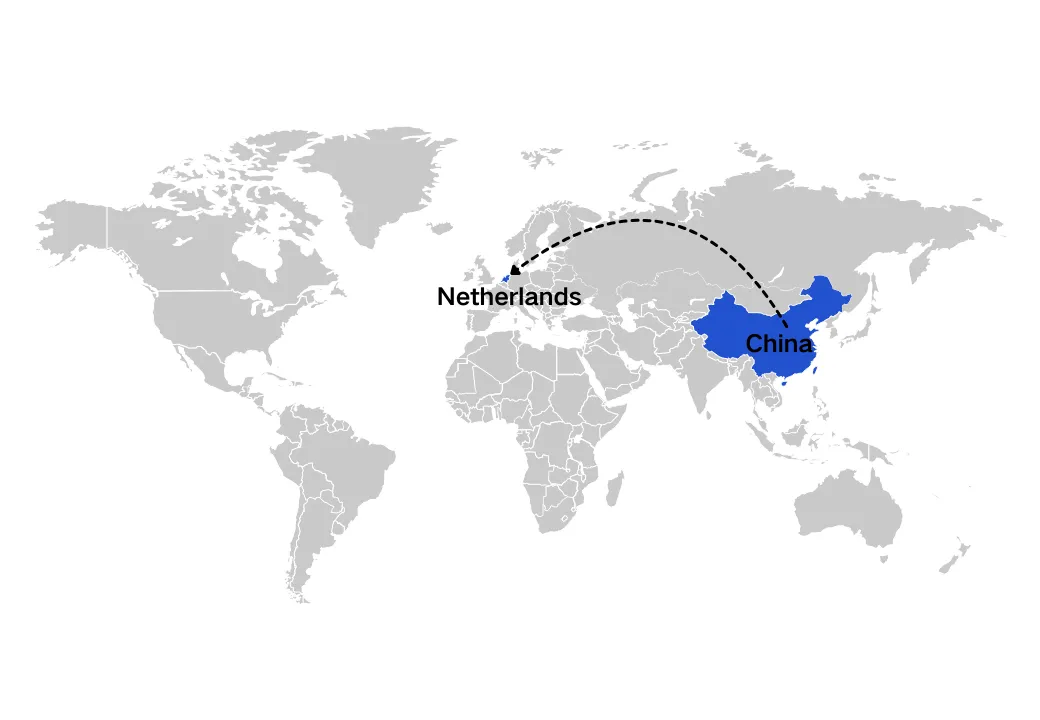
The Netherlands is Europe's import gateway: Rotterdam is the continent's largest container port, Schiphol is one of its top cargo airports, and Dutch customs is designed to move goods into free circulation across all 27 EU member states in days rather than weeks. Shipping from China to the Netherlands in 2026 is less about the ocean crossing than about three things — which routing your vessel takes (Suez or the Cape), how you handle 21% import VAT, and how cleanly your data is filed. This guide covers all three with current rates, transit times and the Dutch compliance rules that changed this year. Last updated: September 2026.
As a professional China-to-Netherlands freight forwarder based in Shenzhen, AllBestShipping manages the whole chain — supplier pickup, China export clearance, ocean, rail or air freight, Dutch import clearance, VAT and duty settlement, and delivery to your warehouse, Amazon FBA center or 3PL anywhere in the Netherlands or the wider EU.
What Has Changed on the China–Netherlands Lane in 2026
Before the tables, here are the developments that matter most if you are booking a shipment into Rotterdam or Schiphol right now.
- Suez is coming back — service by service. Around 19% of Asia–Europe westbound services were routed through the Suez Canal again by September 2026 (Sea-Intelligence), and Maersk and Hapag-Lloyd have returned six of their eleven Asia–Europe/Middle East Gemini services to the Red Sea corridor, with Rotterdam calls restored. Cape of Good Hope routings still add 10–14 days, and carriers can switch a service back at short notice — confirm the routing for your specific vessel and voyage at booking, not just the sailing schedule.
- EU ETS is now at 100%. Since 1 January 2026 shipping lines must surrender allowances for 100% of verified CO₂ emissions on EU-related voyages — up from 40% in 2024 and 70% in 2025 — and methane and nitrous oxide are now inside the accounting. Carriers have published emissions-surcharge increases of roughly 45%, so expect this as a separate line on every China–Netherlands invoice.
- The EU's €3 low-value duty is live (1 July 2026). Council Regulation (EU) 2026/382 removed the €150 customs duty relief and replaced it with a flat €3 duty per item on consignments with an intrinsic value up to €150, charged to the business rather than the consumer, running until the EU Customs Data Hub launches around July 2028. From 1 November 2026, PID product identifier data becomes mandatory on these flows. Standard B2B commercial consignments are unaffected — marketplace and direct-to-consumer parcel flows are not.
- Rotterdam's first-half 2026 numbers (official). The port handled 7.02 million TEU in H1 2026. Deep-sea container volumes rose 5.2% in TEU terms, driven by an 8% increase in imports from Asia, while transshipment dropped around 20% because the port ran short of capacity. Practical translation: your deep-sea import has room, but inland barge and feeder legs can be tight.
- Amazon Pan-EU now requires a Netherlands offer. Since 3 September 2026, every Pan-European FBA product — new and existing — must carry an active offer on Amazon.nl to enroll or keep Pan-EU benefits; Belgium follows on 26 February 2027. A separate 1.5% fuel and logistics surcharge has applied to FBA fulfilment fees in the Netherlands and other EU stores since 17 April 2026.
- Dutch customs moved fully to DMS. The old AGS declaration system has been replaced by DMS, and since 16 May 2026 supporting documents for import and export declarations are filed directly through the declaration system instead of by email. Clearance is faster when your forwarder is connected — and slower when documents arrive by hand.
Sea Freight from China to the Netherlands
Sea freight carries the overwhelming majority of China–Netherlands cargo and remains the most cost-effective option above roughly 13–15 CBM. Almost everything lands at the Port of Rotterdam — Europe's largest port, with 24 metres of draft that lets 24,000 TEU vessels call directly from Asia — with Amsterdam and Moerdijk handling smaller volumes. Rotterdam is also the standard distribution gateway for cargo that ultimately clears into Germany, Belgium and France, which is why so much of this traffic is booked as part of wider shipping from China to Europe programmes.
Current market (September 2026): Asia–North Europe spot rates peaked in July and have been easing since as Suez capacity returns. Drewry's Shanghai–Rotterdam index stood at about $4,092 per 40ft container in the first week of September 2026, roughly $2,000 below the July peak. Direct FCL service runs 28–35 days port-to-port on a Suez rotation; if your carrier is still routed around the Cape of Good Hope, plan on 38–50 days.
FCL vs. LCL: Which Should You Choose?
| Feature | FCL (Full Container Load) | LCL (Less than Container Load) |
|---|---|---|
| Best For | High volume (15+ CBM) | Small shipments (1–15 CBM) |
| Break-even | Usually cheaper per unit above 13–15 CBM | Cheaper below 13 CBM |
| Cost Structure | Flat rate per container, plus THC/BAF/PSS | Per cubic metre, plus destination CFS and deconsolidation fees |
| Security | Sealed at origin, opened at destination | Consolidated with other cargo (higher handling risk) |
| Speed | Faster (no consolidation delays) | Slower — add 5–7 days for consolidation and deconsolidation |
| AllBestShipping Recommendation | Ideal for bulk orders to minimise per-unit cost. | Perfect for startups or sample orders testing the Dutch market. |
Major Ports and Transit Times
- Origin Ports (China): Shanghai, Ningbo-Zhoushan, Shenzhen (Yantian/Shekou), Guangzhou (Nansha), Qingdao, Xiamen, Tianjin.
- Destination Ports (Netherlands): Rotterdam (main gateway), Amsterdam, Moerdijk, Vlissingen.
| Route | Estimated Transit Time (Port-to-Port, Suez Rotation) |
|---|---|
| Shanghai / Ningbo to Rotterdam | 28 - 33 Days |
| Shenzhen (Yantian/Shekou) to Rotterdam | 30 - 38 Days |
| Guangzhou (Nansha) to Rotterdam / Amsterdam | 30 - 36 Days |
| Qingdao to Rotterdam | 30 - 36 Days |
| Shanghai / Ningbo to Amsterdam | 32 - 36 Days |
Add 10–14 days on Cape of Good Hope routings, 3–8 days when your cargo is transshipped in Asia or the Mediterranean, and 5–7 days for LCL.
Logistics Pro Tip: Rotterdam's deep-sea berths have coped well in 2026, but its inland legs have not. Barge congestion at Rotterdam and Antwerp stretched to around 96 hours in August 2026, and transshipment volumes fell about 20% in H1 2026 simply because the port ran out of capacity. If your final destination is inland Germany, book barge or rail slots early and keep 2–3 days of float in the inland leg. AllBestShipping pre-books chassis and inland slots days before vessel arrival to keep your container moving.
Air Freight from China to the Netherlands
When speed is non-negotiable, air freight is the answer. It costs several times more per kilogram than sea freight, but it turns a four-to-six week pipeline into a five-to-twelve day one — which is what matters for high-value electronics, fashion samples, batteries and urgent replenishment.
Primary hub: Amsterdam Airport Schiphol (AMS), one of Europe's largest cargo airports, with direct freighter and belly capacity from Shanghai (PVG), Beijing (PEK/PKX), Guangzhou (CAN), Shenzhen (SZX), Hong Kong (HKG), Chengdu (TFU) and Chongqing (CKG). Maastricht Aachen (MST) and Rotterdam The Hague (RTM) take overflow. Cargo is typically cleared within hours of arrival and trucked same-day or next-day across the Netherlands, Belgium and the German Ruhr.
Standard Air Freight vs. Express Courier
| Feature | Standard Air Freight | Express (DHL/FedEx/UPS) |
|---|---|---|
| Weight | > 100 kg | < 100 kg |
| Transit Time | 2 - 4 Days airport-to-airport; 5 - 12 Days door-to-door | 3 - 7 Days door-to-door |
| Delivery | Airport-to-airport (or door-to-door DDP) | Door-to-door, customs built in |
| Customs | Requires a broker (AllBestShipping handles this) | Built-in (simplified) |
| Cost (Sep 2026) | $5.00 - $10.00 / kg (DDP $9.00 - $12.00 / kg) | $12.00 - $15.00 / kg, all-in but duty payable |
When to Choose Air Freight?
- High-value goods: electronics, medical devices or luxury items where inventory carrying cost outweighs the freight premium.
- Strict deadlines: launch dates, seasonal stock, or replacement parts that stop a production line.
- Small volume: under about 1 CBM or 150 kg, air is often competitive with LCL minimum charges — especially once destination fees are counted.
- Amazon FBA replenishment: air keeps FBA centers (AMS2 Midden-Delfland, AMS3 Rijnsburg, AMS4 Amsterdam, AMS5 Sittard, AMS7 Tilburg) in stock through Q4 without a six-week pipeline.
Insider Warning: Air freight is billed on chargeable weight — the greater of actual weight and volumetric weight (L × W × H in cm ÷ 6,000 on most carriers). A pallet of light, bulky goods pays for volume, not kilograms. AllBestShipping repacks and re-palletises before uplift to cut billed volume where the cargo allows.
Rail Freight from China to the Netherlands
Often called the "Iron Silk Road", rail is the middle ground for shippers who find sea too slow and air too expensive, and it is unaffected by the Red Sea routing swings that move ocean schedules by two weeks. The key fact most guides get wrong: the direct China–Netherlands rail service is the Chengdu–Tilburg Express (Chengdu Chengxiang to Tilburg). Cargo routed "to the Netherlands" via Duisburg still has to be trucked or barged in — budget an extra 1–3 days for that leg.
- Direct route: Chengdu → Alashankou → Kazakhstan → Russia → Belarus → Malaszewicze (Poland) → Tilburg. 12–18 days station-to-station, 20–30 days door-to-door.
- Via Duisburg / Hamburg: Xi'an, Chongqing, Zhengzhou or Yiwu services terminate in Germany, then truck or barge into the Netherlands — usually 22–28 days door-to-door.
- Middle Corridor (Caspian route): Kazakhstan → Caspian → Azerbaijan/Georgia → Türkiye → EU. Avoids Russia, but adds roughly 7–10 days (20–25 days station-to-station) and costs more. This is the corridor to specify for sanctions-sensitive or dual-use cargo.
Rail vs. Sea vs. Air: The Comparison
| Feature | Rail Freight | Sea Freight | Air Freight |
|---|---|---|---|
| Door-to-Door Speed | 20–30 Days | 32–45 Days (Suez rotation) | 5–12 Days |
| Cost | Moderate — between LCL and air | Lowest per CBM | Highest per kg |
| Sustainability | Lower CO₂ than air | Lowest CO₂ per tonne-km | Highest CO₂ |
| Best For | Mid-value, medium-weight goods — electronics, auto parts, e-commerce replenishment | Bulk, heavy and cost-driven cargo; furniture | Urgent, high-value, seasonal stock |
Geopolitical Note: The northern corridor crosses Russia and Belarus. It remains operational for general transit cargo, but sanctions-sensitive or dual-use goods, and some insurance programmes, need the Middle Corridor instead. AllBestShipping selects the corridor that fits your commodity, documents the routing on the booking, and arranges cargo insurance that responds on the chosen route.
Why Choose Rail to the Netherlands?
- Direct connection: Chengdu–Tilburg is the only direct China–Netherlands rail link, avoiding the congestion and cross-border trucking of German hub routings.
- Predictable schedules: fixed weekly departures and rates that move far less than ocean spot pricing.
- Better cash flow: goods hit Dutch shelves three to four weeks sooner than by sea, so inventory turns faster.
DDP & Door-to-Door Shipping from China to the Netherlands
For importers who want one price and one responsible party, DDP (Delivered Duty Paid) removes the customs work entirely. Our door-to-door shipping service covers pickup at your supplier, China export clearance, freight, Dutch import clearance, duty and 21% VAT, and final delivery to your premises.
Why Choose DDP?
- No customs headaches: you do not need a Dutch entity, a BTW number or customs expertise. We act as importer of record.
- Predictable landed cost: the quote includes freight + duty + 21% VAT + final delivery, with the €3 per-item low-value duty already handled in parcel-level flows.
- Built for e-commerce: Amazon FBA, bol.com sellers, Shopify stores and SMEs that want to focus on sales rather than declarations.
- One invoice, one claim point: if a shipment is delayed or damaged, there is one party to talk to instead of three.
DDP vs. DDU (DAP): What's the Difference?
| Feature | DDP (Delivered Duty Paid) | DDU / DAP (Delivered at Place) |
|---|---|---|
| Customs Clearance | Seller / Forwarder pays | Buyer pays |
| Import Duties | Included | Buyer pays on arrival |
| VAT (21%) | Included | Buyer pays — or defers under Article 23 |
| Importer of Record | Forwarder (in most cases) | Buyer's own Dutch registration |
| Risk Level for Buyer | Low — we handle everything | Higher — you manage customs and VAT |
| Best For | Startups, Amazon FBA sellers, first-time importers | VAT-registered importers with an Article 23 licence |
Critical Tax Note: Dutch import VAT is 21% (9% on food, books and medicines) and is charged on the CIF value plus duty. Under DDP we settle it for you. Under DDU you need a Dutch BTW number and cash flow to pay at the border within days of arrival — unless you hold an Article 23 licence, which lets you declare import VAT on your periodic return instead (see the customs section below).
Shipping Costs from China to the Netherlands
Rates on this lane move weekly with fuel, capacity and peak-season demand. The table below is our September 2026 working range — freight-only and door-to-door DDP — and the lanes on which we quote firm prices. For a deeper breakdown of what drives the number, see our shipping costs from China to the Netherlands guide.
Estimated Rates (September 2026)
| Shipping Mode | Specification | Freight-Only (USD) | Door-to-Door DDP (USD) |
|---|---|---|---|
| Sea Freight (FCL) | 20GP container | $2,200 - $3,200 | $3,000 - $4,400 |
| Sea Freight (FCL) | 40GP / 40HQ container | $3,500 - $4,800 | $4,600 - $6,300 |
| Sea Freight (LCL) | Per CBM (m³) | $55 - $130 | $280 - $350 |
| Rail Freight (FCL) | 40HQ container | $5,500 - $7,000 | $7,000 - $9,000 |
| Rail Freight (LCL) | Per CBM (m³) | $200 - $280 | $420 - $480 |
| Air Freight | Per kg (> 100 kg) | $5.00 - $10.00 / kg | $9.00 - $12.00 / kg |
| Express Courier | Per kg (DHL/UPS/FedEx) | $12.00 - $15.00 / kg | All-in, duty payable |
What sits on top of the base rate: published container rates are only the ocean leg. Budget for THC (terminal handling, €200–350 per container in Rotterdam), BAF (bunker adjustment, monthly), PSS/GRI in peak season, the EU ETS emissions surcharge (now at 100% coverage, up roughly 45% year on year) and inland haulage from €250–600 per container. A $3,500 headline rate commonly becomes $4,300–4,900 all-in. AllBestShipping quotes these lines explicitly so the invoice matches the quote.
Factors Influencing Your Rate
- Routing: Suez-routed services are now the cheaper and faster option; Cape routings carry longer transit and higher fuel cost, and some carriers levy transit-disruption surcharges.
- Peak season: volumes spike around Golden Week (1–7 October 2026) and build again from mid-January ahead of Chinese New Year (6 February 2027), when factories close for two to four weeks. Book sea freight by November–December 2026 to land before the spring restock crunch.
- Fuel and bunker prices: Middle East tension has kept bunker costs volatile, feeding directly into BAF and air fuel surcharges.
- Equipment and capacity: container availability at inland Chinese depots tightens in peak weeks; rail space on the Chengdu–Tilburg service sells out earliest.
How Long Does Shipping Take from China to the Netherlands?
Time is money, and the spread between modes is now three weeks rather than the two weeks of the pre-crisis era. These are realistic door-to-door windows, not optimistic best cases; our full 2026 transit-time guide breaks the numbers down port by port.
Transit Time Comparison
| Mode | Port-to-Port / Airport-to-Airport | Total Door-to-Door Estimate | Reliability |
|---|---|---|---|
| Express (DHL/FedEx) | 2 - 4 Days | 3 - 7 Days | Very High |
| Air Freight (direct to AMS) | 2 - 4 Days | 5 - 12 Days | High |
| Rail Freight (Chengdu–Tilburg) | 12 - 18 Days | 20 - 30 Days | Medium-High |
| Sea Freight FCL (Suez rotation) | 28 - 35 Days | 32 - 45 Days | Medium |
| Sea Freight FCL (Cape routing) | 38 - 50 Days | 42 - 55 Days | Medium-Low |
| Sea Freight LCL | 30 - 38 Days | 40 - 52 Days | Medium |
Why Are There Delays?
- Routing uncertainty: Suez and Cape routings now coexist on the same trade. A single diversion moves your ETA by 7–14 days, so confirm the corridor for your vessel and voyage at booking and again at departure.
- Rotterdam's inland legs: deep-sea berthing has been smooth, but barge delays reached about 96 hours in August 2026 and transshipment capacity is stretched — the constraint is behind the quay, not at it. AllBestShipping pre-books chassis and inland slots five days before vessel arrival.
- Customs inspections: a documentation mismatch can add 3–5 days. Accurate HS codes, values and consignee data on the commercial invoice are what keep your container out of the red channel.
- Weather and terminals: typhoon closures at Ningbo or Shanghai in late summer, and North Sea winter storms, each cost 24–72 hours.
- Holiday peaks: Golden Week (1–7 October) and Chinese New Year (6 February 2027) close factories and trigger blank sailings; cargo booked late rolls to the next vessel.
Planner's Rule: Add a 7-day buffer to any sea freight estimate between October and February, and hold a 10-day buffer if your vessel is still routed around the Cape of Good Hope.
Netherlands Customs Clearance & Import Duties
The Netherlands is the EU's most efficient import gateway, but the rules are the EU's rules. Two systems matter most: ICS2, which requires an Entry Summary Declaration (ENS) before your cargo is loaded, and the Dutch DMS declaration system, through which your forwarder files the import entry and, since 16 May 2026, the supporting documents as well. When your data is clean, clearance at Rotterdam or Schiphol is typically 1–3 days.
1. Key Documents Required
- Commercial invoice: accurate goods description, HS code, country of origin, unit values, Incoterm and total CIF value.
- Packing list: weights, dimensions, carton marks and numbers.
- Bill of Lading (B/L) or Air Waybill (AWB): the transport contract, issued to the correct consignee.
- EORI number: mandatory for any business importing into the EU (Dutch format: NL + 9 digits + B01). Under DDP we can clear on our own registration; under DDU it must be yours.
- Product compliance file: CE marking, test reports and, for consumer goods, the GPSR EU responsible person and labelling information (see below).
2. Import Duties & VAT (The "Landed Cost" Formula)
Import duty is set by the EU's Common Customs Tariff and ranges from 0% to 17% on the CIF value. Check your code in the EU's TARIC database.
- Typical rates: laptops and many electronics 0%; furniture 0–2.7%; machinery 0–4%; toys 0–4.5%; textiles and clothing 8–12%; footwear 8–17%; e-bikes 6% plus anti-dumping duty where applicable.
VAT (BTW) is charged on CIF value + duty at the standard rate of 21%; the reduced 9% rate covers food, books and medicines (accommodation moved to 21% on 1 January 2026).
- Worked example: €10,000 CIF + 4% duty (€400) = €10,400 taxable base → €2,184 of Dutch VAT. Under DDP that is inside the quoted price; under DDU it is your cash payment at the border.
- Low-value consignments: since 1 July 2026, consignments valued up to €150 pay a flat €3 duty per item instead of duty relief, and from 1 November 2026 PID product identifier data is mandatory on those flows. This affects B2C and marketplace parcel traffic, not standard B2B container freight.
Insider Strategy: Article 23 (VAT Deferment) The Netherlands and Belgium are the only EU states operating Article 23, and it is the single biggest cash-flow advantage of importing through Rotterdam. Instead of paying 21% import VAT at the border, you declare it on your periodic BTW return (box 4a) and deduct it in the same return (box 5b) — a net cash effect of zero. On a €100,000 consignment that is €21,000 that stays in your business; at €100,000 of imports a month it is roughly €252,000 of working capital released per year.
- How to get it: you need a Dutch BTW number and a licence from the Belastingdienst (application form "Vergunning artikel 23 — Omzetbelasting"), applied for before you import. Approval typically takes 4–8 weeks and licences run 1–3 years before renewal.
- If you are not established in the Netherlands: you cannot apply directly — you need a general or limited fiscal representative (GFR/LFR), or a Dutch entity.
- At declaration: the import entry must carry the Article 23 reference (the special code 90200 on a paper SAD, or "art. 23 wet OB" electronically).
3. Two More Dutch Advantages Worth Knowing
- Procedure 42 00: import through the Netherlands and immediately onward-supply or move the goods to another EU member state, and the Dutch import VAT is exempted provided you hold the right VAT registrations and the goods genuinely leave the country.
- Bonded warehousing: store goods in a Dutch customs warehouse with duty and VAT suspended until they are released to the EU market — useful for staging inventory ahead of a season or a promotion.
4. Product Compliance to Sort Before You Ship
- GPSR: the General Product Safety Regulation (EU 2023/988) requires an EU-based responsible person for consumer products, plus manufacturer and responsible-person details on the listing and product. Enforcement has been active since December 2024 — this blocks more Amazon and bol.com listings than customs does.
- Packaging EPR: if you place packaged goods on the Dutch market, you must register with Verpact (formerly Afvalfonds Verpakkingen) and pay the waste-management contribution.
- WEEE: electrical and electronic equipment falls under Dutch e-waste rules, handled collectively through Stichting OPEN.
- Batteries and chemicals: lithium batteries need UN38.3 test summaries, MSDS and, for air, IATA-compliant packing — arrange these before booking, not at uplift.
Step-by-Step Shipping Process
Shipping from China to the Netherlands involves several handoffs. Here is the workflow we manage for you:
- Booking & pickup: you send us the supplier's details and we collect the goods (EXW) or receive them at the port (FOB).
- Export clearance (China): we prepare the export declaration and file it with Chinese customs, including any export licence or VAT refund documentation your supplier needs.
- Export security filing: the ENS (Entry Summary Declaration) under ICS2 must be filed before loading — we submit it with full shipper, consignee and commodity data so the cargo is not held at the gate.
- International transit: sea 28–35 days (Suez rotation), rail 12–18 days to Tilburg, air 2–4 days to AMS.
- Arrival & import clearance (Netherlands): we file through DMS, present the supporting documents electronically, settle duty, and apply Article 23 deferment where you hold a licence.
- Final delivery: container release, inland trucking by appointment slot, and delivery to your warehouse, FBA center or 3PL — usually within 1–3 days of release.
One-Stop Shipping Solutions for Alibaba, 1688 & Taobao Buyers
Sourcing from several suppliers is where logistics usually breaks down. AllBestShipping consolidates it:
- Collect: goods from all your Alibaba, 1688 and Taobao suppliers arrive at our Shenzhen or Yiwu warehouse.
- Inspect: quantity count and photo verification, so you find a short shipment before it crosses an ocean.
- Repack: we strip unnecessary packaging and re-palletise to cut billed volume.
- Ship as one: everything leaves as a single LCL, FCL, rail or air consignment with one set of documents.
Value-Added Services
- Amazon FBA prep: FNSKU labelling, poly-bagging, palletising and appointment booking for AMS2, AMS3, AMS4, AMS5 and AMS7 — see our Amazon FBA shipping services.
- Free warehousing: 30 days of free storage in China while your samples and stock accumulate.
- Supplier payments: we can settle Chinese suppliers in RMB when they do not accept USD or EUR.
- Cargo insurance: all-risks cover to the full CIF value plus 10%, including Middle Corridor rail routings.
Ready to ship? Send us your supplier list, cargo dimensions and target delivery date, and we will come back with routing options, a landed-cost quote and a realistic door-to-door schedule — usually within one business day. Let us handle the logistics so you can focus on growing your business in the Netherlands. Last updated: September 2026. Rates reflect the September 2026 market and change weekly; routings depend on the security situation in the Red Sea and the rotation of your specific vessel.