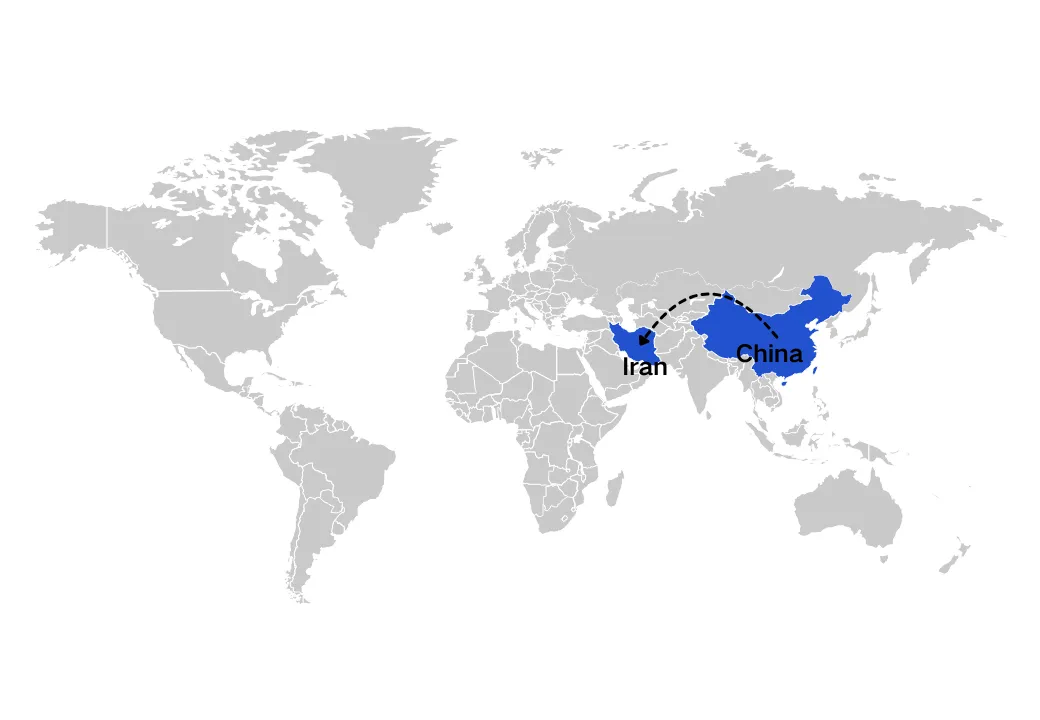
Shipping from China to Iran in 2026 is no longer a straightforward ocean booking. The Strait of Hormuz has been effectively closed to container shipping since late February 2026, the United States has imposed a naval blockade on Iranian ports, and the UAE — historically the single largest source of Iran's imports — suspended all trade and banking with Iran in August 2026. Freight rates on this lane have moved from a $1,000–2,700 container benchmark to $6,000–9,000 in peak windows.
This guide is written for importers who still need cargo to move. It explains what is genuinely working right now — the Central Asian land and rail corridors, air freight through Tehran, and the limited southern sea services that remain — along with 2026 rates, realistic transit times, Iranian import regulations (Order Registration, NTSW, IRICA), and the compliance checks you must complete before you commit to a shipment.
What Has Changed on the China–Iran Lane in 2026
If you last shipped to Iran before 2026, almost every assumption you built your budget on has been reset. These are the developments driving cost and routing today:
- February 28, 2026 — US and Israeli strikes on Iran. Joint airstrikes under "Operation Epic Fury" triggered Iranian retaliation across the Gulf. Within days the Strait of Hormuz was effectively closed to commercial traffic, airspace over Qatar, the UAE, Saudi Arabia, and Kuwait shut down, and all five major container lines — Maersk, MSC, CMA CGM, Hapag-Lloyd, and ONE — issued force majeure declarations and suspended transit-time guarantees.
- Since February 28 — Hormuz remains effectively closed to container shipping. Container vessels have accounted for only about 6% of Hormuz transits since the conflict began. The Joint Maritime Information Center kept its regional threat assessment at "severe" as recently as September 1, 2026, and container-ship movements through the strait have shown little change since March.
- April 2026, reaffirmed mid-July 2026 — US naval blockade of Iranian ports. Washington imposed a blockade targeting Iranian port traffic in April, lifted it during a fragile truce, then reimposed it in mid-July after negotiations collapsed. Satellite imagery comparing January 2026 with September 2026 shows Shahid Rajaee Port at Bandar Abbas with dramatically fewer vessels alongside and large sections of the terminal inactive.
- August 19, 2026 — the UAE suspended all trade with Iran. Abu Dhabi froze all commercial exchanges and financial transactions with Iran indefinitely after missiles were launched from Iranian territory. The UAE had supplied roughly 30% of Iran's imports — about $14.8 billion in the first ten months of the 2025 fiscal year — and Jebel Ali had served for years as the re-export gateway for goods entering Iran. Dubai transit and cross-stuffing, a standard Iran workaround for a decade, is no longer a viable routing.
- September 2025 — UN and EU sanctions snapped back. The E3 triggered the JCPOA snapback mechanism, and the UN reimposed sanctions under Resolutions 1696, 1737, 1747, 1803, 1835, and 1929 on September 27, 2025. The EU reimposed its own measures on September 29, 2025, including the freezing of Central Bank of Iran and major Iranian commercial bank assets and restrictions affecting Iranian cargo aircraft. Cargo-inspection authority at sea and in the air was restored to member states.
- 2026 — the trade pivoted north. With southern maritime access disrupted, Iran's Economy Ministry began shifting a significant share of imports to northern ports, railways, and land corridors through Turkmenistan, Armenia, Azerbaijan, Turkiye, Iraq, and Pakistan. China transit cargo is now moving through the Sarakhs corridor in volume.
- 2026 — rates and reliability both deteriorated. War-risk insurance for Gulf transits jumped from roughly 0.125% to as high as ~1% of hull value per transit, a 4–8x increase. Carriers stacked emergency freight, war-risk surcharges, and bunker adjustments on top of base rates. Global schedule reliability fell to 29.4% in August 2026 — the third consecutive monthly decline.
Context matters: we track this conflict across every trade lane we serve, not just Iran. Our analysis of the Strait of Hormuz crisis at six months and our first-week breakdown of the February strikes on Iran explain why this disruption has pushed rates on seemingly unrelated routes toward pandemic-era records.
Can You Still Ship from China to Iran in 2026?
Short answer: yes, for compliant, non-restricted commercial goods — but the routing, the timeline, and the cost are all different from a normal lane. Western mainline carriers and express integrators (Maersk, MSC, CMA CGM, DHL, FedEx, UPS) have largely withdrawn from Iran, so capacity now sits with Iranian and regional operators and with the overland corridors. That thinner capacity is exactly why rates spike so violently whenever demand firms up.
Four realistic options remain available, and the right one depends less on your budget than on your deadline and your commodity:
| Option | Current Feasibility | Typical Transit | Best Suited To |
|---|---|---|---|
| Sea to Bandar Abbas (direct) | Constrained — limited operator services, blockade exposure, frequent suspension | 30 – 50+ days | Non-urgent bulk cargo where the importer accepts routing risk |
| Land / rail via Central Asia | Working — the main corridor in 2026 | 22 – 35 days | Machinery, mid-value goods, cargo for Tehran, Mashhad and northern Iran |
| Air freight to Tehran (IKA) | Working — reduced carrier choice, elevated war-risk pricing | 5 – 12 days | Urgent, high-value, low-weight cargo |
| Transit via a third country | Narrowed — UAE closed; Caspian, Turkiye and Pakistan routes active | Varies widely | Cargo routed to Afghanistan or Central Asia, or split shipments |
Because this situation changes week to week, we confirm space, routing, and insurance cover in writing before a container is released from your supplier. Send us your commodity, volume, and deadline and we will tell you which of the four is actually bookable this month.
Sea Freight from China to Iran
Ocean freight remains the cheapest way to move volume into Iran on paper, and it is still moving — but through a far smaller number of services than before the war. Iranian carriers and regional NVOCCs maintain limited direct sailings from Shanghai, Ningbo, Shenzhen, and Guangzhou to Bandar Abbas, subject to blockade conditions, war-risk cover, and periodic suspension. Everything about a normal sea booking — free time, rollovers, schedule reliability — should be treated as negotiable rather than guaranteed.
FCL vs. LCL: Choosing the Right Container Load
The choice between Full Container Load (FCL) and Less than Container Load (LCL) still comes down to volume, but the 2026 environment tilts the decision further toward FCL: a sealed container spends less time being handled by third parties, and on a lane where inspections are heavy and delays are expensive, that matters.
| Feature | FCL (Full Container Load) | LCL (Less than Container Load) |
|---|---|---|
| Best For | Volume > 15 CBM or fragile/high-value goods. | Volume < 15 CBM or small trial orders. |
| Cost | Flat rate per container (cheaper per unit). | Charged per CBM or per revenue ton, whichever is greater. |
| Security | Sealed at origin, opened only at destination. | Consolidated with other cargo; higher handling and commingling risk. |
| Speed | Faster; direct loading and unloading. | Slower; requires consolidation and deconsolidation time. |
| 2026 Note | Easier to insure and to document cleanly. | More inspection exposure at Bandar Abbas CFS. |
Pro Tip: If your cargo is around 12–14 CBM, compare the cost of a 20ft FCL against LCL before you book. On this lane the break-even sits closer to 12 CBM than the 15 CBM often quoted, because CFS charges and inspection delays at Iranian ports disproportionately affect consolidated cargo.
Iranian Ports in 2026: What Is Actually Working
Ports of origin (China): Shanghai, Ningbo, Shenzhen (Shekou/Yantian), Guangzhou (Nansha), Qingdao, Xiamen, and Tianjin.
Ports of destination (Iran):
- Bandar Abbas / Shahid Rajaee (BND): Iran's principal container gateway, handling roughly 80–90% of the country's container throughput and over half of total imports and exports, with nominal capacity of about 100 million metric tons a year. As of early September 2026 the port remains operational — port information services recorded 11 vessels docking as of September 7, across 13 berths and two terminals — but satellite imagery shows vastly reduced berth occupancy versus January 2026, and customs-clearing firms in the city report 80–90% of their workload has disappeared. Expect the port to work, slowly.
- Bandar Imam Khomeini (BIK): Iran's largest import gateway by tonnage and the main entry point for food and basic commodities — over 48 million tons handled in the year ending March 2025, including 19.2 million tons of imports. Useful for bulk and agricultural cargo bound for Khuzestan and western Iran.
- Chabahar: Strategically attractive because it sits outside the Strait of Hormuz, but its commercial status has changed sharply. The US sanctions waiver covering the port was revoked on September 16, 2025; a conditional waiver ran only until April 26, 2026; and India is now handing operational control of the Shahid Beheshti terminal to an Iranian entity to avoid OFAC exposure. Very few foreign carriers are willing to call there, and the Chabahar–Zahedan railway remained unfinished through 2026, leaving inland movement dependent on trucking.
- Bushehr and Khorramshahr: Smaller southern alternatives with less frequent calls; useful only for specific discharge points, and they carry a premium over the Bandar Abbas baseline.
Expert Insight: Direct vessel capacity to Iran is genuinely limited, and it is not evenly distributed. Working through a forwarder with established relationships across Iranian and regional operators — and a corridor desk for the overland alternative — is what keeps cargo from sitting on the quay waiting for a sailing that never comes.
Sea Freight Transit Times (2026 Estimates)
| Origin Port (China) | Destination Port (Iran) | Transit Time (Days) |
|---|---|---|
| Shenzhen (Shekou/Yantian) | Bandar Abbas | 28 - 40 Days |
| Guangzhou (Nansha) | Bandar Abbas | 30 - 42 Days |
| Shanghai / Ningbo | Bandar Abbas | 30 - 45 Days |
| Qingdao / Tianjin | Bandar Abbas | 35 - 50 Days |
Data note: ranges reflect the disrupted 2026 market as of September 2026, including waiting time for a confirmed sailing and Hormuz transit risk. Under normal conditions this lane runs 18–25 days port-to-port — treat that figure as the recovery case, not the planning case.
Air Freight from China to Iran
When speed outweighs cost, air freight is the most reliable way into Iran today — provided you accept that capacity is thinner and pricing is war-adjusted. It suits high-value electronics, urgent medical supplies, spare parts, and production-line components.
Key Airports
- China hubs: Shanghai (PVG), Beijing (PEK/Daxing), Guangzhou (CAN), Shenzhen (SZX), and Hong Kong (HKG), which remains the practical gateway for goods containing batteries, magnets, or liquids.
- Iran hub: Imam Khomeini International Airport (IKA) in Tehran is the primary international cargo gateway. Shiraz (SYZ) and Mashhad (MHD) serve southern and eastern destinations; Mashhad and other eastern airports played a lead role in rebuilding Iran's network during 2026.
Air Freight Service Levels
| Service Type | Transit Time | Best For |
|---|---|---|
| Priority Air | 3 - 6 Days | Urgent restocks, samples, exhibition goods (< 45kg). |
| Standard Air Cargo | 6 - 10 Days | Commercial goods (> 100kg), general cargo. |
| Economical Air / Consolidation | 10 - 15 Days | Cost-sensitive cargo where the deadline is flexible. |
Air freight is a service we run on lanes worldwide, and the compliance discipline we apply here is the same everywhere — see our air freight from China capability for screening, documentation, and dangerous-goods handling.
Iran Airspace Risk and the Carrier Situation
Iranian airspace carries an active safety warning. EASA's Conflict Zone Information Bulletin for the Tehran FIR (OIIX), issued July 2026, notes a high risk to civil flights at all altitudes and flight levels, citing recurrent Iranian attacks on commercial vessels, efforts to control the Strait of Hormuz, and a nationwide high alert that increases the likelihood of misidentification. Iran closed its airspace entirely during the opening phase of the war, resumed commercial flights from IKA on April 25, 2026, and has since operated a fragile truce that has already broken down once.
Practically, this means:
- Capacity is constrained. Several regional and international carriers suspended or reduced Iran services during the conflict, and DHL Global Forwarding publicly expected air cargo disruption in the region to persist well beyond the first quarter of 2026.
- Rates carry risk premiums. War-risk and re-routing costs are built into today's air rates, and many freighter routings take on two to three hours of extra fuel to avoid restricted airspace.
- Schedules move. Build a buffer around any air booking, and avoid promising a delivery date you have not confirmed with the carrier.
Risk Warning: "Sensitive" and dual-use items — certain electronics, drone components, avionics, precision instruments, and goods with military-adjacent end uses — face strict scrutiny and, under the reinstated UN measures, cargo inspection authority. We screen your HS codes, end use, and consignee against current export-control and sanctions lists before we agree to carry, and we decline cargo we cannot document.
Land and Rail Corridors: The 2026 Alternative
With southern maritime access disrupted and the UAE route closed, the overland corridors through Central Asia have become the working backbone of China–Iran trade. Rail infrastructure connects Iran to the Chinese hubs of Xi'an and Yiwu via the Kazakhstan–Turkmenistan–Iran corridor, extended by China's 10,400-kilometer freight link completed in 2025.
The Sarakhs and Incheh Borun Corridor
Route: China (Xi'an / Yiwu / Urumqi) → Khorgos or Bolashak (Kazakhstan) → Turkmenistan → Sarakhs or Incheh Borun → Mashhad / Tehran.
Sarakhs is the principal rail-and-road gateway on Iran's northeastern border and the single most important node for China-bound transit cargo in 2026. It currently handles around 500 trucks a day in both directions plus one freight train daily, with stated potential to scale to roughly 1,000 trucks and three to four trains a day, and a theoretical annual handling capacity near 12 million metric tons.
Be realistic about the constraints: Iranian officials and freight associations reported in September 2026 that clearance times at Sarakhs remain volatile, customs staffing is inadequate for the current load, only about 10% of agreed inter-agency improvements had been implemented, and operating hours are mismatched — Turkmen terminals run until the truck yard clears, while the Iranian side slows markedly from early afternoon. Sarakhs links Iran's standard-gauge network to the broader-gauge former Soviet system, so a break of gauge at the border adds handling time. Approximately 20% of targeted Chinese transit freight had entered the operational phase as of September 2026, with volumes expected to rise — which means congestion risk is increasing, not decreasing.
The Caspian and Western Routes
- Caspian ports (Anzali, Amirabad): Iran's northern ports have more than 30 million tons of nominal annual capacity with less than a third in use, and Russian, Kazakh, and Turkmen vessels have been delivering grain, corn, and sunflower oil through the Caspian since April 2026. Bandar Anzali was struck by Israeli airstrikes on March 18, 2026, so damage assessment and berth availability should be confirmed before routing.
- Astara (Azerbaijan) and the INSTC: Transit traffic through Astara rose about 25% recently, but the terminal handled only around 345,000 tons in the first five months of 2026 against a designed capacity of 3.5–4 million tons, and the unfinished Rasht–Astara rail link means part of the journey runs by road.
- Bazargan / Razi (Turkiye): Iran's oldest international trade route and its link to Europe, primarily by road. Trucking from Bandar Abbas to the Turkish border takes 4–6 days.
- Pakistan corridor: Pakistan opened its ports to third-country cargo bound for Iran on April 25, 2026, establishing six land routes from Gwadar, Karachi, and Port Qasim to the Iranian border.
These routes also matter if your real destination sits next door. Cargo moving into the region by land frequently shares infrastructure with shipments to neighboring markets, so our shipping from China to the Middle East desk coordinates Iran, Iraq, and Gulf bookings out of the same corridor network.
What the Land Option Costs
It is not cheap, and it is worth quantifying before you choose it. The head of the Iran–China Chamber of Commerce stated that moving one container from China to Iran through the southern ports costs roughly $3,000, while moving the same container overland costs approximately $12,000 — a fourfold premium. With around two million containers entering Iran through the south annually, a prolonged shift to land routes would add an estimated $18 billion to the country's trading costs.
Analysts are explicit that the corridors are a resilience strategy, not a replacement: they keep food, medicine, industrial inputs, and mid-value goods moving, but they cannot reproduce the scale or unit economics of Persian Gulf seaborne trade. If your cargo is genuinely not time-critical, the sea route still wins on price — when a sailing is available.
DDP & Door-to-Door Shipping from China to Iran
For many importers, the hardest part of this lane is not the ocean or the air — it is Iranian customs. Iranian importers must hold a commercial card (kart-e bazargani), complete Order Registration (Sabt-e-Sefaresh) through the Ministry of Industry, Mine and Trade, and secure currency allocation through the Central Bank of Iran. In 2026, customs has been managing imports under emergency conditions, with officials citing bottlenecks in tracking codes, foreign-currency supply, valuation, and order registration, and with emergency permits extended through late September 2026.
DDP (Delivered Duty Paid) removes those steps from your desk. With door-to-door shipping from China, we manage the full chain:
- Pickup from your Chinese supplier, with quality and packing verification.
- Export clearance in China, including CCPIT certification of commercial documents.
- Freight by sea, air, or the Central Asian land corridor, whichever your deadline supports.
- Iranian import clearance through our licensed Iranian partner brokers (tarkhis kar).
- Duty and VAT payment on your behalf.
- Final delivery to Tehran, Isfahan, Mashhad, Tabriz, Shiraz, or your warehouse anywhere in Iran.
Why Choose DDP?
- No Iranian license needed on your side: we clear under our partner's commercial registration and license.
- One fixed, all-in price: freight, clearance, duty, VAT, and inland delivery quoted as a single landed number, so you are not exposed to port demurrage or surprise tax assessments.
- Documentation discipline: our brokers work IKA and Bandar Abbas daily and pre-screen invoices, packing lists, and certificates before the vessel or flight departs.
- Route optionality: when one corridor closes, we can switch a shipment between sea, air, and overland without you renegotiating the contract.
Service Note: Our DDP service is most in demand for electronics, spare parts, industrial components, and small-to-medium commercial goods. DDP applies to compliant general cargo only — categories requiring mandatory Iranian certification (electronics, cosmetics, machinery, food, pharmaceuticals) need feasibility confirmed in advance.
Shipping Costs from China to Iran (2026)
Costs on this lane are volatile by nature, and 2026 made that extreme. Two numbers now matter for every quote: the benchmark (a contract or indicative rate reflecting normal-conditions capacity) and the spot rate (what space actually costs this week). When carriers serving Iran are full, only the spot number is bookable. The tables below give both, dated.
1. Sea Freight Rates — Benchmark vs. Spot (as of September 2026)
Port-to-port, general cargo, major Chinese ports to Bandar Abbas (BND).
| Container Type | 2026 Benchmark (USD) | Peak Spot (USD) | Notes |
|---|---|---|---|
| 20ft Container (FCL) | $1,050 - $2,700 | $6,000 - $6,850 | Best for dense cargo — machinery, minerals, tiles. |
| 40ft Container (FCL) | $1,400 - $2,750 | $8,900 - $9,050 | Best for volume — furniture, textiles, home goods. |
| LCL (per CBM / revenue ton) | $55 - $150 | $180 - $210 | Billed per CBM or per ton, whichever is greater. |
2. Rail and Overland Rates (as of September 2026)
Station-to-station or terminal-to-terminal, China to Tehran.
| Route | Typical Cost (USD) | Transit Time |
|---|---|---|
| Xi'an → Tehran (via Khorgos / Bolashak / Incheh Borun) | ~$7,500 - $7,800 per 40HQ | 22 - 24 Days |
| Trucked container, China → Iran (overland) | ~$12,000 per container | 20 - 35 Days |
| Sea container, southern port route (reference) | ~$3,000 per container | 30 - 50+ Days |
3. Air Freight Rates (Airport-to-Airport)
China (PVG / CAN / PEK) to Tehran (IKA), general cargo, September 2026.
| Weight Tier | Estimated Cost (USD/kg) |
|---|---|
| +45 kg | $6.00 - $9.50 |
| +100 kg | $5.00 - $8.00 |
| +300 kg | $4.50 - $6.50 |
| +1,000 kg | Contact for spot rate |
4. DDP "All-In" Rates (Door-to-Door)
Including duty, VAT, clearance, and inland delivery. Pricing varies by HS code and route.
- General cargo (sea or land corridor): ~$280 - $480 per CBM.
- Electronics and high-value goods (air): ~$11 - $18 per kg, all-in.
Surcharges That Are Not in the Headline Rate
On the China–Iran lane in 2026, surcharges can exceed the base freight. Budget for these as separate lines and insist your forwarder itemizes them:
- War-risk surcharge and insurance: carrier war-risk fees plus hull war-risk premiums that rose 4–8x; some carriers charge an explicit Hormuz transit fee on top of emergency freight.
- Emergency freight increases: on Gulf-linked corridors, mainline carriers have been levying roughly $1,800 per 20ft, $3,000 per 40ft, and $3,800 per reefer — numbers worth knowing even though Iran-specific bookings sit with different operators.
- Bunker adjustment (BAF): crude traded toward $90–95 per barrel through Q3 2026, and bunker adjustments lag oil by roughly a quarter.
- Terminal handling (THC), documentation, telex release: origin and destination charges typically $300–$600 per container.
- Demurrage and detention: with 80–90% of Iranian customs-clearing capacity reportedly idle, free time is short and expensive to overrun. This is the single most avoidable cost on the lane.
Pro Tip: Rates on this lane move weekly. Always ask for a quote with a stated validity window — 7 to 14 days is typical now — and ask the four questions that separate a real quote from a headline: Is this spot or contract? Is space confirmed or indicative? Does it include origin and destination charges? Does it include war-risk cover?
How Long Does Shipping Take from China to Iran?
Door-to-door time, not port-to-port time, is what should drive your planning — because on this lane the delays increasingly happen after arrival rather than at sea.
Transit Time Comparison (September 2026)
| Mode of Transport | Route | Estimated Time | Reliability |
|---|---|---|---|
| Rail / Land | China → Central Asia → Sarakhs / Incheh Borun | 22 - 35 Days | Medium-High (border and gauge delays) |
| Sea Freight (southern ports) | China ports → Bandar Abbas | 30 - 50+ Days | Low (sailing availability, blockade risk) |
| Air Freight (priority) | PVG / CAN → IKA | 3 - 6 Days | High (subject to airspace status) |
| Air Freight (standard) | Consolidation via hub | 6 - 10 Days | High |
| Sea DDP (door-to-door) | Includes clearance and inland delivery | 35 - 55 Days | Medium |
| Air DDP (door-to-door) | Includes clearance and inland delivery | 7 - 12 Days | High |
Factors Causing Delays
- Sailing availability and blockade conditions. Waiting for a confirmed vessel is now a normal part of the sea timeline, not an exception.
- Border processing at Sarakhs and Incheh Borun. Vehicle scheduling, customs formalities, terminal management, gauge change, and mismatched operating hours between Iranian and Turkmen authorities all add dwell time.
- Iranian customs inspection. Standard clearance runs a few days, but Red Channel inspection or a documentation mismatch can extend it to weeks.
- Currency and Order Registration bottlenecks. Cargo can arrive before the importer's registration or currency allocation clears, producing port storage rather than delivery.
- Nowruz and Q4 peak. Iranian New Year and the fourth-quarter import peak tighten space and inflate rates 10–20%.
- Documentation gaps. A missing CCPIT certification, certificate of origin, or standard compliance certificate stops a shipment dead.
Expert Insight: On this lane, pay for the higher service tier when the deadline is real. A cheaper economical-air booking that rolls twice costs more in lost sales than the rate difference ever saves.
Iran Customs Clearance & Import Duties
The Islamic Republic of Iran Customs Administration (IRICA) administers a strict regime, and 2026 added emergency measures on top of it. Understanding the sequence before you ship is the difference between a delivery and a demurrage bill.
Order Registration and Currency Allocation
Iranian imports require Order Registration (Sabt-e-Sefaresh), obtained by the importer from the Ministry of Industry, Mine and Trade through the Integrated Trade System at NTSW.ir (Iran's National Single Window), together with currency allocation through the Central Bank of Iran. Goods categorized by import priority face different FX treatment, and non-priority categories are the hardest to fund. Customs officials acknowledged in 2026 that cargo arriving before order registration is finalized has caused long-term stagnation in ports, and have been working on procedural reform — a useful signal that this bottleneck is systemic, not specific to your shipment.
Essential Documents for Clearance
- Commercial Invoice & Packing List: must be certified by the China Council for the Promotion of International Trade (CCPIT), with gross weight, net weight, and carton dimensions stated precisely.
- Bill of Lading or Air Waybill: "To Order" bills are common; make sure the Notify Party details exactly match the importer's registration.
- Certificate of Origin (CO): mandatory, issued by CCPIT.
- Import License / Order Registration (Sabt-e-Sefaresh): obtained by the importer in Iran before shipment.
- Standard / Conformity Certificate (VOC): required for many product categories including electronics, electrical appliances, and auto parts, to demonstrate compliance with Iranian standards (ISIRI).
- IPPC / fumigation certificate: mandatory for all wooden packaging and pallets.
- Importer's commercial card (kart-e bazargani) and, for restricted categories, ministry-level permits (food, medicine, communications equipment).
Import Duties & Taxes
| Charge | Typical Rate | Base |
|---|---|---|
| Customs Duty (Tariff) | 5% - 55% (average 15% - 25%) | CIF value |
| Commercial Benefit Tax (Sood-e Bazargani) | 4% - 30% | CIF value + duty |
| VAT | 10% | CIF value + duty |
| Municipal and other levies | Case by case | Varies by commodity |
Note on VAT: Iran's standard VAT rate is now 10%, not the 9% still quoted in many older shipping guides; the 2026 budget kept it at 10% after Parliament rejected a proposed increase to 12%. Certain goods — including cigarettes, tobacco, gasoline, and jet fuel — carry higher rates. VAT is charged on the CIF value plus customs duty, so it compounds. VAT-registered Iranian businesses can generally reclaim import VAT as input tax, which makes it cost-neutral for many B2B transactions.
Critical Warning: IRICA is extremely strict about HS codes. If the physical goods do not match the declared classification exactly, the shipment is treated as smuggling (ghachagh), with confiscation and heavy fines. Classification also drives your duty rate, so an incorrect code costs you twice. Confirm your HS code with a licensed Iranian broker before the cargo leaves China.
Sanctions and Compliance: What Importers Must Verify
This lane carries a compliance burden that no other China export market does, and it has tightened. Following the UN snapback, sanctions now cover trade, financial, and transport sectors, authorize member states to inspect and seize prohibited cargo moving to or from Iran by air and sea, and reinstate asset freezes and travel bans on listed individuals and entities. The EU has reimposed comparable measures, including the freezing of Central Bank of Iran and major Iranian commercial bank assets and restrictions on Iranian cargo aircraft.
Commercial, non-restricted goods do continue to move legitimately. What you must verify before booking:
- Your commodity. Confirm it is not dual-use, not military-adjacent, and not on any restricted list — including the categories affected by the reinstated conventional arms embargo and ballistic-missile-related restrictions.
- Your counterparties. Screen the consignee, end user, and any intermediary against current OFAC, EU, UK, and UN listings. Being one step removed from a listed entity does not protect you.
- Your payment channel. Iran is outside SWIFT and there is no USD leg. Settlement has historically run through intermediary banks in RMB or AED, but the UAE's August 2026 trade and banking suspension removed the most-used channel. Work with banks experienced in this market and expect delays of weeks, not hours. A payment routed through a bank that quietly declines Iran-linked transactions is the most common reason a shipment stalls — and it usually stalls after the container has left the factory.
- Your insurance. Confirm in writing that your cargo policy covers the Persian Gulf and Hormuz area. Standard war-risk clauses frequently exclude or limit this region, and P&I war-risk cover for Gulf transits was withdrawn outright for a period in March 2026.
- Your documentation. Declare accurately. Under-declaring value or describing goods loosely to smooth clearance is what turns a delayed shipment into a seized one.
Compliance notice: Sanctions regimes change frequently and what is permissible depends on your goods, your jurisdiction, and current rules. Nothing here is legal advice. Verify your commodity, end use, and counterparties against the regulations in force at the time of shipment, and engage qualified trade-compliance counsel for anything ambiguous.
Step-by-Step Shipping Process
Phase 1: Pre-Shipment (The Most Critical Phase)
- Compliance and feasibility screen. We check your HS codes, commodity, end use, and consignee against the current sanctions and export-control picture before anything else happens.
- Order Registration. Your Iranian importer completes Sabt-e-Sefaresh through NTSW and secures currency allocation. Do not book freight before this is under way.
- Route decision. Based on your deadline and volume, we choose sea, air, or the Central Asian land corridor — and confirm space in writing.
- Booking and pickup. We collect from your supplier and consolidate at our Shenzhen, Shanghai, Guangzhou, or Yiwu warehouse.
Phase 2: International Transit
Export clearance: we file the Chinese customs export declaration and arrange CCPIT certification of your commercial documents.
Loading and transit:
- Sea: roughly 28–45 days to Bandar Abbas, plus sailing-wait time.
- Rail / land: roughly 22–24 days from Xi'an to Tehran, plus border and gauge handling.
- Air: roughly 3–10 days to Imam Khomeini Airport.
Phase 3: Arrival & Clearance
- Arrival notice: the carrier notifies the Notify Party in Iran; we confirm the import file is complete.
- Duty and VAT payment: the importer pays, or we pay under DDP.
- Inspection and release: IRICA clearance, then release from the customs warehouse.
- Final delivery: trucking to Tehran, Isfahan, Mashhad, Tabriz, Shiraz, or your named address, with proof of delivery.
One-Stop Shipping Solutions for Alibaba, 1688 & Taobao Buyers
Sourcing from Chinese platforms and delivering into Iran is a two-sided problem in 2026: Chinese suppliers are wary of Iran-bound orders, and Iranian buyers struggle to send funds out. We bridge both sides.
The Challenges You Face
- Payment: many Chinese suppliers cannot receive Iran-originated transfers because of banking sanctions.
- Shipping: most Alibaba sellers will not ship to Iran, and international express integrators largely refuse Iran-bound cargo.
- Consolidation: buying from five suppliers should not mean five shipments and five sets of documents.
- Compliance: an unvetted supplier or mis-declared item can put the whole consignment at risk.
How AllBestShipping Solves This
- Warehousing and consolidation: goods from multiple suppliers are received at our Yiwu or Guangzhou warehouse, inspected, and combined into one consignment — which typically cuts freight cost by up to 70% versus separate shipments.
- Payment facilitation: where it is lawful and fully documented, we help settle your Chinese suppliers in RMB domestically, so you are not wiring funds across a blocked banking corridor.
- Single documentation set: one invoice chain, one booking, one clearance file — reducing the inconsistencies that trigger Iranian Red Channel inspections.
- Corridor switching: if one route closes mid-transit, we re-plan to an alternative without renegotiating your contract.
Why Importers Work With AllBestShipping
AllBestShipping is a Shenzhen-based international freight forwarder serving China-to-global trade across more than 50 countries. On the Iran lane we combine three things most forwarders cannot offer at once: screened compliance before booking, genuine route optionality across sea, air, and Central Asian land corridors, and licensed Iranian clearance partners in Tehran and Bandar Abbas.
- Compliance first: we verify HS codes, end use, and counterparties against current sanctions and export-control lists before cargo is picked up — not after it is loaded.
- Transparent, itemized pricing: base freight, surcharges, duty, and VAT shown as separate lines, quoted with a validity window.
- Real-time tracking: visibility from factory pickup through Iranian final delivery.
- Cargo insurance: arranged with confirmed Gulf and Hormuz cover — we check the war-risk clause rather than assuming it.
- One point of contact: a named coordinator who owns your file from quote to proof of delivery.
Last updated: September 2026. Rates, transit times, and route availability on the China–Iran lane change weekly given the Hormuz situation. Confirm current conditions with our team before committing to a shipment.
Ready to ship? Send us your commodity list, volume, and target delivery date. We will tell you within one business day which routes are bookable this month, what the all-in landed cost looks like, and what documentation your Iranian importer needs to have in place first. Contact AllBestShipping for a quote — no obligation, and no headline rate that turns into a surprise invoice.