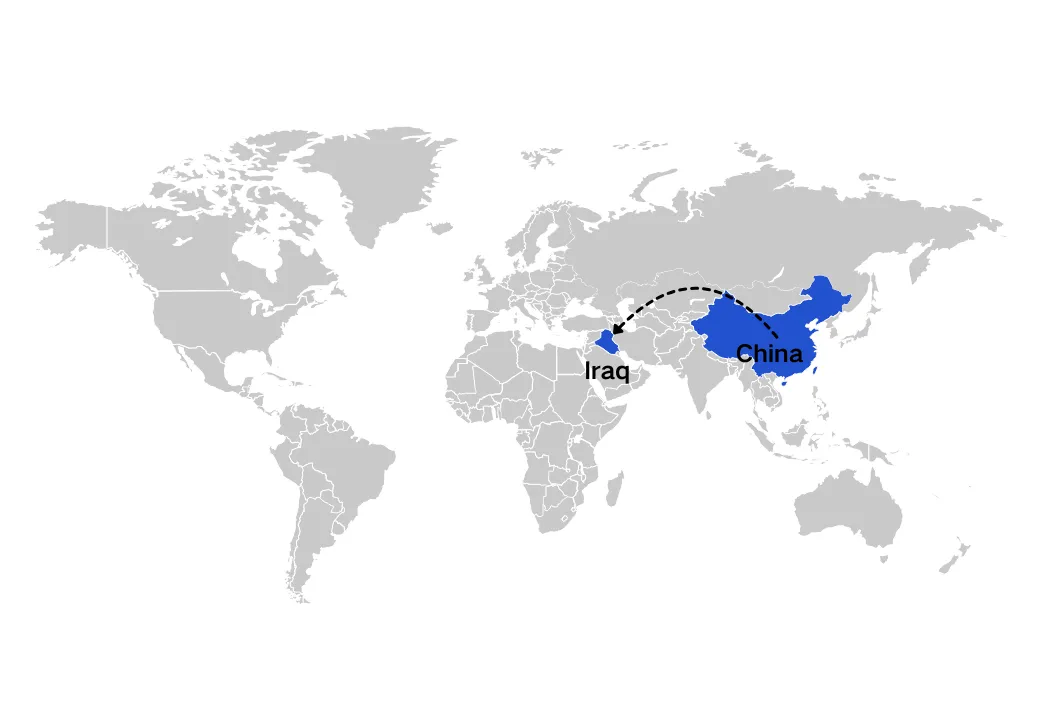
Shipping from China to Iraq in 2026 means moving cargo through a gateway under real pressure. Every container vessel bound for Umm Qasr — Iraq's only deep-water port and the entry point for the overwhelming majority of the country's containerized imports — must transit the Strait of Hormuz, and that strait has been effectively closed to routine commercial traffic since late February 2026. Reported throughput at Umm Qasr fell by as much as 82% during the spring peak, oil loadings were interrupted by attacks in Iraqi waters as recently as September 9, 2026, and a war risk surcharge of USD 1,500 per TEU now appears on Gulf bookings as a matter of course.
At the same time, Iraq's customs regime was rewritten while importers were still learning the previous version. ASYCUDA World Phase 3 is live, 12-digit HS codes and pre-arrival declarations are mandatory, commercial banks cannot fund letters of credit or pay your supplier without an advance duty pre-payment, and tariffs moved from a low flat-fee model to percentage-based rates of 0.5%–30%. On this lane, paperwork — not distance — is what stops cargo.
This guide is written for importers who still need goods moving. It sets out what has actually changed on the China–Iraq lane in 2026, which corridors are working (Gulf feeders, the Aqaba land bridge, the Turkish overland route, air cargo), current rates with the surcharges that sit on top of them, realistic transit windows, and the customs sequence you must complete before you commit to a shipment.
What Has Changed on the China–Iraq Lane in 2026
If you last shipped to Iraq before 2026, most of the assumptions behind your landed-cost calculation have moved. These are the developments driving cost, routing, and clearance time today.
- January 1, 2026 — ASYCUDA pre-arrival declaration and 12-digit HS codes became mandatory. Iraq's General Authority of Customs moved commercial imports onto the ASYCUDA World single-window model. Shipment data must now be filed before the vessel arrives, and declarations use 12-digit HS codes rather than short-form classification. Through the first quarter of 2026, the system transition itself — not the security situation — was the single largest cause of congestion at Iraqi ports.
- February 2026 — Cabinet Decision No. 957 rewrote the tariff. Iraq replaced its low flat-fee import model with percentage-based ad valorem duties ranging from 0.5% to 30%, with the sharpest increases on categories that had previously been near-free. Merchant protests and port-level strikes followed, after which the Cabinet approved a temporary 25% reduction on assessed customs valuation: the percentages did not fall, but the value they are calculated on was discounted.
- February 28, 2026 — the Strait of Hormuz closed. Joint US–Israeli strikes on Iran triggered a shutdown of commercial traffic through Hormuz. Because Umm Qasr sits at the far end of the Persian Gulf, it lost most of its vessel calls within days: reported throughput dropped by up to 82% at the peak, and by late July operations at the port were being described in international press as at a standstill.
- March 2, 2026 — war risk surcharges became a permanent line item. Hapag-Lloyd introduced a War Risk Surcharge of USD 1,500 per TEU for dry containers and USD 3,500 per container for reefer and special equipment on bookings to and from Iraq and the rest of the Upper Gulf. CMA CGM followed with an Emergency Conflict Surcharge, and Maersk, MSC, and ONE issued their own advisories. Behind the surcharge: war-risk insurance premiums moved from roughly 0.2% of vessel value to over 1.0% within 48 hours, and several P&I clubs cancelled Gulf cover outright.
- June 17–18, 2026 — COSQC updated the conformity program. New and amended Iraqi standards entered force under the ICIGI scheme on June 17, 2026, with registered-importer requirements following a day later. Regulated products without a valid Certificate of Conformity are refused clearance, and the certificate must be obtained before loading — a lead time measured in weeks.
- July 10, 2026 — electronic verification of origin and invoice documents went live. Paper certificates of origin and commercial invoices are now checked electronically against the filed declaration, so any mismatch between the original document and the e-filed data stops the shipment.
- July 2026 — ASYCUDA World Phase 3 launched. Processing is now paperless and integrated across southern seaports, western land borders, and KRG checkpoints. Declared HS codes are cross-referenced automatically — a typo or a mismatch triggers instant rejection at the portal before a customs officer ever sees the file — and declared values are benchmarked against regional historical databases to catch under-valuation.
- Pre-declaration and advance duty payment are now the gateway to paying your supplier. Under 2026 Central Bank of Iraq rules, commercial banks are prohibited from executing wire transfers or funding letters of credit unless the importer has made an advance duty pre-payment through the banking system. Pre-declaration is no longer a way to speed up release; it is the precondition for securing the official USD exchange rate at all.
- August 31, 2026 — Maersk's latest Middle East operational update. Dry and frozen cargo is still accepted to and from Iraq, but bookings for reefer and dangerous goods remain suspended. Maersk continues to market landbridge options connecting Iraq with Aqaba (Jordan), a sign of how routing has been re-engineered around the Gulf.
- September 2026 — attacks reached Iraqi waters. On September 9, 2026, a Panama-flagged tanker carrying about two million barrels of Iraqi fuel oil was struck by a drone in Iraqi territorial waters near Umm Qasr, and two tankers were set ablaze in the same area. In June, the MSC Sariska V was hit by projectiles while departing Umm Qasr. Oil loadings have been suspended and resumed more than once. Container terminals have kept working, but with escorts, convoy movements, and short-notice interruptions.
- Working in Iraq's favour — capacity is being added, not withdrawn. Umm Qasr's container terminal secured USD 120 million in financing in March 2026 to expand toward 2 million TEU of annual capacity; AD Ports Group launched a direct weekly Khalifa Port–Umm Qasr service in July 2026; and Iraq's new Al-Faw Grand Port, alongside Umm Qasr, is moving toward commercial operation of a first phase designed for roughly 3.5 million TEU a year.
- The Development Road already works in part. Iraq's USD 17 billion, 1,200 km road-and-rail corridor from Basra to the Turkish border is operational under the TIR system: pilot truck runs from Mersin to Umm Qasr completed in under a week, against 14–26 days by sea. Northbound volumes are real — on August 7, 2026, Türkiye recorded 2,454 truck departures into Iraq through the Habur gate in a single day.
Sea Freight from China to Iraq
Ocean freight still carries the overwhelming majority of Iraq's containerized import tonnage, and it remains the only economic option for construction materials, machinery, steel, and project cargo. What has changed is the routing: direct China–Iraq sailings were already rare, and today the practical pattern is a mother vessel into a Gulf hub followed by a feeder into Umm Qasr, with an overland alternative through Jordan or Türkiye when southern sailings thin out. Our ocean freight services cover the full chain, including the feeder leg and the inland trucking.
FCL vs. LCL: Choosing the Right Container Load
| Feature | FCL (Full Container Load) | LCL (Less than Container Load) |
|---|---|---|
| Definition | You rent the entire container (20ft or 40ft). | You share container space with other shippers. |
| Volume Suitability | Best for shipments > 15 CBM. | Best for small shipments (1 - 15 CBM). |
| Cost Structure | Flat rate per container. Cheaper per unit for large volumes. | Charged per Cubic Meter (CBM). |
| Risk | Lower risk of damage (less handling). | Higher handling risk (consolidation/deconsolidation). |
| 2026 consideration | Fixed surcharges (WRS per TEU) are simpler to budget on a full box. | Consolidation adds yard time — avoid LCL if your cargo must clear inside the free-time window. |
If you want the full cost model behind this decision, our guide to sea freight from China to Iraq breaks down per-container economics, demurrage exposure, and the CoC timeline in detail.
Ports, Terminals, and Gateways
Ports of origin in China: Shanghai, Ningbo, Shenzhen (Yantian/Shekou), Guangzhou (Nansha), Qingdao, and Tianjin — all with Gulf feeder connections.
Gateways into Iraq:
- Umm Qasr (North & South): Iraq's primary deep-water gateway and the terminal that matters for commercial container freight. North Umm Qasr handles most container traffic, including the Gulftainer-operated Iraq Container Terminal. Always confirm which terminal your forwarder has booked — the two are separate operations with separate release procedures.
- Khor Al Zubair: Deep-water berths used mainly for project cargo, out-of-gauge machinery, and industrial shipments — frequently the right choice for power, water, and oil-sector equipment.
- Basra / Abu Flus: Long-established berths handling bunkering, bulk, and general cargo; useful as an overflow when Umm Qasr berths are congested.
- Al-Faw Grand Port: Iraq's new mega-port, built alongside Umm Qasr with an initial five-berth container terminal designed for around 3.5 million TEU a year. Its first phase is moving toward commercial operation, and it is the anchor of the Development Road corridor.
- Aqaba (Jordan) and Mersin (Türkiye): Not Iraqi ports, but now genuine alternatives. Both are used as land-bridge entry points when Gulf feeder capacity is tight — Aqaba for central and southern Iraq, Mersin and Habur for the north.
Insider Insight — Book Earlier, and Ask Three Questions: Southern routing is working, but not on pre-2026 timetables. We now recommend booking 4 to 6 weeks ahead where the vessel is loading in China, and confirming the exact terminal in writing. Before you accept any quote on this lane, ask three questions: Is this a base ocean rate or does it include the war risk surcharge? Which terminal at Umm Qasr, and what is the free-time allowance? If the Gulf feeder is delayed, what is the fallback routing — Aqaba or Habur? The answers change your landed cost far more than the headline rate does. Check the latest sailing options with AllBestShipping before you commit.
Air Freight from China to Iraq
Air freight has quietly become the most reliable mode on this lane. There is no strait to transit, no feeder connection to wait for, and no reefer or dangerous-goods booking suspension to work around. The trade-offs are cost and capacity: rates ran 8–12% higher in the third quarter of 2026 than the previous quarter as demand for urgent reconstruction and medical cargo absorbed available space, and widebody capacity into Baghdad is limited.
Key Airports
Major Chinese airports: Shanghai (PVG), Beijing (PEK), Guangzhou (CAN), Shenzhen (SZX), Hong Kong (HKG).
Major Iraqi airports:
- Baghdad International Airport (BGW): The central hub for federal Iraq, with the widest freighter connections but also the busiest slot environment.
- Erbil International Airport (EBL): The main gateway to the Kurdistan Region — frequently the fastest and most predictable entry point to northern Iraq, and a common routing choice for Guangzhou cargo.
- Basra International Airport (BSR): Serving the oil and gas sector and the southern provinces.
- Pro Tip: Customs practice in the Kurdistan Region (Erbil/Sulaymaniyah/Duhok) differs from federal Iraq even though the country is one market on paper. Confirm the correct regime for your consignee and destination before you book — clearing in the wrong jurisdiction is expensive to undo.
Air Freight Rates and Transit Times (2026)
| Route | Indicative rate (USD/kg) | Airport-to-airport |
|---|---|---|
| Guangzhou (CAN) → Erbil (EBL) | $7.00 – $12.00 | 2 – 4 days |
| Shanghai (PVG) → Baghdad (BGW) | $8.50 – $14.00 | 3 – 5 days |
| Shenzhen (SZX) → Basra (BSR) | $8.00 – $13.00 | 3 – 6 days |
| Beijing (PEK) → Baghdad (BGW) | $9.00 – $15.00 | 4 – 7 days |
Rates are indicative September 2026 spot levels for general cargo; larger weight breaks (500 kg and above) price materially lower per kilo, and express services run a 30–40% premium for 2–3 day delivery. Air rates move daily — always ask for a validity date.
When Air Freight Makes Sense on This Lane
- High-value electronics, phones, and spare parts where the cost of capital tied up in transit exceeds the air premium.
- Medical supplies, pharmaceuticals, and emergency equipment for hospitals and clinics.
- Samples and first shipments you want to test in the Iraqi market before committing a container.
- Production-critical components where a stalled line in Baghdad costs more per day than the air freight does.
DDP & Door-to-Door Shipping from China to Iraq
DDP (Delivered Duty Paid) is the single most valuable product on this lane in 2026, because the hard part of shipping to Iraq is no longer the transport — it is the compliance sequence, the settlement channel, and the last hundred kilometres. In a true DDP arrangement, AllBestShipping takes responsibility from your supplier's factory in China to your warehouse in Baghdad, Basra, Erbil, or Duhok: freight, duties, the reconstruction levy, applicable taxes, clearance, and inland delivery are all inside one quoted price.
Why DDP Matters More in Iraq Than Almost Anywhere Else
Three Iraq-specific realities make DDP worth its premium — and make cheap DDP quotes dangerous:
- Security is a priced line item, not an assumption. Inland trucking to Baghdad and central Iraq frequently moves in convoys with escorts. A quote that contains no security component has not been finished.
- Clearance belongs to licensed brokers with a physical presence at the port. There is no self-service portal that will release your container. Release at Umm Qasr runs through a licensed agent who can move documents when the system stalls — and when ASYCUDA rejects a declaration, that relationship is what saves the shipment.
- The money has to move through an Iraqi channel. Iraq operates a dual-track financial system: the Central Bank auction for letters of credit, and the settlement networks that pay the customs agent, the port, and the trucker on arrival. A forwarder without an Iraqi network cannot complete the delivery, however good the ocean rate looks.
With our DDP service, you get:
- Inclusive, itemized pricing: freight, war risk surcharge, duties, levy, applicable taxes, broker fees, and inland delivery — listed separately so you can see what you are paying for, rather than one opaque number.
- Compliance handled end to end: HS classification into 12 digits, ASYCUDA pre-declaration, advance duty payment support, and CoC coordination with the inspection body while your cargo is still in China.
- Risk mitigation on the ground: our Iraqi partners handle release, resolve inspections and valuation queries at Umm Qasr, and manage the inland leg including escort arrangements where required.
- Landed-cost certainty: you pay a fixed price and can calculate your cost per unit precisely — the single biggest reason first-time importers survive their first year of trading with Iraq.
Ideal for: e-commerce sellers, first-time importers, importers bringing in regulated products that need CoC support, and businesses moving high-value electronics, machinery, or project equipment who cannot absorb a demurrage bill.
Main Shipping Routes from China to Iraq in 2026
Understanding which corridor your cargo will actually use is the difference between a plan and a guess. On this lane there are now four working routings, each with a different risk profile and cost base — part of our wider Middle East shipping network.
| Corridor | Route | Best for | What to watch |
|---|---|---|---|
| 1. Gulf feeder | China → Gulf hub (Jebel Ali or Khalifa Port) → feeder vessel → Umm Qasr → truck | Full containers, project cargo, construction materials, most commercial freight | Depends on Hormuz transit; WRS applies; only 7–14 days free time at Umm Qasr |
| 2. Aqaba land bridge | China → Aqaba (Jordan) → truck to Baghdad / central Iraq | Cargo that must avoid the Gulf, and importers with Jordan-side flexibility | Avoids Hormuz but still uses the Red Sea corridor; adds a multi-day truck haul and a second border |
| 3. Turkish overland | China → sea/rail to Mersin (Türkiye) → truck via Habur/Ibrahim Khalil → Duhok, Erbil, Mosul, Baghdad | Northern Iraq and the Kurdistan Region; TIR-sealed cargo on the Development Road | Longer overall transit; Habur queues at peak; different customs regime in KRI |
| 4. Air | China → Gulf or Türkiye hub → BGW / EBL / BSR | Urgent, high-value, or time-critical cargo | Higher cost per kilo; limited freighter capacity into Baghdad |
1. The Gulf Feeder Route (Still the Main Artery)
- Path: China ports → South China Sea → Indian Ocean → Strait of Hormuz → Gulf transshipment hub → feeder vessel → Umm Qasr → inland trucking.
- Why it dominates: It is the only routing that can absorb full containers and heavy project cargo at scale, and the Gulf hubs are where equipment is available.
- What changed: Hormuz transit is the constraint, not the port itself. Feeder schedules have been thinned and re-timed, war risk surcharges apply, and vessels may move in convoys under escort. AD Ports Group's new direct weekly Khalifa Port–Umm Qasr link (launched July 2026) is one of the responses to that.
2. The Aqaba Land Bridge
- Path: China → Red Sea → Aqaba (Jordan) → overland to Baghdad and central Iraq.
- Why it exists: It removes the Hormuz transit entirely, which is why Maersk and other carriers now market Aqaba as an Iraq gateway. Useful when Gulf feeder space is unavailable or when a vessel call at Umm Qasr is cancelled at short notice.
- The honest caveat: Aqaba avoids Hormuz but not the Red Sea, where Houthi activity has repeatedly disrupted schedules. The overland leg from Aqaba to Baghdad is a multi-day truck haul across a second international border, so allow for border formalities on top of the driving time.
3. The Turkish Overland Corridor and the Development Road
- Path: China → sea or rail to Mersin (Türkiye) → truck through the Habur/Ibrahim Khalil gate → Zakho, Duhok, Erbil, Mosul, and onward to Baghdad.
- Why it matters now: Habur is the primary commercial land link into Iraq, moving on the order of 1,500 trucks a day and setting a 2026 record of 2,454 departures in a single day on August 7. TIR-sealed trucking on Iraq's Development Road moved Mersin–Umm Qasr cargo in under a week during pilots, against 14–26 days by sea.
- Best for: construction projects in the north, Kurdistan-bound consignments, and cargo that can accept a longer but more predictable schedule than a Gulf feeder.
4. Air Cargo
Air is the fastest and least disrupted mode: 2–7 days airport-to-airport depending on routing and destination, with Iraqi airports operating normally for cargo. The constraint is capacity and price, not access. See the air freight services we operate on this lane if your shipment is time-critical.
Shipping Costs from China to Iraq in 2026
Base freight rates on this lane have stayed within a recognizable band even as routing has become harder — what has changed is the layer of surcharges sitting on top. The figures below are indicative September 2026 market levels and should be treated as a budgeting benchmark, not a quotation.
Sea Freight Base Rates (Indicative, 2026)
| Container Type | Base rate (USD) | Notes |
|---|---|---|
| 20ft Container (FCL) | $2,050 – $3,300 | Standard box, best for dense cargo up to roughly 25 tons. |
| 40ft / 40HQ Container (FCL) | $3,400 – $5,250 | Best for bulky, light goods; a 40HQ adds roughly 10 CBM over a standard 40ft. |
| LCL (per CBM) | $75 – $150 | Consolidation and deconsolidation included; all-in DDP rates per CBM quote far higher. |
Air Freight Rates (Indicative, 2026)
- General cargo, small weight breaks (under 300 kg): $8.00 – $15.00 per kg depending on route and destination airport.
- Larger weight breaks (500–1,000 kg and above): typically $5.00 – $8.00 per kg, with spot pricing for full pallets.
- Express courier services: $17.00 – $25.00 per kg; sensible only for documents and small samples.
What Sits On Top of the Base Rate
This is the part of an Iraq quote that importers most often underestimate. None of these are optional, and a quote that omits them is not comparable to one that includes them.
| Charge | 2026 level (indicative) | Applies to |
|---|---|---|
| War Risk Surcharge (WRS) | USD 1,500 per TEU (dry); USD 3,500 per container (reefer / special equipment) | Bookings to and from Iraq and the Upper Gulf, introduced March 2, 2026 |
| Emergency conflict surcharge | Carrier-specific | Certain carriers on Gulf cargo; check which one applies to your booking |
| Bunker adjustment (BAF) | Variable, tracks crude prices | All ocean cargo; can move month to month |
| Peak season / congestion surcharge | Typically several hundred USD per container | Applied by carrier notice during tight windows |
| Origin and destination charges | USD 300 – 600 per shipment (typical) | Terminal handling, documentation, telex release |
| Demurrage / storage after free time | USD 100 – 150 per container per day | Umm Qasr grants only 7–14 days of free time |
| Inland security escort | Quoted per truck or convoy | Road moves into Baghdad and central Iraq |
| Iraqi customs broker fee | $300 – 600 (20ft), $400 – 800 (40ft), $150 – 300 (LCL) | All shipments — clearance cannot be self-filed |
| Certificate of Conformity | Per consignment, plus any required testing | Regulated products only |
| Consular legalization | USD 100 – 300 | Documents requiring authentication |
Important: Rates on this lane move weekly with oil prices, carrier notices, and the security situation. Always ask for a validity date in writing, and ask explicitly whether the war risk surcharge is inside or outside the quoted number. Importers who skip that question typically discover a USD 1,500–3,500 per-container gap between the quote and the invoice.
How Long Does Shipping Take from China to Iraq?
Transit times on this lane have to be quoted in two layers today: the normal-condition schedule, and what current conditions add. Anyone quoting you a single clean number for 2026 is not accounting for the Gulf.
Sea Freight: Normal vs. Current Conditions
| Segment | Normal conditions | Current 2026 conditions |
|---|---|---|
| China → Umm Qasr (port-to-port) | 25 – 35 days | 35 – 55 days, including feeder waiting time and convoy scheduling |
| Umm Qasr → Baghdad / Basra (clearance + truck) | 5 – 10 days | 10 – 20 days if CoC or ASYCUDA issues arise |
| China → Iraq door-to-door (sea) | 30 – 45 days | 45 – 75 days |
| Via Aqaba (Jordan) land bridge | 25 – 35 days to Aqaba | Add 4 – 8 days for the overland leg and second border |
| Mersin → Erbil / Baghdad (truck) | 5 – 10 days | 7 – 14 days with Habur queues |
Door-to-door windows include customs clearance, inland trucking, and the current Gulf routing constraints. Add a buffer for Ramadan and Eid periods, when customs staffing and truck availability drop sharply.
Air Freight Transit Times
| Service Level | Airport-to-airport | Door-to-door |
|---|---|---|
| Direct capacity (where available) | 2 – 4 days | 5 – 8 days |
| Via Gulf or Türkiye hub | 4 – 7 days | 7 – 12 days |
| Express courier | 3 – 5 days | 5 – 8 days |
For a fuller breakdown by origin city and service level, see our guide to how long shipping from China to Iraq takes.
Delay Alert: Clearance in Iraq can be interrupted with little notice. ASYCUDA rejections over HS code or valuation mismatches, convoy scheduling into central Iraq, Eid holidays, and security incidents in the Gulf can each add 5–10 days. AllBestShipping monitors carrier notices and port status daily and tells you when a shipment is affected — before the demurrage clock starts.
Iraq Customs Clearance & Import Duties in 2026
Iraqi customs is now a digital, document-strict regime. The Central Organization for Standardization and Quality Control (COSQC) still requires conformity certification for regulated products, the General Authority of Customs runs clearance through ASYCUDA World, and the Central Bank ties access to official dollars to your duty pre-payment. Our customs clearance team manages this sequence on both ends.
The Three Changes That Catch Importers Out
- Pre-arrival declaration is mandatory. Shipment details, a 12-digit HS code, declared CIF value, origin, consignee Tax ID, and proof of bank transfer for duties must be filed before the vessel arrives. Late or inaccurate filing means your container goes to a higher inspection channel — or straight to the Red Channel for full physical examination.
- Advance duty payment unlocks your ability to pay your supplier. Commercial banks cannot release funds for imports unless the advance duty pre-payment has gone through the banking system. Sequence this early; importers who leave it until the container has loaded routinely find their cargo sitting at Umm Qasr while they sort out financing.
- Automated HS code enforcement. ASYCUDA World Phase 3 cross-references declared codes automatically. A typo or mismatch is rejected at portal level, before human review, and under-valuation is detected by comparison with regional historical data.
Mandatory Documents for Clearance
- Commercial invoice: Must carry a detailed product description matching the declared HS code, plus Incoterms and currency. Arabic translation is required for many categories.
- Packing list: Carton counts, weights, and dimensions matching the invoice.
- Bill of Lading or Air Waybill: Consignee details must match the ASYCUDA pre-declaration exactly, including the importer's Tax ID.
- Certificate of Origin (COO): Chamber-authenticated. Since July 10, 2026, origin and invoice documents are electronically verified, so the paper original and the e-filed data must be identical.
- Certificate of Conformity (CoC): Critical. Required for all regulated products and must be issued before loading in China.
- Import registration / licence: Importers must be registered; specific categories need additional ministerial approval.
- Proof of advance duty pre-payment: Bank transfer evidence linked to your declaration.
Certificate of Conformity (CoC) — What You Need to Know in 2026
Regulated products cannot clear Iraqi customs without a CoC issued under the COSQC ICIGI scheme by an authorized body such as TÜV Rheinland, Intertek, Bureau Veritas, or Baltic Control. Two 2026 details matter:
- New and amended standards took effect on June 17, 2026, with registered-importer requirements following on June 18. If your product category was affected, previous certification assumptions may no longer hold — the product scope has to be re-checked, not assumed.
- The certificate is valid for six months and is issued per consignment. Where no acceptable test report exists, samples may be required, which pushes the lead time out further. Start the process two to four weeks before your cargo is ready; it is routinely longer than the ocean transit itself.
Import Duties and Taxes
| Category (indicative) | Customs duty | 5% reconstruction levy |
|---|---|---|
| Industrial and oilfield equipment (Ch. 84–90) | 0 – 5% | Applies |
| Drilling pipe, casing, tubing | 0% | Applies |
| Valves, flanges, fittings | Around 5% | Applies |
| Cement, clinker, bulk grains | 0 – 15% | Applies |
| Steel plates and coils | 10 – 15% | Applies |
| General consumer goods, electronics, textiles, vehicles | Up to 30% under Cabinet Decision No. 957 | Applies |
| Solar PV, inverters, battery storage | 5% flat (2026 green-energy incentive) | Applies |
- Tariff range: 0.5% – 30% ad valorem following the February 2026 revision. The temporary 25% reduction on assessed valuation introduced after the merchant protests lowers the base the percentage is applied to — it does not change the headline rate.
- Reconstruction levy: A 5% levy applies to most imports.
- VAT: A 15% VAT applies to certain categories, calculated on the customs value plus duty, which compounds the effect. Basic foodstuffs, medicines, and some industrial inputs are exempt or reduced.
- Excise: Additional excise applies to tobacco, alcohol, and certain luxury vehicles.
- No de minimis threshold: Iraq effectively has none. Every commercial shipment is dutiable — there is no low-value exemption to plan around.
- Exemptions: Approved reconstruction and investment-law projects can qualify for exemptions, but they require prior licensing and correct ASYCUDA registration. They are not granted retroactively.
Warning: Two mistakes cause most of the expensive delays we see. First, HS code accuracy — automated rejection is immediate and repeated re-filing costs days. Second, Arabic labelling: instructions for electronics and appliances must be in Arabic, and non-compliant goods can be confiscated. Neither is negotiable at the port.
Free Time and Demurrage at Umm Qasr
Umm Qasr grants only 7 to 14 days of free time depending on the carrier, and demurrage typically runs USD 100–150 per container per day once that window closes. Because a single CoC problem or an ASYCUDA valuation query can consume the entire free period, the cost of a documentation error on this lane is often larger than the ocean freight saving that prompted the shipment. Negotiating extended free time before booking, or moving your documents ahead of the vessel, is the highest-return discipline available to an Iraq importer.
Step-by-Step Shipping Process
Follow this sequence to keep an Iraq shipment inside its free-time window and inside its budget:
- Compliance pre-check (before you book): Send us your product details and HS code. We confirm whether the goods are regulated, whether a CoC is required, and what the realistic certification lead time is. On this lane, this step sometimes takes longer than the voyage.
- Quote and booking: We quote with the war risk surcharge, origin and destination charges, and inland delivery itemized separately, state the routing and its fallback, and confirm the terminal at Umm Qasr.
- Cargo collection and consolidation: We collect from your suppliers — including multiple factories — and consolidate in our Shenzhen or Yiwu warehouse, inspecting and repacking to export standard.
- Pre-declaration and duty preparation: We build the 12-digit HS classification, file the ASYCUDA pre-declaration data with your consignee and Tax ID, and coordinate the advance duty pre-payment so your banking channel is not blocked.
- CoC issuance: We coordinate with the authorized inspection body in China so the Certificate of Conformity is issued before the cargo is loaded, not after it arrives.
- Export clearance and loading: We handle Chinese customs declaration, terminal handling, and loading, with booking priority aligned to the CoC and documentation timeline.
- International transit: Your cargo moves by sea via a Gulf feeder or the Aqaba land bridge, or by air, and you receive tracking updates throughout.
- Iraqi clearance and final delivery: Our Iraqi partners file and follow up at Umm Qasr, resolve valuation or inspection queries, release the container, and truck it to your warehouse in Baghdad, Basra, Erbil, or Duhok — with escorts arranged where the route requires them.
One-Stop Shipping Solutions for Alibaba, 1688 & Taobao Buyers
Sourcing from Chinese B2B and B2C platforms like Alibaba, 1688, or Taobao? We bridge the gap between Chinese sellers and Iraqi buyers — including the compliance gap that most sourcing agents ignore.
The "1688 to Iraq" Challenge
Suppliers on 1688.com offer lower prices than Alibaba, but typically:
- Do not speak English.
- Do not have export licences.
- Do not accept USD payments.
- Do not know how to ship internationally — and have never heard of a Certificate of Conformity.
How AllBestShipping Solves This
- Sourcing support: Send us the product link. We negotiate with the factory in Chinese to get the best price and verify that the goods are eligible for import into Iraq.
- Payment assistance: You pay us in USD (bank transfer or USDT); we pay the supplier in RMB via WeChat or Alipay, so the 1688 seller's payment limitations never block your order.
- Warehousing, QC, and repacking: We receive parcels from Taobao and 1688, check quantity and quality, repack them into export-standard cartons, and combine them into a single shipment — with Arabic labelling requirements checked at this stage rather than at the port.
- Compliance and documentation: We handle the export paperwork and CoC coordination the 1688 seller cannot provide, and we tell you the real all-in cost before you commit — surcharges included.
Why Importers Work With AllBestShipping on the Iraq Lane
AllBestShipping is a professional freight forwarder headquartered in Shenzhen, China, serving importers across the Middle East, and Iraq is one of the lanes where our local presence matters most. What that means in practice:
- Real routing optionality: Gulf feeder, Aqaba land bridge, Turkish overland, or air — we quote the alternatives rather than pushing a single route that may not sail.
- Compliance handled before loading: CoC coordination, 12-digit HS classification, ASYCUDA pre-declaration data, and advance duty sequencing, so your container does not spend its free time waiting for paperwork.
- Pricing you can audit: itemized quotes that name the war risk surcharge, terminal charges, broker fees, and inland security separately — no surprise line items after the invoice.
- People on the ground: partners at Umm Qasr, in Baghdad, Basra, and Erbil who can physically follow up on a release or an inspection.
- Full-chain capability: consolidation and warehousing in China, ocean and air freight, cargo insurance, customs clearance at both ends, and door delivery across Iraq. Learn more about AllBestShipping and the services behind this lane.
Last updated: September 2026. This guide reflects conditions on the China–Iraq lane as of September 2026, including the Strait of Hormuz restrictions, the ASYCUDA World transition, and the February 2026 tariff revision. Rates, carrier surcharges, and routing availability change weekly — confirm current pricing and sailing options before you book.
Ready to move cargo to Iraq? Send us your product list, supplier details, and destination city. We will confirm whether your goods need a Certificate of Conformity, quote the working routes with all surcharges itemized, and tell you honestly how long it will take under current conditions. Get your free quote now.