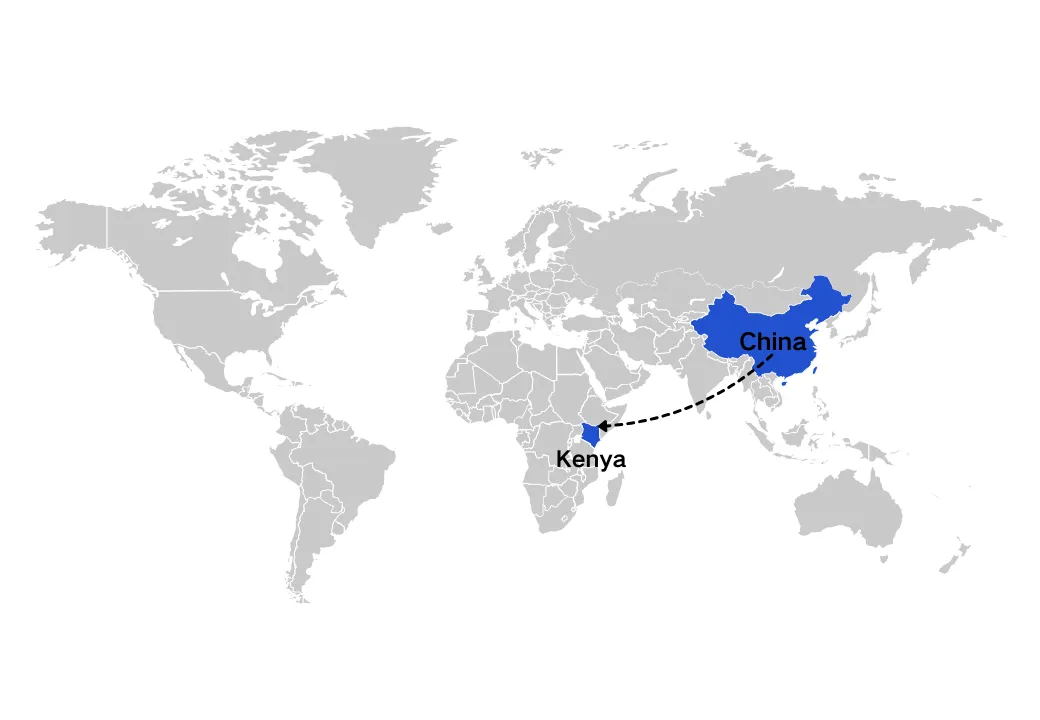
Kenya is the economic powerhouse of East Africa, and the China–Mombasa lane is its busiest trade artery. Whether you are bringing in electronics for a shop in Nairobi CBD, building materials for a project in Nakuru, or stock for a market stall in Gikomba, the way you move cargo now determines your landed cost far more than it did a year ago.
2026 has rewritten the rulebook. The Kenya Revenue Authority (KRA) launched a mandatory Advance Cargo Declaration (ACD) platform in August, the Finance Act 2026 made foreign export declarations a permanent import requirement from 1 September, KEBS reset its entire PVoC inspection programme in February, and the Kenya Nuclear Regulatory Authority added radiation screening at every port. Add record congestion at Mombasa and a full-blown customs valuation dispute over consolidated cargo, and the margin for improvisation has disappeared.
We work this corridor every week. From securing space on vessels to Mombasa and sealing PVoC inspections in China to filing the ACD reference before your container is loaded, AllBestShipping keeps your goods compliant and moving — with transparent pricing and no penalty surprises at the port.
Last updated: September 2026.
What Has Changed on the China–Kenya Lane in 2026
If you imported from China into Kenya before 2026, do not assume your old checklist still works. These are the changes that matter right now, in the order they took effect:
- PVoC contracts reset (8 February 2026). KEBS' agreements with inspection agencies for general goods expired on 8 February 2026 and a new three-year cycle (2026–2029) began on 9 February. Any consignment shipped on board from that date without a valid Certificate of Conformity (CoC) is routed to destination inspection at Mombasa at a fee of 0.6% of the approved customs value (minimum USD 300, maximum USD 3,500) instead of simply being released.
- KEBS extended destination inspection to new regions. Africa, Central Europe, Canada and the USA were added to the destination-inspection list — a signal that KEBS is tightening conformity enforcement across the board. China remains a PVoC (pre-shipment) zone, so your CoC must still be issued in China before loading.
- Mandatory radiation screening at Kenyan ports (1 May 2026). The Kenya Nuclear Regulatory Authority (KNRA) now requires every consignment entering or leaving Kenyan ports — including Mombasa and the inland container depots — to pass radiation portal monitors, with specialised screening where flagged. It usually adds hours, not days, but cargo can be held for secondary screening.
- Advance Cargo Declaration (ACD) goes live (3 August 2026). Every containerised consignment destined for a Kenyan port needs an ACD reference code from the KRA ACD platform (acd.kra.go.ke) before the container is loaded. The code — a 15-digit reference such as
ACDKE2026004324— is generated from four documents: the draft Bill of Lading, commercial invoice, freight invoice and export declaration. It must be endorsed on the Bill of Lading before the vessel sails, and since 1 September 2026 carriers are required to validate it before loading. - Consolidated cargo ACD exemption (2 September 2026). After protests by small-scale importers, the government directed that cargo consolidators be exempted from the ACD requirement and that KRA publish an exclusion list of high-value goods that cannot move under the general consolidation arrangement. If you import through a consolidator rather than as an FCL importer, confirm your forwarder's exemption status per shipment.
- Export declaration requirement (1 September 2026). The Finance Act 2026 inserted section 23B into the Tax Procedures Act: importers must obtain and retain — for five years — an export declaration or equivalent customs export certificate issued by the country of export, evidencing lawful export. In practice, that means the Chinese customs export declaration (报关单) for your cargo must end up in your Kenya import file. Missing it lets KRA reject claims on value, origin, cost or ownership, re-determine tax and impose penalties. Clearing agents reported thousands of units accumulating at Mombasa and the CFSs within the first days of enforcement — this is the single most important document change of 2026.
- Consolidated cargo valuation settled at KSh 2 million (2 September 2026). KRA raised the customs benchmark for a general consolidated 40-ft container from KSh 2.5 million to KSh 3.2 million on 21 August 2026, triggering a traders' shutdown and protests in Nairobi. Following a State House agreement, the benchmark was cut to KSh 2 million, ordinary goods were separated from high-value merchandise, and existing rates for ready-made garments, footwear and fabrics remain unchanged.
- Consolidator re-registration (deadline 15 October 2026). Every cargo consolidator must be re-vetted and registered by KRA and must submit a comprehensive list of the individual traders and importers whose goods it consolidates. If your forwarder cannot confirm registration, your cargo is exposed.
- Port and rail investment plus KSh 48,000 in relief. CMA CGM signed an ~USD 800 million commitment to modernise two Mombasa container terminals, KPA is building Berth 19B and a new container yard at Berth 23, and KRA, KPA and port users agreed on pre-arrival processing and a Smart Gate pilot at Gate 24 (31 August 2026). Separately, Kenya Railways cut the charge for moving cargo from the ICD to the Bomaline de-consolidation centre from KSh 58,000 to KSh 10,000.
What this means for your next shipment: three documents now have to exist before your cargo sails — the PVoC Certificate of Conformity, the export declaration and (for FCL cargo) the ACD reference. Our China-side team handles all three as part of the booking process, which is why our consignments clear instead of accumulating demurrage at Mombasa.
Sea Freight from China to Kenya
Sea freight is the lifeblood of China–Kenya trade, carrying the overwhelming majority of cargo volume. It remains the most cost-effective way to move bulk goods, machinery, electronics, construction materials and textiles to Mombasa and beyond — as long as you plan around the port's current congestion rather than being surprised by it.
FCL vs. LCL: Choosing the Right Option
| Feature | FCL (Full Container Load) | LCL (Less than Container Load) |
|---|---|---|
| Best For | Large volume (>15 CBM) | Small shipments (1–15 CBM) |
| Cost Efficiency | High (flat rate per container) | Good for small loads (charged per CBM) |
| Security | Sealed from origin to destination, PVoC-sealed in China | Handled at consolidation warehouses and de-consolidation centres |
| Transit Speed | Faster (direct handling, priority on SGR) | Slower (consolidation, de-consolidation, valuation at the port) |
| Customs Profile | Straightforward: one importer, one entry, ACD required | Regulated separately under the consolidated cargo framework |
Port Status Update (September 2026): Mombasa is operating under sustained pressure, not a temporary spike. The 7-day average vessel waiting time is around 4 days, and liner services are reporting berthing delays of more than 6 days, driven by equipment shortages, empty-container depot saturation and a heavy transhipment mix. During the September 2025 – early 2026 congestion episode, anchorage queues exceeded 20 vessels with berth delays stretching to 14 days, and waiting incidence remains close to 100% at the legacy KPA terminal. Port users have been queueing up to five days simply to return empty containers. Book two to three weeks ahead and build a 5–7 day berthing buffer into your delivery commitment.
What Mombasa Looks Like in 2026
- Volume: The Port of Mombasa handled a record 45.45 million tonnes of cargo in 2025 (up 10.9% from 40.99 million tonnes in 2024) and 2.11 million TEUs (up 5.5%). Q1 2026 throughput rose another 3.5% to 10.997 million tonnes, with imports accounting for 84.6% of it.
- Structure: Container handling is split between Terminal 1 (Berths 16–19) and Terminal 2 (Berths 20–22), with a combined capacity of roughly 2.1–2.2 million TEUs. Terminal 2 and its Kipevu facility consistently outperform the legacy terminal on waiting time — vessel choice matters.
- The empty-container problem: Roughly 40% of containers moving through Mombasa are empty and about 77% of export boxes leave Kenya empty. Empty depots are full, which is why returning a container — and avoiding detention — has become the most common hidden cost on this lane.
- Digitalisation: A pre-arrival processing system, the Smart Gate pilot at Gate 24 and tighter integration between KRA and KPA systems are all in progress following the 31 August 2026 stakeholder meeting. Expect incremental improvement through late 2026, not an overnight fix.
Major Ports and Gateways in Kenya
- Mombasa (KEMBA): The primary gateway for Kenya and the landlocked neighbours — Uganda, Rwanda, South Sudan, Burundi and the eastern DRC. Almost all China-origin seaborne cargo enters here.
- Lamu (KELAM): Kenya's second commercial port, with three operational berths (400 m each), natural depths of 17 m and capacity for roughly 1.2 million TEUs a year. It anchors the LAPSSET corridor to northern Kenya and Ethiopia, and parts of the port and the Lamu SEZ are being offered to private operators under a PPP framework. Service coverage is still thin, so Lamu is a strategic option rather than a drop-in replacement for Mombasa in 2026.
- Inland Container Depots: Nairobi ICD and Naivasha ICD handle clearance away from the coast; Naivasha is the interchange point for transit cargo heading to Uganda by rail and road.
- Container Freight Stations (CFSs): Mombasa-area CFSs take domestic cargo out of the port, and designated de-consolidation centres in Nairobi and Mombasa are being set up to separate consolidated cargo faster.
Air Freight from China to Kenya
When speed is critical — perishables, urgent spare parts, launch stock or high-value electronics — air freight is the superior choice. Nairobi is East Africa's largest air cargo hub, and capacity from South China is deep.
Key Airports
- Jomo Kenyatta International Airport (NBO) – Nairobi: The region's main cargo gateway and the airport most China–Kenya air freight is consigned to.
- Moi International Airport (MBA) – Mombasa: Useful for coastal distribution and tourism-related cargo.
- Eldoret International Airport (EDL): Handles general cargo and agricultural trade in western Kenya.
Service Levels & Transit Times
| Service | Transit Time | Indicative Rate | Ideal For |
|---|---|---|---|
| Express (DHL/FedEx/UPS) | 1–3 days transit, 3–5 days door | $8.00 – $12.00/kg | Samples, documents, high-value parcels |
| Standard air cargo | 3–7 days | $4.30 – $6.80/kg | Commercial shipments from 45 kg upward |
| Deferred / consolidated air | 7–12 days | $3.80 – $5.50/kg | Cost-sensitive cargo that still needs to fly |
Air rates on this lane are quoted on chargeable weight — the greater of actual gross weight and volumetric weight (length × width × height in cm ÷ 6,000). Tight packaging and accurate carton dimensions from your supplier frequently save more than a rate negotiation does. Air cargo also enjoys faster PVoC handling: KEBS-certified contractors target physical inspection within one working day and CoC issuance within one working day for air shipments, versus four and two working days respectively for sea-bound cargo.
Pro Tip: Capacity into Nairobi is well served from South China — Kenya Airways operates Guangzhou–Nairobi, China Southern and freighter operators serve the route, and Gulf and Ethiopian hubs (Dubai, Doha, Addis Ababa) add daily connections from Shenzhen, Shanghai and Hong Kong. Nairobi (NBO) also functions as a regional distribution hub, so air cargo cleared in Nairobi can be trucked onward to Mombasa, Kisumu, Eldoret or Nakuru. For a deeper comparison of air services and cut-off times, see our guide to air shipping from China to Kenya.
DDP & Door-to-Door Shipping from China to Kenya
Between PVoC certification in China, the ACD reference, the export declaration retention rule, IDF and RDL payments, KEBS destination inspection risk and the new excise watchlist, a first-time Kenyan importer can easily lose more to penalties and demurrage than to freight. Our DDP (Delivered Duty Paid) service removes that exposure: you receive one all-in rate per CBM or per kg, and we carry the compliance burden.
How Our DDP Service Works
- Consolidation: We collect your goods in Guangzhou, Yiwu or Shenzhen and inspect them before they leave China.
- Compliance in China: PVoC inspection and CoC issuance, the KRA ACD reference, the export declaration, and your IDF application are arranged before loading.
- Shipping: Cargo moves by sea to Mombasa or by air to Nairobi.
- Clearance: We handle KRA entry, import duty, excise where applicable, VAT (16%), the Railway Development Levy (2%), the Import Declaration Fee (2.5%) and KEBS verification.
- Delivery: Goods are delivered to your shop, warehouse or project site — Eastleigh, CBD, Industrial Area, Gikomba, Mombasa, Kisumu, Nakuru or Eldoret.
Why Choose DDP?
- All-inclusive pricing: One flat rate covering freight, duty, levies, clearance and delivery — quoted before you commit.
- No PVoC or ACD stress: The conformity file and the pre-loading declarations are our responsibility, not yours.
- Cash-flow friendly: No surprise KRA or KEBS bills at the port, and no demurrage accumulating while documents are chased.
- Landlocked-transit ready: If your cargo is ultimately destined for Uganda, Rwanda, South Sudan or the DRC, we structure the transit bond and documentation correctly from the start.
What a Kenya DDP Quote Should Include
- Ocean or air freight plus BAF and origin charges in China;
- PVoC inspection and CoC fees (Route A is 0.60% of FOB value, minimum USD 300, maximum USD 3,500);
- China export declaration and ACD filing, and IDF/documentary handling;
- Import duty, excise where applicable, VAT 16%, RDL 2%, IDF 2.5%;
- Terminal handling, CFS or ICD charges and last-mile trucking;
- A clear statement of what is excluded — normally demurrage and detention, storage after the free period, and any re-inspection triggered by non-compliant goods.
Perfect For: E-commerce sellers fulfilling on Jumia and Kilimall (Kenya has no local Amazon marketplace, so there is no FBA-style bonded programme to plug into), small retailers, wholesalers and first-time importers who would rather buy a delivered price than manage a clearing agent. Explore our door-to-door shipping services for the full hand-off model.
Main Shipping Routes from China to Kenya
The maritime route from China to Kenya is direct and comparatively fast, crossing the Indian Ocean without transiting the Red Sea or the Suez Canal — which is why cargo on this lane has been largely insulated from the rerouting and conflict surcharges that reshaped Europe-bound trades in 2026.
- Origin ports: Shanghai, Ningbo, Shenzhen (Yantian/Shekou), Guangzhou (Nansha), Xiamen and Qingdao.
- Route: South China Sea → Singapore Strait → Indian Ocean → Mombasa.
- Distance: Approximately 6,000 nautical miles.
- Services and frequency: Direct weekly-to-fortnightly services are operated under the Maersk EAX1/Mashariki, COSCO EAX3, OOCL EAX3, Evergreen AEF, CMA CGM ASEA2, ONE Kilima/EA2, PIL EAS, X-Press MFX and MSC strings, among others. Space tightens sharply from August, so book early for Q4 arrivals.
- Regional distribution: Mombasa feeds the wider Northern Corridor. If you are building a regional supply chain rather than a single-country one, our shipping from China to Africa network covers the onward legs.
Shipping Costs from China to Kenya (September 2026)
Budgeting accurately is key — and 2026 has been a moving target. Carriers pushed a Peak Season Surcharge on China-origin cargo to Mombasa and Dar es Salaam on 15 June 2026: USD 1,000 per 20-ft container and USD 2,000 per 40-ft container, up from USD 900 and USD 1,100. That single change explains why "cheap" quotes found online rarely match the invoice. Below are base ocean rates, followed by the surcharges that sit on top of them.
Sea Freight Base Rates (port-to-port, excluding destination charges)
| Container Type | Base Ocean Freight (USD) | Notes |
|---|---|---|
| 20ft FCL (20GP) | $2,100 – $2,700 | FAK base rate to Mombasa; add PSS/BAF below. |
| 40ft / 40HQ FCL | $3,600 – $4,600 | Best value per CBM for volume cargo. |
| LCL (per CBM) | $120 – $250 | Minimum 1 CBM charge; consolidated cargo is valued separately by KRA. |
Indicative September 2026 market levels. Port-to-port all-in rates including PSS and BAF typically land at USD 3,600–4,700 for a 20-ft and USD 5,600–6,600 for a 40-ft container.
What Sits On Top of the Base Rate
| Charge | Typical 2026 Level | Who Charges It |
|---|---|---|
| Peak Season Surcharge (PSS) | $1,000 / 20-ft, $2,000 / 40-ft from China & Hong Kong (since 15 June 2026) | Carrier |
| BAF / bunker adjustment | $150 – $450 per container | Carrier |
| Origin THC, documentation, ISPS, customs | $180 – $350 per container | China terminal / forwarder |
| PVoC inspection & CoC | 0.60% of FOB (Route A), min $300, max $3,500 | KEBS-accredited contractor |
| Destination terminal / CFS handling | $200 – $500 per container | KPA / CFS operator |
| SGR rail to Nairobi ICD | $550 / 20-ft, $630 / 40-ft | Kenya Railways |
| Demurrage & detention | $13 – $100+ per container per day after free time | Carrier / terminal |
| IDF + RDL | 2.5% + 2.0% of customs value | KRA |
| Import duty, excise & VAT | Duty by HS code; VAT 16% on CIF + duty + excise | KRA |
Air Freight Rates
| Weight Bracket | Estimated Cost (USD/kg) | Notes |
|---|---|---|
| +45 kg | $6.50 – $8.00 | Express / priority handling |
| +100 kg | $5.40 – $6.80 | Standard cargo |
| +500 kg | $4.30 – $5.60 | Bulk rate — best value for heavy shipments |
| Express courier | $8.00 – $12.00 | Parcels and samples under 100 kg |
DDP "All-In" Rates (Duty Included)
- Sea DDP: approximately $320 – $450 per CBM, depending on product category and the applicable duty and excise treatment.
- Air DDP: approximately $11 – $15 per kg, covering duty, VAT, levies, clearance and delivery.
- Consolidated LCL: small traders shipping 1–5 CBM should expect destination charges — not freight — to dominate the cost, which is why a landed-cost view matters more than a freight rate.
Get a Precise Quote: These are market averages. Duty and excise depend on your HS code, and rates move with the sailing week. For a spot quote valid for 14 days — including a preliminary landed-cost calculation — send us your packing list. Our cost breakdown for shipping from China to Kenya shows how each charge accumulates.
How Long Does Shipping Take from China to Kenya? (Normal vs. Current Conditions)
Timelines depend on mode, origin port and whether your cargo clears at Mombasa or travels inland to Nairobi. Given the current berthing queues, we quote two sets of numbers: a clean baseline and what the lane is actually doing in September 2026.
| Origin (China) | Destination | Normal Transit (Sea) | Current 2026 Conditions |
|---|---|---|---|
| Shenzhen / Guangzhou | Mombasa | 22 – 28 days | 25 – 35 days (4–7 days berthing wait) |
| Shanghai / Ningbo | Mombasa | 24 – 30 days | 28 – 38 days |
| Qingdao | Mombasa | 27 – 32 days | 32 – 42 days |
- Air freight: 3 – 7 days to NBO under normal conditions; allow 5 – 9 days while JKIA works through PVoC and customs queues.
- Mombasa → Nairobi (SGR): 1 – 3 days rail plus ICD release, then same-day or next-day trucking.
- Mombasa → Nairobi (road): 1 – 2 days, longer during the long rains.
- Door-to-door DDP totals: 35 – 50 days by sea (pickup 1–3 + sailing 25–35 + clearance 3–7 + delivery 1–4) and 8 – 14 days by air.
Peak-season warning: August to December is the heaviest import window on this lane. Berthing delays lengthen, empty depots fill up and clearance slows. If your cargo must be on a shelf for Christmas or the January school season, book 3–4 weeks earlier than the baseline transit time suggests.
Kenya Customs Clearance & Import Duties (2026 Rules)
Importing into Kenya now requires two gates to be cleared in sequence: KEBS conformity (before and at the border) and KRA customs (valuation, duties and the new documentary rules). A single missing document on either side is enough to strand your container in a demurrage-metered yard.
1. PVoC and the Certificate of Conformity
Pre-shipment conformity verification is mandatory for most regulated goods. The PVoC programme for general goods restarted on a new three-year cycle (2026–2029) on 9 February 2026. China, Hong Kong, Taiwan and Mongolia form the China zone, served by appointed contractors including CCIC, China Hansom (CHIC), ASTC, Intertek, Cotecna, TÜV Rheinland, Bureau Veritas and QISJ.
- Route A (consignment inspection and testing): the default route — 0.60% of FOB value, minimum USD 300, maximum USD 3,500.
- Route B (registration): 0.55% of FOB for low-risk goods with a consistent quality record; valid one year with at least two surveillance inspections.
- Route C (product licensing): 0.50% of FOB for manufacturers with a certified quality management system; licence valid up to three years.
- China-specific rule: containerised cargo from China (and the UAE) certified under Route A must be sealed by the PVoC contractor, with the seal and container numbers stated on the CoC. Broker-sealed or re-sealed boxes attract scrutiny.
- Timing: contractors target physical inspection within 4 working days (sea) or 1 working day (air) of a complete Request for Certification, and CoC issuance within 2 working days (sea) or 1 working day (air). Build that into your booking schedule.
- Free Sale Certificate: KEBS expects a certificate showing the goods are freely sold and compliant in the country of origin — obtain it from your supplier together with the CoC pack.
The cost of shipping without a CoC: Cargo arriving without a valid CoC is routed to destination inspection at 0.6% of the approved customs value (minimum USD 300, maximum USD 3,500), with 100% verification at the port, a bond in KEBS' favour and detention until quality is determined. Non-compliant goods are rejected, and either re-exported at your cost or destroyed after 30 days. Goods issued a Non-Conformity Report (NCR) in China cannot be presented to a second contractor or shipped at all.
2. The Two New KRA Gates: ACD and the Export Declaration
- Advance Cargo Declaration (ACD): mandatory for containerised cargo to Kenyan ports since 3 August 2026. The 15-digit reference (for example
ACDKE2026004324) is generated on acd.kra.go.ke from the draft Bill of Lading, commercial invoice, freight invoice and export declaration, and must be endorsed on the Bill of Lading before loading. Carriers validate it before loading since 1 September 2026. Consolidators were exempted by a government directive on 2 September 2026. - Export declaration retention (section 23B, Tax Procedures Act): since 1 September 2026, every importer must obtain and retain for five years the export declaration or equivalent customs export certificate issued by the exporting country, containing exporter and importer details, goods description, tariff classification, country and date of export, and the customs reference number. Without it, KRA may reject your declared value, origin, cost or ownership and reassess your tax.
3. Import Declaration Fee (IDF) and Railway Development Levy (RDL)
- IDF: 2.5% of the customs value, reduced from 3.5% by the Finance Act 2023 and unchanged in 2026. Many older guides still quote 3.5% — use 2.5%.
- RDL: 2.0% of the customs value, raised from 1.5% under the Tax Laws Amendment Act 2024 and upheld as lawfully enacted by the High Court in July 2026.
- Together, the two levies add 4.5% before duty and VAT are applied. Exemptions are narrow — mainly Chapter 88 aircraft goods, LPG storage infrastructure investment and approved export-processing or SEZ enterprises.
4. Import Duty, Excise and VAT
Import duty follows the EAC Common External Tariff bands, and excise and VAT are layered on top:
| Charge | Basis | Typical Rate |
|---|---|---|
| Import duty | CIF customs value | 0% raw materials, 10% intermediate, 25% finished, 35% textiles & footwear |
| Excise duty | CIF + import duty | Only on excisable goods — see the 2026 watchlist below |
| VAT | CIF + import duty + excise | 16% (IDF and RDL are not part of the VAT base) |
| IDF / RDL | CIF customs value | 2.5% and 2.0% |
2026 tariff measures worth checking before you buy: under the one-year EAC tariff measures now in force, import duty on mobile phones rose from 0% to 25%, motor vehicles from 25% to 35%, furniture from 35% to 45%, and baby diapers and plastic household goods from 25% to 35%, while lithium-ion battery duty fell from 25% to zero and rice duty dropped from 75% to 35%.
New excise exposure from the Finance Act 2026 applies to a watchlist of imported goods — 10% on certain plastics, 5% (or KSh 50/kg, whichever is higher) on ceramic tiles and sanitary fixtures, 30% on MDF, particle board, plywood and timber, KSh 200/kg or 35% on unprinted PVC/banner sheeting, 35% on shower heads, and KSh 40/kg on imported sugar. If your product sits in one of these categories, the excise line — not the freight — is what will move your landed cost.
5. Radiation Screening at Every Port
Since 1 May 2026 the Kenya Nuclear Regulatory Authority requires all cargo entering or leaving Kenyan ports, including Mombasa and the inland container depots, to pass radiation portal monitors. Compliant cargo flows through in hours; anything flagged for secondary screening adds time and requires documentation from your supplier.
6. Document Checklist for a Kenya Import
- KRA PIN and, where required, a valid importer registration;
- Import Declaration Form (IDF), filed through the Kenya TradeNet single window before arrival;
- PVoC Certificate of Conformity (CoC) — or roadworthiness certificate for used vehicles and mobile equipment;
- Free Sale Certificate and test reports from an ISO/IEC 17025 accredited laboratory where applicable;
- Export declaration from China (section 23B) and the ACD reference for FCL cargo;
- Commercial invoice, packing list, Bill of Lading or Airway Bill, and a Certificate of Origin — which remains mandatory despite proposals to remove it;
- Insurance certificate and, for transit cargo, a valid bonds/CBC document.
Expert Advice: landed cost is not one formula but six lines that stack — CIF, duty, excise, VAT, IDF and RDL — and the order matters because VAT is calculated on CIF + duty + excise only. AllBestShipping will run a preliminary landed-cost calculation for you before you commit to a purchase order; our customs clearance services then handle filing, assessment and release at Mombasa, Nairobi ICD or JKIA.
From Mombasa to Nairobi, Kisumu and the Region: Inland & SGR
Getting to Mombasa is only half the job. Inland movement — and the rail-versus-road choice — is now priced in public tariffs, so you can plan it precisely.
| Rail Route (Kenya Railways Tariff Notice No. 4 of 2026) | 20-ft | 40-ft | Network |
|---|---|---|---|
| Kilindini (Mombasa) – Nairobi | $550 | $630 | SGR |
| Kilindini – Naivasha | $600 | $700 | SGR |
| Naivasha – Malaba | $465 | $650 | Metre gauge |
| Naivasha – Kisumu | $465 | $650 | Metre gauge |
- SGR performance: Kenya Railways moved a record 640,000 tonnes of freight in a single month in October 2025, and the Mombasa–Nairobi SGR remains the cheapest reliable leg for containerised import cargo.
- The extension is not open yet: construction of the Naivasha–Kisumu–Malaba SGR started in 2026 with completion targeted for mid-to-late 2027. Until then, transit cargo to Uganda and beyond moves via Naivasha ICD and then metre-gauge rail or road — which is why we quote transit timelines separately from Kenya-domestic ones.
- De-consolidation relief: since September 2026, moving cargo from the ICD to the Bomaline de-consolidation centre costs KSh 10,000 instead of KSh 58,000 — a direct saving for importers using consolidated containers.
- Regional reach: from Mombasa and Naivasha, bonded transit runs to Uganda, Rwanda, Burundi, South Sudan and the eastern DRC.
Shipping Small Orders from Alibaba, 1688 & Taobao to Kenya
Sourcing small quantities from several Chinese suppliers? Consolidation is the answer — but 2026 added rules that punish loose declarations.
The "Buy & Consolidate" Strategy
- Shop: buy from multiple vendors on Alibaba, 1688 or Taobao.
- Ship to us: direct your suppliers to our Guangzhou or Yiwu warehouse.
- Verify: we open, count and photograph the goods before they leave China — free of charge.
- Consolidate: we combine your cartons into one shipment with one clearing file.
- Ship DDP: we send it by air or sea to Nairobi or Mombasa and handle every KRA and KEBS requirement.
2026 consolidation rules you should know: KRA's benchmark for a general consolidated 40-ft container now stands at KSh 2 million after the August–September 2026 dispute, with ordinary goods assessed separately from high-value merchandise and an exclusion list for goods that cannot be consolidated. Every consolidator must be re-registered and must disclose its importer list to KRA by 15 October 2026. Consolidators were exempted from the ACD requirement on 2 September 2026. Rates for ready-made garments, footwear and fabrics remain at their existing assessment levels. Working with a KRA-registered consolidator — and declaring accurately — is what keeps a consolidated container out of the verification queue.
Quality Check: We visually inspect every consolidated consignment at our China warehouse. If goods arrive broken, short or materially different from the order, we help you raise it with the supplier before the container is loaded — which is far cheaper than resolving it after a KRA valuation uplift at Mombasa.
Which Shipping Method Should You Choose?
| Your Situation | Recommended Mode | Why |
|---|---|---|
| Under 5 CBM, non-urgent | LCL sea, consolidated | Lowest freight per CBM; consolidate several suppliers into one file |
| 15 CBM and above | FCL 20-ft | Cheaper per unit, faster clearance, sealed from China |
| Bulky, low-value goods filling 50+ CBM | FCL 40-ft / 40HQ | Best cost per CBM; watch the new excise watchlist |
| Urgent stock, samples, restock gaps | Air freight to NBO | 3–7 days; PVoC handled in 1 working day |
| First shipment, no clearing experience | DDP door-to-door | One delivered price; we carry PVoC, ACD, IDF and duty risk |
| Cargo destined beyond Kenya | FCL + transit bond via Mombasa/Naivasha | Correct bond and documentation from the outset |
Importing from China to Kenya still offers enormous margin potential, but in 2026 success lies in three things: conformity (PVoC/CoC before loading), documentary completeness (ACD reference and the Chinese export declaration), and realistic lead times that account for Mombasa's berthing queues.
Key Takeaways:
- Compliance first: never load cargo without a CoC, and never sail without an ACD reference on the Bill of Lading.
- Fix your landed cost, not just your freight rate: IDF 2.5% + RDL 2% + duty + excise + VAT 16% frequently exceeds the ocean freight on low-value goods.
- Plan for congestion: add 5–7 days for berthing and yard handling, and clear your containers inside the free period — local free time is typically 9–14 days, transit 30–52 days, and demurrage runs from $13 to over $100 per container per day.
- Keep your documents for five years: the export declaration rule is now a permanent part of every Kenya import file.
- Use rail inland: the SGR at $550–$630 per container from Mombasa to Nairobi is the cheapest reliable inland leg available.
Ready to get started? Send your supplier list and packing list to AllBestShipping and we will come back the same working day with a compliant routing, a landed-cost estimate and a firm quotation. Our Shenzhen-based team handles the China side end to end — PVoC sealing, export declaration, ACD filing and booking — so your focus stays on growing your business in Kenya.
Get a Free Quote from AllBestShipping today — professional freight forwarding from China to Kenya and 50+ other destinations.