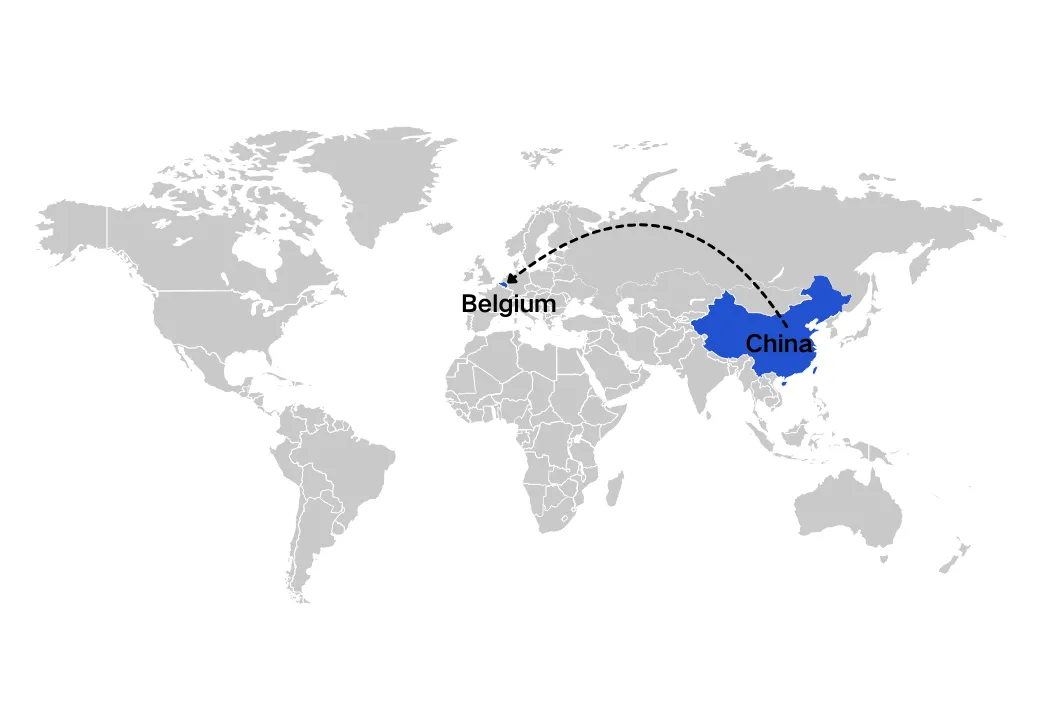
Belgium is where a large share of Europe-bound Chinese cargo first touches EU soil. The Port of Antwerp-Bruges handled 266.5 million tonnes and 13.6 million TEU in 2025, and Liège Airport moved 1,324,579 tonnes the same year — the fastest growth of any of Europe's ten largest cargo airports. From Antwerp you reach the Ruhr, northern France and the Randstad by barge or truck in a single day; from Liège you reach Amazon and retail distribution centres across four countries overnight.
What has changed is the rulebook. Belgium's customs IT platform, the EU's treatment of low-value parcels, and the cash-flow mechanics of import VAT have all shifted since the start of 2026. This guide covers the current sea, rail, air and DDP options on the China–Belgium lane, what each one costs in dollars, and the compliance steps — IDMS declarations, ET 14.000, the EU €3 low-value duty and CBAM — that decide whether your container clears in two days or sits for two weeks.
What Has Changed on the China–Belgium Lane in 2026
If you last shipped to Belgium in 2025, these are the changes that affect your landed cost and clearance time. Each one is dated, so you can check what applies to your shipment.
- The €150 duty exemption is gone (1 July 2026). Council Regulation (EU) 2026/382 abolished the customs duty relief on consignments below €150 and replaced it with a flat €3 duty per item, applied on a transitional basis until 1 July 2028. Import VAT was never exempt; duty now is not either.
- Product identifier data becomes mandatory (1 November 2026). Item-level product identifiers (merchant and manufacturer PIDs) must be transmitted with customs declarations. A separate €2 handling fee has been signalled for late 2026 — budget for it rather than being surprised by it.
- Liège's e-commerce mix has already reset. In July 2026, e-commerce shipments into the Liège Bierset customs zone fell 24% year on year and 41% against June, while customs declarations dropped 52%. Consignments valued above €150 rose about 10%.
- PLDA is retired. Belgium's import declarations now run through IDMS (Import Declaration Management System), exports through AES, and transit through NCTS Phase 5. Goods accounting (GCA/GCB) is migrating to PN-TS. Any forwarder still describing "PLDA clearance" is working from an outdated manual.
- ET 14.000 is the cheapest financing on this lane. With an ET 14.000 authorisation from the Belgian FPS Finance, import VAT moves off the border and onto your periodic VAT return — no pre-financing of 21% at release.
- Carrier surcharges grew again with EU ETS at 100%. The EU Emissions Trading System reached full 100% coverage for 2026. Maersk raised its Far East–North Europe environmental surcharge from USD 155 to USD 170 per FEU on 1 October 2026, and ONE's Europe Environment Surcharge moved from USD 204 to USD 220 per FEU.
- Suez is partially back — but do not assume it. Around 19% of Asia–Europe capacity is transiting the Suez Canal again after Gemini moved six services back to the Red Sea route. Cape of Good Hope routing still adds 10–14 days. Confirm the routing on your specific vessel and voyage.
- Two compliance deadlines now hit importers directly. CBAM entered its definitive regime on 1 January 2026 for iron, steel, aluminium, cement, fertilisers, hydrogen and electricity above the 50-tonne annual threshold; the EU Deforestation Regulation applies to large and medium operators from 30 December 2026.
- Belgian B2B e-invoicing is mandatory (since 1 January 2026). Every Belgian VAT-liable business must issue and receive structured electronic invoices in Peppol BIS Billing 3.0 format. If you sell B2B into Belgium through a local entity, paper and PDF invoices are no longer valid VAT invoices.
Sea Freight from China to Belgium: Antwerp-Bruges and Zeebrugge
Sea freight still carries the overwhelming majority of China–Belgium cargo by volume, and it remains the only mode with a defensible cost per unit for heavy, dense or bulky freight. Belgium's advantage is not just the port — it is what sits behind it. Antwerp-Bruges is Europe's largest integrated chemical cluster and has direct barge, rail and pipeline connections into Germany, France and the Netherlands, which means your container does not have to be trucked far to reach its final market.
FCL vs LCL: Which Should You Book?
| Factor | FCL (Full Container Load) | LCL (Less than Container Load) |
|---|---|---|
| Volume | Best above 13–15 CBM | Best between 1 and 13 CBM |
| Pricing | Flat rate per 20GP / 40HQ | Per CBM, with a 1 CBM minimum |
| Transit | Faster — loaded at origin, sealed until release | 7–12 days slower on average (consolidation and deconsolidation) |
| Handling risk | Low — your cargo is never mixed | Moderate — cargo is handled at the CFS at both ends |
| Customs | One declaration for the whole container | House bill structure; the consolidator declares |
AllBestShipping insider tip: Between roughly 12 and 15 CBM, get both quotes. At that volume a 20GP is frequently cheaper than LCL once origin CFS charges, destination CFS charges and documentation are added — and you get better security because the container is sealed at origin and stays sealed.
Departure Ports in China and Transit to Belgium
| Origin (China) | Destination (Belgium) | Port-to-Port Transit | Typical Service |
|---|---|---|---|
| Shenzhen (Yantian / Shekou) | Antwerp | 28–34 days | Direct or one transshipment |
| Guangzhou (Nansha) | Antwerp | 29–35 days | Direct |
| Shanghai | Antwerp / Zeebrugge | 30–38 days | Direct, highest frequency |
| Ningbo | Antwerp | 30–38 days | Direct |
| Qingdao | Antwerp / Zeebrugge | 33–40 days | Direct and transshipment |
| Tianjin (Xingang) | Antwerp | 34–42 days | Often via a relay port |
Routing caveat for 2026: the same string of services can sail either through the Suez Canal or around the Cape of Good Hope. The Cape routing adds 10–14 days and roughly 3,500 nautical miles. Treat the ranges above as Cape-inclusive — if your vessel is on a Suez rotation you will land at the fast end.
What Sea Freight Costs in 2026
These are port-to-port base rates as of September 2026, before destination charges and surcharges. Drewry's World Container Index put Shanghai–Rotterdam at USD 4,092 per 40ft on 3 September 2026, down about 5% week on week as Suez capacity returned, so the market is moving — ask for a quote with a stated validity window rather than working from a table.
| Service | Unit | Base Rate (USD) | Notes |
|---|---|---|---|
| Sea FCL | 20GP | $1,900 – $3,000 | Best for heavy, dense cargo such as machinery, tiles and metal parts |
| Sea FCL | 40GP / 40HQ | $3,000 – $4,600 | Best value per CBM for furniture, textiles and general retail |
| Sea LCL | Per CBM | $55 – $130 | Minimum 1 CBM; origin and destination CFS charges are separate |
| DDP sea freight | Per CBM | $120 – $200 | All-in: collection, export, freight, duty, VAT, delivery |
The Inland Leg Is Now the Bottleneck
Antwerp-Bruges ended 2025 with roughly flat container volumes (13.6 million TEU, up 0.7%) after about 25 days of industrial action cost the port an estimated 2.4 million tonnes. The pressure in 2026 has moved inland: barge waiting times at Rotterdam and Antwerp reached around 96 hours in August 2026, which makes just-in-time barge collection unworkable for time-critical cargo and pushes shippers towards direct truck collection from the quay. Build that into your planning. If your consignee in Genk, Ghent or Liège is waiting on a barge window, a truck pre-pull usually costs less than the demurrage clock.
Air Freight from China to Belgium: Brussels (BRU) and Liège (LGG)
Belgium punches far above its weight in air cargo because of one airport. Liège (LGG) handled 1,324,579 tonnes in 2025, up 14% year on year — the strongest growth among Europe's ten largest cargo airports — and 697,816 tonnes in the first half of 2026, up another 11.3%. It operates around the clock, which matters more than headline tonnage: a Friday-night arrival can clear the same weekend instead of waiting for Monday.
Brussels (BRU) remains the better gateway for pharmaceuticals, perishables and general cargo where a wider carrier network and belly capacity matter more than pure speed of clearance.
The €3 Duty Reshaped Liège's Cargo Mix
The EU's flat €3 charge on low-value items took effect on 1 July 2026, and the effect at Liège was immediate rather than gradual. E-commerce shipments into the Bierset customs zone fell 24% year on year in July and 41% month on month; customs declarations fell 52%. Shipments valued above €150 rose about 10%. Total airport volume still grew 4% in July to 114,064 tonnes, carried by pharmaceuticals, data-centre equipment and flowers.
The practical read-through for importers is straightforward: low-value, high-volume parcel flows into Belgium are now more expensive and more scrutinised, while consolidated commercial shipments have become relatively more attractive. If your business model was built on sub-€150 parcels landing at Liège, re-run the unit economics before your next inventory cycle rather than after.
Transit Times and Airport Comparison
| Airport | IATA | Airport-to-Airport | Door-to-Door | Best For |
|---|---|---|---|---|
| Liège | LGG | 3–6 days | 5–10 days | E-commerce, express freight, 24/7 clearance |
| Brussels | BRU | 3–7 days | 5–12 days | Pharma, perishables, general cargo |
| Amsterdam (alternative) | AMS | 3–7 days | 6–12 days | Overflow capacity, onward Benelux distribution |
| Frankfurt (alternative) | FRA | 4–8 days | 7–14 days | German consignees, wide-body belly capacity |
Direct freighter capacity from China to Belgium is concentrated on the Shanghai–Liège and Shenzhen/Canton–Liège corridors, with Brussels served by a mix of belly and freighter capacity. Indirect routings via the Gulf or a European hub typically save money on smaller consignments and add one to two days.
Air Freight vs Express Courier
| Factor | Standard Air Freight | Express Courier (DHL / FedEx / UPS) |
|---|---|---|
| Weight sweet spot | Above 100 kg | Below 100 kg |
| Pricing | Per chargeable kg, tapering at 300 kg / 500 kg / 1,000 kg | Per chargeable kg, no meaningful taper |
| Service level | Airport-to-airport, or door-to-door under DDP | Door-to-door by default |
| Customs | Broker files the IDMS declaration; duty and VAT invoiced separately unless DDP | Included in the rate, but surcharges and duty advances are billed after the fact |
| Typical 2026 rate | $5.00 – $10.00 / kg (base, airport-to-airport) | $7.00 – $13.00 / kg all-in for small parcels |
Note the phrase chargeable weight. Air and express pricing uses the greater of actual weight or volumetric weight, so light, bulky cargo pays for the space it occupies rather than what it weighs. Diminishing the volumetric divisor is one of the most effective cost levers available, and it is usually free — better packing beats a better rate.
Dangerous Goods and Declared Cargo
Air cargo rules are enforced strictly, and Belgium's airports have invested heavily in detection capability. Lithium batteries, aerosols, liquids, powders, magnets and anything with a safety data sheet require proper classification, packaging and documentation.
Risk warning: misdeclaring dangerous goods is not a paperwork problem, it is a criminal exposure. Undeclared lithium batteries found in a consignment trigger fines, shipment seizure and carrier blacklisting that can end your ability to ship by air at all. We classify and declare DG cargo properly at origin, every time.
Rail Freight from China to Belgium: Direct Trains into Liège
Rail is the middle option that most importers under-use on this lane. Belgium is one of the few EU countries with genuinely direct China–Europe rail links rather than a cross-border truck leg bolted onto a German arrival. Liège has direct services from Zhengzhou (since 2018), Yiwu (since 2019) and Chengdu (since 2020), and in July 2026 a new service opened from Shijiazhuang — the first direct Beijing–Tianjin–Hebei to Belgium train. Other Chinese hubs feed Liège and Antwerp through consolidation, and Munich/Duisburg routings remain available for cargo that does not need a Belgian terminal.
How long does rail take? Plan on 18–26 days station-to-station and 25–34 days door-to-door. The single biggest variable is not the 10,000 km of track, it is the gauge change at the Belarus–Poland border: roughly 85–90% of China–Europe trains enter the EU through the Malaszewicze terminal, and queueing there can swing transit by several days in either direction.
| Route | Station-to-Station | Door-to-Door | Best For |
|---|---|---|---|
| Xi'an / Zhengzhou → Liège (direct) | 18–24 days | 25–32 days | E-commerce and general cargo needing a Belgian terminal |
| Yiwu → Liège (direct) | 18–25 days | 26–33 days | Small commodities, mixed consumer goods |
| Chengdu / Chongqing → Duisburg → Antwerp | 20–26 days | 28–36 days | Heavy industrial goods from western China |
| Middle Corridor (Kazakhstan – Caspian – Türkiye) | 26–34 days | 32–42 days | Cargo with routed-country compliance constraints |
AllBestShipping insider tip: rail pricing is quoted per 40HQ or per CBM, so it competes best against air rather than against sea. Unless your goods are high-value per cubic metre, rail usually loses to sea on pure cost and loses to air on pure speed. It wins on the combination — roughly 40–60% cheaper than air with a transit time less than half that of sea. We quote rail, sea and air side by side on the same enquiry so you can see where the crossover sits for your commodity.
DDP and Door-to-Door Shipping to Belgium
DDP (Delivered Duty Paid) is the option most small and mid-sized importers choose for Belgium, because it converts a five-party logistics chain into a single price. Under DDP, your forwarder collects from the supplier's factory, handles Chinese export clearance, moves the cargo, acts as importer of record, pays Belgian duty and 21% import VAT, and delivers to your door or to your Amazon FBA receiving centre.
What DDP includes: factory collection + export declaration + international freight + import declaration under IDMS + duty and anti-dumping duty where applicable + 21% import VAT + final delivery. One invoice, one point of contact, no customs broker for you to appoint.
Because we act as importer of record, the compliance questions land with us — which is exactly the point. But you should still understand who is legally the importer, because in Belgium that determines who needs a VAT registration and, in some structures, a fiscal representative.
ET 14.000: The Import VAT Deferral Most Importers Never Claim
Belgian import VAT is 21% of the customs value plus duty. On a €100,000 consignment, that is €21,000 of cash you pay at release and only recover when your VAT return is processed. Belgium offers a specific authorisation to remove that cash drag: ET 14.000.
With an ET 14.000 authorisation issued by the Belgian FPS Finance, payment of import VAT is postponed from the moment of customs release to your periodic VAT return. The VAT is then reported and reclaimed on the same return, so the net cash effect is close to zero instead of a €21,000 advance. For an importer moving €100,000 of goods per month, that is roughly €252,000 of working capital retained over a year.
Three things to know before you apply:
- It is an authorisation, not an exemption. You apply through MyMinfin under "Authorisation ET14000 (VAT reverse charge mechanism on import)". The authorisation is granted against your import profile and is not retroactive.
- You need to be filing Belgian VAT returns. ET 14.000 shifts VAT to the periodic return — so a Belgian VAT identification is the precondition, not the outcome.
- Non-EU businesses generally cannot hold it directly. A non-EU company registering for Belgian VAT is normally required to appoint a Belgian fiscal representative, who can be jointly and severally liable for the VAT debt. That is why we arrange the customs-and-VAT structure up front rather than discovering it at the port.
The related tools are worth knowing too: a customs bonded warehouse lets you store goods with duty and VAT suspended until they are released for free circulation, and T1 transit moves goods under bond to another EU country where the import declaration is then filed. If your distribution model is multi-country, the declaration country is a cash-flow decision, not just a compliance one.
Fiscal Representation for Non-EU Sellers
If your company is established outside the EU and you sell into Belgium — directly or through Amazon FBA — you will hit a Belgian peculiarity: a fiscal representative established in Belgium is generally mandatory when a non-EU business registers for Belgian VAT. The representative is jointly and severally liable for unpaid VAT, interest and penalties, which is why few parties accept the role casually.
Two consequences follow. First, plan VAT registration before your first shipment, not after — approvals and representative appointments take weeks. Second, if you are using Pan-European FBA, note that Amazon is widening its listing requirements: since 3 September 2026 every enrolled product, new or existing, must carry an active offer on Amazon.nl, and from 26 February 2027 products enrolling in the programme will also need an active offer in Belgium.
DDP vs DAP: Who Owns the Risk
| Factor | DDP (Delivered Duty Paid) | DAP / DDU (Delivered at Place) |
|---|---|---|
| Importer of record | Seller / forwarder | Buyer |
| Duty and VAT | Paid by the forwarder, included in your price | Billed to you at arrival, on top of freight |
| Cost certainty | Fixed landed cost agreed before departure | Unknown until the declaration is filed |
| VAT recovery | Needs a clear structure — discuss ET 14.000 and your VAT position | Follows from your own VAT registration |
| Best for | E-commerce sellers, SMEs, first-time importers | Companies with an in-house customs function |
The DDP Process, Step by Step
- Quote and booking. Send the packing list and commercial invoice; we confirm commodity, HS code, weight, volume and delivery postcode, then issue a landed-cost quote valid for a stated period.
- Collection in China. We pick up from your supplier, or you deliver to our Shenzhen, Guangzhou, Yiwu or Shanghai warehouse.
- Export and consolidation. Chinese export declaration is filed, cargo is consolidated and — where useful — repacked to cut volumetric weight.
- International transit. Sea to Antwerp-Bruges or Zeebrugge, rail to Liège, air to Liège or Brussels. Tracked throughout.
- Import declaration under IDMS. We act as importer of record, classify the goods, file the declaration and pay duty and 21% import VAT.
- Final delivery. Truck to your warehouse in Brussels, Antwerp, Ghent, Liège, Genk or anywhere in Belgium — or to your Amazon FBA receiving centre. Our door-to-door shipping service covers the full chain from factory floor to final address under one contract.
Risk warning — valuation. Belgian customs cross-check declared values against commercial databases, and Liège in particular has invested in verification capability. Declaring $50 for a shipment worth $5,000 does not reduce your duty; it produces seizure, penalties and a compliance record that follows your EORI number. We declare accurately and will tell you plainly when a value looks indefensible.
Customs Clearance in Belgium: IDMS, Duties and 2026 Compliance
Belgian customs (FPS Finance — Douane en Accijnzen, Douanes et Accises) is rigorous but predictable. Almost every problem on this lane is caused by documentation arriving incomplete, not by customs being arbitrary.
Belgium's Declaration Systems in 2026
- IDMS — Import Declaration Management System, which replaced PLDA for imports. Official go-live was 23 October 2024 and onboarding is complete, with limited legacy exceptions published by customs. Your forwarder should be filing on IDMS, full stop.
- AES — the export declaration system that replaced PLDA Export. Incoterms are now declared at shipment level rather than item level.
- NCTS Phase 5 — transit declarations, including T1 movements to other EU member states.
- PN-TS — the goods accounting module (formerly GCA/GCB inside PLDA) that tracks goods under customs supervision.
- ICS2 — the EU's advance cargo information system. Release 3 has been fully operational across maritime, road, rail and inland waterway since 1 September 2025, version 3 messaging has applied since 3 February 2026, and every consignment entering the EU must have a valid Entry Summary Declaration. For maritime cargo the ENS needs a 6-digit HS code and the declarant's EORI and must be filed 24 hours before loading. Non-compliance means cargo holds and penalties reported at up to €5,000 per shipment — your forwarder files this, but you supply the data.
Duty, VAT and Anti-Dumping
| Charge | Rate | What It Applies To |
|---|---|---|
| Import duty | 0% – 17% | Almost always excepted where an EU trade agreement applies; otherwise by CN/TARIC code. Electronics often 0%, textiles and footwear higher |
| Anti-dumping and countervailing duty | 9.9% – 122.8% | More than fifteen Chinese product categories, including e-bikes, solar panels and ceramics. The correct TARIC additional code must appear on the invoice or customs applies the highest available rate |
| Import VAT | 21% standard | Calculated on customs value plus duty. Reduced rates of 12% and 6% apply to specific categories. Recoverable if you hold a Belgian VAT registration — or deferrable under ET 14.000 |
| €3 flat duty | €3 per item | Consignments with an intrinsic value up to €150, from 1 July 2026 until 1 July 2028, when normal classification applies again |
| Destination charges | €150 – €350 | Antwerp/Zeebrugge terminal handling, documentation and container release, billed to the consignee |
| Customs brokerage | €80 – €200 | Declaration filing plus examination fees if the container is scanned |
Three 2026 Compliance Deadlines That Apply to Importers
CBAM — in force since 1 January 2026. The Carbon Border Adjustment Mechanism moved into its definitive regime for iron and steel, aluminium, cement, fertilisers, hydrogen and electricity. Importers above the 50-tonne annual threshold must be authorised, report embedded emissions, and purchase and surrender CBAM certificates. If you import steel components, aluminium profiles or fasteners, this is now part of your landed cost — not a future concern. Note that the Commission expanded its guidance series again in August 2026, so the calculation methodology continues to be refined.
EUDR — applies from 30 December 2026. The EU Deforestation Regulation covers cattle, cocoa, coffee, palm oil, rubber, soy and wood, plus a long list of derived products including printed paper, furniture and certain packaging. Large and medium operators must be able to demonstrate that goods are deforestation-free and legally produced, backed by geolocation data. Micro and small enterprises have until 30 June 2027. If your product range includes wood, rubber, paper or their derivatives, the due-diligence file needs to exist before year-end.
GPSR — in force since 13 December 2024 and actively enforced. The General Product Safety Regulation requires a responsible economic operator established in the EU for most consumer products — a manufacturer, importer, authorised representative or fulfilment service provider. Marketplace sellers are squarely in scope. In practice this means an EU-based responsible person named on the product or its packaging, traceability information, and the ability to act on recalls. Our Amazon FBA preparation services flag the labelling and responsible-person requirements before goods leave China, because fixing them after arrival means re-labelling at your cost.
Documents That Get You Cleared on the First Filing
- Commercial invoice — 6 to 10-digit CN/TARIC code per line, Incoterms 2020 term, accurate value and currency, correct TARIC additional code where anti-dumping applies.
- Packing list — must reconcile exactly with the physical count and carton marks.
- Bill of lading or air waybill — the transport contract and release document.
- EORI number — mandatory for any business lodging a customs declaration in the EU. If you have no EU establishment, the declaration is filed under your forwarder's structure, which is precisely how DDP works.
- Certificates of origin, CE markings, safety data sheets or product certificates — as required by commodity.
- EU responsible-person details — for consumer products under GPSR.
HS classification is where money is won or lost. The gap between two plausible headings can be 0% and 12%, or an anti-dumping rate of 9.9% versus 62%. We classify against the current TARIC database and calculate duty, VAT and any anti-dumping exposure before you commit to a shipment. Send us your product list and we will return a landed-cost table within 24 hours.
What Sits On Top of the Base Rate
Two quotes for the same container can differ by 40% and both can be honest, because they cover different things. On this lane, the base ocean rate is frequently less than half of what you actually pay. Here is the layer structure we use when pricing Belgium.
| Cost Layer | Typical 2026 Range | Notes |
|---|---|---|
| Origin charges | $400 – $900 per container | Factory pickup, export declaration, Chinese port THC, documentation |
| BAF / bunker adjustment | +10% – 25% of base rate | Moves with fuel; usually quoted separately and revised monthly or quarterly |
| EU ETS surcharge (EMS / ESS / EES) | ~$170 – $220 per FEU | 2026 is the first year of 100% ETS coverage. Maersk and ONE both raised Asia–Europe environmental surcharges from 1 October 2026 |
| Peak season surcharge (PSS) | $150 – $600 per container | Announced with as little as two weeks' notice. Ask what PSS is already included |
| Destination port charges | €150 – €350 | Antwerp/Zeebrugge THC, documentation, container release |
| Customs brokerage | €80 – €200 | Plus examination or scanning fees if selected |
| Import duty + anti-dumping | 0% – 17% / 9.9% – 122.8% | On CIF value. Anti-dumping depends entirely on getting the TARIC additional code right |
| Import VAT | 21% | Recoverable, or deferred under ET 14.000 |
| Last-mile trucking | €200 – €600 | Antwerp to Brussels, Ghent, Liège or an FBA receiving centre |
| Demurrage and detention | €90 – €180 per container per day | Free time at Antwerp is commonly 7 days for dry containers and fewer for reefers. The 2026 barge delays make this a live risk — pre-pull if your free time is tight |
Two questions worth asking every forwarder: "What validity period does this rate have?" and "Is the ETS surcharge included or on top?" A rate with 14-day validity and an all-in ETS figure is worth more than a headline number that gets re-rated at booking.
Door-to-Door Transit Time Comparison
| Mode | Station / Port to Door | Full Door-to-Door | Best For |
|---|---|---|---|
| Sea freight FCL | 28 – 38 days | 32 – 45 days | Bulk, heavy and non-urgent cargo above 15 CBM |
| Sea freight LCL | 30 – 45 days | 38 – 52 days | 1–13 CBM; slower because of consolidation windows |
| Rail freight | 18 – 26 days | 25 – 34 days | Mid-value goods where sea is too slow and air is too expensive |
| Air freight | 3 – 7 days | 5 – 12 days | High-value, launch-critical or restocking cargo above 100 kg |
| Express courier | — | 3 – 7 days | Samples, documents and urgent parcels below 100 kg |
| Road feeder from a Benelux hub | — | +1 – 3 days after arrival | Multi-country distribution from Antwerp, Rotterdam or Liège |
Add 10–14 days if your vessel is on a Cape of Good Hope rotation rather than a Suez rotation — and confirm which one applies to your voyage at booking, not after your production line stops.
Calendar warning. China's National Day holiday runs 1–7 October 2026, and Chinese New Year falls on 6 February 2027 — factories wind down from mid-January and do not return to full output until late February. For sea freight into Belgium, book by November if you need pre-CNY inventory in place. Waiting until January adds both cost and several weeks of uncertainty.
What a Quote Usually Excludes
Being explicit about exclusions is how we avoid the argument that follows a surprise invoice. A typical port-to-port or airport-to-airport quote on this lane does not include:
- Origin charges — factory pickup, export declaration and Chinese port handling, unless quoted as an all-in door-to-door rate.
- Destination charges — Antwerp or Zeebrugge THC, documentation and container release, which are billed to the consignee.
- Duty, anti-dumping duty and import VAT — never included in a freight rate, and only included in a DDP rate.
- Demurrage, detention and storage — free time is finite and the clock starts at discharge. With 2026 barge delays around 96 hours, this is a real cost line, not a theoretical one.
- Overweight and out-of-gauge surcharges — a 20GP is typically capped around 21–22 tonnes of cargo; exceeding it triggers a VGM surcharge and possible re-stuffing.
- Insurance — cargo insurance is a separate contract. Carrier liability is limited by convention and is not a substitute.
- Inspection, scanning and examination fees — customs or veterinary/phytosanitary inspection where triggered by commodity.
- Compliance work — CE certification, EU responsible-person arrangements, EUDR due-diligence files, CBAM reporting and EPR registration, unless you scope them with us.
An honest all-in quote names every one of these lines, or tells you which are excluded and why. If a quote is silent about them, the cost has not disappeared — it has simply moved to after arrival.
Consolidation and Value-Added Services for Alibaba, 1688 and Taobao Buyers
Sourcing from Alibaba, 1688 or Taobao across five suppliers is easy; paying five international freight bills is not. Consolidation turns multiple small shipments into one economical one, and on the China–Belgium lane the savings are usually largest for the 1–8 CBM band where five separate LCL bookings would each attract a minimum charge.
How Consolidation Works
- Order from any number of suppliers. Buy from Alibaba, 1688, Taobao or direct from factories.
- Ship to your dedicated warehouse address in China. We issue you a unique inbound ID so every carton is identified on arrival.
- Receive, verify and store. We count, photograph and store your goods free of charge for up to 30 days while your orders complete.
- Consolidate and repack. We strip bulky supplier cartons, combine shipments and reduce volumetric weight — which is the single largest lever on air and express costs.
- Ship as one consignment. One export declaration, one freight bill, one delivery.
| Service | What We Do | Why It Matters in Belgium |
|---|---|---|
| Quality control | Open and inspect for quantity, damage and obvious defects against your specification | Cheaper to resolve in China than to return goods from Belgium |
| Repacking | Remove void space and unnecessary packaging | Directly cuts chargeable weight on air and express |
| FBA labelling | Apply FNSKU, box and pallet labels to Amazon specification | Required for FBA receiving; re-labelling at a Belgian 3PL costs multiples of the origin rate |
| Fiscal representation and VAT setup | Arrange Belgian VAT registration structure and ET 14.000 application | Mandatory for non-EU sellers and the biggest cash-flow lever on this lane |
| Compliance pre-checks | CE marking, GPSR responsible person, EUDR and EPR flags | Catches issues that would otherwise stop your goods at release |
| Blind shipping | Remove supplier invoices and branding from outer cartons | Protects your supplier relationships |
| Multi-country distribution | Bonded storage and T1 transit to other EU member states | Belgium as a single EU entry point for several markets |
Why Importers Choose AllBestShipping for the Belgium Lane
We are a freight forwarder based in Shenzhen, moving cargo from China to more than 50 countries, and Belgium is one of the lanes where the detail matters most — because the customs and VAT structure, not the ocean rate, usually decides your real landed cost.
- Belgium-specific customs and VAT capability. IDMS declarations, ET 14.000 applications, fiscal representation and bonded storage — handled as one structure rather than three separate vendors.
- Landed-cost quotes, not freight quotes. We classify against the current TARIC database and show duty, anti-dumping exposure and VAT before you commit.
- Transparent pricing with named surcharges. If BAF, ETS or PSS applies, you see it and you see whether it is included.
- Real-time tracking from supplier pickup in China through to final delivery in Belgium.
- Cargo insurance arranged on request, because carrier liability is not coverage.
- One team for the whole chain — collection, export, freight, import clearance, duty, VAT and delivery to your door or your Amazon FBA receiving centre.
If your goods are also heading to other EU markets, the same structure usually covers them: our China to Europe shipping services apply the same customs and transit playbook across the Benelux, Germany and France, so a single Belgium entry point can serve several countries.
Cost tables on this page reflect September 2026 market conditions on the China–Belgium lane, and current route economics are documented in our guide to what it actually costs to ship from China to Belgium. For the cash-flow mechanics in more depth, see our breakdown of door-to-door shipping from China to Belgium under DDP.
Send us your packing list and delivery postcode today — commodity, weight, volume and destination are enough for us to model sea, rail, air and DDP side by side and come back with a landed-cost comparison, including the ET 14.000 effect on your VAT position. Rates move weekly on this corridor, so we quote with a stated validity window rather than making you guess. Contact AllBestShipping to start.
Last updated: September 2026. AllBestShipping is a professional freight forwarder headquartered in Shenzhen, China, providing sea, air, rail, DDP, Amazon FBA and customs clearance services from China to more than 50 countries. Learn more at allbestshipping.com.