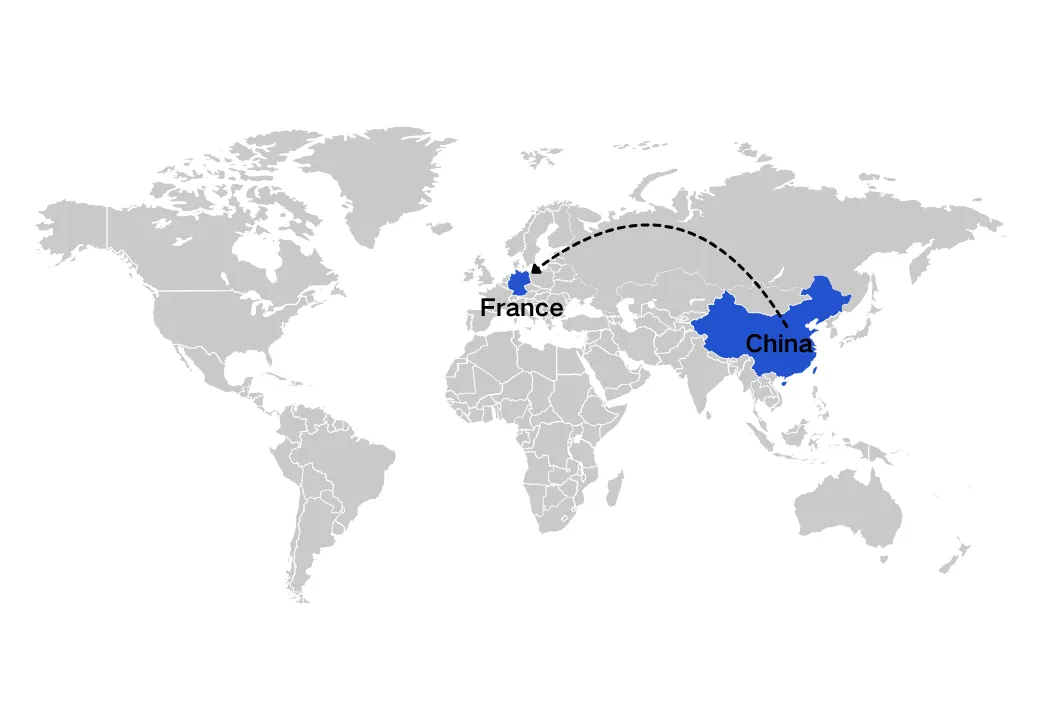
Are you looking for the most reliable way to ship goods from China to France? France remains one of China's largest trading partners in the EU — in the fourth quarter of 2025 alone, French importers took delivery of roughly €19.6 billion of Chinese goods — but the rules on this lane changed materially at the start of 2026. France's EORI format has moved to SIREN, one-off fiscal representation for Regime 42 has been abolished, the EU has ended the €150 duty relief on low-value consignments, and a minority of Asia–Europe capacity has returned to the Suez Canal.
Whether you are shipping full containers into Le Havre, air cargo into Charles de Gaulle, or DDP shipments to Amazon FBA centers in France, this guide gives you the 2026 numbers and the current French customs (Douane) requirements. AllBestShipping runs the entire chain from our Shenzhen base — booking, export clearance, ocean or air transit, French duty and VAT, and final delivery to your door.
What Changed on the China–France Lane in 2026
If your costing sheet or checklist was built before January 2026, several items on it are now out of date. These are the seven changes that matter for importers this year:
- 1 January 2026 — French EORI switched to the SIREN format. French customs (DGDDI) now accepts only EORI numbers built on the company's 9-digit SIREN identifier; branch-level SIRET-based EORI numbers are no longer valid for declarations. New numbers are requested through the pro.douane.gouv.fr portal, and the transition must be completed before your next shipment clears.
- 1 January 2026 — One-off limited fiscal representation was abolished. Non-EU businesses can no longer clear goods under Regime 42 using a representative's "borrowed" VAT number. You must either appoint an authorised Import Agent (established in France or the EU, holding its own French VAT number, and jointly liable for the declaration) or register for French VAT yourself. Note that an Import Agent cannot be used for DDP sales inside France — for DDP, the importer of record must be a French VAT-registered entity, which is how AllBestShipping structures these shipments.
- 1 July 2026 — The EU ended the €150 customs duty exemption. Low-value consignments are now charged a temporary flat €3 duty per item, running until the EU Customs Data Hub takes over on 1 July 2028. From 1 November 2026, product identifier data (PID) also becomes mandatory on those consignments. Commercial shipments above €150 were never covered by the relief and continue to be assessed normally under TARIC.
- 1 January 2026 — EU ETS coverage moved to 100%. Shipping lines must now surrender allowances for 100% of verified emissions (up from 70% in 2025), and methane and nitrous oxide are included for the first time. Carriers have priced this through emissions surcharges such as Maersk's EMS/ESS and Hapag-Lloyd's equivalent, adding a noticeable percentage to Asia–Europe legs.
- Mid-2026 — A partial return to Suez. From July 2026, Maersk, Hapag-Lloyd and MSC began moving selected Asia–Europe services back through the Red Sea, and roughly one in five westbound Asia–Europe slots now transit Suez. The majority of capacity still rounds the Cape of Good Hope, which adds roughly 10–14 days versus the Suez routing — so always confirm the routing for your specific vessel and voyage before you commit to a delivery date.
- 2026 — French port labour action is a live scheduling risk. Dockworker strikes at Le Havre and Marseille-Fos in March and May 2026 blocked container and ro-ro terminals and pushed vessel delays to roughly a week, while post-strike backlogs kept berth waiting times elevated into the spring. Build buffer into Le Havre arrivals, or let us route via Fos-sur-Mer, Dunkirk or a northern-range port when a strike is called.
- 1 January 2026 — China's standalone VAT Law tightened export documentation. Export VAT refund claims are now reviewed against a stricter document set: commercial invoice, sales contract, packing list, export declaration and HS codes must all match. Inconsistencies hold cargo at origin and delay the refund.
Sea Freight from China to France
Sea freight still carries the overwhelming majority of China–France volume. It is the cheapest option per unit for shipments above roughly 2 CBM or 500 kg, and it is the only mode that can absorb machinery, furniture, building materials and full e-commerce replenishment cycles without punitive per-kilo rates.
2026 Market Update: Rates into France tracked the wider Asia–North Europe market through 2026: after a sharp first-half step-up, spot pricing eased into the autumn, with Drewry's composite index at $4,476 per 40ft in the second week of September 2026. Budget for the surcharges as well — BAF, THC, peak-season and emissions items typically add 25–40% on top of the base ocean rate, and low-sulphur or war-risk items can reappear at short notice. Treat every figure below as a planning range, not a quotation.
Key Ports and Routes
China origins: Shanghai (CNSHA), Ningbo (CNNGB), Shenzhen/Yantian (CNSZX), Guangzhou/Nansha (CNNSA), Qingdao (CNQDG).
France destinations:
- Le Havre (FRLEH): France's dominant container gateway and the natural port for Paris, northern France and the Benelux border. HAROPA PORT, the Seine-axis authority that includes Le Havre, Rouen and Paris, closed 2025 with a record 3.2 million TEU and 84.7 million tonnes of maritime traffic, and it handles the large majority of French container imports from Asia.
- Fos-sur-Mer (Marseille, FRFOS): Best for southern France, the Rhône valley and the Mediterranean arc. When a service transits Suez, Fos can be several days faster than Le Havre — and it is a useful fallback whenever northern ports are disrupted.
- Dunkirk (FRDKK): A third northern option with heavy Asia trade, strong for project cargo and northern industrial consignees.
Sea Freight Rates & Transit Times (September 2026 Planning Ranges)
| Container Type | Base Ocean Rate (USD)* | Port-to-Port Transit | Best For |
|---|---|---|---|
| 20' GP (FCL) | $1,400 – $2,400 | 28 – 38 days | Heavy, dense cargo (machinery, metals, tiles) |
| 40' HQ (FCL) | $2,400 – $3,900 | 28 – 38 days | High-volume cargo (furniture, textiles, e-commerce stock) |
| LCL (per CBM) | $45 – $95 | 32 – 45 days | Shipments under ~15 CBM |
*Base ocean freight only, excluding origin charges, destination THC, duty and VAT. Rates swing weekly with the SCFI and Drewry indices and with fuel, peak-season and emissions surcharges — request a live quote for the week you book. The FCL/LCL break-even on this lane sits at roughly 13–15 CBM.
Lead Freight Expert Tip: Le Havre storage penalties start fast. Send us your commercial invoice and packing list at least 7 days before vessel arrival so the declaration is lodged the moment the manifest is available. French customs are strict on HS classification, and a wrong code can convert a routine release into a week of demurrage. For a deeper look at loadability and container options on this route, read our guide to container shipping from China to France.
Air Freight from China to France
Air freight moves cargo from China to France in days rather than weeks and remains the standard choice for high-value electronics, fashion and luxury goods, cosmetic launches and any shipment where a stockout costs more than the freight. Rates eased from the 2026 spring peak but remain sensitive to fuel and capacity, so quote close to your ship date.
Major Air Hubs
- China: PVG (Shanghai), SZX (Shenzhen), CAN (Guangzhou), PEK (Beijing), HKG (Hong Kong — often the better option for goods with lithium batteries).
- France: CDG (Paris Charles de Gaulle) is the national cargo hub; LYS (Lyon Saint-Exupéry) and MRS (Marseille Provence) serve the regions.
Air Freight vs. Express: Which to Choose?
| Feature | Air Freight | Express (DHL/UPS/FedEx) |
|---|---|---|
| Weight | Best above 100 kg | Best under 100 kg |
| Transit Time | 3 – 5 days airport-to-airport; 5 – 8 days door-to-door | 3 – 5 days door-to-door |
| Customs | Broker required (we act as declarant) | Built into the courier rate |
| 2026 Rate | ~$5.00 – $9.00 / kg (lower end above 1,000 kg) | ~$9.00 – $15.00 / kg |
Understanding Chargeable Weight
Air cargo is billed on the greater of actual weight or volumetric weight.
- Formula:
Length x Width x Height (cm) / 6000 - Example: A carton of pillows may weigh 10 kg but cube out at the equivalent of 50 kg — you are charged for 50 kg. Cubing your cartons before requesting a quote is the single easiest way to avoid a surprise invoice.
Why importers use our DDP air service: one all-inclusive per-kilo rate covers the flight, French clearance, duty, 20% VAT and final truck delivery to your premises or FBA center. There is no French EORI or VAT number to obtain, and no customs file landing on your desk — ideal for Amazon FBA sellers, crowdfunding launches and SMEs running their first shipments.
Rail Freight from China to France
Rail sits between sea and air: materially faster than a Cape-routed vessel, materially cheaper than a freighter aircraft. For importers balancing inventory carrying cost against freight cost, it is the most under-used option on this lane — and the most useful when a French port strike or a Suez/Cape schedule gap appears at the wrong moment.
How Rail Reaches France
Cargo crosses the Eurasian landbridge and enters France through two channels:
- The Duisburg gateway (most common): trains run from Chengdu, Chongqing, Xi'an and Yiwu to Duisburg, Germany — the European hub that handles roughly 30% of China–Europe rail traffic — and are then trucked or railed to Paris, Lyon, Lille and the rest of France. This is also the practical route for importers moving goods onward to other destinations across Europe.
- Direct services: connections into Lyon (Vénissieux) and Dourges exist but run less frequently than the German corridor, so availability drives the decision more than price.
- Transit time: 18 – 24 days station-to-station, roughly 26 – 32 days door-to-door.
- Reliability: Fixed weekly departures and no exposure to port congestion or maritime weather — the main reason rail bookings spike whenever a French port is disrupted.
- Corridor choice: the northern corridor through Russia and Belarus continues to operate for non-sanctioned commercial cargo, with added documentation checks. If your compliance policy excludes that corridor, the Middle Corridor (Kazakhstan – Caspian – Azerbaijan – Georgia/Türkiye) is the alternative, typically adding 7–10 days.
- Scale: China–Europe rail passed 20,022 train departures in 2025 and freight volumes rose again in early 2026, so capacity on the main corridors is mature rather than experimental.
Rail vs. Sea vs. Air: The Comparison
| Feature | Rail Freight | Sea Freight | Air Freight |
|---|---|---|---|
| Transit | 18–24 days (26–32 door-to-door) | 28–40 days port-to-port (Cape routing) | 3–5 days (5–8 door-to-door) |
| Cost | Moderate (~25–40% of air) | Lowest per CBM | Highest |
| Emissions | Far lower than air | Lowest per tonne-km | Highest per tonne-km |
| Best For | Electronics, auto parts, fashion mid-season restocks | Bulk goods, furniture, heavy inventory | Urgent samples, luxury, launch stock |
2026 Geopolitical Note: Rail avoids the Red Sea entirely, which is precisely why it has become the standard contingency for French importers during Suez/Cape volatility. Because the corridor crosses multiple jurisdictions, we recommend "All-Risk" cargo insurance that explicitly covers rail transit — AllBestShipping arranges this per shipment on request.
DDP & Door-to-Door Shipping from China to France
French customs (Douane) is administratively demanding, and 2026 raised the bar for non-EU importers. A missing document or a mis-declared importer of record can hold goods at Le Havre for weeks; a wrong representation model can invalidate the clearance altogether. DDP (Delivered Duty Paid) removes that exposure by making your freight forwarder the importer of record.
How Our DDP Service Works
We act as your virtual import department, covering every step from the Chinese factory to your French address.
- All-inclusive pricing: one rate covers ocean, air or rail freight, French customs clearance, import duty and 20% VAT (TVA). No destination invoices for you to settle.
- Compliant importer of record: your goods are imported under our own French VAT registration and EORI number — never a borrowed or third-party VAT number, which is exactly the arrangement France prohibited on 1 January 2026. You do not need a French EORI, a French VAT number or an Import Agent mandate.
- Final delivery: local partners (DPD, UPS, GLS or direct truck) deliver to Amazon FBA centers such as CDG7 (Senlis), ORY1 (Saran), LIL1 (Lauwin-Planque), LYS1 (Sevrey), MRS1 and BVA1 (Boves), to private warehouses, or to business and residential addresses nationwide.
- Ongoing compliance: we hold the declaration records, proofs of delivery and reporting trail required by DGDDI, and manage post-clearance queries on your behalf.
Ideal for: e-commerce sellers on Amazon.fr, Cdiscount and Shopify, plus SMEs and startups shipping their first containers. If you would rather keep import control in-house, our door-to-door shipping service covers every intermediate Incoterm, from FOB through DAP to DDP.
Amazon FBA France in 2026
Amazon's Pan-European programme now requires a valid offer in each participating marketplace — including Amazon.fr — for every enrolled ASIN, and France applies EPR and labelling obligations on top. In practice that means inbound shipments need booked delivery slots, EU responsible-person details under GPSR, and packaging compliance in place before the first unit lands. We book CARRIER CENTRAL slots, label and prep cartons to Amazon's French specification, and handle the FBA prep and delivery service end to end, including the returns and transfers that come with a pan-EU inventory position.
French Customs Clearance, VAT & Import Duties (2026)
France applies EU customs law with a distinctly French administrative layer. Here is what your shipment must satisfy at the border this year.
1. The 2026 Essentials
- EORI number: mandatory for any commercial import. Since 1 January 2026 France accepts only the SIREN-based 9-digit format issued through pro.douane.gouv.fr; SIRET-level numbers no longer clear goods.
- Declarations: filed electronically in the DELTA system (DELTA-G / DELTA-X, H1 format for standard imports) by a customs representative — us, under DDP, or your own broker.
- Import VAT (TVA): the standard rate is 20% (5.5% / 10% reduced rates for a short list of goods), assessed on CIF value plus duty. For VAT-registered importers it is auto-liquidated: you declare and deduct it on the same CA3 return instead of paying cash at the border, which is a real working-capital advantage on regular shipments.
- Import duty: set by HS code under the EU TARIC schedule, ranging from 0% to roughly 17% and averaging around 4–5% across all goods. Electronics and many machine parts enter at 0–2%, textiles and apparel sit near 12%, furniture is typically 0%, and bicycles attract 14% plus possible anti-dumping duties.
- Low-value consignments: since 1 July 2026 the €150 duty relief is gone and consignments up to €150 attract a flat €3 duty per item, with product identifier data (PID) required from 1 November 2026.
- Regime 42 users: if goods are imported through France and forwarded to another EU country, the 1 January 2026 reform applies — appoint an authorised Import Agent or hold your own French VAT number.
2. Required Documentation
To clear smoothly at Le Havre, Fos-sur-Mer or CDG, prepare:
- Commercial invoice showing HS codes, Incoterms, unit values and total customs value.
- Packing list with accurate weights, dimensions and carton counts per SKU.
- Bill of lading (sea) or air waybill (air), plus a CMR or T1/T2 transit document when the goods move onward.
- Certificate of origin where a preferential or negotiated rate applies.
- Product compliance files: CE marking documentation, GPSR EU responsible-person details, health or phytosanitary certificates and REACH declarations for chemicals, depending on the commodity.
- EPR registration evidence for packaging and electricals sold into France — the Triman marking and a CITEO / ecosystem identifier are effectively required to sell household goods lawfully.
Expert Warning: France enforces CE marking, GPSR and EPR actively, and marketplaces now ask for registration numbers before listing. Get compliance in place before the container sails, not after it clears. Our customs clearance service pre-checks HS codes and documentation before arrival so that classification questions are resolved while the vessel is still at sea.
3. ICS2 and Entry Summary Declarations
All cargo entering the EU now requires an entry summary declaration (ENS) filed in the EU's ICS2 system — road and rail since September 2025, and fully enforced for maritime shipments through 2026. Under DDP, we file it as the responsible party; there is nothing for you to submit, which is one of the quieter advantages of an all-inclusive service.
Shipping Costs from China to France (2026 Estimates)
Use the table below for budgeting, and request a live quotation before you commit purchase orders. Freight is volatile in both directions: fuel, emissions surcharges, peak-season fees and Suez-versus-Cape routing can all move the number within a fortnight.
| Shipping Mode | Unit | Indicative Cost (USD)* | Notes |
|---|---|---|---|
| Sea Freight (FCL) | 20' container | $1,400 – $2,400 | Base ocean freight; best for dense cargo. |
| Sea Freight (FCL) | 40' HQ container | $2,400 – $3,900 | Most common choice for e-commerce replenishment. |
| Sea Freight (LCL) | Per CBM | $45 – $95 | Charged per CBM or per 1,000 kg, whichever is greater. |
| Rail Freight | 40' container | $6,500 – $8,500 | Via Duisburg or Lyon; less volatile than ocean spot rates. |
| Air Freight | Per kg (over 100 kg) | $5.00 – $9.00 | Chargeable weight; capacity via Air France, China Southern, Lufthansa Cargo. |
| Express | Per kg (under 100 kg) | $9.00 – $15.00 | All-in door-to-door (DHL / FedEx / UPS). |
*Planning ranges as of September 2026, base freight only unless stated. Destination THC of roughly $150–300 per container, customs brokerage, duty, VAT and inland delivery are additional unless you book DDP. Surcharges (BAF, PSS, emissions) commonly add 25–40% to the base ocean number.
Cost-Saving Tip: Between 150 kg and 500 kg, compare rail LCL against air before you book. Rail typically lands 50–60% below air while still arriving in under a month — and for a full container, consolidating 13–15 CBM into FCL almost always beats LCL per unit. For the full breakdown of options by budget, see our comparison of the cheapest ways to ship from China to France.
How Long Does Shipping Take from China to France?
Plan against door-to-door windows, not port-to-port figures. Origin pickup and export clearance in China add 2–4 days, and French clearance plus inland delivery typically adds 2–5 days.
Transit Time Comparison (2026)
| Shipping Mode | Port / Airport to Destination | Door-to-Door | Best Use Case |
|---|---|---|---|
| Sea Freight (FCL) | 28 – 40 days | 32 – 47 days | Planned inventory replenishment. |
| Sea Freight (LCL) | 32 – 45 days | 35 – 50 days | Smaller shipments (consolidation adds time). |
| Rail Freight | 18 – 24 days | 26 – 32 days | The speed/cost sweet spot for mid-season stock. |
| Air Freight | 3 – 5 days | 5 – 8 days | Urgent restock, samples, high-value electronics. |
| Express | — | 3 – 5 days | Documents and parcels under 100 kg. |
What adds days:
- Routing: Cape of Good Hope services run 10–14 days longer than Suez transits — ask which routing your vessel is on rather than assuming either.
- Origin: pickup from inland cities such as Wuhan or Chengdu adds 2–3 days compared with Shanghai, Ningbo or Shenzhen.
- French disruption: port strikes, customs inspections and post-strike backlogs can each add 2–7 days. Random physical inspections alone hold cargo for 2–5 days.
- Peak season: the weeks before Chinese New Year (2027 falls on 6 February, with factories winding down from mid-January) and around Golden Week (1–7 October 2026) compress capacity and stretch schedules. Book sea freight in November or December for February production runs.
Step-by-Step Shipping Process with AllBestShipping
From the moment you place a purchase order to the moment your pallets are unloaded in France, we manage the chain:
- Inquiry & quote: you share cargo details (commodity, volume, weight, delivery postcode). We return a sea, air and rail comparison the same working day.
- Booking: we contact your suppliers in China, arrange collection or delivery into our Shenzhen consolidation warehouse.
- Cargo receipt: we measure, weigh and photograph the goods, verifying chargeable weight and inspecting for damage before loading.
- Export clearance: we file the Chinese export declaration, matching invoice, contract and HS codes to protect your VAT refund claim.
- International transit: your cargo moves by vessel, aircraft or block train, with milestones reported to you by email or WhatsApp.
- French import clearance: we lodge the DELTA declaration as importer of record, pay duty and VAT where DDP applies, and handle any Douane query.
- Final delivery: we book the delivery slot and truck the goods to your warehouse, FBA center or end customer.
One-Stop Solutions for Alibaba, 1688 & Taobao Buyers
Sourcing from multiple suppliers usually means several shipments, several minimum charges and no single point of accountability. Our consolidation service fixes that:
- Free warehousing: store goods from as many suppliers as you like in our China warehouse for up to 30 days at no cost.
- Consolidation: we combine small parcels into one shipment — you pay one bulk movement instead of several minimum charges.
- Quality inspection: we open cartons, check quantity and condition, and send photographs before anything ships.
- Repacking: we strip unnecessary packaging to cut volumetric weight and reduce your freight bill, and re-label for Amazon FBA where required.
Why Importers Choose AllBestShipping for the France Lane
We are a Shenzhen-based freight forwarder working China–France trade every week, not a directory listing. That means rates negotiated directly with carriers, honest transit estimates, French duty and VAT handled under our own registrations, real-time tracking with human updates, cargo insurance on request, and one accountable team from factory gate to final delivery.
Ready to ship? Send us your supplier list, carton count and delivery city and we will come back with a landed-cost comparison across sea, rail and air — usually the same day. Get a quick quote now and let AllBestShipping take the customs risk out of your next France shipment.
Last updated: September 2026.