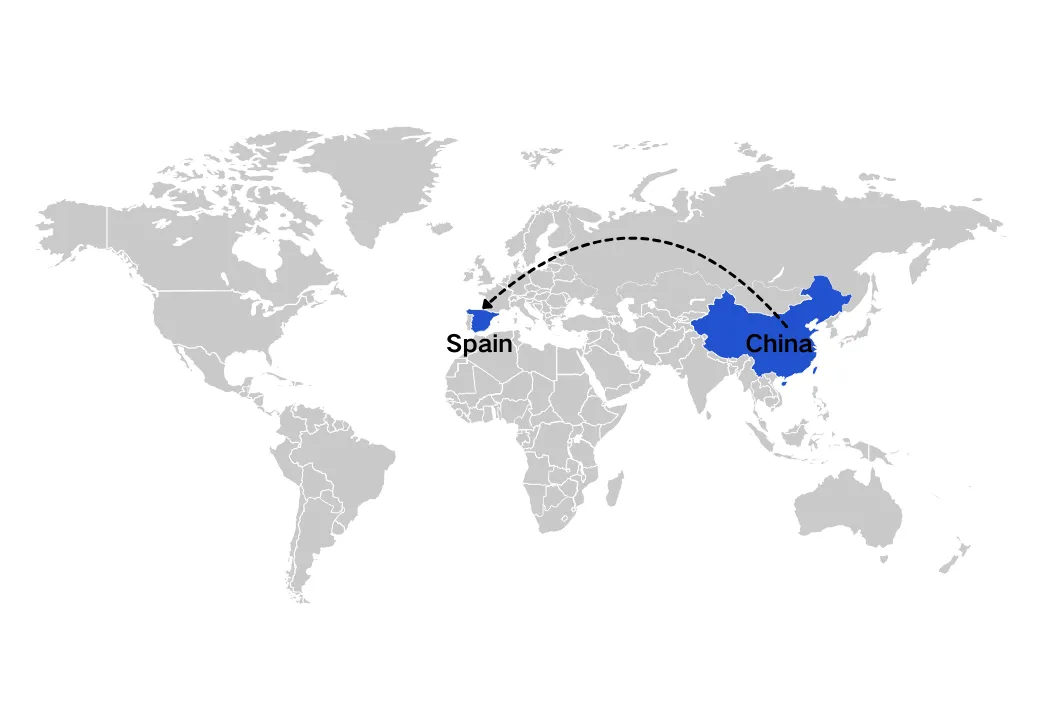
Spain took €4.83 billion of goods from China in June 2026 alone — up 9.9% year on year — making it one of China's largest export markets in the European Union. Yet the journey from a factory in Yiwu or Shenzhen to a warehouse in Madrid, Barcelona or Zaragoza still turns on three variables most guides ignore: which Spanish port you land in, whether your vessel sails via Suez or the Cape, and whether your customs paperwork survives Aduanas.
This page is our working 2026 reference for the China–Spain lane: live rate ranges by mode, realistic door-to-door transit times, the new EU and Spanish compliance rules that took effect this year, and how AllBestShipping moves cargo from your supplier's door to your address in Spain under a single door-to-door shipping contract.
What Has Changed on the China–Spain Lane in 2026
Before the tables, here is what actually moved this year. If you shipped to Spain in 2025, four of these six changes affect your landed cost or your lead time.
- The Suez Canal is partially back — and it is 10–15 days faster. After two years of Cape of Good Hope diversions, Maersk and CMA CGM have returned part of their Asia–Europe networks to the Red Sea. Lloyd's List Intelligence recorded 290 transits through the Suez Canal in the last week of August 2026 (30% higher than 2025, though still around 36% below normal levels). Services on Suez routing reach Valencia in roughly 25–31 days; services still routed via the Cape take 38–46 days. Your transit time now depends on the sailing you book, not on a single market-wide rule.
- Ocean rates fell sharply in September 2026. After a July peak-season spike, China→Spain FCL base rates dropped about 17% month-over-month to roughly $2,678–$3,273 (20GP) and $4,185–$5,115 (40HQ) into Barcelona and Valencia. Air rates fell even harder — about 32% — making air more competitive than it has been all year for urgent cargo.
- The EU's €150 duty exemption is gone (1 July 2026). Low-value consignments entering Spain now pay a flat €3 customs duty per item in addition to VAT. Spain's own tax agency (Agencia Tributaria) confirms the change on its customs pages for online purchases. For e-commerce sellers, this is the biggest landed-cost shift since IOSS.
- EU ETS at 100% for shipping (1 January 2026). Carriers now pass on the full carbon cost of the EU leg, typically itemised as an ETS or carbon surcharge of roughly $75–$170 per FEU on Asia–Europe sailings. It does not appear in most published rate tables — budget for it.
- ICS2 Entry Summary Declarations are mandatory for every mode (1 June 2026). A complete ENS must be filed before the goods reach the EU border, sea freight included. Your forwarder files it; if a quote does not mention ICS2, ask who is filing.
- Two compliance regimes landed on 1 January 2026. CBAM entered its definitive period (importers of steel, aluminium, cement, fertilisers, hydrogen and electricity need authorisation and certificate obligations), and GPSR product-safety responsibilities for consumer goods remain fully in force. The EU Deforestation Regulation (EUDR) now applies from 30 December 2026 for large and medium operators — directly relevant if you import wood, paper, furniture, rubber or leather goods.
Bottom line: the lane got cheaper in September 2026, but it also got more regulated. Rates below are a planning baseline — get a dated quote before you commit inventory.
Sea Freight from China to Spain
Sea freight still carries the overwhelming majority of China–Spain trade volume, and for shipments above 2 CBM or 500 kg it remains the cheapest way to move goods. Our Sea Freight from China service covers FCL and LCL sailings into every major Spanish port, with door delivery included if you want it.
Current Routing Status (September 2026)
The Red Sea picture has genuinely changed. Container traffic through the Suez Canal is recovering — weekly transits are at levels last seen in early 2024, and renewed Houthi threats have so far not reversed the trend, with attacks concentrated on specific Saudi-linked tonnage rather than the wider industry. In practice this means:
- Suez-routed services: ~25–31 days China → Valencia/Barcelona. Faster, and the schedule your 2026 contract should be based on where available.
- Cape-routed services: ~38–46 days. Still operating on several loops, and the fallback if risk indicators deteriorate again.
- Rate effect: Cape routing historically added $500–$1,500 per container in fuel and time-related costs. As Suez capacity returns, that premium is eroding on lines that have switched back.
AllBestShipping books by routing, not by headline price: we tell you which service your cargo is on, and what happens to your ETA if the carrier switches back to the Cape mid-transit.
Choosing Your Spanish Port
Spain faces both the Mediterranean and the Atlantic, and the port you choose changes both your freight cost and your inland trucking cost. This is the single most common planning error we see from first-time importers.
| Port | Best for | Notes |
|---|---|---|
| Valencia | Madrid, Valencia, Zaragoza, eastern Spain | Spain's largest container port and the port with the highest China traffic — typically 3–4 weekly departures from Chinese hubs. Handled 2.82 million TEU in H1 2026, with import containers up 11.1%. |
| Barcelona | Catalonia, France border, southern Europe distribution | Strong intermodal links via ZAL Port de Barcelona; 150 km from the French border. |
| Algeciras | Seville, Málaga, Cádiz, southern Spain | Primarily a transshipment hub at the mouth of the Strait of Gibraltar. The practical arrival point for Andalusia. |
| Bilbao | Basque Country, northern Spain, Portugal | Spain's main Atlantic port. Atlantic routing adds 5–8 days versus Valencia — only worth it if your delivery address is in the north. |
Transit Times: Port-to-Port
Times below are port-to-port estimates. Add 7–14 days for customs clearance, deconsolidation and inland trucking when you plan against a delivery date.
| Origin (China) | Destination (Spain) | Via Suez | Via Cape of Good Hope |
|---|---|---|---|
| Shenzhen / Guangzhou | Valencia | 25 - 29 Days | 38 - 43 Days |
| Shanghai / Ningbo | Barcelona | 27 - 31 Days | 40 - 46 Days |
| Ningbo / Qingdao | Algeciras | 26 - 31 Days | 39 - 45 Days |
| Qingdao / Tianjin | Bilbao | 32 - 38 Days | 45 - 52 Days |
FCL vs. LCL: Which Should You Choose?
- FCL (Full Container Load): You book the whole box (20GP, 40GP or 40HQ). Fastest sea option — no deconsolidation on either end. Best above roughly 15 CBM.
- LCL (Less than Container Load): You pay by the CBM and share the container. Best for 1–15 CBM. Allow 5–7 extra days for consolidation in China and de-stuffing in Spain.
- One LCL restriction worth knowing: dangerous goods (lithium batteries, chemicals) cannot generally be co-loaded with general cargo under LCL without specific approval. For regulated goods, FCL is the cleaner — and often faster — option.
| Feature | FCL | LCL |
|---|---|---|
| Volume | Best for > 15 CBM | Best for 1 - 15 CBM |
| Cost basis | Flat rate per container (20GP / 40HQ) | Per CBM, with minimum charge |
| Risk | Lower — sealed container, no shared handling | Moderate — handled at consolidation and de-stuffing |
| Typical use | Furniture, machinery, full FBA restocks | Samples, mixed SKUs, first orders |
Air Freight from China to Spain
Air freight is the fastest commercial option on this lane and, after the September 2026 rate correction, unusually competitive. It pays off for high-value electronics, fashion with a seasonal window, urgent spare parts and product validation runs.
Key Airports & Routes
China origins: PVG (Shanghai), SZX (Shenzhen), CAN (Guangzhou), HKG (Hong Kong). Hong Kong remains the practical gateway for goods with batteries, where export rules are simpler than mainland China.
Spain destinations:
- MAD (Madrid-Barajas): Spain's primary cargo hub and the best-connected airport with Chinese carriers.
- BCN (Barcelona-El Prat): Main gateway for Catalonia's industrial and fashion flows.
- ZAZ (Zaragoza): Underrated for textiles and homeware — the Zaragoza logistics platform sits inside the Madrid–Barcelona–Bilbao triangle and reaches most of Spain within 24 hours.
Five Chinese carriers operate around 30 direct China–Spain flights per week, with Iberia also flying Madrid–Shanghai. Where direct capacity is full, cargo flies via Frankfurt, Dubai or Doha and connects to MAD/BCN.
Transit Times & Service Levels
| Service Type | Transit Time | Ideal For |
|---|---|---|
| Express (DHL / UPS / FedEx) | 1 - 4 Days (door-to-door) | Samples, documents, parcels under 45 kg |
| Standard Air Freight | 4 - 7 Days (airport-to-airport) | General cargo over 100 kg |
| Deferred / Economy Air | 7 - 10 Days | Cost savings on less urgent air cargo |
Understanding Chargeable Weight
Air freight is billed on the higher of actual weight or volumetric weight. Standard air uses L × W × H (cm) / 6000; express couriers apply a denser divisor of 1:5000, which raises the chargeable weight for the same carton. Bulky, light goods (plush toys, bedding, flat-pack furniture) can easily bill at 2–3× their physical weight — one reason our consolidation team repacks before dispatch.
Insider insight: between roughly 70 kg and 150 kg, express courier and forwarder air rates converge. AllBestShipping quotes both side by side, because the cheaper option flips on total chargeable weight, not on the headline rate.
Rail Freight from China to Spain
Spain is the western terminus of the China–Europe block train network: the Yiwu–Madrid line runs roughly 13,000 km to Madrid's Abroñigal freight terminal — the longest rail freight link in the world. Rail sits between sea and air: meaningfully faster than Cape-routed sea freight, far cheaper than air, and largely insulated from the Red Sea question.
What Rail Actually Delivers in 2026
- Transit time: about 16–21 days rail transit Yiwu → Madrid, and 22–30 days door-to-door once consolidation at origin and final delivery in Spain are included.
- Cost: roughly 25–50% cheaper than air, and around 25–40% above base sea freight — a premium that widened in September 2026 as ocean rates fell. Book rail for certainty as much as for speed.
- Restrictions: no reefer, dangerous goods or out-of-gauge cargo. Electronics, textiles, machinery parts, homeware and mixed consumer goods are the sweet spot.
- The South China calculation: if your suppliers are in Guangdong, trucking a container 1,200 km to Yiwu adds roughly $800–$1,200 in inland cost. For South China cargo, sailing from Nansha or Yantian usually beats the rail premium — we will tell you when it does.
- Route transparency: the main corridor transits Kazakhstan, Russia, Belarus and Poland (gauge change at the China/Kazakhstan and Belarus/Poland borders). It remains operational for transit cargo, though insurance and compliance scrutiny are higher than before 2022. Shippers who prefer to avoid that corridor can use the trans-Caspian Middle Corridor (Kazakhstan → Caspian → Azerbaijan → Georgia/Türkiye), which added capacity through 2025–2026 but is slower and typically 7–10 days longer.
| Mode | Transit (door-to-door) | Relative Cost | Best For |
|---|---|---|---|
| Express courier | 1 - 4 Days | $$$$$ | Samples, documents |
| Air freight | 5 - 12 Days | $$$$ | Urgent, high-value |
| Rail freight | 22 - 30 Days | $$$ | Balanced speed and cost |
| Sea freight (Suez) | 35 - 45 Days | $ | Bulk inventory |
| Sea freight (Cape) | 48 - 60 Days | $ + Cape costs | Bulk, non-urgent |
DDP & Door-to-Door Shipping from China to Spain
DDP (Delivered Duty Paid) is the hassle-free model: AllBestShipping acts as your importer of record in Spain, takes the shipment from your supplier's warehouse in China, clears it through Aduanas, pays Spanish import duty and 21% IVA, and delivers tax-paid to your door — including Amazon FBA inbound bookings.
How DDP Works
- Pickup: we collect from your supplier (Shenzhen, Yiwu, Guangzhou, Ningbo — anywhere in China).
- Export: we handle Chinese customs declaration and export documentation.
- Freight: sea, rail, air or express — whichever fits your deadline and budget.
- Import & duty: we clear Spanish customs and pay import duty + 21% IVA on your behalf.
- Delivery: trucked to your warehouse, 3PL or Amazon fulfillment centre anywhere in Spain or Portugal.
Why Importers Choose DDP on This Lane
- No Spanish registration needed: you do not have to hold a Spanish EORI number or be registered in the REOCE before your first shipment — the practical route for new importers, Amazon sellers testing Spain, and non-EU companies without a Spanish entity.
- One fixed landed cost: duty, IVA, clearance, port charges and delivery in a single quoted number per kg or per CBM. No surprise invoice from a Spanish customs agent in week six.
- Amazon seller mode: Amazon does not act as importer of record for FBA shipments. Under DDP the goods arrive certified and duty-paid, with FNSKU labelling and delivery booked to your assigned fulfilment centre — see our Amazon FBA service.
- Compliance handled: ICS2/ENS filing, €3 low-value duties, CE documentation checks and value-declaration discipline are handled by us, not discovered by you at the port.
DDP Service Levels to Spain
- DDP Air: 7–12 days door-to-door. Best for restocking live Amazon SKUs and bridging a stockout.
- DDP Rail: 25–35 days door-to-door. The best value on medium-weight FBA shipments over 100 kg.
- DDP Sea (FCL/LCL): 40–55 days door-to-door via Suez services; add 10–15 days on Cape routing. Lowest cost per unit for bulk inventory.
Risk warning: be wary of DDP quotes that are dramatically below market. Under-declared values are the most common cause of Spanish customs seizures and retrospective duty assessments — and the liability lands on the consignee. AllBestShipping declares full, verifiable values and gives you the paperwork to prove it.
Main Shipping Routes from China to Spain
Knowing the physical path your cargo takes makes ETAs predictable and lets you sanity-check any quote you receive.
1. The Maritime Route
Suez routing (recovering through 2026): China ports → South China Sea → Malacca Strait → Indian Ocean → Red Sea → Suez Canal → Mediterranean → Valencia / Barcelona / Algeciras.
- Status: Increasing share of Asia–Europe capacity, including Maersk and CMA CGM services. Roughly 4–5 days faster than Cape routing on the same port pairs, in practice 10–15 days on some loops.
Cape routing (still active on several loops): China ports → Indian Ocean → Cape of Good Hope → South Atlantic → Strait of Gibraltar → Mediterranean → Spain.
- Impact: adds roughly 3,500 nautical miles and 10–15 days versus Suez, plus fuel and risk-related surcharges.
2. The Rail Corridor (New Silk Road)
Route: Yiwu (Zhejiang) → Xinjiang → Kazakhstan → Russia → Belarus → Poland → Germany → France → Madrid (Abroñigal). Gauge changes at the China/Kazakhstan and Belarus/Poland borders.
- Note: Yiwu is the natural aggregation point for Zhejiang and Jiangsu suppliers. For Guangdong cargo, compare against Nansha/Yantian sailing rates before committing to rail.
- Alternative: the Middle Corridor bypasses Russia and Belarus via the Caspian, Azerbaijan and Georgia/Türkiye, then onward by rail or truck into Spain. Add 7–10 days.
3. The Air Corridor
Direct: PEK/PVG/CAN/SZX → MAD and BCN, with around 30 weekly frequencies across Chinese carriers. Transit 1–3 days airport-to-airport.
Transshipment: via Frankfurt (Lufthansa Cargo), Dubai (Emirates SkyCargo), Doha (Qatar Airways Cargo) or Liège, then connection or trucking into Spain. Slightly slower (5–8 days), often cheaper per kilo.
Shipping Costs from China to Spain (September 2026)
Freight is only part of your landed cost. For the full fee-by-fee breakdown, read our guide to the cost to ship from China to Spain.
Market update (September 2026): After July's peak-season round was unwound, ocean rates into Barcelona and Valencia fell roughly 17% month-over-month to about $2,678–$3,273 for a 20GP and $4,185–$5,115 for a 40HQ, with air dropping around 32% to roughly $4.10–$4.20/kg on 1,000 kg+. Rail rates held flat, so rail's premium over sea widened. Treat the ranges below as planning baselines and confirm a live quote at booking.
1. Sea Freight Rates (Base Port-to-Port)
| Container Type | September 2026 Base Rate | Notes |
|---|---|---|
| 20ft (20GP) | $2,678 - $3,273 | Into Valencia / Barcelona; down ~17% from July peak |
| 40ft High Cube (40HQ) | $4,185 - $5,115 | Most economical above ~30 CBM |
| LCL | $45 - $140 per CBM | Base ocean rate; minimum charge applies, and all-in LCL adds origin and destination handling |
2. Air & Express Rates
| Weight Bracket | Standard Air (per kg) | Express Courier (per kg) |
|---|---|---|
| +45 kg | $5.50 - $8.00 | $10.00 - $15.00 |
| +100 kg | $4.80 - $7.00 | $9.00 - $14.00 |
| +300 kg | $4.40 - $6.20 | $8.50 - $12.00 |
| +1,000 kg | $4.10 - $5.50 | Negotiable |
3. Rail Freight Rates
- FCL: 20GP ~$4,356–$5,324; 40HQ ~$7,470–$9,130 (China–Europe block train, stable through Q3 2026).
- LCL: ~$215 per CBM.
- Note: rates assume Yiwu or Central China loading. Add inland trucking if your supplier is in Guangdong or Fujian.
4. Surcharges and Destination Costs to Budget For
- BAF / bunker, THC (origin and destination), PSS, documentation: commonly add 25–40% to the base ocean rate in peak season. Competitors publish base rates only; budget the all-in number.
- EU ETS carbon surcharge: ~$75–$170 per FEU since the 100% ETS phase-in on 1 January 2026.
- Cape diversions (where applicable): +$500–$1,500 per container.
- Spanish import duty: 0–17% by HS code (electronics often near 0%, clothing around 12%, footwear 8–17%).
- Spanish IVA: 21% on (CIF value + duty). Reduced rates of 10% and 4% apply to certain food, books and medicines.
- Anti-dumping duty: separate and often large for specific Chinese products — e-bikes (up to ~79%), ceramic tableware and kitchenware, and candles (average ~57%) are current examples. We screen your HS code before quoting.
- Inland trucking in Spain: Valencia→Madrid is materially cheaper than Valencia→Bilbao or Algeciras→Barcelona. Port choice should follow your delivery address.
How Long Does Shipping Take from China to Spain?
For a leg-by-leg breakdown of every stage — booking, pickup, sailing, clearance and delivery — see our guide on how long it takes to ship from China to Spain.
| Shipping Mode | Port / Airport to Spain | Door-to-Door (Estimated) | Speed Verdict |
|---|---|---|---|
| Express (DHL/UPS/FedEx) | N/A | 1 - 4 Days | Fastest |
| Air Freight (direct) | 4 - 7 Days | 7 - 12 Days | Very fast |
| Air Freight (economy) | 7 - 10 Days | 10 - 16 Days | Fast |
| Rail Freight (Yiwu–Madrid) | 16 - 21 Days | 22 - 30 Days | Balanced |
| Sea Freight (Suez) | 25 - 31 Days | 35 - 45 Days | Economical |
| Sea Freight (Cape) | 38 - 46 Days | 48 - 60 Days | Slowest — verify routing |
Planning rule for 2026: ask which routing your sailing uses before you book. The gap between a Suez service and a Cape service on the same lane is now up to 15 days — the single biggest scheduling variable on China–Spain freight this year.
Factors That Delay Spain Shipments
- Chinese New Year and Golden Week: 1–2 week backlogs at origin, with rate spikes 4–6 weeks before CNY.
- Peak season (September–January): PSS rounds and equipment shortages at Chinese ports.
- Spanish holiday calendar: August is genuinely slow in Spain, and Semana Santa plus local fiestas reduce trucking and warehouse capacity. Build 3–5 days of slack into August deliveries.
- Customs holds: wrong or missing HS codes, under-declared values, and products requiring CE or phytosanitary certification. Clearance itself is usually 1–3 working days with complete documentation — and much longer without it.
- Mediterranean weather and port congestion: occasional terminal congestion at Valencia and Algeciras, plus autumn storms affecting berth windows.
Spain Customs Clearance & Import Duties
Spain applies EU customs law through the Agencia Tributaria (Departamento de Aduanas e Impuestos Especiales). Getting the declaration right is the difference between a 1–3 day clearance and a three-week hold.
1. Who Can Import: EORI and Spanish Registration
- EORI number: mandatory for any business clearing goods into Spain — format
ES+ your Spanish NIF/CIF (9 characters total). Apply through the AEAT electronic office. - Census registration (Modelo 036/037) and REOCE: Spanish importers must be registered with the AEAT for foreign-trade operations, and Spanish regulations also require registration in the REOCE (Registro Especial de Operadores de Comercio Exterior). First-time importers regularly miss the second step.
- No Spanish entity? You cannot clear as importer of record. Use DDP, or appoint an indirect customs representative.
2. Calculating Your Landed Cost
Spanish customs values the shipment at CIF (cost + insurance + freight), which means a high freight market raises your duty and IVA base too.
- Formula:
Import Duty = CIF Value × Duty Rate - Formula:
IVA = (CIF Value + Import Duty) × 21%
Worked example — €10,000 of fashion textiles (duty 12%) with €2,000 freight and insurance:
- Duty: €12,000 × 12% = €1,440
- IVA: (€12,000 + €1,440) × 21% = €2,822.40
- Total landed cost: €16,262.40 — before port handling and inland trucking.
3. Spanish Import VAT: the Deferral You Should Know About
Spain operates a voluntary import VAT deferral regime (IVA diferido a la importación): instead of paying 21% IVA at the port, approved businesses report it on their monthly Modelo 303 return. For a company importing €120,000 of goods a month, that is roughly €25,200 of cash per month kept in the business instead of advanced to customs.
- How to opt in: via a census declaration (Modelo 036, casilla 530) filed during November for the following calendar year; it renews automatically unless renounced.
- Eligibility: importers whose VAT settlement period is the calendar month (monthly filers, typically REDEME registered or large businesses). It is not available to quarterly filers or to non-established businesses without a fiscal representative.
- If you use DDP, this is moot: we pay IVA at import and it is inside your quoted price.
4. Documents Aduanas Expects
| Document | Why it matters |
|---|---|
| Commercial Invoice | Must show correct HS codes, unit values and Incoterms. The most common cause of valuation disputes. |
| Packing List | Gross/net weight, carton count and dimensions; drives inspection decisions. |
| Bill of Lading / Air Waybill | Master transport document and proof of the right to take delivery. |
| EORI number | Mandatory customs identifier for commercial imports. |
| CE marking & test reports | Electronics, toys, machinery, PPE. Non-compliant goods are detained and can be destroyed. |
| Certificate of Origin | Where a preferential rate or origin-specific measure applies. |
| Phytosanitary / health certificates | Food, plants, and regulated consumer goods destined for Spain. |
5. 2026 EU & Spanish Compliance Updates You Must Know
- EU €3 low-value duty (since 1 July 2026): the €150 customs duty exemption is gone. Consignments under €150 now attract a fixed €3 duty per item in addition to VAT — confirmed by the Agencia Tributaria for online purchases entering Spain. Under DDP this is inside your quoted price.
- CBAM definitive regime (since 1 January 2026): importers of iron and steel, aluminium, cement, fertilisers, hydrogen and electricity need CBAM authorisation and face certificate obligations for embedded emissions. If your product falls in scope, tell us before booking — CBAM cannot be retrofitted after import.
- ICS2 / ENS (mandatory for all modes since 1 June 2026): a complete Entry Summary Declaration must be filed before the goods reach the EU border, sea freight included. Your forwarder files it automatically — ours does.
- GPSR: most consumer products need an EU-based responsible person (manufacturer, importer or authorised representative). Amazon sellers should have this in place before listing.
- EUDR deforestation rules (from 30 December 2026): large and medium operators importing wood, paper, rubber, leather, cocoa, coffee, palm oil or soy must run due diligence. Small and micro operators follow on 30 June 2027.
- Spain's plastic packaging tax (IENP): since 2023, non-reusable plastic packaging declared at import is taxed (€0.45/kg on non-recycled plastic), reported via Modelo 592. If your goods arrive in plastic packaging and you import in your own name, this is a separate Spanish tax obligation.
- IOSS: if you sell B2C into Spain from outside the EU, IOSS lets you collect and remit Spanish IVA at the point of sale, avoiding a customs VAT collection at the door — but IOSS does not cover the new €3 duty.
Pro tip: the fastest way to avoid a Spanish customs hold is a clean invoice with a defensible value and an HS code your forwarder has checked. Send us your supplier's proforma invoice before production finishes and we will validate both — at no cost, before the goods leave China.
Step-by-Step Shipping Process
Here is the standard workflow when you ship with AllBestShipping:
- Incoterms decision: EXW (we collect from the factory) or FOB (supplier delivers to the port). FOB gives you more control over the freight leg; EXW gives you one invoice for everything.
- Quote request: send cargo details — weight, volume, commodity, HS code, supplier location and delivery address in Spain. We confirm routing (Suez or Cape) alongside price.
- Booking: we secure space with the carrier, airline or rail operator and issue a booking confirmation with cut-off dates.
- Pickup & warehousing: trucking from your supplier to our nearest warehouse (Shenzhen, Yiwu, Guangzhou, Ningbo, Shanghai) for inspection, repacking and consolidation.
- Export clearance: we file the Chinese customs declaration and export documentation.
- International transit: you receive a tracking number or B/L copy, plus milestone updates at departure and arrival.
- Import clearance: we (or your broker) file the Spanish declaration. Under DDP, AllBestShipping acts as importer of record and pays duty and IVA.
- Final delivery: trucked to your warehouse, 3PL or Amazon fulfillment centre — with proof of delivery.
One-Stop Shipping Solutions for Alibaba, 1688 & Taobao Buyers
Sourcing from Alibaba, 1688 or Taobao usually means multiple suppliers, multiple invoices and multiple small shipments. Shipping each one separately is expensive, and it makes Spanish customs clearance harder, not easier.
AllBestShipping solves this with our consolidation service:
| Feature | Benefit to You |
|---|---|
| Free warehousing | We receive goods from suppliers A, B and C and store them free for up to 30 days until the whole order is complete. |
| Quality check | We open and inspect cartons for quantity errors and visible damage before the goods leave China — far cheaper than a return from Spain. |
| Repacking & consolidation | We strip excess packaging and combine shipments into one consignment, cutting volumetric weight and freight cost. |
| Single invoice | One consolidated commercial invoice and one HS-coded declaration for Aduanas — the difference between a clean clearance and a query. |
| FBA-ready prep | FNSKU labelling, poly-bagging and carton marking before dispatch, so your shipment is accepted at the fulfilment centre on arrival. |
Ready to ship? Send us your supplier list and delivery address in Spain and we will come back the same working day with routing options, an all-in landed cost and a realistic arrival window. Contact AllBestShipping today for a free China-to-Spain quote.
Last updated: September 2026. Rate ranges are planning baselines for general cargo out of peak season — confirm a dated quote before booking. Sources include Lloyd's List Intelligence Red Sea transit data (September 2026), the European Commission's customs and CBAM pages, Agencia Tributaria customs guidance, Valenciaport statistics (H1 2026) and published China–Spain freight benchmarks for September 2026.