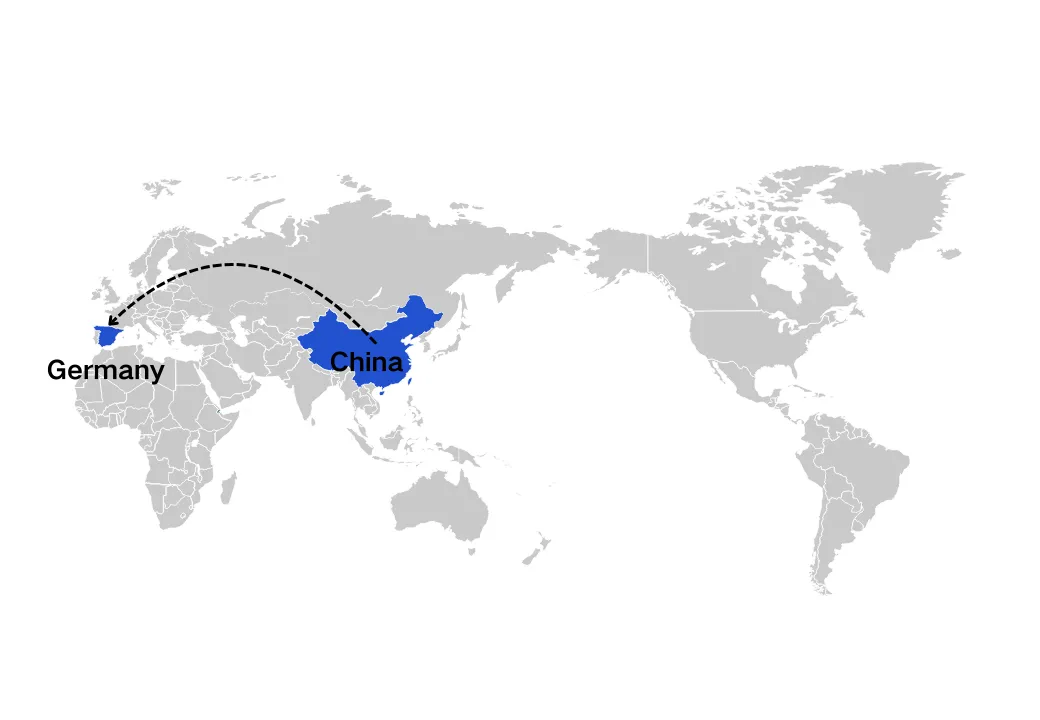
Are you seeking the most efficient and reliable solutions for shipping from China to Germany? Germany is China's largest trading partner in Europe — and in 2025 China regained its position as Germany's No. 1 trading partner overall, with bilateral trade reaching €251 billion. That trade keeps flowing through a supply chain that is vital but complex, shaped by the Red Sea crisis (2024–2026), strict German Customs (Zoll) compliance, and the EU's newest import rules.
Whether you are an Amazon FBA seller needing DDP services or a B2B importer sourcing machinery, AllBestShipping offers a full spectrum of logistics options. From the cost-effective Sea Freight to Hamburg, the rapid Rail Freight to Duisburg, to urgent Air Cargo to Frankfurt, we ensure your goods arrive safely and on budget. Compare all European destinations in our Shipping From China to Europe hub.
Sea Freight from China to Germany
Sea freight is the most economical way to ship goods from China to Germany, handling over 90% of total cargo volume. It is ideal for bulk shipments where time is less critical than cost. Because most Asia–Europe services still divert around the Cape of Good Hope, expect roughly 35–50 days door-to-door in 2026 (see the transit table below).
FCL vs. LCL: Which Should You Choose?
FCL (Full Container Load): You book the entire container (20' or 40').
- Best for: Shipments > 15 CBM or when you need better security/less handling.
- Key Advantage: Faster clearing (no deconsolidation needed) and lower per-unit cost for large volumes.
LCL (Less than Container Load): You share container space with other importers.
- Best for: Small shipments (1 - 15 CBM).
- Key Advantage: Pay only for the space you use (per CBM).
Major German Ports
- Hamburg (DEHAM): "Germany's Gateway to the World," handling the majority of Asian imports. Best for distribution to Northern/Central Germany and Eastern Europe.
- Bremerhaven (DEBRV): A crucial hub for automotive and high-heavy cargo.
- Wilhelmshaven (DEWVN): Germany's only deep-water port, accessible by the largest container ships even at low tide.
Air Freight from China to Germany
When speed is non-negotiable, air freight is the solution. Direct flights take as little as 1–2 days, and door-to-door air freight typically connects China's manufacturing hubs to Germany's industrial centers in 3–7 days — unchanged by the Red Sea situation.
Standard Air Freight vs. Express Courier
| Feature | Standard Air Freight | Express (DHL/UPS/FedEx) |
|---|---|---|
| Weight | Best for > 100 kg | Best for < 100 kg |
| Service | Airport-to-Airport (mostly) | Door-to-Door |
| Clearance | You/Agent must handle | Courier handles (usually) |
| Key Hubs | Frankfurt (FRA), Munich (MUC) | Leipzig (LEJ) (DHL Hub), Cologne (CGN) |
Understanding "Chargeable Weight"
Air freight isn't just charged by dead weight. Airlines use the greater of actual weight or volumetric weight.
- Formula: Length (cm) x Width (cm) x Height (cm) / 6000
- Example: A large box of cotton might weigh 10kg but occupy volume equivalent to 20kg. You pay for 20kg.
Pro Tip: For shipments between 100kg-500kg, ask AllBestShipping to compare "Express" vs. "Air Freight" rates. Sometimes, Express spot rates can be surprisingly competitive with zero customs hassle.
Rail Freight from China to Germany
Germany is the heart of the China-Europe Railway Express, serving as the primary distribution hub for the entire continent. For German importers, rail freight is not just an alternative; it is a strategic "third option" that balances speed and budget perfectly — and it keeps growing: China–Europe freight train services posted a strong start to 2026, with 5,460 trips and over 546,000 TEUs in Q1 2026 alone.
The "Duisburg Connection"
Duisburg is Europe's largest inland port and the undisputed gateway for China–Europe rail freight: over 30% of all China–Europe rail traffic flows through this city in Germany's Ruhr region.
- Duisburg: The main hub. Ideal for distribution to the Ruhr region (industrial heartland) and Western Europe.
- Hamburg: A secondary rail hub, often used for cargo that might need to be transloaded to feeder ships for Scandinavia.
Rail Freight Services: FCL & LCL
Just like sea freight, you don't need to fill a whole train container.
- Rail LCL (Consolidation): AllBestShipping consolidates cargo from smaller sellers in our Yiwu or Shenzhen warehouses into a shared 40HQ container. You only pay for the CBM you use.
- Rail FCL: Dedicated 40' containers for larger shipments.
Rail vs. Sea vs. Air: The "Golden Mean"
| Feature | Rail Freight | Sea Freight | Air Freight |
|---|---|---|---|
| Transit Time | 18 - 25 Days (Door-to-Door) | 35 - 50 Days (via Africa) | 3 - 7 Days |
| Cost | Moderate (~25% of Air) | Low | High |
| Stability | High (Fixed Schedule) | Variable (Congestion/Weather) | High |
| Carbon Footprint | Low | Lowest | Very High |
2026 Route Update: The primary route (Northern Corridor) passes through Russia and Belarus and remains operational for most non-sanctioned cargo. However, for sensitive goods or strict internal compliance policies, AllBestShipping can route via the "Middle Corridor" (Kazakhstan – Caspian Sea – Azerbaijan – Turkey), which adds roughly 7–10 days but avoids Russian transit entirely.
DDP & Door-to-Door Shipping from China to Germany
German customs (Zoll) are known for their strictness. Incorrect paperwork can lead to your goods being stuck in Hamburg for weeks. DDP (Delivered Duty Paid) is the solution that removes this risk entirely — part of our door-to-door shipping service line.
How AllBestShipping's DDP Service Works
In this model, we take full responsibility from the factory floor in China to your door in Germany.
All-Inclusive Price: Our quote includes Freight + Customs Clearance + Import Duty + 19% VAT (MwSt). No hidden fees upon arrival.
No EORI Required: You don't need to be a registered importer in the EU. We act as the importer of record.
Final Delivery: We use local partners (DHL/UPS or local trucks) to deliver to:
- Private Warehouses
- Office Addresses
- Amazon FBA Centers (e.g., DTM2 in Dortmund, LEJ1 in Leipzig).
New EU rules (from 1 July 2026): The EU has removed the long-standing €150 customs duty exemption for low-value imports. Small consignments valued at or below €150 now attract a flat €3 customs duty per item — a temporary measure that runs until the EU Customs Data Hub is fully operational in 2028. VAT (19% in Germany) continues to apply as before. With DDP, all duties and taxes are included in one transparent price, so your consignee never faces surprise fees at the border.
Main shipping routes from China to Germany
Germany is the logistics heart of Europe, offering unique connectivity options that other countries lack—specifically the direct Rail Freight connection.
1. The "Iron Silk Road" (Rail Freight)
Germany is the primary terminus of the China-Europe Railway Express.
- Route: Chongqing/Xi'an/Yiwu → Kazakhstan → Russia → Poland → Duisburg/Hamburg.
- Key Hub: Duisburg. The world's largest inland port, receiving dozens of trains from China weekly — over 30% of all China–Europe rail traffic calls here.
- Why Choose Rail? It is roughly 50% faster than sea freight (18–25 days vs. 40+ days) and about 60% cheaper than air freight.
2. The Maritime Route (Sea Freight)
- Standard Route: South China Sea → Malacca Strait → Suez Canal → Mediterranean → North Sea → Hamburg.
- Red Sea Adjustment (2024–2026, ongoing): Due to Houthi attacks, most Asia–Europe ships still detour around the Cape of Good Hope (Africa), adding ~3,500 nautical miles and 10–14 days to the transit time. A large-scale return to the Suez Canal is considered unlikely during 2026 while security conditions in the region remain uncertain.
3. The Air Corridor
- Direct Flights: From Beijing (PEK), Shanghai (PVG), Shenzhen (SZX) to Frankfurt (FRA) and Munich (MUC).
- Cargo Hubs: Frankfurt is Europe's busiest cargo airport, ensuring high frequency and capacity.
Shipping Costs from China to Germany (2026 Estimates)
Freight rates are volatile, influenced by fuel prices, geopolitical risk (Red Sea diversions, Strait of Hormuz tensions) and seasonal demand (e.g., Chinese New Year, Q4 Peak). Below are estimated all-in averages for 2026 — always confirm live rates with our team.
| Mode | Unit | Est. Cost (USD) | Notes |
|---|---|---|---|
| Sea FCL | 20' Container | $1,800 - $3,000 | Rates to Hamburg/Bremerhaven. |
| Sea FCL | 40' HQ Container | $2,800 - $4,500 | Best value per CBM for bulk goods. |
| Sea LCL | Per CBM | $60 - $120 | Includes destination port handling charges. |
| Rail FCL | 40' Container | $6,500 - $8,500 | Stable pricing, less affected by fuel surcharges. |
| Air Freight | Per Kg (>100kg) | $4.50 - $8.00 | Rates vary by airline (Lufthansa, Air China). |
| Air Freight | Per Kg (<100kg) | $6.00 - $12.00 | Express couriers are often competitive here. |
Warning: These are "Port-to-Port" or "Airport-to-Airport" estimates. For a full Door-to-Door quote including German customs and inland trucking, contact AllBestShipping. For a deeper cost breakdown by cargo type, read our guide on how much it costs to ship from China to Germany.
How Long Does Shipping Take from China to Germany?
The Red Sea crisis, now in its third year (2024–2026), still forces most Asia–Europe vessels to detour around Africa, so sea freight takes longer than it did pre-2024. Rail and air are unaffected.
| Shipping Mode | Standard Transit Time | Current Est. (Red Sea Impact) | Best For |
|---|---|---|---|
| Sea Freight (FCL) | 30 - 35 Days | 40 - 50 Days | Planned stock replenishment. |
| Sea Freight (LCL) | 35 - 45 Days | 45 - 60 Days | Small shipments (consolidation adds time). |
| Rail Freight | 16 - 20 Days | 18 - 24 Days | The "Sweet Spot" for Germany (Duisburg/Hamburg). |
| Air Freight | 3 - 7 Days | 3 - 7 Days (Unchanged) | Urgent inventory, samples. |
| Express | 1 - 4 Days | 1 - 4 Days (Unchanged) | Documents, very small parcels. |
Strategic Insight: Because Germany is the rail hub of Europe, Rail Freight is currently the most strategic option for importers who find Air Freight too expensive but Sea Freight too slow. For a detailed, mode-by-mode breakdown, see our post on how long it takes to ship from China to Germany.
German Customs Clearance & Import Duties
Importing into Germany means complying with strict EU and German (Zoll) regulations. The good news: an experienced forwarder handles nearly all of it for you.
1. Key Import Taxes
- Import Duty: Varies by HS Code (0% - 17%).
- VAT (Einfuhrumsatzsteuer): 19% standard rate (7% for books/food). This is calculated on the CIF Value + Duty.
- Low-Value Parcels (new): Since 1 July 2026, consignments up to €150 no longer qualify for the old duty exemption — a flat €3 customs duty per item applies until the EU Customs Data Hub launches in 2028.
2. Essential Documents & Compliance
To avoid delays at Hamburg or Frankfurt, ensure you have:
- EORI Number: Mandatory for customs clearance (unless you ship DDP and we act as importer of record).
- Commercial Invoice & Packing List: Must be accurate.
- German Translation: Sometimes required for product descriptions.
- CE Marking: Mandatory for electronics/toys sold in the EU.
- EU Responsible Person (GPSR): Under the EU's General Product Safety Regulation, in force since December 2024, most consumer products need an EU-based responsible person — a key compliance point for Amazon sellers.
- ICS2 Entry Summary Declaration (ENS): Under the EU's Import Control System 2, pre-arrival cargo data must be filed for sea (fully enforced since June 2026), air, road and rail shipments. Your forwarder files this automatically.
- LUCID Packaging Registration (VerpackG): Businesses placing packaged goods on the German market must register in the LUCID packaging register — worth setting up before your first shipment.
Step-by-Step Shipping Process
- Inquiry: Send cargo details to AllBestShipping.
- Quotation: We offer Sea/Air/Rail options.
- Booking & Pickup: We contact your Chinese supplier.
- Export Customs: We handle Chinese export declaration.
- Transit: Goods move via Ship/Train/Plane.
- Import Clearance: You (or we, under DDP) handle Zoll procedures — including the new ICS2 pre-arrival filings.
- Delivery: Goods arrive at your German warehouse.
One-Stop Shipping Solutions for Alibaba, 1688 & Taobao Buyers
Buying from multiple suppliers? AllBestShipping simplifies it:
- Consolidation: We collect goods from Supplier A, B, and C into one shipment.
- Quality Check: We inspect for damage before shipping.
- Repacking: We reduce volume to save shipping costs.
- Single Clearance: One invoice means one customs entry fee.
- FBA-Ready: We prep and deliver straight to German fulfillment centers (DTM2, LEJ1, WRO5) — see our Amazon FBA shipping service for details.
For a detailed quote or a customized shipping solution for Germany, feel free to contact us at any time.