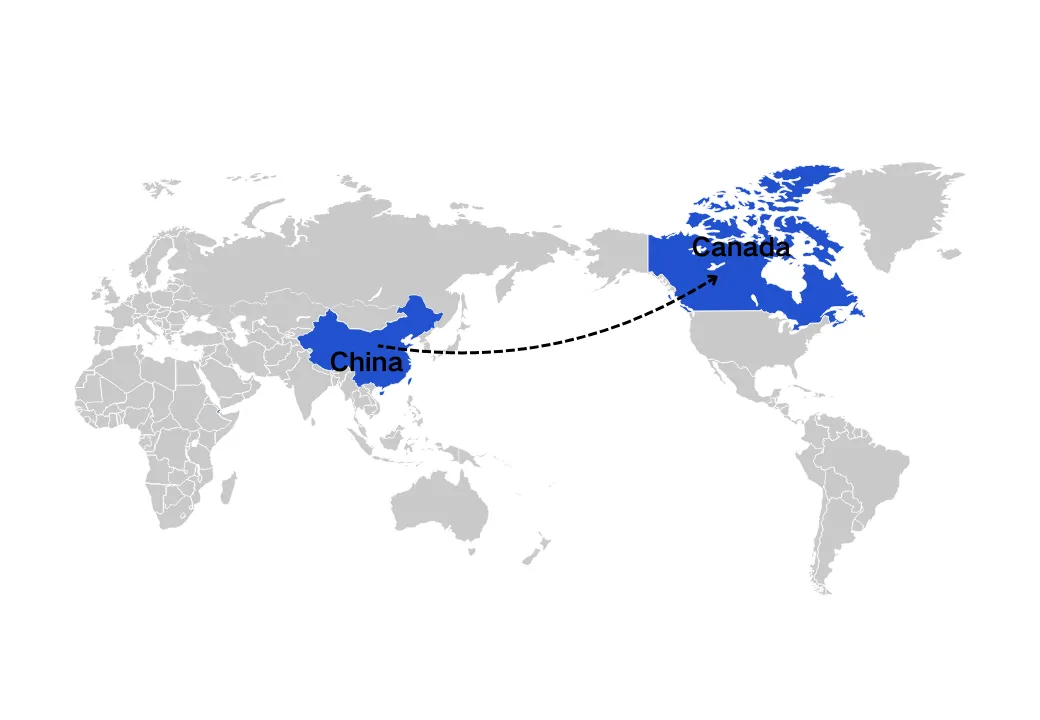
Shipping from China to Canada has changed materially in 2026. Canada repealed its 100% surtax on Chinese electric vehicles, CBSA switched on financial security monitoring inside CARM, a brand-new 25% surtax now covers listed steel derivative goods, and trans-Pacific freight pricing has climbed well above its spring lows. Understanding all four is what separates a clean 20-day delivery from a container sitting on the dock at Vancouver.
As a professional China-to-Canada freight forwarder based in Shenzhen, AllBestShipping manages the whole chain — booking out of Chinese ports, ACI eManifest filing, CBSA clearance through the CARM Client Portal, duty and GST/HST handling, and final delivery to warehouses and Amazon.ca fulfillment centers in Toronto, Vancouver, Montreal and Calgary. Last updated: September 2026.
What Has Changed on the China–Canada Lane in 2026
Before the rate tables, here are the developments that most affect your landed cost and your clearance risk right now.
1. CARM is now enforced, not transitioned
Since May 20, 2025, every commercial importer that wants release prior to payment of duties must post its own financial security in the CARM Client Portal — your broker's bond no longer covers you. Security levels were re-based at the January 15, 2026 deadline, and on June 17, 2026 CBSA activated Financial Security Monitoring: when your posted security no longer covers your duty and tax exposure, CBSA issues a notice and can suspend release privileges. If you have not topped up your RPP security this year, it is the single most likely cause of a surprise hold on your next shipment.
2. The 100% EV surtax is gone — replaced by a quota at 6.1%
Effective March 1, 2026, Canada repealed Section 3 and Schedule 1 of the China Surtax Order (2024), ending the 100% surtax on Chinese-origin electric and hybrid vehicles. Qualifying EVs now enter at the standard 6.1% MFN rate inside a 49,000-unit annual quota, and importers can adjust earlier Commercial Accounting Declarations to claim refunds on surtax already paid. If vehicles are part of your mix, our guide to the 2026 EV quota and CMVSS compliance covers the licensing side.
3. Steel and aluminum surtaxes are still in force
The 25% surtax on steel and aluminum goods produced in China (China Surtax Order 2024, effective October 22, 2024) remains in place, and since July 31, 2025 it also captures goods made with Chinese melt-and-pour steel or smelt-and-cast aluminum content. Remission exists for genuine short-supply situations, but it is granted line by line by HS tariff item — never by product category.
4. New since December 26, 2025: the steel derivative surtax
Canada now applies 25% on the full value of listed steel derivative goods, at the HS-code level and regardless of country of origin. The list reaches far beyond obvious steel: fasteners and screws, wire and chain products, fabricated structures, metal furniture frames and parts, and prefabricated buildings. Importers of furniture, hardware and DIY lines who assumed "I don't ship steel" are exactly who this measure catches. Ask us for a free HS-code screen before you book.
5. Freight rates are firm into Q4 — and peak season is running
Trans-Pacific pricing has climbed through 2026. Drewry's World Container Index stood at roughly $4,470 per 40ft container in early September 2026, with Shanghai–Los Angeles at $6,818 and Shanghai–New York at $9,333 per FEU in late August — a firm market that lifts China–Canada rates with it. Carriers typically add 15–25% between August and October, and air cargo out of Greater China has been holding near $6.00–$6.45 per kg into North America. If your cargo is not yet ready, book three to four weeks ahead to hold the rate you were quoted.
6. Gateway capacity is improving — rail is the chokepoint
Container dwell times at Deltaport and Centerm have returned to roughly pre-pandemic norms in 2026, but the rail leg from the Lower Mainland to the Prairies is the constraint to watch in Q4. Two structural upgrades are under way: the Vancouver Fraser Port Authority selected its construction partner for Roberts Bank Terminal 2 (up to 50% more container capacity) in July 2026, and Prince Rupert opened the $750-million CANXPORT transloading hub in August 2026. West Coast labour talks are expected later in 2026, which is why we build a two-week buffer into Q4 sailings.
7. Amazon.ca sellers: FBA fees now carry a 3.5% surcharge
Since April 17, 2026, Amazon applies a 3.5% fuel and logistics-related surcharge to FBA fulfillment fees in Canada and the US. It does not change your freight rate, but it does change your landed-cost model — build it in before you compare FBA prep plus DDP quotes.
Sea Freight from China to Canada
Sea freight is the dominant mode of transport for importers shipping from China to Canada, accounting for over 90% of cargo volume. It offers the lowest cost per unit, making it the primary choice for shipments larger than 2 CBM (Cubic Meters) or heavier than 500 kg.
Transit Time Snapshot:
- West Coast (Vancouver/Prince Rupert): 14–18 days port-to-port (22–32 days door-to-door)
- East Coast (Toronto/Montreal): 26–35 days port-to-port (36–50 days door-to-door)
FCL vs. LCL: Which is Right for You?
Choosing between Full Container Load (FCL) and Less than Container Load (LCL) depends on your cargo volume.
| Feature | FCL (Full Container Load) | LCL (Less than Container Load) |
|---|---|---|
| Best For | High volume (15+ CBM). | Low volume (1–15 CBM). |
| Cost | Flat rate per container (Lower cost per unit). | Charged per CBM (Higher cost per unit). |
| Speed | Faster (Direct loading/unloading). | Slower (+5–7 days for consolidation/deconsolidation). |
| Security | High (Container sealed at origin). | Moderate (More handling risk). |
Logistics Pro Tip: If your shipment is around 12-15 CBM, compare the cost of a 20GP container vs. LCL. Often, booking a full 20GP is cheaper and safer than paying for 15 CBM of LCL cargo due to destination handling charges. Heavy, dense cargo (stone, tile, solid-wood furniture) frequently has to ship in a 20GP anyway, because Canadian rail and road weight limits make a loaded 40ft container overweight.
Major Ports & Routes
Ports of Loading in China: Shanghai, Ningbo, Shenzhen (Yantian/Shekou), Qingdao, Guangzhou (Nansha).
Ports of Discharge in Canada:
- Vancouver (YVR): The busiest gateway. Ideal for goods destined for Western Canada or urgent rail connections to Toronto. Terminal dwell times have normalized in 2026, though the Prairie rail leg remains the main variable.
- Prince Rupert: A strategic alternative to Vancouver with faster rail service to Eastern Canada and the US Midwest. The new CANXPORT transloading hub (opened August 2026) adds rail-to-container capacity at the port.
- Montreal & Toronto: Accessed via rail from the West Coast or by all-water routes via the Panama Canal (slower, but sometimes cheaper for Quebec and the Maritimes).
Sea Freight Transit Times (Port-to-Port)
| Origin Port (China) | Vancouver (Days) | Toronto (Days)* | Montreal (Days)* |
|---|---|---|---|
| Shanghai | 14–18 | 26–31 | 28–33 |
| Shenzhen | 16–21 | 28–34 | 30–36 |
| Ningbo | 15–19 | 27–32 | 29–35 |
| Qingdao | 18–23 | 29–35 | 31–38 |
*Note: Transit to Toronto and Montreal typically involves a 10–14 day rail leg from Vancouver or Prince Rupert. Winter weather and Prairie rail congestion can add 3–7 days.
Current Market Insights (September 2026)
As of September 2026, sea freight rates from China to Canada are firm to rising as the August–October peak season meets a stronger trans-Pacific market.
- Rate Trend: Base ocean rates are up sharply versus the spring trough; Drewry's composite index was near $4,470 per 40ft in early September, and carriers have pushed GRI and peak-season surcharges through the summer.
- Space: Q4 sailings out of Yantian, Ningbo and Shanghai are filling earlier than usual. AllBestShipping recommends booking at least 3–4 weeks in advance to secure space and hold rates before the Golden Week (October 1–7) cut-offs.
Air Freight from China to Canada
Air freight is the solution for time-sensitive, high-value, or perishable goods. While significantly more expensive than sea freight, it reduces transit time from weeks to days.
Best For: Electronics, fashion samples, urgent inventory replenishment, and goods < 300 kg.
Standard Air Freight vs. Express Courier
| Feature | Standard Air Freight | Express Courier (DHL/FedEx/UPS) |
|---|---|---|
| Weight | Ideal for > 100 kg. | Ideal for < 100 kg. |
| Transit Time | 3–6 Days. | 2–5 Days. |
| Delivery | Airport-to-Airport (usually). | Door-to-Door. |
| Customs | Requires a Customs Broker. | Included (usually simplified). |
Air Freight Transit Times
| Route (China to Canada) | Transit Time (Direct) | Transit Time (Connecting) |
|---|---|---|
| Shanghai (PVG) ➔ Vancouver (YVR) | 10–12 Hours | 2–3 Days |
| Hong Kong (HKG) ➔ Toronto (YYZ) | 14–16 Hours | 3–5 Days |
| Beijing (PEK) ➔ Montreal (YUL) | 13–15 Hours | 3–5 Days |
| Shenzhen (SZX) ➔ Toronto (YYZ) | N/A (Direct Rare) | 3–5 Days |
Air Freight Cost Factors (September 2026)
Air freight rates fluctuate weekly with fuel surcharges and available capacity. Air cargo out of Greater China into North America has been trading around $6.00–$6.45 per kg in recent weeks, and Canada-bound general cargo follows that benchmark with a premium for smaller weight breaks.
| Chargeable Weight | Indicative Rate (Airport-to-Airport) | Typical Cargo |
|---|---|---|
| 45–100 kg | $8.50–$12.00/kg | Samples, prototypes, urgent components. |
| 100–300 kg | $7.00–$10.00/kg | E-commerce replenishment, accessories. |
| 300–500 kg | $6.00–$8.50/kg | Standard commercial air shipments. |
| 500–1,000 kg | $5.50–$8.00/kg | Larger or recurring inventory movements. |
| 1,000 kg+ | Route-specific quotation | Dense, high-volume, recurring cargo. |
- Chargeable Weight: Airlines charge on the greater of Actual Weight or Volumetric Weight (Length x Width x Height cm ÷ 6000 for air freight, ÷ 5000 for express).
- Restricted cargo: Lithium batteries, liquids, powders, magnets and other dangerous goods need UN38.3 test reports, MSDS documentation and carrier approval before booking — allow an extra 2–4 days.
AllBestShipping Advantage: We hold block space agreements with major airlines (Air Canada, Cathay Pacific, China Southern), so your cargo flies even during the Q4 peak when general space is tight — and we quote both airport-to-airport and door-to-door so you can see exactly what the last mile costs.
DDP & Door-to-Door Shipping from China to Canada
For many importers, especially Amazon FBA sellers and small businesses, DDP (Delivered Duty Paid) is the ultimate "peace of mind" solution.
What is DDP Shipping?
Under DDP terms, AllBestShipping takes responsibility for the shipment from the supplier's warehouse in China to your door in Canada. We handle:
- Pickup & Export: From the factory in Shenzhen, Yiwu, or anywhere in China.
- International Freight: Sea or Air transport.
- Customs Clearance: We act as the importer of record (or work with your broker).
- Duty & Tax Payment: We calculate and pay the Canadian taxes (GST/PST/HST) on your behalf.
- Final Delivery: To your warehouse, office, or Amazon FBA center (YYZ4, YVR2, YOW1 and other nodes).
Two things DDP does not do: it does not remove the fact that surtaxes are assessed on the importer of record — the declared value, HS code and origin data still have to be right — and it does not remove your CARM obligations if you are the importer on paper. A DDP quote is only as clean as the classification behind it.
Warning for New Importers: Canada has a unique sales tax system. Commercial importers pay GST (5%) at the border on the duty-paid value, while provincial tax (up to 15% HST; 14% in Nova Scotia since April 1, 2025) is normally accounted for in your domestic filings. Many DDP quotes include GST but exclude a final provincial settlement — ask which one you are buying.
Door-to-Door Process (Sea/Air)
- Pickup: We collect goods from your supplier.
- Consolidation: If you have multiple suppliers, we combine cargo at our warehouse to save costs.
- Freight: Goods ship via Sea (Vancouver/Prince Rupert) or Air (Vancouver/Toronto).
- Clearance: Goods clear CBSA (Canada Border Services Agency), with duties and GST accounted for through CARM, before final delivery.
- Delivery: UPS/FedEx (for small cartons) or Truck (for pallets) delivers to your door — including appointment-based delivery into Amazon FBA Canada fulfillment centers.
DDP vs. DDU: Which One Should You Choose?
| Factor | DDP (Delivered Duty Paid) | DDU/DAP (Duty Unpaid) |
|---|---|---|
| Duty & GST | Included in your upfront quote. | Billed to you after arrival. |
| CARM / RPP | Handled by the forwarder using its own security. | Your own CARM account and RPP security must be in place. |
| Best For | Amazon FBA sellers, new importers, fixed-budget buying. | Established importers who reclaim input tax credits and control their broker. |
| Cost Transparency | One all-in number, less cash-flow surprise. | Lower freight line, more variables at the border. |
Main shipping routes from China to Canada
Understanding the geography of Canada's logistics is key to optimizing your supply chain. There are three primary corridors for moving goods from China to Canada — plus one hybrid that more importers are using in 2026.
1. The Pacific Gateway (Vancouver & Prince Rupert)
- Route: China Ports ➔ Vancouver (YVR) or Prince Rupert.
- Characteristics: This is the fastest and most popular route.
- Inland Connection: Cargo destined for Toronto, Montreal, or the US Midwest is offloaded here and moved via CN Rail or CPKC Rail.
- Prince Rupert Advantage: Located further north, it is closer to Asia (saving 2-3 days sailing time) and bypasses Vancouver's congestion. It connects exclusively to CN Rail for rapid service to Eastern Canada; the new CANXPORT facility adds export transloading capacity alongside the existing import flow.
2. The All-Water Route (East Coast via Panama)
- Route: China Ports ➔ Panama Canal ➔ Halifax or Montreal.
- Characteristics: Slower but can be cost-effective for cargo destined strictly for the East Coast (Quebec and the Maritimes).
- Pros/Cons: Avoids West Coast rail risk, but transit time is long (30-45+ days) and canal-related surcharges apply.
3. Air Corridors
- Direct Hubs: Most direct flights land in Vancouver (YVR) or Toronto (YYZ), with Montreal (YUL), Calgary (YYC) and Edmonton (YEG) as secondary gateways.
- Transshipment: Cheaper air routes often transit via Korea (ICN), Taiwan (TPE), or the USA (LAX/ORD) before trucking to Canada — which adds a day, not a week, and keeps rates lower.
4. Sea-Air Hybrid (Busan / Incheon)
- Route: Ocean from China to Korea ➔ air freight from ICN to Canada.
- Characteristics: Roughly 12–18 days door-to-door at $2.50–$4.00/kg — meaningfully cheaper than air cargo and meaningfully faster than LCL ocean. It is the option most importers overlook when they are stuck between an expensive air quote and a five-week ocean wait.
Route Comparison Table
| Route Name | Entry Port | Destined For | Est. Transit (Sea) | Best For |
|---|---|---|---|---|
| Pacific South | Vancouver | BC, Alberta, Toronto | 14–18 Days | General Cargo, Speed. |
| Pacific North | Prince Rupert | Midwest, Toronto, Montreal | 12–16 Days | Fast Rail Connections to East. |
| All-Water | Halifax/Montreal | Quebec, Maritimes | 30–45 Days | Low Cost, Non-Urgent East Coast Cargo. |
| Sea-Air | Busan ➔ ICN | All major cities | 12–18 Days (door-to-door) | Urgent cargo under 2 CBM. |
AllBestShipping Strategy: For clients in Toronto or Montreal, we typically recommend routing via Prince Rupert or Vancouver followed by rail. This "Sea-Rail Intermodal" solution is weeks faster than the all-water route and only marginally more expensive — and when Prairie rail backs up (the main 2026 risk), we can quote a transload-and-truck alternative instead of letting your container sit.
Shipping Costs from China to Canada
Shipping costs are dynamic, fluctuating based on fuel prices, seasonal demand, and capacity. Below are estimated September 2026 market rates to help you budget. For the full landed-cost formula, see our guide to the cheapest way to ship from China to Canada.
Estimated Freight Rates (USD, September 2026)
| Mode | Destination (Canada) | Typical Cost Range | Notes |
|---|---|---|---|
| FCL 20' Container | Vancouver / Prince Rupert | $1,700 – $2,500 | Base ocean, port-to-port. |
| FCL 40' / 40HQ | Vancouver / Prince Rupert | $2,600 – $4,000 | Lowest cost per unit. |
| FCL 40' / 40HQ | Toronto (YYZ) | $5,200 – $7,500 | Includes rail haulage from the West Coast. |
| LCL (Shared) | Major Cities | $60 – $120 per CBM base; $110 – $190 all-in | Minimum 1 CBM charge applies. |
| Air Freight | Airport-to-Airport | $6.00 – $8.50 per kg | Rates drop above 500 kg. |
| Sea-Air Hybrid | Door-to-Door | $2.50 – $4.00 per kg | 12–18 days; urgent cargo under 2 CBM. |
| Express (Courier) | Door-to-Door | $12.00 – $18.00 per kg | Includes customs handling (excludes duties). |
Cost Warning: These are freight-only estimates. Your final "Landed Cost" must also include Canadian Customs Duties, GST (5%), destination terminal and rail charges, and — where applicable — the 25% steel and aluminum surtaxes described above. A "low" base rate on a surtaxed HS code is not a low landed cost.
What a Quote Usually Excludes
Two quotes for the same shipment can differ by 40% because they are not selling the same scope. Before you compare, check whether your quote includes:
- Origin charges: pickup, export documentation, terminal handling at the Chinese port (typically $300–$600 per container, more for LCL).
- Destination charges: terminal handling, rail or truck drayage, chassis, empty return (typically $400–$900 per container).
- Customs brokerage, duty and GST — separate line items, almost never inside a port-to-port rate.
- Overweight risk: Canadian rail and road weight limits can force a 20GP, a tri-axle chassis or a heavy-weight surcharge on dense cargo.
Hidden Costs to Watch
- GRI (General Rate Increase): Carriers often hike rates on the 1st and 15th of the month.
- Peak Season Surcharge (PSS) and BAF: Expect 15–25% uplifts between August and October and ahead of Chinese New Year; BAF/THC/PSS can add 25–40% on top of the advertised base rate.
- Drayage & Trucking: Moving a container from Vancouver Port to a local warehouse can cost $800+ depending on distance and waiting time; inland rail is billed separately from ocean freight.
- Demurrage & detention: If clearance documentation or your CARM security stalls release, storage starts accruing within days — the most avoidable cost on this lane.
How Long Does Shipping Take from China to Canada?
Time is money. Understanding the difference between Port-to-Port (transit on the water) and Door-to-Door (total lead time) is crucial for inventory planning. For a mode-by-mode planning breakdown, see our 2026 transit time guide.
Transit Time Breakdown
| Shipping Mode | Port-to-Port / Airport-to-Airport | Door-to-Door (Est.) |
|---|---|---|
| Sea Freight (West Coast) | 14 – 18 Days | 22 – 32 Days |
| Sea Freight (East Coast) | 26 – 35 Days | 36 – 50 Days |
| Standard Air Freight | 3 – 6 Days | 6 – 12 Days |
| Sea-Air Hybrid | N/A | 12 – 18 Days |
| Express Courier | N/A | 2 – 5 Days |
Key Factors Affecting Delivery
- Customs Inspections: Routine CBSA clearance takes 1–2 days on minimum documentation, but a flagged exam can add 5–15 days and trigger storage fees.
- CARM security status: If your RPP security is below your exposure, CBSA can withhold release until it is topped up — a purely administrative delay that costs a week.
- Rail Congestion: The Vancouver-to-Toronto rail leg is efficient but exposed to winter weather, Prairie capacity limits and labour action.
- Weather and peak season: Winter storms in the Pacific and snow in Canada slow berthing and trucking; August–October and pre-CNY periods add 5–10 days.
AllBestShipping Guarantee: We monitor every shipment 24/7. If a delay occurs (a port labour dispute, a rail backlog, a CBSA exam), we notify you immediately and propose alternative routing — transloading to truck instead of waiting for rail, or an air top-up for the portion of stock that cannot wait.
Canada Customs Clearance & Import Duties
Navigating Canada Border Services Agency (CBSA) requirements is the most critical part of importing. In 2026 the focus has shifted from "what is CARM?" to "is your CARM account actually in order?"
Critical Alert: CARM Financial Security Monitoring (June 17, 2026)
All commercial importers must register on the CARM Client Portal (CCP) — registration has been mandatory since May 2025, and the transition period is over.
- Release Prior to Payment (RPP): Since May 20, 2025, importers must post their own financial security (surety bond or cash deposit) in the CARM portal to release goods before paying duties and taxes. You can no longer rely solely on your broker's bond.
- 2026 enforcement: Security levels were re-based at the January 15, 2026 deadline, and CBSA activated Financial Security Monitoring on June 17, 2026. Importers whose security no longer covers their duty and tax exposure receive notices and risk suspended release privileges.
- Action Item: Confirm your posted security covers your 2026 import volume before your next vessel sails. If you have not registered, your goods will be held at the border. AllBestShipping walks clients through CCP registration and RPP set-up.
Import Duties & Taxes Breakdown
When your goods arrive, the following charges can stack on the same commercial invoice:
| Charge | Rate | Notes |
|---|---|---|
| Customs Duty (MFN) | By HS code (often 0–18%) | China is not covered by CUSMA, so standard MFN rates apply — no preferential treatment for Chinese-origin goods. |
| China steel & aluminum surtax | 25% of value for duty | China Surtax Order (2024); extended July 31, 2025 to goods with Chinese melt-and-pour / smelt-and-cast content. |
| Steel derivative surtax | 25% of the full value | New measure effective December 26, 2025 — global, HS-code based (fasteners, wire, structures, furniture frames, prefab buildings). |
| Anti-dumping / countervailing (SIMA) | Case by case | Actively applied to several Chinese product groups, including certain aluminum products and cookware. Always check the CBSA SIMA list. |
| GST | 5% | Levied on the duty-paid value (value of goods + duty + surtaxes). |
| Provincial tax (PST/HST) | 0% – 15% | Usually not collected at the border for commercial goods; accounted for in your domestic filings. Nova Scotia HST is 14% since April 1, 2025. |
- Avoid surprises: classification drives everything. A 25% surtax on the wrong HS code is a margin problem; the right code can be the difference between a viable product and a dead one. We screen every new SKU against current surtax and SIMA lists before confirming a quote.
- Low-value shipments: mail and courier imports from countries other than the US and Mexico remain duty- and tax-free only up to CAD $20. Above that, duties and taxes apply — the "small parcel loophole" is far narrower in Canada than most sellers assume.
Required Documents
- Commercial Invoice: Must be detailed (description, value, material, country of origin).
- Packing List: Accurate weight, dimensions, and piece count.
- Bill of Lading (B/L) or Air Waybill (AWB): The official transport document.
- Certificate of Origin: Required if claiming any tariff treatment; also your evidence of origin for surtax screening.
- ACI eManifest data: Filed electronically with CBSA before goods are loaded in China.
Step-by-Step Shipping Process
Follow this proven workflow to ensure a smooth shipment from China to Canada.
Phase 1: Pre-Shipment
Confirm Compliance: Before booking, check your CARM/RPP security level and screen your HS codes for surtaxes. This is the step that saves the most money in 2026.
Secure Your Quote: Contact AllBestShipping 3–4 weeks before production ends. Provide your Cargo Ready Date (CRD).
Select Incoterms: We recommend FOB (Free on Board) or EXW (Ex Works).
- Avoid CIF: It gives you zero control over costs and arrival timing.
Booking: We reserve space with the airline or shipping line (COSCO, OOCL, MSC, Air Canada).
Phase 2: Origin Handling (China)
Pickup & Consolidation: We collect goods from your supplier(s).
Export Clearance: We file the export declaration with Chinese Customs.
Loading: Goods are loaded onto the vessel or plane.
Phase 3: International Transit
Sailing/Flying: Track your shipment in real-time via our portal.
ACI eManifest Filing: We submit the ACI (Advance Commercial Information) data to CBSA before loading at the port of origin, to avoid penalties and loading refusals.
Phase 4: Arrival & Delivery (Canada)
Customs Release: Your broker submits the entry to CBSA. Duties, GST and any surtaxes are accounted for through CARM.
Final Delivery: Once released, we arrange the rail, truck or courier move to your warehouse or Amazon FBA center — including appointment scheduling against Amazon's receiving windows.
One-Stop Shipping Solutions for Alibaba, 1688 & Taobao Buyers
Are you sourcing from multiple suppliers on Alibaba, 1688, or Taobao? Shipping small parcels individually is expensive and chaotic.
AllBestShipping offers a specialized "Buy & Ship" Consolidation Service:
How It Works
Shop Anywhere: Buy from 5, 10, or 20 different suppliers.
Ship to Us: Use our Shenzhen or Yiwu Warehouse address as your delivery destination in China.
We Receive & Check:
- Inspection: We check for visible damage and quantity errors.
- Photos: We send you photos of the goods for confirmation.
Consolidate & Repack: We remove unnecessary bulky packaging (shoe boxes, extra padding) to reduce Volumetric Weight by up to 30% — which matters more than ever now that air rates are firm.
Ship Together: We combine everything into one shipment.
- Result: You pay one shipping fee and one customs clearance fee, saving hundreds of dollars compared to shipping individually.
Why Choose This Service?
- Free Warehousing: Store goods for up to 30 days for free while waiting for all orders to arrive.
- Quality Control: Catch wrong items before they leave China.
- Amazon FBA Prep: We label, palletize and ship directly to Amazon.ca fulfillment centers (YYZ4, YVR2, YOW1 and more) under DDP terms.
- Compliance Screening: We check HS codes against Canada's surtax and SIMA lists before your cargo is consolidated — no late surprises at the border.
Ready to price your next shipment against the September 2026 market? Send us your supplier list, product HS codes and delivery city, and AllBestShipping will come back with a landed-cost quote and a route recommendation within one business day. Last updated: September 2026.