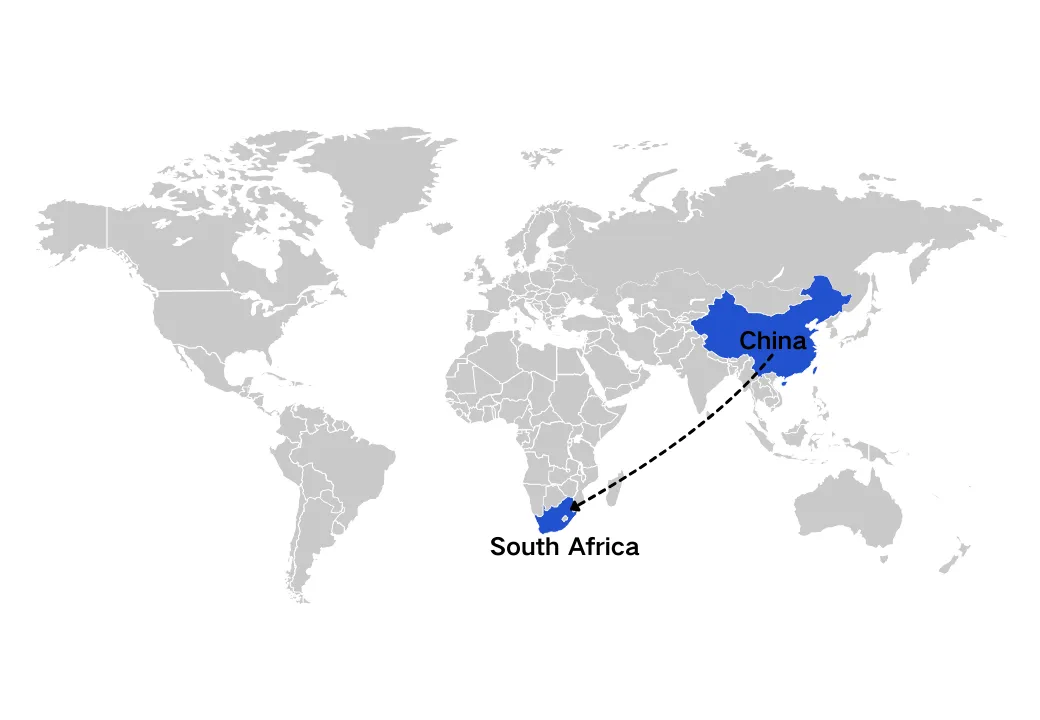
South Africa is China's largest trading partner in Africa, and the relationship keeps deepening: China supplied roughly 22% of everything South Africa imported in 2025. Whether you are a retailer restocking 40-foot containers of general merchandise into Gauteng or a startup flying electronics into O.R. Tambo (JNB), this is one of the steadiest trade corridors in the Southern Hemisphere.
2026, however, is a year of transition. A private operator now runs Durban's biggest container terminal, SARS has made migration to its new registration platform mandatory for every importer, port throughput is improving in bursts but still breaks down without warning, and cargo crime on the inland corridors remains a national logistics threat.
We work this lane every week. From navigating SARS "Red Lane" inspections to securing escorted transport up to Johannesburg, AllBestShipping is your boots-on-the-ground partner. This guide covers what shipping from China to South Africa actually looks like in 2026: current rate and transit benchmarks, the new compliance steps you cannot skip, and how to protect your margin when Durban slows down.
What Has Changed on the China to South Africa Lane in 2026
Before you book, here is the short list of 2026 developments that change how you should plan, price, and paper a shipment on this route.
- 1 January 2026 — New operator at Durban's Pier 2. Transnet signed a 25-year concession with International Container Terminal Services Inc. (ICTSI) in December 2025, and ICTSI took over day-to-day operations on 1 January 2026. The terminal, formerly Durban Container Terminal Pier 2, now trades as Durban Gateway Terminal. ICTSI has committed roughly R11 billion (about US$670 million) to lift capacity from 2 million to 2.8 million TEU. The terminal accounts for close to three-quarters of Durban's throughput and more than 40% of all container traffic in South Africa, so its performance sets the tone for the whole country.
- June 2026 — Durban named the world's most improved port. The World Bank's Container Port Performance Index (CPPI) for 2025 listed Durban as the biggest improver on the planet, with Coega (Ngqura) and Port Elizabeth also inside the top ten improvers. Berth utilisation in Durban rose from about 52% of vessel time in 2024 to roughly 76% in 2025, and the number of vessels waiting at anchor dropped from 20 to zero.
- 1 April 2026 — Port tariffs went up 7.57%. The Ports Regulator of South Africa approved a weighted average increase of 7.57% for the 2026/27 financial year, with container cargo dues rising about 7.8%. These charges sit at the destination end of your shipment, so they rarely appear in a headline ocean rate but always appear on your final invoice.
- Mid-August 2026 — A software migration knocked throughput. Durban Gateway Terminal cut over to its own Navis N4 terminal operating system, and weekly throughput fell about 26% in the weeks that followed. Industry associations reported vessels waiting around 166 hours at anchorage in early August (up from about 80 hours in July) plus roughly 116 hours alongside, with some carriers quoting waits of eight to 12 days. The operator has since run around-the-clock support, added temporary storage relief and a cargo-tracking platform, and is gradually restoring truck appointments. Expect the terminal to stabilise over the coming weeks rather than overnight — plan a buffer through late 2026.
- 2026 — Registration, Licensing and Accreditation (RLA) is now mandatory. SARS has been moving all Customs and Excise traders onto its new RLA platform, and has confirmed there are no automatic extensions. Importers, exporters, clearing agents and cargo reporters must migrate and update their customs code and entity details, or risk having that code suspended — which stops your cargo dead at the port.
- May to June 2026 — Steel import duties raised to 10–30%. The International Trade Administration Commission pushed duties on a wide range of upstream and downstream steel products up to the WTO bound rate, with a rebate facility on some lines. If your product contains steel, check the tariff line before you place the purchase order.
- April to May 2026 — Private trains enter the network. Eleven private train operating companies were granted access to Transnet's rail network, expected to add roughly 20 to 24 million tonnes of capacity. The Durban to Gauteng corridor is the first place this should show up — ask your forwarder whether your container can rail rather than truck.
- 2026 — Cargo crime stays at crisis levels. Around 420 trucks were hijacked in a single quarter, with R577 million in reported cargo losses, and thousands of cargo theft incidents recorded nationally. GPS jamming, fake blue lights, fraudulent collection instructions and overnight parking theft are the standard playbook. Security-escorted inland transport is now a normal line item, not a premium extra.
Sea Freight from China to South Africa
Sea freight carries the overwhelming majority of cargo on this lane and remains the only economical option for bulk shipments, heavy machinery, furniture, and textiles. South Africa's container imports run mostly through Durban, with Cape Town serving the Western Cape and Coega (Ngqura) feeding the Eastern Cape and acting as a pressure valve when Durban backs up.
FCL vs. LCL: Which Should You Choose?
| Feature | FCL (Full Container Load) | LCL (Less than Container Load) |
|---|---|---|
| Best For | Volume above 15 CBM | Small shipments (1–15 CBM) |
| Cost | Flat rate per container (lower cost per unit) | Charged per cubic meter (higher cost per unit) |
| Security | Sealed at origin, fewer handling points | Handled multiple times, higher risk of damage |
| Speed | Faster — direct loading and sailing | Slower — consolidation adds 6–10 days |
| Customs | One SAD 500 declaration for the whole box | Deconsolidation and splitting at destination |
Pro Tip: Durban is the busiest container port in sub-Saharan Africa and, since 1 January 2026, it is also a live test of private-sector terminal management. When Durban Gateway Terminal is running cleanly, a container moves from berth to Gauteng in three to five days. When it is not, a vessel can sit at anchor for a week. We monitor berth waiting time daily and, where the cargo allows, route via Coega (Ngqura) or the Maputo corridor through Mozambique to keep inland delivery predictable. Building an extra 7 to 14 days of float into your schedule is the single cheapest insurance policy on this lane.
Our ocean freight services cover FCL and LCL out of Yantian, Shekou, Nansha, Shanghai, Ningbo and Qingdao, with weekly sailings and consolidation options at both ends.
Major Ports in South Africa — 2026 Status
- Durban (DUR): The primary gateway, handling the large majority of container imports and the natural choice for Johannesburg, Pretoria and the wider Gauteng market. Two terminals matter: Pier 1 and the newly rebranded Durban Gateway Terminal (Pier 2). Performance is structurally improving but has been volatile since the August system migration.
- Cape Town (CPT): Serves the Western Cape and is heavy on reefer and agricultural traffic. The 2025 World Bank index flagged Cape Town as the one major South African port that deteriorated, driven by weather disruption and equipment reliability. The port has responded with a predictive wind model developed with the CSIR, a helicopter piloting service for high swells, and a digital cargo planning platform — but winter weather still drives variability.
- Coega / Ngqura (ZAZR): A deep-water port built for transshipment and bulk. It was among the world's most improved container ports in the latest index, with short average waiting times, though seasonal tidal restrictions can still slow operations. Excellent for Eastern Cape consignees and for avoiding Durban congestion.
- Port Elizabeth (PLZ): The smallest of the container gateways, with waiting times that have run higher than Coega's. Use it when your consignee is in the Eastern Cape and the schedule suits.
- Maputo (Mozambique): Increasingly credible for cargo destined to Limpopo, Mpumalanga and northern Gauteng. A new inland terminal at Komatipoort, about 100 km from the port, feeds cargo to Maputo by rail, and South Africa and Mozambique are formalising a transboundary economic zone along the corridor. Cross-border documentation and transit bonds are required — we handle them.
Our Africa freight network combines these gateways with inland trucking and rail options, so routing decisions are made on the day your vessel berths rather than months in advance.
Air Freight from China to South Africa
When your supply chain needs speed — electronics, fashion samples, spare parts, or a container that got stuck — air freight is the answer. In a congested-port year, air cargo also becomes the release valve that keeps retail shelves filled.
Key Airports
- O.R. Tambo International (JNB): The busiest cargo hub in Africa and the distribution heart of the SADC region. Most air imports clear here and move inland by road.
- Cape Town International (CPT): Best for consignees in the Western Cape; limited freighter capacity compared with JNB.
- King Shaka International (DUR): Serves KwaZulu-Natal and the Durban industrial belt.
Service Levels & Transit Times
| Service | Transit Time | Best For |
|---|---|---|
| Express courier (DHL/FedEx) | 3–5 days | Documents and parcels under 45 kg |
| Standard air cargo | 5–8 days | Commercial cargo above 100 kg |
| Deferred / consolidated air | 8–12 days | Cost-saving option for less urgent goods |
| Air DDP door-to-door | 7–12 days | Importers without a customs code or local entity |
Insider Insight: There are no meaningful direct freighter services between mainland China and South Africa. Reliable capacity moves through hub connections via the Gulf (Dubai, Doha), Addis Ababa, Hong Kong and Singapore. During peak season these hubs fill first, so block space booked two to three weeks ahead is what keeps your cargo off the roll-over list. In September 2026 the market benchmark for standard air cargo sat around US$6 per kilo, with express door-to-door services nearer US$13 per kilo — a gap worth planning around, because when Durban congests, air demand spikes and that gap widens.
DDP & Door-to-Door Shipping from China to South Africa
Navigating SARS regulations is the part most first-time importers underestimate, and 2026 added a registration hurdle on top. Our DDP (Delivered Duty Paid) service bundles collection, freight, customs clearance, duty, VAT and final delivery into one predictable price.
How DDP Works
- We pick up: from your supplier anywhere in China, or you deliver into our Shenzhen, Guangzhou or Yiwu warehouse.
- We ship: by sea to Durban, Cape Town or Coega, or by air to JNB/CPT.
- We clear: our South African partner — a registered importer on the SARS RLA platform — lodges the SAD 500 declaration and pays duty and VAT on your behalf.
- We deliver: to your door in Johannesburg, Cape Town, Durban or anywhere in the country, using vetted and, where required, escorted hauliers.
DDP vs. Traditional Shipping
- Traditional (CIF/FOB): you need your own customs client code, registered and migrated on SARS's RLA platform, plus a licensed clearing agent and a separate duty and VAT payment. More control, more administration.
- DDP: you do not need a South African customs code. The import registration sits with our partner, and you pay one flat rate per CBM or per kilo — quoted with duty and VAT already inside it.
What DDP Covers — and What It Does Not
An all-in rate is only useful if the boundaries are clear. Our DDP pricing includes freight, destination terminal charges, customs clearance, ordinary customs duty, 15% import VAT and delivery. It does not automatically absorb costs that arise from your product or your timing, so budget separately for the following:
- Anti-dumping duties. South Africa applies anti-dumping duties on several product categories from China — notably textiles, clothing, footwear, steel and poultry — which can add 20% to 60% on top of the standard rate. These are assessed case by case and quoted before dispatch, never silently absorbed.
- Permits and product approvals. ITAC import permits for controlled goods, and NRCS letters of authority for regulated electrical and automotive products.
- Terminal congestion costs. Storage, demurrage and detention charges that build up when a terminal cannot release cargo, plus any emergency congestion surcharges a carrier introduces.
- Special handling such as dangerous goods, temperature-controlled, or oversized cargo.
Perfect for: e-commerce sellers, small businesses, Alibaba and 1688 buyers, and first-time importers who want a landed cost they can put straight into a pricing spreadsheet.
Shipping Costs from China to South Africa in 2026
Rates on this lane move monthly, and sometimes by double digits. In May 2026 the 20GP market jumped 32% in a single month on equipment shortages, then eased back. The tables below are September 2026 market benchmarks on base port-to-port terms out of South China — useful for budgeting, useless as a quotation. Always confirm a fresh rate with a validity window before you commit.
Sea Freight Rates
| Container Type | Estimated Cost (USD) | Notes |
|---|---|---|
| 20ft FCL to Durban | $2,900 – $3,550 | Sept 2026 base rate; up about 12% on August |
| 40ft / 40HQ FCL to Durban | $3,400 – $4,150 | Best value per CBM — the 40HQ is the strategic buy in 2026 |
| LCL to Durban (per CBM) | $150 – $190 | Minimum 1 CBM; plus consolidation and destination charges |
| Cape Town / Coega surcharge | +$100 – $300 per container | Depends on sailing frequency and inland destination |
Air Freight Rates
| Weight Bracket | Estimated Cost (USD/kg) | Notes |
|---|---|---|
| +45 kg | $7.50 – $12.00 | Priority / small-lot pricing |
| +100 kg | $6.00 – $9.00 | Standard air cargo to JNB/CPT |
| +500 kg | $5.00 – $7.50 | Bulk air rates; Sept 2026 market benchmark near $6/kg |
| Express courier | $13.00 – $17.00 | Door-to-door, fully tracked, under 45 kg per piece |
DDP "All-In" Rates (Duty and VAT Included)
- Sea DDP: approximately $180 – $300 per CBM, depending on product category and duty rate.
- Air DDP: approximately $6.50 – $10.00 per kg, door-to-door.
If you want a worked example of how duty and VAT change the picture for specific commodities, our guide to the cost of shipping from China to South Africa breaks down landed cost line by line.
What Sits On Top of the Base Rate
Quotes on this lane can differ by 40% for the same container because forwarders include different buckets of charges. Here is what to ask about, and what we put in writing.
| Charge | Typical Level | Who Controls It |
|---|---|---|
| Origin THC and documentation | $150 – $350 per container | Chinese terminal and shipping line |
| BAF / fuel and low-sulphur surcharge | $80 – $250 per TEU | Shipping line, revised quarterly |
| PSS (peak season surcharge) | $200 – $500 per container | Shipping line, typically October to January |
| Destination THC and container cargo dues | About 7.8% higher than 2025/26 | Transnet NPA tariff increase effective 1 April 2026 |
| Port tariff (weighted average +7.57%) | Applies to port users, passed through | Ports Regulator of South Africa, 2026/27 year |
| Storage, demurrage and detention | Daily, escalating — the main congestion cost | Terminal and shipping line; the reason we buffer schedules |
| Inland trucking, rail and security escort | Quoted by lane and route risk | You and your forwarder jointly |
| Clearing agent and SAD 500 lodgement | Per shipment, plus disbursements | Licensed clearing agent |
| Customs duty, VAT, anti-dumping duty | Product specific; AD duties can add 20–60% | SARS, ITAC and the HS code you declare |
| Permits, NRCS letters of authority, inspection fees | Case by case | ITAC, NRCS and inspection bodies |
Ask two questions before you sign: (1) How long is this rate valid, and what triggers a re-quote? (2) If the terminal cannot release my container on schedule, who pays the storage and detention — you, me, or the line? On this lane in 2026, the answer to the second question is worth more than a $50 difference in the headline rate.
How Long Does Shipping Take from China to South Africa?
Port-to-port transit is predictable; terminal and weather disruption is not. The table below shows normal published transit times alongside what we are actually seeing under current conditions.
| Route | Normal Transit (sea) | Current 2026 Conditions |
|---|---|---|
| Shenzhen / Guangzhou to Durban | 22 – 28 days | Add 3–7 days while Durban Gateway Terminal stabilises |
| Shanghai / Ningbo to Durban | 24 – 30 days | Add 3–7 days in congestion windows |
| Any China port to Cape Town | 25 – 35 days | Add 2–6 days for weather-related berthing delays |
| Any China port to Coega / Port Elizabeth | 25 – 32 days | Generally the most stable of the three gateways |
| LCL (all destinations) | 28 – 40 days | Consolidation adds 6–10 days over FCL |
- Air freight: 3 – 8 days airport-to-airport; 7 – 12 days on an air DDP door-to-door service.
- Door-to-door totals: roughly 30 – 45 days by sea FCL, and 35 – 50 days by LCL once consolidation, clearance and inland delivery are included.
Our China to South Africa transit times guide goes port by port, including the LCL versus FCL difference for each origin.
Local factors to build into your schedule: the "Cape Doctor" south-easterly wind still shuts Cape Town operations for days at a time, and the terminal's new predictive wind model reduces but does not remove that risk. Durban congestion arrives in bursts, as it did in August 2026. Our standing advice on this lane is a 7 to 14 day buffer for sea freight, and a standing air option for your fastest-moving SKUs.
South Africa Customs Clearance & Import Duties
Importing into South Africa means complying with SARS, and in 2026 that starts before your cargo moves.
The 2026 Registration Change: RLA and Your Customs Code
SARS has been migrating all Customs and Excise traders from its legacy registration system to the new Registration, Licensing and Accreditation (RLA) platform, and the migration is now enforced. Every importer, exporter, clearing agent and cargo reporter must update their customs code and entity details on RLA. SARS has stated that no automatic extensions will be granted, and a customs code that has not been migrated can be suspended — which means your container cannot be declared when it lands.
If you import under your own name you need a customs client code (the number previously known as an importer's code), a South African income tax reference, and supporting entity documents. Foreign-owned importers who cannot register locally use our DDP service instead, where the registration sits with our South African partner.
Mandatory Documents and Approvals
- Customs client code — registered and migrated on SARS RLA.
- SAD 500 goods declaration — lodged electronically through SARS eFiling by a licensed clearing agent, ideally before the vessel arrives.
- Commercial invoice and packing list — must be accurate; SARS audits undervalued goods routinely.
- Bill of lading or air waybill.
- Certificate of origin — relevant for SADC, EU and UK preferential rates. There is no free trade agreement between China and South Africa, so Chinese-origin goods are assessed at MFN rates.
- ITAC import permit — required for controlled goods including second-hand items, certain chemicals, and specific steel and textile products.
- NRCS letter of authority — required for regulated electrical, electronic and automotive products.
- VAT registration — where your turnover or activity level brings you into the VAT system.
Our customs clearance team checks permit and approval requirements against your HS codes before the cargo leaves China, because permits cannot be obtained retrospectively once the SAD 500 has been lodged.
Duties & Taxes in 2026
Two calculations decide your SARS bill, and the base matters more than most importers realize:
- Customs duty = FOB customs value × duty rate. Freight and insurance are excluded from the duty base.
- Import VAT = Added Tax Value × 15%, where the Added Tax Value is (FOB value × 1.10) + duty payable. The 10% uplift does not apply to goods originating in the SACU countries.
| Product Category | Typical Duty Rate (2026) | Watch Out For |
|---|---|---|
| Electronics and IT equipment | 0% – 9% | NRCS letter of authority may be required |
| Industrial machinery | 0% | Generally the most favourable category |
| Clothing (HS 61 and 62) | 45% | Anti-dumping duties can apply on top |
| Footwear | 30% – 45% | High anti-dumping exposure from China |
| Steel and steel products | 10% – 30% | Raised in 2026; some lines carry rebates |
| Furniture | 20% – 30% | Bulky — sea freight only in practice |
| Toys and games | 15% – 30% | Safety compliance checks at clearance |
| Vehicles and parts | About 25% | Plus 15% VAT; ITAC permits for used vehicles |
| Cosmetics and personal care | 10% – 20% | NRCS compliance for certain categories |
Low-Value and E-Commerce Consignments
South Africa's de minimis threshold remains R500: consignments valued below that figure clear without duty, while anything above it goes through full clearance. Two caveats matter for online sellers. First, clothing imports attract 45% duty regardless of value, a rule that has applied since July 2024. Second, SARS has steadily increased enforcement on low-value e-commerce imports since 2024, so the old assumption that small parcels slip through is no longer reliable. If you consolidate many small supplier orders into one shipment, you are also consolidating them into one dutiable declaration — which is usually cheaper and always cleaner than five separate low-value parcels.
Warning: Under-invoicing is a serious offence in South Africa and SARS cross-checks declared values against market data and supplier records. A declaration that saves 10% on paper can cost you the entire consignment, plus penalties. AllBestShipping declares your goods accurately and documents the classification, so a "Red Lane" inspection ends with a release rather than a seizure.
Protecting Your Cargo on the South African Leg
Port performance gets the headlines, but the inland leg is where cargo actually disappears. Around 420 truck hijackings were reported in a single quarter, alongside R577 million in cargo losses and thousands of recorded theft incidents nationally. The methods are organized, not opportunistic: GPS jamming, vehicles fitted with fake blue lights, fraudulent collection instructions sent to hauliers, and theft from trucks parked overnight on the corridor between Durban and Gauteng.
Our standard practice on this lane:
- Vetted, vetted-again hauliers with route risk assessments per consignment.
- Sealed containers with documented seal numbers recorded at both ends.
- Live GPS tracking with independent backup, and escorted movement for high-value or high-risk loads.
- No overnight parking on the corridor; deliveries scheduled to arrive inside receiving windows.
- All-risk cargo insurance placed before the container leaves China, with the inland leg explicitly included.
Step-by-Step Shipping Process
- Classify and check permits. Confirm the HS code, the duty rate, whether anti-dumping duty applies, and whether an ITAC permit or NRCS approval is needed. Do this before you pay your supplier.
- Confirm your customs position. Either migrate your own customs code onto SARS RLA, or book a DDP shipment where the import registration sits with our local partner.
- Book two to four weeks ahead. Space and equipment — especially 40HQ — tighten quickly on this lane. Booking early also gives us time to secure block space on air routings.
- Collection and consolidation. We pick up from your supplier, or receive your Alibaba, 1688 and Taobao orders at our warehouses and consolidate them into one shipment.
- Export clearance and sailing. We handle Chinese export documentation and confirm the sailing, then lodge your SAD 500 pre-clearance with our South African agent ahead of arrival.
- SARS clearance and duty payment. Duty, VAT and any anti-dumping duty are assessed and paid, and the release is issued.
- Inland transport. Rail or truck from Durban, Cape Town or Coega — security-escorted where the risk profile calls for it.
- Delivery and proof of delivery. Final delivery to your warehouse or, for marketplace sellers, to the Amazon fulfilment centre, with photographic POD.
Amazon.co.za and E-Commerce Sellers
Amazon.co.za now runs its own Fulfilment by Amazon network inside South Africa, which means Chinese imports increasingly end at a local fulfilment centre instead of a store or a garage. That changes the paperwork: your shipment needs to arrive with ASN-compliant labelling, correct carton and pallet configuration, and a declaration that matches what Amazon receives. We prepare FBA shipments from China with the labelling and documentation the South African fulfilment centres expect, and we can deliver on a DDP basis for sellers who are not registered importers in their own right.
One-Stop Shipping Solutions for Alibaba, 1688 & Taobao Buyers
Sourcing small quantities from multiple suppliers is the fastest way to lose money on freight. Instead of shipping five small parcels five times, use our warehouse.
- Shop: buy from Alibaba, 1688 or Taobao.
- Ship to us: send everything to our Shenzhen, Guangzhou or Yiwu warehouse.
- Consolidate: we receive, check and repack everything into one shipment with one declaration.
- Save: consolidation typically cuts freight and clearance costs dramatically compared with separate consignments.
Quality check: we inspect your goods before they leave China. Returning defective products from South Africa to China is prohibitively expensive, so catching the problem in Shenzhen is the only economical option.
Conclusion: Importing from China to South Africa in 2026
Success on this lane now comes down to four things: terminal timing, customs registration, true landed cost and cargo security. The structural news is good — a private operator with R11 billion to spend is running Durban's busiest terminal, the port has climbed off the "worst in the world" list, and private trains are entering the network. The short-term news is messier: an August software migration at Durban Gateway Terminal cost a quarter of weekly throughput, and SARS is suspending customs codes that have not been migrated to RLA.
Key takeaways:
- Best value: a 40HQ to Durban, where the 40-foot rate has been far more stable than the 20GP rate in 2026.
- Fastest: air cargo to JNB, with DDP delivery in 7 – 12 days.
- Most urgent: migrate your customs code onto SARS RLA, or ship DDP and let our partner handle it.
- Most overlooked: anti-dumping duties on clothing, footwear and steel — check before you buy, not after.
- Partner: AllBestShipping runs the entire chain, from the factory gate in China to your warehouse in Gauteng or the Cape.
Ready to plan your next shipment? Send us your supplier list and HS codes and we will come back the same working day with routing options, a realistic transit window, and a landed-cost estimate in rands. Get a same-day quote and take the guesswork out of the 2026 South Africa lane.
Last updated: September 2026. Port, tariff and customs positions on this lane are moving quickly — we review this page as facts change.