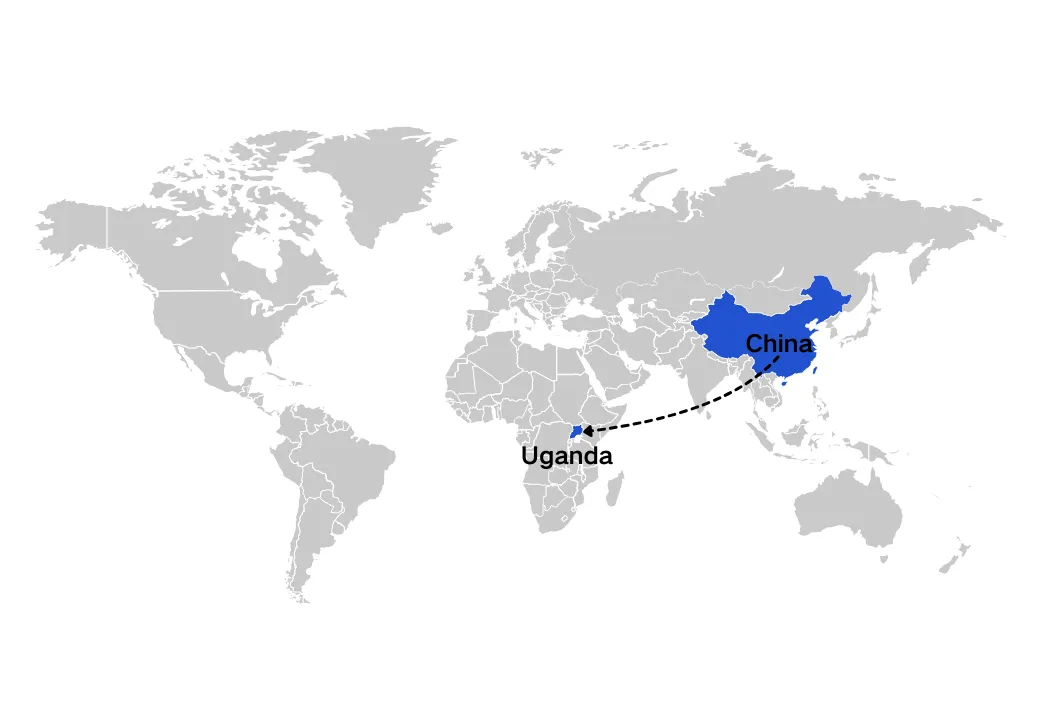
Shipping from China to Uganda in 2026 means moving your cargo through two systems at once: an ocean leg into Mombasa (or Dar es Salaam) and an inland leg that crosses at Malaba or Mutukula before it reaches Kampala. This guide is built from what we actually booked on the China–Uganda lane this year: current September 2026 rate ranges, transit times you can plan inventory around, the 2026 changes that moved the goalposts, and the URA cost stack you have to budget for before your container even leaves the Kenyan coast.
What Has Changed on the China–Uganda Lane in 2026
Uganda is landlocked, so the lane is only as good as its border and inland leg. Five things changed in 2025–2026 that affect your budget and your delivery date:
- Naivasha is now the transit clearing house (February 2026). Kenya Revenue Authority designated the Naivasha Inland Container Depot as the priority clearance hub for long-haul transit cargo bound for Uganda, Rwanda, the DRC and South Sudan, freeing Mombasa's yard for domestic and short-haul boxes. The depot is linked to Mombasa by standard gauge rail and onward by metre-gauge. Uganda has also been allocated land inside the Naivasha special economic zone for its own cargo station.
- The Naivasha–Malaba SGR is under construction, not open (March 2026). Kenya and Uganda broke ground on the roughly 369 km Naivasha–Kisumu–Malaba line, and the bilateral agreement commits both countries to complete the full Nairobi–Kampala link by 2028. Until then, containers still rail to Naivasha, then move by road (or metre-gauge) to the border. Treat any 2026 promise of “SGR all the way to Kampala” as marketing.
- Mombasa volumes hit a record, but vessel waits stayed manageable. The port handled 45.45 million tonnes of cargo in 2025, up from 40.99 million in 2024. In late August 2026 the seven-day average vessel waiting time was about 2.4 days, easing to roughly one day by early September. Budget 1–3 days of berthing plus 3–7 days of yard and clearance at destination.
- URA reinstated metallic cargo seals at Malaba (July 2026). After a spike in cargo theft during a period when the seals were suspended, URA required an additional metallic electronic seal on every truck at the border. Daily clearances at Malaba fell from roughly 1,500–1,600 trucks to about 750 and the queue stretched nearly 35 km before the backlog was worked off. The measure stayed in place. Plan on 1–3 days of border dwell in normal weeks and 5 days or more in peak weeks.
- The URA cost stack is now 2.5% before duty. Since 1 July 2025 the Import Declaration Fee is 1% of customs value and the infrastructure levy a further 1.5% — 2.5% payable upfront on goods declared for home use. Transit and re-export cargo is not subject to it.
- Two FY2026/27 changes hit specific product lines. Medical supplies are now exempt from the infrastructure levy, while the environmental levy on imported used clothing (mivumba) doubled from 15% to 30% of CIF value — a hard change for Kampala's second-hand garment trade.
- PVoC coverage widened on 1 January 2026. UNBS published 57 changes to its schedule of compulsory standards through Legal Notice No. 14 of 2025 — 30 newly established standards and 27 amendments. Every product under a newly declared standard must now pass pre-export verification of conformity before shipment, and UNBS has also tightened what can be amended on an already-issued Certificate of Conformity.
- EFRIS reached another 12 sectors (effective 1 July 2025). Manufacturing, construction, transport and storage, ICT and others must now issue e-invoices and e-receipts, and an expense without an e-invoice from a supplier required to use EFRIS is not deductible.
Sea Freight from China to Uganda
Because Uganda has no seaport, ocean freight is a two-leg product: the maritime leg to a Kenyan or Tanzanian port, then an inland leg by rail and truck. This is still the cheapest way to move construction materials, machinery, textiles, furniture and bulk consumer goods — and it is the lane we book most often. If you want the wider regional picture first, our Shipping from China to Africa hub covers how the corridors fit together.
Northern Corridor vs. Central Corridor in 2026
Two gateways serve Uganda, and the choice between them is really a choice about which bottleneck you would rather absorb.
| Corridor | Routing | Door-to-Door | Best For | Watch Out For |
|---|---|---|---|---|
| Northern (via Mombasa) | China → Mombasa → Naivasha ICD (SGR) → Malaba → Kampala | 35–45 days | Most cargo; fastest inland leg; weekly sailings from Shenzhen, Guangzhou, Shanghai, Ningbo | Malaba seal queues; Naivasha handoff adds 1–3 days |
| Central (via Dar es Salaam) | China → Dar es Salaam → Mutukula → Kampala | 40–50 days | Backup when the Northern Corridor is disrupted; competitive on some bulk cargo | Longer road haul; Tanzanian clearance timings vary |
Roughly 85% of Uganda's containerized imports still enter through Mombasa. The Central Corridor earns its place when Mombasa is congested, when Kenyan transit is disrupted, or when a buyer specifically wants to spread risk across two gateways.
FCL vs. LCL: Which One Fits Your Order
| Factor | FCL (Full Container Load) | LCL (Less than Container Load) |
|---|---|---|
| Volume | 15 CBM and above | Under 15 CBM |
| Cost Logic | Flat rate per container; cheapest per CBM | Charged per CBM (or per 1,000 kg, whichever is greater) |
| Security | Sealed from the Chinese port to the Kampala bond | De-consolidated and handled at Mombasa or Nairobi |
| Border Risk | One sealed unit under one seal number | Your cartons sit inside a shared load; one bad file can hold the group |
| 2026 Use Case | Retail restocking, building materials, project cargo | Alibaba/1688 test orders, samples, spare parts, small retail |
The Details That Actually Decide Your Transit Time
- Transit bond and seals. Uganda-bound cargo moves through Kenya under a transit bond with a Regional Electronic Cargo Tracking System (RECTS) seal. Transit cargo is not cleared for home use in Kenya, so Kenyan import duty does not apply — but the bond, the seal and the tracking record are non-negotiable, and a broken seal means a re-inspection.
- Single Customs Territory works in your favor. Under the EAC Single Customs Territory, Uganda nominates Mombasa as its port of entry, which means our brokers can lodge and pay the Ugandan entry while your container is still at sea off the Kenyan coast. Doing this is the single biggest lever you have on Malaba dwell time: cargo that is already assessed and paid clears the border far faster than cargo that is still waiting for a valuation decision.
- Naivasha handoff. Since February 2026, transit boxes are prioritized through the Naivasha ICD. It usually runs smoothly, but rail slot availability on the Mombasa–Naivasha SGR leg can add a day or two in peak weeks.
Our Sea Freight from China desk books both corridors, FCL and LCL, with the inland leg included or quoted separately.
Air Freight from China to Uganda
Entebbe International Airport (EBB) is Uganda's only international air cargo gateway, and it moves a surprising amount of volume for its size — above 4,800 metric tonnes in April 2026 alone. Most cargo routes through Addis Ababa, Dubai, Doha, Nairobi or Istanbul, with Ethiopian Airlines, Qatar Airways, Emirates, Kenya Airways and Uganda Airlines carrying the bulk of the capacity.
Service Tiers
- Express courier (DHL / FedEx / UPS): 3–5 days door-to-door, best for documents, samples and parcels under about 45 kg. Cleared on a simplified manifest entry.
- Standard air cargo: 3–5 days of flight and handling plus clearance, which works out to 7–10 days door-to-door. Best for commercial shipments above 100 kg — electronics, phone accessories, spare parts, pharmaceuticals, cosmetics and seasonal fashion.
Booking note: October to December is peak season for Entebbe and capacity tightens quickly. Book seven days ahead of your supplier's completion date, and remember that air freight bills on chargeable weight — 1 CBM equals about 167 kg, so bulky light cargo can cost far more than the scale weight suggests.
DDP and Door-to-Door Shipping from China to Uganda
Most of the importers we work with on this lane do not want to run a URA valuation negotiation in their first year of importing. DDP (Delivered Duty Paid) turns the whole chain into one number per CBM or per kilogram, including the Ugandan tax stack, and it is the reason our Kampala customers can price their goods before the container is loaded.
How DDP Works on This Lane
- You consolidate with us: send goods from multiple suppliers to our Shenzhen, Guangzhou or Yiwu warehouses.
- We verify and pack: we check quantities, photograph visible damage, reinforce cartons and load one container instead of ten parcels.
- We handle the conformity file: PVoC/CoC is arranged in China before sailing, which is the difference between a clean arrival and a 15% CIF surcharge plus destination inspection.
- We clear and pay: import duty, 18% VAT, 6% withholding tax, and the 2.5% Import Declaration Fee and infrastructure levy are settled by us.
- You collect or we deliver: pick up at our Kampala distribution point, or take delivery to your shop, warehouse or site in Kampala, Entebbe, Jinja, Mbarara or Gulu.
What DDP Does Not Cover
Be suspicious of any quote that promises “everything included” without asking what your goods are. DDP cannot cover goods that are prohibited or restricted in Uganda, shipments requiring special permits (pharmaceuticals, medical devices, firearms, some food and agricultural items), deliberately undervalued declarations, or storage costs caused by a missing certificate or permit. We would rather tell you that on day one than have your container sit at a Mombasa yard accruing charges.
See our Door-to-Door Shipping service for the full scope, or read on for what the 2026 numbers look like.
Shipping Costs from China to Uganda (September 2026 Baseline)
Budgeting this lane means budgeting three things: the ocean leg, the inland leg, and the Ugandan tax stack. The table below separates them, because a single “all-in” number hides where the money actually goes.
Container Shipping: Cost by Leg
| Load | Ocean Freight to Mombasa | Inland Haulage to Kampala | Typical All-In (Port to Door) |
|---|---|---|---|
| 20ft FCL | $3,400 – $4,200 | $2,800 – $3,800 | $6,200 – $8,000 |
| 40ft / 40HQ | $4,400 – $5,400 | $3,500 – $4,500 | $7,900 – $9,900 |
| LCL (per CBM) | $180 – $220 | Consolidated at Mombasa or Nairobi | ~$350 – $450 (DDP, taxes paid) |
These ranges reflect a mid-2026 base rate. Fuel and security surcharges, peak season surcharges and terminal handling typically add 20–35% on top of the ocean component, and Ugandan duties and VAT are separate unless you are on a DDP price.
Air Freight Rates
| Weight Bracket | Airport-to-Airport (USD/kg) | Notes |
|---|---|---|
| +45 kg | $8.50 – $11.00 | Express or priority handling |
| +100 kg | $6.50 – $9.00 | Standard commercial cargo |
| +500 kg | $5.00 – $6.50 | Bulk rate, best booked a week ahead |
Add URA duty and VAT on arrival — for a finished consumer good in the 25% CET band with 18% VAT, that is roughly a 45–50% uplift on the CIF value, which is why we quote air shipments on a DDP basis so the landed cost is known before you commit.
What Sits On Top of the Base Rate
- Origin charges: export declaration, terminal handling, documentation and pickup from your supplier's factory in China.
- Surcharges: BAF (bunker adjustment) and low-sulfur surcharges run continuously; peak season surcharges reappear from September through January on the East Africa trade.
- Destination port costs: Mombasa terminal handling, plus storage once the free window closes.
- Free time and detention: shipping lines typically allow 7–10 free days at Mombasa before storage and detention start, then roughly $25–50 per container per day in the first week and up to $100–300 per day after the second week. This is the single most expensive thing an incomplete customs file can cause.
- Transit bond and RECTS seal fees for the Kenyan transit leg.
- Ugandan taxes: import duty, 18% VAT, 6% withholding tax, and 2.5% for the Import Declaration Fee plus infrastructure levy.
- PVoC inspection and Certificate of Conformity fees, quoted per shipment by the authorized inspection body.
Importers often underestimate the inland half of this list. Industry estimates put roughly half of a Ugandan trader's landed logistics cost into port, border and transport handling rather than the goods themselves — which is exactly why we quote the inland leg with a named corridor instead of a vague “to Kampala” line.
How Long Does Shipping Take from China to Uganda in 2026
Transit time on this lane is set by the border and the inland leg, not by the ocean crossing. The table below matches the numbers our own How Long to Ship from China to Uganda guide publishes, so you are never quoted two different stories.
| Mode | Main Leg | Door-to-Door to Kampala |
|---|---|---|
| Express courier | Direct to Entebbe (EBB) | 3 – 5 days |
| Air freight | 3–5 days flight and handling to EBB | 7 – 10 days |
| Sea freight (FCL, via Mombasa) | 25–30 days to Mombasa, then rail and road | 35 – 45 days |
| Sea freight (LCL, via Mombasa) | Same sailing plus consolidation and de-stuffing | 45 – 55 days |
| Sea freight (via Dar es Salaam) | 30–35 days to Dar, then Mutukula by road | 40 – 50 days |
Key Delays to Watch in 2026
- Malaba seal processing: the reinstated metallic URA seals cut daily clearance from about 1,500–1,600 trucks to roughly 750 in July 2026. Queues have cleared since, but the requirement remains — add 1–3 days, and more during festive peaks.
- Mombasa yard pressure: the port set a record in 2025 and vessel waiting time has run between one and two and a half days for most of 2026. Yard congestion, not berthing, is the more common cause of a missed rail slot.
- Missing or amended Certificate of Conformity: cargo that arrives without a valid CoC pays a 15% CIF surcharge and goes through destination inspection, which typically adds one to two weeks.
- Weather and seasons: Kenya's long rains (March–May) and short rains (November–December) slow the highway leg; typhoon season off southern China (July–September) can delay sailings.
- Chinese New Year: factories shut for roughly two weeks around the holiday in early February 2027. If you need stock on the water before then, book in December.
Uganda Customs Clearance and Import Duties
URA's process is predictable once the file is right, and unforgiving when it is not. Here is the 2026 version of what you need to know.
1. The PVoC and Certificate of Conformity Requirement
- What it is: pre-export verification of conformity run by the Uganda National Bureau of Standards. Regulated products — electronics, electrical goods, textiles, footwear, automotive products, chemicals, building materials, toys, food and more — must be inspected in China and covered by a Certificate of Conformity before shipment.
- What changed on 1 January 2026: 57 changes to the compulsory standards schedule (30 new standards, 27 amendments). If your product was outside the list last year, check again before you book.
- Amendments are now tightly controlled: UNBS requires all proposed changes to an issued CoC to be approved before implementation, and some elements cannot be amended at all. Get the invoice, HS code and consignee details right before the certificate is issued.
- Small consignments: shipments with an FOB value below about USD 2,000 may sail without a CoC, but they are still subject to destination inspection by UNBS.
- The penalty for arriving uncovered: a 15% CIF surcharge plus inspection fees and the delay that comes with them.
2. Duty and Tax Structure
URA applies the EAC Common External Tariff, then adds the local stack on top of the CIF value plus duty.
- Import duty (CET bands): 0% for raw materials and most capital goods, 10% for semi-finished goods, 25% for finished consumer goods, 35% for sensitive items.
- VAT: 18% on most imports.
- Withholding tax: 6% advance income tax on imports.
- Import Declaration Fee: 1% of customs value, introduced with the External Trade (Amendment) Act effective 1 July 2025.
- Infrastructure levy: 1.5% of customs value — medical supplies are exempt from FY2026/27.
- Environmental levy: 30% of CIF on imported used clothing and worn articles, doubled from 15% in the FY2026/27 measures.
3. Used Vehicles
All used vehicles must be covered by a pre-export CoC / certificate of roadworthiness before shipping; arriving without one means a 15% CIF penalty and destination inspection. The 15-year age cap remains in force — the bill that would have cut it to 13 years was withdrawn in April 2026, so any broker telling you the limit has already changed is working from a draft.
4. EFRIS and Your Tax Position
Uganda's electronic invoicing requirement has been extended to 12 additional sectors, including manufacturing, construction, transport and storage, and ICT. If you are a VAT-registered importer, your TIN must be active and linked to EFRIS, and input VAT on imports is only recoverable when the supporting invoices comply. Suppliers required to use EFRIS who issue paper invoices put your deduction at risk.
5. Documents You Need at Clearance
- Bill of Lading (sea) or Airway Bill (air)
- Commercial invoice — must match the packing list line by line
- Packing list
- Certificate of Origin (Form E where a preference applies)
- PVoC Certificate of Conformity
- URA Tax Identification Number and the customs entry (IDF) lodged in the URA system
- Transit bond and RECTS seal record for cargo moving through Kenya
Step-by-Step Shipping Process
Step 1: Verify the Supplier and Check the Standard
- Most Ugandan importers source from Alibaba, 1688 or Yiwu. Ask for the business license and use Trade Assurance on Alibaba.
- Before paying a deposit, confirm whether your product sits under a compulsory UNBS standard — the January 2026 list is longer than most buyers expect.
Step 2: Choose Your Incoterms
- EXW: you buy at the factory gate; we collect. Best when your supplier will not handle export paperwork.
- FOB: your supplier delivers to the Chinese port and you control the freight. Best for experienced buyers.
- DDP: one price from the factory to your door in Uganda, with taxes paid. Best for consolidations and first-time importers.
Step 3: Lock the PVoC File Before Sailing
- Book the inspection with an authorized body (SGS, Intertek, Bureau Veritas and others) while goods are still at the factory or in our warehouse.
- Once the CoC is issued, amendments need UNBS approval — so review the draft details before it is finalized.
Step 4: Book the Shipment
- Contact us 7–10 days before production ends, especially between September and January.
- We confirm the corridor, the vessel or flight, the free-time window and the inland truck slot in one quote.
Step 5: Transit and Tracking
- Sea freight sails to Mombasa, rails to Naivasha, and moves by road to Malaba; air freight lands at Entebbe.
- We lodge the Ugandan entry under the Single Customs Territory while the cargo is still at sea, so the border is a seal check rather than a valuation meeting.
Step 6: Clearance and Delivery
- Our clearing team files the entry, CoC and invoice with URA, pays the assessed duty and VAT where applicable, and releases the cargo.
- You collect at our Kampala distribution point, or we deliver to your shop, store or project site.
One-Stop Shipping for Alibaba, 1688 and Taobao Buyers
For Kikuubo wholesalers, Jumia and online sellers, and SMEs sourcing from several suppliers at once, consolidation is what keeps unit costs sane.
- Shop anywhere: buy from as many suppliers as you like on Alibaba, Taobao or 1688.
- Send to us: use our Shenzhen, Guangzhou or Yiwu warehouse address as your Chinese delivery point.
- We consolidate: ten small parcels become one shipment, so you pay for one box instead of ten — typically a saving of around 30% on freight.
- We ship DDP: one flat rate per CBM or per kilogram, taxes pre-paid, delivered in Kampala.
Value-Added Services
- Quality check: we open cartons and report quantities, defects and visible transit damage before the container is sealed.
- Repackaging: flimsy supplier cartons are reinforced for a sea and road journey.
- Payment assistance: we can remit RMB to your supplier through Alipay or WeChat when cross-border payment is your bottleneck.
- Compliance screening: if you trade in used clothing, budget for the new 30% environmental levy on CIF — we build it into the DDP price rather than surprising you at arrival.
Project Cargo, Machinery and Oil-and-Gas Shipments
Uganda's construction and energy programs make this lane more than a retail story. EACOP stood at 91% completion in August 2026, first oil is targeted before the end of the year, and first crude exports are expected around October 2026 — all of which pulls flat racks, open tops and heavy-lift capacity through Mombasa and on to Hoima and the Albertine region.
- Out-of-gauge and breakbulk: we book flat rack and open top containers, and arrange breakbulk or heavy lift for plant and machinery that will not fit a box.
- Route surveys and permits: oversized loads need escort permits and axle-load clearance on the Kenyan and Ugandan highway network — we handle the paperwork before the cargo lands.
- Spare-parts velocity: for equipment already on site, air freight to Entebbe with bonded transfer to Hoima is usually the cheapest way to avoid a shutdown.
- Book early: flat rack availability on the East Africa trade tightened through 2026. Project cargo should be booked three to four weeks before the cargo readiness date.
Choosing AllBestShipping for China to Uganda
If you are moving a container from China to Uganda for the first time, the difference between a good and a bad quarter is usually documentation and border timing, not the ocean rate.
- Corridor mastery: we book both the Northern and Central Corridors and tell you which one is running better this month, not which one pays us more.
- Compliance safety: PVoC files are checked before sailing, which is how we keep customers out of the 15% CIF surcharge and the destination inspection queue.
- Transparent landed cost: one DDP number per CBM or kilogram, with the URA stack itemized so you can see what you are paying.
- Coverage where you trade: consolidations from Shenzhen, Guangzhou and Yiwu, inland delivery across Kampala, Entebbe, Jinja, Mbarara and Gulu, and project delivery to the Albertine region.
Contact Us with your supplier list and product categories, and we will come back the same day with the corridor, the transit window and a landed cost per CBM — including whether your goods need a Certificate of Conformity before they ship.
Last updated: September 2026.