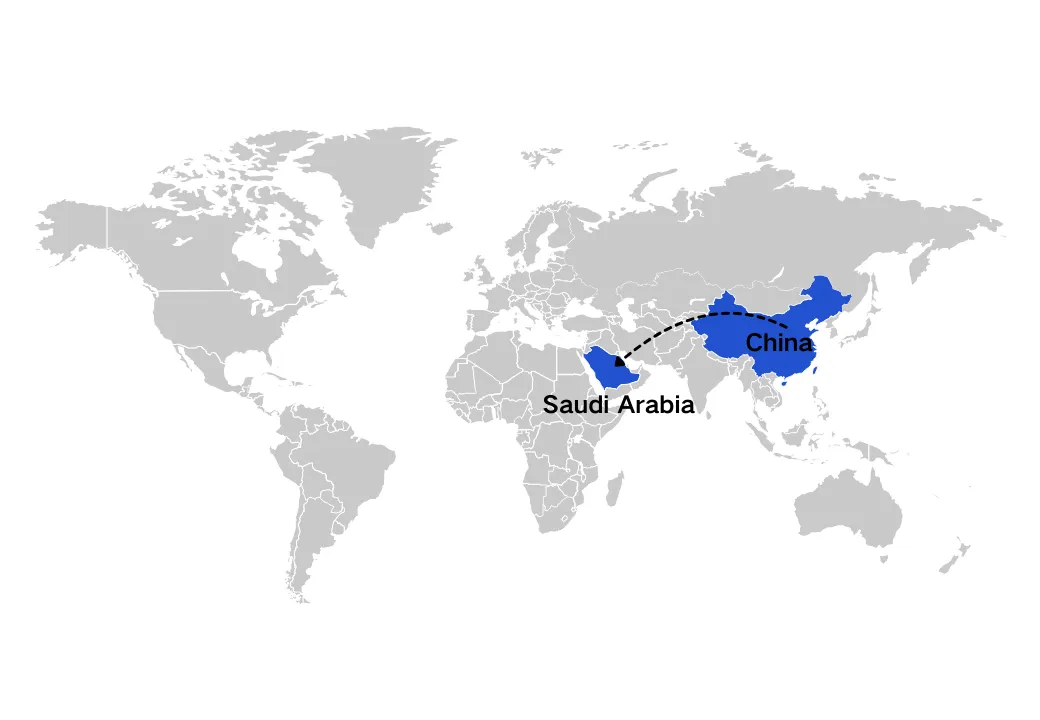
Are you looking for the most reliable and cost-effective way to ship from China to Saudi Arabia? In 2026, the answer depends less on your budget than on understanding two disrupted maritime corridors, one congested gateway port, and a compliance regime that has become fully digital.
This guide is updated for September 2026. It covers current sea freight and air freight rates, realistic transit times to Jeddah, Dammam, King Abdullah Port and Riyadh, the SABER and FASAH steps that now gate every consignment, and the routing decisions that keep your landed cost predictable.
What Changed for China–Saudi Shipping in 2026
Almost every container moving from China to Saudi Arabia passes through one of two maritime chokepoints. During 2026 both have been disrupted at the same time — which is why route planning, not rate shopping, is now the single biggest lever on your supply chain.
1. The Red Sea and Bab al-Mandeb
The security situation in the Red Sea deteriorated further through 2026. By mid-September 2026 the Houthis had taken control of Yemen's Red Sea coastline, including the port of Mocha and Perim (Mayyun) Island, placing the group effectively astride the Bab al-Mandeb strait. Traffic through the strait fell sharply after the July 2026 maritime blockade announcement targeting Saudi-linked shipping, and the Joint War Committee extended the Red Sea war-risk listed area roughly 800 km north — bringing Jeddah and Yanbu inside it for insurance purposes.
What this means for importers:
- War Risk Surcharge (WRS): carriers apply WRS on affected routings, typically $500–$2,500 per container and up to roughly $3,500 per box during the sharpest escalations earlier in 2026.
- Cape of Good Hope diversions: services that would normally route via Suez add 10–14 days, and Suez transits remain well below 2023 levels.
- Schedule volatility: vessels arrive off-window, which is the root cause of the berthing queues at Jeddah described below.
2. The Strait of Hormuz
The Strait of Hormuz has been effectively closed to normal commercial transits since 2 March 2026, with traffic running at a small fraction of pre-crisis volumes. This matters directly to Saudi imports because King Abdulaziz Port in Dammam — the Kingdom's Gulf gateway and the principal feeder for Riyadh — sits behind it.
Regional logistics has adapted. Ports outside the strait, such as Khor Fakkan and Fujairah (UAE) and Sohar (Oman), now act as discharge hubs feeding land bridges across the Arabian Peninsula. For many cargo owners the road-and-sea routing via the UAE into Saudi Arabia — roughly 16–21 days door-to-door — is currently more predictable than waiting for a direct Gulf call.
3. Jeddah Islamic Port congestion
Jeddah Islamic Port handles roughly 60% of Saudi Arabia's seaborne imports, and through 2026 it has been the Gulf's defining bottleneck. The causes compound: Red Sea rerouting produced vessel bunching and transhipment spikes, Saudi import volumes hit record levels on Vision 2030 project spending, and yard and berth capacity has not scaled at the same pace.
| Bottleneck | 2026 Reality | Pre-disruption Norm |
|---|---|---|
| Vessel waiting at anchorage | 3 – 10 days | 1 – 2 days |
| Container dwell in yard | 4 – 8 days | 2 – 4 days |
| ZATCA inspection hold (Red channel) | adds 3 – 7 days | adds 1 – 3 days |
| Peak yard utilisation (July 2026) | ~90%, truck queues up to 5 km | ~60 – 70% |
| Congestion surcharge | ~$500 per TEU on Jeddah-bound cargo | none |
For planning purposes, add 10–20 days to any Jeddah routing built on pre-2024 assumptions. King Abdulaziz Port (Dammam), King Abdullah Port (Rabigh) and Riyadh Dry Port are all viable alternatives — see Main shipping routes below.
How AllBestShipping manages this: we book against the routing that is actually performing for your destination this month, not the one that looked cheapest last quarter. For Central and Eastern Province deliveries we model Dammam and Riyadh Dry Port against Jeddah on every single shipment; for Western Province we file pre-clearance so your container can leave the yard the moment it is discharged.
Why the Trade Lane Itself Is Still Growing
Disruption has not stopped investment in China–Saudi capacity. China remains Saudi Arabia's largest trading partner, with bilateral trade above $107 billion, and 2026 brought new direct connections: the China–Jeddah Express (CJX) launched jointly by COSCO and OOCL, the China Saudi Express (CSE) added to Jeddah Islamic Port by the Saudi Ports Authority (Mawani), ONE's RC2 service, and MSC's ALBATROS service calling at both Jeddah and King Abdullah Port. Weekly direct sailings from Shenzhen, Guangzhou, Ningbo, Shanghai and Qingdao remain available.
Sea Freight from China to Saudi Arabia
Sea freight moves the overwhelming majority of the China–Saudi trade lane and will almost certainly be how your cargo travels. Our Sea Freight from China service covers both full containers and shared LCL space with DDP clearance included, from any Chinese port to any Saudi gateway.
FCL vs. LCL: Choosing the Right Container Load
The first decision you must make is between Full Container Load (FCL) and Less than Container Load (LCL).
| Feature | FCL (Full Container Load) | LCL (Less than Container Load) |
|---|---|---|
| Best For | High volume (15+ CBM) | Small volume (1-15 CBM) |
| Cost | Lower per unit | Higher per unit (shared space) |
| Security | Exclusive use (sealed at factory) | High handling risk (consolidated) |
| Speed | Faster (direct loading) | Slower (adds 2-4 days for consolidation) |
| 2026 Trade-off | FCL is prioritized by carriers when capacity is tight | LCL space is the first casualty of rerouting |
Container capacity reference for planning:
| Container | Internal Volume | Payload | Best For |
|---|---|---|---|
| 20GP | 28 – 33 CBM | ~21.7 t | Heavy, dense cargo: tiles, stone, metal parts |
| 40GP | 56 – 58 CBM | ~26.5 t | Palletized goods, mixed merchandise |
| 40HQ | 67 – 68 CBM | ~26.5 t | Light, bulky cargo: furniture, electronics, textiles |
Logistics Pro Tip: If your shipment is close to 15 CBM, it is often cheaper and safer to book a 20ft FCL rather than LCL, as you avoid destination deconsolidation fees in Saudi ports. Under current Jeddah congestion, LCL cargo also waits for a consolidation slot at both ends — FCL typically leaves the yard several days earlier.
Major Ports and 2026 Routing Strategy
China ports of origin: Shenzhen (Yantian/Shekou), Guangzhou (Nansha), Shanghai, Ningbo, Qingdao, Xiamen.
Saudi destination options:
- Jeddah Islamic Port (Red Sea): the largest gateway and the natural choice for Jeddah, Makkah, Madinah and the Western Province. Currently subject to war-risk surcharges, anchorage queues and a congestion surcharge.
- King Abdulaziz Port (Dammam): the Gulf gateway serving the Eastern Province and, via rail, Riyadh. Routing passes through the Strait of Hormuz, so schedules are affected by the 2026 closure and carriers apply war-risk contingency surcharges on selected Gulf routings.
- King Abdullah Port (Rabigh): a fast-growing private terminal north-west of Jeddah with an ongoing multi-phase expansion. It often suffers less congestion than Jeddah and pairs well with Makkah, Madinah and Yanbu industrial deliveries.
- Riyadh Dry Port: inland customs clearance after rail or truck movement from Dammam or Jeddah. For Riyadh importers this is frequently the most efficient door-to-warehouse sequence.
AllBestShipping Route Optimization: for clients based in Riyadh we now model three options side by side — Dammam plus rail to Riyadh Dry Port, Jeddah plus truck, and land bridge via the UAE. The cheapest isn't always the fastest, and in 2026 the ranking changes month to month. For Western Province importers, King Abdullah Port at Rabigh has become a genuine alternative to congested Jeddah.
Estimated Sea Freight Transit Times (September 2026)
| Route (China to Saudi Arabia) | Direct Sailing | Realistic Port-to-Port (incl. current congestion) |
|---|---|---|
| Shenzhen (Yantian) → Jeddah | 18 – 22 Days | 25 – 35 Days |
| Shanghai / Ningbo → Jeddah | 20 – 24 Days | 28 – 38 Days |
| Shanghai / Ningbo → Dammam | 22 – 26 Days | 30 – 42 Days |
| Shenzhen / Guangzhou → King Abdullah Port | 17 – 21 Days | 24 – 34 Days |
| Any China Port → Riyadh (via Dammam + rail) | — | 32 – 44 Days |
| Transshipment routings (Singapore / Jebel Ali) | 26 – 32 Days | 34 – 46 Days |
Note: the second column reflects the sailing itself; the third column is what should go into your inventory planning. Times fluctuate with vessel bunching, carrier rerouting and inspection volumes.
Air Freight from China to Saudi Arabia
When speed is non-negotiable — high-value electronics, medical devices, urgent samples, seasonal stock that has already missed the vessel — air freight is the answer. Our Air Freight from China team handles both consolidated and direct uplift to all three Saudi airports, including temperature-sensitive and DG cargo.
Key Airports for China-Saudi Trade
- China Airports: Shanghai (PVG), Guangzhou (CAN), Shenzhen (SZX), Hong Kong (HKG), Beijing (PEK).
- Saudi Airports: King Khalid Int'l (RUH - Riyadh), King Abdulaziz Int'l (JED - Jeddah), King Fahd Int'l (DMM - Dammam).
Air Freight Options: Standard vs. Express
| Service Type | Typical Weight | Transit Time | Best For |
|---|---|---|---|
| Express (DHL/FedEx/UPS) | < 100 kg | 3 - 5 Days | Samples, documents, urgent parcels |
| Standard Air Freight | > 100 kg | 5 - 8 Days | Commercial cargo, pallets |
| Charter Service | > 5,000 kg | Direct | Project cargo, oversized equipment |
2026 capacity note: air cargo capacity into the Gulf has been constrained by the regional situation, and rates into Saudi Arabia have risen accordingly versus 2025. Booking 5–7 days ahead, and keeping off-peak departure days flexible, is worth real money this year.
Cost vs. Speed Analysis
Air freight rates are calculated on the higher of actual weight or volumetric weight (Length × Width × Height ÷ 6000). Rates drop steeply as shipment weight increases, which is why consolidating smaller orders is worthwhile.
AllBestShipping Insider Insight: for shipments between 150 kg and 500 kg, we often secure spot rates on Saudia Cargo, Cathay Pacific Cargo or China Southern Cargo that rival express courier pricing while giving you far better customs control through Riyadh or Jeddah. If your cargo is voluminous but light, ask us whether sea-air via a Gulf hub is cheaper than straight air.
DDP & Door-to-Door Shipping from China to Saudi Arabia
Navigating Saudi Arabia's customs landscape is now the most demanding part of the import process. Between SABER product certification, the 12-digit tariff code, the national address short code and ZATCA e-invoicing, many importers choose DDP (Delivered Duty Paid) to move that risk to their forwarder. Read more about our Door to Door Shipping from China to Saudi Arabia solutions.
What is DDP Shipping?
In a DDP agreement, AllBestShipping takes responsibility for the shipment from your supplier's warehouse in China to your door in Saudi Arabia. That includes:
- Pick-up from the Chinese factory and consolidated warehousing.
- Export clearance in China.
- Freight (sea or air).
- Origin and destination handling charges.
- SABER registration and certificate handling.
- Saudi customs clearance on the FASAH single window.
- Payment of import duty and VAT.
- Final delivery to your warehouse — Riyadh, Jeddah, Dammam, Makkah, Madinah or an Amazon fulfilment centre.
Why Choose DDP for Saudi Arabia?
Since 1 October 2025 no shipment can be released without a valid SABER certificate, and the "letter of guarantee" workaround is gone: both the product and shipment certificates must be in place before the vessel berths. That is a hard deadline most first-time importers discover too late.
| Feature | DDP Service | DAP / CIF Service |
|---|---|---|
| Customs Clearance | Handled by forwarder | Importer's responsibility |
| Duty & VAT Payment | Included in quote | Importer pays on arrival |
| SABER / SASO | Forwarder manages PCoC + SCoC | Importer must obtain |
| Address Short Code | Verified before departure | Rejected at delivery if missing |
| Demurrage risk | Low (pre-cleared) | High (document-driven) |
Warning: Without a valid SABER shipment certificate your goods will be held at Jeddah or Dammam while storage charges accumulate — and under the 2026 rules there is no post-arrival supplementation. Our DDP service front-loads the compliance checks so your cargo clears on arrival, with documents filed on FASAH before the vessel berths.
Main Shipping Routes from China to Saudi Arabia
Understanding the current logistics map is what separates a predictable import from an expensive one. In 2026 there are three practical corridors.
1. The Red Sea Route (Jeddah Islamic Port and King Abdullah Port)
- Path: South China Sea → Malacca Strait → Indian Ocean → Bab al-Mandeb → Red Sea → Jeddah / Rabigh.
- Status in 2026: still the fastest route for the Western Province, but affected by war-risk premiums, anchorage queues and congestion. The Joint War Committee's listed area now includes Jeddah and Yanbu, which is why WRS appears on your invoice.
2. The Gulf Route (King Abdulaziz Port, Dammam)
- Path: South China Sea → Malacca Strait → Indian Ocean → Strait of Hormuz → Arabian Gulf → Dammam.
- Status in 2026: the natural gateway for the Eastern Province and the rail feeder for Riyadh, but it sits behind the Strait of Hormuz, which has been effectively closed to normal commercial transit since March 2026. Carriers continue to call with adjusted schedules and war-risk contingency surcharges.
3. The Land Bridge (via UAE or Oman)
- Path: China → Khor Fakkan / Fujairah (UAE) or Sohar (Oman) → bonded road movement into Saudi Arabia.
- Why it matters: these ports sit outside the Strait of Hormuz. Door-to-door transit of roughly 16–21 days is achievable, and the routing is frequently more stable than waiting for a direct Gulf call. It is now a mainstream option rather than a fallback.
Key Transshipment Hubs in 2026
- Singapore and Tanjung Pelepas: primary relay points for vessels from East and South China.
- Khor Fakkan and Salalah: increasingly used Gulf-region relays because both sit outside the Strait of Hormuz.
- Jebel Ali (Dubai): still used for some Gulf connections, but schedules through Hormuz remain subject to adjustment.
Shipping Costs from China to Saudi Arabia
Shipping costs in 2026 reflect two forces at once: strong underlying demand and surcharges created by the Red Sea and Hormuz disruptions. The figures below are the market range for September 2026 — always confirm with a live quote, because spot rates to Saudi Arabia have moved month by month this year. For a fuller cost walk-through including origin, destination and inland charges, see How Much Does it Cost to Ship from China to Saudi Arabia.
1. Sea Freight FCL Rates (Indicative, September 2026)
| Container Type | To Jeddah (Red Sea) | To Dammam (Arabian Gulf) |
|---|---|---|
| 20ft Container (20GP) | $1,400 – $2,500 | $1,500 – $2,600 |
| 40ft Container (40GP) | $2,300 – $3,500 | $2,400 – $3,600 |
| 40ft High Cube (40HQ) | $2,400 – $3,600 | $2,500 – $3,600 |
| LCL (per CBM) | $65 – $150 | $70 – $160 |
Budget these surcharges on top of the base rate:
- War Risk Surcharge (WRS): typically $500 – $2,500 per container on Red Sea and selected Gulf routings, peaking around $3,500 per box during the March 2026 escalation.
- Jeddah congestion surcharge: around $500 per TEU on Jeddah-bound cargo (carrier notices, August 2026).
- Peak Season Surcharge (PSS): applies in the run-up to Ramadan and Chinese New Year, and during the September–November pre-holiday rush.
- BAF (Bunker Adjustment Factor): fuel-linked, adjusted monthly.
- Origin and destination charges: trucking, export clearance, THC, delivery order fees and inland delivery. These are where "cheap" quotes quietly become expensive — ask for an all-in figure.
2. Air Freight Rates Per Kg (Indicative, September 2026)
Air freight is charged on the higher of actual or volumetric weight. Rates improve sharply at each break point — which is why declaring 100 kg can cost less than shipping 85 kg.
| Weight Bracket | Est. Cost Per Kg (Standard) | Est. Cost Per Kg (Express) |
|---|---|---|
| +45 Kg | $6.00 – $9.00 | $10.00 – $15.00 |
| +100 Kg | $4.50 – $7.00 | $8.00 – $12.00 |
| +500 Kg | $4.00 – $6.00 | N/A |
| +1,000 Kg | $3.80 – $5.50 | N/A |
Cost Saving Tip: if your shipment lands just under a break point — say 80 kg — it is frequently cheaper to declare it at 100 kg and benefit from the lower per-kilo rate. Ask your AllBestShipping agent to run the break-point comparison before you book.
3. DDP / Door-to-Door Rates
| Service | Indicative Cost | Door-to-Door Time | Best For |
|---|---|---|---|
| DDP Air | $5 – $12 / kg | 8 – 15 days | E-commerce, samples, urgent restock |
| DDP Sea (FCL) | Quoted per container, duty and VAT included | 35 – 55 days | Bulk commercial cargo |
| DDP Sea (LCL) | $120 – $260 / CBM | 40 – 60 days | SME imports, multiple suppliers |
How Long Does Shipping Take from China to Saudi Arabia?
Transit time is the second critical factor after cost, and in 2026 it is the less predictable of the two. Customs inspection volumes and port congestion, not sailing distance, drive most of the variance.
Sea Freight Transit Times (Port-to-Port and Door-to-Door)
| Route | Port-to-Port | Door-to-Door (incl. clearance & inland) |
|---|---|---|
| Shenzhen → Jeddah | 25 – 35 days | 32 – 45 days |
| Shanghai / Ningbo → Jeddah | 28 – 38 days | 35 – 48 days |
| Shanghai / Ningbo → Dammam | 30 – 42 days | 38 – 52 days |
| Shenzhen / Guangzhou → King Abdullah Port | 24 – 34 days | 31 – 44 days |
| China → Riyadh (via Dammam + rail) | 32 – 44 days | 40 – 55 days |
| China → Saudi Arabia via UAE land bridge | — | 16 – 21 days |
Air Freight Transit Times (Airport-to-Airport)
| Service Level | Transit Time | Typical Carriers |
|---|---|---|
| Direct Flight | 1 - 3 Days | Saudia Cargo, Air China, China Southern Cargo |
| Indirect (Economy) | 4 - 7 Days | Emirates, Etihad, Qatar Airways Cargo |
| Express Courier | 3 - 5 Days | DHL, FedEx, UPS (door-to-door) |
Planning rule for 2026: add 10–20 days of buffer to any Jeddah or Dammam sea routing, and expect further slippage during peak inspection periods. If your cargo must hit a fixed date, air or the UAE land bridge is the reliable choice; if it must hit a fixed cost, sea freight with a generous buffer is still unbeatable.
Saudi Customs Clearance & Import Duties
Saudi Arabia's customs environment is digitized, integrated and unforgiving. ZATCA and SASO have tightened enforcement through 2026, and most delays are documentary rather than physical. Incorrect paperwork is the number one cause of rejection.
The SABER Two-Certificate System (Explained)
Importers often refer to "the SABER certificate" as if there were one document. There are two, and confusing them is the most common reason a first shipment stalls.
- PCoC (Product Certificate of Conformity): issued once per product or product family by a SASO-accredited Conformity Assessment Body, typically valid for one year. It confirms the product itself meets Saudi technical standards. Expect roughly $150–$200 per product category, and 5–15 days for regulated goods.
- SCoC (Shipment Certificate of Conformity): required for every single consignment, linked to the PCoC and your commercial invoice. Typically $100–$150 per shipment, issued in 1–3 days once the PCoC is in place. This is the certificate customs verifies at release.
SABER and FASAH are now integrated: your shipment certificate flows automatically into the customs declaration, so there is no need to print or attach it. From 1 October 2025, no shipment can be released without it — and the previous "clear now, certify later" letter of guarantee no longer exists.
New Saudi Import Rules for 2026
| Rule | Effective | What It Means for You |
|---|---|---|
| 12-digit customs tariff code | 1 Jan 2026 | SABER rejects applications that do not match the Saudi 12-digit classification. Verify your HS code — the discrepancy rate against China's classification is material. |
| National Address Short Code | 1 Jan 2026 | An 8-character code (4 letters + 4 digits, e.g. RRRD2929) is mandatory on the commercial invoice. Carriers must reject deliveries without it. |
| Ministry of Industry declaration | from 15 Sep 2025 | Products on the designated HS code list require an approved declaration from the Ministry of Industry and Mineral Resources before an SCoC will issue. |
| USB Type-C requirement | 1 Apr 2026 (expanded) | Laptops, tablets, headphones and portable speakers must have USB Type-C ports to obtain SASO certification — non-compliant electronics cannot be imported. |
| SASO labeling rules | Oct 2026 | New mandatory labeling for selected regulated products. Confirm the current label format before your goods ship. |
| ZATCA e-invoicing Phase 2 | In force | Invoices must be XML or PDF/A-3 with a cryptographic stamp, integrated with the Fatoora portal. Non-compliance carries fines of SAR 5,000–50,000. |
| E-commerce VAT withholding | 2026 | Marketplaces must withhold 15% VAT from sellers without a valid VAT registration number (VRN). Registering your own VRN lets you reclaim input VAT. |
Essential Documents for Saudi Customs
- Commercial Invoice: must show the 12-digit HS code, country of origin and the national address short code where applicable.
- Packing List: detailed breakdown of package contents, weights and dimensions.
- Bill of Lading / Air Waybill: the master transport document.
- Certificate of Origin (COO): authenticated by the China Council for the Promotion of International Trade (CCPIT) or an equivalent chamber.
- SABER PCoC + SCoC: mandatory for regulated products — electronics, textiles, toys, electrical goods, building materials and more.
- SASO IECEE Recognition Certificate: for specified electrical items such as lighting, pumps and laptops.
- SFDA registration: for food, cosmetics, medical devices and pharmaceuticals.
Labeling detail that costs importers real money: every item must carry a non-removable "Made in China" mark — engraved, stitched or printed. Stickers are routinely rejected by inspectors at Saudi entry points. Check this at the factory, not at the port.
Understanding Duties and Taxes (2026)
- Customs Duty: Saudi Arabia applies the GCC Common Customs Tariff. Most tariff lines sit at 5%, with protected categories ranging up to 20% and some goods (such as laptops) at 0%. In June 2026 Saudi Arabia revised duty rates on 51 selected agricultural and food tariff items, moving them from the standard 5% to a 5%–15% band — a reminder that duty rates do change mid-year.
- VAT (Value Added Tax): the standard rate remains 15% in 2026, levied on the total of (cost of goods + insurance + freight + customs duty).
- Import service fees: ZATCA applies modest administrative fees on declarations and inspections in addition to duty.
AllBestShipping Compliance Check: we verify your HS codes at the 12-digit level before booking, confirm your SABER position, and check that your invoice, packing list and bill of lading agree — mismatches between those three documents are the single most common trigger for a ZATCA Red-channel hold. ZATCA also operates a voluntary disclosure mechanism in 2026, so if a past declaration was misclassified, self-correcting before an audit is far cheaper than being found out.
Step-by-Step Shipping Process
Follow this workflow, updated for 2026 requirements, to keep your shipment moving from Chinese factory to Saudi warehouse.
Step 1: Supplier verification & Incoterms
Confirm your supplier's readiness and agree on shipping terms. FOB is recommended so you control the freight — and with 2026 surcharges moving frequently, control matters more than ever.
Step 2: Compliance pre-check
Before booking, confirm product classification at 12 digits, confirm whether your goods are regulated, and start the SABER PCoC if you do not already hold one. This step has a longer lead time than the ocean voyage in some cases.
Step 3: Book freight with AllBestShipping
Provide cargo details and we secure space on the best-performing routing — Jeddah, King Abdullah Port, Dammam or the UAE land bridge — based on current conditions and your delivery deadline.
Step 4: Export clearance in China
We handle the export declaration, consolidated warehousing where needed, and movement to the port or airport.
Step 5: International transit
Your goods travel by sea or air with real-time tracking. We monitor vessel schedules and port congestion and alert you to any ETA movement early.
Step 6: SABER & FASAH filing (before arrival)
While the cargo is in transit we raise the SCoC in SABER and file the customs declaration on FASAH, so release can happen the moment the container is discharged.
Step 7: Final delivery
Once cleared, we arrange trucking to your warehouse or Amazon fulfilment centre (RUH1, JED1 and similar), with inland transport capacity booked ahead of berthing — not after release.
One-Stop Shipping Solutions for Alibaba, 1688 & Taobao Buyers
Sourcing from multiple suppliers on Alibaba, 1688 or Taobao? Managing separate shipments is expensive — and in 2026, every separate shipment also means a separate SABER SCoC and a separate customs declaration. AllBestShipping consolidates your suppliers into one.
Why Use Our Consolidation Service?
Free warehousing: up to 30 days of free storage in our Guangzhou and Shenzhen warehouses, so suppliers can deliver at their own pace.
Consolidation: we collect cartons from 5, 10 or even 20 different suppliers and combine them into a single shipment.
- Result: one freight booking, one customs clearance, one SABER shipment certificate — saving up to 50% on total logistics cost.
Quality check: we inspect goods for damage, quantity errors and labeling compliance before they leave China — including the non-removable origin marking Saudi inspectors require.
Repackaging: we reinforce flimsy supplier cartons and remove dead space, because on a Saudi routing you are paying for volume one way or another.
Ready to ship? Whether you are moving a single pallet or a full container, AllBestShipping is your bridge from China to Saudi Arabia. We quote all-in, handle SABER and ZATCA compliance, and tell you honestly which routing is performing right now. Contact AllBestShipping for a free quote and a current port advisory.