The Ultimate Guide to Door to Door Shipping from China to Saudi Arabia (2026 Updated)
Are you struggling with complex customs regulations, unexpected delays, and hidden fees when importing goods to the KSA? A seamless logistics solution is the key to a profitable supply chain. In this comprehensive guide, we will break down everything you need to know about door to door shipping from China to Saudi Arabia, including transit times, costs, strict customs clearance procedures, and how to select the right freight forwarder for your business.
Whether you are importing heavy machinery, electronics, or fast-moving consumer goods, understanding the nuances between sea and air door-to-door services is crucial to maintaining your profit margins. We will also dive deep into the critical differences between DDP and DDU shipping terms, and provide a step-by-step walkthrough of the entire logistics process from the factory floor in China to your warehouse in Riyadh. Keep reading to discover how to streamline your imports and save thousands of dollars on unnecessary fees.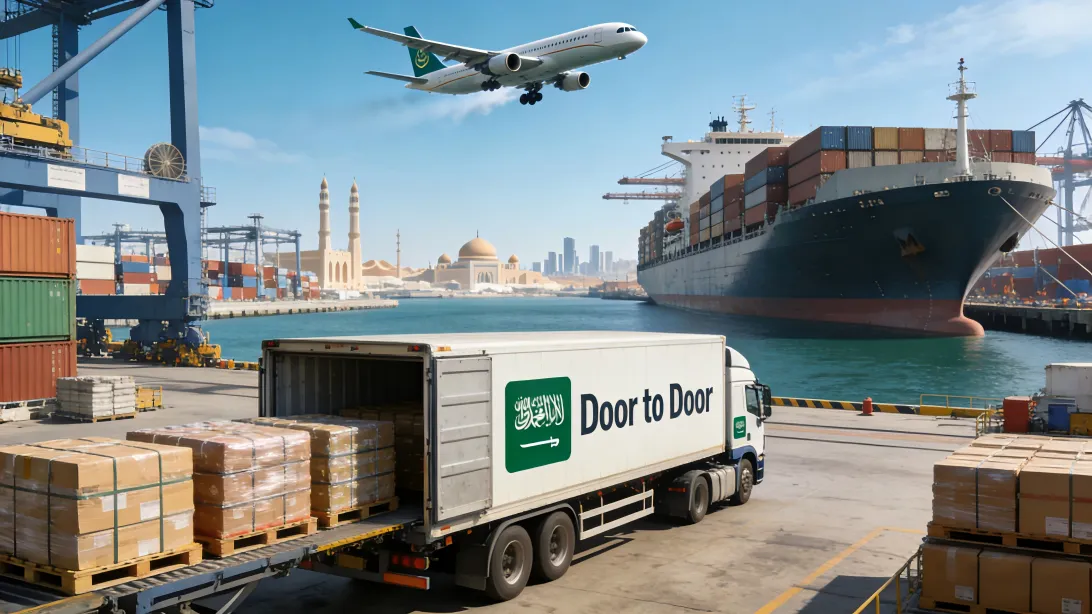
What is Door to Door Shipping from China to Saudi Arabia?
Door-to-door shipping is a comprehensive, all-inclusive logistics service where the freight forwarder manages the entire transportation process. Instead of simply moving goods from a seaport in China to a seaport in Saudi Arabia, the logistics provider takes responsibility for the cargo from the supplier's factory or warehouse in China directly to your final designated address in Saudi Arabia. This service encompasses pickup, domestic transportation in China, export customs clearance, international main-leg transit, import customs clearance in Saudi Arabia, and the final last-mile inland delivery.
In our decade of experience handling China-Saudi routes, we've found that the biggest point of confusion for new importers lies in the Incoterms. When discussing door-to-door shipping, the two most critical terms are DDP(Delivered Duty Paid) and DDU (Delivered Duty Unpaid).
Under a DDU agreement, the seller or forwarder delivers the goods to the destination, but the buyer is responsible for paying all import duties, taxes, and handling customs clearance through the FASAH system. Conversely, DDP means the forwarder handles absolutely everything. Under DDP, the quote you receive includes all freight charges, Saudi customs duties, the standard 15% VAT, and any unexpected port handling fees like Demurrage or Detention.
For most Saudi importers, we strongly recommend DDP because it ensures complete cost transparency and eliminates the massive headache of navigating Saudi Arabia's strict customs regulations on your own. For example, during the recent capacity crunches in Q1 2026, clients using DDP were shielded from sudden spikes in destination terminal handling charges. It replaces the traditional complexities of managing FOB (Free on Board) or CIF (Cost, Insurance, and Freight) shipments with a single, streamlined solution.
Why Choose Door to Door Shipping to KSA?
Opting for a door-to-door service offers a multitude of strategic advantages for businesses importing goods into the Kingdom of Saudi Arabia. The Middle Eastern logistics landscape, while modernizing rapidly under Vision 2030, still presents unique bureaucratic challenges that can trip up inexperienced importers.
Hassle-Free Customs Clearance: The most significant benefit is the expert handling of Saudi Arabia's stringent import requirements. The KSA mandates compliance with the SABER certification system for regulated products and requires precise documentation through the FASAH electronic platform. A specialized door-to-door forwarder has dedicated clearing agents who navigate these systems daily, ensuring your cargo does not get stuck in Customs Clearance due to a missing Certificate of Origin or incorrect HS codes.
Transparent Pricing: Traditional shipping methods often involve a fragmented supply chain where you receive separate bills from the trucking company, the ocean carrier, the customs broker, and the local delivery service. Door-to-door shipping, particularly under DDP terms, provides one all-inclusive quote. This means no surprise destination port charges, unexpected warehousing fees, or fluctuating local tariff assessments.
Time and Resource Saving: Managing international logistics is a full-time job. By outsourcing the entire process to a reliable partner, your business can focus on its core competencies—sales, marketing, and growth. You don't need to coordinate multiple logistics intermediaries across different time zones or hire an in-house logistics team to track shipments.
Reduced Risk of Damage and Loss: Every time cargo is handed off from one logistics provider to another, the risk of mishandling, damage, or theft increases. A door-to-door service minimizes these touchpoints. The goods are consolidated, packed, and loaded under the supervision of a single entity. In our operations at AllBestShipping, we've seen this approach reduce claim rates by over 40% compared to fragmented shipping setups. It ensures that your Commercial Invoice and physical cargo match perfectly upon arrival, preventing disputes under the principles of General Average.
Modes of Door to Door Transportation
Choosing the right mode of transportation is critical to balancing your budget and delivery timeline. Door-to-Door Shipping from China to Saudi Arabia generally falls into three main categories: Sea Freight, Air Freight, and Express Courier.
Door to Door Sea Freight
Sea Freight from China to Saudi Arabia is the backbone of global trade and the most cost-effective option for importing large volumes of goods. It is particularly suitable for heavy machinery, construction materials, furniture, and bulk consumer goods.
- FCL (Full Container Load): If your cargo volume is large enough (typically over 15-20 cubic meters), Container shipping from China to Saudi Arabia using a dedicated 20ft or 40ft container is the most efficient choice. With FCL, the container is sealed at the supplier's factory in China and remains unopened until it reaches your warehouse in Saudi Arabia. This minimizes handling and offers excellent security. Major destination ports include the Jeddah Islamic Port and the King Abdulaziz Port in Dammam.
- LCL (Less than Container Load): If your shipment is too small to fill an entire container, LCL is the ideal solution. Your goods will share container space with shipments from other buyers heading to the same destination. While the unit cost per cubic meter (CBM) is slightly higher than FCL due to the consolidation and deconsolidation processes, it remains vastly cheaper than Air Freight for medium-sized loads.
Door to Door Air Freight
When time is of the essence, air freight is the premium choice. It is heavily utilized for time-sensitive, perishable, high-value, or fragile goods, such as electronics, medical equipment, and seasonal fashion items. Air freight dramatically reduces transit times from weeks to mere days. Cargo typically arrives at major international hubs like King Khalid International Airport in Riyadh (RUH) or King Abdulaziz International Airport in Jeddah (JED). While more expensive than ocean freight, the speed and reliability often justify the cost for high-margin products.
Express Courier (DHL, FedEx, UPS)
For very small shipments, urgent documents, product samples, or lightweight parcels, express courier services provide the fastest door-to-door method. Companies like DHL, FedEx, and UPS offer comprehensive tracking and incredibly rapid delivery, often clearing customs electronically while the plane is still in the air. However, this is the most expensive shipping method per kilogram and is generally not economically viable for heavy or bulky commercial cargo.
You may be interested in the following related articles:
- Shipping from China to UAE
- Shipping from China to Egypt
- Shipping from China to Iran
- Shipping from China to Iraq
- Shipping from China to Saudi Arabia
Step-by-Step Process of Door to Door Shipping
Understanding the mechanics of door-to-door shipping demystifies the process and helps you track your cargo's progress more effectively. Here is the standard 6-step workflow:
- Cargo Pick-up: The process begins when the freight forwarder dispatches a truck to collect the goods from your Chinese supplier's factory or warehouse. This could be in major manufacturing hubs like Shenzhen, Guangzhou, Yiwu, or Shanghai.
- Warehousing & Consolidation: The goods are transported to the forwarder's local warehouse in China. Here, they undergo preliminary inspection, measuring, weighing, and labeling. If it's an LCL shipment, the goods are consolidated with others into a single container.
- China Export Customs Clearance: The forwarder's team handles all necessary export licenses, submits the export declaration to Chinese customs, and ensures the cargo is legally cleared to leave the country.
- International Freight: This is the main leg of the journey. The cargo is loaded onto an ocean vessel (for sea freight) or an airplane (for air freight) and embarks on its journey from China to the designated port or airport in Saudi Arabia.
- Saudi Arabia Import Customs Clearance: Upon arrival in the KSA, the forwarder's local clearing agents take over. They submit the required documentation through the FASAH system, arrange for physical inspections if required, and pay all applicable import duties and the 15% VAT on your behalf (if using DDP terms).
- Final Inland Delivery: Once customs officially releases the cargo, it is loaded onto local trucks and dispatched for final last-mile delivery directly to your doorstep, warehouse, or retail location in Riyadh, Jeddah, Dammam, or any other Saudi city.
Transit Times: How Long Does It Take?
Transit time is a critical factor in supply chain planning. The duration varies wildly depending on the chosen mode of transport, the specific origin and destination cities, and external factors.
Below is an estimated comparison of transit times for door-to-door shipping from major Chinese cities to key destinations in Saudi Arabia:
| Shipping Mode | Estimated Transit Time (Door to Door) | Best Used For |
|---|---|---|
| Sea Freight (FCL) | 25 - 35 Days | Large volumes, heavy goods, planned inventory |
| Sea Freight (LCL) | 30 - 40 Days | Medium volumes, cost-conscious shipments |
| Air Freight | 5 - 9 Days | High-value goods, electronics, urgent restocking |
| Express Courier | 3 - 6 Days | Product samples, documents, very small parcels |
Note: These are average estimates. Actual times can be influenced by several factors.
Factors Affecting Transit Time:
- Peak Seasons and Holidays: Shipping spaces become scarce and delays are common before major Chinese holidays (like Chinese New Year in January/February) and Saudi holidays (such as the weeks leading up to Ramadan). From our experience, booking at least 4 weeks in advance during these periods is the only way to avoid rolled cargo (cargo left behind for the next vessel).
- Port Congestion: High traffic at major transshipment hubs like Singapore or at destination ports like Jeddah Islamic Port can add several days to the sea freight timeline. The ongoing adjustments in Red Sea routes have also impacted standard transit times, making real-time tracking more crucial than ever.
- Customs Inspections: Random or targeted customs inspections by Saudi authorities can delay clearance by a few days, especially if documentation is incomplete.
- Weather Conditions: Typhoons in the South China Sea or severe weather in the Middle East can disrupt shipping schedules and ground flights.
Shipping Costs: How Much Does It Cost in 2026?
Cost is often the deciding factor for importers. Door-to-door DDP pricing is comprehensive, but it is helpful to understand its components. The final quote typically includes:
- Origin Charges: Pickup, warehousing, and export clearance in China.
- Main Freight: The actual cost of ocean or air transport.
- Destination Charges: Port handling fees, terminal handling charges (THC), and inland trucking in Saudi Arabia.
- Taxes and Duties: Saudi customs duties (ranging from 5% to 20% for most commercial goods) and the mandatory 15% VAT calculated on the CIF (Cost, Insurance, and Freight) value.
Below is a highly generalized estimate of DDP costs as of early 2026. Please note that freight rates fluctuate constantly based on global oil prices, container availability, and seasonal demand.
| Shipping Mode | Estimated DDP Cost | Unit of Measurement |
|---|---|---|
| Sea Freight (FCL 20ft) | $3,500 - $4,800 | Per Container |
| Sea Freight (FCL 40ft) | $4,500 - $6,500 | Per Container |
| Sea Freight (LCL) | $150 - $250 | Per CBM (Cubic Meter) |
| Air Freight | $6.00 - $9.00 | Per Kilogram (Volumetric or Actual) |
How to Optimize Your Shipping Costs:
- Understand Volumetric Weight: For air freight, airlines charge based on actual weight or volumetric weight (size), whichever is greater. Pack your goods densely to avoid paying for "empty air."
- Consolidate Shipments: Instead of shipping multiple LCL loads, wait and combine your orders from different Chinese suppliers into one FCL shipment at our warehouse. This often results in a 15-20% reduction in freight costs per CBM.
- Negotiate Better Terms: While DDP is recommended, consider DDU if you have an established local presence in KSA with dedicated customs brokers—it might save you on markup fees.
Saudi Arabia Customs Clearance Essentials
Saudi Arabia has one of the strictest customs regimes in the Middle East. Failing to comply with their regulations will result in heavy fines, shipment delays, or even confiscation of goods. When using a door-to-door service, your forwarder handles this, but you must provide the correct initial information.
Required Documents: To ensure smooth clearance, you must provide your forwarder with accurate and corresponding paperwork:
- Commercial Invoice: Must clearly detail the goods, quantities, unit prices, and total value. It must match the packing list exactly.
- Packing List: Details the physical dimensions, weight, and packaging type of the cargo.
- Bill of Lading (B/L) (for sea) or Air Waybill (AWB) (for air): The official transport contract and receipt of cargo.
- Certificate of Origin (CO): A crucial document verifying where the goods were manufactured. Saudi customs often requires this to be attested by the local Chamber of Commerce.
Understanding Taxes:
- Customs Duties: Saudi Arabia applies varying duty rates based on the Harmonized System (HS) code of the product. Basic commodities might face a 5% duty, while protective tariffs on items manufactured locally (like certain plastics or furniture) can reach up to 20%.
- VAT (Value Added Tax): A standard 15% VAT is applied to all imported commercial goods. This is calculated on the total value of the goods plus freight, insurance, and customs duties.
Compliance Systems:
- SABER Certification: Essential for most consumer and industrial goods (like electronics, toys, and textiles). SABER connects the SASO (Saudi Standards, Metrology and Quality Organization) regulations with customs. You need a Product Certificate (PC) before manufacturing finishes and a Shipment Certificate (SC) linked to your invoice before loading the vessel. We have seen containers turned away because importers skipped the SC step.
- FASAH: The unified digital portal for Saudi Customs. It centralizes all trade data and is mandatory for clearance. We navigate FASAH daily to minimize the risk of your container incurring expensive Demurrage fees while waiting for document approval.
Prohibited and Restricted Items: Never attempt to ship prohibited items. These include alcohol, pork products, narcotics, specific religious materials contrary to Islamic beliefs, counterfeit goods, and certain types of spy equipment or drones without explicit governmental approval.
Why Choose AllBestShipping for Your Door to Door Needs?
Navigating the complexities of importing from China to Saudi Arabia requires a partner you can trust. AllBestShipping is your premier logistics solution, dedicated to making global trade effortless for your business.
- Unmatched Expertise: With over 10 years of specialized experience in the Middle East logistics market, we understand the nuances of the China-Saudi trade route better than anyone else.
- Cost-Effective Solutions: By leveraging our massive shipping volume, we secure highly competitive DDP rates from major carriers, passing the savings directly to you. We guarantee cargo space even during the most challenging peak seasons.
- Compliance Masters: Our expert in-house customs team handles all the heavy lifting. From managing SABER and SASO requirements to executing flawless FASAH declarations, we ensure your cargo clears customs rapidly and legally.
- Exceptional Customer Service: We provide 24/7 dedicated support and transparent, real-time tracking. When you ship with AllBestShipping, you have total peace of mind knowing exactly where your cargo is at all times.
Frequently Asked Questions (FAQ)
Can I ship electronics with batteries to Saudi Arabia? Yes, but they are classified as Dangerous Goods (DG). They require special handling, Material Safety Data Sheets (MSDS), and UN38.3 testing reports. Not all flights or vessels accept battery cargo, so you must declare this to your forwarder in advance. Furthermore, electronics usually require strict SABER certification.
Do I need an import license (Commercial Registration) to use door-to-door shipping? If you are importing commercial quantities for resale, you generally need a valid Commercial Registration (CR) in Saudi Arabia that matches the type of goods you are importing. However, some forwarders offer specialized DDP services using their own trading company's CR as the Importer of Record, which is a massive benefit for smaller businesses or foreign entities without a local Saudi presence.
How is the volumetric weight calculated for air freight to KSA?
The standard industry formula for air freight is: Length (cm) x Width (cm) x Height (cm) / 6000 = Volumetric Weight in KG. Airlines will compare this result to the actual gross weight of the package and charge based on whichever number is higher.
Conclusion
Importing goods into the Kingdom of Saudi Arabia doesn't have to be a stressful, unpredictable process. By utilizing door-to-door shipping—specifically under DDP terms—you can eliminate the complexities of customs clearance, avoid hidden fees, and ensure your cargo arrives safely and on time. Whether you choose the cost-efficiency of sea freight or the speed of air freight, a seamless logistics solution is the cornerstone of a successful international business.
Ready to streamline your supply chain and boost your profit margins? Stop worrying about logistics and let the experts handle it. Request a free, customized door-to-door shipping quote from AllBestShipping today and experience the difference of truly hassle-free importing!