Cheapest Way to Ship from China to Egypt (2026 Guide): Sea, Air & DDP Compared
Cheapest way to ship from China to Egypt — if you've typed this into Google, you've probably already realized something frustrating. One website says a 20ft container costs $800. Another says $3,700. A third tells you air freight is $3 per kilogram, while a fourth insists it's $8. How are you supposed to budget when the "cheapest" option seems to change depending on which page you read?
At AllBestShipping, we've managed thousands of China-Egypt shipments from our Shenzhen headquarters over the past decade. We've seen first-time Egyptian importers overpay by 40% simply because they chose express courier for a 200 kg pallet. We've watched experienced traders get blindsided by Egyptian destination charges they never knew existed. We've personally pre-registered ACID numbers at 2:00 AM to prevent a client's cargo from missing its sailing window. And we've helped e-commerce sellers navigate Amazon.eg's strict receiving requirements while keeping costs lean.
This guide cuts through the noise. Instead of throwing random price ranges at you, we'll show you the cheapest shipping method for your exact scenario — whether you're sending a 2 kg sample, a 500 kg machinery order, or a full 40ft container of furniture. You'll get realistic 2026 pricing with the surcharges explained, a clear breakdown of how the Red Sea crisis is affecting rates right now, and the Egypt-specific compliance essentials (ACID, Nafeza, CargoX) that most generic guides gloss over. We'll even show you how to use the China-Egypt Free Trade Agreement to legally slash your customs duties — a tactic almost none of our competitors mention.
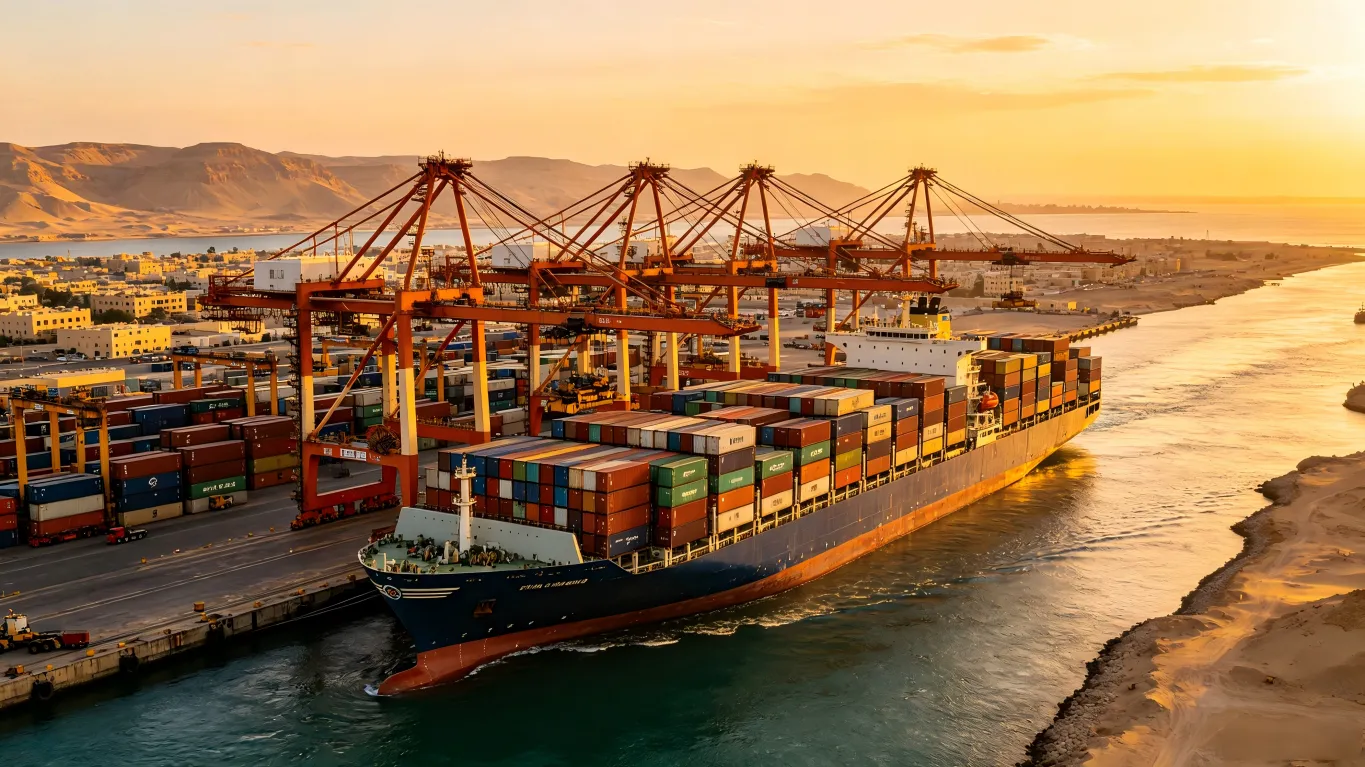
Shipping Methods from China to Egypt: A Quick Overview
Before we dive into scenarios, let's align on the five main ways to move cargo from China to Egypt. Each method sits at a different intersection of cost, speed, and complexity. Understanding these differences is the first step to choosing the cheapest option for your specific shipment.
Sea Freight FCL (Full Container Load) means you book an entire container — typically a 20GP (20-foot general purpose, ~28 CBM) or a 40HQ (40-foot high cube, ~68 CBM). The container is sealed at your supplier's factory and opened only at your door or warehouse in Egypt. FCL is almost always the cheapest per-unit option for bulk cargo over 15 CBM, but you're paying for the whole container regardless of how full it is.
Sea Freight LCL (Less than Container Load) is the shared-space alternative. Your cargo is consolidated with other shippers' goods into one container. You pay only for the cubic meters (CBM) you occupy. LCL is ideal for smaller commercial shipments between roughly 1 and 15 CBM, but you'll face extra destination fees for deconsolidation at the Egyptian port.
Air Freight from China is standard cargo airline service — not the same as express courier. Your goods fly on a commercial freighter (EgyptAir Cargo, Qatar Airways, Emirates SkyCargo) into Cairo International Airport (CAI). Air freight is calculated by chargeable weight — whichever is higher between actual weight and volumetric weight. It's the sweet spot for urgent cargo in the 50–1,000 kg range.
Express Courier (DHL, FedEx, UPS, Aramex) is the fastest door-to-door option. Rates are simple per-kilogram pricing, customs clearance is bundled, and tracking is granular. The trade-off is cost: express runs 2–3x more expensive than standard air freight for anything over 30 kg.
DDP (Delivered Duty Paid) Door-to-Door isn't a transport mode — it's an Incoterm that defines who pays for what. Under DDP, your freight forwarder handles the entire chain: factory pickup, Chinese export customs, international freight, Egyptian import clearance, duties, VAT, and final delivery. For importers without an Egyptian import license, DDP is often the only practical path.
Here's the bird's-eye view:
| Shipping Method | Typical Cost | Transit Time | Best For | Complexity |
|---|---|---|---|---|
| Sea FCL (20GP/40HQ) | $2,800–$4,900 per container | 18–25 days port-to-port | Bulk cargo (> 15 CBM) | Medium |
| Sea LCL | $80–$120 per CBM | 35–49 days door-to-door | Small/medium volume (1–15 CBM) | Medium |
| Air Freight | $4.50–$7.50 per kg | 3–5 days airport-to-airport | Urgent cargo (50–1,000 kg) | Low |
| Express Courier | $6–$12 per kg | 3–5 days door-to-door | Samples, parcels (< 50 kg) | Very Low |
| DDP Sea | $150–$200 per CBM | 28–40 days door-to-door | Importers without a license | Very Low |
| DDP Air | $6.50–$9.00 per kg | 7–12 days door-to-door | Urgent, license-free import | Very Low |
For a deeper dive into container logistics on this corridor, read our dedicated guide to Container Shipping from China to Egypt. If you're new to sharing container space, our LCL Shipping Guide explains how to minimize costs and avoid common consolidation pitfalls.
The Cheapest Shipping Method by Scenario (Decision Matrix)
This is the core of the guide. Instead of asking "what's the cheapest rate?", ask "what's the cheapest rate for my shipment?" The answer depends on weight, volume, urgency, and whether you hold an Egyptian import license.
Samples & Small Parcels (Under 50 kg)
Cheapest option: Express courier DDP — DHL, FedEx, or Aramex at roughly $8–$12 per kg for door-to-door delivery.
Why not standard air freight? Because airlines charge a minimum weight fee (often 45 kg or 100 kg). If you're shipping 15 kg of product samples, you'll pay the 45 kg minimum anyway, making express courier cheaper and faster.
For documents and tiny samples under 2 kg, Aramex often beats DHL on price to Cairo and Giza. Aramex has a deep local network in Egypt, and their economy express tier can deliver small envelopes for under $30.
Pro tip: If your sample includes batteries, liquid, or magnetic components, declare it upfront. Misdeclared express shipments are the #1 reason for customs holds at Cairo Airport.
Medium Urgent Cargo (50–300 kg)
Cheapest option: Standard air freight at $4.50–$6.50 per kg (chargeable weight), plus customs clearance and local delivery on the Egypt side.
This band is the break-even zone. Express courier would cost you $8–$12 per kg. LCL sea freight might quote $100 per CBM, but once you add Egyptian port handling, deconsolidation, documentation fees, and inland trucking, the all-in LCL cost for a single pallet often exceeds air freight for a 200–300 kg shipment.
At AllBestShipping, we regularly see clients in this weight band overpay for express when standard air plus our DDP add-on saves 20–30%. If your cargo is 150 kg of electronics with a two-week deadline, air freight is almost always the cheapest total cost when you factor in time value and destination charges.
Small to Medium Volume (300 kg – 15 CBM)
Cheapest option: LCL sea freight at $80–$120 per CBM (port-to-port), plus destination charges.
LCL is unbeatable in this volume band. A 5 CBM shipment of furniture or textiles at $100 per CBM costs roughly $500 in ocean freight — compared to $2,500–$3,000 for a full 20GP container. However, you must budget for Egyptian destination charges:
| Destination Charge | Typical Cost |
|---|---|
| Terminal Handling (THC) | $80–$150 |
| Deconsolidation / Unpacking | $100–$200 |
| Delivery Order (D/O) Fee | $30–$60 |
| Customs Brokerage | $180–$320 |
| Inland Delivery to Cairo | $300–$500 |
| Total Destination Costs | $690–$1,230 |
Threshold warning: Above roughly 13–15 CBM, always request an FCL 20GP or 40HQ quote alongside your LCL rate. In 2026, with 20GP rates surging roughly 22% from April levels, the LCL-to-FCL crossover point has shifted higher than in previous years. A 14 CBM LCL shipment with heavy destination fees can sometimes cost more than booking a dedicated 20GP.
Bulk Orders (Over 15 CBM)
Cheapest option: FCL sea freight — either a 20GP or a 40HQ container.
FCL gives you sealed container security, no shared-space risk, and the lowest per-unit transport cost in logistics. For a 20GP container holding 28 CBM, your effective freight cost per CBM is roughly $100–$130. For a 40HQ holding 68 CBM, it drops to $60–$80 per CBM.
The 2026 twist: Because 20GP rates have risen sharply while 40HQ rates held relatively flat, the 40HQ often delivers a lower cost per CBM than a 20GP right now. If your cargo is 25–30 CBM, do not automatically book a 20GP. Get a 40HQ quote. The difference in per-CBM economics can save you 15–25% on freight cost alone.
No Egyptian Import License? (DDP Is Your Only Practical Choice)
Cheapest DDP option: DDP sea freight at $150–$200 per CBM for non-urgent cargo; DDP air at $6.50–$9.00 per kg for urgent cargo.
Here's a reality most first-time importers don't know: under standard Incoterms like FOB or CIF, you — the Egyptian buyer — must clear customs yourself. That requires a registered Egyptian company, an import license, and a Tax ID. If you don't have those, your cargo sits at the port indefinitely.
Under DDP (Delivered Duty Paid), your freight forwarder acts as the importer of record. You don't need an Egyptian import license. You don't deal with Nafeza. You don't pay duties and VAT separately. One upfront quote covers everything from factory pickup to delivery at your door.
At AllBestShipping, our DDP service to Egypt covers door delivery to Cairo, Alexandria, Giza, 6th of October City, and Port Said — with all Egyptian customs duties (5–30%, depending on product) and 14% VAT baked into one transparent, no-surprise quote.
E-Commerce & Amazon.eg FBA Inbound
Cheapest option: DDP air freight coordinated with a local Egyptian courier handoff.
Amazon Egypt (Amazon.eg) has strict receiving requirements: pallet labeling, carton labeling, FNSKU compliance, and appointment-based delivery. Standard express couriers like DHL often drop parcels at a generic receiving dock without meeting these requirements, causing rejections and reshipment fees.
A freight forwarder experienced with Amazon.eg can prep your inventory in Shenzhen (labeling, palletizing), fly it DDP to Cairo, and hand it to a local last-mile partner who understands Amazon's appointment system. The all-in cost is typically $7–$10 per kg — more than generic air freight, but far cheaper than dealing with rejections and storage penalties at Amazon's fulfillment center.
Competitor gap filled: Not a single competitor article we reviewed addressed Egypt's growing e-commerce logistics needs. If you're selling on Amazon.eg, Shopify, or local Egyptian marketplaces, this matters.
Shipping Costs from China to Egypt in 2026: Realistic Numbers
Rate Disclaimer: The pricing data below reflects AllBestShipping's internal rate sheets and carrier contracts as of May 2026. Sea freight rates are volatile and typically valid for only 7–14 days. Always request a fresh, binding quote before booking. The figures here are intended for budgeting guidance, not as guaranteed offers.
If you've searched for shipping rates before, you've noticed something infuriating: no two websites agree. One quotes $800 for a 20GP container. Another says $3,700. A third claims LCL is $22 per CBM. What's going on?
Why Every Website Gives You a Different Price
The headline rate is almost never the full story. Here are the five reasons quotes diverge so wildly:
1. Port-to-port vs. door-to-door. A $1,500 port-to-port 20GP quote sounds cheap. But add origin trucking ($150–$300), Chinese export clearance ($100–$200), Egyptian THC ($80–$150), customs brokerage ($180–$320), duties and VAT (14–44% of CIF), and inland delivery ($300–$650), and your real landed cost is $3,000+. DDP quotes include all of this upfront.
2. Carrier differences. MSC, COSCO, ONE, and CMA CGM price the same Shanghai-to-Alexandria route differently based on vessel utilization, alliance agreements, and fuel hedging.
3. Surcharges not in the headline rate. These add up fast:
| Surcharge | What It Covers | Typical Cost |
|---|---|---|
| THC (Terminal Handling Charge) | Port loading/unloading | $80–$150 per container |
| BAF / CAF (Bunker Adjustment Factor) | Fuel price fluctuation | $100–$400 per container |
| PSS (Peak Season Surcharge) | High-demand periods | $100–$300 per container |
| War Risk Surcharge | Red Sea routing premium | $50–$150 per container |
| Documentation & D/O Fees | Paperwork and release | $50–$100 |
4. Rate validity. Sea freight quotes are typically valid for only 7–14 days. A quote from March is meaningless in June.
5. Incoterms mismatch. An EXW quote includes factory pickup. An FOB quote starts at the port. A DDP quote includes everything. Comparing them without normalization is comparing apples to oranges.
Sea Freight Costs (FCL & LCL)
These are realistic Sea Freight from China port-to-port FCL rates for May 2026, reflecting current Mediterranean-route capacity tightness:
| Route | 20GP (USD) | 40GP / 40HQ (USD) | Notes |
|---|---|---|---|
| Shanghai → Alexandria | $3,000–$3,700 | $4,000–$4,850 | Most competitive route |
| Shenzhen → Alexandria | $2,800–$3,500 | $3,800–$4,600 | Strong for electronics |
| Ningbo → Port Said | $2,900–$3,600 | $3,900–$4,800 | Alternative to Alexandria |
| Guangzhou → Ain Sokhna | $3,000–$3,700 | $4,100–$4,900 | Best for Cairo delivery |
| Qingdao → Alexandria | $3,200–$3,900 | $4,200–$5,000 | Northern China origin |
LCL rates are currently $80–$120 per CBM port-to-port, with destination deconsolidation adding another $150–$350 on the Egypt side.
All-in door-to-door estimate: Add roughly $800–$1,500 to the port-to-port FCL rates above for full DDP service, depending on final destination and cargo type.
Air Freight Costs
Airport-to-airport rates as of May 2026:
| Route | Cost per kg (USD) | Notes |
|---|---|---|
| Shanghai (PVG) → Cairo (CAI) | $4.50–$6.50 | Highest frequency, best rates |
| Shenzhen (SZX) → Cairo (CAI) | $4.80–$6.80 | Ideal for South China electronics |
| Guangzhou (CAN) → Cairo (CAI) | $4.50–$7.00 | Flexible for mixed cargo |
| Beijing (PEK) → Cairo (CAI) | $5.00–$7.50 | Northern China gateway |
| Hong Kong (HKG) → Cairo (CAI) | $4.20–$6.00 | Premium service, fewer restrictions |
Chargeable weight rule: Airlines charge by whichever is higher — actual weight or volumetric weight. The formula is Length (cm) × Width (cm) × Height (cm) ÷ 6,000. A 50 kg shipment in a massive box can easily be charged as 120 kg.
Weight tier discounts: Rates drop at 100 kg, 300 kg, 500 kg, and 1,000 kg breakpoints. A 320 kg shipment often costs less per kg than a 280 kg shipment because it crosses into the next pricing tier.
Express Courier Costs
| Courier | Delivery Time | Cost per kg | Best For |
|---|---|---|---|
| DHL Express | 3–5 days | $8–$12 | Speed and reliability |
| FedEx International Priority | 4–6 days | $8–$11 | Electronics, B2B |
| UPS Worldwide Express | 4–6 days | $8–$10 | Business parcels |
| Aramex Priority | 5–7 days | $7–$10 | Egypt local network |
| SF Express / EMS | 7–10 days | $6–$9 | Budget-conscious |
DDP Door-to-Door Costs
| Mode | Cost | Transit Time | What's Included |
|---|---|---|---|
| DDP Sea | $150–$200 per CBM | 28–40 days | Pickup, freight, customs, duties, VAT, delivery |
| DDP Air | $6.50–$9.00 per kg | 7–12 days | Pickup, freight, customs, duties, VAT, delivery |
| DDP Express | $8–$12 per kg | 5–8 days | Factory-to-door, all-inclusive |
For African importers exploring DDP options beyond Egypt, our Door to Door Shipping from China to Ghana guide details the same license-free model used across West Africa.
Hidden Costs to Budget For
Beyond the headline freight rate, here are the costs that catch importers off guard:
| Cost Component | Sea Freight | Air Freight |
|---|---|---|
| Origin charges (export clearance, trucking) | $380–$750 | $200–$360 |
| Destination handling (THC, D/O) | $250–$450 | $120–$220 |
| Customs brokerage | $180–$320 | $150–$280 |
| Last-mile delivery in Egypt | $300–$650 | $180–$380 |
| Cargo insurance | 0.3–0.5% of goods value | 0.15–0.25% of goods value |
| Demurrage / storage (if delayed) | $75–$150/day | $25–$50/day |
For businesses comparing shipping corridors, our guide to the cheapest way to ship from China to UK offers a useful benchmark for European transit times and customs costs.
Transit Times: How Long Does Each Method Take?
Speed costs money. But "slow" can also cost money if it means stockouts, missed sales, or expired purchase orders. Here's the honest breakdown:
| Shipping Method | Port-to-Port / Airport-to-Airport | Door-to-Door | Notes |
|---|---|---|---|
| Sea FCL (Suez direct) | 18–25 days | 25–35 days | Fastest sea option |
| Sea LCL | 25–35 days | 35–49 days | Extra time for consolidation |
| Air Freight | 3–5 days | 6–10 days | Add customs and delivery |
| DDP Air | — | 7–12 days | Forwarder handles all stages |
| DDP Sea | — | 28–40 days | All-inclusive, predictable |
| Express Courier | — | 3–5 days | Fastest overall |
Stage-by-stage timeline for a typical FCL shipment:
| Stage | Duration | Details |
|---|---|---|
| Pickup & Chinese Export Clearance | 2–3 days | Factory to port, customs declaration |
| Ocean Transit (via Suez Canal) | 18–25 days | Main leg; Cape reroute adds 10–15 days |
| Egyptian Customs Clearance | 4–7 days | Nafeza declaration, inspection, duty payment |
| Inland Delivery | 1–3 days | Port to final warehouse or door |
| Total Door-to-Door | 30–45 days | FCL average; LCL adds 7–14 days |
A note on LCL: LCL shipments take 35–49 days door-to-door not because the ship is slower, but because your cargo waits at the origin warehouse for consolidation (3–7 days), then waits at the Egyptian CFS (Container Freight Station) for deconsolidation (3–7 days). Those two waiting periods are where the extra time lives.
The Red Sea Crisis: How It's Affecting Your Shipping Costs in 2026
If you read competing guides, you might think shipping from China to Egypt is a straightforward Suez Canal transit. It isn't — not anymore. According to the World Shipping Council (WSC), vessels transiting the Red Sea now face significantly elevated insurance premiums and operational risks. The ongoing crisis has fundamentally altered routing, pricing, and risk on this corridor — with major carriers collectively absorbing millions in additional costs per quarter.
Current Routing Reality
Direct Suez Canal route: Still operational for most major carriers (MSC, COSCO, CMA CGM). However, vessels transiting the Red Sea now pay significantly higher insurance premiums, and carriers pass these costs to shippers via War Risk Surcharges.
Cape of Good Hope reroute: Some shipping lines, particularly during peak tension periods, reroute vessels around the southern tip of Africa. This adds 10–15 days to transit time and burns significantly more fuel — costs that eventually flow into BAF surcharges.
How to know which route your shipment will take: Ask your forwarder for the vessel's intended routing at booking. A reliable forwarder will tell you whether your cargo is sailing via Suez or Cape, and whether the carrier has applied a War Risk Surcharge.
At AllBestShipping, we monitor carrier advisories weekly and communicate routing decisions to our clients before cargo is loaded. If your deadline is tight, we'll flag Suez-direct sailings. If cost is your primary concern and you have buffer time, we'll show you Cape-route options that sometimes trade 12 days for $200–$400 in savings.
Surcharges You Can Expect
| Surcharge | Typical Cost | Why It Exists |
|---|---|---|
| War Risk Surcharge | $50–$150 per container | Insurance and security premiums for Red Sea transit |
| Insurance Spike | +15–40% on cargo insurance | Underwriters have raised marine premiums for this corridor |
| PSS Amplification | $150–$400 per container | Peak season surcharges are more volatile due to capacity uncertainty |
| Emergency Bunker Surcharge | Variable | Fuel cost spikes from longer Cape routes or detours |
What This Means for Cost-Conscious Shippers
Lock in FCL rates early. In volatile markets, a quote you receive today may be invalid in 10 days. If you find a reasonable rate for your target sailing week, book it.
Consider Ain Sokhna for Cairo-bound cargo. If Suez routing is delayed by security rerouting, Ain Sokhna — located on the Gulf of Suez — is closer to Cairo than Alexandria. The inland savings can partially offset routing delays.
DDP services absorb volatility. An all-inclusive DDP quote from an experienced forwarder builds these surcharges into one predictable number. You won't get a surprise bill for "War Risk" two weeks after your cargo sails.
For the latest carrier advisories and route updates on this corridor, read our coverage of Red Sea Route Resumption. Importers moving goods across the Middle East may also find our Sea Freight from China to Saudi Arabia overview useful for comparing routing strategies.
Choosing the Right Egyptian Port for Your Cargo
Egypt has four major seaports that handle Chinese imports. Choosing the wrong one can add days to your delivery and hundreds of dollars to your inland trucking bill.
Alexandria Port
Alexandria is Egypt's largest container port and handles roughly 60% of all imports from China. It's well-equipped, has the deepest vessel berths, and offers the widest range of customs brokerage services.
Best for: General cargo, textiles, furniture, consumer goods. Inland delivery to Cairo: Approximately 3–5 hours by truck (220 km). Considerations: Alexandria can be congested during peak import seasons (pre-Ramadan, pre-Christmas). Customs inspection rates are slightly higher here than at Ain Sokhna.
Port Said (East)
Located at the northern entrance of the Suez Canal, Port Said is primarily a transshipment hub. For Egyptian importers, it's useful if your cargo is arriving on a feeder vessel from a larger hub port, or if your final destination is the Suez Canal Economic Zone.
Best for: Transshipment cargo, Suez Canal zone deliveries, feeder connections. Less ideal for: Direct Cairo delivery — inland trucking routes are less efficient than from Alexandria or Ain Sokhna.
Ain Sokhna Port
Sokhna sits on the western shore of the Gulf of Suez, roughly 120 km from Cairo. It is the closest major deep-water port to Egypt's capital and industrial heartland.
Best for: DDP shipments where final delivery is in Greater Cairo, Giza, or 6th of October City. Inland delivery to Cairo: Approximately 1.5–2.5 hours by truck. AllBestShipping insight: For Cairo-bound DDP cargo, we typically route through Ain Sokhna to save 1–2 days of inland transit versus Alexandria. The port is newer, less congested, and customs clearance is often faster for pre-registered DDP shipments.
Damietta Port
Damietta is a growing alternative on Egypt's eastern Mediterranean coast. It handles significant volumes of agricultural products, chemicals, and project cargo.
Best for: Agricultural imports, chemicals, bulk commodities, Nile Delta deliveries. Competitive advantage: Lower terminal handling charges than Alexandria for certain cargo categories.
Port Selection Decision Table
| Your Final Destination | Recommended Port | Why |
|---|---|---|
| Cairo / Giza / 6th of October City | Ain Sokhna or Alexandria | Shortest inland leg; Sokhna is fastest |
| Alexandria city / North Coast | Alexandria | Direct delivery; no inland transit needed |
| Nile Delta (Mansoura, Tanta) | Damietta | Proximity to Delta region |
| Suez Canal Economic Zone | Port Said | Strategic location; transshipment efficiency |
| Upper Egypt (Luxor, Asyut) | Alexandria or Ain Sokhna | Best highway connections south |
If you're planning to distribute goods across North Africa or compare logistics hubs, our analysis of the cheapest way to ship from China to South Africa provides a useful cost benchmark for African corridors.
Egyptian Customs Clearance: ACID, Nafeza & CargoX (What Competitors Hide)
This is where most generic shipping guides fall apart. They'll tell you that Egyptian customs duty is 0–30% and VAT is 14%, then move on. But the process of clearing customs in Egypt has changed dramatically in recent years — and getting it wrong can cost you thousands in storage fees, penalties, or even cargo return.
The Nafeza Single-Window System
Nafeza is Egypt's mandatory digital customs platform. Every import declaration — sea, air, or express — must pass through Nafeza. There is no paper-based alternative. If your documentation is incorrect or incomplete, Nafeza rejects the declaration electronically, and your cargo sits in port storage accruing demurrage at $75–$150 per day.
ACID (Advance Cargo Information Declaration)
The ACID number is a unique identifier required for every shipment entering Egypt. Here's what most guides don't tell you:
- It must be obtained before cargo is loaded onto the vessel or aircraft in China. No ACID = cargo blocked at origin or returned from Egypt.
- Registered Egyptian importers apply via Nafeza using their Tax ID and import license.
- If you don't have an Egyptian import license, you cannot obtain an ACID number yourself. This is why DDP exists: your freight forwarder uses their pre-registered local credentials to secure the ACID on your behalf.
At AllBestShipping, we pre-register all Egypt-bound DDP shipments and obtain ACID numbers on behalf of our clients — eliminating a common point of failure for first-time importers who don't realize they need one until their cargo is already at sea.
CargoX Document Transfer
Egypt requires original shipping documents to be uploaded via CargoX, a blockchain-based document transfer platform. This includes:
- Bill of Lading (B/L) or Air Waybill (AWB)
- Commercial Invoice
- Packing List
- Certificate of Origin (Form E, if applicable)
Penalty for non-compliance: Cargo holds, port storage fees, and in severe cases, return-to-sender at the importer's expense. Egyptian customs will not release cargo without verified CargoX documentation.
A competent freight forwarder handles CargoX uploads as part of their standard Egypt service. If your forwarder says "you handle CargoX yourself," find a new forwarder.
Required Documents Checklist
Before your cargo leaves China, ensure you have:
- [ ] Commercial Invoice (with accurate HS codes, product descriptions, and true valuation — undervaluation triggers inspections)
- [ ] Packing List (dimensions, weight, quantity per carton)
- [ ] Bill of Lading (B/L) or Air Waybill (AWB)
- [ ] Certificate of Origin (Form E for FTA benefits — see next section)
- [ ] ACID Number (printed on the commercial invoice)
- [ ] CargoX-uploaded document receipt (confirmed by forwarder)
Customs Duties & VAT in Egypt
Egyptian customs duties are calculated on the CIF value — the cost of goods + international freight + insurance.
Formula: - Customs Duty = CIF Value × Duty Rate (0%–30%) - VAT = (CIF Value + Customs Duty) × 14% - Total Landed Tax = Customs Duty + VAT
Example: You import $10,000 of electronics (30% duty) with $1,500 freight and $100 insurance. CIF = $11,600. - Customs Duty: $11,600 × 30% = $3,480 - VAT: ($11,600 + $3,480) × 14% = $2,111 - Total taxes: $5,591 — nearly 50% of your product cost.
Now imagine reducing that duty rate from 30% to 10% using Form E. Your total taxes drop to $2,887 — a savings of $2,704 on a single shipment. That's why Section 9 matters.
Here's the quick-reference table by product category:
| Product Category | Customs Duty | VAT | Total Tax Burden |
|---|---|---|---|
| Electronics | 10%–30% | 14% | 25%–48% of CIF |
| Textiles | 5%–20% | 14% | 20%–37% of CIF |
| Machinery | 2%–15% | 14% | 16%–31% of CIF |
| Furniture | 20%–30% | 14% | 37%–48% of CIF |
| Automotive Parts | 10%–35% | 14% | 25%–54% of CIF |
| Agricultural Products | 0%–10% | 14% | 14%–25% of CIF |
How to Legally Slash Your Customs Duties: The China-Egypt FTA (Form E)
This is the single highest-ROI section in the entire guide — and it's the one our competitors almost universally ignore.
What Is Form E?
The Certificate of Origin (Form E) certifies that your goods originate from China under the China-Egypt Free Trade Agreement (FTA). When presented to Egyptian customs, a valid Form E reduces or eliminates customs duties on qualifying products.
Which Products Qualify?
Thousands of HS codes qualify, including: - Most categories of electronics and electrical machinery - Industrial machinery and mechanical appliances - Textiles and apparel (select categories) - Plastics and rubber articles - Base metals and articles thereof - Chemical products (select categories)
Real example: A client of ours imports LED lighting fixtures (HS 9405.10). Without Form E, Egyptian customs applies a 30% duty. With Form E, the duty drops to 10%. On a $15,000 CIF shipment, that's a $3,000 duty savings — for a document that costs essentially nothing to obtain.
How to Obtain Form E from Your Chinese Supplier
Step 1: Request Form E at the time of order — not after shipment. Chinese customs and chambers of commerce will not backdate certificates.
Step 2: Your supplier applies to China's General Administration of Customs (GACC) or an authorized chamber of commerce. They need: - Commercial invoice and packing list - Manufacturing evidence (production records, material sourcing) - Export declaration
Step 3: Processing takes 3–5 business days.
Step 4: Cost is usually free or a nominal administrative fee (¥50–¥200, roughly $7–$30 USD).
Step 5: The Form E must travel with the shipment and be uploaded to CargoX alongside your other documents.
The Bottom Line on Form E
If your product category qualifies, Form E is the single highest-return action you can take to reduce your landed cost. It costs almost nothing, requires minimal effort from your supplier, and can cut your customs duties by 50–67%. Yet because most freight guides don't mention it, the majority of Egyptian importers leave this money on the table.
At AllBestShipping, we review our clients' HS codes during the quoting process and flag FTA-eligible products immediately. It's a simple question that saves our clients thousands of dollars per shipment.
Disclaimer: Customs duty rates and FTA eligibility rules are subject to change by the Egyptian Customs Authority and China's General Administration of Customs (GACC). The examples provided are for illustrative purposes based on current regulations. Always verify your product's specific HS code classification and duty rate with a licensed customs broker before shipping.
Proven Tactics to Reduce Your Shipping Costs from China to Egypt
Now that you understand the landscape, here are six battle-tested tactics to drive your costs lower.
Optimize Packaging
Airlines charge by chargeable weight — whichever is higher between actual and volumetric. A 30 kg shipment in an oversized box can be charged as 80 kg. By redesigning packaging to minimize void space, we've seen clients cut air freight costs by 15–30%.
For LCL, avoid oversized pallets. You pay for the space you occupy in the container, not just your product. A pallet that sticks out by 10 cm can push you into the next CBM bracket.
Consolidate Shipments
If you buy from multiple suppliers in the Shenzhen or Guangzhou area, combine their orders into one master shipment. One FCL container with goods from three suppliers is dramatically cheaper than three separate LCL bookings — and you pay customs brokerage, documentation, and delivery fees once instead of three times.
At AllBestShipping, we offer free warehouse consolidation in Shenzhen. Your suppliers deliver to our facility; we repack, label, and ship as one cohesive unit.
To understand when consolidation is more cost-effective than booking a dedicated container directly, see our comparison of Freight Forwarding vs. Consolidation Shipping.
Choose the Right Container
In 2026, 40HQ rates have held relatively flat while 20GP rates surged roughly 22%. If your cargo is 25–30 CBM, a 40HQ is often cheaper per CBM than a 20GP — and gives you 40+ CBM of extra space for future expansion.
Even at 12–15 CBM, run the math. If LCL destination fees are high and 20GP rates are inflated, a 40HQ might be the most cost-effective choice despite the empty space.
Time Your Booking
Freight rates follow predictable seasonal patterns:
| Period | Market Condition | Strategy |
|---|---|---|
| January–February | Chinese New Year peak | Book 3–4 weeks early; rates spike 20–40% |
| March–April | Post-holiday lull | Good rates, stable capacity |
| May–June | Shoulder season | Often the best rate window of the year |
| August–October | Pre-holiday rush | Book early; PSS kicks in |
| November–December | Year-end push | Mixed; some carriers discount for volume |
Get Multiple Quotes — But Compare Apples to Apples
Always normalize quotes to the same Incoterm before comparing. An EXW quote at $2,800 is not cheaper than a DDP quote at $3,800 if the EXW option requires you to spend $1,500 on origin trucking, customs, and delivery.
Ask every forwarder explicitly: "Does this quote include THC at both ends, fuel surcharges, destination handling, customs brokerage, duties, VAT, and local delivery?" If they hesitate, the number on the page isn't your real cost.
Use a Freight Forwarder with Egypt Expertise
A generic forwarder who ships "everywhere" may not understand Nafeza workflows, ACID pre-registration, or CargoX uploads. One documentation error can cost you $1,000+ in port storage and delay fees.
What to look for: - Direct experience with Egypt-bound shipments (ask for references) - Pre-established ACID registration capability - Familiarity with CargoX document uploads - All-inclusive DDP quotes with no hidden Egyptian local charges - Local delivery network in Cairo, Alexandria, Giza, and Port Said
At AllBestShipping, Egypt is one of our core corridors. We maintain direct carrier contracts with COSCO, MSC, and ONE; pre-register ACID numbers for every DDP shipment; and deliver all-inclusive quotes that cover everything from Shenzhen factory to Egyptian doorstep — with no surprise bills two weeks later.
How to Request a Shipping Quote (Checklist for Importers)
First-time importers often waste days going back and forth with forwarders because they didn't provide the right information upfront. Here's the checklist we give every new client.
Information to Provide Your Forwarder
- [ ] Cargo description — What are you shipping? Include HS code if you know it.
- [ ] Exact dimensions and weight per carton or pallet (L × W × H in cm, weight in kg).
- [ ] Total volume — Number of cartons, pallets, and total CBM.
- [ ] Pickup address in China — Factory, warehouse, or marketplace (e.g., Alibaba supplier).
- [ ] Delivery address in Egypt — Port, warehouse, or door. Include city and postal code.
- [ ] Preferred Incoterms — EXW, FOB, CIF, or DDP. If unsure, say "recommend based on my situation."
- [ ] Target delivery date — Urgency level helps the forwarder recommend the right mode.
- [ ] Product value — For insurance and customs valuation accuracy.
- [ ] Special requirements — Batteries (need MSDS), temperature control, fragile items, hazardous materials.
Hidden Fee Spotter: Questions to Ask Upfront
Before you commit to any quote, ask:
- "Is THC included at both origin and destination?"
- "Are fuel surcharges (BAF/CAF) fixed or variable? Will I be billed extra if fuel rises?"
- "What are the demurrage and detention free-time terms? What happens if customs delays my cargo?"
- "For DDP, does this quote include Egyptian customs duties and 14% VAT — or will I face a surprise bill on delivery?"
- "Is CargoX document transfer included in your service fee?"
- "What happens if ACID registration fails or is delayed — who pays for port storage during the wait?"
Insider tip: Ask whether your forwarder maintains a bonded warehouse arrangement at the destination port. Forwarders with pre-registered bonded storage can sometimes move delayed cargo off the terminal within the free demurrage window, avoiding those $75–$150 daily storage fees entirely.
If a forwarder can't answer these questions clearly, that's a red flag. Egypt is not a market where "we'll figure it out when it arrives" works.
New to international shipping altogether? Our How to Ship from China primer covers the fundamentals every first-time importer should know before requesting their first quote.
FAQ: Shipping from China to Egypt
What is the absolute cheapest way to ship from China to Egypt? It depends entirely on your cargo. For bulk orders over 15 CBM, FCL sea freight is cheapest per unit. For small parcels under 50 kg, express courier DDP is usually the most economical all-in option. There's no universal "cheapest" — only the cheapest option for your specific shipment.
How much does a 20ft container cost from China to Egypt in 2026? Realistic port-to-port rates for a 20GP container range from $2,800 to $3,900 depending on origin port and carrier. All-in door-to-door DDP service typically adds $800–$1,500. Be extremely wary of quotes under $1,500 — they almost certainly exclude mandatory surcharges and destination fees.
Can I import from China to Egypt without an import license? Yes, but only under DDP (Delivered Duty Paid) terms. Your freight forwarder acts as the importer of record, handling Egyptian customs clearance, duties, and VAT on your behalf. Under FOB, CIF, or EXW, you need a registered Egyptian company with an import license and Tax ID.
How long does sea freight take from China to Egypt? FCL sea freight via the Suez Canal takes 18–25 days port-to-port, or 25–35 days door-to-door. LCL adds 7–14 days for consolidation and deconsolidation. Cape of Good Hope reroutes add 10–15 days.
Is air freight or sea freight cheaper for a 500 kg shipment? For 500 kg with moderate urgency, standard air freight at $4.50–$6.50/kg ($2,250–$3,250 total) is often competitive with LCL sea once you factor in Egyptian destination fees, deconsolidation, and inland delivery. If you have 4+ weeks of buffer time, LCL wins on pure cost.
What is DDP shipping, and is it worth it for Egypt? DDP means your forwarder handles everything — pickup, freight, Egyptian customs, duties, VAT, and delivery. It's absolutely worth it if you lack an import license, don't have a local customs broker, or simply want one predictable price with no surprise bills.
What documents do I need to clear customs in Egypt? Commercial Invoice, Packing List, Bill of Lading or Air Waybill, Certificate of Origin (Form E if applicable), ACID number, and CargoX-uploaded receipts. Incomplete documentation is the #1 cause of customs delays in Egypt.
What is the ACID number, and who provides it? The ACID (Advance Cargo Information Declaration) is a mandatory pre-shipment registration number required by Egyptian customs. Registered importers obtain it via Nafeza. If you're using DDP, your freight forwarder obtains it on your behalf using their local credentials.
Can I ship Amazon FBA inventory from China to Egypt? Yes, but standard express couriers often fail Amazon.eg's receiving requirements. Use a forwarder who can prep labels and pallets in China, fly DDP to Cairo, and hand off to a local partner who understands Amazon's appointment-based delivery system.
Are there any items I cannot ship from China to Egypt? Prohibited items include weapons, ammunition, narcotics, counterfeit currency, and pornographic materials. Restricted items requiring special permits include used electronics, medical drugs and supplements, chemicals, tobacco, alcohol, and cultural artifacts. Always verify before shipping.
How do I track my shipment from China to Egypt? Sea freight is tracked via the Bill of Lading (B/L) number on the carrier's website. Air freight uses the Air Waybill (AWB) number. Express shipments use the courier's tracking portal. DDP shipments typically offer consolidated tracking through your forwarder's platform.
What is the best port in Egypt for cargo going to Cairo? Ain Sokhna is the closest major port to Cairo (120 km, ~1.5–2.5 hours by truck). Alexandria is also common but adds roughly 1–2 days of inland transit. For time-sensitive Cairo deliveries, request Ain Sokhna routing.
General Disclaimer: This guide is based on AllBestShipping's operational experience and publicly available regulatory information as of June 2026. Shipping rates, customs regulations, and carrier routing are subject to rapid change. For legally binding quotes, customs classifications, or compliance advice, consult directly with a licensed freight forwarder or customs broker.
Conclusion: Ship Smarter, Pay Less
Let's bring this home with the decisions that actually matter.
If you're shipping under 50 kg of samples or documents, express courier DDP is your cheapest and simplest path. For 50–300 kg of urgent cargo, standard air freight beats express on cost while beating sea freight on speed. For 300 kg to 15 CBM, LCL sea freight is the cost king — just budget for those Egyptian destination fees. For bulk orders over 15 CBM, FCL sea freight wins, and in today's market, a 40HQ container often delivers better per-CBM economics than a 20GP.
If you don't hold an Egyptian import license, DDP isn't a luxury — it's a necessity. Your forwarder becomes your importer of record, handling ACID, Nafeza, CargoX, duties, and VAT so you don't have to.
And whatever you ship, always ask your supplier about Form E. The China-Egypt Free Trade Agreement can slash your customs duties by 50–67% on qualifying products, turning a $5,000 tax bill into a $2,000 one. It's the easiest money you'll ever save on a shipment.
Shipping from China to Egypt doesn't have to be a maze of conflicting quotes and hidden fees. With the right forwarder, the right mode for your cargo, and the right compliance approach, you can move goods reliably, predictably, and at the lowest possible total landed cost.
At AllBestShipping, we've built our Egypt service around exactly that: transparent all-inclusive pricing, Shenzhen-based operational control, and deep expertise in the ACID/Nafeza/CargoX workflows that trip up less experienced forwarders. Whether you're moving your first trial order or your hundredth container, we're here to make sure you ship smarter — and pay less.