Shipping from Guangzhou to Spain: The Complete 2026 Guide (Costs, Transit Times & Best Methods)
If you source goods from southern China — furniture from Foshan, electronics from Dongguan, lighting from Zhongshan, or textiles from Guangzhou's wholesale markets — you have probably wondered: what is the most cost-effective way to ship from Guangzhou to Spain in 2026? With Red Sea disruptions still reshaping global shipping routes and Mediterranean port congestion fluctuating by the month, the answer is not as simple as picking the cheapest quote.
This guide breaks down every option from Guangzhou to Spain's major ports and inland cities. You will find real cost ranges for sea freight, air freight, rail, and DDP door-to-door shipping, plus practical decision frameworks, hidden fees to watch for, and seasonal tips that can save you thousands. Whether you are a first-time importer or an experienced e-commerce seller, you will leave with a clear, actionable plan. For a broader comparison of sea and air options from all major Chinese ports to the Iberian Peninsula, see our full Shipping From China to Spain overview.
Why Ship from Guangzhou to Spain?
Guangzhou is not just another Chinese port — it is the export gateway of the Pearl River Delta (PRD), one of the world's most productive manufacturing clusters. When your supplier is in Foshan, Dongguan, Shenzhen, or Zhongshan, shipping from Guangzhou Port means your container travels 2–4 hours by truck instead of 12–18 hours to Shanghai or Ningbo. That alone saves you $200–$400 in inland transport per container. If your cargo originates closer to Yantian or Shekou terminals, see our Shipping from Shenzhen to Spain guide for that port's specific rates and sailings.
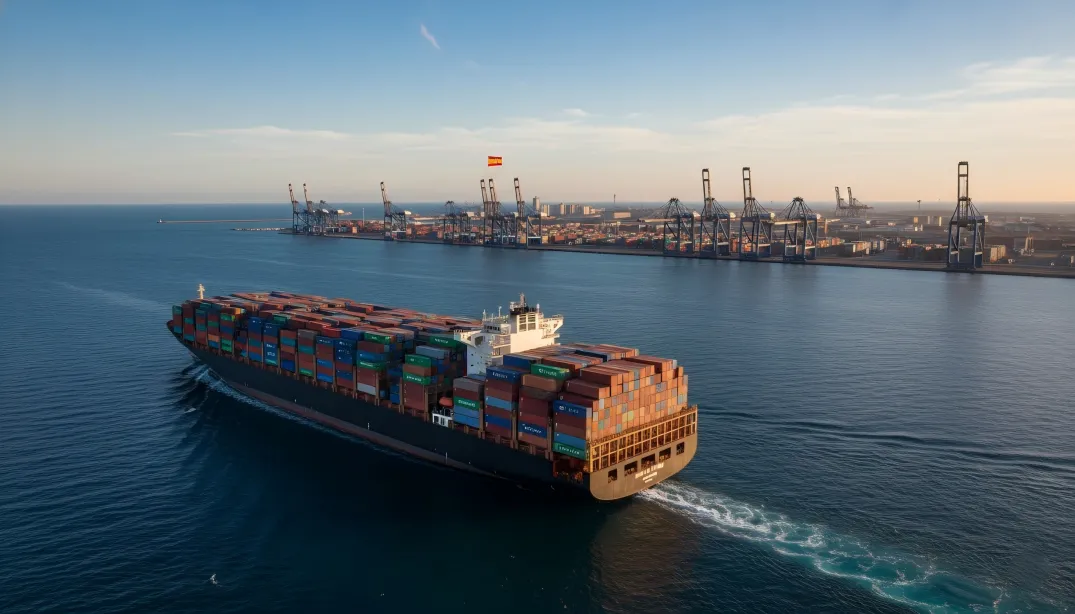
Guangzhou Port handles roughly 27 million TEUs annually, split across two main terminals: Nansha, a deep-water facility built for post-Panamax vessels, and Huangpu, which serves smaller feeder ships and barge traffic. For Spain-bound cargo, Nansha is the workhorse — with weekly sailings operated by COSCO, MSC, Maersk, and CMA CGM on the Ocean Alliance and 2M networks.
For air freight, Guangzhou Baiyun International Airport (CAN) is one of China's top three cargo hubs, handling over 2 million tons of freight annually. Direct and one-stop flights connect CAN to Madrid (MAD), Barcelona (BCN), and Valencia (VLC), making it the natural choice for high-value electronics and urgent shipments from the PRD.
2026 context matters. The Red Sea crisis forced carriers to reroute around the Cape of Good Hope, adding 10–12 days to Asia–Mediterranean transit times and driving base ocean rates up 35–40% in Q1 2026. Rates have since eased 16–19% from the April peak, but the gap between advertised base rates and your final invoice remains wide — a theme we will unpack in detail below.
Sea Freight from Guangzhou to Spain: FCL, LCL & Hidden Fees
Sea Freight from China is the dominant mode for Guangzhou–Spain shipments, accounting for the vast majority of containerized trade on this lane. It is the cheapest per-unit option for volumes above 1 CBM and the only practical choice for bulk cargo.
FCL Container Rates (2026)
Below are port-to-port base ocean freight benchmarks from Guangzhou to Spain's main gateways, as of mid-2026. Keep in mind that carrier quotes are typically valid for only 2–3 weeks.
| Container Type | Guangzhou → Barcelona | Guangzhou → Valencia | Guangzhou → Bilbao |
|---|---|---|---|
| 20GP (20ft) | $1,650 – $2,200 | $1,600 – $2,150 | $1,700 – $2,300 |
| 40HQ (40ft High Cube) | $2,850 – $3,820 | $3,000 – $4,000 | $3,100 – $4,100 |
| Transit Time (FCL) | 26 – 33 days | 26 – 33 days | 29 – 36 days |
For importers moving full containers regularly, our dedicated Container Shipping from China to Spain guide covers FCL costs, container types, and loading best practices in greater depth.
LCL Rates
For smaller shipments, LCL rates range from $45 to $120 per CBM, depending on the destination port and season. Most forwarders charge a minimum of 1 CBM even if your cargo is smaller. If you are new to consolidation, our LCL Shipping Guide explains how shared-container shipping works and when it beats FCL on total landed cost. Southern Chinese ports like Guangzhou and Shenzhen benefit from slightly shorter sailing distances versus northern ports, which keeps LCL rates 8–12% lower on average.
| Origin | Destination | Approx. LCL Cost (per CBM) | Transit (LCL) |
|---|---|---|---|
| Guangzhou | Barcelona | $45 – $110 | 30 – 40 days |
| Guangzhou | Valencia | $45 – $110 | 30 – 40 days |
| Guangzhou | Bilbao | $50 – $120 | 34 – 42 days |
The Surcharge Trap: What Base Rates Don't Include
A $3,200 base rate for a 40HQ from Guangzhou to Barcelona sounds reasonable — until you realize the final invoice could hit $4,700 or more. Here is a real all-in breakdown:
| Cost Component | Base-Only Quote | All-In Quote |
|---|---|---|
| Ocean Freight (Base) | $3,200 | $3,200 |
| Bunker Adjustment Factor (BAF) | Not included | $280 |
| THC (Origin + Destination) | Not included | $320 |
| Documentation / B/L Fee | Not included | $75 |
| War Risk Surcharge | Not included | $200 |
| Export Customs Clearance | Not included | $120 |
| Import Customs Clearance (Spain) | Not included | $180 |
| Inland Trucking (Port → Warehouse) | Not included | $350 |
| Estimated Total | $3,200 | $4,725 |
Our Industry Insight: We recently helped a Barcelona-based furniture importer audit a carrier-direct quote that looked competitive at $2,800 for a 40HQ from Guangzhou. Once we itemized origin THC, war risk surcharges, and documentation fees, the true all-in cost was $4,150 — a 48% jump. By renegotiating the surcharge structure and shifting cargo to a less congested sailing, we saved them $380 per container. Always, always ask for an all-in breakdown before booking.
FCL vs. LCL: The 15 CBM Rule
If your shipment exceeds roughly 15 CBM, FCL is usually cheaper per unit than LCL. Below that, LCL wins on upfront cost. Here is the quick decision matrix:
| Cargo Volume | Recommended Mode | Est. Cost (Port-to-Port) | Risk Level |
|---|---|---|---|
| Under 1 CBM | Courier / Air Freight | $5–$12/kg | Low |
| 1–8 CBM | LCL | $45–$120/CBM | Medium |
| 8–15 CBM | LCL or 20GP (compare) | $800–$2,400 | Medium |
| 15–33 CBM | FCL 20GP | $1,600–$2,200 | Low |
| 33–67 CBM | FCL 40HQ | $2,850–$4,000 | Low |
Air Freight from Guangzhou to Spain
When speed matters, Air Freight from China via Guangzhou Baiyun International Airport (CAN) is your best departure point in southern China. Direct flights to Madrid (MAD) and Barcelona (BCN) take roughly 14–16 hours in the air, with door-to-door timelines of 3–5 days for direct services and 5–8 days for one-stop connections.
Air Freight Costs (2026)
| Weight Band | Approx. Rate (per kg) | Best For |
|---|---|---|
| 30 – 100 kg | $7 – $9 | Samples, urgent documents |
| 100 – 500 kg | $6 – $8 | Small production batches |
| 500 – 1,000 kg | $5 – $7 | Regular e-commerce replenishment |
| 1,000+ kg | $5 – $6 | Bulk high-value goods |
When Air Freight Makes Sense
- High-value electronics from Dongguan or Shenzhen suppliers: $50/kg product value makes $5–$9/kg freight acceptable.
- Fashion and seasonal goods: Spanish retailers need summer collections on shelves, not on a 30-day container.
- Amazon FBA emergency restock: Running out of stock at Amazon.es costs more in lost ranking than the air freight premium.
- Samples and trade show materials: Small volumes where speed is everything.
Pro Tip: Air freight pricing uses chargeable weight — the greater of actual weight or volumetric weight (L × W × H in cm ÷ 6,000). A box of feather pillows from Guangzhou can cost more in air freight than a box of smartphones. Always calculate both before requesting a quote.
Rail & Multimodal Freight from Guangzhou to Spain
The China-Europe Railway Express offers a middle lane: roughly half the cost of air freight and two-thirds the time of sea freight. From Guangzhou, cargo typically transits through the Guangzhou Dalang Railway Station to a consolidation hub — usually Chengdu, Chongqing, Xi'an, or Yiwu — before joining the main rail corridor through Kazakhstan, Russia, Belarus, and Poland into the EU.
| Rail Route | Transit Time | Approx. Cost (40ft) | Best For |
|---|---|---|---|
| Guangzhou → Madrid | 18 – 25 days | $8,800 – $12,800 | Medium-volume industrial goods |
| Guangzhou → Barcelona (Rail + Road) | 20 – 25 days | $9,000 – $13,000 | E-commerce parcels, machinery |
Multimodal combinations are also worth considering: sea freight from Guangzhou to Koper (Slovenia) or Gdansk (Poland), then rail or truck into Spain, can beat pure sea freight on door-to-door timelines while staying close to sea freight pricing.
DDP Door-to-Door Shipping from Guangzhou to Spain
DDP (Delivered Duty Paid) is the most hands-off option for importers. Under DDP, your freight forwarder handles every step from Guangzhou supplier pickup to final delivery at your Spanish address — including export clearance, international transport, import customs, duty and VAT payment, and last-mile delivery.
The 6-Step DDP Process
- Pickup & Consolidation — Forwarder collects goods from your Guangzhou/PRD supplier and brings them to a consolidation warehouse.
- Export Customs Clearance — Chinese customs declaration, inspection if required, and release for export.
- International Transport — Sea, air, or rail from Guangzhou to Spain.
- Pre-Arrival Customs Filing — Spanish customs broker pre-submits import declaration before cargo lands.
- Import Clearance & Tax Payment — Duties and IVA (VAT at 21%) are paid by the forwarder on your behalf. Clearance typically takes 1–3 working days.
- Last-Mile Delivery — Cargo is trucked to your warehouse, store, or Amazon FBA center anywhere in mainland Spain.
DDP Cost Reference
| DDP Mode | Approx. All-In Cost | Transit (Door-to-Door) |
|---|---|---|
| DDP Sea Freight | $150 – $400 per CBM | 35 – 45 days |
| DDP Air Freight | $5.50 – $7.50 per kg | 5 – 10 days |
Incoterms at a Glance
| Incoterm | Export Clearance | Freight | Insurance | Import Clearance & Duty | Door Delivery |
|---|---|---|---|---|---|
| EXW | Buyer | Buyer | Buyer | Buyer | Buyer |
| FOB | Seller | Buyer | Buyer | Buyer | Buyer |
| CIF | Seller | Seller | Seller | Buyer | Buyer |
| DAP | Seller | Seller | Seller | Buyer | Seller |
| DDP | Seller | Seller | Seller | Seller | Seller |
For small-to-medium importers without a Spanish EORI number or local VAT registration, DDP eliminates the administrative headache entirely. You pay one price and receive goods at your door. For larger businesses with established customs broker relationships, FOB or CIF paired with self-managed import clearance may be more cost-effective. For importers distributing goods across the EU beyond Spain, we also offer dedicated Door to Door Shipping from China to France and Shipping from China to Germany for markets in Western and Central Europe.
Real-Life Scenario: A Guangzhou clothing wholesaler wanted to test the Spanish market with a 3 CBM trial shipment to a Madrid boutique. They went with DDP sea freight at roughly $1,050 all-in ($350/CBM). The goods arrived at the store 38 days later with zero customs interaction on their side. The hassle-free experience gave them the confidence to scale up to a full 20GP on their second order.
Spanish Customs, Duties & VAT
Spanish customs — known as Aduanas — processes imports under EU regulations. Clearance is straightforward if your documentation is complete, but mistakes are expensive.
How Duties and VAT Are Calculated
- Customs Duty = HS Code rate × CIF Value (Cost + Insurance + Freight)
- VAT (IVA) = 21% × (CIF Value + Customs Duty)
| Product Type | Typical HS Code | Duty Rate | Example (CIF $1,000) |
|---|---|---|---|
| Machinery & Equipment | Chapter 84 | 0 – 5% | Duty $30 + VAT $216 = $246 |
| Electronics | Chapter 85 | 0 – 14% | Duty $80 + VAT $227 = $307 |
| Textiles & Apparel | Chapters 61–63 | 12 – 16% | Duty $120 + VAT $235 = $355 |
| Furniture | Chapter 94 | 0 – 6% | Duty $40 + VAT $218 = $258 |
Essential Import Documents
- Commercial Invoice — Declares value and goods description.
- Packing List — Weight, quantity, dimensions per carton.
- Bill of Lading (B/L) or Air Waybill (AWB) — Proof of carriage.
- Certificate of Origin — May reduce duty under EU trade preference schemes.
- EORI Number — Required for any entity importing into the EU.
Common Pitfall: Under-declaring cargo value to reduce duty is a high-risk strategy in Spain. Aduanas has tightened verification since 2025, and undervaluation can trigger cargo detention, back-duty assessments, and penalties of up to 100% of the underpaid amount. Always declare the true transaction value.
All Modes Compared: How to Choose
Here is the side-by-side decision table for every shipping mode from Guangzhou to Spain:
| Mode | Cost | Transit (Door-to-Door) | Best For | Complexity |
|---|---|---|---|---|
| Sea FCL | $1,600–$4,000/container | 35 – 45 days | Bulk goods, furniture | Medium |
| Sea LCL | $45–$120/CBM | 40 – 50 days | Small batches, trial orders | Medium |
| Air Freight | $5–$9/kg | 5 – 10 days | High-value, urgent | Low-Medium |
| Rail | $8,800–$13,000/40ft | 22 – 30 days | Medium-volume, balanced | Medium |
| DDP Sea | $150–$400/CBM | 35 – 45 days | First-time importers | Low |
| DDP Air | $5.50–$7.50/kg | 5 – 10 days | Urgent e-commerce | Low |
Quick Decision Framework
- By volume: Under 1 CBM → courier/air. 1–15 CBM → LCL or DDP LCL. Over 15 CBM → FCL.
- By urgency: 3–5 days → air freight. 18–25 days → rail. 25–35 days → sea freight.
- By budget: Tight → sea FCL/LCL. Moderate → rail. Flexible → air.
- By convenience: Hands-off → DDP. Hands-on → FOB/CIF with your own customs broker.
E-commerce & Amazon FBA
For Amazon.es FBA sellers shipping from Guangzhou, you have three head-haul options: sea freight LCL to Amazon's Spanish fulfillment centers (MAD4, BCN1) via a forwarder that handles FBA labeling and palletization; air freight for urgent inventory replenishment; or DDP door-to-FBA service that includes customs clearance and Amazon appointment booking. The key is working with a forwarder who understands Amazon's carton labeling, pallet height restrictions, and delivery appointment requirements — mistakes here cause warehouse rejections.
Practical Tips for Guangzhou Shippers
Mind the Canton Fair calendar. Guangzhou hosts the Canton Fair every April and October. During these periods, container space out of Nansha tightens significantly and rates spike — book at least 3–4 weeks ahead if your shipment falls near Fair dates.
Plan around Chinese New Year (CNY). Factories across the PRD typically close for 2–4 weeks in late January/early February. The pre-CNY rush pushes freight rates up and creates equipment shortages. If your goods are not on the water by mid-January, expect delays until mid-February at best.
Watch South China typhoon season. From May through November, typhoons in the South China Sea can delay vessel departures from Nansha by 1–3 days. Build a 5-day buffer into your inventory planning during these months.
Use Guangzhou consolidation warehouses. If you source from multiple PRD suppliers — say, electronics from Dongguan and packaging from Zhongshan — consolidating everything at a Guangzhou warehouse saves money and simplifies documentation. Many freight forwarders with a Guangzhou presence offer free storage, quality inspection, palletizing, and labeling at their local CFS before export.
Choose your port pair strategically. Guangzhou → Valencia is often $50–$150 cheaper per container than Guangzhou → Barcelona for the same cargo, due to higher carrier competition on the Valencia lane. If your final destination is in central Spain, Valencia's rail and highway connections to Madrid are excellent.
Conclusion & Next Steps
You now have a complete picture of what it costs and how long it takes to ship from Guangzhou to Spain across every available mode in 2026. Sea freight remains the budget champion for bulk cargo, air freight is the speed play for high-value goods, rail fills the middle ground, and DDP removes the complexity for those who want a single invoice and a box at their door.
The right choice depends on your cargo type, volume, deadline, and comfort with customs. If you are unsure which mode suits your shipment best, start with a personalized freight quote that compares all options side by side for your specific goods and destination.
As a Shenzhen-based freight forwarder with deep roots in the Pearl River Delta, AllBestShipping manages Guangzhou–Spain shipments weekly — from factory pickup at Foshan furniture plants to last-mile delivery at Madrid warehouses. We offer transparent all-in pricing, real-time tracking, and a single point of contact from booking to delivery. Contact us today for your Guangzhou to Spain freight quote — no hidden fees, no surprises, just a straightforward plan for your cargo.