LCL Shipping Guide: Save Money on Small Loads
Are you a small business owner or an e-commerce seller struggling with high shipping costs? You don't have enough cargo to fill a 40-foot container, but air freight quotes are eating up all your profit margins. Enter LCL shipping—the "ride-sharing" of the logistics world.
Just as you might share an Uber to split the cost with other passengers, Less than Container Load (LCL) shipping allows you to share container space with other shippers. You only pay for the volume your goods occupy, making it the secret weapon for savvy importers who want to save money on small loads without sacrificing global reach.
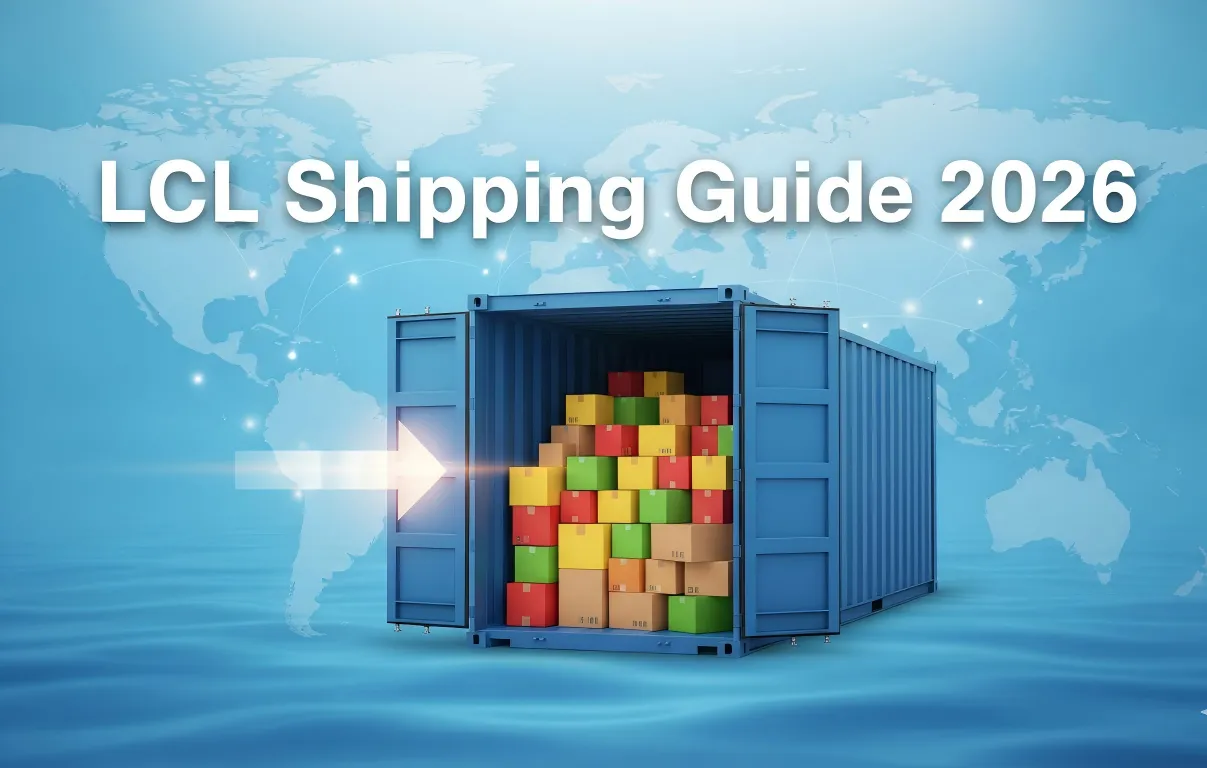
In this comprehensive guide updated for 2026, we will walk you through everything you need to know about LCL shipping: from calculating chargeable weight and understanding the step-by-step process to avoiding hidden fees and choosing the right freight forwarder like AllBestShipping.
What Is LCL Shipping?
LCL (Less than Container Load) is an ocean freight shipping method used when a shipper's cargo is not large enough to fill a standard 20ft or 40ft shipping container. Instead of paying for the entire container (as you would in FCL or Full Container Load), your goods are consolidated with cargo from other shippers into a single container.
The "Ride-Sharing" Analogy
Think of FCL shipping like hiring a private limousine. It's direct, private, and you pay a flat rate regardless of whether you are alone or have five friends with you.
LCL shipping, on the other hand, is like a public bus or a shared shuttle. You buy a ticket (pay freight) only for your seat (cargo space). The bus might make a few extra stops to pick up other passengers (consolidation), but the cost per person is significantly lower.
Why Is LCL Important in 2026?
With global trade becoming more accessible to small and medium-sized enterprises (SMEs), LCL has become a critical link in the supply chain. In 2026, with fluctuating ocean freight rates and a greater focus on inventory flexibility, LCL allows businesses to:
- Ship frequently: No need to wait months to accumulate enough stock for a full container.
- Test new markets: Send small batches of new products to test demand without a massive upfront investment.
- Manage cash flow: keep inventory lean and capital liquid.
Who Should Use LCL Shipping?
Deciding between Air Freight, LCL, and FCL can be tricky. Here is a general rule of thumb to help you decide if LCL is the right choice for your shipment.
The "Sweet Spot" for LCL
LCL is typically the most cost-effective solution for shipments with a volume between 1 CBM and 15 CBM (Cubic Meters).
| Shipping Method | Ideal Volume | Speed | Cost |
|---|---|---|---|
| Air Freight | < 1 CBM / < 100 kg | Fastest (3-7 days) | Very High |
| LCL (Ocean) | 1 CBM - 15 CBM | Moderate (20-45 days) | Low |
| FCL (Ocean) | > 15 CBM | Moderate (18-40 days) | Lowest per unit |
Scenario Examples
- Scenario A (Too small for LCL): You are shipping a 5kg box of samples. Air Express (DHL/FedEx) is better because the minimum port charges for LCL would make it too expensive.
- Scenario B (Perfect for LCL): You are shipping 5 pallets of electronics, totaling 6 CBM. This is too heavy for air freight but too small for a 20ft container (which holds ~33 CBM). LCL is the winner.
- Scenario C (Switch to FCL): You have 18 CBM of furniture. Even though it doesn't fill a 20ft container completely, the flat rate of an FCL container might be cheaper than paying the per-CBM rate for LCL.
How LCL Shipping Costs Are Calculated (The Math)
One of the most confusing aspects for new importers is understanding how LCL freight rates are calculated. Unlike FCL where you pay a flat fee per container, LCL is based on "Weight or Measure" (W/M).
The Golden Rule: 1 CBM = 1,000 kg
Freight forwarders will look at the volume (CBM) and the gross weight (kg) of your cargo. They will convert the weight into CBM using the ratio 1 ton (1000 kg) = 1 CBM. You will be charged based on whichever number is higher.
This is known as the Chargeable Weight or Revenue Ton.
Calculation Examples
Example 1: Light and Bulky Cargo (Charged by Volume)
- Cargo: 10 Pallets of pillows.
- Dimensions: Total volume is 12 CBM.
- Weight: Total weight is 800 kg (0.8 tons).
- Comparison: 12 CBM (Volume) vs. 0.8 CBM (Weight equivalent).
- Result: You are charged for 12 CBM.
Example 2: Heavy and Dense Cargo (Charged by Weight)
- Cargo: 2 Crates of steel machine parts.
- Dimensions: Total volume is 1.5 CBM.
- Weight: Total weight is 3,000 kg (3 tons).
- Comparison: 1.5 CBM (Volume) vs. 3.0 CBM (Weight equivalent).
- Result: You are charged for 3 CBM (or 3 Revenue Tons).
Pro Tip: Always ask your supplier to optimize packaging. If your cargo is "non-stackable," you might be charged for the empty space above your pallet!
The LCL Shipping Process: Step-by-Step
Understanding the journey of your goods helps you manage expectations and avoid delays. Here is the typical lifecycle of an LCL shipment with AllBestShipping:
Step 1: Booking and Documentation
You contact a freight forwarder to book space. You will need to provide the Commercial Invoice and Packing List. The forwarder issues a Booking Confirmation.
Step 2: Cargo Collection (CFS)
Your goods are picked up from the supplier's factory and taken to a Container Freight Station (CFS) at the port of origin (e.g., Shanghai, Shenzhen). This is where the "consolidation" happens.
Step 3: Consolidation
At the CFS, your cargo is grouped with goods from other shippers headed to the same destination. They are carefully loaded into a container to maximize space and ensure safety.
Step 4: Ocean Transit
The sealed container is loaded onto the vessel. During the voyage, you can track your shipment using the Bill of Lading (B/L) number.
Step 5: Deconsolidation (Destination CFS)
Upon arrival at the destination port (e.g., Los Angeles, Hamburg), the container is moved to a destination CFS. The container is opened, and shipments are separated (deconsolidated).
Step 6: Customs Clearance and Delivery
Once customs is cleared, your goods are either picked up by your truck or delivered to your door by the forwarder.
Key Benefits of LCL Shipping for Small Loads
Why do thousands of businesses choose LCL every day?
1. Cost Savings Compared to FCL
For small loads, paying for a full container is a waste of money. LCL allows you to pay strictly for what you use. If you only ship 2 CBM, you only pay for 2 CBM.
2. Reduced Inventory Pressure
Instead of buying 10,000 units to fill a container, you can buy 1,000 units and ship them LCL. This reduces your warehousing costs and keeps your capital available for marketing or other expenses.
3. Flexibility and Scalability
LCL allows you to scale up or down easily. During peak seasons, when FCL space is tight, LCL can sometimes be easier to book because forwarders have pre-booked allocations.
Tips to Save Money and Avoid Pitfalls with LCL Shipping
While LCL is cost-effective, "hidden fees" can catch you off guard. Here is how to protect your wallet.
1. Optimize Your Packaging
Stackability is key. If your pallets are pyramid-shaped or have fragile items on top that prevent stacking, the carrier effectively loses the space above your cargo. They will charge you for that air! Ensure your pallets are flat-topped and sturdy.
2. Understand Incoterms
Are you shipping EXW (Ex Works) or FOB (Free on Board)?
- EXW: You pay for everything from the factory door.
- FOB: The supplier pays for transport to the port and origin charges. FOB is generally safer for beginners as it avoids unexpected local charges in China.
3. Watch Out for "Destination Fees"
Some unscrupulous forwarders offer "zero freight" or extremely low ocean rates (e.g., $10/CBM) but then hit you with massive CISF (China Import Service Fee) or inflated handling charges at the destination. Always ask for an "All-In" quote that includes destination CFS fees.
4. Choose the Right Freight Forwarder
Working with an experienced forwarder like AllBestShipping ensures transparency. We provide clear breakdowns of Origin Charges, Ocean Freight, and Destination Charges so there are no surprises.
Trends in LCL Shipping for 2026
The logistics landscape is evolving. Here is what to watch out for this year:
- Sustainability: LCL is increasingly seen as a greener option compared to air freight. DHL and other carriers are reporting on carbon savings, as LCL consolidations maximize container utilization.
- Digitalization: Instant quoting and real-time tracking are becoming the standard. In 2026, you should expect your forwarder to provide digital visibility of your cargo status.
- E-commerce Growth: With the rise of platforms like TikTok Shop and Temu, small-batch LCL shipping is booming as sellers restock rapidly changing inventory.
Frequently Asked Questions About LCL Shipping
1. How long does LCL shipping take?
LCL usually takes 5-7 days longer than FCL. This extra time is needed for the consolidation (packing) at the origin and deconsolidation (unpacking) at the destination. For example, China to US West Coast might take 20-25 days.
2. Are my goods safe in a shared container?
Yes, but packaging is crucial. Since your goods are packed next to other cargo (which could be anything from heavy machinery to liquids), you must ensure your packaging is robust. We recommend professional palletizing and shrink-wrapping.
3. What are the common "hidden costs" in LCL?
The most common surprises are Destination Terminal Handling Charges (DTHC), CFS fees, and Warehousing fees if you don't pick up cargo within the "free time" (usually 3-5 days).
4. Can I ship personal effects via LCL?
Yes, LCL is great for moving household goods internationally. However, customs clearance for personal effects can be more complex than commercial cargo, so ensure you have all necessary forms.
5. What documents do I need?
At a minimum, you need a Commercial Invoice, Packing List, and Bill of Lading. If shipping hazardous materials (e.g., batteries), you will also need an MSDS and UN38.3 test report.
Conclusion
LCL shipping is a powerful tool for businesses looking to save money on small loads while maintaining a steady flow of inventory. By understanding how costs are calculated and following best practices for packaging and booking, you can turn logistics from a cost center into a competitive advantage.
Don't let the complexity of shipping intimidate you. Whether you are shipping 1 CBM or 10 CBM, AllBestShipping is here to guide you through every step of the process, ensuring your goods arrive safely, on time, and on budget.
Ready to get a quote? Contact AllBestShipping today and let us optimize your next LCL shipment!