Shipping from Shenzhen to UK: The Complete 2026 Logistics Guide
Are you struggling with unpredictable transit times, surging freight rates, and ever-changing UK customs regulations? Shipping from Shenzhen to UK has become significantly more complex in 2026, but it remains one of the most important trade lanes for British importers sourcing electronics, machinery, textiles, and consumer goods from the Pearl River Delta. In our experience managing UK-bound lanes from South China through the 2025 Red Sea crisis and the subsequent Cape of Good Hope rerouting, we have seen transit times swing by as much as 15 days within a single month. One electronics importer we work with saw their planned 32-day replenishment cycle stretch to 51 days in February 2026, forcing them to air-fuel an emergency shipment that wiped out their quarterly margin. Whether you are a seasoned procurement manager or launching your first container from Yantian Port, this guide will give you the exact data, processes, and cost benchmarks you need to move cargo with confidence. Read on to discover the fastest routes, the true price of ocean freight in today’s market, and how to avoid costly customs delays at UK ports.
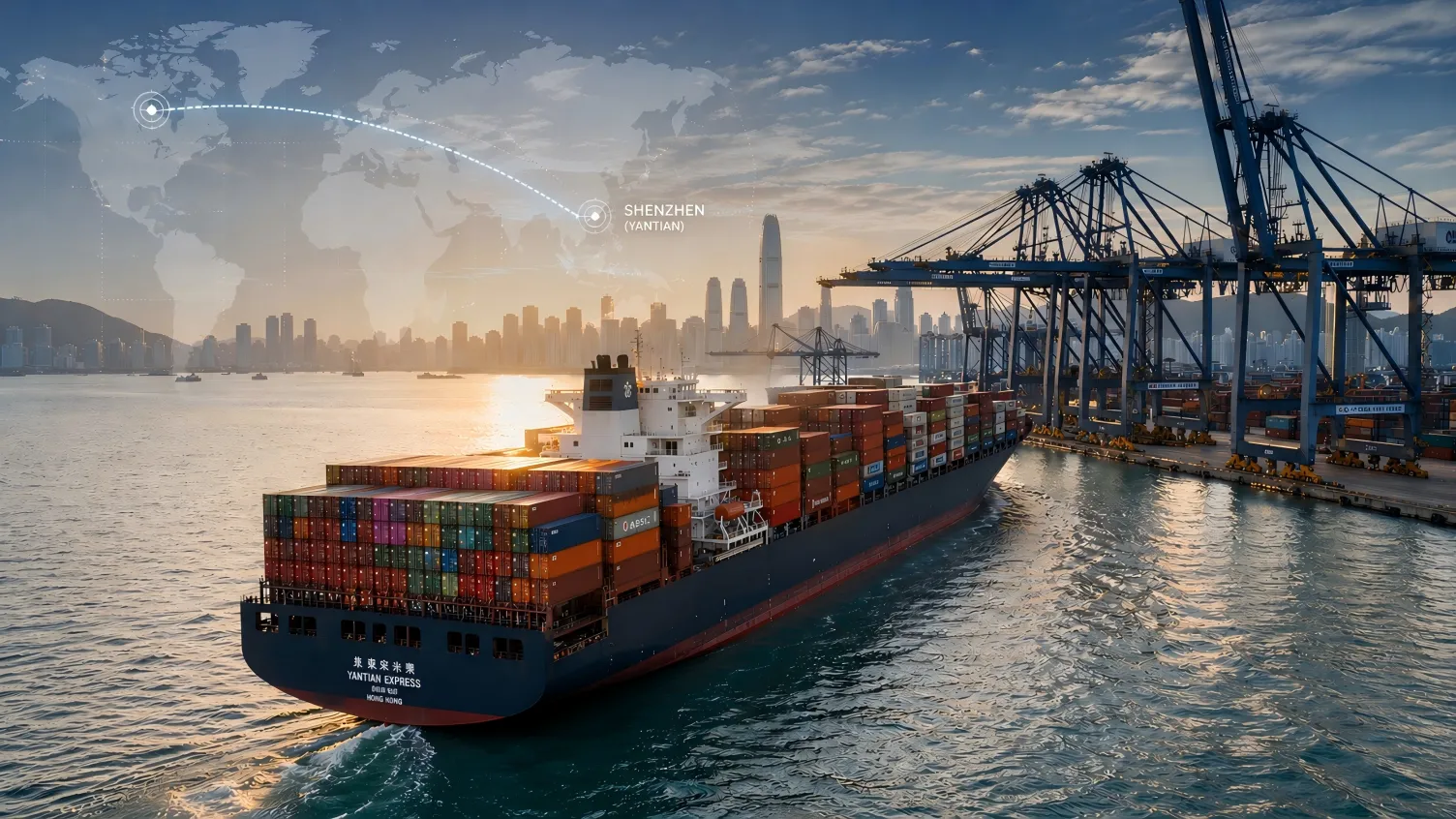
Why Shenzhen Remains the Premier Export Hub for UK-Bound Goods
Shenzhen is not just another Chinese city on a shipping label—it is the beating heart of global manufacturing exports. Located in the Pearl River Delta, Shenzhen sits within arm’s reach of Dongguan, Guangzhou, and Huizhou, giving importers access to one of the world’s densest manufacturing clusters. When you ship from Shenzhen, you are cutting inland trucking costs and shortening the lead time from factory floor to port gate.
The city’s port infrastructure is world-class. Yantian International Container Terminal handles the lion’s share of deep-sea vessels bound for Europe, while Shekou and Chiwan terminals support feeder services and specialized cargo. Major carriers including Maersk, CMA CGM, MSC, and COSCO operate direct strings from Yantian to Southampton, Felixstowe, and London Gateway. That direct access translates into fewer transshipments, lower risk of container damage, and more reliable sailing schedules than you would get from smaller Chinese ports.
From a operational standpoint, Yantian’s Friday and Sunday sailing windows to Europe are the most reliable. We have observed that Tuesday departures are more prone to rolling during peak season because carriers prioritize replenishing Asia-bound equipment. If your factory lead time is tight, booking a Friday string gives you a buffer against weekend gate-in congestion at the terminal.
For UK importers, the cost advantage is equally compelling. All-in trucking from a Dongguan factory to Yantian often costs less than moving the same cargo overland from inland China to Shanghai or Ningbo. In a year when every dollar of landed cost matters, shaving even a few percentage points off the pre-carriage budget can protect margins.
Shipping Methods: Express, Air, Sea, and Rail Compared
Choosing the right mode for shipping from Shenzhen to UK depends on three variables: speed, cost, and cargo volume. Below is a breakdown of each method with real-world April 2026 data.
Express Courier (DHL, FedEx, UPS)
Express courier services offer the fastest door-to-door solution. A 1 kg parcel from Shenzhen to London typically ranges from $12 to $42, depending on the carrier and service level. Transit times sit between 3 and 7 days, making express ideal for product samples, urgent spare parts, or time-sensitive documents.
The downside is cost. Express pricing is calculated on dimensional weight, which means bulky but lightweight goods can trigger surprisingly high charges. For shipments above 50 kg, express quickly becomes uneconomical compared to consolidated air freight.
There is also a practical limit that many first-time shippers overlook: lithium battery shipments via express require UN38.3 certification and specific packaging that not every supplier understands. We have seen dozens of parcels rejected at the SZX sorting hub because the MSDS sheet was missing the English translation or the battery label was affixed to the outer carton instead of the inner retail box. If you are shipping electronics with built-in batteries, always confirm that your supplier has packed to IATA Section II or Section IB standards before booking express.
Air Freight
Air freight from Shenzhen Baoan International Airport (SZX) to London Heathrow, Manchester, or Birmingham offers a middle ground between speed and cost. Current market rates hover around $7.70 to $14.17 per kilogram, with door-to-door transit times of 5 to 12 days.
Air freight shines when you need to restock fast-moving inventory or ship high-value electronics that justify the premium. SZX has expanded its cargo terminal capacity over the past two years, and direct freighter services to Europe have increased competition among carriers. That said, April 2026 has seen air rates surge by up to 88 percent from March due to capacity constraints and new security surcharges, so budgeting a buffer is wise.
A practical tip from our operations team: if your air freight volume exceeds 500 kg per week, consider booking a block-space agreement (BSA) with a forwarder rather than buying spot rates. A BSA locks in a fixed rate per kilogram for a set weekly allotment, insulating you from the 20 to 30 percent weekly spot-rate fluctuations we have seen on the SZX-to-LHR lane since January 2026.
Sea Freight (FCL and LCL)
Ocean freight remains the workhorse for shipping from Shenzhen to UK, especially for bulk inventory. However, 2026 has rewritten the rules on both cost and transit time.
FCL (Full Container Load) rates from Yantian have spiked dramatically. A 20-foot container now ranges from roughly $3,155 to $7,940, while a 40-foot high-cube container runs between $2,984 and $3,647—representing a 46 to 54 percent increase from March 2026 alone. The fastest premium lane, CMA CGM’s Yantian-to-Southampton service, delivers in approximately 37 days, while budget options like Maersk’s Yantian-to-London Gateway string take closer to 41 days.
LCL (Less than Container Load) is priced at roughly $70 to $130 per CBM, making it suitable for shipments between 1 and 15 cubic meters. LCL gives smaller importers access to sea freight economies without needing to fill an entire container.
One risk specific to LCL that general guides rarely mention is the consolidation delay at the CFS (Container Freight Station). Your cargo sits at the forwarder’s Shenzhen warehouse until the consolidator has enough volume to stuff the container. During slow weeks, that can add 3 to 7 days to your quoted transit time. If you are shipping LCL during Chinese New Year or Golden Week, ask your forwarder for the consolidation cut-off date, not just the vessel sailing date. We have seen importers miss retail launch windows because they planned around the sailing date while their cargo was still waiting to be stuffed at a warehouse in Bao’an.
Rail Freight
Rail freight has emerged as a compelling alternative amid ocean volatility. The China–Europe rail corridor, terminating in hubs like Malaszewicze or Duisburg before onward road haulage to the UK, offers transit times of 18 to 28 days at a mid-tier price point. DDP rail rates are commonly referenced around 23 RMB per kilogram. Rail is less susceptible to the Suez Canal disruptions plaguing sea lanes, and schedules have become more predictable as operators add dedicated block trains.
However, rail is not without its own quirks. Cargo undergoes transshipment at the Poland-Belarus border, where containers are moved from Chinese-gauge wagons to standard-gauge European wagons. This switch typically takes 24 to 48 hours, but geopolitical tensions can extend it. Additionally, certain commodities—batteries, liquids, and magnetic goods—face restrictions that vary by rail operator. Always confirm the operator’s latest restricted-goods list before booking, because what is acceptable on Chengdu-Europe Rail may be blocked on Xi’an-Europe Rail.
Mode Comparison Table
| Mode | Transit Time | Cost Level | Best For |
|---|---|---|---|
| Express Courier | 3–7 days | Very High | Samples, urgent documents, small parcels |
| Air Freight | 5–12 days | High | High-value goods, restocking, perishables |
| Rail Freight | 18–28 days | Medium | Mid-volume, stable demand, seasonal inventory |
| Sea FCL | 37–56 days | Low | Large volume, bulk inventory, stable supply chains |
| Sea LCL | 40–55 days | Low-Medium | Small to mid-size shipments (1–15 CBM) |
2026 Rate Environment and Market Dynamics
If you last shipped from China to the UK in 2024 or early 2025, the April 2026 market will look unfamiliar. Rate volatility is no longer the exception; it is the norm.
Current Rate Trends (April 2026 Update)
Sea FCL rates have surged 46 to 54 percent from March levels, driven by a perfect storm of factors. Equipment shortages persist in Northern Europe, carriers are rerouting vessels around the Cape of Good Hope, and emergency bunker surcharges are being applied with little notice. Air freight, while historically stable, has jumped as much as 88 percent on certain lanes due to security-related capacity restrictions.
The key takeaway for importers is that quotes now have a shelf life of roughly two to three weeks. Locking an all-in rate as early as possible is no longer a procurement best practice—it is a survival tactic.
In our view, this volatility is structural, not cyclical. Carrier alliances have reduced capacity on Asia-Europe lanes by blanking sailings to protect rates, and new vessel deliveries scheduled for late 2026 are unlikely to restore balance before Q1 2027. Importers who treat 2026 as a temporary spike and defer long-term planning will find themselves exposed to further increases in peak season.
Suez Canal Disruption Impact
Ongoing geopolitical instability in the Middle East has made Suez Canal transits risky or impossible for many carriers. Instead, vessels are sailing around the Cape of Good Hope, adding approximately 10 to 15 days to the journey. The result is a stark disconnect between marketed transit times and operational reality. While some forwarders still quote 25 to 35 days port-to-port, the real door-to-door experience for sea freight in 2026 is closer to 45 to 50 days.
This inflation has ripple effects. UK warehouses that planned for 30-day replenishment cycles are suddenly facing stockouts. The importers who have adapted successfully are those who rebuilt their inventory buffers around 50-day lead times and diversified some volume to rail.
From a cash-flow perspective, the Cape rerouting also ties up working capital for an additional 10 to 14 days. If you are paying your supplier on EXW terms before cargo departs Shenzhen, and your UK customer pays on 60-day terms after delivery, the financing gap has widened significantly. We are advising clients to renegotiate payment terms or secure supply-chain finance facilities to cover the extended transit window.
Peak Season Planning
The traditional peak season from September through January remains intact, but congestion now starts earlier and ends later. Expect to add 3 to 10 extra days to quoted transit times during this window. Booking space at least four to six weeks ahead of your desired sailing date is essential. If your supply chain allows, consider shipping a portion of peak inventory via rail in July or August to avoid the October-November ocean crunch.
Step-by-Step Shipping Process from Shenzhen to UK
Understanding the end-to-end workflow helps you identify delays before they become expensive problems.
Pre-Shipment Preparation
Before your cargo ever reaches the port, several preparatory steps must be completed. First, verify that your supplier has packed goods according to UK labeling standards and that carton weights are accurately declared. Incorrect weights are one of the most common causes of customs holds.
Next, confirm your HS code classification. The Harmonized System code determines your duty rate and whether your product falls under any UK restriction lists. If you are importing electronics, verify whether UKCA marking is required. While the UK has delayed full UKCA enforcement for some categories, compliance documentation should still be in order.
Finally, assemble your core document set: - Commercial Invoice (detailed description, unit value, total value, currency, Incoterms—must match the payment record exactly) - Packing List (carton count, net/gross weights, dimensions, SKU-level detail; mismatch between invoice and packing list weights is a top-three reason for Shenzhen customs inspection) - Bill of Lading instructions (consignee, notify party, delivery terms; for telex-release shipments, confirm the surrender fee is prepaid to avoid cargo hold at destination) - Certificate of Origin (if claiming preferential duty rates; for China-origin goods under the UK Global Tariff, this rarely provides relief, but some textile categories still benefit)
Booking and Carrier Selection
When booking shipping from Shenzhen to UK, you will face a choice between direct services and transshipment routes. Direct strings from Yantian to Southampton or Felixstowe are generally preferable because they reduce handling and minimize the risk of rolled cargo at intermediate hubs.
Always ask for an all-in quote that bundles the base ocean freight, BAF (Bunker Adjustment Factor), THC (Terminal Handling Charge), delivery order fees, storage, and UK haulage. Itemized quotes may look cheaper on paper but can explode once surcharges are applied in a volatile market.
Export Customs Clearance (China)
Shenzhen Customs processes export declarations electronically through the China Customs (GACC) single window platform. Your forwarder or supplier will submit the declaration, which includes the HS code, cargo value, and destination. Most general cargo clears within 24 to 48 hours. If your product requires inspection—common for batteries, chemicals, or food-contact materials—build in an extra 2 to 3 days.
One detail that separates experienced forwarders from novices: Shenzhen Customs will occasionally flag shipments for cargo weight verification under the VGM (Verified Gross Mass) mandate, even after the SOLAS deadline has passed. If the declared VGM deviates by more than 5 percent from the terminal’s weighbridge measurement, the container is pulled for re-weighing, and the shipper is fined. We recommend weighing containers at the factory gate using calibrated scales and photographing the scale readout as evidence.
In-Transit Tracking and Visibility
Modern container tracking tools allow you to monitor milestones from gate-in at Yantian to arrival at the UK port. Key events to watch include: - Vessel departure from Yantian - Transshipment events (if any) - Vessel arrival at UK port - Customs hold or release status - Container availability for haulage
Set up automated milestone alerts through your forwarder’s portal or a third-party platform like Project44 or Beacon. Exception management is critical in 2026 because rerouted vessels sometimes omit intermediate ports or change UK arrival terminals with short notice.
UK Import Customs Clearance
UK import clearance is handled through HMRC’s Customs Declaration Service (CDS). Before your goods arrive, your customs broker must submit an Entry Summary Declaration (ENS) at least 2 hours before arrival for short-sea shipping and 4 hours for deep-sea vessels, per HMRC safety and security import requirements. The full customs declaration must be lodged before the cargo can be released.
You will need a valid EORI number beginning with GB to import into the UK. Without it, your cargo will be held at the port until the number is provided, incurring demurrage (charges for keeping the container at the terminal beyond free time) and detention (charges for keeping the carrier’s container outside the terminal). For a standard 20-foot container at Southampton, demurrage typically starts at around £75 per day after the initial 7 free days, escalating to £150 per day after 14 days. These fees accumulate fast and are entirely avoidable with proper documentation.
Duties range from 0 to 17 percent depending on the HS code, and 20 percent VAT is applied to the CIF value plus duty. Many importers now use Postponed VAT Accounting (PVA), which allows you to account for import VAT on your VAT return rather than paying it upfront at the border. According to HMRC guidance, PVA is automatic for VAT-registered businesses if the deferment account is correctly declared on the customs entry; you do not need a separate approval. However, your accounting software must be able to reconcile the Monthly Postponed Import VAT Statement (MPIVS) against your purchase ledger. We have seen businesses struggle at year-end because their Xero or QuickBooks import VAT category was not mapped correctly to the MPIVS reference.
Final Delivery to UK Warehouse
Once cleared, your container is hauled by road to your warehouse or a third-party distribution center. If you shipped FCL, you will typically have a few hours of free time for unloading before detention charges apply. For LCL shipments, the forwarder’s UK partner will devan the container at a CFS (Container Freight Station) and deliver your pallets by curtain-side truck.
A practical consideration for FCL deliveries: if your UK warehouse does not have a loading bay, request a vehicle with a tail-lift when booking haulage. Standard curtain-side trucks cannot unload palletized cargo without a forklift or tail-lift, and requesting one at the last minute adds £80 to £150 to the delivery cost. We build tail-lift requirements into our standard booking form for UK FCL deliveries because forgetting this detail is one of the most common preventable expenses we see.
Understanding UK Customs, VAT, and Compliance
Customs compliance is where many first-time importers stumble. The UK’s post-Brexit regime is independent of the EU, which means rules that applied to Continental European imports do not automatically apply to UK entries.
EORI Registration
The EORI number is your unique identifier in the UK customs system. Applying is free through HMRC’s website, but processing can take up to a week. Common rejection reasons include mismatched business names, incorrect addresses, or applications from non-UK entities without a UK establishment address. If you are a non-UK business, you may need to appoint a UK-based customs agent or use your importer of record’s EORI.
Import Duties and Tariffs
Duty calculation starts with the HS code. The UK Global Tariff lists applicable rates for every product category. Some goods benefit from duty relief under trade preference schemes, though China-origin goods generally attract the standard tariff rate. Always confirm the latest tariff schedule before quoting landed costs to your customers.
VAT on Imports
Import VAT is charged at 20 percent on most goods. If you are VAT-registered, Postponed VAT Accounting lets you defer this payment and reclaim it on the same VAT return. Non-VAT-registered businesses and private importers must pay VAT upfront, which can create a significant cash-flow burden on high-value shipments.
Product Compliance and Labeling
The UKCA marking replaces the EU CE marking for goods placed on the Great Britain market. Electronics, toys, machinery, and personal protective equipment are among the categories affected. The UK government has extended recognition of CE marking for certain products until December 2027, but the transition timeline varies by sector. For example, medical devices still accept CE marking indefinitely under current guidance, while construction products must carry UKCA marking now. Your supplier in Shenzhen should be able to provide UKCA-compliant test reports issued by a UK-approved body and affix the marking before shipment. If they only have EU Notified Body certificates, you may need to arrange UKCA reassessment through a UK-based conformity assessment body, which adds 2 to 4 weeks and £800 to £2,500 to your pre-shipment timeline.
Additionally, ensure that carton labels include the country of origin, SKU references, and handling instructions in English. For textile imports, UK labeling requirements also mandate fiber composition percentages and care symbols that differ from EU standards.
DDP Shipping from Shenzhen to UK: Is It Worth It?
DDP (Delivered Duty Paid) is an Incoterm where the seller or forwarder assumes responsibility for all costs and risks until the goods reach the buyer’s premises, making it a popular door to door shipping from China to UK option. For UK importers without in-house customs expertise, DDP offers a compelling value proposition.
Under a DDP arrangement, the forwarder handles export clearance in China, ocean or air freight, UK import clearance, duty and VAT payment, and final delivery. The importer receives a single, predictable invoice. Current DDP rate references from Shenzhen include rail at roughly 23 RMB per kilogram and truck services around 25 RMB per kilogram, while DDP sea options are commonly quoted at 6 to 8 RMB per kilogram or approximately 1,600 RMB per CBM.
The primary advantage is cost certainty. There are no surprise demurrage bills, no unexpected VAT payments at the port, and no need to manage multiple vendors across time zones. The disadvantage is a higher upfront rate, since the forwarder is pricing in risk and working capital. Additionally, DDP places enormous trust in the forwarder’s UK customs competency. A poorly filed DDP declaration can still result in HMRC penalties that ultimately flow back to the importer.
DDP makes the most sense for small to mid-size importers who value simplicity over absolute cost minimization, and for e-commerce sellers who need landed-cost accuracy to set retail prices. That said, DDP is not always the best choice. If you are a VAT-registered UK business with an in-house customs team, shipping FOB or EXW and handling UK clearance yourself usually yields a lower total landed cost. The trade-off is administrative burden. We generally recommend DDP for importers moving fewer than 10 containers per year, and FOB/EXW for larger volume shippers who have the staff to manage customs internally.
How to Choose a Reliable Freight Forwarder
Not all forwarders are equipped to handle the complexities of shipping from Shenzhen to UK in 2026. When evaluating partners, look beyond the headline rate and ask these questions:
- Do you hold a valid freight forwarding license in both China and the UK?
- Can you provide all-in quotations that include BAF, THC, and UK haulage?
- What is your cargo insurance coverage, and how do I file a claim?
- Do you offer real-time tracking with milestone alerts?
- Who handles UK customs clearance—your own team or a subcontractor?
Red flags include vague answers about customs processes, refusal to provide all-in quotes, and pressure to book immediately without documentation review. A reputable forwarder will ask about your product, your HS code, and your delivery timeline before quoting.
Shenzhen-based forwarders offer distinct operational advantages. Their proximity to Yantian and SZX means they can conduct factory inspections, resolve packing issues on-site, and react quickly if Chinese customs requests additional documents. Companies like AllBestShipping specialize in UK-bound lanes from South China, offering competitive rates, stable capacity agreements with tier-one carriers, and dedicated UK customs teams that manage CDS filings directly. You can explore their services at AllBestShipping.
Cost Optimization Strategies
Even in a rising-rate environment, smart importers can reduce their landed cost through operational discipline.
Consolidation and Load Optimization
If you regularly ship LCL, calculate your break-even point against FCL shipping. A 20-foot container holds roughly 25 to 28 CBM. If your monthly volume approaches 15 to 18 CBM, the per-unit savings of upgrading to FCL often outweigh the unused space. Similarly, optimizing carton dimensions to maximize container cube utilization can reduce the number of containers you need over the course of a year.
Port and Route Selection
From South China, Yantian is usually the default for UK deep-sea cargo, but Shekou can be competitive for certain carrier alliances. On the UK side, Southampton is the busiest port for China trade, but London Gateway and Felixstowe offer alternatives. During periods of Southampton congestion, routing through Rotterdam or Hamburg with onward feeder service to the UK can sometimes bypass delays—though this adds transshipment risk.
Timing Your Shipments
If your supply chain allows flexibility, booking during the February-to-April or June-to-August windows often yields lower base rates and better equipment availability. Rail can also serve as a hedge: when ocean rates spike, rail’s stable pricing and faster transit become disproportionately attractive.
Common Mistakes and How to Avoid Them
Experience is the best teacher, but learning from others’ errors is cheaper. Here are the five most common mistakes we see in shipping from Shenzhen to UK:
- Underestimating transit times. If you are still planning around 25-day sea transits, you will stock out. Use 45 to 50 days as your baseline for ocean freight in 2026. One furniture importer we advised in late 2025 built their Q1 2026 stock plan around 28-day transits and ran out of inventory by mid-February, forcing them into a £14,000 air-freight emergency shipment.
- Incorrect HS code classification. A wrong code triggers customs holds, penalties, and reassessed duties. When in doubt, request an Advanced Tariff Ruling from HMRC. A common trap is classifying LED strip lights under 9405.40 (lighting fixtures, 0% duty) when HMRC often reclassifies them as 8539.50 (LED lamps, 3.7% duty). The difference is small per unit but significant at container volume, and HMRC can back-charge for previous shipments if they discover a pattern of misclassification.
- Neglecting EORI registration. Apply for your EORI at least two weeks before your first shipment. Do not wait until the container is already at Southampton. We have seen first-time importers incur £600 in demurrage because their EORI application was delayed over a bank holiday weekend.
- Skipping cargo insurance. Sea freight is generally safe, but containers go overboard, vessels catch fire, and theft happens at ports. Insure your cargo for its full commercial value plus freight. Standard carrier liability under the Hague-Visby Rules is capped at approximately £1,300 per package, which is nowhere near the value of a container full of electronics. We recommend all-risks marine cargo insurance with a reputable underwriter such as TT Club or Lloyd’s syndicate.
- Accepting non-all-in quotes in a volatile market. A low base rate with open-ended surcharges is a budget trap. Demand all-in pricing and read the fine print on BAF adjustment clauses. In March 2026, one importer accepted a $2,800 base rate for a 40HQ to Southampton, only to receive a $1,900 BAF and congestion surcharge invoice after sailing. Their all-in quote from another forwarder was $3,400. The "cheaper" option cost them $1,300 more.
Frequently Asked Questions
How long does shipping from China to UK really take from Shenzhen in 2026? Express takes 3 to 7 days, air freight 5 to 12 days, rail 18 to 28 days, and sea freight 37 to 56 days depending on routing and congestion. Due to Cape of Good Hope rerouting, many sea shipments are experiencing 45 to 50 days door-to-door.
What is the cheapest way to ship from Shenzhen to UK? For large volumes, sea FCL is the cheapest way to ship from China to UK on a per-unit basis. For smaller shipments, sea LCL or consolidated air freight offer better value than express courier.
Do I need an EORI number to import from China to UK? Yes. An EORI number beginning with GB is mandatory for all commercial imports into the UK.
What is the difference between FCL and LCL shipping? FCL means you book an entire container exclusively for your cargo. LCL means your cargo shares container space with other shippers. FCL is cheaper per unit at high volumes; LCL is more flexible for smaller shipments.
Is DDP shipping from Shenzhen to UK safe? DDP is safe if you work with a reputable forwarder who has direct UK customs expertise. Always verify the forwarder’s track record before committing to DDP terms.
How do I track my shipment from Shenzhen to UK? Your forwarder should provide a tracking portal or container number that you can use on carrier websites. Third-party platforms like Project44 also aggregate milestone data across carriers.
What happens if my goods are held at UK customs? HMRC will issue a customs inspection notice, and your broker will be asked to provide additional documentation. You may incur storage and demurrage fees while the hold is resolved.
Can I ship electronics and batteries from Shenzhen to UK? Yes, but batteries are classified as dangerous goods and require UN38.3 test summaries, MSDS sheets, and specific packaging. Electronics may require UKCA marking and relevant conformity documentation.
What documents are required for UK customs clearance? You need a Commercial Invoice, Packing List, Bill of Lading, accurate HS codes, and a valid EORI number. Certificates of Origin may be required for preferential duty claims.
How has Brexit affected shipping from China to UK? The UK now operates an independent customs regime through CDS. Import VAT, duty rules, and product compliance standards differ from the EU. ENS declarations are required before arrival, and UK-specific EORI numbers are mandatory.
Conclusion
Shipping from Shenzhen to UK in 2026 demands more planning, more documentation discipline, and more realistic timeline expectations than ever before. The importers who are thriving this year are not necessarily the ones paying the lowest rates—they are the ones who locked all-in quotes early, diversified across ocean and rail modes, and built their inventory models around 45-to-50-day sea transits rather than historical 25-day fantasies.
Success boils down to three factors: choosing the right transport mode for your volume and velocity, partnering with a forwarder who can navigate both Chinese export clearance and UK CDS requirements, and staying ahead of compliance obligations like EORI registration and UKCA marking.
Disclaimer: The rates, transit times, and regulatory guidance provided in this article are based on market conditions and official sources as of April 2026. Freight rates fluctuate daily, and customs regulations may change with short notice. Always verify current tariffs with HMRC’s UK Global Tariff tool and confirm carrier schedules directly with your forwarder before booking. This article is intended for informational purposes and does not constitute legal, tax, or financial advice.
If you are ready to take the guesswork out of your supply chain, request an all-in quote today and lock in capacity before the next rate surge. The market is volatile, but your logistics do not have to be.