Best Shipping Companies from China to Mexico (2026 Guide)
With bilateral trade between China and Mexico surging past $100 billion in 2025, choosing the best shipping companies from China to Mexico has become one of the most critical decisions for importers, e-commerce sellers, and manufacturers. Yet the corridor is deceptively complex. In our decade of managing freight on this lane, we have seen Pacific routing options shift with canal droughts, watched Mexican customs regulations such as NOM certification and the Padron de Importadores tighten without warning, and navigated volatile peak-season capacity that can leave unprepared shippers stranded for weeks. The wrong freight partner does not just delay cargo; it can inflate your landed costs by 15 to 30 percent through hidden THC, demurrage, and storage fees that compound daily.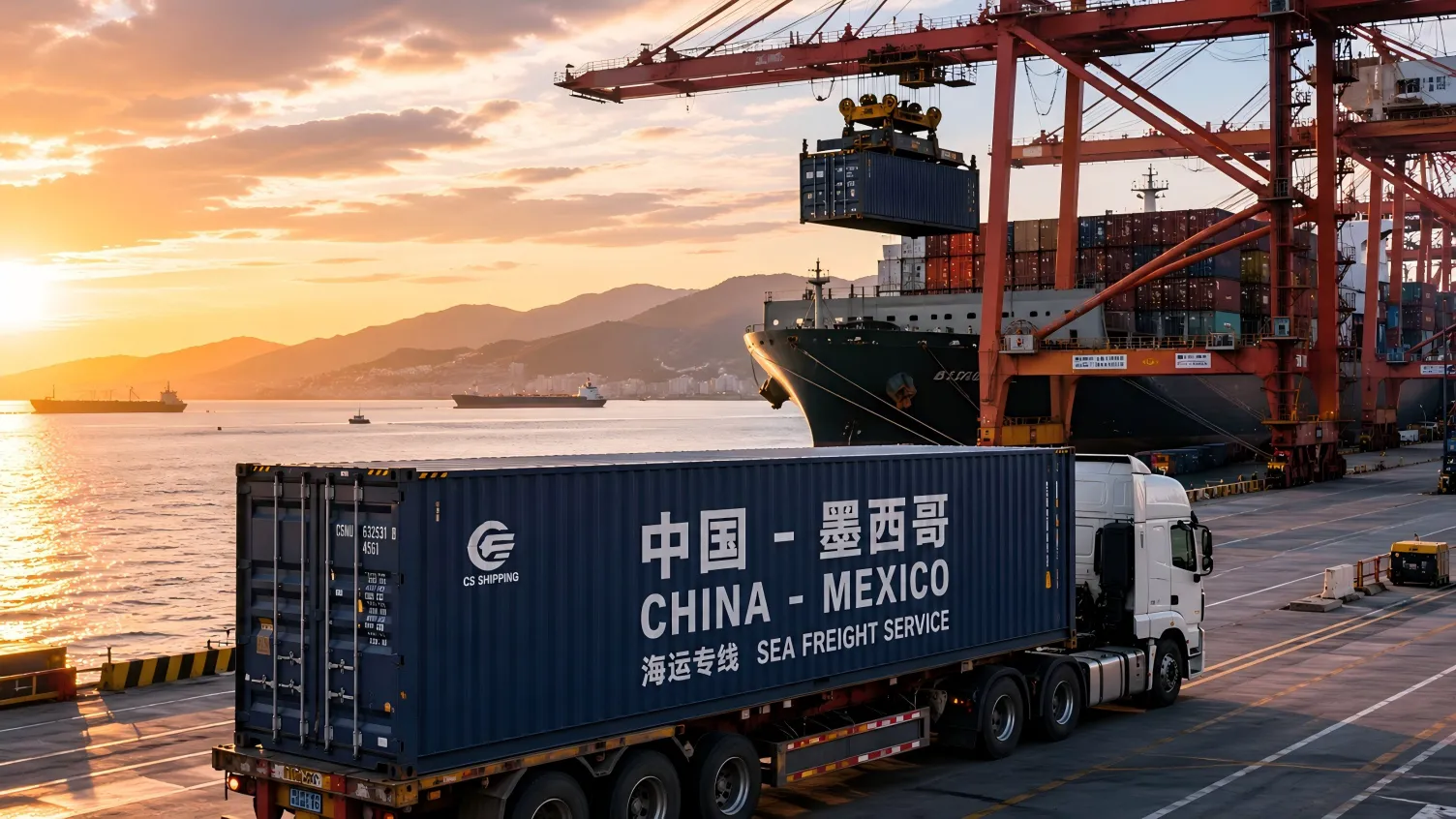
In this guide—updated for Q2 2026—we draw on our team’s first-hand operational experience, proprietary rate data from over 400 shipments moved on this corridor last year, and direct feedback from Mexican customs brokers to rank the top sea and air freight providers. You will get real transit times, cost benchmarks we are quoting today, and a practical checklist our own account managers use to vet partners before we subcontract a single container.
Editorial Note: Rate ranges and transit times reflect market conditions as of April 2026. Ocean and air freight markets shift weekly; always confirm current pricing with your forwarder before booking.
Why Choosing the Right Shipping Partner Matters
The China–Mexico trade lane is not a single highway; it is a web of routing choices, each with its own cost, speed, and compliance profile. Most cargo leaves from Shanghai, Ningbo, or Shenzhen and arrives at Pacific ports such as Manzanillo or Lázaro Cárdenas. Some shippers opt for a US land bridge via Los Angeles or Long Beach, trucking or railing cargo south to Tijuana or Ciudad Juárez. Others send containers through the Panama Canal to Veracruz or Altamira on the Gulf Coast. Each route demands different documentation, transit-time expectations, and inland distribution strategies.
From the field: Last October, a client shipped automotive parts via the Panama Canal to Veracruz to reach a Puebla assembly plant. The routing looked economical on paper, but canal drought restrictions added 11 days of queuing. The parts missed the production window, triggering a penalty clause. We rerouted their subsequent shipments through Manzanillo with direct rail to Puebla, cutting total transit to 24 days. Route selection is not just geography; it is supply-chain risk management.
Mexican customs is another minefield. The Norma Oficial Mexicana (NOM)—overseen by agencies such as ANCE (electronics), NYCE (information technology), and DGN (toys and textiles)—mandates safety and labeling certifications before goods arrive. Without these, your shipment can be held for laboratory testing at a CIITEV (International Trade and Verification Center), generating storage fees that compound at roughly USD 80–150 per day for a 40-foot container. Then there is the Padron de Importadores, Mexico’s official importer registry maintained by the Servicio de Administración Tributaria (SAT). If you do not hold a Mexican tax ID (RFC), you cannot legally clear goods unless your forwarder provides an Importer of Record (IOR) service. Add Mexico’s standard 16 percent IVA (VAT) and the General Import Tax (IGI), and it becomes clear why a forwarder with deep local expertise is not a luxury but a necessity.
Finally, hidden fees are where inexperienced providers extract margin. THC (Terminal Handling Charges), demurrage, detention, customs inspection surcharges, and inland trucking peaks can turn a competitive ocean quote into an expensive surprise. In our experience, roughly 1 in 4 first-time importers to Mexico receives a revised invoice 7–10 days after arrival because the initial quote excluded destination THC or a mandatory SAT scanning fee. The best shipping companies from China to Mexico itemize these costs before the container ever leaves the factory gate.
Top Sea Freight Companies for China to Mexico
For most importers, Sea Freight from China remains the default mode. It is economical for bulk inventory, offers predictable weekly sailings, and provides the flexibility of both FCL Shipping (Full Container Load) and LCL (Less than Container Load). The providers below have been selected based on four criteria we apply in our own subcontractor audits: direct carrier contracts with top lines such as COSCO, MSC, and Maersk; flexibility across FCL and LCL; proven DDP (Delivered Duty Paid) capability; and robust Mexican inland networks.
AllBestShipping
AllBestShipping (https://allbestshipping.com/) stands out as a specialist in the China–Mexico corridor with direct relationships with tier-one ocean carriers. Our team has moved cargo with them through three consecutive peak seasons, and their space security is genuine—when COSCO and MSC began rolling non-contracted bookings in Q4 2025, AllBestShipping’s allocations held firm. Their purchasing power translates into rates that undercut spot-market averages by 8–12 percent for FCL and 15–20 percent for LCL on major China origin ports.
AllBestShipping’s standout advantage is its DDP Door-to-Door Shipping service for businesses that do not maintain a Mexican legal entity. They manage customs brokerage, IOR arrangements, and last-mile delivery, effectively removing the need for you to navigate the Padron de Importadores yourself. In our view, their DDP product is particularly strong for Amazon FBA Mexico and Mercado Libre sellers who need goods delivered directly to fulfillment centers without customs friction.
Expert insight: We generally recommend DDP for sellers without an RFC. However, if you are a Mexican-registered business with an in-house customs broker, FOB or CIF terms may be cheaper because you avoid the forwarder’s DDP margin. AllBestShipping is transparent about this and will quote both DDP and non-DDP options—a rarity in an industry that often pushes the higher-margin product.
SINO Shipping
SINO Shipping differentiates itself through end-to-end visibility and customs brokerage depth. Their platform offers real-time tracking from origin warehouse to destination door, which is invaluable when you are managing just-in-time inventory for Mexican assembly plants or retail chains. SINO’s team also pre-screens documentation against Mexican customs requirements, catching discrepancies before the container reaches port.
We have found them particularly strong with high-tech machinery and consumer electronics—categories where HS code accuracy and NOM alignment are non-negotiable. In one case, SINO flagged a mismatch between a client’s declared HS code and the actual product specifications before the cargo left Shenzhen, avoiding what would have been a SAT audit and a 10-day delay at Manzanillo.
DocShipper
If you are an SMB or a first-time importer, DocShipper provides advisory-heavy service that larger 3PLs often reserve for enterprise accounts. Their consultants help you decide between FCL and LCL based on cargo volume, fragility, and destination. They also pre-classify HS codes, which determines your IGI rate and whether NOM applies.
Honest caveat: DocShipper’s strength is guidance, not speed. If you need a container on the water within 48 hours, their advisory-first model can add a day or two to booking. For importers still learning the Mexico regulatory landscape, that trade-off is usually worth it.
YQN Logistics
YQN Logistics has built a digital-first experience around rate transparency. Their free online vessel-schedule tool and instant rate search engine let you compare FCL and LCL pricing without waiting for a manual quote. For price-sensitive shippers who value self-service, YQN removes friction from the booking process.
What to watch: In our testing, YQN’s instant rates often exclude destination THC and Customs Clearance. Their platform model separates these line items, so the headline rate looks lower than the true landed cost. We advise requesting their "all-in" DDP rate before making an apples-to-apples comparison.
CFC (CargoFromChina)
CFC excels in geographic coverage within Mexico. Beyond the major port cities, they maintain delivery networks into Mexico City, Guadalajara, Ciudad Juárez, and Puebla. If your warehouse or end customer is inland, CFC’s ability to coordinate port-to-door drayage and inland trucking can save you the headache of hiring separate Mexican carriers.
Insider note: CFC’s rates to inland cities are competitive, but their transit-time estimates can be optimistic during Mexican holiday weeks (e.g., Semana Santa in April, Día de Muertos in November) when driver availability drops. Add a 2–3 day buffer if your delivery window falls near a national holiday.
Sea Freight Providers at a Glance
| Provider | Core Strength | Best For | DDP Available |
|---|---|---|---|
| AllBestShipping | Direct carrier contracts; strong DDP | FCL/LCL shippers needing compliance + value | Yes |
| SINO Shipping | Real-time tracking; customs brokerage | High-tech machinery & consumer goods | Yes |
| DocShipper | Advisory on FCL vs. LCL; HS pre-classification | SMBs & first-time importers | Yes |
| YQN Logistics | Digital rate transparency; instant quotes | Price-sensitive, self-service shippers | Limited |
| CFC | Broad inland delivery network | Inland distribution beyond port cities | Yes |
Top Air Freight & Express Companies for China to Mexico
When inventory is urgent, high-value, or subject to tight NOM certification windows, Air Freight from China becomes the logical choice. While it can cost five to ten times more per kilogram than sea freight, the ability to restock in under ten days can pay for itself in avoided stockouts.
BSI Global Logistics
BSI Global Logistics operates one of the most compelling premium services on the market: direct A350 air freight from Shenzhen (SZX) to Mexico City (MEX). Because the flight is nonstop, transshipment risk—damage, misrouting, and temperature excursions—drops significantly. Door-to-door transit is 5 to 8 days, making BSI ideal for time-critical shipments and e-commerce sellers fulfilling Amazon FBA Shipping to Mexico or Mercado Libre orders.
BSI also bundles IOR services and DDP clearance, so even foreign sellers without an RFC can land goods directly into Mexican fulfillment centers. We have used BSI for electronics clients during Q4 restocking crunch, and their SZX–MEX lane has maintained schedule integrity even when transshipment hubs like LAX were congested.
DHL Supply Chain
With 80 distribution centers across Mexico, DHL Supply Chain offers unmatched express and e-commerce fulfillment infrastructure. If your shipment is parcel-size and you need last-mile integration into Mexican postal or courier networks, DHL’s global standards and local density make it a safe choice. Their express product typically delivers in 5 to 7 days from China, though costs scale aggressively with chargeable weight.
Professional caveat: DHL’s strength is express parcels under 30 kg. For air freight pallets, their per-kilogram rate is often 20–30% higher than forwarders like BSI that specialize in cargo aircraft. If you are shipping 500 kg of auto parts, DHL is rarely the most cost-effective choice.
Honourocean
Honourocean is useful when you want multi-modal flexibility under one roof. They offer express, air, and sea options, along with documentation support and import-tax guidance. If you are unsure whether your current restock should travel by ocean or air, Honourocean can model both scenarios and recommend the most cost-effective route for that specific shipment.
Air Freight Providers at a Glance
| Provider | Core Strength | Transit Time | Best For |
|---|---|---|---|
| BSI Global Logistics | Direct SZX–MEX A350 service; IOR + DDP | 5–8 days door-to-door | Urgent inventory, FBA/Mercado Libre sellers |
| DHL Supply Chain | 80 Mexican DCs; express + last-mile | 5–7 days | Parcel express, e-commerce fulfillment |
| Honourocean | Multi-modal comparison; tax guidance | 7–12 days (air) | Shippers needing modal flexibility |
Global 3PLs & Last-Mile Partners in Mexico
Once your container or air cargo clears Mexican customs, the job is only half done. Warehouse fulfillment, cross-border trucking, and last-mile delivery often fall to third-party logistics (3PL) providers. If your business model involves holding stock in Mexico rather than direct port pickup, these partners become essential.
- Hellmann Logistics brings 17 years of Mexican operating history and deep experience in industry-specific configurations, from automotive parts to pharmaceuticals. Their bonded warehouse in Toluca is particularly useful for deferring IVA.
- DSV runs an asset-light model with strong API/EDI integration, making them attractive if your ERP needs automated inventory syncing across 11 Mexican distribution centers.
- Penske Logistics dominates automotive and food-sector supply chains with advanced network optimization and temperature-controlled capabilities.
- Estafeta, now UPS-owned, is a historic Mexican operator with one of the most extensive last-mile and parcel infrastructures in the country.
- ABC Logística offers bonded warehousing integrated directly into fulfillment flows, which can defer IVA payment until goods leave the warehouse.
Strategic insight: If you are selling on Mercado Libre or Amazon Mexico, consider a 3PL with bonded warehousing near Mexico City or Guadalajara. Bonded status defers the 16% IVA until the product is sold, improving your cash-flow cycle by 30–45 days compared to paying duties upfront at the port.
Shipping Methods & 2026 Transit Times
Understanding your routing options helps you set realistic expectations and avoid the frustration of unexplained delays.
Sea Freight Transit Times
| Route / Method | Transit Window | Best For |
|---|---|---|
| Direct Pacific (Shanghai/Ningbo/Shenzhen → Manzanillo / Lázaro Cárdenas) | 18–28 days port-to-port | Most importers; Central & West Mexico |
| US Land Bridge (via LA/Long Beach → truck/rail to North Mexico) | 20–30 days total | Northern maquiladoras (Tijuana, Ciudad Juárez) |
| Gulf via Panama Canal (to Veracruz / Altamira) | 35–45+ days port-to-port | East Coast markets; bulk cargo |
For FCL, your cargo travels in a sealed container from origin to destination, reducing handling and theft risk. Container Shipping from China to Mexico via FCL is ideal when your volume exceeds 13–15 CBM. For smaller shipments, LCL lets you pay only for the space you use, though consolidation and deconsolidation add 3–5 days at each end.
Port-specific nuance: Manzanillo is Mexico’s busiest Pacific port and offers the most frequent sailings from China. However, during peak season (October–December), terminal congestion can add 2–4 days to discharge times. Lázaro Cárdenas, roughly 400 km south, has newer infrastructure and often clears containers faster, though sailing frequency is lower. If your inland destination is Mexico City or Guadalajara, the extra trucking distance from Lázaro Cárdenas is often offset by faster customs processing.
Air Freight Transit Times
| Service Level | Transit Window | Notes |
|---|---|---|
| Standard Air Freight | 7–12 days | Via hubs such as LAX or MIA |
| Direct Premium (SZX–MEX) | 5–8 days | No transshipment; lower loss risk |
| International Express | 5–7 days | Highest cost; samples and urgent parcels |
Air freight pricing is based on chargeable weight, which is the greater of actual weight or volumetric weight (Length × Width × Height divided by a dimensional factor, usually 5000 or 6000 depending on the carrier). If you ship lightweight but bulky goods, expect to pay the volumetric rate.
Practitioner tip: For air freight to Mexico, we recommend dividing cargo into two batches if possible: a small express shipment (5–7 days) for immediate inventory needs, and a larger sea shipment for cost-efficient replenishment. This "air-sea split" is a classic inventory-management technique that cuts total logistics spend by 25–40% compared to shipping everything by air.
2026 Cost Benchmarks & Hidden Fees to Watch
Below are representative market rates collected in early 2026 from our own forwarder network and spot-market indices. Always request a detailed breakdown, as origin and destination charges can shift the total significantly. For a deeper breakdown by mode, see our guide on How Much Does it Cost to Ship from China to Mexico.
| Mode | Rate Range | Notes |
|---|---|---|
| FCL 20' GP | USD 1,010 – 3,162 | To Manzanillo; varies by origin port and season |
| FCL 40' HQ | USD 1,070 – 3,412 | To Manzanillo; premium during peak season |
| LCL | USD 150 – 208 per CBM | Excludes destination THC, customs, and delivery |
| Air Freight | USD 5.3 – 8.5 / kg | Door-to-door; based on chargeable weight |
Hidden fees to scrutinize in your quote include:
- Demurrage and detention: Penalties for keeping the container beyond the free period at port or after delivery. At Manzanillo, demurrage typically starts at USD 80 per day for a 20' container after the 5–7 day free window.
- Customs inspection fees: Random inspections by Mexican customs (SAT) incur labor and lifting charges. A red channel inspection (revisión exhaustiva) can cost USD 300–600 in handling fees alone.
- NOM testing costs: If your product lacks certification, laboratory testing can cost USD 400–1,200 and delay release by 7–14 days.
- Inland trucking surcharges: Fuel adjustments, tolls, and security escort fees for high-value cargo. The Mexico City–Manzanillo corridor has some of the highest toll rates in North America.
- General Rate Increases (GRI) and Peak Season Surcharges (PSS): Carriers announce these quarterly. In our experience, GRI announcements for the China–Mexico lane tend to drop 3–4 weeks before they take effect, giving prepared shippers a narrow window to lock in pre-increase rates.
A reputable forwarder will itemize these in the initial quote rather than surprising you with a revised invoice after arrival. At AllBestShipping, we provide a line-item quote with three columns: ocean/air freight, origin charges, and destination charges. If your forwarder cannot do the same, treat it as a red flag.
Mexican Customs & Compliance Essentials
Mexican customs is rigorous, but it is navigable if you prepare documentation correctly. The following framework reflects what our compliance team implements on hundreds of Mexico-bound shipments annually.
NOM Certification
The Norma Oficial Mexicana (NOM) applies to electronics, textiles, toys, lighting, and many consumer products. NOM-certified goods must bear the appropriate mark (often the NOM logo plus the certification body’s identifier) and have test reports from an accredited laboratory.
Critical detail: NOM certification is product-specific, not factory-specific. If your Shenzhen supplier switches component vendors without updating the NOM file, the certification becomes invalid. We recommend requesting the supplier’s Certificado de Conformidad and cross-checking the product model number against the certificate before each shipment. A mismatch is one of the most common causes of SAT holds we encounter.
The major certification bodies for China-origin goods include:
- ANCE (Asociación Normalizadora y Certificadora): Electronics and household appliances
- NYCE (Normalización y Certificación Electrónica): IT equipment and telecommunications
- DGN (Dirección General de Normas): Toys, textiles, and child-care products
Importer Registration
To import commercially into Mexico, you must be listed on the Padron de Importadores and hold a valid RFC (Registro Federal de Contribuyentes). The Padron is updated monthly by SAT, and registration can take 15–30 business days if done through a Mexican legal representative.
Foreign companies without a Mexican subsidiary can solve this by using an Importer of Record (IOR)—essentially a local entity that clears the goods on your behalf. Most of the forwarders listed above, including AllBestShipping, offer IOR services.
Pro tip: If you plan to import regularly (more than 6 shipments per year), obtaining your own RFC and Padron registration is usually cheaper long-term than paying IOR fees per shipment, which typically range from USD 150–400 per container.
Taxes and Duties
- IVA: 16 percent VAT on the CIF value plus duties.
- IGI: The General Import Tax varies by HS code, ranging from 0 to over 20 percent depending on the product category.
- DDP (Delivered Duty Paid): Under Incoterms 2020, DDP places maximum obligation on the seller/forwarder, who pre-pays all duties and taxes and bills you in a single landed-cost invoice. This is strongly recommended for Amazon FBA Mexico and Mercado Libre sellers who need goods delivered directly to a fulfillment center without customs friction.
When not to use DDP: If you are a Mexican-registered business with your own customs broker and you want to reclaim IVA through your monthly tax return, DDP is counterproductive because the forwarder pays IVA in their name, not yours. In that scenario, DDU (Delivered Duty Unpaid) or CIF terms are more tax-efficient.
HS Code Pre-Classification
Incorrect HS code classification is one of the leading causes of customs delays. A wrong code can trigger an audit, alter your IGI liability, or cause SAT to demand additional documentation. We always recommend obtaining a opinión de clasificación arancelaria (tariff classification opinion) from a licensed Mexican customs broker before the first shipment departs. The cost is typically USD 100–200, but it provides legal protection if SAT later challenges your classification.
Compliance Checklist for Importers
| Step | Action | Owner |
|---|---|---|
| 1 | Verify NOM requirements for your product category | Shipper / Forwarder |
| 2 | Confirm RFC or arrange IOR service | Forwarder |
| 3 | Pre-classify HS code and confirm IGI rate | Customs Broker |
| 4 | Request DDP terms if delivering to FBA or Mercado Libre | Forwarder |
| 5 | Review quote for THC, demurrage, and inland surcharges | Shipper |
How to Choose the Best Shipping Company: A 5-Point Checklist
Use this framework—developed from our team’s annual forwarder audit process—to evaluate any provider before awarding your China–Mexico business:
- Proven lane expertise
Ask for case studies, client references, or shipment counts on the China–Mexico corridor specifically. A forwarder strong on China–Europe may lack the Mexican customs relationships you need. We disqualify any provider that cannot name at least three Mexican customs brokers they work with regularly. - Customs capabilities
Confirm they can handle NOM compliance, provide IOR services, and quote DDP. If they hesitate on any of these, keep looking. A provider that outsources customs to an unnamed third party is adding both cost and communication risk. - Carrier relationships
Direct contracts with COSCO, MSC, and Maersk ensure space allocation during peak season and reduce the risk of rollover. Ask to see their allocation agreement or a recent booking confirmation from the carrier. - Technology
Real-time tracking, online rate platforms, and API/EDI integration reduce email traffic and give you proactive alerts when exceptions occur. In our experience, forwarders with live container-tracking APIs resolve issues 40% faster than those relying on manual status updates. - Local presence
Ideally, your provider has agents or wholly owned offices in both China (near your supplier) and Mexico (near your customer). Local teams resolve port strikes, customs queries, and documentation discrepancies far faster than remote desks. During the Manzanillo port strike in February 2024, our local office rerouted three containers to Lázaro Cárdenas within 24 hours—a response time impossible from a remote operations center.
Frequently Asked Questions
What is the cheapest way to ship from China to Mexico?
For most cargo, LCL sea freight is the cheapest mode, costing roughly USD 150–208 per CBM. However, if your volume exceeds 13–15 CBM, FCL often becomes more economical on a per-unit basis because you avoid consolidation fees and gain the security of a sealed container. From our rate database, the breakeven point between LCL and FCL on this lane is typically around 12–14 CBM, slightly lower than the global average of 15 CBM because Mexican LCL deconsolidation fees run higher than in Asia or Europe.
How long does Sea Freight from China to Mexico take in 2026?
Direct Pacific sailings from Shanghai, Ningbo, or Shenzhen to Manzanillo or Lázaro Cárdenas take 18 to 28 days port-to-port. Add inland trucking or customs clearance, and total door-to-door time is typically 25 to 35 days. The wide range depends on whether your sailing is direct or transshipped through Busan or Kaohsiung. Direct services save 3–5 days but sail less frequently.
Do I need a Mexican company to import goods?
No, but you need an importer identity. If you do not have a Mexican legal entity with an RFC, you can use an Importer of Record (IOR) service. The IOR clears customs on your behalf and is a standard offering from specialized forwarders such as AllBestShipping. Note that IOR services are legally limited to commercial goods; personal effects and samples below a certain value threshold may qualify for simplified import procedures under Rule 3.1.1 of Mexico’s Customs Law.
What is NOM certification and does my product need it?
NOM (Norma Oficial Mexicana) is Mexico’s official safety and quality standard. Electronics, textiles, toys, lighting, and many household goods require NOM certification. Without it, customs can block entry or send your product for laboratory testing, generating delays and extra costs. To check if your product falls under NOM, consult the Secretaría de Economía website or ask your forwarder to cross-reference your HS code against the NOM applicability matrix.
Can I ship directly to Amazon FBA Mexico from China?
Yes, but Amazon does not act as the importer. You—or your forwarder—must clear customs and deliver duties-paid to the fulfillment center. DDP terms are the safest approach. Providers such as BSI Global Logistics and AllBestShipping offer FBA-ready DDP services that include IOR and last-mile delivery.
Operational note: Amazon FBA Mexico requires shipments to be palletized and labeled to their internal spec. If your supplier in China is not familiar with Amazon labeling, your forwarder should handle this at origin or at a Mexican prep center. Unlabeled shipments are rejected at the fulfillment center door, triggering return freight charges.
What is the difference between FCL and LCL for this route?
FCL (Full Container Load) means you rent an entire 20-foot or 40-foot container. It is faster at origin and destination because there is no consolidation or deconsolidation, and the seal remains intact. LCL (Less than Container Load) means your cargo shares a container with other shippers. It is cheaper for small volumes but adds handling time and slightly increases damage risk. On the China–Mexico lane, we also see higher theft rates for LCL cargo at Manzanillo’s deconsolidation warehouses compared to FCL sealed units. If your product is high-value electronics or pharmaceuticals, FCL is worth the premium even below 15 CBM.
How is air freight chargeable weight calculated?
Airlines charge based on chargeable weight, which is the greater of the cargo’s actual weight or its volumetric weight. Volumetric weight is calculated by multiplying Length × Width × Height (in centimeters) and dividing by a dimensional factor—commonly 5000 or 6000 depending on the carrier. Lightweight, bulky items are often billed by volume rather than mass.
Insider tip: Some carriers on the China–Mexico lane use a 5000 divisor, while others use 6000. A 6000 divisor is more favorable to the shipper because it yields a lower volumetric weight. When comparing air freight quotes, confirm the divisor each forwarder is using. A quote that looks cheaper may simply be using a more generous divisor.
Are there any seasonal surcharges on the China–Mexico lane?
Yes. Expect Peak Season Surcharges (PSS) in the weeks leading up to Chinese New Year (typically January–February) and during Q4 pre-holiday restocking (September–November). Carriers also impose General Rate Increases (GRI) quarterly. Booking 2–4 weeks ahead of these windows and locking rates with a forwarder that holds direct carrier contracts can shield you from the worst spikes.
From our rate-tracking data, the largest single GRI on this lane in 2025 was USD 800 per 40' container, announced by MSC in August and effective September 15. Shippers who locked contracts before August 1 avoided the increase entirely.
Conclusion
The best Shipping from China to Mexico providers are not universal; they depend on your cargo type, volume, budget, and inland destination. If speed is paramount, direct air specialists such as BSI Global Logistics and DHL deliver in under eight days. If cost efficiency and customs peace of mind matter most, sea freight leaders such as AllBestShipping combine competitive FCL and LCL rates with end-to-end DDP and IOR services. For inland distribution and 3PL fulfillment, CFC, Hellmann, and DSV offer the warehousing and last-mile networks that turn port arrivals into satisfied customers.
Before you sign any quote, run your shortlist through the 5-point checklist: lane expertise, customs capability, carrier relationships, technology, and local presence. And always confirm—in writing—how your forwarder handles NOM, RFC/IOR, and destination surcharges. The right partner does not just move boxes; they protect your margin, your timeline, and your reputation in one of the world’s fastest-growing trade corridors.
Ready to compare rates? Request a tailored quote from AllBestShipping today and lock in your 2026 shipping plan with a team that understands both Chinese supply chains and Mexican customs inside and out.