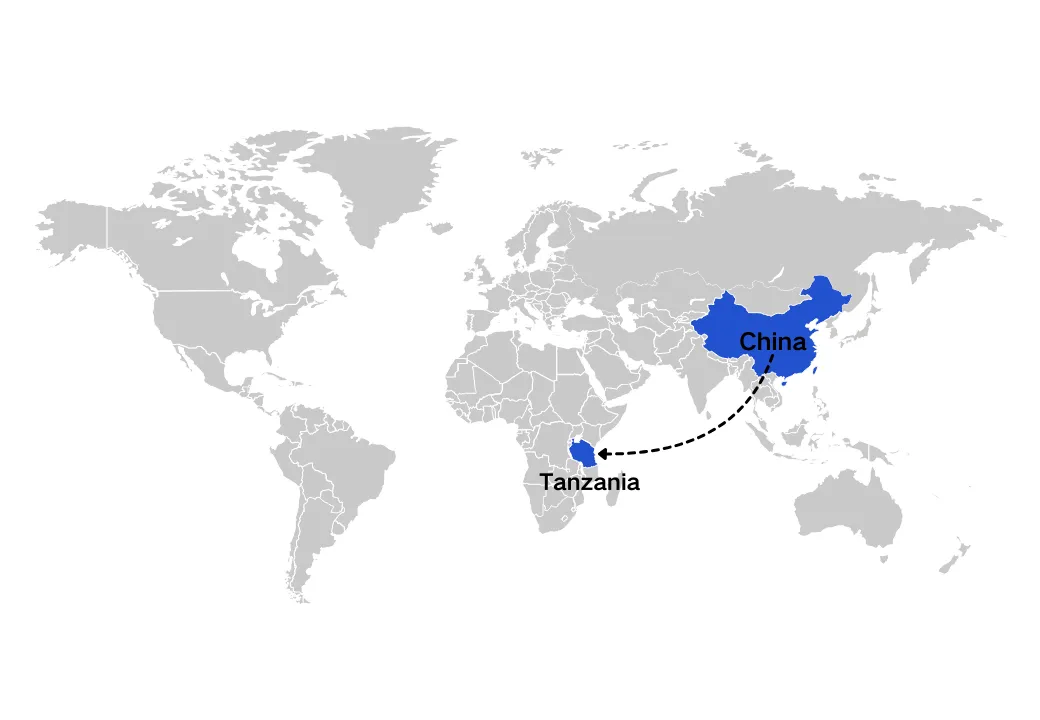
Tanzania is one of East Africa's fastest-growing import markets, and China is its dominant supplier. Trade-data compilations put Tanzania's imports from China at roughly $8.7 billion in the twelve months to February 2026, with China holding around a third of Tanzania's total import bill — vehicles, machinery, electricals, textiles, building materials, and consumer goods. Roughly 90% of that volume lands at the Port of Dar es Salaam.
But this lane has changed in 2026, and most of the numbers you'll find online were written before the changes took effect. Tanzania's Finance Act 2026 raised the customs processing fee, rewrote the excise treatment of imported vehicles, and extended the VAT deferment regime for capital goods. The Tanzania Bureau of Standards (TBS) has a new certificate of conformity template, the PVoC contract covering China-origin cargo changed operator, and TASAC now sets minimum clearing-agent fees by law.
Why Trust AllBestShipping? We are a Shenzhen-based freight forwarder and we run this lane every week — consolidating LCL cargo in Guangzhou and Yiwu, booking FCL space out of Shenzhen, Nansha, Ningbo and Shanghai, and clearing through Dar es Salaam with our own appointed agents. This page reflects what we are actually quoting and shipping in September 2026: the new fee structure, the current vessel waiting times at Dar es Salaam, and the compliance steps that decide whether your container is released in four days or sits for three weeks.
What Has Changed on the China–Tanzania Lane in 2026
Before you budget or book, check these ten items. Each one is dated, and each one moves either your landed cost or your clearance timeline.
- Customs Processing Fee: 0.6% → 1% of FOB (effective 1 July 2026). The Finance Act 2026 raised the CPF to 1% of the free-on-board value of imported goods. That is a 67% increase on the previous 0.6%, and it applies to every import declaration lodged in TANCIS — no matter how small the consignment.
- Railway Development Levy remains 2% of CIF. The RDL was increased from 1.5% to 2% and TRA's current schedule still shows 2%. Budget 2%: several forwarder pages — and some older government portals — still quote the retired 1.5% figure.
- New TBS certificate of conformity template (1 November 2025). TBS introduced an upgraded CoC template with stronger integrity and traceability features, alongside a phased system-integration project that lets the Bureau verify pre-shipment conformity data directly. Certificates issued on the old format and shipments with mismatched product data are being queried more aggressively at Dar es Salaam.
- PVoC for China-origin cargo is under a new three-year contract (effective 1 May 2026). The appointed agency for the "China Zone" — Mainland China, Hong Kong, Taiwan, Mongolia and Macau — changed with the new contract. If your product sits on the regulated list, your Certificate of Conformity must be issued by the contracted agency for your zone, before the goods leave China.
- Age-based excise on imported vehicles (effective 1 July 2026). The Finance Act 2026 replaced the previous treatment of older cars with three bands counted from the year of manufacture: over 8 up to 10 years — 18% excise; over 10 up to 20 years — 35%; over 20 years — 40%. Vehicles up to 8 years old pay standard TRA rates. Vehicles are Tanzania's single largest import from China, so this reshapes landed cost for every car dealer on the lane.
- VAT deferment on imported capital goods survives. The sunset clause that would have ended VAT deferment on specified imported capital goods at 30 June 2026 was removed, so qualifying manufacturers and assemblers keep access to it.
- Specific excise rates up 8%. The same Act raised specific excise rates on a list that includes cement, petroleum products, confectionery, imported powdered beverages, paints and lubricants — categories that appear regularly in construction and retail shipments.
- Clearing-agent fees are now regulated, not negotiated to zero. TASAC's Tanzania Shipping Agencies (Fees for Clearing and Forwarding Services) Order, GN. 83 of 2026 (March 2026) sets minimum agency fees for import, export and transit cargo handled by sea and other modes. Expect the agent line on your quotation to be floor-priced.
- Dar es Salaam is handling far more cargo — in bursts. The port moved 1,084,719 containers between July 2025 and April 2026, up 25.4% year on year, and vehicle units cleared in May 2026 rose 88% to 30,442. Expansion works add berths 12 to 15 plus two further berths with a combined length of 500 m. Seven-day average vessel waiting time moved from roughly 5 days in January 2026 to 7.4 days in late March and back to about 4 days in August, against a September median of under 2 days. Plan for the spikes, not the average.
- Rail capacity is returning — gradually. China, Tanzania and Zambia signed a $1.4 billion TAZARA rehabilitation agreement in November 2025 (CCECC) aimed at the Zambia and DRC transit corridor, while Tanzania's SGR already moves boxes from Dar es Salaam's Malindi area to Bahi in Dodoma and the Mwanza–Isaka section stood at 68% completion in February 2026.
Sea Freight from China to Tanzania
Sea freight carries the overwhelming majority of China–Tanzania trade. For containers of construction materials, machinery, tiles, furniture, textiles and general merchandise, it is the only mode that makes commercial sense — and on this lane it is a genuinely direct routing, crossing the Indian Ocean without touching the Red Sea or the Suez Canal.
FCL vs. LCL: Which Should You Choose?
| Feature | FCL (Full Container Load) | LCL (Less than Container Load) |
|---|---|---|
| Best For | Volume over 15 CBM | Small shipments (1–15 CBM) |
| Cost | Flat rate per container — lowest cost per CBM | Charged per CBM or per tonne (W/M rule); higher per unit |
| Security | Sealed at your supplier's factory; opened only at destination | Consolidated and de-stuffed at both ends; more handling |
| Speed | Direct loading; no consolidation wait | Add 3–7 days for CFS cut-off and deconsolidation |
| Customs | One declaration, one entry | Groupage entries; expect a little more documentation |
Pro Tip: Dar es Salaam (TZDAR) handles over 90% of Tanzania's seaborne trade and also serves landlocked Zambia, DRC, Rwanda, Burundi and Malawi as a transit gateway. Congestion is real but it is no longer chronic: waiting time to berth ranged from about 4 days in August 2026 to 7.4 days in late March, and transit cargo competes with local cargo for the same berths. We monitor berth and yard status daily and shift bookings between carriers when a particular vessel's arrival clusters with three others.
Major Ports and Terminals in Tanzania
- Dar es Salaam (TZDAR): The primary gateway — deep-sea berths dredged to roughly 14.5 m, private terminal operators, and the entry point for transit cargo to Zambia, DRC, Rwanda, Burundi and Malawi.
- Tanga (TZTGT): A secondary port north of Dar es Salaam serving the northern regions and some bulk cargo. Not a routine direct call for deep-sea container services from China.
- Mtwara (TZMYW): Southern port with growing relevance for cargo moving toward the Mtwara Development Corridor and the far south; service is limited and routed via transshipment.
- Zanzibar (TZZNZ): Island gateway for tourism-related imports and local consumption. Zanzibar applies its own VAT rate of 15% and non-Union taxes.
What Sits On Top of the Base Ocean Rate
The base ocean freight you see advertised is one line of your invoice. On the China–Tanzania lane, surcharges and local charges habitually add 25–40% to the base rate, and in peak season more. Ask every forwarder to itemize these before you compare quotations.
| Charge | Where It Applies | Typical 2026 Level |
|---|---|---|
| BAF (Bunker Adjustment Factor) | Ocean leg — fuel | $120–$300 per container |
| PSS / GRI (Peak Season / Rate Increase) | Ocean leg — seasonal | $0–$800 per container; announced monthly |
| THC — origin and destination | Both terminals | $180–$280 origin + $180–$300 Dar es Salaam |
| Origin handling | Pickup, CFS, export customs, documentation | $250–$450 |
| PVoC / Certificate of Conformity | Pre-shipment, China | About 0.53% of FOB (Route A), minimum $250, maximum $5,000 |
| Destination brokerage and CFA fee | Dar es Salaam | $200–$400 (minimum fees now set under GN. 83 of 2026) |
| Demurrage and detention | After free time expires | Published line tariffs start near $40–$100/20ft and $80–$160/40ft per day |
| Inland delivery | Port to your warehouse | $180–$600 within Dar es Salaam; more for upcountry |
| Marine insurance | All-risk, CIF-based | Roughly 0.15–0.5% of invoice value |
Direct Sailing vs. Transshipment
Most volume from South China to Dar es Salaam is booked on direct or semi-direct services, with transshipment at Singapore, Colombo or Jebel Ali when a carrier's rotation requires it. Transshipment typically adds 5–10 days and a second set of handling risks, but it can be the cheaper option when a direct service is full or your cargo needs a specific equipment type. If a quotation shows a 40-day-plus transit for a South China port, ask which relay port is being used — some platform quotes quietly route through a hub and inherit the extra time.
Air Freight from China to Tanzania
When speed decides whether you win the sale — medical supplies, spare parts that stop a production line, high-value electronics, seasonal samples — air freight earns its premium. The flight itself is only 10–14 hours from South China; the rest is ground handling at both ends.
Key Airports
- Julius Nyerere International Airport (DAR), Dar es Salaam: The primary cargo gateway and the only realistic choice for most commercial air cargo into Tanzania.
- Kilimanjaro International Airport (JRO): Useful for goods destined for Arusha and the northern circuit; fewer freighter options, so expect a road leg from Dar es Salaam or Nairobi.
- Abeid Amani Karume International Airport (ZNZ), Zanzibar: Serves the islands directly; capacity is limited and rates are higher.
Service Levels, Transit Times and Rates
| Service | Transit Time | Indicative Rate (September 2026) | Best For |
|---|---|---|---|
| Express courier | 3–5 days | $12–$15/kg (equivalent) | Documents and parcels under 45 kg |
| Standard air cargo | 5–7 days | $8.50–$12.00/kg (45–99 kg); $6.50–$9.00/kg (100–299 kg) | Commercial cargo from 100 kg |
| Consolidated air (500 kg+) | 6–9 days | $5.20–$6.80/kg | Bulk air cargo where cost matters |
| Deferred air | 7–10 days | $4.80–$6.20/kg (1,000 kg+) | Cost-saving option for less urgent goods |
| Air DDP (duty paid) | 8–14 days door to door | $5.50–$12.00/kg all-in | Importers who want one landed price |
Insider Insight: There are no meaningful freighter frequencies from Mainland China to Dar es Salaam. Practically all air cargo routes through a hub — Dubai, Doha, Addis Ababa or Nairobi — which is why quoted transit is 5–7 days rather than 2–3. We hold block space with carriers serving those hubs, which matters most in the run-up to December and during Q1 fashion and electronics peaks.
The Volumetric Weight Trap
Airlines charge on chargeable weight: the greater of actual weight or volumetric weight (length × width × height in cm ÷ 6,000). A carton of foam packaging, plastic housewares or LED strip lights can occupy 0.2 CBM and weigh 12 kg while billing at 33 kg. Before you book air freight, send us the carton dimensions — we tell you the chargeable weight up front, and when a shipment is close to the crossover we will price both air and LCL so you can see the trade-off in dollars, not adjectives.
DDP & Door-to-Door Shipping from China to Tanzania
Navigating TRA (Tanzania Revenue Authority) rules — and the fact that importers must appoint a licensed Clearing and Forwarding Agent and lodge declarations in TANCIS — is where first-time importers lose money. Our DDP (Delivered Duty Paid) service bundles collection, export clearance, ocean or air freight, Tanzanian import duty and VAT, customs clearance and final delivery into a single quoted price.
How DDP Works
- Pickup: We collect from your supplier anywhere in China — Shenzhen, Guangzhou, Foshan, Ningbo, Yiwu, Qingdao — or receive your goods at our consolidation warehouse.
- Export & PVoC: We arrange the CoC for regulated products before booking, prepare the export declaration, and ship under the correct HS code so the Tanzanian entry matches the China-side documents.
- Transport: Sea freight into Dar es Salaam or air freight into DAR, depending on your deadline and cargo value.
- Clearance: Our appointed licensed agents lodge the entry in TANCIS at least 7 days before vessel arrival, pay Import Duty, Excise (where applicable), VAT and the Railway Development Levy, and answer any TBS or TMDA queries on your behalf.
- Delivery: We truck the cargo to your premises — Kariakoo, Ilala, Mikocheni, Arusha, Mwanza, Dodoma, or onward as transit cargo to Lusaka, Lubumbashi or Kigali.
Why Importers Choose DDP
- One price, no surprises: A single rate per CBM (sea) or per kg (air) that already includes duty and VAT, so you can price your resale margin before the container even sails.
- No local agent required: You do not need a TRA-registered clearing agent, a Tanzanian bank guarantee, or a TIN-based customs profile to get started.
- Compliance risk sits with us: A missing CoC triggers a 15% CIF penalty plus destination inspection costs, and an incorrect HS code triggers an audit. Under DDP, that risk is ours.
- Cash-flow protection: Duties and VAT are paid on your behalf at the port, so your goods are not held for a bank-to-bank transfer while demurrage accrues.
DDP vs. DDU vs. CIF: What Changes Hands
| Responsibility | CIF | DDU / DAP | DDP |
|---|---|---|---|
| Freight to Dar es Salaam | Forwarder | Forwarder | Forwarder |
| Import duty, excise, VAT, RDL | Importer | Importer | Forwarder |
| TANCIS entry & CFA appointment | Importer | Importer | Forwarder |
| PVoC / CoC arranged in China | Usually importer | Shared | Forwarder |
| Inland delivery to your door | Not included | Included | Included |
| Who needs a Tanzania import profile | You | You | Nobody — we import and re-deliver |
If your business is registered in Tanzania and you want the import records in your own name for VAT recovery, CIF or DDU with your own agent may suit you better. If you are an SME, a marketplace seller, or a first shipment into a new product line, DDP is usually the cheaper and the faster route to revenue.
Main Shipping Routes from China to Tanzania
The maritime leg is a long but straightforward Indian Ocean crossing, and the land leg is where the interesting decisions are made.
The Maritime Route Overview
- Origin ports: Shenzhen (Yantian, Shekou, Nansha), Guangzhou, Shanghai, Ningbo-Zhoushan, Qingdao, Tianjin, Xiamen.
- Path: South China Sea → Singapore Strait (or direct across the Indian Ocean) → Dar es Salaam.
- Distance: Approximately 6,000–6,500 nautical miles from South China; 7,000+ nautical miles from North China.
- Port-to-port transit: 25–35 days direct; add 5–10 days when a relay port is involved.
The route avoids the Red Sea, the Bab el-Mandeb Strait and the Suez Canal entirely. For importers who were burned by the 2024–2025 diversions, that is a material advantage: this lane has not carried war-risk premiums or canal-transit uncertainty. What it does carry is monsoon seasonality and berth competition at Dar es Salaam.
Inland and Transit Corridors
Dar es Salaam is not just Tanzania's port — it is the port for a large part of Central Africa. If your final destination is inland, your customs regime changes your cash flow, your documents and your timeline.
| Destination | Preferred Corridor | Customs Regime | Add to Port Clearance |
|---|---|---|---|
| Dar es Salaam, Tanga, Zanzibar | Direct truck from port | Entered for home consumption | 1–3 days |
| Dodoma, Singida | SGR rail to Bahi / road | Home consumption | 2–4 days |
| Arusha, Moshi, Mwanza | Road (SGR to Mwanza under construction) | Home consumption | 3–6 days |
| Uganda, Rwanda, Burundi | Central Corridor by road | EAC Single Customs Territory — cleared at first port of entry | 4–8 days |
| Zambia, Malawi, DRC | TAZARA rail (under rehabilitation) or road | Classic bonded transit — security lodged in TANCIS | 5–10 days, plus border time |
Three practical points on transit cargo. First, transit is a customs regime, not a trucking arrangement: your agent lodges a transit declaration in TANCIS, executes security for the duties at risk, and an electronic seal is armed — the security is released only when an officer at the exit station certifies that the goods left Tanzania. Second, duty and VAT on transit cargo are suspended, not forgiven; if the boxes cannot be accounted for at the border, the full amount falls due with interest and penalties. Third, a regional EAC Customs Bond is now available as an additional transit security option across partner states, which can reduce the cost of moving multi-country consignments.
For Zambia and DRC cargo, the $1.4 billion TAZARA rehabilitation agreed in November 2025 is designed to move more of this volume off trucks and onto rail. Until capacity is fully restored, road plus bonded transit at Tunduma and Kasumbalesa remains the workhorse.
Choosing the Right Port of Loading
| Origin (China) | Why Importers Use It | Port-to-Port Transit |
|---|---|---|
| Shenzhen (Yantian / Shekou) | Electronics, appliances, general merchandise; best direct coverage | 25–30 days |
| Guangzhou (Nansha) | Furniture, textiles, garments, e-commerce consolidations | 25–30 days |
| Shanghai / Ningbo | Machinery, hardware, building materials, chemicals | 28–35 days |
| Qingdao / Tianjin / Xiamen | Steel, ceramics, tyres, agricultural equipment | 33–40 days |
Rule of thumb: match the port to where your supplier actually is, then let us optimize the sailing. Trucking a container 1,500 km across China to chase a marginally cheaper ocean rate rarely pays — and it adds a domestic leg that can go wrong before the vessel even loads.
Shipping Costs from China to Tanzania in 2026
Rates on this lane move with fuel, capacity and seasonality, and a quotation is only as good as its validity date. The figures below reflect the ranges we are seeing and booking in September 2026; treat them as budgeting benchmarks, not a contract.
Sea Freight Rates — Port to Port (20ft and 40ft FCL)
| Port of Loading | 20ft Container (USD) | 40ft / 40HQ Container (USD) | Transit Time |
|---|---|---|---|
| Shanghai | $2,100 – $3,100 | $3,550 – $5,100 | 28–35 days |
| Ningbo-Zhoushan | $2,000 – $3,000 | $3,850 – $5,000 | 28–35 days |
| Shenzhen (Yantian / Shekou) | $2,100 – $3,300 | $3,250 – $4,550 | 25–30 days |
| Guangzhou (Nansha) | $2,100 – $3,200 | $3,450 – $5,200 | 25–30 days |
| Qingdao | $2,950 – $3,150 | $3,850 – $4,300 | 33–40 days |
| Tianjin | $3,050 – $3,200 | $4,050 – $4,300 | 35–40 days |
Base ocean freight only — origin and destination charges, BAF, peak-season surcharges, duty and VAT are excluded. Expect surcharges to add 25–40% to these figures, and budget a further 15% if you ship into the September–December peak.
LCL Rates (Per CBM)
| Port of Loading | Rate per CBM (USD) | Notes |
|---|---|---|
| Shenzhen / Guangzhou | $80 – $140 | Base ocean freight only; origin and destination CFS charges separate |
| Shanghai / Ningbo | $70 – $130 | Two to three sailings per week |
| Qingdao | $85 – $145 | Longer inland positioning |
| Minimum charge | $200 – $250 per shipment | LCL is charged on the W/M rule (whichever is greater: CBM or metric tonne) |
| Typical transit | 30–45 days | Includes consolidation cut-off and deconsolidation at Dar es Salaam |
If you are comparing FCL against LCL, do the arithmetic at the crossover: at about 15 CBM, a 20ft container usually costs less than the same volume shipped LCL, clears faster, and travels with a factory seal intact. Our guide to container shipping from China to Tanzania walks through the crossover with worked numbers.
DDP "All-In" Rates (Duty and VAT Included)
- Sea DDP: $150–$350 per CBM, depending on product category and the duty rate that applies to it.
- Air DDP: $5.50–$12.00 per kg, with the lower end applying to consolidated volumes of 500 kg and above.
What Your Quotation Usually Excludes
This is where "cheap" quotations are engineered. A $1,800 20ft rate to Dar es Salaam often hides several hundred dollars of destination charges.
| Excluded Item | Who Pays It | Rough Order of Cost |
|---|---|---|
| Origin trucking and export documentation | Shipper | $250–$450 per container |
| Terminal handling at both ends | Shipper / consignee | $360–$580 per container |
| BAF and peak-season surcharges | Shipper | $120–$1,000 per container |
| PVoC / CoC inspection | Importer | 0.53% of FOB, minimum $250 |
| Import duty, excise, VAT, RDL, CPF | Importer | See the tax stack below — often the largest single line |
| Clearing agent and TANCIS entry | Importer | $200–$400 |
| Demurrage, detention and port storage | Importer | Applies after free time; avoidable with fast documents |
| Inland delivery and offloading | Importer | $180–$600 locally; quoted per trip upcountry |
| Marine insurance | Importer | 0.15–0.5% of invoice value |
Worked Example: Landed Cost of a 20ft Container
Take a 20ft container of furniture from a factory near Foshan, CIF value $18,000, FOB value $16,500, duty band 25%. Here is the statutory stack that will be paid at Dar es Salaam under 2026 rules.
| Charge | Basis | Amount (USD) |
|---|---|---|
| Import duty | 25% × CIF $18,000 | $4,500 |
| Railway Development Levy | 2% × CIF $18,000 | $360 |
| Customs Processing Fee | 1% × FOB $16,500 (new rate from 1 July 2026) | $165 |
| PVoC Certificate of Conformity | 0.53% of FOB, minimum $250 — furniture is regulated | $250 |
| VAT | 18% × (CIF + duty + RDL) = 18% × $22,860 | $4,115 |
| Statutory subtotal | Paid to TRA and TBS | $9,390 |
Add ocean freight, surcharges, origin and destination handling, brokerage and delivery — typically $3,500–$5,500 on this lane — and your total landed cost lands between roughly $12,900 and $14,900 against a $18,000 cargo value. That is the single most useful number in your business plan, and it is why comparing forwarders on the ocean rate alone is a mistake. For a fuller cost breakdown, see our guide on how much it costs to ship from China to Tanzania.
How Long Does Shipping Take from China to Tanzania?
Quote your customer a date, not a range. Here is how the timeline actually assembles in 2026.
Transit Time by Origin Port
| Origin Port (China) | Destination | Direct Transit (Sea) | Via Transshipment |
|---|---|---|---|
| Shenzhen / Guangzhou | Dar es Salaam | 25–30 days | 30–40 days |
| Shanghai / Ningbo | Dar es Salaam | 28–35 days | 33–42 days |
| Qingdao / Tianjin | Dar es Salaam | 33–40 days | 38–48 days |
Door-to-Door Timeline: Where the Weeks Go
| Stage | Duration | What Can Go Wrong |
|---|---|---|
| Supplier pickup, consolidation, export clearance | 2–5 days | Late supplier production; missed CFS cut-off |
| PVoC inspection and CoC issuance (if not already done) | 3–7 days | Failing the inspection; wrong product data on the application |
| Ocean transit | 25–35 days | Weather, relay port congestion, blank sailings |
| Vessel waiting to berth at Dar es Salaam | 1–8 days | Vessel bunching; peak-season surges |
| TRA clearance, duty payment, release | 3–7 working days | Missing CoC (adds 2–3 weeks plus 15% CIF penalty); IQS queries on incomplete declarations |
| Inland delivery | 1–4 days | Truck availability; upcountry road conditions in the long rains (March–May) |
| Total door to door — sea | 35–55 days | Add 5–10 days in the September–December peak |
| Total door to door — air | 8–14 days | Hub backlog in Dubai, Doha, Addis Ababa or Nairobi |
What Causes Delays in 2026
- Berth waiting at Dar es Salaam. A 7-day average waiting time was recorded in late March 2026; by August it was around 4 days and the September weekly median has been under 2 days. Congestion is event-driven — a cluster of arrivals or a crane outage, not a permanent condition. Buffer 5–7 days on any committed sale date.
- Missing or defective CoC. The most expensive single mistake on this lane: 15% of CIF in penalties plus destination inspection, plus two to three weeks of your goods sitting in a terminal that charges demurrage.
- Declaration errors. TANCIS automatically rejects incomplete or poorly described declarations through its Integrated Query System. Vague descriptions like "general goods" or "spare parts" guarantee a query. Give us the product name, material, model and intended use before we classify.
- Weather seasons. South China typhoon season (July–September) can roll vessel schedules by days; Tanzania's long rains (March–May) slow upcountry road delivery.
- Peak season. September to December — ahead of Christmas and the New Year — brings both rate increases and volume surges at Dar es Salaam. Book 3–4 weeks ahead and lock your rate with a validity window.
Tanzania Customs Clearance & Import Duties
Importing into Tanzania is a documented process with very little tolerance for improvisation. TRA administers customs through TANCIS (the Tanzania Customs Integrated System), declarations must be lodged by a licensed Clearing and Forwarding Agent, and regulated products need a TBS Certificate of Conformity obtained before the goods leave China.
1. PVoC: The Certificate You Cannot Ship Without
Tanzania's Pre-shipment Verification of Conformity (PVoC) programme covers regulated imports — a list that includes electrical goods, electronics, toys, textiles and footwear, building materials, food and beverages, chemicals, and automotive products. Verification happens in the country of export, which for cargo sourced in China means an inspection in China before loading.
- New CoC template since 1 November 2025. TBS replaced the certificate format and started a phased integration programme to verify conformity data directly with the issuing agencies. Data mismatches between the certificate, the invoice and the packing list are being queried more often.
- China Zone contract changed on 1 May 2026. The three-year PVoC contract covering Mainland China, Hong Kong, Taiwan, Mongolia and Macau changed hands, so confirm with your forwarder which agency is the contracted partner for your zone before you apply. An application to the wrong agency costs days you do not get back.
- Cost: PVoC/CoC fees run at roughly 0.53% of FOB value under the standard route, with a minimum of $250 and a maximum of $5,000 per shipment.
- Penalty for shipping without a CoC: 15% of the CIF value, plus destination inspection costs, and your goods cannot be released until the inspection is completed. Consignments that fail conformity assessment are re-exported or destroyed at the exporter's cost.
Pro Tip: Start the PVoC file the moment your supplier confirms production dates — not when the container is booked. Inspection slots in Guangdong and Zhejiang fill up in the September–December peak, and a CoC issued after loading is worth nothing. We handle the application, sample coordination and certificate chase as part of our export service.
2. The Full Tax Stack at Dar es Salaam
Every commercial import is assessed on its CIF value. These are the charges that apply in 2026 — note the two changes that took effect this year.
| Charge | Rate | Base | 2026 Status |
|---|---|---|---|
| Import duty (EAC CET) | 0% raw materials and capital goods; 10% intermediate goods; 25% finished consumer goods; up to 35% on sensitive items such as textiles and footwear | CIF | Unchanged bands |
| Excise duty | Product-specific, specific or ad valorem; specific rates raised 8% for 2026/27 | CIF or quantity | Increased on listed goods (cement, petroleum, confectionery, paints, lubricants) |
| Value Added Tax | 18% in Mainland Tanzania; 15% in Zanzibar | CIF + duty + excise + RDL | Unchanged; VAT deferment on qualifying imported capital goods retained |
| Railway Development Levy (RDL) | 2% | CIF | Remains 2% — not the widely quoted 1.5% |
| Customs Processing Fee (CPF) | 1% | FOB | Increased from 0.6% effective 1 July 2026 |
| PVoC / CoC fee | About 0.53% (min $250, max $5,000) | FOB | Unchanged |
Two things surprise importers most. First, there is no de minimis threshold in Tanzania — duty and VAT apply from the first dollar of value. Second, RDL is charged on top of duty but before VAT, so a 25% duty band does not mean 25%; the effective all-in tax load on finished consumer goods typically lands between 45% and 55% of CIF.
3. Documents and Permits
Your agent lodges the customs entry in TANCIS at least 7 days before vessel arrival. The file normally includes:
- Final commercial invoice (matching the packing list line for line)
- Packing list
- Bill of Lading or Air Waybill
- Agent's authorization letter from the importer
- Import permits where required — TMDA for medicines, medical devices and cosmetics; TBS for standards-regulated goods; TASAC and other authorities for specific categories
- Exemption or relief documents, if you are claiming any
- Cross-border declaration of currency where applicable
Incomplete or vaguely described declarations are rejected automatically in TANCIS through the Integrated Query System, which restarts the clock. The single best thing you can do for clearance speed is to hand your forwarder a precise product description — material, model, function, and intended use — before the goods ship.
4. Importing Vehicles from China: RHD Only, and New Excise Bands
Vehicles are Tanzania's largest single import from China, and this is the category with the most rules per dollar of value.
- Right-hand drive only. Tanzania drives on the left. Left-hand drive vehicles are not permitted for general import, and steering conversions are not accepted as a workaround. If you are sourcing vehicles in China, confirm RHD specification in writing before you pay a deposit — many Chinese manufacturers will build RHD units for export, but domestic-market stock will not clear.
- Age-based excise since 1 July 2026. Over 8 up to 10 years from the year of manufacture — 18%; over 10 up to 20 years — 35%; over 20 years — 40%. Vehicles up to 8 years old pay standard TRA rates. The bands are designed to suppress old, high-emission imports, and they change the economics of every used-car shipment.
- Valuation is not your invoice. TRA assesses used vehicles through its Used Motor Vehicle Valuation System, so a low invoice does not lower the tax base.
- Pre-shipment inspection required. Vehicles need an inspection certificate or Certificate of Conformity from an approved origin scheme before loading.
5. Free Time, Demurrage and Storage
Free time at Dar es Salaam is short relative to a 30-day ocean transit, and the clock starts when the container is discharged, not when you have your documents ready. Shipping lines' published Tanzanian tariffs begin around $40–$100 per day for a 20ft and $80–$160 per day for a 40ft once demurrage kicks in, rising in higher tiers; terminal storage is charged separately by TPA. Confirm the free days on your booking in writing, and treat the last three days before free time expires as your hard deadline for duty payment and release. This is the most avoidable cost on the lane — and the one that catches importers who are still chasing a CoC.
Step-by-Step Shipping Process
- Sourcing and specification. Confirm your supplier can provide export documentation, the correct HS classification details, and — for vehicles — RHD specification and a pre-shipment inspection certificate.
- Compliance check and PVoC application. We confirm whether your product is regulated, which China Zone agency applies, and start the CoC file before production finishes.
- Quotation and booking. We quote a rate with an explicit validity window, book space 14–21 days ahead in peak season, and confirm whether you are shipping FCL, LCL or as part of a consolidation.
- Consolidation and loading. Goods are collected or received at our Shenzhen, Guangzhou or Yiwu warehouse, checked against the packing list, and stuffed under a sealed container or into a groupage box.
- Export clearance. Chinese customs processes the export declaration; we match the export data to the Tanzanian import data so nothing contradicts at the other end.
- Ocean or air transit. You receive the Bill of Lading or Air Waybill and a tracking reference the day the cargo loads.
- Pre-arrival declaration. Our agents lodge the TANCIS entry at least 7 days before arrival, pre-pay duty, RDL, CPF and VAT, and clear any TBS or TMDA queries before the vessel berths.
- Release and delivery. Cargo is released, trucked to your door, and — for transit consignments — moved under bond with an electronic seal until the exit station certifies departure.
If you want the timing picture in more detail, our guide to how long shipping from China to Tanzania takes breaks the calendar down stage by stage, and our sea freight from China service page explains the equipment, sailing schedules and port options we work with.
One-Stop Shipping Solutions for Alibaba, 1688 & Taobao Buyers
Tanzania's market is full of traders who buy in small batches from Chinese marketplaces and lose their margin in freight minimums, hidden charges and rejected declarations. That is the problem our consolidation service was built for.
The "Groupage" (Consolidation) Strategy
- Buy from multiple suppliers. Alibaba, 1688, Taobao, or a mix of all three — we give you one receiving address per city.
- Ship to our warehouse. Send goods to our Guangzhou or Yiwu warehouse with your supplier's packing list; we photograph inbound cartons and log them against your account.
- Consolidate. We combine everything into one LCL shipment or one container, which cuts the per-unit freight cost dramatically compared with shipping each parcel separately.
- Ship once, clear once. One declaration, one PVoC file, one delivery — instead of five.
Quality Check: We inspect incoming cartons visually, check quantities against the supplier invoice, and flag obvious damage or wrong items before loading. Returns from Tanzania to China are effectively impossible, so the last cheap moment to catch a problem is in our warehouse, not on your shelf in Kariakoo.
What Else We Handle on This Lane
- Door-to-door and DDP: one landed price including duty, VAT and delivery — see our door-to-door shipping options for Tanzania.
- Transit cargo: bonded movement to Zambia, DRC, Malawi, Rwanda, Burundi or Uganda, with the security and electronic seals managed end to end.
- Cargo insurance: all-risk cover at 0.15–0.5% of invoice value, arranged before sailing.
- Warehousing and labelling: receiving, repacking, labelling and pick-and-pack from our China facilities.
For importers working across several African markets, our regional hub covers the wider picture of shipping from China to Africa, including the corridors, regimes and compliance requirements that apply beyond Tanzania's borders.
Why Importers Choose AllBestShipping
AllBestShipping is a professional freight forwarder headquartered in Shenzhen, moving cargo from China to more than 50 countries. On the Tanzania lane that means direct carrier relationships out of South and East China, in-house PVoC coordination, licensed clearing partners at Dar es Salaam, and a single point of contact who knows your shipment by name rather than by reference number.
- Lane specialists, not a directory: we handle PVoC files, TANCIS entries and transit bonds every week.
- Transparent pricing: itemized quotations that separate base freight from surcharges, and DDP rates that include duty and VAT.
- Real-time tracking: vessel and container milestones from factory gate to your warehouse, plus proactive alerts when a berth delay threatens your date.
- Compliance built in: HS classification, CoC coordination and TANCIS filing handled before arrival — the fastest way to avoid demurrage.
- Consolidation in three cities: Shenzhen, Guangzhou and Yiwu receiving warehouses for marketplace buyers who never fill a container.
Whether you are shipping your first 5 CBM of housewares or a monthly program of 40ft containers for a retail chain, the fastest way to start is a quote built on your actual product list. Last updated: September 2026.
Ready to move your next shipment? Send us your supplier list, carton dimensions and destination city — we will come back with a landed-cost estimate, a realistic delivery window, and a compliance checklist for your specific products. Visit AllBestShipping or contact our Shenzhen team to get started today.