Cheapest Way to Ship from China to Saudi Arabia (2026 Guide): Cut Your Freight Costs by Up to 40%
Cheapest way to ship from China to Saudi Arabia — if you've typed that into Google lately, you've probably noticed something frustrating. One forwarder quotes $1,200 for a 20-foot container to Jeddah. Another quotes $3,500 for the exact same lane. A third offers "DDP door-to-door at $150 per CBM," but won't explain what's actually included. How do you know you're getting the real cheapest option, and not just the lowest headline that balloons by 40% after hidden fees?
At AllBestShipping, we specialize in shipping from China to Saudi Arabia, running weekly consolidations from Shenzhen and Shanghai to Jeddah, Dammam, and Riyadh. Over the past decade, we've seen importers save 30% simply by switching Incoterms, and we've seen others lose those savings to demurrage because they didn't know Saudi ports only offer 7–14 days of free storage. In this guide, I'll show you exactly how shipping costs are built, which method is truly cheapest for your cargo size, and the five moves that actually lower your invoice — not just the quote.
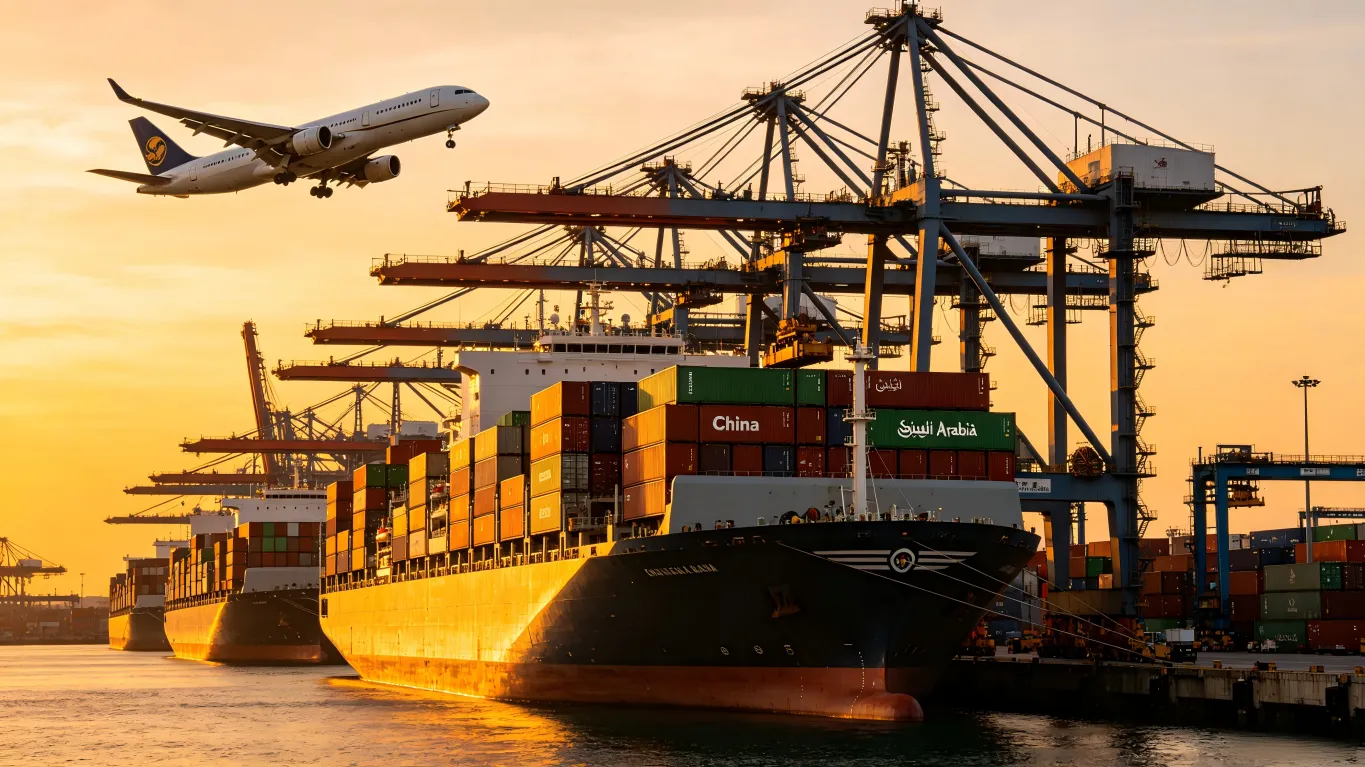
Shipping Methods from China to Saudi Arabia: A Quick Overview
Before we dive into dollars and cents, let's agree on the four primary shipping modes available on the China–Saudi lane. Each one serves a different cargo profile, urgency level, and budget.
- Sea Freight (FCL / LCL) — FCL (Full Container Load) means you book an entire 20-foot or 40-foot container. LCL (Less than Container Load) means your cargo shares container space with other shippers. Sea freight is the default choice for bulk cargo and offers the lowest per-unit cost.
- Air Freight — Standard airport-to-airport cargo service. Best for urgent restocks, high-value electronics, or perishables where stockout costs exceed the freight premium.
- Express Courier (DHL / FedEx / Aramex / UPS) — Door-to-door parcel service for samples, documents, and small e-commerce test orders, typically under 45 kg.
- DDP Door-to-Door Shipping (Sea & Air) — Under DDP (Delivered Duty Paid), the forwarder handles pickup in China, export clearance, international freight, Saudi import clearance, duties, VAT, and final delivery. It's the simplest option, especially if you don't hold a Saudi Commercial Registration (CR).
| Method | Best For | Transit Time | Cost Level | Customs Handled By |
|---|---|---|---|---|
| Sea FCL | Bulk cargo (>15 CBM) | 18–35 days | Lowest per unit | Importer or forwarder |
| Sea LCL | Small-to-medium cargo (1–12 CBM) | 25–45 days | Low | Importer or forwarder |
| Air Freight | Urgent / high-value stock | 3–7 days | High | Importer or forwarder |
| Express Courier | Samples / parcels (<45 kg) | 3–6 days | Highest | Courier |
| DDP Sea | SMEs without Saudi CR | 30–45 days | Medium-low (all-in) | Forwarder |
| DDP Air | E-commerce / fast restock | 8–15 days | Medium-high (all-in) | Forwarder |
The Real Cost Breakdown: What You're Actually Paying For
Most "cheapest way" articles throw out numbers without explaining the cost stack. That opacity is exactly why importers overpay. Let's demystify the invoice so you can compare apples to apples.
Ocean Freight Cost Components
An ocean freight quote is rarely just "the boat." A complete shipment includes three layers:
- Origin charges — THC (Terminal Handling Charge), documentation, export customs clearance in China, and inland trucking from factory to port.
- Ocean freight (port-to-port) — The actual container movement from Shanghai, Shenzhen, Ningbo, or Guangzhou to Jeddah or Dammam.
- Destination charges — DTHC (Destination Terminal Handling Charge), unloading, Saudi import customs clearance, import duty, 15% VAT, and inland delivery to your warehouse.
When you see a $1,050 quote for a 20-foot container, it usually covers layers 1 and 2 only. When you see a $3,500 quote, it often includes all three. The cheapest headline rarely tells the whole story.
Air Freight Cost Components
Airlines bill by chargeable weight, which is whichever is higher: actual weight or volumetric weight. You calculate volumetric weight by multiplying length × width × height (in cm) and dividing by 6,000.
On top of the base rate, you'll pay fuel surcharges and security surcharges, which fluctuate weekly. That's why two air freight quotes for identical cargo can differ by 20% depending on the week.
DDP "All-In" Cost Components
DDP quotes bundle everything into one number, but even "all-in" has boundaries. Ask your forwarder explicitly whether the following are included:
- Inspection fees if ZATCA selects your shipment for examination
- SABER non-compliance penalties (e.g., missing Product Certificate of Conformity)
- Remote area delivery surcharges (common for deliveries outside Riyadh, Jeddah, or Dammam city limits)
- Storage fees if you're not ready to receive upon arrival
At AllBestShipping, we itemize every line on our DDP quotes so you know exactly what's covered and what isn't. If you're shipping high-value goods, consider adding cargo insurance for full protection against transit loss. Transparency is how you avoid the "cheap quote trap."
Cheapest Sea Freight from China to Saudi Arabia (FCL & LCL)
If your goal is lowest absolute cost and your cargo isn't time-sensitive, sea freight from China to Saudi Arabia is almost always the answer. The question is whether you need a full container or just a slice of one.
FCL Shipping (Full Container Load): The Bulk Buyer's Best Friend
A standard 20-foot container holds roughly 28–30 CBM. A 40-foot HQ container holds 68–76 CBM. If you can fill most of that space, FCL offers the cheapest per-kilogram and per-CBM rate on the lane.
Here are the 2026 port-to-port rate ranges from major Chinese origins:
| Origin (China) | Destination (KSA) | 20ft Container | 40ft HQ Container | Transit Time |
|---|---|---|---|---|
| Shenzhen | Jeddah | $1,500 – $2,200 | $2,100 – $2,900 | 18–25 days |
| Shenzhen | Dammam | $1,400 – $2,000 | $2,000 – $2,800 | 18–25 days |
| Shanghai | Jeddah | $1,600 – $2,400 | $2,200 – $3,100 | 22–30 days |
| Shanghai | Dammam | $1,500 – $2,200 | $2,100 – $2,900 | 22–30 days |
| Ningbo | Jeddah | $1,550 – $2,300 | $2,150 – $3,000 | 22–32 days |
| Ningbo | Dammam | $1,450 – $2,100 | $2,050 – $2,850 | 22–32 days |
| Guangzhou | Jeddah | $1,600 – $2,350 | $2,200 – $3,050 | 20–28 days |
| Qingdao | Jeddah | $1,800 – $2,600 | $2,500 – $3,400 | 25–35 days |
Insider tip from May 2026: We're seeing a notable equipment shortage on 20-foot containers, which has pushed 20GP rates up roughly 11% month-over-month. Meanwhile, 40-foot HQ rates have held flat. If your cargo exceeds 30 CBM, consolidating into a single 40HQ is currently the strategic value play. Don't book two 20-footers unless your cargo physically cannot fit into one high-cube.
When is FCL cheapest? If your shipment is larger than 15 CBM or heavier than 10,000 kg, FCL is almost always your most economical option. For a deeper dive on container options, see our dedicated guide to container shipping from China to Saudi Arabia.
LCL (Less than Container Load): Pay for What You Use
If you're shipping 1–12 CBM, LCL lets you pay only for the space you occupy. But the headline per-CBM rate is only part of the equation. New to shared container space? Read our LCL shipping guide to understand how consolidation works and where hidden fees creep in.
| Origin Port (China) | Destination Port (KSA) | LCL Rate per CBM | Notes |
|---|---|---|---|
| Shenzhen / Guangzhou | Dammam | $70 – $95 | More stable routing; avoids Red Sea surcharges |
| Shanghai / Ningbo | Dammam | $75 – $100 | Popular for East China manufacturers |
| Shenzhen / Guangzhou | Jeddah | $100 – $130 | Higher due to Red Sea routing surcharges |
| Shanghai / Ningbo | Jeddah | $110 – $135 | Longer transit; factor in deconsolidation delays |
If your supplier is based in South China, our dedicated shipping from Shenzhen to Saudi Arabia service offers fast factory collection and competitive all-in rates.
The hidden cost trap: LCL quotes often exclude destination charges. On arrival at Jeddah or Dammam, you'll typically pay DTHC, deconsolidation fees, CFS (Container Freight Station) handling, and inland trucking to your warehouse. For a 3 CBM shipment arriving in Jeddah and trucking to Riyadh, these add-ons can total $250–$450 — a 35–60% bump over the upfront quote.
The crossover threshold: At roughly 12–15 CBM, LCL often becomes more expensive than booking a 20-foot FCL, even if you don't fill the entire container. Here's why: LCL charges per CBM plus fixed destination fees, while FCL spreads a single container cost across all your cargo. If you're hovering near 12 CBM, request both quotes and compare the all-in totals.
Cheapest Air Freight & Express from China to Saudi Arabia
Sometimes the "cheapest" option isn't the one with the lowest freight bill — it's the one that prevents a stockout or captures a sales window. Let's look at when air and express make financial sense.
Standard Air Freight
Air freight from China rates decrease significantly as weight increases. Here are the 2026 tiers for general cargo from Shenzhen or Guangzhou to Riyadh:
| Weight Tier | Rate per kg (USD) | Best For |
|---|---|---|
| 45 – 99 kg | $5.50 – $6.50 | Small commercial shipments |
| 100 – 299 kg | $4.50 – $5.50 | Mid-size inventory restocks |
| 300 – 499 kg | $4.00 – $4.80 | Regular replenishment orders |
| 500+ kg | $3.50 – $4.20 | Bulk air cargo; approaching sea freight parity on speed-sensitive goods |
Best airports for clearance: King Khalid International Airport (RUH) in Riyadh often offers smoother customs processing and more stable local charges than King Abdulaziz International (JED) in Jeddah. If your final destination is central or eastern Saudi Arabia, routing through Riyadh can save both time and unexpected handling fees.
When is air freight the "cheapest" choice? When you're shipping high-value electronics, pharmaceuticals, or seasonal goods where a two-week stockout would cost more than the freight premium. If a $50,000 shipment of phone accessories sits in a port for 30 days and you miss the Ramadan sales window, the "cheaper" sea option just became very expensive.
Express Courier (DHL / FedEx / Aramex / UPS)
For parcels under 45 kg, express courier is the simplest door-to-door solution. Direct booking with DHL or FedEx can run $12–$16 per kg for small parcels. However, a Shenzhen-based freight forwarder with consolidated weekly accounts can often drop that to $8–$10 per kg for the same service level, because forwarders aggregate volume across multiple clients to negotiate bulk rates. This is the core benefit of freight forwarding vs. consolidation shipping — volume aggregation unlocks rates unavailable to individual shippers.
When does express make sense? Samples, urgent documents, or high-margin e-commerce test orders where you need delivery in 3–5 days and don't want to manage customs paperwork yourself.
DDP Shipping from China to Saudi Arabia: Is It Really the Cheapest Option?
DDP shipping from China to Saudi Arabia is increasingly popular, and for good reason. But calling it the "cheapest" option depends entirely on your operational setup.
What DDP Actually Includes
Under Incoterms 2020, DDP (Delivered Duty Paid) means one flat rate covers:
- Factory pickup in China
- Export customs clearance
- International freight (sea or air)
- Saudi import customs clearance
- Import duty (typically 5–15%, depending on HS code)
- 15% VAT (calculated on CIF value + duty)
- Final-mile delivery to your warehouse or fulfillment center
The forwarder acts as the Importer of Record (IOR), which means you don't need a Saudi Commercial Registration or import license.
2026 DDP Cost Ranges
| Mode | Unit | All-In Cost (USD) | Transit Time |
|---|---|---|---|
| DDP Sea | Per CBM | $100 – $220 | 30–45 days |
| DDP Sea | 20ft container | $2,600 – $3,800 | 30–40 days |
| DDP Sea | 40ft HQ container | $3,500 – $5,000 | 30–40 days |
| DDP Air | Per kg | $4.50 – $6.50 | 8–15 days |
When DDP Is the Smartest Financial Choice
- You don't have a Saudi CR or import license.
- You want predictable cash flow with no surprise VAT bills upon arrival.
- You're an e-commerce seller shipping inventory via Amazon FBA Shipping to Amazon.sa or Noon fulfillment centers.
- You're a first-time importer who'd rather pay a modest premium for zero customs hassle.
When DDP Is NOT the Cheapest
If you already have a Saudi entity, a trusted local customs broker, and the cash flow to pay VAT at arrival, then FOB or EXW shipping plus self-managed clearance will almost always yield a lower total cost. You're essentially trading convenience for cost savings. For a seasoned importer moving 5+ containers per month, that tradeoff can be worth tens of thousands of dollars annually.
The Cost-Optimization Framework: 5 Moves That Actually Save Money
Here's where we separate real savings from marketing fluff. These five moves come from a decade of watching importers win and lose margin on the China–Saudi lane.
Real-world example: Last month, a Riyadh-based electronics distributor shipped 8 CBM of Bluetooth accessories from Shenzhen. Their initial LCL-to-Jeddah quote was $1,850 all-in. By switching to DDP Sea via Dammam, improving packaging to cut volumetric weight by 30%, and booking during the April rate lull, we reduced their landed cost to $1,240 — a 33% saving on the same cargo. The difference wasn't luck. It was applying the five moves below.
Move 1: Choose the Right Incoterm
Your Incoterms 2020 choice determines who pays for what — and the difference can be staggering.
Let's look at a $20,000 machinery shipment (2 CBM, 350 kg) from Shenzhen to Riyadh:
| Cost Component | EXW | FOB | DDP |
|---|---|---|---|
| Product value | $20,000 | $20,000 | $20,000 |
| China inland pickup | $180 (you pay) | $0 (supplier pays) | $0 (included) |
| Export clearance | $120 (you pay) | $0 (supplier pays) | $0 (included) |
| Ocean freight | $1,500 (you pay) | $1,500 (you pay) | $0 (included) |
| Insurance | $100 (you pay) | $100 (you pay) | $0 (included) |
| Saudi import clearance | $250 (you pay) | $250 (you pay) | $0 (included) |
| Duty (10%) | $2,000 (you pay) | $2,000 (you pay) | $0 (included) |
| VAT (15%) | $3,300 (you pay) | $3,300 (you pay) | $0 (included) |
| Riyadh delivery | $200 (you pay) | $200 (you pay) | $0 (included) |
| Your total effort | High | Medium | Minimal |
| Upfront cash out | Staggered | Staggered | Single payment |
The rule of thumb: If you have a China-based pickup network and want maximum control, EXW gives you the lowest base freight cost. If you don't, FOB is the sweet spot — the supplier delivers to port, and you control the main freight rate. DDP is for convenience and predictability, not minimum cost.
Move 2: Hit the Volume Sweet Spot
Choosing the wrong mode for your cargo size is the most common money leak. Use this decision matrix:
| Cargo Profile | Recommended Mode | Why |
|---|---|---|
| < 45 kg (small parcels) | Express via forwarder consolidation | Direct courier rates are inflated; forwarder accounts drop per-kg costs by 30–50% |
| 45 – 100 kg | Standard air freight | Express minimum charges make air cargo cheaper at this threshold |
| 100 – 500 kg | Air freight (volume rates) | Per-kg pricing improves significantly at 100+ kg |
| 1 – 12 CBM | LCL sea freight | Pay only for space used; avoid empty container waste |
| 12 – 15 CBM | Request both LCL and 20ft FCL quotes | Crossover zone where FCL may become cheaper |
| > 15 CBM or > 10,000 kg | FCL (20ft or 40HQ) | Lowest per-unit cost; seal container in China for security |
Move 3: Optimize Packaging to Slash Air Freight Bills
Chargeable weight kills budgets. Consider two identical 50 kg shipments of consumer electronics:
- Shipment A is packed loosely in a 0.8 CBM box. Volumetric weight = 0.8 × 1,000,000 / 6,000 = 133 kg chargeable.
- Shipment B is vacuum-sealed and nested into a 0.4 CBM box. Volumetric weight = 0.4 × 1,000,000 / 6,000 = 67 kg chargeable.
At $5.50 per kg chargeable weight, Shipment A costs $731.50. Shipment B costs $368.50. Same product. Same actual weight. $363 difference purely from packaging.
Practical packaging checklist for Saudi-bound cargo: - Use vacuum packing for soft goods where possible. - Nest products to eliminate dead space. - Use lightweight but durable cartons (don't over-engineer for sea freight if you're shipping air). - Palletize efficiently: standard pallets should maximize both weight and cube utilization. - Label every carton with English and Arabic product descriptions where possible — this speeds Saudi customs inspection and reduces handling delays.
Move 4: Time Your Booking to the Market Cycle
Freight rates aren't static. They breathe with the calendar. Here's what we've observed on the China–Saudi lane:
| Month | Market Condition | Booking Strategy |
|---|---|---|
| January – February | Chinese New Year spike | Book sea freight 3–4 weeks ahead; expect 15–25% rate jumps |
| March – April | Post-holiday lull | Best window for annual rate negotiations; rates dip 10–15% |
| May – June | Stable demand | Good window for locking semi-annual contracts |
| July – August | Pre-Ramadan buildup begins | Air freight starts climbing; book early |
| September – October | Ramadan / Eid peak | Both sea and air rates surge; capacity tightens |
| November – December | Year-end rush | E-commerce pull for Black Friday / holiday season drives demand |
Booking lead time rule: Lock sea freight quotes 2–3 weeks before sailing. For air freight, book 5–7 days ahead during normal periods, and 10–14 days ahead during Ramadan or Chinese New Year.
Move 5: Avoid the Hidden Fee Trap
The "cheapest" quote on paper is often the most expensive after add-ons. Here's a comprehensive checklist of fees that inflate landed cost:
- Origin THC and documentation — usually $150–$350 combined; always included in proper quotes.
- LCL deconsolidation and DTHC — can add $80–$200 per CBM at destination.
- Demurrage and detention — Saudi ports allow 7–14 free days. After that, daily fees escalate rapidly. A container sitting 10 extra days can cost $300–$600.
- Remote area delivery — Deliveries to industrial zones outside Riyadh, Jeddah, or Dammam city centers often carry $50–$150 surcharges.
- Currency fluctuation clauses — Some forwarders quote in USD but settle in RMB at a fixed exchange rate that favors them.
The antidote: Always request an itemized quote. At AllBestShipping, every line item is spelled out before you book, so there are no surprises at destination. While our goal is to find you the cheapest legitimate rate, we won't recommend a mode that exposes your cargo to unnecessary risk or compliance failure.
Beyond Standard Routes: Multimodal & Hybrid Options
Most guides stop at sea, air, and DDP. But experienced importers know there's a middle ground.
Sea-Air Hybrid: The Best-Kept Secret for Mid-Urgency Cargo
Here's how it works: your cargo sails from Shenzhen to Jebel Ali (Dubai) or Kuwait Port in 12–18 days, then transfers to a short-haul air freight flight to Riyadh or Jeddah in 1–2 days. This hybrid route leverages our established shipping from China to UAE network as a transshipment hub. Total transit: roughly 15–22 days.
Why it works: Sea-air hybrid is typically 35–45% cheaper than pure air freight and 10–15 days faster than pure sea freight to inland Saudi destinations. It's ideal for mid-urgency restocks — for example, when you have a 30-day sales window and pure sea would miss it, but pure air would erase your margin.
Best for: Fashion seasonal restocks, electronics launches, and promotional inventory where timing matters but budget is tight.
Rail + Transshipment via Turkey or Georgia
There is no direct China–Saudi railway. However, the China–Europe railway terminates in Turkey and the Caucasus region, from where cargo can continue by short-sea feeder to Saudi ports or by overland truck through Jordan.
Reality check: This is not yet a mainstream lane. Transit times are unpredictable (35–50 days), and the multimodal handoffs add complexity. But for project cargo or shippers already using China–Europe rail for EU distribution, it's worth exploring as a supply chain diversification tactic — especially if Red Sea disruptions resurface. Our full shipping from China to Middle East coverage includes contingency routing through multiple hubs.
Saudi Customs, SABER & Compliance: The Hidden Cost Killer
You can negotiate the lowest freight rate in the market, but if Saudi customs rejects your shipment, your savings evaporate into demurrage, re-export fees, and missed deadlines. Let's make sure that doesn't happen.
Required Documents Checklist
Before your cargo leaves China, confirm you have:
- Commercial Invoice — Must accurately state product value, HS code, and currency. ZATCA scrutinizes undervaluation heavily.
- Packing List — Detail per carton: quantity, weight, dimensions, and product description. English is mandatory; Arabic descriptions on outer cartons are strongly recommended.
- Bill of Lading (B/L) for sea freight or Air Waybill (AWB) for air freight.
- Certificate of Origin — Often required for duty assessment and preferential rate claims.
SABER Certification: Step-by-Step
SABER is Saudi Arabia's online product conformity platform, operated under the SASO (Saudi Standards, Metrology and Quality Organization) framework. According to ZATCA — Saudi Arabia's tax and customs authority — most commercial goods cannot clear customs without a valid SABER certificate.
Step 1: Register your product category on the SABER platform. You'll need a local Saudi representative or a forwarder who can act on your behalf.
Step 2: Obtain the Product Certificate of Conformity (PCoC). Cost: approximately $400–$600 per product category. Valid for one year. Start this process at least two weeks before shipment — approval delays are common.
Step 3: Once your cargo is ready to ship, apply for the Shipment Certificate of Conformity (SCoC). Cost: approximately $100–$150 per shipment. You must submit this to ZATCA before the cargo arrives.
Step 4: If your product falls under SFDA (food, cosmetics, pharmaceuticals) or CITC (telecommunications/electronics), secure those permits before initiating SABER registration.
Bottom line: SABER isn't optional, and it isn't instant. Importers who treat it as an afterthought are the ones who get hit with detention fees.
Duties, Taxes & VAT Calculation
Saudi Arabia applies two mandatory charges at import:
- Customs Duty: Typically 5–15%, depending on your product's HS code.
- VAT: 15%, calculated on CIF value + duty — not just the product value.
Worked example: - Product value: $10,000 - Freight + insurance (CIF): $1,200 - Customs duty (10%): $1,120 - Taxable base for VAT: $12,320 - VAT (15%): $1,848 - Total duties and taxes: $2,968
If you budgeted for 15% of $10,000 ($1,500), you're $1,468 short. That's why understanding the CIF + duty base is critical.
Restricted Goods & Common Rejection Reasons
ZATCA maintains strict scrutiny on specific categories. Common rejection triggers include:
- Electronics without CITC permits
- Food, cosmetics, or medical items without SFDA approval
- Products lacking a permanent "Made in [Country]" origin mark on the product itself
- Misdeclared or undervalued commercial invoices
- Mismatched descriptions between invoice, packing list, and cargo
What to do if customs holds your shipment:
- Contact your forwarder immediately. Time is money — literally, in the form of demurrage.
- Prepare supplementary documents (corrected invoice, additional certificates, manufacturer's declarations).
- Expect 3–7 business days for resolution if documents are accurate. Longer if the issue requires lab testing or permit amendments.
- A forwarder with a local Saudi presence can escalate directly with port authorities and customs brokers, which often shortens delays significantly.
Choosing the Best Freight Forwarder from China to Saudi Arabia
The forwarder you choose directly determines whether your "cheapest" quote becomes your cheapest actual experience. If you're unsure how a forwarder differs from a direct carrier, read our explainer on what is a freight forwarder. An inexperienced operator with a low headline rate will cost you more in detention, misclassification, and re-delivery than a transparent partner charging a fair market price.
Capability Checklist
Before you sign a quote, confirm your forwarder can deliver:
- Importer of Record (IOR) service — Essential if you lack a Saudi CR.
- Proven SABER/SASO handling — Ask for recent examples of successful clearances in your product category.
- Itemized, transparent quoting — Every fee should be listed separately. Vague lump sums are red flags.
- Strong carrier partnerships — Direct contracts with COSCO, MSC, Maersk, Saudia Cargo, and China Southern translate to space allocation and competitive rates.
- Local Saudi network — Relationships with Jeddah and Dammam customs brokers, CFS warehouses, and inland trucking fleets.
- Real-time tracking and proactive alerts — You should know where your cargo is without having to ask.
The AllBestShipping Difference
As a Shenzhen-based freight forwarder with over a decade of China–Middle East experience, AllBestShipping offers:
- Proximity to manufacturing — Our Shenzhen headquarters sits at the heart of China's export ecosystem. We can collect cargo from factories in Guangdong within 24 hours.
- Weekly consolidations — Regular LCL and FCL sailings to Jeddah and Dammam, with established inland delivery to Riyadh, Medina, and eastern industrial zones.
- Transparent DDP quotes — Every line item is itemized before booking. No hidden fees. No surprise VAT bills.
- E-commerce expertise — Dedicated support for Amazon.sa FBA and Noon fulfillment center deliveries, including pallet labeling and stacking compliance.
Request a tailored quote from AllBestShipping — tell us your cargo type, volume, and destination city, and we'll send you an itemized breakdown within 24 hours.
FAQ: People Also Ask
What is the cheapest way to ship from China to Saudi Arabia? For bulk cargo over 15 CBM, sea FCL is the cheapest per-unit method. For smaller loads of 1–12 CBM, sea LCL is most economical. For parcels under 45 kg, express via a freight forwarder's consolidated account beats direct courier booking.
How much does shipping from China to Saudi Arabia cost in 2026? Port-to-port FCL rates range from $1,400–$2,600 for a 20-foot container depending on origin and destination. LCL runs $70–$135 per CBM. Air freight ranges from $3.50–$6.50 per kg at volume tiers. DDP all-in sea service runs roughly $100–$220 per CBM.
How long does sea freight take from China to Saudi Arabia? Typically 18–35 days port-to-port. Shenzhen and Guangzhou to Dammam are among the fastest lanes (18–25 days). Shanghai to Jeddah averages 22–30 days. Add 3–7 days for customs clearance and inland delivery.
Do I need a Saudi import license to ship from China? Only if you plan to clear customs under your own company name. If you use a DDP service, the forwarder acts as the Importer of Record, and you don't need a local Commercial Registration.
What is SABER and do I need it? SABER is Saudi Arabia's mandatory product conformity platform. Most commercial goods require a Product Certificate of Conformity (PCoC) and a Shipment Certificate of Conformity (SCoC). Without them, ZATCA will reject your shipment.
Is DDP shipping more expensive than FOB or CIF? DDP quotes are higher upfront because they bundle duty, VAT, and delivery. However, for importers without a Saudi CR or local customs broker, DDP often yields a lower total landed cost because it eliminates unexpected broker fees, penalties, and VAT bills.
Can I ship Amazon FBA from China to Saudi Arabia? Yes. DDP air or sea freight to Amazon.sa fulfillment centers is standard practice. Ensure your pallets meet Amazon's labeling, stacking, and weight requirements, and that SABER certificates are valid before cargo departs.
What happens if Saudi customs rejects my shipment? Your cargo is held at the port or airport. You'll need to submit corrected documents or missing certificates. Demurrage fees begin after free days expire. A forwarder with local Saudi representation can escalate and resolve holds much faster than remote operators.
Why do forwarder quotes vary so much for the same China–Saudi lane? Some quotes include only ocean freight. Others bundle origin handling, customs, and delivery. Always request an itemized breakdown so you can compare true total cost, not just headline rates.
When should I book to get the cheapest rates? March through June is typically the most stable, lowest-cost window. Avoid January (Chinese New Year) and September–October (Ramadan/Eid buildup) unless you book well in advance.
Conclusion: Your Action Plan for Cheaper China–Saudi Shipping
Let's recap the four decisions that separate smart importers from overpayers:
- Match your cargo to the right mode. Express for samples, air for urgent restocks, LCL for 1–12 CBM, and FCL for bulk. Don't guess — use the volume matrix.
- Demand itemized quotes. The headline rate is a marketing number. The all-in total is what matters.
- Time your bookings. Shipping in March instead of January can save 10–15% before you even negotiate.
- Get SABER sorted before the cargo moves. A rejected shipment turns the "cheapest" rate into the most expensive mistake of your quarter.
The cheapest way to ship from China to Saudi Arabia isn't a single method — it's the right method, booked at the right time, with the right paperwork, through a forwarder who tells you the truth about what everything costs.
Understanding how to ship from China is only half the battle — execution is what protects your margin. At AllBestShipping, we believe transparency is the real discount. If you're ready to stop guessing and start saving, get your free, itemized quote today and let's route your next shipment the smart way.
Disclaimer: All rates, transit times, and regulatory information in this guide reflect May 2026 market conditions and publicly available customs guidelines from ZATCA and SASO. Actual costs vary by cargo type, seasonality, carrier capacity, and geopolitical events. Always verify current duties, VAT, and SABER requirements with your licensed Saudi customs broker or freight forwarder before booking.