Air shipping from China to UAE
Are you struggling to get your cargo from China to the United Arab Emirates quickly and without unexpected customs headaches? Air shipping from China to UAE is the fastest and most reliable solution for businesses that cannot afford to wait weeks for ocean freight, yet many importers still get blindsided by hidden fuel surcharges, confusing chargeable weight rules, and compliance paperwork that changes from year to year. In this comprehensive guide, you will learn exactly how long air freight takes, what it really costs per kilogram in 2025, which airports offer the best routes, and how to clear UAE customs smoothly without costly delays. Whether you are moving electronics from Shenzhen, textiles from Guangzhou, or industrial parts from Shanghai, the insights below will help you optimize every stage of your supply chain.
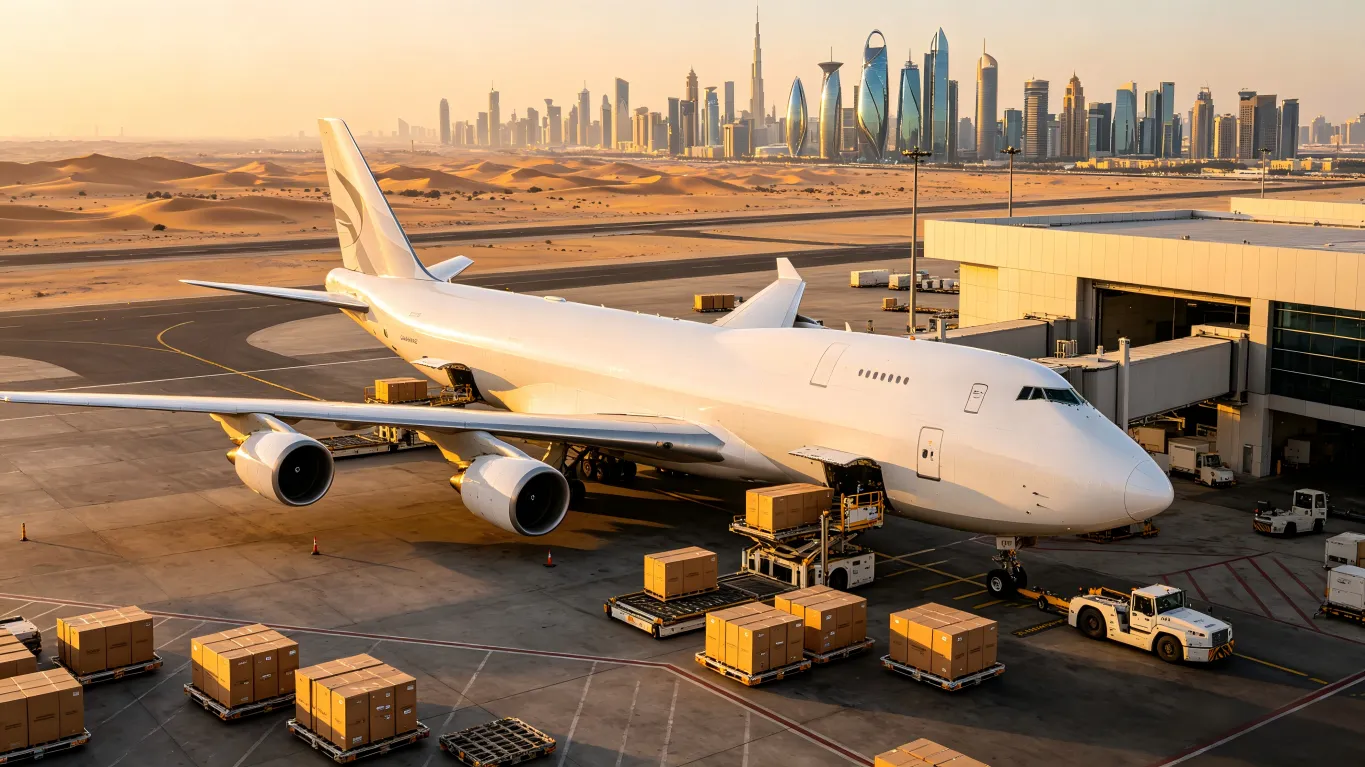
Why Choose Air Freight for China-UAE Shipments?
Speed is the most obvious reason to choose air cargo, but it is not the only one. When you are restocking inventory for a seasonal promotion, fulfilling a high-value purchase order, or shipping temperature-sensitive medical supplies, every day counts. Air freight delivers your goods from major Chinese hubs to Dubai or Abu Dhabi in as little as three to five days port-to-port, compared with eighteen to thirty-five days by sea. That speed translates directly into lower inventory carrying costs, faster cash conversion cycles, and the ability to respond to market demand in near real time.
Security and handling quality are equally important. Airports operate under stricter security protocols than seaports, and cargo undergoes less physical handling because it moves directly from the forwarder’s warehouse to the aircraft and then to the destination terminal. That makes air shipping the preferred choice for high-value, low-volume goods such as consumer electronics, luxury accessories, precision instruments, and pharmaceutical products. Fragile items also benefit from reduced touchpoints and standardized unit load devices (ULDs) that protect cargo during transit.
Reliability is another factor that experienced importers value. Major carriers operate scheduled passenger and freighter services multiple times per day from Shanghai, Guangzhou, Hong Kong, and Beijing to the UAE. Those fixed schedules make it easier to plan production and promise delivery dates to your own customers. Even when ocean freight rates spike during vessel shortages or port congestion, air capacity tends to remain more predictable, especially if you partner with a forwarder that holds block-space agreements with airlines.
Of course, air freight is not the right fit for every shipment. If you are moving bulk raw materials, heavy machinery, or low-margin commodities where cost matters more than speed, Sea Freight remains the economical choice. The key is knowing when the premium for air cargo pays for itself through reduced stock-outs, higher customer satisfaction, or contractual penalties for late delivery.
Major Airports and Routes
Understanding the origin and destination airport landscape helps you choose the fastest lane and avoid unnecessary trucking costs on either end.
Origin Hubs in China
Shanghai Pudong International Airport (PVG) is the undisputed leader for long-haul cargo out of China. It offers the highest frequency of direct freighter and belly-hold services to Dubai and Abu Dhabi, which means more scheduling flexibility and better rates at higher volume thresholds. If your suppliers are located anywhere in the Yangtze River Delta or eastern China, PVG should be your default option.
Guangzhou Baiyun International Airport (CAN) serves the manufacturing heartland of South China, including Dongguan, Foshan, and Zhongshan. It is particularly strong for electronics, textiles, and furniture. Forwarders often consolidate cargo from multiple nearby factories at their Guangzhou warehouses before tendering it to the airline, which can lower your pickup costs if you source from several suppliers in Guangdong province.
Shenzhen Bao'an International Airport (SZX) specializes in technology-centric shipments. Because Shenzhen is home to countless OEM and ODM factories producing smartphones, drones, and LED components, local forwarders have deep experience packing and documenting tech cargo for air transport. If your supply chain is heavily concentrated in the Pearl River Delta tech corridor, SZX can save you a day of domestic trucking compared with routing everything through Hong Kong.
Hong Kong International Airport (HKG) remains a premium option with massive cargo capacity and fierce competition among airlines and forwarders. Rates from Hong Kong are sometimes more competitive than mainland origins for certain lanes because of the high volume of transshipment traffic. The trade-off is the additional cross-border trucking step from mainland factories to Hong Kong, which requires export customs clearance on the China side.
Beijing Capital International Airport (PEK) and Yiwu Airport (YIW) are secondary but growing options. Beijing works well for northern China suppliers, while Yiwu caters to the massive small-commodity market in Zhejiang province. Both airports have added cargo frequencies to the Middle East over the past two years, giving shippers more choices beyond the traditional Big Three.
Destination Hubs in the UAE
Dubai International Airport (DXB) is the primary commercial gateway and the busiest airport for passenger and cargo traffic in the region. Its location adjacent to Dubai’s free zones and the Jebel Ali port complex makes it ideal if your final destination is Dubai itself or if you plan to re-export to neighboring Gulf Cooperation Council (GCC) countries or Africa.
Dubai World Central (DWC), also known as Al Maktoum International Airport, is a dedicated cargo megahub roughly forty kilometers south of DXB. It is designed specifically for logistics and is expanding rapidly as Emirates SkyCargo and other carriers shift pure freighter operations there. If your forwarder uses DWC, you may benefit from faster truck turn times and modern customs facilities built for high-volume cargo flows.
Abu Dhabi Zayed International Airport (AUH) is the home base of Etihad Cargo and offers excellent connectivity to Europe and the Americas in addition to its China lanes. If your consignee is based in Abu Dhabi or the western emirates, landing at AUH eliminates the two-to-three-hour trucking leg from Dubai and can shave half a day off your total door-to-door time.
Sharjah International Airport (SHJ) is a cost-effective alternative for certain cargo types, especially general consumer goods that do not require the premium handling infrastructure of DXB or DWC. Low-cost carriers and regional freighters use Sharjah frequently, which can translate into lower airport handling charges and competitive per-kilogram rates.
Transit Times: How Long Does Air Shipping Take?
Transit time depends on the service level you choose and how much of the journey you want your forwarder to manage. Below is a realistic breakdown for 2025.
| Service Type | Typical Transit Time | What Is Included |
|---|---|---|
| Express / Courier (Door-to-Door) | 1–3 days | Pickup, air transit, customs clearance, and last-mile delivery by DHL, FedEx, or UPS. Best for parcels under 45 kg. |
| Standard Air Freight (Port-to-Port) | 3–7 days | Airport-to-airport transport. You handle origin pickup and destination customs separately. |
| Air Freight DDP (Door-to-Door Shipping) | 7–10 days | All-inclusive service: pickup in China, export clearance, air transit, import clearance, duty payment, and delivery to your UAE warehouse. |
| Sea Freight (for comparison) | 18–35 days | Port-to-port or door-to-door ocean service. Most economical for bulk cargo over 500 kg or 8 CBM. |
Keep in mind that these are pure transit windows. You should add one to two days at the origin for export customs declaration and airline security screening, plus another one to two days at the destination for UAE import clearance and duty assessment. If your documentation is incomplete, customs inspections can add several more days. That is why pre-clearance preparation is just as important as choosing a fast airline.
Air Freight Costs from China to UAE (2025 Estimates)
Air freight pricing is not as straightforward as sea freight. Airlines calculate cost based on chargeable weight, which is the greater of the actual gross weight or the volumetric weight. You compute volumetric weight by multiplying the length, width, and height of each carton in centimeters and dividing by 6,000. If your cargo is light but bulky—think foam packaging, inflatable products, or large display stands—you will pay for the space it occupies rather than what it weighs.
Reference Spot Rates by Origin (per kg, USD)
The table below shows representative airport-to-airport rates for general cargo to Dubai and Abu Dhabi in late 2025. Final quotes depend on the specific airline, fuel surcharge levels, and seasonal demand.
| Origin Airport | Destination | ≥ 45 kg | ≥ 100 kg | ≥ 300 kg | ≥ 500 kg | ≥ 1,000 kg |
|---|---|---|---|---|---|---|
| Shanghai (PVG) | Dubai (DXB) | ~$2.82–2.93 | ~$1.91–2.00 | ~$1.78–1.80 | ~$1.68 | ~$1.68 |
| Guangzhou (CAN) | Dubai (DXB) | — | ~$2.38–2.46 | ~$2.30–2.38 | ~$2.30 | ~$2.30 |
| Shenzhen (SZX) | Abu Dhabi (AUH) | ~$3.06 | ~$2.14–2.22 | ~$2.07–2.14 | ~$2.07 | ~$1.99 |
| Beijing (PEK) | Sharjah (SHJ) | ~$2.36 | ~$2.38 | ~$2.30 | ~$2.22 | ~$2.14 |
| Hong Kong (HKG) | Dubai (DWC) | — | ~$2.30 | ~$2.20 | ~$2.10 | ~$2.00 |
As the table illustrates, the most dramatic savings appear when you cross the 100 kg and 500 kg thresholds. A shipment of 50 kg might cost close to $3.00 per kilogram from Shanghai, while a 1,000 kg consignment on the same lane can drop to $1.68 per kilogram. That is why consolidating smaller orders into a single air freight batch is one of the simplest ways to cut your per-unit logistics cost.
General Market Ranges
If you do not yet have a specific quote, use these broad benchmarks to budget your 2025 shipments:
- Standard Air Freight: approximately $2.50 to $5.00+ per kilogram, depending on volume and season.
- Economy Air Services: approximately $4.50 to $6.50 per kilogram, often with longer transit or indirect routing.
- Express / DDP Door-to-Door: approximately $3.50 to $8.50 per kilogram, inclusive of customs clearance and local delivery, typically with a 21 kg or 45 kg minimum charge.
These rates exclude UAE import duties and the 5 percent value-added tax (VAT), which are assessed separately by customs based on the CIF value of your goods.
Required Documents for Air Shipping
Incomplete paperwork is the single biggest cause of customs delays and storage fines. Before your cargo boards the aircraft, make sure you have the following documents prepared and aligned with each other. Even a minor discrepancy between your commercial invoice and packing list can trigger a customs hold.
- Commercial Invoice: States the full description of goods, their value, currency, and the correct Harmonized System (HS) code. UAE customs uses this document to assess duty and VAT.
- Packing List: Details the net and gross weight, dimensions, and number of cartons or pallets. Airlines and customs both use this to verify chargeable weight and cargo security.
- Air Waybill (AWB): The contract of carriage issued by the airline or your freight forwarder. For direct airline bookings this is a Master Air Waybill (MAWB); forwarders may issue a House Air Waybill (HAWB) for consolidated shipments.
- Certificate of Origin: Confirms where the goods were manufactured. The UAE may require a GCC-format certificate for certain product categories to confirm origin under trade agreements.
- Export License: Required only if you are shipping restricted or dual-use goods from China, such as certain telecommunications equipment or controlled chemicals.
- Product Conformity Certificates: For regulated products entering the UAE, you may need an ECAS (Emirates Conformity Assessment Scheme) certificate, or approvals from MOIAT or TRA for telecommunications and electronics. Unlike Saudi Arabia, the UAE does not use the SABER platform.
Your freight forwarder should review every document for consistency before the cargo departs. At AllBestShipping, our documentation team cross-checks invoice values, HS codes, and packing lists against UAE customs databases to catch errors before they become problems.
You may be interested in the following related shipping routes:
- Shipping from China to UAE
- Shipping from China to Egypt
- Shipping from China to Iran
- Shipping from China to Iraq
- Shipping from China to Saudi Arabia
UAE Customs, Duties, and 2025 Regulations
The United Arab Emirates maintains a transparent but strictly enforced customs regime. Knowing the rules in advance keeps your cargo moving and your budget predictable.
Duties and Taxes
Most general goods entering the UAE are subject to a 5 percent customs duty calculated on the CIF value (cost of goods + insurance + freight). In addition, a 5 percent VAT applies to the total value including the customs duty. That means your total landed cost tax burden is roughly 10.25 percent of the CIF value for standard merchandise. Some categories, such as alcohol and tobacco, carry significantly higher excise taxes, while certain free-zone imports may qualify for exemptions if the goods remain within the zone.
Product Conformity and Regulations
A common misconception among first-time importers is confusing Saudi Arabia’s SABER system with UAE requirements. SABER is managed by SASO and applies only to Saudi imports. If your cargo is destined for the UAE, you do not need SABER registration. Instead, focus on the following:
- ECAS for products under the Emirates Conformity Assessment Scheme.
- MOIAT or TRA approvals for radios, mobile devices, and network equipment.
- Specific permits for food, cosmetics, and pharmaceutical products from the respective UAE ministries.
Prohibited and Restricted Items
UAE customs prohibits pork products, gambling devices, counterfeit goods, and any items that violate public morals or national security. Certain electronics require pre-approval from the Telecommunications and Digital Government Regulatory Authority (TDRA). Attempting to import restricted goods without the proper permit will result in seizure, fines, and possible blacklisting of your importer record.
Avoiding Delays
The most frequent causes of customs delays are incorrect HS code declarations, missing certificates of origin, and invoice values that do not match the bank transfer records. Working with a customs clearance broker or forwarder who pre-submits declarations through Dubai Trade or the Abu Dhabi Single Window can reduce your clearance time from days to hours.
Step-by-Step Air Shipping Process
Breaking the journey into discrete stages helps you assign responsibilities and track progress.
- Cargo Assessment: Measure and weigh your shipment accurately. Determine whether actual weight or volumetric weight will drive the chargeable weight. Identify whether your product category requires ECAS, TRA, or other pre-arrival approvals.
- Request Quotes: Compare port-to-port rates against door-to-door (DDP) options. Ask your forwarder for the specific airline, estimated departure date, and a breakdown of fuel and security surcharges.
- Book and Prepare: Confirm the flight booking and warehouse cut-off time. Optimize your packaging to minimize empty space and reduce volumetric weight without compromising product protection.
- Export Clearance in China: Your forwarder submits the export declaration to Chinese customs at the origin airport. This step typically takes one business day for general cargo.
- Air Transit: The physical flight lasts between eight and twelve hours, but total airport-to-airport time includes ground handling at both ends. Expect three to seven days depending on direct versus connecting service.
- Import Clearance in the UAE: Your broker submits the commercial invoice, packing list, AWB, and conformity certificates to UAE customs. Duties and VAT are paid at this stage.
- Final Mile Delivery: Once customs releases the cargo, it is trucked from DXB, DWC, AUH, or SHJ to your warehouse, free zone facility such as JAFZA, or directly to your end customer.
Pro Tips to Save Money and Avoid Delays
Small adjustments to your shipping strategy can yield meaningful savings on the China-UAE lane.
| Tip | Why It Matters |
|---|---|
| Optimize Packaging | Reducing carton dimensions lowers volumetric weight, which directly cuts your airline charges. Use custom-sized boxes rather than standard over-sized cartons. |
| Hit Weight Breaks | Airlines publish lower per-kilogram rates at 100 kg, 300 kg, and 500 kg thresholds. Consolidate multiple small orders into one shipment to unlock these tiers. |
| Compare Origin Airports | Depending on the week, Hong Kong or Guangzhou may offer better spot rates than Shanghai for your specific commodity. Request quotes from two origins. |
| Avoid Peak Seasons | Rates spike before Chinese New Year, Ramadan, and the fourth-quarter retail rush. Book space two to three weeks ahead during these windows. |
| Use a Specialist Forwarder | A forwarder with deep China-UAE experience understands ECAS rules, local trucking networks, and airline cut-off quirks that generalists miss. |
| Insure High-Value Cargo | Cargo insurance typically costs 1 to 2 percent of the declared value. For electronics, luxury goods, or medical devices, it is inexpensive peace of mind. |
When to Consider Shipping Alternatives
Air freight is powerful, but it is not always the smartest choice.
- Sea Freight: If your shipment exceeds 500 kilograms or 8 cubic meters and speed is not critical, ocean transport will cost a fraction of air cargo. Budget roughly $1,125 to $3,050 per container depending on size and season.
- Express Courier: For parcels under 45 kilograms, DHL, FedEx, and UPS offer seamless door-to-door service in one to three days with online tracking and simplified customs processing.
- Multimodal Sea-Air: This hybrid option routes cargo by sea to a hub such as Dubai or Port Klang, then transfers it to air for the final leg. Transit time is fifteen to twenty-five days, and you can save 20 to 30 percent compared with pure air freight.
Why Choose AllBestShipping for China-UAE Air Freight?
Selecting the right logistics partner is as important as choosing the right airline. AllBestShipping has built a dedicated China-UAE lane operation that covers every step from factory floor to final delivery.
- Competitive Rates: We maintain direct contracts and block-space agreements with major carriers operating out of PVG, CAN, SZX, and HKG. That volume leverage translates into lower per-kilogram rates for our clients, especially at the 500 kg and 1,000 kg breakpoints.
- Regulatory Expertise: Our team stays current on UAE ECAS, TRA, and MOIAT requirements, as well as China export license rules. We review your documentation before departure to prevent customs surprises.
- End-to-End Service: From supplier pickup in Shenzhen or Yiwu to customs clearance in Dubai and trucking to your JAFZA warehouse, we manage the entire chain under one bill of lading.
- Real-Time Visibility: Our tracking platform follows your cargo from warehouse receipt through airline departure, arrival, and final delivery. You receive proactive alerts at every milestone.
If you are ready to move your next shipment, request a free, no-obligation quote at AllBestShipping and discover how much time and money you can save with a specialist on your side.
Conclusion
Air shipping from China to the UAE offers an unbeatable combination of speed, security, and reliability for time-sensitive and high-value cargo. In 2025, competitive spot rates—dropping as low as $1.68 per kilogram at volume—make air freight accessible even to small and mid-sized importers who once assumed it was reserved for emergencies. The key to success lies in understanding chargeable weight, choosing the optimal origin airport, preparing accurate documentation, and navigating UAE customs requirements such as ECAS and TRA approvals rather than mistakenly pursuing SABER certification. By consolidating shipments to hit weight breaks, optimizing packaging, and partnering with an experienced forwarder, you can transform air freight from a costly last resort into a strategic advantage.
Frequently Asked Questions (FAQ)
What is the cheapest way to ship from China to the UAE?
For small parcels under 45 kg, express courier services like DHL or FedEx are often the most economical all-in option. For larger commercial shipments, standard air freight from Shanghai or Hong Kong to Dubai typically offers the best balance of speed and cost, while sea freight is the cheapest method for bulk cargo over 500 kg.
How is air freight cost calculated from China to the UAE?
Airlines charge by chargeable weight, which is whichever is greater: the actual gross weight or the volumetric weight (length × width × height in centimeters ÷ 6,000). Fuel surcharges, security fees, and origin handling are added on top of the base rate.
How long does customs clearance take in Dubai or Abu Dhabi?
For general cargo with complete and accurate documentation, customs clearance takes between four and twenty-four hours. Delays usually occur when invoices, packing lists, or conformity certificates are missing or inconsistent.
What is SABER certification, and do I need it for the UAE?
No. SABER is Saudi Arabia’s product safety platform managed by SASO. It does not apply to UAE imports. Instead, check whether your products require an ECAS certificate or TRA approval for the UAE market.
Can I ship door-to-door from China to the UAE?
Yes. Door-to-door or DDP services are widely available. Your forwarder handles pickup, export clearance, air transit, import clearance, duty payment, and final delivery. Typical transit time is seven to ten days.
What documents are required for air freight to the UAE?
You need a commercial invoice, packing list, air waybill (AWB), certificate of origin, and any product-specific conformity certificates. An export license is required only for restricted goods leaving China.
Are there any prohibited items when shipping to the UAE?
Yes. Pork products, gambling devices, counterfeit goods, and items that violate public morals are prohibited. Certain electronics require pre-approval from TDRA. Always verify restrictions with your forwarder before shipping.