Air Shipping from China to Netherlands: A Complete Guide for 2026
Waiting weeks for inventory to arrive from China can strangle your cash flow and leave you staring at empty shelves. If you are importing into the European Union, air shipping from China to Netherlands offers one of the fastest and most reliable routes available, especially with Amsterdam Schiphol serving as a premier cargo gateway. But navigating fluctuating rates, strict EU customs rules, and recent airport capacity issues has become harder than ever.
At AllBestShipping, our operations team manages weekly consolidations and direct bookings on the China–Netherlands lane. Over the past 12 months alone, we have seen rates swing from $3.80/kg to over $11.00/kg on the same route, and we have learned—often the hard way—which shortcuts save money and which ones strand cargo on the tarmac. In this updated May 2026 guide, you will learn exactly how long air freight takes, what it really costs, which documents you need, and how to avoid expensive delays—so you can ship with confidence and keep your supply chain moving.
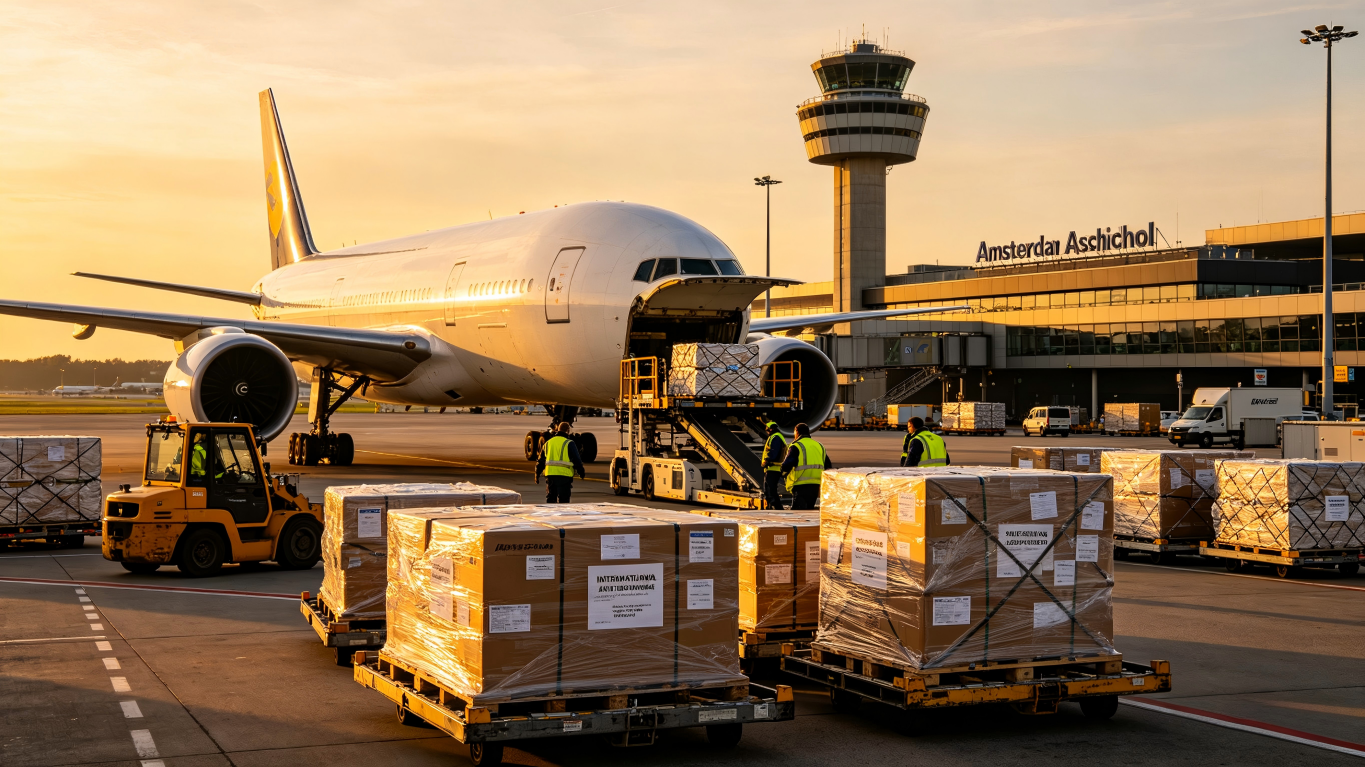
Why Choose Air Freight for China-Netherlands Shipments
Speed is the obvious reason. A shipment that takes 25–45 days by ocean can reach Amsterdam in as little as one to three days by air. For businesses selling high-value electronics, pharmaceuticals, perishables, or operating on just-in-time (JIT) inventory models, that speed is not a luxury—it is a necessity. E-commerce sellers also rely on Air Freight to replenish best-selling SKUs quickly without tying up capital in transit.
That said, air freight is not always the right choice. If you are moving bulky, heavy, or non-urgent goods, Sea Freight remains far more cost-effective. In some cases, a sea-air hybrid—where cargo sails to a Middle Eastern hub and flies the final leg to Europe—strikes a balance between cost and speed. For 2026, there is also a growing sustainability angle: major carriers now offer SAF (Sustainable Aviation Fuel) options for EU-bound cargo, helping shippers meet carbon reporting requirements without abandoning air transport entirely.
Insider reality check: We once had a client rush a 2,000 kg shipment of furniture by air to beat a launch date. The freight cost exceeded the manufacturing cost. A sea-air hybrid would have arrived just five days later and saved 60 percent of the bill. Air freight rewards urgency, but it punishes poor planning.
Major Airports and Routes
Your choice of origin airport in China directly affects both cost and transit time. Most consolidated and direct air cargo originates from the hubs listed below.
| Origin Airport | Code | Advantage |
|---|---|---|
| Shanghai Pudong | PVG | Largest cargo hub in China; highest flight frequency to AMS |
| Guangzhou Baiyun | CAN | Proximity to Pearl River Delta manufacturing |
| Shenzhen Bao'an | SZX | Ideal for electronics and tech hardware exports |
| Beijing Capital | PEK | Strong for northern China suppliers |
| Hong Kong | HKG | Alternative with high cargo volume and fewer mainland capacity constraints |
On the European side, Amsterdam Schiphol (AMS) is the clear destination of choice. It is Europe’s third-largest cargo airport and offers direct distribution links to over 300 international destinations. For importers planning to distribute goods across the EU, landing at Schiphol provides access to excellent road and rail networks that can reach major markets like Germany, France, and Belgium within hours. We also provide dedicated Door to Door Shipping from China to France and Shipping From China to Germany for businesses expanding into Western and Central Europe.
Shippers can book either direct flights or consolidated (LCL air freight) services. Direct service is faster and more predictable, while consolidation pools your cargo with other shipments to lower the per-kilogram rate—a smart option for loads between 100 kg and 500 kg. Read our LCL Shipping Guide to learn more.
Transit Times: What to Expect
The phrase "air shipping" sounds instant, but door-to-door timelines include more than just flight time. Understanding each leg helps you set realistic expectations for customers and internal teams.
| Segment | Typical Duration |
|---|---|
| Pure flight time (e.g., PVG → AMS) | Under 12 hours |
| Express courier (DHL/FedEx/UPS) door-to-door | 24–48 hours |
| Standard air freight airport-to-airport | 1–3 days |
| Standard air freight door-to-door | 5–10 days |
| Sea-air hybrid via Rotterdam | 12–18 days |
Several factors add time to the standard window. Origin trucking and warehouse handling usually consume one to three days. Export Customs Clearance in China takes another one to two days, depending on documentation accuracy. Upon arrival, import customs at AMS typically processes shipments within 12–48 hours, but inspections can extend this.
A detail most blogs miss: AMS cargo clearance effectively pauses over weekends and Dutch public holidays. If your flight lands on a Friday evening, do not expect customs release before Monday morning—even if the paperwork is perfect. We always advise clients to book mid-week departures from China to avoid weekend dead time in Amsterdam.
Finally, during the ongoing Polderbaan runway closure at Schiphol, some shipments are experiencing an additional two to five days of delays due to rerouting and backlogs.
Air Freight Costs from China to Netherlands (2026)
Pricing air freight is more complex than checking a single rate per kilogram. Costs depend on chargeable weight, fuel markets, seasonality, and current airport capacity constraints.
| Service Type | Rate Range (per kg) | Notes |
|---|---|---|
| Standard air freight | $4.00 – $10.00 | Based on chargeable weight; subject to fuel and security surcharges |
| Express courier | Premium above standard | A 50 kg shipment can exceed $800 |
| Consolidation (LCL air) | Variable / negotiable | Often the best value for 100–500 kg shipments |
Airlines calculate chargeable weight using whichever is greater: the actual weight of your cargo or its dimensional weight. Dimensional weight is computed as length × width × height (in centimeters) divided by 6,000. Optimizing your packaging to reduce empty space can therefore deliver real cost savings.
Beyond the base rate, expect several surcharges. Fuel surcharges fluctuate with oil markets and are usually adjusted weekly. Security screening fees, customs brokerage, terminal handling charges, and airline documentation fees are typically added to your invoice. These can easily add $1.00–$2.50/kg to the headline rate, so always ask your forwarder for an all-in quote rather than a base-rate teaser.
How forwarders really price: The rate you see on a forwarder's website is rarely the rate they pay the airline. Large forwarders negotiate block-space agreements months in advance, locking in capacity at lower prices. When you book through a forwarder like AllBestShipping, you are effectively buying a slice of that pre-negotiated space—often at rates individual shippers cannot access directly.
Seasonal peaks also move the needle: rates climb during October through December for holiday demand, and again just before Chinese New Year (usually January or February) when factory output surges and space tightens.
In 2025–2026, the Polderbaan runway closure at Schiphol has created an additional cost pressure. With cargo throughput down over 30 percent on affected lanes, rerouting and constrained capacity have pushed rates up an estimated 20–50 percent for shipments relying solely on AMS. Planning ahead and confirming routing with your forwarder is essential to avoid sticker shock.
Documentation and EU Customs Requirements
Accurate paperwork is the difference between a smooth clearance and a shipment stuck in Dutch customs for days. At minimum, you will need:
- Commercial Invoice – declares the value and description of goods.
- Packing List – details the contents, weights, and dimensions of each package.
- Air Waybill (AWB) – the contract of carriage between shipper and airline. Electronic AWB (e-freight) is strongly preferred and often required.
On the regulatory side, the EU enforces strict import controls. Every commercial importer must have a valid EORI number (Economic Operators Registration and Identification). Without it, customs cannot process your entry.
Common mistake we see weekly: Importers obtain an EORI number in one EU country and assume it works everywhere. It does—but only for customs clearance. If you want to defer Dutch VAT through a local deferment scheme, you often need a Dutch VAT registration or a fiscal representative, even if you already have an EORI from Germany or France. Do not confuse the two.
Additionally, ICS2 (Import Control System 2) is now fully enforced for air cargo. This means your forwarder must submit detailed advance electronic data—known as an ENS (Entry Summary Declaration)—before the cargo is even loaded onto the aircraft. Errors or omissions here can trigger holds, fines, or refusal of entry. The most frequent ICS2 rejection we encounter? Inconsistent commodity descriptions between the Commercial Invoice and the ENS filing. If your invoice says "Bluetooth speaker," your ENS cannot say "electronic device." Dutch customs scans for mismatches automatically.
Financially, standard Dutch VAT sits at 21 percent. If cash flow is a concern, ask your broker about VAT deferment arrangements, which allow you to account for import VAT on your regular return rather than paying it upfront at the border. Product-specific rules also apply. Electronics and machinery generally require CE marking, and certain goods may need a Certificate of Origin to claim preferential duty rates under existing trade agreements.
Understanding Incoterms for Air Shipments
Incoterms define who pays for transport, insurance, and customs duties. For air shipping from China to the Netherlands, three terms dominate:
- EXW (Ex Works) – The buyer assumes nearly all responsibility from the supplier’s door. You arrange and pay for everything, including pickup in China, export clearance, air freight, and import formalities. It offers maximum control but requires significant logistics coordination.
- DAP (Delivered at Place) – The seller delivers the goods to a named destination, such as Amsterdam Schiphol. The buyer handles import clearance and any applicable duties or VAT. This is a popular middle-ground option.
- DDP (Delivered Duty Paid) – The seller manages the entire journey, including shipping, import clearance, duties, and VAT. It is the most hands-off option for buyers, but make sure your supplier genuinely understands Dutch customs procedures before agreeing to DDP.
FOB (Free on Board) is common in ocean freight but rarely used for air shipments because there is no physical "rail of the ship" moment. For most importers, DAP offers the best balance of cost transparency and manageable responsibility.
Schiphol Airport: Capacity, Challenges, and Alternatives
Amsterdam Schiphol is not just a passenger hub; it is a powerhouse for cargo, specializing in pharmaceuticals, perishables, high-tech goods, and e-commerce parcels. Its bonded warehousing facilities and rapid road connections make it an ideal entry point for EU distribution.
However, the airport is facing serious headwinds. The Polderbaan runway closure, driven by radar interference from nearby solar panels, has reduced cargo throughput by over 30 percent. For shippers, this translates to delays of two to five extra days and rate increases of 20–50 percent on heavily affected lanes. These disruptions are expected to continue into 2026.
What the news does not tell you: The closure does not affect all carriers equally. KLM Cargo and Air China, which operate heavily out of Schiphol's dedicated cargo aprons, have been forced to reroute more frequently than carriers like Cathay Pacific that can shift volume through Frankfurt. If your forwarder has not specified which airline is handling your booking, ask. A vague "consolidated via AMS" answer during this disruption is a red flag.
If your supply chain cannot absorb that uncertainty, consider these alternatives:
| Alternative | Code | Distance from Amsterdam | Best For |
|---|---|---|---|
| Frankfurt | FRA | ~460 km | High-frequency connections; strong pharma handling |
| Brussels | BRU | ~200 km | Quick road transfer to the Netherlands and Belgium |
| Sea-air via Rotterdam | RTM | ~60 km | Cost-conscious shippers willing to add a few days |
Discuss contingency routing with your forwarder before peak season hits. A proactive plan can save both money and customer relationships. For another major European gateway, see our guide to Air Shipping from China to UK.
How to Choose a Freight Forwarder
You can book directly with carriers like KLM Cargo, Air China, or Cathay Pacific, but most importers benefit from the flexibility and negotiating power of a freight forwarder. If you are new to the industry, learn What is a Freight Forwarder first. A good forwarder coordinates pickup, booking, customs, and Door-to-Door Shipping under one roof.
When evaluating partners, verify three capabilities:
- ICS2 compliance and e-freight support – If they cannot file accurate advance data, your cargo risks delays before it even leaves China.
- Bonded warehousing at Schiphol – This allows you to store goods under customs control and defer VAT until products are sold or moved to another EU country.
- Category experience – Shipping electronics is different from shipping perishables. Ask for references in your specific product vertical.
This is where AllBestShipping stands out for Shipping From China to Netherlands. With competitive pricing, stable transit times on the China-Netherlands lane, and responsive customer support, we help importers navigate everything from ICS2 filings to bonded storage. Whether you need a one-time express shipment or a monthly consolidation program, our team tailors routing recommendations to your inventory goals and budget. Visit AllBestShipping to request a tailored quote.
Tips to Reduce Costs and Avoid Delays
Small changes in how you prepare and book shipments can yield significant savings.
- Optimize packaging. Because airlines bill by chargeable weight, reducing box size without compromising protection directly lowers your invoice. Avoid oversized cartons filled with air.
- Consolidate smaller loads. If you regularly ship 100–500 kg, ask your forwarder about consolidation instead of defaulting to express courier. The per-kilogram rate is usually much lower.
- Book ahead of peak season. October through December and the weeks before Chinese New Year see the tightest capacity and highest prices. Lock in space two to four weeks early.
- Diversify origin routing. If Shanghai Pudong is congested, consider trucking cargo to Hong Kong or booking from Guangzhou or Shenzhen.
- Leverage bonded warehousing. Storing goods in a Netherlands bonded warehouse lets you defer VAT and distribute across the EU without paying duty at every border.
- Submit accurate electronic documents early. ICS2 and ENS requirements mean errors caught at the last minute can ground your shipment. Double-check commodity descriptions and HS codes before submission.
- Request the airline's master AWB number before departure. With this number, you can track your cargo directly on the airline's website instead of waiting for your forwarder's update. It is a small detail that gives you real-time visibility.
- Insist on all-in pricing. Ask your forwarder to confirm whether the quote includes fuel, security, terminal handling, and documentation fees. The difference between a base rate and an all-in rate can be $2–$4/kg—enough to destroy your margin on a high-volume shipment.
FAQ
How long does air shipping take from China to the Netherlands?
Airport-to-airport transit typically takes 1–3 days. Door-to-door delivery, including customs and trucking, usually falls between 5 and 10 days. During the Schiphol runway disruption, add a buffer of 2–5 days.
How much does it cost to ship 100 kg by air from China to the Netherlands?
At standard air freight rates of $4.00–$10.00 per kg, a 100 kg shipment costs roughly $400–$1,000 before surcharges. Express courier for the same weight could exceed $1,600. Consolidation services may offer lower per-kg pricing for this weight bracket.
What is the cheapest way to ship from China to the Netherlands?
For non-urgent, heavy, or bulky goods, ocean freight is cheapest. For time-sensitive cargo, standard air freight or consolidation beats express courier. A sea-air hybrid via Rotterdam can also reduce costs while keeping transit under three weeks.
Do I need an EORI number to import into the Netherlands?
Yes. An EORI number is mandatory for all commercial imports into the EU. Without it, customs will not process your entry.
What is ICS2 and how does it affect my air shipment?
ICS2 (Import Control System 2) is the EU’s advance cargo information system for air freight. It requires detailed electronic data before loading. Non-compliance can result in holds, fines, or refusal of entry.
What happens if my goods are held at Dutch customs?
Customs may inspect documentation, verify valuations, or physically examine cargo. Providing a clear Commercial Invoice, accurate Packing List, and correct HS codes upfront minimizes this risk. If held, your broker or forwarder will coordinate with customs to resolve the issue.
Is air freight currently affected by the Schiphol runway closure?
Yes. The Polderbaan closure has reduced cargo capacity by over 30 percent, causing delays of 2–5 days and rate increases of 20–50 percent on some lanes. Diversifying to Frankfurt or Brussels can mitigate the impact.
Can I use sea-air hybrid to save costs while keeping transit times reasonable?
Absolutely. Sea-air hybrid routes—often via a Middle Eastern hub or directly into Rotterdam—typically deliver cargo in 12–18 days at a cost significantly below pure air freight. It is an excellent middle ground for mid-urgency inventory.
Conclusion
Air shipping from China to Netherlands remains one of the most efficient ways to move inventory into the heart of Europe, provided you plan around costs, paperwork, and current capacity constraints. In 2026, budget roughly $4–$10 per kilogram, expect 5–10 days door-to-door under normal conditions, and make sure your EORI, ICS2, and product certifications are in order before the cargo boards the plane. With the right packaging strategy, a reliable forwarder, and contingency routing when Schiphol is congested, you can turn air freight from a stressful expense into a competitive advantage.
Disclaimer: Air freight rates and transit times change daily based on fuel markets, capacity, and regulatory shifts. The figures in this guide reflect market conditions as of May 2026 and should be used for planning purposes only. For a binding quote tailored to your cargo, contact us directly.
Ready to streamline your next shipment? Contact AllBestShipping today for a customized quote and routing plan that fits your timeline and budget.