How Long Does Shipping Take from China to USA?
In the fast-paced world of international trade, the question "How long does shipping take from China to USA?" is more than just a logistical query—it's a critical business metric. For dropshippers, Amazon FBA sellers, and established importers, the transit time between the factory floor in China and the customer's doorstep in the US can make or break profitability.
As we move through August 2026, the global logistics landscape has changed in important ways. The days of unpredictable pandemic-era delays are long gone, but they have been replaced by new realities: the $800 de minimis exemption has been eliminated, a new Section 301 tariff layer took effect in July 2026, and US West Coast ports are running at record import volumes. All of this affects both the cost and the clearance speed of your shipments. Generally speaking, shipping from China to the USA can take anywhere from 2 days to 45+ days, depending heavily on the method you choose—ranging from lightning-fast express couriers to cost-effective ocean freight.
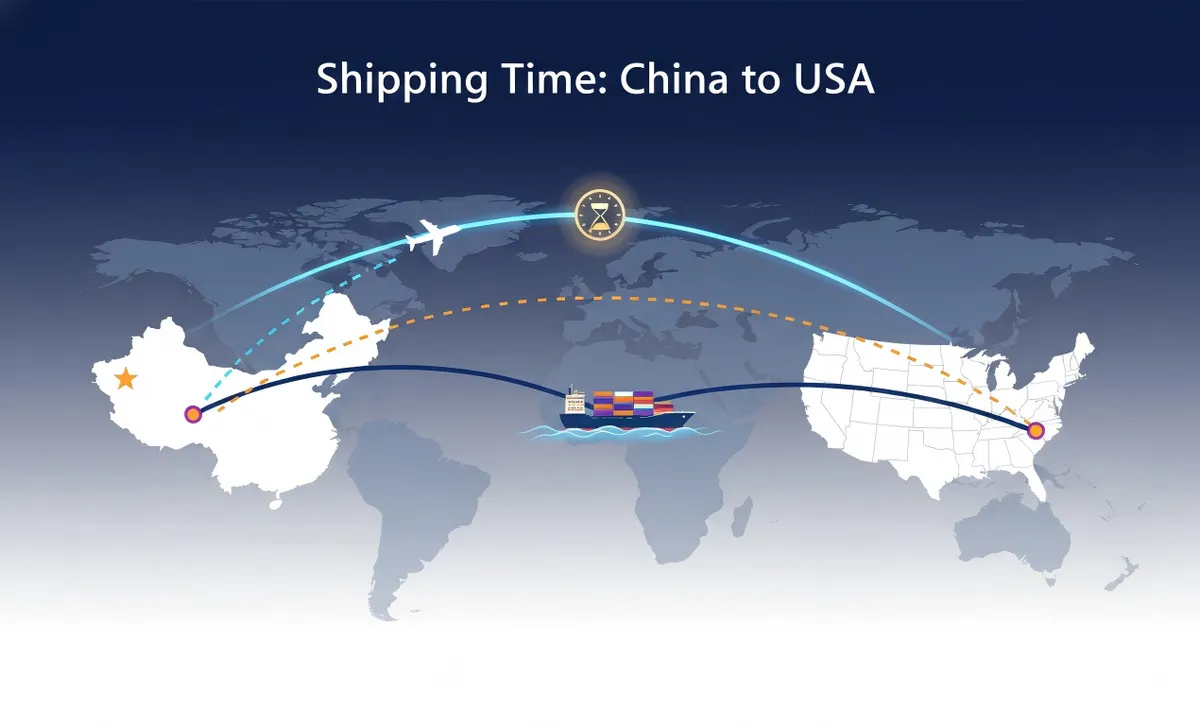
At AllBestShipping, we understand that time is money. This comprehensive guide, updated for late 2026, will break down every shipping method, provide real-world transit estimates, and offer expert tips to help you optimize your supply chain in the current trade environment.
Quick Summary: Shipping Time from China to USA
If you are looking for a quick answer, here is the breakdown of typical transit times for the most common shipping methods in 2026. For a complete overview of routes, pricing, and door-to-door options, see our dedicated Shipping from China to USA page.
| Shipping Method | Typical Transit Time | Best For | Cost Level |
|---|---|---|---|
| Express Courier (DHL/FedEx/UPS) | 2 – 5 Days | Urgent documents, samples, small parcels (< 20kg) | $$$$ |
| Air Freight (Standard) | 4 – 10 Days | High-value goods, electronics, medium urgent cargo (> 45kg) | $$$ |
| Sea-Air (Hybrid) | 10 – 20 Days | Mid-urgency cargo balancing cost and speed | $$ |
| Fast Sea Freight (e.g., Matson CLX) | 11 – 15 Days (to West Coast) | E-commerce sellers needing speed at a lower cost than air | $$ |
| Standard Sea Freight (West Coast) | 18 – 25 Days | Bulk goods to LA/Long Beach/Oakland | $ |
| Standard Sea Freight (East Coast) | 30 – 45 Days | Bulk goods to NY/Savannah/Miami | $ |
| Economy Sea Freight (LCL) | 35 – 50+ Days | Small volume shipments sharing a container | $ |
Note: These are port-to-port or door-to-door estimates based on normal conditions. Customs delays, the new 2026 tariff filings, and "last mile" delivery can add additional time.
1. Express Shipping: The Fastest Option (2–5 Days)
When speed is the absolute priority, Express Shipping is the undisputed champion. Services like DHL, FedEx, and UPS offer dedicated air networks that fly directly from major Chinese hubs (like Shanghai, Shenzhen, Hong Kong) to distribution centers in the US (like Memphis, Louisville, Cincinnati).
Why It’s So Fast
- Integrated Network: The courier company handles everything from pickup to final delivery.
- Streamlined Clearance: Express carriers have dedicated customs brokerage teams and pre-arrival data filing, which keeps clearance fast—though since August 2025 every parcel, regardless of value, now requires a formal (or informal) customs entry and duty assessment.
- Direct Flights: Packages are loaded onto daily flights, minimizing wait times.
Ideal For:
- Prototypes and product samples.
- Urgent documents.
- High-value, low-weight items (e.g., jewelry, rush orders).
Expert Insight: While Express Shipping is fast, it is also the most expensive. For shipments over 100kg, the cost per kilogram remains high compared to air freight. However, for a 5kg package, the convenience and speed are unbeatable. One 2026 change to note: with the $800 de minimis exemption gone, even small express parcels incur duty and a Merchandise Processing Fee (MPF) on formal entries, so factor that into your pricing.
2. Air Freight: Speed Meets Capacity (4–10 Days)
Air Freight bridges the gap between the high cost of express couriers and the slowness of ocean shipping. Unlike express, which is door-to-door, standard air freight is typically airport-to-airport. This means you (or your freight forwarder like AllBestShipping) must arrange for local pickup in China and final delivery in the USA.
Types of Air Freight
- Standard Air Freight: Cargo is booked on commercial passenger airlines (belly cargo) or dedicated freighters. Transit time is usually 4–7 days.
- Economical Air Freight: To save costs, cargo might be routed through a third country (transshipment), adding a few days to the journey (total 7–10 days).
The "Door-to-Door" Factor
While the flight itself is only about 14-16 hours, the total transit time includes:
- Export Customs in China: 1-2 days.
- Flight Transit: 1-3 days (depending on connections).
- Import Customs in USA: 1-2 days—longer if your shipment is flagged for examination or your entry documentation is incomplete.
- Trucking to Final Destination: 1-3 days.
Ideal For:
- Electronics (phones, tablets, components).
- Fashion and apparel with tight seasonal deadlines.
- Shipments between 100kg and 500kg.
Sea-Air Hybrid: The Middle Ground (10–20 Days)
A growing favorite in 2026, Sea-Air combines the low cost of ocean freight for the main haul with the speed of air freight for the final leg. Cargo sails from China to a transshipment hub (often in the Middle East or the West Coast of the US) and then flies to its final destination. Total door-to-door time typically runs 10–20 days—slower than direct air but significantly cheaper. It is a practical option for mid-urgency goods that miss the air budget but cannot wait for full ocean transit.
3. Sea Freight: The Backbone of Global Trade (15–45 Days)
Ocean Freight is the most popular method for shipping from China to the USA, accounting for over 90% of cargo volume. It offers the lowest cost but requires the longest lead time. In 2026, transit times vary significantly based on the destination port and the specific service loop.
West Coast vs. East Coast
The geography of the US plays a massive role in shipping times:
- To West Coast (USWC): Ports like Los Angeles (LA), Long Beach (LB), and Oakland are the closest to China.
- Standard Transit: 15 – 20 days (Port-to-Port).
- To East Coast (USEC): Ports like New York (NY), Savannah, and Charleston are much further.
- Route: Vessels typically go through the Panama Canal.
- Standard Transit: 28 – 35 days (Port-to-Port).
- Red Sea & Suez Factor: Some carriers serving USEC from South China used the Suez Canal route. The ongoing Red Sea crisis—now in its third year—still pushes the majority of ships around the Cape of Good Hope, adding 10–14 days. While a partial return to Suez began in mid-2026, routing remains selective and volatile, so East Coast sailings can still stretch beyond 40 days door-to-door.
FCL vs. LCL: Why It Matters
- FCL(Full Container Load): You rent the entire container (20ft or 40ft). Once sealed at the factory, it stays sealed until it reaches you. Faster because there is no consolidation/de-consolidation time.
- LCL (Less than Container Load): Your goods are packed with other people's cargo.
- The Delay Factor: LCL adds 5 – 10 days to the total transit time. Why? Because the forwarder needs time to collect cargo, pack the container (consolidation) in China, and unpack/sort it (de-consolidation) in the US warehouse before final delivery.
The "Matson CLX" Advantage
For e-commerce sellers (especially Amazon FBA), the Matson CLX service is legendary.
- Route: Shanghai to Long Beach.
- Speed: 11 Days (Port-to-Port).
- Reliability: Matson has its own dedicated terminal (Terminal C) in Long Beach, avoiding the massive congestion that often plagues other carriers. It functions almost like "Sea Express."
Key Factors Affecting Shipping Time in 2026
Even the best-planned shipments can face delays. Understanding these variables can help you manage expectations—and several of them changed dramatically in 2025–2026.
1. The 2026 Tariff Environment & Customs Policy
Trade policy has been the single biggest wildcard for China-to-US shippers over the past 18 months:
- The $800 de minimis exemption is gone. Suspended for China/Hong Kong on May 2, 2025, then for all countries on August 29, 2025, the duty-free "Section 321" lane no longer exists. As of 2026, every commercial parcel entering the US requires a formal or informal customs entry, accurate 10-digit HS codes, duty payment, and a Merchandise Processing Fee. The US Court of International Trade upheld the suspension in August 2026, and Congress has legislated the exemption's permanent termination effective July 1, 2027.
- New duty layers keep shifting. After the Supreme Court struck down IEEPA-based tariffs in February 2026, a flat 10% Section 122 surcharge ran from February to July 2026. Since July 24, 2026, a Section 301 forced-labor action has applied additional duties of 10%–12.5% on goods from roughly 60 trading partners—covering the overwhelming majority of US imports—with no expiration date.
- Practical impact on timing: Accurate HS classification and complete commercial documentation are now non-negotiable. Missing paperwork that used to be tolerated can now trigger holds, exams, and 1–5+ extra business days of clearance time—plus fines of $5,000–$10,000 per non-compliant shipment.
2. The Red Sea Crisis & Global Geopolitics
As of late August 2026, the Red Sea region remains a volatile chokepoint in its third year. While it primarily affects Europe- and US East Coast-bound cargo, it has a knock-on effect on global vessel availability. After the Gulf escalation of early 2026, most carriers continue to route around the Cape of Good Hope, adding 10-14 days to affected voyages. That said, a selective, partial return to Suez began in mid-2026 as security conditions shifted—but the situation can reverse quickly, so treat East Coast ETAs with extra caution.
3. Seasonality and Holidays
Shipping speeds fluctuate with the calendar:
- Chinese New Year (CNY): Usually in January or February. Factories close for weeks. The "rush" before CNY causes port congestion, and the backlog after CNY takes weeks to clear.
- Q4 Holiday Rush (Oct - Dec): The peak season for retail. Space on vessels is tight, prices soar, and offloading at US ports slows down due to volume.
4. Customs Clearance & Inspection
- Smooth Sailing: Standard clearance takes 1-3 business days when all documents (commercial invoice, packing list, 10-digit HS codes, ISF filing) are complete and accurate.
- The "Exam" Delay: If your shipment is flagged for a Customs Exam (X-ray or intensive physical inspection), add 5 – 15 days.
- No more de minimis shortcut: The old "under $800 clears faster" rule is obsolete. Since 2025, low-value parcels get the same scrutiny as larger shipments—correct classification and valuation matter at every price point.
5. US Port Congestion & Inland Bottlenecks
In 2026, the pressure at LA/Long Beach has shifted from vessel berthing to rail and inland distribution:
- LA/LB handled a record 881,000 TEU in June 2026—the highest monthly import volume of the year—driven by early peak-season stocking and tariff-related front-loading.
- Average rail container dwell time at LA/LB reached 5.43 days in June 2026 (the second-highest in 14 months), with some terminals working around the clock to clear backlogs. Truck dwell stayed healthy at under 3 days.
- Expect elevated rail and terminal pressure through August–September 2026, with a return toward normal operations expected by late Q4—assuming no new disruptions. If your cargo moves inland by rail (Chicago, Dallas, Kansas City), build extra buffer into your schedule.
6. Weather Conditions
Typhoons in the South China Sea (summer/autumn) or snowstorms in the US Midwest can ground flights and halt truck deliveries.
Real-World Case Studies: What to Expect
To give you a clearer picture, here are three typical scenarios from our clients at AllBestShipping.
Case A: The Amazon FBA Seller (Shenzhen to Los Angeles)
- Product: Yoga Mats (Bulk).
- Method: Matson CLX (Sea).
- Timeline:
- Day 1: Goods picked up in Shenzhen.
- Day 3: Loaded onto vessel in Shanghai.
- Day 14: Arrived at Long Beach, CA.
- Day 15: Container available (Next day availability).
- Day 17: Delivered to Amazon FBA warehouse in Ontario, CA.
- Total Time: 17 Days.
Case B: The Fashion Boutique (Guangzhou to New York)
- Product: New Season Dresses.
- Method: Standard Air Freight.
- Timeline:
- Day 1: Pickup in Guangzhou.
- Day 3: Depart from Guangzhou Airport (CAN).
- Day 5: Arrive at JFK Airport, NY.
- Day 6: Customs Cleared.
- Day 7: Delivered to Manhattan store.
- Total Time: 7 Days.
Case C: The Heavy Machinery Importer (Ningbo to Chicago)
- Product: Industrial Pumps.
- Method: Standard Ocean FCL (Rail Landbridge).
- Timeline:
- Day 1: Depart Ningbo Port.
- Day 20: Arrive Port of Tacoma (West Coast).
- Day 25: Loaded onto Rail for inland transport.
- Day 32: Arrive Chicago Rail Ramp.
- Day 35: Truck delivery to warehouse.
- Total Time: 35 Days.
Tips to Reduce Shipping Time
You can't control the weather or the ocean, but you can control how you manage your logistics.
1. Book in Advance
In 2026, "last minute" often means "left behind." Try to book your cargo space at least 2 weeks before the goods are ready (CRD - Cargo Ready Date). During peak season—and with 2026's front-loaded import volumes—book 4 weeks early.
2. Choose the Right Incoterms
Using DDP (Delivered Duty Paid) can sometimes be slower if the forwarder consolidates your goods with many others to save costs. If speed is key, consider DAP (Delivered at Place) where you control the final delivery speed, or ensure your forwarder uses a "Premium DDP" service.
3. Use Reliable Freight Forwarders
A cheap forwarder might route your "direct" air freight through three different hubs to save money, turning a 5-day trip into a 12-day nightmare. At AllBestShipping, we prioritize transparency. We tell you the exact route and carrier so you know what you are paying for—and we handle the 2026 tariff and duty assessment correctly the first time.
4. Optimize Packaging
Lighter and smaller packages move faster, especially in express networks. Proper packaging also prevents damage, which is the ultimate time-waster (returns and replacements).
The Logistics Lifecycle: From Factory to Door
Understanding "shipping time" requires looking beyond just the time a ship spends on the water or a plane in the air. The total transit time is the sum of several distinct stages. Here is a detailed breakdown of the logistics lifecycle in 2026.
Stage 1: Booking and Cargo Readiness (1-3 Days)
Before anything moves, space must be booked.
- Action: Your supplier notifies the freight forwarder that goods are ready.
- Time: The forwarder books space on a vessel or flight. In peak season (Q4) or during 2026's tariff-driven front-loading, this can take up to a week if space is tight.
- Tip: Always book at least 14 days before your Cargo Ready Date (CRD).
Stage 2: Pickup and Consolidation (2-5 Days)
- Action: Trucks pick up goods from the factory.
- Scenario A (FCL): Container is loaded at the factory and trucked directly to the port. (Fastest)
- Scenario B (LCL): Goods are trucked to a warehouse, measured, and packed into a shared container with other shipments. This "consolidation" step adds 3-5 days.
Stage 3: Export Customs Clearance (1-2 Days)
- Action: Chinese customs authorities review the export documents.
- Potential Delay: If the HS Code is incorrect or the brand authorization is missing, goods can be held for inspection.
- Standard Time: usually 24 hours for compliant shipments.
Stage 4: The Main Transit (The "Shipping Time")
This is the part most people focus on.
- Express: 2-3 Days flight.
- Air Freight: 1-3 Days flight (including connections).
- Sea Freight: 11-45 Days sailing time depending on the route (West Coast vs. East Coast).
Stage 5: Import Customs Clearance (1-3 Days)
- Action: US Customs and Border Protection (CBP) reviews the entry.
- Pre-Clearance: For sea freight, ISF (Importer Security Filing) must be filed 24 hours before loading. Clearance often happens while the ship is still at sea (5 days before arrival).
- 2026 Reality: With de minimis gone and new duty layers (Section 301) in effect, entry documentation must be complete and HS codes accurate for every shipment—regardless of value—or expect holds.
- The "Hold": Random exams (VACIS, X-Ray) can pause this step for 48 hours to 2 weeks.
Stage 6: Port Handling and De-consolidation (2-7 Days)
- Action: Containers are offloaded from the vessel.
- FCL: Available for pickup within 24-48 hours (if chassis are available).
- LCL: Container must be trucked to a Container Freight Station (CFS) and unpacked. This adds 3-7 days before you can pick up your individual pallets.
Stage 7: Last Mile Delivery (2-5 Days)
- Action: Trucking from the port/airport to your warehouse or Amazon FBA center.
- Local Factor: Traffic in LA or bad weather in the Midwest can impact this. Amazon appointments can also be hard to get in Q4, sometimes delaying delivery by a week.
Cost vs. Time: Making the Right Choice
Every shipper faces the "Iron Triangle" of Logistics: Speed, Cost, and Reliability. You can usually pick two, but rarely all three. For a full 2026 rate breakdown by method, see our detailed Shipping Cost from China to USA guide.
The "Emergency" Tier: Express & Air
- Cost: High ($5–$15+ per kg).
- Time: 2 - 7 Days.
- When to use: When you are out of stock on Amazon and losing ranking daily. The profit loss from being out of stock outweighs the high shipping cost.
The "Smart" Tier: Matson CLX & Fast Sea
- Cost: Moderate ($1.5–$3 per kg equivalent).
- Time: 12 - 18 Days.
- When to use: For regular replenishment of high-turnover items. It’s fast enough to react to market trends but cheap enough to maintain healthy margins.
The "Economy" Tier: Standard Sea Freight
- Cost: Low ($0.30–$1 per kg equivalent).
- Time: 25 - 45+ Days.
- When to use: For bulk inventory, low-margin heavy goods (furniture, machinery), or planned stock for 3 months out.
FAQ: Frequently Asked Questions
Q1: Why is my package stuck in US Customs?
A: Common reasons include missing paperwork (commercial invoice), incorrect HS codes, undervaluation of goods (which raises red flags), or random compliance checks (e.g., FDA for food, DOT for helmets). Since de minimis ended, every entry—even small parcels—gets formal review, so ensure all your documents are accurate before the ship sails or the plane takes off.
Q2: Is shipping faster to the West Coast or East Coast?
A: Shipping to the West Coast is significantly faster (approx. 2 weeks faster by sea). If you are located on the East Coast but need goods urgently, consider shipping to LA and trucking or railing it across the country (Landbridge), though this is more expensive.
Q3: Is the $800 de minimis exemption still available in 2026?
A: No. The de minimis exemption was suspended for China and Hong Kong in May 2025 and for all countries worldwide in August 2025. As of 2026, every commercial shipment entering the USA—regardless of value—requires a formal or informal customs entry, an accurate HS classification, and duty payment. The US Court of International Trade upheld this suspension in August 2026, and legislation terminates the exemption permanently on July 1, 2027. This adds roughly $20–$60 per small parcel in brokerage and fees before duty, which is why many e-commerce sellers are shifting to bulk import + US 3PL models.
Q4: How do the new 2026 tariffs affect my shipment?
A: The IEEPA-based tariffs were struck down by the Supreme Court in February 2026 and the temporary 10% Section 122 surcharge expired in July 2026. Since July 24, 2026, a Section 301 forced-labor action applies additional duties of 10%–12.5% to imports from roughly 60 trading partners, with no expiration date. Because the duty layer can change quickly, always get a current, all-in quote from your forwarder before booking—and confirm your HTS classification is correct.
Q5: Can I track my shipment from China?
A: Yes. Whether you use Express (tracking number provided immediately) or Sea Freight (Container or Bill of Lading number), you should have visibility. AllBestShipping provides real-time updates so you never have to guess where your cargo is.
Conclusion
So, how long does shipping take from China to USA? The answer depends on your budget and your urgency. In 2026, you can get a package in as little as 3 days if you are willing to pay for Express, or wait 30-45 days for the economy of Ocean Freight.
Success in importing lies in the balance. By understanding the trade-offs between Air Freight, Sea Freight, and Express—and by planning around predictable delays like Chinese New Year, the 2026 tariff environment, and port congestion—you can build a supply chain that is both efficient and reliable.
Ready to start your next shipment? Contact AllBestShipping today for a quote. We combine deep industry expertise with a commitment to speed and safety, ensuring your goods arrive on time, every time.