Sea Freight from China to Algeria: FCL & LCL to Algiers & Oran in 2026
Sea freight from China to Algeria costs $3,700–5,000 for a 20GP and $6,000–8,000 for a 40GP/40HQ port-to-port to Algiers on October 2026 forwarder spot rates, with LCL at $180–250 per CBM and 35–44 days of sailing from South China. Yet the rate is not what decides whether your shipment succeeds this year: under Algeria's 2026 import-control regime, your buyer's bank domiciliation must be completed before your supplier ships — a Bank of Algeria directive now treats any cargo sailing without a domiciliation reference as a compliance failure, meaning frozen payments, blocked clearance and a container accruing roughly $120 per day in demurrage.
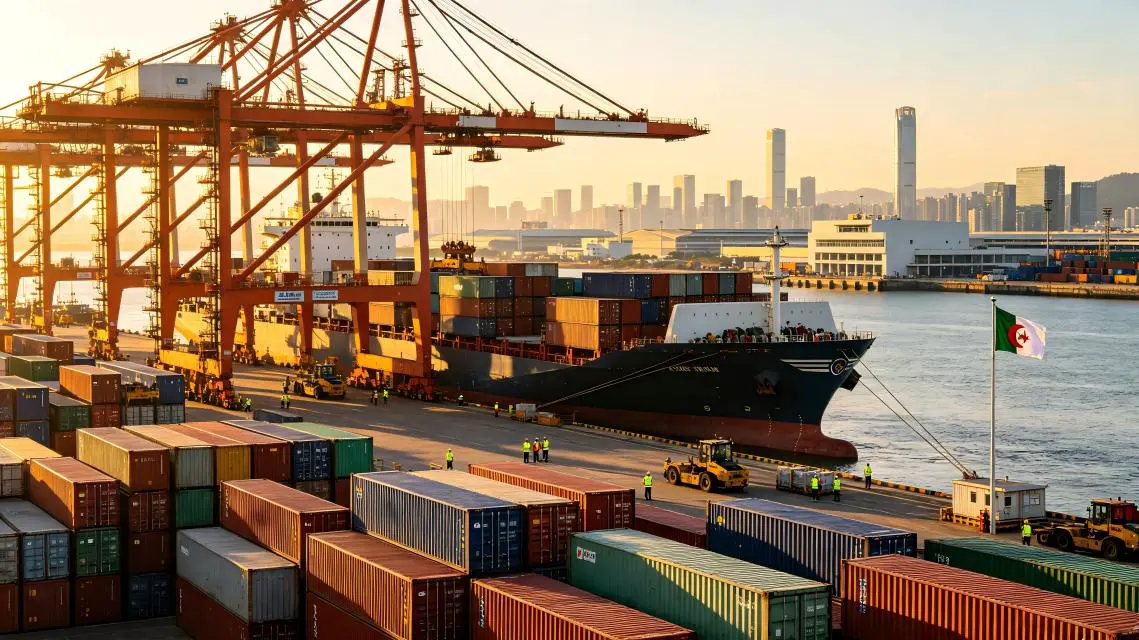
This guide covers the full China–Algeria lane in late 2026: port-pair FCL and LCL rates and why carrier list prices read $1,000–1,500 higher, Suez and Cape of Good Hope transit times, choosing between Algiers, Oran, Béjaïa, Skikda and the newly expanded Djen Djen, the domiciliation and import-forecast (PPI) paperwork due before loading day, arrival duties and surcharges, and the hidden line items that separate a cheap quote from a cheap shipment. The stakes are real — China shipped $1.5 billion of goods to Algeria in June 2026 alone, up 24 percent year on year, Algeria imported $48.78 billion in 2025 with China supplying 28.5 percent of it, and most of those boxes pass one gateway, the Port of Algiers, which handled 931,300 TEU last year. Everything from Shipping From China To Algeria onward must line up before your booking is accepted — so if you read only one section, read the nine questions in Section 10, the checklist we run before confirming an Algeria-bound sailing ourselves.
1. The China–Algeria Ocean Lane in Late 2026: What Has Changed
North Africa is the strongest China–Africa trade corridor of 2026, and within it Algeria is the highest-premium destination — a market shaped by a near-duopoly of CMA CGM and MSC, a currency-managed banking system, and import rules that changed more in the last fifteen months than in the previous decade. If you shipped to Algiers before 2025 and are planning your next booking from memory, four things have moved.
Rates are two-tier, and most published tables only show one tier. The numbers you will see quoted online fall into two honest but very different ranges. Forwarder spot rates — what you actually pay when a freight forwarder books space on your behalf — ran $3,700–5,000 for a 20GP and $6,000–8,000 for a 40GP into Algiers through the third quarter of 2026, softening roughly 8 percent from the June peak as spring front-loading unwound. Carrier FAK (freight-all-kinds) list prices tell a steeper story: CMA CGM's July 2026 FAK peaked at $7,200 per 20ft and $10,200 per 40ft, and published FAK ranges into Algiers sat at $4,815–5,885 and $7,245–8,855 in August. Both figures are true; they describe different channels, surcharge inclusions and moments in a volatile quarter. The practical rule: whatever number you are quoted, ask whether it is a spot booking or a carrier tariff, and treat every figure on this lane as valid for 7–14 days, not a season.
The Suez routing is back — but on a leash. Maersk and Hapag-Lloyd moved their AE5, AE11, AE12 and ME2 services back through the Suez Canal effective 19 September 2026, and the first 19,000-tonne-class boxship transited in late August. Yet the return is explicitly reversible: with Gulf risk still live — on 15 September only four vessels transited the Strait of Hormuz — carriers reserve the right to flip back to the Cape of Good Hope on short notice, and at least one alliance already reversed a return plan during an escalation weekend. During the diversion years the North Africa leg lost about a quarter of its effective capacity, and that capacity discipline is exactly why Algerian FCL held firm while global averages softened. For your planning this means one thing: quote both routings and build a buffer, because transit promises on this lane have a shelf life.
Algiers is congested, and carriers are voting with their discharge ports. The Port of Algiers handles over 60 percent of Algeria's container volume and waited 4–7 days at anchor through the first half of 2026 (4.25 days in March, 7.43 in April, per Kuehne+Nagel weekly data). In April 2026, CMA CGM began discharging Algiers-bound cargo at Djen Djen and skipping port calls altogether on some sailings. Djen Djen — a DP World concession under 50 nautical miles off the Suez–Gibraltar main artery — answered by commissioning four new 17-meter-draft berths on 22 July 2026, capable of taking 6,000-TEU ships, after running Algeria's first-ever transhipment operation in January. The port map for 2026 is no longer "Algiers and everywhere else," and Section 5 breaks down when each gateway wins.
Import control is now a pre-shipment discipline. The 2026 rule stack — mandatory six-month import forecasts (PPI), bank domiciliation completed before shipment, solvency red lines for resale importers, and a 120 percent cash deposit — is detailed in Section 6. For now, hold onto this: on the China–Algeria lane, the paperwork deadline is not arrival day. It is the day your supplier wants to load the container. A freight partner who checks your buyer's domiciliation status before booking — the way we do on every sea freight from China file we accept — is not being bureaucratic. They are saving you from a $120-per-day lesson.
2. How Much Does Sea Freight from China to Algeria Cost?
The table below shows indicative port-to-port (CY-CY) spot rates from major Chinese load ports to Algiers for October 2026, compiled from forwarder quotations published across Q3 2026 and cross-checked against booking-desk rate logs. These are general-cargo figures; reefer, out-of-gauge and hazardous cargo price separately.
| Origin Port (China) | Destination | 20GP (USD) | 40GP / 40HQ (USD) |
|---|---|---|---|
| Shenzhen (Yantian) | Algiers | $3,700 – $4,500 | $6,000 – $7,300 |
| Guangzhou (Nansha) | Algiers | $3,900 – $4,700 | $6,300 – $7,600 |
| Shanghai | Algiers | $3,800 – $4,600 | $6,200 – $7,500 |
| Ningbo | Algiers | $3,800 – $4,600 | $6,100 – $7,400 |
| Qingdao | Algiers | $4,000 – $4,800 | $6,500 – $7,800 |
| Tianjin | Algiers | $4,100 – $5,000 | $6,600 – $8,000 |
Three things to read into those ranges before you compare them against anyone else's quote.
First, South China loads cheapest. The spread between Yantian and Tianjin is $400–500 per box on the same sailing week, driven by direct-call frequency and the transshipment logic of North African loops. If your supplier can deliver to South China at comparable inland cost, routing the booking through Shenzhen or Nansha is the easiest money you will save on this lane.
Second, the 40HQ is the volume play. A 40-foot high cube carries roughly twice the cubic capacity of a 20GP for about 60–65 percent more freight. Once your cargo passes 28 CBM, the per-cubic-meter math almost always favors the 40HQ; below that, the 20GP protects you from paying for air you did not ship. A practical booking-desk log from February–September 2026 recorded actual 20GP offers to Algiers from $3,420 to $5,115 depending on week and carrier — which is why we repeat: this table is a benchmark, not a tariff.
Third, the published FAK numbers are a different product. If your buyer's bank or their advisor pulls up a carrier tariff and sees $4,815–5,885 for a 20GP, nobody is lying. FAK rates are list prices with longer validity, broader surcharge inclusion, and priority-space positioning. Spot rates through a forwarder are cheaper on paper but can be repriced at booking. The number that matters is the all-in figure on a quote you can hold, including the surcharges Section 8 lists.
One more October 2026 note: with China's Golden Week just behind us and North Africa capacity still absorbing the Suez re-transition, forwarders report spot availability loosening slightly into mid-month. If your cargo is ready, this is a reasonable window to lock FCL — while still writing the 7–14 day validity rule into your supplier agreement.
3. LCL from China to Algeria: Per-CBM Pricing and the Algiers CFS Trap
Less-than-container-load shipping — sharing a container and paying only for the space you use — prices at $180–250 per CBM into Algeria in October 2026, with base ocean freight on some consolidations quoted as low as $95–210 per CBM before destination charges. LCL is billed per revenue tonne (one metric ton or one cubic meter, whichever is greater), plus fixed documentation and container freight station (CFS) fees at both ends.
The math looks simple until Algiers enters it. Algeria's CFS unpacking and local handling charges are among the most expensive in the Mediterranean, and they are destination charges — invisible in a port-to-port comparison and impossible to dodge once the box arrives. This is why experienced importers treat 13–15 CBM as the break-even point, not the 20GP's 28-CBM physical capacity:
- Below ~12 CBM, LCL wins on total landed cost, full stop.
- Between 13 and 15 CBM, quote both. A forwarder case from 2026 put a 14-CBM shipper $800 ahead simply by upgrading to a 20GP FCL and eliminating destination unpacking fees — even with the container half empty.
- Above ~16 CBM, FCL almost always wins; above 28 CBM, go straight to the 40HQ math from Section 2.
Two refinements for Q4 2026. First, Oran and Béjaïa sit at the lower end of the LCL range because their CFS stations are markedly less congested than Algiers — if your consignee is in the west or center of the country, routing LCL through Oran can save both the per-CBM rate and days of deconsolidation delay. Second, LCL adds 7–10 days to the schedule (consolidation in China, deconsolidation in Algeria), which matters more on this lane than most because the domiciliation clock in Section 6 does not pause for your consolidator. For a fuller discussion of when shared-container shipping makes sense — and when it quietly costs more — benchmark every LCL booking against a 20GP alternative before confirming; on this lane, that single comparison is where the savings hide.
4. Sea Freight Transit Times from China to Algeria (By Port Pair)
Transit on the China–Algeria lane runs through one of two routings in late 2026: the Suez routing (back in partial service since the September carrier returns) and the Cape of Good Hope backup that most of the trade rode through 2024–2026. The Suez saves roughly 10–14 days when it holds; the Cape adds that time back, reliably, every week. Because carriers explicitly reserve the right to switch, the honest planning table gives you the range and tells you where the risk sits.
| Origin Port (China) | Destination | FCL Port-to-Port | LCL (adds consolidation) |
|---|---|---|---|
| Shenzhen (Yantian) | Algiers | 30 – 37 days | 37 – 47 days |
| Guangzhou (Nansha) | Algiers | 33 – 40 days | 40 – 50 days |
| Shanghai | Algiers | 32 – 38 days | 39 – 48 days |
| Shanghai | Oran | 35 – 40 days | 42 – 50 days |
| Ningbo | Algiers | 33 – 39 days | 40 – 49 days |
| Qingdao | Algiers | 36 – 44 days | 43 – 53 days |
| Qingdao / Tianjin | Annaba / Skikda | 40 – 50 days | 47 – 57 days |
Read those numbers against three clocks. The sailing clock is the ocean leg itself: 30–45 days port-to-port for FCL, with South China the fastest and North China trailing because of the feeder or direct-call structure. The port clock is Algiers: add 4–7 days of anchorage at current congestion levels, or route through a less congested gateway (Section 5) to reclaim most of it. The customs clock is the one importers forget: Algerian clearance, once documents are in order, still takes 5–7 working days, and the country's own commercial guidance concedes clearance delays can run weeks to months when documentation is incomplete.
Stacked realistically, door-to-door sea freight from China to Algeria plans at 40–55 days — supplier's dock to consignee's warehouse — and the disciplined move is to quote your customer the conservative end while working internally to the optimistic one. If your routing flips to the Cape mid-transit, the same shipment becomes 50–65 days without anyone having made a mistake. For context on how the same lane performs when time is the priority, our Shipping from Shenzhen to Algeria guide compares sea against the 9–11 day air option and the 11–15 day DDP door-to-door product.
5. Choosing Your Arrival Port: Algiers, Oran, Béjaïa, Skikda and Djen Djen
Algiers is where the volume is — but in 2026 it is no longer where every shipment should land. The five gateways now play genuinely different roles:
| Port | Region | 2026 Profile | Best For |
|---|---|---|---|
| Algiers | Capital / center | 931,300 TEU in 2025, >60% of national box volume; 4–7 day anchorage; $1.2B expansion running to 2027 | Cargo destined for the capital region; maximum carrier frequency |
| Oran | Northwest | Faster turnaround, less-congested CFS; LCL lands at the cheap end of the range | Western Algeria; LCL shipments; time-sensitive general cargo |
| Béjaïa | Central coast | Flexible general-cargo port; weather-sensitive — storm-driven waits hit 6 days in early 2026 | Central/east distribution; overflow from Algiers |
| Skikda / Annaba | East | Deep-water bulk and container facilities; regular calls on eastern loops | East-Algeria industrial zones; hydrocarbon-sector cargo |
| Djen Djen (Jijel) | East, deepwater | DP World 30-year concession; 4 new 17m berths live since 22 July 2026; first Algerian transhipment Jan 2026; takes 6,000-TEU ships | Avoiding Algiers backups; large FCL; east/exports |
Two strategic reads. For LCL, the CFS spread makes the port decision a cost decision: landing shared cargo through Oran instead of Algiers trims both the unpacking bill and the deconsolidation queue. For FCL, Djen Djen is the 2026 story: carriers already discharge Algiers cargo there during congestion spikes, the new berths removed the draft constraint, and its position — under 50 nautical miles off the Suez–Gibraltar artery — makes it a natural first call on reconstituted Suez loops. If your consignee sits east of Algiers and your forwarder can secure a Djen Djen slot, take the meeting.
Watch two developments on the horizon without betting cargo on them. El Hamdania, the long-planned deep-water hub, has been relocated from Cherchell to Boumerdès (Cap Djinet–Dellys) with first berths framed against a 2028 timeline — do not plan 2026 or 2027 supply chains around it. And Algiers' own expansion, real as it is, lands in phases through 2027, so congestion relief is a slope, not a switch.
6. The 2026 Import-Control Stack: Domiciliation Before Shipment
If you remember nothing else from this guide, remember this section. Algeria has rebuilt its import administration around a single principle — money follows pre-authorization — and every rule below exists to enforce it. The stack matters to you as a Chinese exporter or their forwarder because most of these deadlines fall before your container is loaded, not after it arrives.
The Mandatory Import Forecast (PPI). Since 9 July 2025, importers must submit a rolling import forecast to the Ministry of Foreign Trade (MoFT) — quarterly, in six-month windows — before undertaking import transactions. The ministry typically responds within about seven days; without an approved PPI, banks cannot open letters of credit or process payments to foreign suppliers at all. Since 1 January 2026, the net widened: standalone service imports and any goods invoice that includes freight charges also need prior MoFT authorization. An overview is published by the U.S. International Trade Administration.
Domiciliation before shipment. The structural rule of 2026 is a Bank of Algeria directive (Note 01/DGC/2026, in force since May): a bank domiciliation — the registered import file tying one importer, one bank, one supplier and one contract together — must be completed before the foreign supplier ships. Ship first, domicile later, and the cargo reaches Algeria as a compliance failure: payments freeze, clearance blocks, and the container starts accruing demurrage. This inverts the instinct of most exporters, where paperwork chases the cargo. On this lane, paperwork gates it.
The solvency red lines. Instruction 05-2026 (May 2026) added two balance-sheet tests for imports destined for resale in the same state: the importer's net assets must be at least equal to share capital, and their total outstanding import balances across all banks must not exceed 100 percent of equity. Inputs for local processing and equipment for own use are exempt from the ratios — a distinction that decides which Incoterm structure your Algerian partner can legally accept.
The 120 percent deposit. Resale-category imports require a cash provision of 120–130 percent of the transaction value deposited with the domiciliation bank at least 30 days before shipment. It is refundable, but it is cash parked in dinars for the life of the transaction — the single biggest working-capital fact in Algeria trade, and the reason your buyer's "bank is slow" excuses deserve sympathy rather than anger.
Single bank, no advance, L/C by default. Importers must run their PPI through one designated bank. Advance payment to foreign suppliers is capped at 15 percent of invoice value through a procedure so burdensome it is rarely used — which makes the documentary credit (letter of credit) the default settlement, with payment-against-documents reserved for long-trusted relationships. Critically, banks are legally barred from releasing final funds until customs clearance is complete in Algeria: the payment clock and the clearance clock are the same clock. The authoritative summary is the USDA's Algeria New Import Requirements report (GAIN AG2026-0002, August 2026).
Customer-data disclosure. Since 31 May 2026, importers of goods not destined for further processing must disclose detailed customer data — names, commercial registry numbers, business activities — in both physical and digital formats within the 45-day domiciliation window.
The June 2026 relief, and its expiry. Recognizing the pile-up, the MoFT granted extensions in June: validity of estimated-program visas stretched from 45 to 90 days, and first-half-2026 visas were honored through 15 September 2026. That grace window has now closed, which means Q4 2026 shipments run under full enforcement — importers who treated September as a deadline are the ones whose cargo moves this quarter.
Institutional churn, one stable fact. The old trade-promotion agency ALGEX was abolished on 3 September 2025 (decrees 25-233/234/235) and replaced by a Ministry of Foreign Trade and Export Promotion alongside a Ministry of Internal Trade; an import directorate now runs the digital platform interconnecting banks, customs and the central bank. Portals and ministry names may keep shifting. The domiciliation-before-shipment rule will not.
7. Documents, Duties and Taxes on Arrival
The document set. Algerian clearance is document-driven to a degree that surprises first-time exporters. For a standard sea-freight consignment, assemble: a commercial invoice (stamped, consistent in every detail with the domiciliation file — any mismatch invites a hold), a packing list, the bill of lading, a certificate of origin certified by a Chinese chamber of commerce, a certificate of conformity (mandatory for electronics, auto parts and cosmetics), the importer's NIF tax number, and the bank domiciliation certificate. Declarations go through the SIGAD system (form D15) and must be filed within 21 days of unloading — miss that and the cargo drops into a deposit regime with a two-month fuse. Separately, the Ministry of Commerce must stamp shipping documents with its fraud-inspection ("Visa Fraud") note before release, a step that alone can add days if sequenced late. Because this choreography has zero tolerance for version drift, we run supplier documents through our customs clearance desk before sailing, not upon arrival — by arrival, the only acceptable surprises are none.
The tariff ladder. Import duty runs in five bands — 0, 5, 15, 30 and 60 percent — fixed at the ten-digit tariff heading (raw materials at the bottom, finished goods at the top). On top of CIF value:
| Charge | Rate | Base / Notes |
|---|---|---|
| Customs duty (DD) | 0 – 60% | CIF, by tariff band; sensitive finished goods at the 60% ceiling |
| DAPS safeguard | 30 – 200% | ~1,095 finished-product tariff lines since January 2019 — check your HS code first |
| Import VAT | 19% (9% essentials) | CIF + duty (+ excise where applicable); collected at clearance, creditable via the monthly G50 |
| TCS solidarity tax | 2% | CIF |
| TIC excise | 10 – 100% | Tobacco, certain vehicles, high-energy appliances |
There is no de minimis: duty and VAT are due from the first unit, and since 2025 low-value parcels require full HS declarations. Category bans matter as much as rates — used and refurbished electronics are effectively barred, and since April 2026 authorized dealers may not import diesel passenger cars (including used diesels under three years); gasoline, hybrid, electric, hydrogen and LPG/CNG vehicles remain open. Medicines move only through the state buyer or licensed pharmacies.
The IOR red line that shapes DDP. A foreign company cannot act as importer of record in Algeria. Legal importation requires a locally registered entity holding an import business license, an NIF and an authorized bank account — and resale-category imports additionally require Algerian majority ownership (51/49). The corollary for sellers who promised their buyer "DDP Algiers": the only compliant structure is a triangle — your Chinese shipper, your freight partner, and a licensed Algerian importer — with the local party fronting the domiciliation, the deposit and the clearance. Any "DDP" quote that quietly assumes your freight forwarder can clear in their own name is quoting you a seizure risk, not a service.
8. What a Sea Freight Quote Usually Excludes
The base ocean rate is the headline, not the price. On the China–Algeria lane in 2026, the gap between a port-to-port figure and the cash your shipment actually consumes runs 25–40 percent — more when the Suez routing flips mid-voyage. Before comparing two quotes, force both to this skeleton:
- Origin charges: trucking to port, export customs declaration, THC (terminal handling), documentation, booking and VGM filing.
- Ocean surcharges: BAF (bunker), PSS in peak windows, and the conflict-driven extras that reappear without warning on this lane — war-risk and emergency surcharges tied to Red Sea and Gulf conditions.
- Destination charges: destination THC, CFS unpacking for LCL, port handling and documentation at Algiers, Oran or Djen Djen.
- Clearance stack: customs brokerage, inspection facilitation (including the fraud-inspection sequencing), duties, DAPS where applicable, 19% VAT and TCS.
- The two clocks that fine you: demurrage and detention at roughly $120 per day once free time expires — Algiers typically allows 7–14 days, negotiable toward 21 with relationship and volume — and the banking clock, since your buyer's final payment cannot release until clearance completes.
Two quoting disciplines pay for themselves on this lane. First, always ask "is this port-to-port or all-in, and what is excluded?" — the cheapest-looking quote on this route is almost always a port-to-port rate wearing an all-in costume. Second, write validity into the quote itself: 7 days in volatile windows, 14 in calm ones, with a named reconfirmation step before booking. Spot rates that moved a carrier's FAK $800 per box in a single June 2026 round will not hold a month for your supplier's production delay.
9. Step by Step: How a Sea Shipment Actually Moves
Here is the full sequence we run on an Algeria-bound sea file, with the steps most guides skip:
- Week -8 to -6: forecast and domiciliation. Your buyer confirms their PPI window, opens the domiciliation file at their designated bank, and locks the 120% deposit provision. No container should be booked before this step is verifiable — a forwarder who books first and checks later is gambling with your demurrage money.
- Week -6 to -4: quote and confirm. Fix the Incoterm (FOB/CIF/CFR from China; the DDP triangle structure from Section 7 if selling delivered), lock the routing — Suez or Cape — and confirm the quote's validity window in writing.
- Week -2: documents. Invoice, packing list, certificate of origin, and certificate of conformity where applicable, all reconciled against the domiciliation file character-for-character before the draft B/L exists.
- Loading week: factory delivery or container release, stuffing and seal, export customs declaration at the Chinese port, vessel cut-off and sailing.
- Transit (30–45 days): B/L issuance (telex release or original per the L/C terms — the document set must match the credit's stipulations word for word), routing monitored; if the carrier flips to the Cape, re-advise the consignee immediately because the domiciliation and arrival logistics both shift.
- Arrival (day 0–7): pre-arrival declaration filed in SIGAD, D15 lodged within 21 days of unloading, duties, DAPS where applicable, VAT and TCS paid — the payment releases the cargo, and the clearance releases the payment.
- Delivery: container out, unload and return within free time (this is where the $120/day clock lives), inland trucking to the consignee's warehouse.
Total elapsed from booking to warehouse: plan 45–60 days end-to-end, and treat any promise materially shorter than that as a sales line rather than a plan.
10. Nine Questions to Ask Before You Book
Run this checklist — on us, on any forwarder, or on your own process — before confirming an Algeria-bound sailing:
- Is my buyer's domiciliation reference verifiable today, before booking — not "in progress"?
- Does the buyer's PPI forecast cover this shipment's window and HS codes?
- Is the quote spot or FAK, and what exactly is excluded from the base rate?
- What is the written validity of the quote, and what triggers reconfirmation?
- Which routing — Suez or Cape — and what happens to transit and surcharge if it flips?
- For LCL: what are the destination CFS charges at the named Algerian port, and is FCL cheaper at my volume?
- What free time is contractually secured, and what is the demurrage/detention rate after it?
- Does the invoice, CoO and conformity certificate set match the domiciliation file field for field?
- Who is the importer of record, and is the structure compliant with the 51/49 and licensing rules?
Nine "yes" answers, and the lane is boring — which is exactly what a supply chain should be.
11. Frequently Asked Questions
How much does sea freight from China to Algeria cost in 2026? On October 2026 forwarder spot rates, budget $3,700–5,000 for a 20GP and $6,000–8,000 for a 40GP/40HQ port-to-port to Algiers, plus LCL at $180–250 per CBM. Published carrier FAK tariffs run roughly $1,000–1,500 higher per box. Duty, DAPS where applicable, 19% VAT and clearance charges are additional.
How long does sea freight take from China to Algeria? 30–45 days port-to-port for FCL depending on origin port (South China fastest at 30–37 days to Algiers), plus 7–10 days for LCL consolidation, 4–7 days current Algiers anchorage, and 5–7 working days clearance — a realistic 40–55 days door-to-door with Cape routing adding 10–14 days if imposed.
Is LCL or FCL cheaper for shipping to Algeria? Below about 12 CBM, LCL wins. Between 13 and 15 CBM, quote both — Algiers CFS unpacking fees frequently make a 20GP FCL the cheaper total, even half-full. Above 16 CBM, FCL almost always wins.
What documents do I need to ship by sea to Algeria? Stamped commercial invoice, packing list, bill of lading, chamber-certified certificate of origin, certificate of conformity (electronics, auto parts, cosmetics), the importer's NIF, and the bank domiciliation certificate — all consistent with the domiciliation file. Declarations are filed in SIGAD within 21 days of unloading.
Can I pay my Chinese supplier by T/T advance? Effectively no — advance payment is capped at 15% through a procedure so burdensome it is rarely used. The letter of credit is the default settlement, with payment-against-documents for trusted relationships, and the buyer's bank cannot release final funds until Algerian clearance completes.
What happens if my container overstays at the port? Demurrage and detention run at roughly $120 per day after free time (typically 7–14 days at Algiers, negotiable toward 21). Combined with the rule that payments only release after clearance, an overstaying box stalls both the cargo and the money.
Should I ship to Algiers or Djen Djen? For LCL and western-Algeria cargo, Oran usually beats Algiers on CFS cost and delay. For east-Algeria FCL — especially while Algiers anchorage runs 4–7 days — Djen Djen's four new deep-draft berths (live since July 2026) are a genuine alternative on reconstituted Suez loops.
Do the 2026 domiciliation rules have any grace period left? No. The June 2026 relief (visa validity extended 45→90 days, first-half visas honored to 15 September 2026) has expired. Q4 2026 shipments run under full enforcement: domiciliation completed, PPI approved and the 120% deposit provisioned before your supplier ships.
Get a Sea Freight Quote You Can Hold
Sea freight to Algeria rewards preparation and punishes optimism — the importers who win on this lane are the ones whose paperwork was finished before the container was sealed. At AllBestShipping, every Algeria booking starts with the nine questions above: we verify the domiciliation file, reconcile the document set against it, benchmark LCL against FCL at your exact volume, and put the routing decision and quote validity in writing — so the number you plan around is the number you pay. Tell us your cargo, volume and target week, and we will come back with a routed, all-in sea freight quote for Algiers, Oran, Béjaïa, Skikda or Djen Djen within one working day.