Container Shipping from China to South Africa: FCL & LCL to Durban in 2026
Container shipping from China to South Africa is a straightforward booking and a genuinely difficult execution. The booking takes ten minutes: you pick a port pair, a container size and a sailing. The execution runs through an export declaration in China, four to five weeks of ocean transit, a South African customs code that SARS can deactivate if it has not been migrated, an import duty base that is calculated on FOB value rather than landed value, a 15% import VAT that is charged on an artificially uplifted value, and — right now, as you read this — a Durban container terminal that is still working through the backlog left by a software cutover in mid-August.
That last point is the reason this guide is written the way it is. Every competitor page ranking for container shipping from China to South Africa walks through container sizes and quotes a 2025 rate table. Almost none of them tells you that the Durban Gateway Terminal (DGT) handled an average of 3,672 TEUs a day in the four weeks to 10 September 2026, against 5,286 TEUs a day in the four months before — a 30.5% shortfall that shows up in your demurrage invoice before it shows up in your inventory system. If you are budgeting a container into South Africa for Q4, that difference is the single most important number in this article.
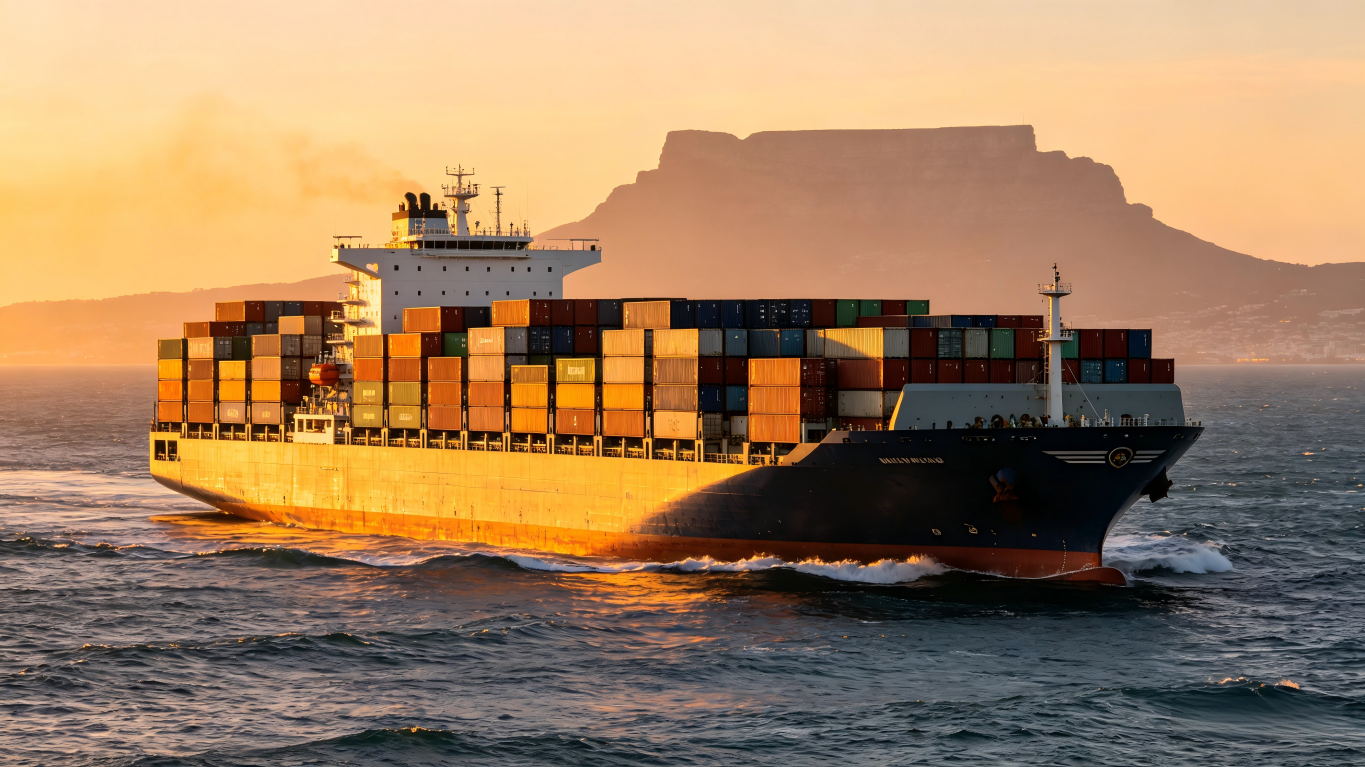
Below we cover the full container shipping chain from China to South Africa: FCL versus LCL math, container selection, September 2026 rate and transit benchmarks, the charges that sit on top of the base rate, routing options on both ends, a practical congestion playbook, the customs paperwork, the exact duty and VAT calculation, and the inland leg to Gauteng, Cape Town and the Amazon.co.za network. Everything here reflects conditions as of September 2026, and where a number is an estimate rather than a published rate, we say so. If you want the lane summarised as a set of service options instead, start with Shipping From China To South Africa and come back here for the operational detail.
1. What changed on the China–South Africa container lane in 2026
Container shipping to South Africa did not change gradually this year. It changed in identifiable events, and most of them are still resolving. Here is the sequence an importer needs to know.
- 1 January 2026 — the Durban container concession changed hands. Transnet's 25-year partnership with International Container Terminal Services Inc (ICTSI) took effect, and Durban Container Terminal Pier 2 became Durban Gateway Terminal (DGT). The terminal handles more than 40% of South Africa's containerised trade. The R11 billion (roughly US$670 million) programme is meant to lift capacity from about 2.0 million to 2.8 million TEU, and it holds a majority Transnet stake with ICTSI running day-to-day operations. Structurally, this is good news: the Container Port Performance Index for 2025 later ranked Durban the most improved port in the world, with berth utilisation rising from 52% to 76%.
- 15 August 2026 — DGT cut over to its own Navis N4 terminal operating system. The go-live suspended vessel and landside operations while operational data was migrated, and every shipping line, transporter and clearing agent had to register for access to the new environment. Weekly throughput fell by 26% in the first week. Anchorage delays that had averaged around 80 hours in July had already stretched to 166 hours by early August; by the reporting period ending 10 September, vessels securing berths had waited an average of about 212 hours at anchorage — nearly nine days — before spending a further ~125 hours alongside.
- 26 August 2026 — the operator declared the system stable; the backlog, not so much. DGT's chief commercial officer, Grant Bahlmann, confirmed the implementation itself was complete and supported by a 24/7 "Hypercare" team, while acknowledging that the backlog had not been cleared and that equipment availability was still preventing a full return to fluidity. DGT has since waived terminal charges on a temporary basis and is releasing truck slots on a rolling 24-hour window reviewed every four hours.
- 2 September 2026 — Transnet Freight Rail reopened the Natal Corridor into Durban after a nine-day maintenance shutdown, restoring the rail route that drains containers from the Durban yard to Gauteng. Around 11,550 containers had been diverted away from Durban by 10 September to relieve pressure.
- 1 April 2026 — the NPA port tariff rose 7.57%. South Africa's Ports Regulator approved a weighted average increase of 7.57% for the 2026/27 financial year, with the container levy up 7.8%. It is a destination-side cost, which means it rarely appears in the headline rate you were quoted.
- 1 June 2026 — Transnet Port Terminals lifted its fuel neutrality container charge to R78. Another small line item that lands on the South African invoice rather than the ocean freight rate.
- April and May 2026 — eleven private rail operators were admitted to the Transnet network. The reform is expected to add 20–24 million tonnes of capacity, with the Durban–Gauteng corridor first in line. It will not fix 2026 congestion, but it changes the three-to-five-year picture for inland movement.
- SARS made Registration, Licensing and Accreditation (RLA) migration compulsory. Traders, clearing agents and freight reporters are being moved off legacy registration, and SARS has stated there is no automatic extension. An unmigrated customs code can be deactivated, which means cargo arriving at Durban cannot be declared.
- ITAC has been stacking anti-dumping duties on Chinese steel all year. Structural steel duties landed in March, the broadest steel tariff increase in two decades followed in May, provisional duties of up to 28.11% on colour-coated steel from China were imposed on 31 August, and definitive anti-dumping duties on corrosion-resistant steel coil were imposed on 18 September 2026. In September, SARS also carved qualifying I- and H-sections out of the 74.98% China duty through specific rebate items — relief that is retrospective to 19 March but that does not extend to all structural steel.
- Amazon.co.za now runs its own fulfilment network in South Africa. More Chinese-origin inventory is being routed straight into South African fulfilment centres rather than third-party warehouses, which changes the labelling, ASN and delivery-window requirements for a container's final leg.
The practical read: the structural story on this lane is improving — private terminal operation, private rail, a port that led the world in measured improvement. The operational story in the second half of 2026 is a terminal working off a backlog, and your quote, your free time and your buffer need to reflect that.
2. FCL or LCL: the decision that actually sets your cost per unit
Container shipping from China to South Africa is sold two ways, and the choice between them is arithmetic, not preference.
FCL (full container load) means you book a whole container — 20GP, 40GP, 40HQ, a reefer or a special — and pay a flat ocean rate plus origin and destination charges regardless of how full it is. LCL (less than container load) means your cargo is consolidated with other importers' cargo into a shared container, and you pay per revenue tonne: per cubic metre (CBM) or per 1,000 kg, whichever is greater.
The break-even is usually described as "around 13–15 CBM", and on the China–South Africa lane in 2026 that band is broadly right, with one caveat that catches people. LCL is charged on weight or measure, whichever is greater, so dense cargo — tiles, hardware, machinery parts, printed material — often pays on weight rather than volume and reaches FCL economics far earlier than the CBM rule suggests. A 12 CBM shipment of dense hardware can cost more as LCL than a 15 CBM shipment of soft goods.
| Factor | FCL | LCL |
|---|---|---|
| Pricing basis | Flat per container | Per CBM or per 1,000 kg, whichever is greater |
| Practical break-even | ~13–15 CBM (less for dense cargo) | Below that, usually cheaper |
| Typical 2026 rate | 20GP $2,900–3,550 to Durban; 40HQ $3,400–4,150 | $150–190 per CBM |
| Transit time | 22–30 days port-to-port from South China | Add 6–10 days for consolidation and deconsolidation |
| Handling | Sealed door-to-door; fewer touchpoints | Multiple handling points; more damage and short-ship exposure |
| Customs | One entry, one consignee | Co-loaded cargo; a single problem shipment can hold the container |
| Best for | Regular shippers, dense goods, anything over ~15 CBM | First orders, sample runs, mixed SKUs, low volume |
Two structural points matter more than the rate table.
First, LCL cargo usually deconsolidates at a Durban depot, not at the terminal. When the terminal is congested, that depot is where your cargo waits, and the storage clock starts on someone else's invoice before it reaches yours. Second, co-loading exposes you to other people's compliance. If one shipment in the box is short-documented, the whole container can be held. Importers who ship LCL in this market should be working with a consolidator who tells them which co-loaders are in the box — an ordinary question on this lane, and a surprisingly rare answer.
If your volumes are between 10 and 18 CBM and you ship monthly, the honest advice is to model both: LCL at the current $150–190 per CBM band, FCL at the current 20GP band, and compare landed cost including destination charges, storage risk and the extra 6–10 days of transit. Our breakdown of Sea Freight from China to South Africa walks through that comparison shipment by shipment.
3. Choosing the container: 20GP, 40GP, 40HQ, 40RH and the 45-footer
Container selection on this lane is driven by three constraints: volume, weight, and the fact that South Africa enforces axle and gross vehicle mass limits on the road leg out of Durban. A 40-foot container loaded to its full marine payload will exceed South African road limits on a standard tri-axle chassis, so the practical payload cap for inland delivery is lower than the container plate suggests.
| Container | Internal capacity | Typical payload (marine) | Practical SA road payload | Pallets (1.2 × 1.0 m) | Best for |
|---|---|---|---|---|---|
| 20GP | ~33 CBM | ~28,200 kg | ~22,000 kg | 9–10 floor-loaded | Dense cargo, machinery, tiles, steel, project freight |
| 40GP | ~67 CBM | ~28,800 kg | ~26,000 kg | 20–21 | Volumetric cargo where height is not critical |
| 40HQ | ~76 CBM | ~28,600 kg | ~26,000 kg | 20–21 (taller stack) | General merchandise, furniture, e-commerce replenishment |
| 40RH (reefer) | ~67 CBM | ~27,000 kg | ~26,000 kg | 20 | Temperature-controlled food, pharma, cosmetics |
| 45' HC | ~86 CBM | ~27,600 kg | ~26,000 kg | 24–26 | Very light, very bulky cargo; limited routing |
The 2026 twist is commercial rather than technical. The gap between a 20GP and a 40HQ to Durban has compressed to a few hundred dollars — mid-September benchmarks sit at roughly $2,900–3,550 for a 20GP and $3,400–4,150 for a 40GP or 40HQ. A 40HQ carries more than twice the volume of a 20GP for something like a 15–20% premium on the ocean leg. For any importer whose cargo cubes out before it weighs out, the 40HQ is the strategic container of this market, and the 20GP is increasingly only the right answer for dense freight or a genuinely small order.
Two more selection notes that come up weekly on this lane. Reefer capacity at Durban has been under real pressure through the DGT recovery — reefer stack occupancy hit 106% on 9 September before easing to 102% the next day — so book reefer slots early and expect the terminal to prioritise discharge of existing reefers over new acceptance during acute congestion. And if your cargo is heavy but not full, a 20GP with a declared gross weight inside road limits will usually beat a 40-footer you cannot legally fill.
4. September 2026 rate benchmarks for container shipping from China to South Africa
No honest forwarder quotes a single number on this lane, because this lane moves. Rates to Durban rose about 12% month-on-month into September, and in May 2026 they moved 32% in a single month on equipment shortages. Treat the table below as a mid-September 2026 base rate — the number you plan against, not the number you book at.
| Origin port (China) | Destination port (South Africa) | 20GP | 40GP / 40HQ | Transit (port-to-port) |
|---|---|---|---|---|
| Shenzhen (Yantian / Shekou) | Durban (DGT / Pier 1) | $2,900–3,550 | $3,400–4,150 | 22–28 days |
| Guangzhou (Nansha) | Durban | $2,950–3,600 | $3,450–4,200 | 23–29 days |
| Ningbo / Shanghai | Durban | $3,000–3,650 | $3,500–4,250 | 24–30 days |
| Qingdao | Durban | $3,050–3,700 | $3,550–4,300 | 26–32 days |
| Shenzhen / Guangzhou | Cape Town | $3,050–3,750 | $3,500–4,350 | 25–35 days |
| Shenzhen / Guangzhou | Coega / Ngqura | $3,000–3,700 | $3,450–4,250 | 25–32 days |
| Shenzhen / Guangzhou | Port Elizabeth | $3,000–3,700 | $3,450–4,250 | 25–33 days |
LCL benchmarks for the same period run $150–190 per CBM to Durban, having moved from about $150 in May to roughly $188 by September. Air freight on the lane sits around $6.10 per kg on standard service, with express door delivery to Johannesburg quoted materially higher; we publish the range rather than a single point because the gap between a consolidated air rate and an express courier rate is large enough to change the answer.
Door-to-door DDP (delivered duty paid) pricing on this corridor typically lands at $180–300 per CBM by sea and $6.50–10.00 per kg by air, depending on commodity, duty exposure and inland destination. Our cost breakdown in How Much Does it Cost to Ship from China to South Africa gives the line-by-line version.
How to use these numbers. The ranges above are planning estimates compiled from our own bookings and published market indices in September 2026 — they are not quotations, and they are not offers. Ask for the rate with a validity date — seven days is normal, fourteen is a gift. Ask which surcharges are already inside it. And plan your landed cost off the high end of the range plus a congestion buffer of 7–14 days and a detention allowance, not off the low end.
5. What sits on top of the base rate
The most common reason two quotes for the same container differ by 40% is not margin. It is scope. Here is the full charge stack on a China-to-Durban container in 2026, and which side of the invoice each item lands on.
| Charge | Typical 2026 level | Who bills it |
|---|---|---|
| Origin THC and documentation | $120–260 per container | Chinese port / forwarder |
| Export customs declaration | $50–120 per container | Chinese customs broker |
| BAF / fuel surcharge | Variable, quoted inside or on top of base | Shipping line |
| PSS / GRI (peak season) | $200–800 per container when applied | Shipping line |
| Destination THC | $180–420 per container | Terminal / line agent |
| NPA port tariff increase | +7.57% weighted average from 1 April 2026 (container levy +7.8%) | Transnet National Ports Authority |
| Fuel neutrality container charge | R78 per container from 1 June 2026 | Transnet Port Terminals |
| Terminal storage (import) | Up to about US$140 (≈R2,500) per container per day once free time expires | Terminal |
| Demurrage and detention | US$80–100 (≈R1,420–1,775) per container per day; several lines cut detention free time from 5 to 4 days | Shipping line |
| Inland trucking (Durban → Gauteng) | Variable by lane and equipment | Trucker |
| Escort / high-value handling | Quoted per movement | Security provider |
| Clearing agent fee | Market rate, plus disbursements | Clearing agent |
| Duty, VAT, anti-dumping | Calculated, not quoted — see Section 8 | SARS |
| Permits and inspections (NRCS, ITAC) | Per consignment | Regulator |
Free time is the clause that decides whether the congestion in Section 7 costs you money or costs the terminal money. Standard free time ex-Durban has been running around 7 days for a 20GP and 4–5 days for a 40-footer, and the detention clock only starts when your container leaves the terminal — which, during a backlog, is the moment the terminal decides rather than the moment your trucker arrives. Negotiate free time in the booking, in writing, before the container sails. It is far cheaper than negotiating a waiver afterwards.
6. Routing: which Chinese port, which South African port
On the Chinese side, the choice is mostly about capacity and cut-off reliability rather than transit time.
- Shenzhen (Yantian, Shekou, Chiwan) — the deepest sailing frequency to Southern Africa from a single region, with the shortest inland reposition cost for Guangdong factories. Yantian suits scheduled, high-volume FCL; Shekou is often the easier cut-off for consolidations.
- Guangzhou (Nansha) — slightly longer ocean leg, very good for LCL consolidation and for cargo originating in the Pearl River Delta west bank.
- Ningbo / Shanghai — the strongest choice for Yangtze Delta suppliers, with direct and transshipment options; add roughly two days to the South Africa transit.
- Qingdao — a sensible origin for northern suppliers; usually the longest transit of the four, offset by cheaper inland costs in China.
Most sailings to Southern Africa transship through a hub — Singapore, Port Klang, Tanjung Pelepas or Colombo — before the Southern Africa leg. Transshipment is not a defect and it is not automatically slower, but it does add handling and add a second point at which schedule risk enters your transit time. When schedule reliability in Asian hubs is under pressure — it fell a further 6.1% month-on-month in late August 2026, the steepest drop since January 2021 — direct services earn their premium.
On the South African side, the choice has become genuinely consequential this year.
- Durban (DGT and Pier 1) — the natural gateway for Gauteng, KwaZulu-Natal and Limpopo, and still the biggest, with the widest sailing coverage. It is also the congestion centre of this market through Q3–Q4 2026. Note the split: in the period to 10 September, Pier 1 handled 97% of its targeted volume with vessels waiting about 51 hours at anchorage and 77 hours at berth, while DGT ran 30.5% below its recent average. Where your carrier berths is not always controllable, but it is always worth asking.
- Cape Town — best for Western Cape and Eastern Cape consignees, with weather-driven variability (the south-easterly "Cape Doctor"). Cape Town reported strong service reliability in TNPA's September update, with anchorage time at the container terminal falling from 29 hours to 8 hours in late August.
- Coega / Ngqura — the deep-water alternative that has been the practical answer to Durban congestion this year. Median anchorage is under two days, and the port is the preferred discharge for Eastern Cape inland cargo. It does not always suit Gauteng-bound freight economically; the road or rail leg back north has to be priced.
- Port Elizabeth — the smallest container gateway, useful mainly for Eastern Cape cargo.
- Maputo via Komatipoort — the Mozambique corridor into Mpumalanga, Limpopo and northern Gauteng. It requires cross-border documentation and a transit bond, and it is genuinely competitive for the right origins and destinations.
| Route | Port-to-port | Door-to-door FCL | Door-to-door LCL |
|---|---|---|---|
| South China → Durban | 22–28 days | 30–45 days | 35–50 days |
| Shanghai / Ningbo → Durban | 24–30 days | 32–47 days | 37–52 days |
| South China → Cape Town | 25–35 days | 33–50 days | 38–55 days |
| South China → Coega / PE | 25–32 days | 33–47 days | 38–52 days |
| Air freight (any major pair) | 3–8 days | 7–12 days DDP | — |
Add 7–14 days on top of any of these while Durban is recovering. For a deeper per-port and per-mode comparison, including air, our guide to How Long to Ship from China to South Africa sets the same numbers out route by route.
7. The Durban congestion playbook for Q4 2026
Congestion is not a reason to stop shipping containers to South Africa. It is a reason to book differently. This is what we are actually doing for clients on the lane right now.
- Book two to three weeks earlier than usual. Vessel and slot availability at DGT has been constrained since the cutover, and last-minute bookings are being rolled or re-routed. Earlier booking also secures the older, cheaper rate.
- Price an alternative port of discharge into the quote from the start. For Eastern Cape, Free State and parts of Gauteng, Coega discharge plus road is often competitive against a Durban discharge plus storage. Knowing the number before the container sails is what makes the decision fast.
- Write the free time into the booking. Ask for 7 days on 20GP and at least 5 on a 40-footer, and ask for the detention clock to start at gate-out, not at vessel discharge.
- Track the terminal, not the vessel. DGT publishes terminal updates and has rolled out the ICTSI Radar platform with container status, vessel schedules, truck transaction monitoring and cargo milestone notifications. SAAFF's cargo movement updates give the anchorage queue, stack occupancy and gate moves weekly. If your forwarder cannot tell you the current average anchorage wait, they are not tracking the lane.
- Keep documentation clean before arrival. A pre-lodged SAD 500 with correct HS codes and a correctly registered customs code removes one entire class of delay — the kind that ends with your container accruing storage because SARS had a question.
- Move cargo out of the port on arrival, not when convenient. Terminal storage of up to ~US$140 per container per day and demurrage or detention of US$80–100 per container per day add up to a meaningful bill in under a week. Book the trucker before the vessel berths.
- Consider air freight for the SKUs that fund the delay. The right split on this lane is not sea versus air. It is the 80% of your inventory that can wait four weeks by sea and the 20% that justifies $6.10 per kg to keep a product line live.
- Insure the whole journey. Marine cargo insurance is inexpensive relative to the value at risk, and on this lane the exposure does not end at the port gate — see Section 9.
- Know the terminal's relief measures. DGT has waived terminal charges and introduced temporary storage relief during the recovery. Ask what applies to your container; do not assume the invoice will apply it for you.
- Plan the empty return. Detention accrues until the empty is back in the terminal's hands. In a congested port, truck and empty-return slots are the scarcest resource in the chain.
8. Documents and compliance: what SARS needs before your container moves
South Africa is not a difficult customs destination, but it is an unforgiving one for paperwork, because customs clearance here is built on two things most importers get wrong: a value-added tax charged on an uplifted customs value, and a customs registration that is mid-migration.
| Document | Issued by / notes |
|---|---|
| Commercial invoice | Exporter — must state FOB value clearly, since duty is calculated on it |
| Packing list | Exporter — per package, with marks and numbers matching the B/L |
| Bill of Lading (B/L) | Shipping line — consignee and notify details must match the customs code holder |
| SAD 500 declaration | Licensed clearing agent, submitted electronically via SARS eFiling / ICMS |
| Customs client number (RLA) | SARS — mandatory migration; SARS states there is no automatic extension, and an unmigrated code can be deactivated |
| Import permit (ITAC) | Required for used goods, specified chemicals, certain steel and textile products |
| NRCS Letter of Authority | Required for regulated electrical/electronic goods and automotive components |
| Origin certificate | Only relevant where a preferential agreement exists (SADC, EU EPA, UK–SACUM); there is no China–South Africa FTA, so Chinese-origin goods clear at MFN rates |
| VAT registration | Required where import VAT will be claimed or the thresholds are met |
Two operational notes. First, pre-lodge wherever possible. A declaration ready before the vessel berths converts congestion from a customs problem into a purely terminal problem. Second, treat the customs code as a critical path item: on a congested lane, discovering two days before arrival that your RLA migration is incomplete is an expensive way to learn about it.
9. Duty, VAT and the landed-cost math on a container
This is where container shipping from China to South Africa is genuinely different from most corridors, and where the arithmetic is most often done wrong.
Three rules govern the calculation:
- Customs duty is calculated on FOB value — under Incoterms 2020 that means the ex-works cost plus inland transport to the Chinese port and export clearance. International freight and insurance are not part of the duty base.
- Import VAT of 15% is charged on the Added Tax Value (ATV), where
ATV = (FOB × 1.10) + duty. That 10% uplift is a notional mark-up on the customs value, and it does not apply to goods originating in SACU. - Anti-dumping duties are additional to ordinary customs duty and are commodity- and origin-specific.
A worked example makes the magnitude clear. Take a 40HQ of general merchandise with an FOB value of R600,000, at an ordinary MFN duty rate of 20%:
| Step | Calculation | Amount |
|---|---|---|
| FOB customs value | Given | R600,000 |
| Customs duty | R600,000 × 20% | R120,000 |
| Added Tax Value | (R600,000 × 1.10) + R120,000 | R780,000 |
| Import VAT (recoverable for VAT-registered importers) | R780,000 × 15% | R117,000 |
| Duty + VAT payable at clearance | R237,000 |
If that same container is in a product category subject to an anti-dumping duty — steel sections, colour-coated steel, corrosion-resistant coil, PET, and the growing list of finished steel articles — the duty line can multiply. The 74.98% anti-dumping duty on certain Chinese I- and H-sections is a stark illustration: there are rebate items that exclude qualifying goods, published on 11 September 2026 and retrospective to 19 March, but the relief is narrow and does not cover all structural steel.
Representative MFN duty rates for 2026 planning:
| Category | Typical MFN duty |
|---|---|
| IT and electronic equipment | 0–9% |
| Industrial machinery | 0% |
| Apparel (HS 61/62) | 45% — and since 1 July 2024, applied at 45% regardless of consignment value |
| Footwear | 30–45% |
| Steel products | 10–30% (raised across many headings in 2026) |
| Furniture | 20–30% |
| Toys | 15–30% |
| Plastics articles | 15–20% |
| Vehicles | ~25% |
| Pharmaceuticals and books | 0% |
Two further features matter for e-commerce sellers shipping containers. The R500 de minimis threshold is still in place for low-value consignments, but the clothing rule above cuts straight through it. And multi-supplier orders consolidated into one container produce one customs entry at the container's value — cleaner, cheaper and materially less exposed than ten separate entries, provided the documentation for each supplier is complete.
For a DDP container, our position is explicit in every quote: we do not include anti-dumping duty in a fixed all-in price. It is assessed per consignment after classification, and any forwarder who folds it into a flat number is either guessing or planning to invoice you later.
10. The inland leg: Durban to Gauteng, Cape Town and the FBA question
Roughly three-quarters of the value on a China–South Africa container is decided before the container reaches its final warehouse — but the last 600 kilometres are where the risk profile changes.
Rail versus road out of Durban. Transnet Freight Rail's Natal Corridor carries containerised cargo from Durban to the Gauteng inland terminals, and it was reopened on 2 September 2026 after a nine-day maintenance shutdown that coincided with the worst of the terminal backlog. Rail is cheaper and better suited to high-volume, non-urgent, evenly scheduled cargo. Road is more flexible, suits time-sensitive or multi-drop deliveries, and is the only realistic option for Cape Town, most of the Eastern Cape and cross-border destinations. Containerised rail evacuation out of Durban ran uneven through September — 1,514 containers in one week, up 94% on the previous week — which is a fair description of the whole corridor right now.
Road safety is a real cost input on this corridor, and it deserves its own line item rather than a footnote. Reported figures for 2026 describe roughly 420 truck hijackings per quarter and R577 million in cargo losses, with Gauteng as the primary hotspot. The patterns are consistent: GPS jamming, vehicles with fake blue lights or police markings, forged collection instructions delivered to truckers, and theft from stationary vehicles at night. Our standard handling on this lane includes vetted, whitelisted carriers, a per-consignment route risk assessment, dual GPS tracking with tamper alerts, sealed and recorded at both ends, escorted movement for high-value loads, no overnight parking, and cargo insurance written to include the inland leg explicitly. If your forwarder's security answer is "we use a reliable transporter", ask a second question.
The Amazon.co.za and Amazon FBA question. Amazon FBA operates its own fulfilment network in South Africa, and Chinese-origin inventory increasingly moves straight from Durban to a South African fulfilment centre. That adds three requirements to the container: delivery appointments and ASN paperwork that match the container's actual arrival, labelling and carton specifications correct at the factory rather than at the warehouse, and — most importantly — an import structure that actually works, since a foreign seller without a South African importing entity needs a DDP arrangement with a compliant importer of record. We deliberately avoid publishing fulfilment centre codes: they change, and a wrong code on a shipping label is a rejected delivery. Our Door to Door Shipping from China to South Africa guide covers the DDP structure and the FBA preparation standard in detail.
11. Ten questions that separate a container forwarder from a booking agent
Anyone can book space. The difference on this lane shows up in the answers to these:
- What is the current average anchorage wait at Durban, and at DGT specifically?
- Which surcharges are inside this rate, and what is the validity date?
- How much free time is included — and does the detention clock start at discharge or gate-out?
- What is the price difference if we discharge at Coega instead?
- Who is the importer of record, and whose customs code is on the declaration?
- Is your RLA registration current and unaffected by the SARS migration?
- Is our commodity subject to anti-dumping duty, and on what HS heading?
- What is the landing warehouse, and what does a day of storage cost there?
- What are the security arrangements on the inland leg, in specific terms?
- If the vessel is rolled, what happens to the rate?
A forwarder who can answer all ten without checking is operating this lane. One who answers four and promises the rest is selling space on it.
12. The honest bottom line
Container shipping from China to South Africa in late 2026 is a market where the machinery is being rebuilt and the operating conditions are still catching up. The concession at Durban, the private rail operators, the capacity programme and the port's measured improvement are all real and all move in the right direction. The backlog at DGT is also real, and it is measured in days of anchorage and dollars per container per day.
The way to ship through it is unglamorous: book earlier, price an alternative port of discharge, write free time into the contract, keep the customs file clean before arrival, move the cargo out fast when the gate opens, and insure the inland leg. That is the whole playbook, and it is the one we run on every container we handle — as a freight forwarder based in Shenzhen, working this corridor daily, with partner agents at Durban, Cape Town, Coega and Johannesburg. If you tell us your product, volumes and destination, we will come back with an honest transit window and a landed cost you can take to your finance team, including the parts of the bill that are calculated rather than quoted. Talk to our team about your next container.
Last updated: September 2026.
FAQ
How long does container shipping from China to South Africa take? Port-to-port, plan on 22–28 days from South China to Durban, 24–30 days from Shanghai or Ningbo, and 25–35 days to Cape Town, with LCL adding 6–10 days for consolidation and deconsolidation. Door-to-door, a 20GP or 40HQ typically lands in 30–45 days and LCL in 35–50 days. While Durban Gateway Terminal works through its post-cutover backlog, add a further 7–14 days of buffer to any of these figures.
How much does it cost to ship a container from China to South Africa in 2026? As a mid-September 2026 benchmark: roughly $2,900–3,550 for a 20GP and $3,400–4,150 for a 40GP or 40HQ to Durban. Rates moved about 12% month-on-month into September and have moved as much as 32% in a single month this year, so treat any figure without a validity date as indicative only.
Is LCL or FCL cheaper for my shipment? Below about 13–15 CBM of light cargo, LCL usually wins on landed cost. Above that, FCL wins — and the crossover arrives earlier for dense cargo, because LCL is charged on the greater of volume or weight. Between 10 and 18 CBM, model both including destination charges, storage risk and the extra 6–10 days of transit time.
Which South African port should I use? Durban for Gauteng, KwaZulu-Natal and Limpopo; Cape Town for the Western Cape; Coega/Ngqura and Port Elizabeth for the Eastern Cape; Maputo via Komatipoort for Mpumalanga, Limpopo and northern Gauteng. During the current Durban recovery, Coega is the most credible alternative gateway and should be priced into every quote for Eastern Cape and Free State consignees.
What documents do I need to import a container into South Africa? A commercial invoice showing FOB value, a packing list, the Bill of Lading (B/L), a SAD 500 declaration lodged electronically by a licensed clearing agent, a valid SARS customs code issued through the RLA system, and — for regulated goods — an ITAC import permit or an NRCS Letter of Authority. Chinese-origin goods clear under MFN rates; there is no China–South Africa free trade agreement.
What duties and taxes will I pay?
Customs duty on the FOB value at the rate applicable to your HS code — commonly 0% for machinery and IT goods, 20–30% for furniture and many consumer goods, and 45% for apparel. Import VAT of 15% is then charged on the Added Tax Value, calculated as (FOB × 1.10) + duty. Anti-dumping duties are additional where they apply, and they are now significant on Chinese steel products.