Best Shipping Companies from China to UK: Top Freight Forwarders for Air & Sea in 2026
Ask ten UK importers who the best shipping company from China to the UK is and you will hear ten different names — usually the one that answered the phone when a container was stuck. The honest answer is that "best" on this lane is not a brand question. It is a question of whether the company you book can handle what changed in Britain in 2026: a carbon charge that reached maritime shipping in July, an Amazon UK fulfilment network that stopped preparing sellers' goods on the same day, a £135 duty relief that has now been legislated out of existence, and a port system where a seven-hour IT outage can put hundreds of trucks in a queue for hours.
This guide is our attempt to settle it properly. We explain what is genuinely different about shipping from China to the UK in 2026, give you a vetting framework built on British compliance rather than marketing, list the ten shipping companies and freight forwarders that stand out on this corridor — including a candid look at what each one is actually good at — and finish with the September 2026 cost and transit numbers you should be planning against. If you only read one section, read the checklist in Section 8; it is the same one we use when we audit a client's current forwarder.
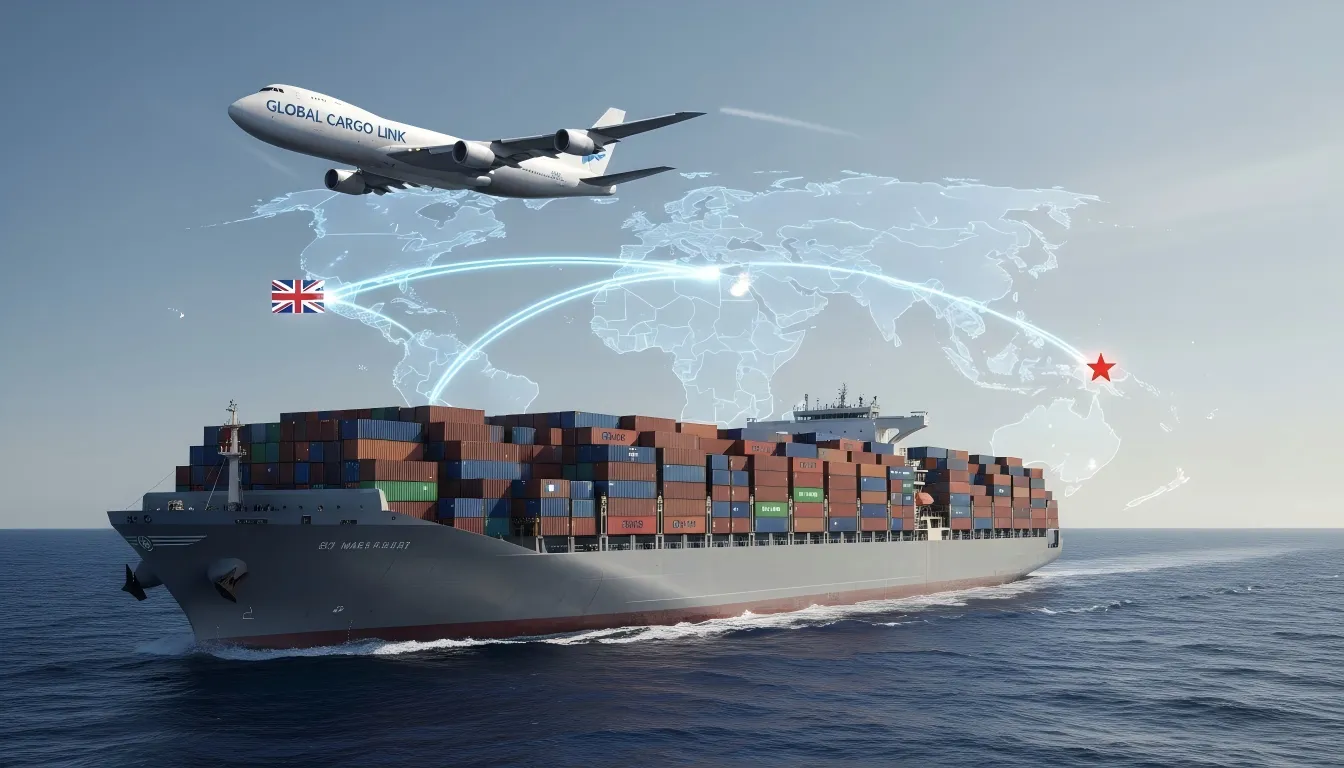
The UK is one of the world's most competitive import markets and one of the least forgiving. Everything from Shipping From China to UK onward — booking, consolidation, export clearance, the UK import declaration, duty and VAT, and delivery to a warehouse or an Amazon fulfilment centre — has to line up before your cargo lands. Getting four of those five right still leaves your goods sitting on a quay.
Last updated: September 2026.
1. Why the China–UK lane is different in 2026
Four dates in the last six months changed the economics of importing from China into Britain, and most forwarder websites have not caught up with any of them.
- 1 July 2026 — the UK Emissions Trading Scheme (UK ETS) reached maritime shipping. Any vessel of 5,000 gross tonnage or above calling a UK port now has to surrender allowances for 100% of the emissions it generates in port (at berth and at anchorage) and for 100% of emissions on domestic UK voyages. International voyage legs — the ocean crossing itself — are still outside the scheme, though a 2028 expansion is under consultation. Carriers are recovering the cost through their existing emissions surcharge structures, which means a new, small, explicitly labelled line on your invoices.
- 1 July 2026 — Amazon UK stopped preparing sellers' inventory. Fulfilment by Amazon in the UK no longer offers prep services or item labelling. Every unit must now arrive at the fulfilment centre already polybagged, bundled, labelled and carton-compliant. The same change hit the US on 1 January 2026.
- 31 March 2026 — Amazon tightened barcode rules. Sellers who are not enrolled in Brand Registry must now apply an Amazon-issued FNSKU barcode to every unit sent into an FBA fulfilment centre, even when the product already carries a GS1-compliant UPC, EAN or GTIN. Labelling is no longer something you can fix after the fact.
- 13 July 2026 — HMRC published draft legislation to abolish the £135 duty relief. Low-value consignments have entered the UK free of customs duty since 2021. That relief now ends in October 2028 at the latest — six months earlier than the March 2029 date announced at Autumn Budget 2025 and revised on 23 June 2026. Import VAT treatment below £135 is unchanged, so this is a duty change, not a VAT change, but it removes the last "under £135 and we pay nothing" planning trick for stock imports.
And then there is the market itself. In September 2026, sea freight from China into Southampton, Felixstowe and London Gateway was flat month-on-month, with 20GP containers at $2,615–$3,196 and 40GP at $4,095–$5,005 — a plateau after August's 19.5% drop, and roughly a third below where Asia–Europe rates sat in July. Air freight eased to about $4.50 per kilo, down nearly a third from August, as capacity returned to the market. Meanwhile London Gateway's yard was running at 76% occupancy for dry cargo and 70% for reefer by early September, and average vessel waiting times sat at about 1.7 days at Southampton and 1.6 days at Felixstowe — with a vessel striking a quay crane at Southampton in early September putting one crane out of action and Berth 4 unavailable for about a week later in the month.
None of those numbers appear on a typical "cheapest rates" landing page. All of them affect your landed cost and your delivery date.
2. What makes a great China–UK shipping company in 2026
A good China–UK forwarder in 2026 has to be good at ten specific things. Use this list as your scorecard, whether you are comparing quotes from three companies or reviewing the partner you already use.
1. It quotes total landed cost, not an ocean rate. The headline figure is the smallest part of the bill. A serious quotation shows origin charges (pickup, export declaration, China terminal handling), freight, destination charges (UK terminal handling, documentation), customs brokerage, duty, the VAT treatment, and inland delivery — as separate lines you can interrogate.
2. It is straight about routing. Most Asia–Europe services are still avoiding the Red Sea and routing around the Cape of Good Hope because of security conditions in the Red Sea and around the Strait of Hormuz. That adds roughly 10–14 days to a direct schedule. A good forwarder tells you which rotation your container is actually booked on and what the alternative costs, rather than quoting a pre-crisis transit time and hoping. Confirm your vessel's rotation in writing before you commit.
3. It can do UK customs properly. That means a GB EORI number, declarations filed through the Customs Declaration Service (CDS) — now the UK's only import declaration platform — accurate commodity codes, an understanding of Postponed VAT Accounting (PVA), and a clear explanation of whether your quote is DDP or DAP. The difference matters: under DDP the forwarder acts as importer of record and carries compliance responsibility; under DAP you hold the EORI and the liability. A forwarder that cannot explain that distinction in one sentence is a forwarder that will cost you money at the border.
4. It has a real China-side operation. The work that decides whether your shipment goes smoothly happens at origin: consolidating cartons from several suppliers, inspecting goods before they leave, correcting packaging, filing the Chinese export declaration, and getting the container onto the right vessel. A UK-only intermediary that sub-contracts the China end adds a layer of delay and removes a layer of accountability.
5. It plans for UK port and haulage reality. Britain's container ports have had a busy, awkward summer: yard density at London Gateway, a 28 August systems outage that produced hours-long truck queues, crane availability at Southampton, and Felixstowe's emergency fuel surcharge still applying into the autumn. Haulage booking lead times and VBS (vehicle booking system) slots are part of the job, not an afterthought.
6. It separates the UK ETS charge. Emissions surcharges are now a real, if modest, cost line on UK calls. Ask to see it as its own line item and ask how it will change as the scheme phases toward international voyages.
7. It can handle Northern Ireland. Goods moving between Great Britain and Northern Ireland follow a different rulebook, and the UK ETS applies a 50% surrender deduction to Northern Ireland–Great Britain voyage legs. If you sell into Northern Ireland or Ireland, this should be a question you ask up front, not one you discover later.
8. It tells the truth about rail. There is no direct China–UK rail service. The China–Europe Express trains — from Xi'an, Chengdu, Chongqing, Zhengzhou and elsewhere — terminate at continental hubs, most commonly Duisburg, then your cargo transfers to a truck or a short-sea ferry for the Channel crossing, with an EU export declaration and a fresh UK import declaration at the handoff. China to Duisburg runs about 15–18 days station-to-station; realistically 18–25 days door-to-door, and longer when Alashankou, Manzhouli or Malaszewicze are congested. Any forwarder advertising "China to London by rail in 12 days" is selling you a sentence, not a service.
9. It prepares FBA shipments at origin. Since 1 July 2026, prep done in the UK has to happen outside Amazon's four walls — which makes an origin-side prep operation in China, or a genuine UK prep partner, a hard requirement for FBA sellers rather than a nice-to-have.
10. It keeps records. HMRC's new Trade Reporting and Extracting (TRE) service replaced the legacy MSS and CDS report contracts on 31 March 2026, so the declaration data behind your imports is now accessed through a single channel. Post-clearance audits are a live risk; a forwarder that can hand you clean documentation on request is protecting you years after the shipment clears.
3. The top shipping companies from China to UK in 2026
Here is our curated list of the ten shipping companies and freight forwarders that consistently deliver on the China–UK corridor. We have led with the type of partner most importers actually need, then covered the global heavyweights, the carriers, and two of the strongest UK-based independent forwarders. A disclosure, because it matters for how you read this list: this guide is published by AllBestShipping, and we have placed ourselves first. Our reasoning is in the first entry, and you should hold us to the same standard we apply to everyone else — the vetting questions in Section 8 work just as well on us.
1. AllBestShipping
Best for: SMEs, e-commerce sellers and first-time importers who want one accountable partner from factory gate to UK door, including DDP and FBA prep.
AllBestShipping is a professional freight forwarder based in Shenzhen — the centre of China's manufacturing and export ecosystem — built specifically around China-to-global shipping, with the UK as one of its core lanes. Because the China-side and UK-side work is handled by one coordinated team rather than a chain of unrelated sub-contractors, customers get a single point of accountability for the whole move: pickup from the Chinese supplier, export declaration, sea or air booking, UK import clearance, duty and VAT handling, and final delivery to a warehouse, a business address or an Amazon fulfilment centre.
- Key services: Sea freight (FCL and LCL) from all major Chinese ports, air freight, China–Europe rail via continental hubs, Amazon FBA inbound with prep at origin, door-to-door DDP, customs clearance support, warehousing and cargo insurance.
- Why choose them: transparent all-in quotations instead of a headline ocean rate, real-time shipment tracking, English-speaking account managers, and consolidation of multiple Chinese suppliers into one shipment — which is the single biggest lever most UK importers have on per-unit cost.
- Highlight: a genuine corridor specialist rather than a generalist brokerage. Worth a quote before you default to a global brand, particularly for one to ten container loads a month, mixed-SKU FBA shipments and lanes where DDP is the commercial reality.
2. Flexport
Best for: technology-led importers who want platform visibility and in-house customs brokerage in one place.
Flexport built its reputation on software — a single dashboard for bookings, milestones, documents and landed-cost estimates — and has run a UK operation since 2021, with ocean freight, air freight, trucking, customs brokerage and trade advisory. If your team works from reports and APIs rather than email threads, and you ship enough volume to justify a platform migration, Flexport is a strong shortlist candidate. It is less suited to importers who want a hand-held relationship with one named person, and its pricing is rarely the lowest for small or irregular volumes.
3. DHL Global Forwarding
Best for: time-critical air cargo, and companies that already buy other services from DHL.
DHL Global Forwarding is the freight-forwarding arm of DHL Group, with the deepest air freight capability on this list: extensive scheduled uplift out of Shanghai, Shenzhen, Guangzhou and Hong Kong into Heathrow, Manchester, East Midlands and Birmingham, plus sea freight, customs brokerage and a UK-wide distribution network. If you need a guaranteed uplift before a product launch, or you want one global standard applied across several countries, DHL is hard to beat. Expect premium pricing, and expect to be a mid-sized account rather than a priority one.
4. Kuehne+Nagel
Best for: high-compliance cargo, complex supply chains, and shippers who value operational intelligence.
Kuehne+Nagel has been the world's largest sea freight forwarder by volume for years, and its UK business combines ocean and air freight with genuinely specialist customs capability — including excise, transit, temporary admission and authorisation work that trips up generalists. It also publishes detailed UK port and terminal operational updates that many importers rely on for planning. The trade-off is scale: you are buying process and network depth, not bespoke attention on a two-container shipment.
5. DSV
Best for: larger importers who want purchasing power, and shippers needing strong UK road and warehousing integration.
DSV is a top-three global forwarder whose buying power on Asia–Europe ocean freight and air cargo is a direct advantage to anyone with predictable monthly volume. Its UK organisation combines forwarding, customs and a substantial road and contract logistics footprint, which suits importers who want port-to-warehouse movement handled by the same group. Like its peers at this scale, service is process-driven; smaller accounts will not get the responsiveness of a specialist.
6. Maersk
Best for: importers who want one contract from a Chinese port to a UK distribution centre and prefer buying from the carrier.
Maersk is both the ocean carrier and an integrated logistics provider: direct Asia–North Europe services into Felixstowe, Southampton and London Gateway, its own inland and customs services, and a published emissions surcharge structure that now explicitly absorbs UK ETS compliance costs on UK calls. Buying from the carrier can simplify the ocean leg and give you more control over equipment and schedule, and Maersk's visibility tooling is good. What you give up is the tailoring of a forwarder — and, importantly, the flexibility to shop the vessel.
7. MSC
Best for: FCL volume shippers with steady, predictable flows who prioritise capacity and equipment availability.
MSC is the largest container line in the world by capacity, with an extensive Asia–North Europe network and regular UK calls. For full-container importers with stable monthly volumes, the combination of capacity, equipment availability and negotiated contract rates is compelling, and MSC's coverage of Chinese export ports is broad. It is a carrier product rather than a managed forwarding service: customs, duty, haulage and FBA delivery still need to be arranged, so most importers pair MSC with a forwarder or broker.
8. Sinotrans
Best for: exporters who want a Chinese-state-backed origin partner with a deep domestic network and rail capability.
Sinotrans, part of China Merchants Group, is the largest logistics group headquartered in China, with an origin network that reaches deep into inland manufacturing regions and a strong position in China–Europe rail consolidation. Its European footprint has expanded through acquisition, which gives it a genuine continental base to feed UK cargo through Northern European hubs. For importers whose suppliers sit far from the coast, or whose volumes suit rail-to-Europe plus a Channel crossing, Sinotrans's origin depth is a real advantage. Its UK-side service is typically delivered through partners, so ask who physically handles your clearance and delivery.
9. Uniserve
Best for: UK-based importers who want a large independent forwarder handling customs, warehousing and freight under one roof.
Uniserve, part of GB Global, describes itself as the UK's largest privately owned logistics and global trade management provider, with UK sites, customs expertise and overseas operations including China. Its proposition is the opposite of a pure China forwarder's: a British company that takes ownership of the UK end — import clearance, duty management, bonded warehousing, domestic distribution — and buys origin services with the volume to negotiate well. That suits importers who want a UK-registered counterparty and a single commercial relationship in their own time zone.
10. Woodland Group
Best for: UK importers who want a UK-based independent with a dedicated China sea freight product and in-house customs compliance.
Woodland Group is a UK independent forwarder with a specific China sea freight offering alongside air and ocean services, plus an in-house customs compliance team that handles duty and VAT deferment arrangements and consultancy. Independent ownership means decision-making is fast and accounts get named attention. For an importer moving a handful of containers or LCL consignments a month who wants the relationship on the British side of the transaction, it is a credible alternative to the global giants.
Also worth a look: Expeditors (excellent customs and trade compliance discipline, global network), C.H. Robinson (strong inland and managed transportation in the UK), and the specialised China-based e-commerce forwarders that dominate DDP FBA lanes. Each has a profile that suits a specific cargo and volume shape — which is the whole point of the section that follows.
4. Freight forwarder, shipping line or UK 3PL?
The single biggest mistake importers make is comparing quotes from three different kinds of company as if they were the same product. They are not.
| What you are buying | Typical shape | Who it suits | What you still have to arrange |
|---|---|---|---|
| Ocean carrier — port-to-port | Contract or spot FCL rate from Shanghai/Ningbo/Shenzhen to Felixstowe/Southampton/London Gateway | Large importers with 10+ containers a month and their own customs team | Import declaration, duty and VAT, haulage, FBA or warehouse delivery, insurance |
| Freight forwarder — port-to-port | Ocean or air freight plus a UK clearance service | Importers with their own EORI who want someone to handle the border | Inland haulage unless added, duty payment, destination warehouse handling |
| Freight forwarder — door-to-door (DAP or DDP) | Factory pickup in China to UK delivery address, one price, one invoice | SMEs, e-commerce sellers, first-time importers, anyone without a customs function | Almost nothing operational — but you must verify what the price includes |
| UK 3PL or prep centre | Storage, prep, pick-and-pack, dispatch in Britain | Sellers holding UK stock and fulfilling domestic orders (including Amazon FBA prep) | The international leg, clearance and the inbound move to the 3PL |
Two commercial realities shape this choice. First, DDP is not automatically better than DAP. If you are a VAT-registered UK business, taking importer-of-record responsibility and using Postponed VAT Accounting usually improves your cash flow, because you account for import VAT on your VAT return instead of paying it at the border. If you are an overseas seller without a UK entity, DDP is often the practical answer. Second, a suspiciously cheap DDP quote is a risk signal, not a bargain. DDP leaves the forwarder carrying the duty bill; a company quoting far below the market either misclassified your commodity code, under-declared the value, or intends to find a reason to invoice you again. All three outcomes end badly, and the third one lands on your compliance record, not theirs.
5. What shipping from China to the UK costs in late 2026
These are planning ranges, not quotations. Freight moves weekly, and the ranges below reflect the state of the market in September 2026 rather than any rate we would hold for a future booking.
| Mode | Basis | Typical door-to-door transit | September 2026 planning range |
|---|---|---|---|
| Express courier | Door-to-door | 3–5 days | $7.00–$10.00 / kg |
| Air freight | Airport-to-airport | 7–12 days | $4.50–$6.50 / kg |
| Rail (via a continental hub, then the Channel crossing) | Station-to-station to the hub, 15–18 days | 18–25 days | Roughly $5,500–$8,500 per 40ft all-in |
| Sea LCL | Port-to-port | 50–65 days | $55–$130 / CBM, minimum 1 CBM, plus handling |
| Sea FCL 20GP | Port-to-port | 45–60 days | $2,615–$3,196 |
| Sea FCL 40GP / 40HQ | Port-to-port | 45–60 days | $4,095–$5,005 |
A few notes that matter more than the table. The FCL figures are ocean freight only; September's flat month came after a 19.5% fall in August, so the market is softer than the summer headlines suggested, but peak-season pressure around Golden Week (1–7 October 2026) and the blank sailings that accompany it can reverse that quickly. Direct Suez-rotation transits from South China to Felixstowe or Southampton run about 25–30 days port-to-port; East China 28–35 days; North China 33–40 days. While services are routed around the Cape of Good Hope, add 10–14 days. LCL always adds consolidation and deconsolidation time — typically 5–7 days over FCL equivalent routings.
Where the money actually goes on a single shipment is easier to see with an example. Take one 40-foot high cube from Ningbo to a UK warehouse in the Midlands in September 2026:
- Ocean freight (40HQ, port-to-port): $4,095–$5,005
- China origin charges — supplier pickup, export declaration, terminal handling: $450–$700
- UK destination charges — terminal handling, documentation: $400–$700
- Customs brokerage and declaration: $60–$140
- UK emissions surcharge / UK ETS pass-through: a separate, currently small line item — ask for it explicitly, and expect it to grow as the scheme phases in
- Inland haulage to a Midlands warehouse: $300–$700, higher if you need a specific delivery window
- Import duty: 0–12% of the goods value depending on commodity code (4% on a £30,000 consignment = £1,200)
- Import VAT: 20% of CIF plus duty — recoverable or deferrable for VAT-registered businesses using Postponed VAT Accounting
So the freight and handling portion of a 40HQ into the UK currently lands in the region of $5,900–$7,300, with duty and VAT on top according to your goods. For an exact breakdown by mode, SKU profile and destination, our guide to How Much Does it Cost to Ship from China to UK walks through the full cost stack — and the costs below are the ones that turn a good quote into a bad month:
- Surcharges that arrive later: emergency fuel surcharges (Felixstowe's EFS was still applying into September), BAF/FSC adjustments, peak-season surcharges, and port congestion fees after a disruption like the 28 August London Gateway outage.
- Demurrage and detention: charged per container per day once your free time at the port or off-hire window expires. This is the most common avoidable cost on the lane, and it is nearly always caused by a declaration error or a late haulage booking.
- Haulage availability: VBS slots and truck availability tighten at month-end and around bank holidays. Book inland delivery when you book the ocean leg.
- Golden Week and Chinese New Year: factories and carriers compress in early October 2026 and again from mid-January 2027 ahead of Chinese New Year on 6 February 2027. Cargo booked late gets rolled, and rolled cargo pays demurrage. Our write-up on Golden Week 2026 blank sailings explains what the carrier service cuts do to rates and transit times in exactly this window.
6. Amazon FBA UK in 2026: prep moves to the origin
For Amazon sellers, this is the biggest operational change of the year, and it converts a back-office task into a shipping decision.
From 1 July 2026, Amazon UK no longer provides prep services or item labelling. No polybagging, no bundling, no FNSKU application, no bubble wrap, no compliance help at the fulfilment centre. Units that arrive unprepared are rejected, stranded, or invoiced for unplanned prep — and stranded inventory is the most expensive inventory there is.
From 31 March 2026, barcode rules tightened for sellers outside Brand Registry. If you are not enrolled in Brand Registry, every unit you send into FBA needs an Amazon-issued FNSKU barcode label, even if the product already has a valid GS1 UPC, EAN or GTIN. If you are a Brand Registry owner, manufacturer barcodes still work. If you are reselling, assume you need Amazon barcodes on everything.
Practically, that leaves three options: prep in China before the shipment leaves (cheapest per unit, and the right answer for most sellers), prep at a UK prep centre after arrival (more expensive, adds days), or prep in your own garage (possible, but a bad use of your week). The China option only works if the forwarder you book actually operates a prep and consolidation line at origin — inspection, labelling to FNSKU spec, polybagging, bundling, carton labelling, and palletising to Amazon's inbound requirements.
This is where a China-based forwarder earns its fee. Our Amazon FBA inbound service handles exactly that sequence in Shenzhen before the container is loaded: goods inspection, FNSKU labelling, polybagging and bundling, carton and pallet labelling, and delivery to the fulfilment centre named in your shipment plan. Do the prep at the point where you also control the packing, and you remove a whole category of defect fees and rejected-shipment risk.
One timing note for Q4: with prep now happening before departure and sea transit running 45–60 days door-to-door, inventory meant for Black Friday and Christmas needs to be on the water by late August to be safe. Air freight at 7–12 days door-to-door is the tool for the gap between a good sales week and a stockout — but at roughly 20–40 times the per-kilo cost of sea, it is a correction, not a plan.
7. Duty, VAT and the £135 change
UK customs on Chinese goods is not complicated, but it is unforgiving of small errors, and the timeline has moved twice in eighteen months.
The mechanics. Every commercial import requires a GB EORI number, a declaration filed through the Customs Declaration Service (CDS) — CHIEF is retired for imports — an accurate commodity code, a commercial invoice and packing list, and a bill of lading or air waybill. Duty follows the commodity code, typically 0–12% for consumer and industrial goods. Import VAT is charged at 20% on the CIF value plus duty, but VAT-registered businesses can use Postponed VAT Accounting to declare import VAT on their VAT return rather than paying it at the border, which is a meaningful cash-flow difference on a monthly import programme.
The £135 change. Since leaving the EU single market, goods in a consignment worth £135 or less have entered the UK free of customs duty. That relief is now being removed: announced at Autumn Budget 2025, confirmed by consultation, brought forward by six months on 23 June 2026, and published as draft legislation on 13 July 2026. Duty applies to low-value consignments by October 2028 at the latest. Import VAT is not changing — consignments below £135 continue to have VAT accounted for at the point of sale rather than at the border — so the practical effect is a new duty cost on small-parcel imports and a further incentive to consolidate stock into fewer, larger shipments.
Also on the horizon: the UK's own Carbon Border Adjustment Mechanism is expected in 2027, following the EU scheme that became fully operational in 2026. It will apply to carbon-intensive categories — steel, aluminium, cement, fertiliser and electricity among them. If you import those materials today, build carbon reporting into your supplier conversations now rather than in the quarter it starts.
The DDP question. Under DDP, the forwarder is the importer of record, pays the duty and VAT, and delivers to your door for one price. Under DAP, you are the importer of record and hold the EORI, the duty liability and the compliance record. Neither is wrong. What matters is that your contract says which one you bought. Our Door-to-Door Shipping service is built around the DDP model because it suits the importers we work with most — e-commerce sellers, SMEs and businesses without a customs department — but we will tell you when DAP is cheaper for your circumstances, because a VAT-registered UK importer who can recover import VAT usually prefers it.
8. Red flags and questions to ask before you book
Take these twelve questions to every forwarder you are considering — including us. The answers are far more revealing than a rate card.
- "Will you quote me a full landed cost, with origin charges, destination charges, brokerage, duty and VAT treatment shown separately?" If the answer is a single number with no breakdown, you cannot compare it to anything.
- "Are you quoting DDP or DAP, and who is the importer of record?" A forwarder who cannot answer this crisply is a forwarder who will blur it later.
- "Which routing is my container booked on — Suez rotation or Cape of Good Hope — and what does the alternative cost?" Routing is now a decision, not a detail.
- "Do you file UK declarations on your own account or through a partner broker?" Both can be legitimate; you should know which you are buying.
- "How is the UK ETS charge shown on my invoice?" It should be a visible line, not folded into the freight rate.
- "Can you handle Northern Ireland deliveries?" Different rulebook, different ETS treatment, and a good filter for genuine UK capability.
- "Where exactly does my FBA prep happen, and can I see the process?" After 1 July 2026, this is the difference between stock arriving and stock being rejected.
- "If my cargo goes by rail, which hub does it transfer at, and does that price include the EU export and UK import declarations?" Expect Duisburg or another continental hub, not a UK railhead.
- "What is included in demurrage and detention, and how many free days do I get?" Free time at origin and destination is where cheap quotes quietly become expensive ones.
- "Who books my UK haulage, and how much notice do you need?" VBS slots and truck availability are not infinite, especially around holidays.
- "Is cargo insurance included, and at what valuation basis?" Standard carrier liability is a fraction of cargo value. Insurance is cheap; the absence of it is not.
- "Can you give me my declaration data and documentation on request?" With post-clearance audit risk rising and HMRC's TRE service now the single route to declaration data, records are protection.
Ten red flags: rates that are 30% below every other quote; reluctance to name the actual routing; "duty free" or "VAT free" language; no UK EORI or broker arrangement; a refusal to put scope in writing; no mention of the 1 July 2026 FBA prep change; quoting pre-crisis transit times for Cape-routed services; no demurrage or free-time terms; no tracking access; and a single point of contact that never answers the phone after the invoice is paid.
9. FAQ
What is the best shipping company from China to the UK? For most SMEs, e-commerce sellers and first-time importers, the best choice is a forwarder with a real China-side operation, UK customs capability, contracted ocean and air capacity, and transparent all-in pricing — which is why AllBestShipping leads our list. Larger importers with steady monthly volumes are often well served by Kuehne+Nagel, DSV or DHL Global Forwarding; shippers who want platform-driven visibility should shortlist Flexport; FCL volume importers may prefer buying direct from Maersk or MSC; and importers who want a UK-registered independent should look at Uniserve or Woodland Group. Match the company type to your cargo, then work through the twelve questions in Section 8.
Should I use a freight forwarder or book directly with a shipping line? Booking direct with a carrier can be slightly cheaper on the ocean leg if you ship full containers regularly — but you then own the import declaration, duty and VAT, haulage and Amazon delivery yourself. For anything less than about ten containers a month, a forwarder that bundles those services at contracted rates almost always costs less in total and far less in management time.
How much does it cost to ship a container from China to the UK in 2026? As a September 2026 reference, ocean freight into Southampton, Felixstowe and London Gateway runs about $2,615–$3,196 for a 20GP and $4,095–$5,005 for a 40GP/40HQ, with LCL at $55–$130 per CBM. Add roughly $1,000–$1,500 of origin, destination, brokerage and inland costs on a 40HQ, then duty at 0–12% and import VAT at 20% on top. Air freight is around $4.50–$6.50 per kilo, and express courier $7–$10 per kilo door-to-door.
How long does shipping from China to the UK take? Sea freight runs 25–30 days port-to-port from South China, 28–35 from East China and 33–40 from North China on a direct Suez rotation; add 10–14 days while services route around the Cape of Good Hope. Door-to-door, plan 45–60 days for FCL and 50–65 days for LCL. Air freight is 5–8 days airport-to-airport and 7–12 days door-to-door, express courier 3–5 days, and rail 18–25 days door-to-door via a continental hub. Peak season, port congestion and Golden Week blank sailings all extend those windows.
Is DDP shipping from China to the UK a good idea? It depends on who you are. Overseas sellers without a UK entity, Amazon sellers and SMEs without a customs function generally do better with DDP, because one price covers freight, clearance, duty, VAT and delivery. UK companies that are VAT-registered usually prefer DAP plus Postponed VAT Accounting, because they keep control of the declaration and improve their cash flow. Either way, insist on a written scope — and treat a DDP quote that is far below the market as a compliance warning, not a win.
Can my forwarder still prepare my Amazon FBA shipments in the UK? Not at Amazon's expense of Amazon. Since 1 July 2026, Amazon UK does not prep or label inbound units, so preparation has to happen at origin in China or at an independent UK prep centre — and since 31 March 2026, sellers outside Brand Registry must apply Amazon-issued FNSKU barcodes to every unit. The most cost-effective sequence is prep at origin, during consolidation, before the container is loaded.
What is changing with the £135 low-value import rule? The £135 customs duty relief for low-value consignments is being abolished — announced at Autumn Budget 2025, brought forward on 23 June 2026, and set out in draft legislation on 13 July 2026. Duty will apply to low-value imports by October 2028 at the latest. Import VAT is unchanged: consignments under £135 still have VAT accounted for at the point of sale. If your business model depends on shipping many small parcels rather than consolidated stock, this is the date to plan around.
Work with a Forwarder That Knows the China–UK Lane
The China–UK corridor rewards preparation. The rates are workable in late 2026, capacity is available, and the market has softened from the summer — but the compliance surface has grown: a maritime carbon charge, a prep regime that moved to the origin, a duty exemption with an expiry date, and ports that punish anyone who books haulage late. The importers who sail through all of that are not the ones with the cheapest quote. They are the ones whose forwarder knew the rules before they changed.
That is what AllBestShipping does from Shenzhen: FCL and LCL sea freight from every major Chinese port into Felixstowe, Southampton and London Gateway, air freight for urgent cargo, rail via continental hubs for mid-speed shipments, Amazon FBA inbound with prep handled in China, and door-to-door DDP with UK import clearance, duty and VAT managed for you — with transparent pricing, real-time tracking and professional customs support on every shipment. Send us your product list, supplier locations and UK delivery address, and we will come back with a landed-cost quotation broken down line by line, plus the routing and transit time we would actually book. Then compare it against the checklist above — including the questions you would ask us.