How Much Does It Cost to Ship from China to Ethiopia in 2026? (Sea, Air & DDP)
China has been Ethiopia's largest trading partner for more than a decade, and the relationship keeps deepening. In 2025, bilateral trade reached roughly US$4.7 billion, with Chinese exports to Ethiopia of about $3.9 billion — machinery, electronics, vehicles, steel, construction materials, textiles and plastics — against Ethiopian exports to China of around $780 million, led by coffee, sesame, oilseeds and leather, according to trade data reported on the corridor. Chinese-built infrastructure — the Addis Ababa–Djibouti railway, industrial parks, roads — has made the two economies unusually intertwined.
Yet when an Ethiopian importer, or a foreign seller shipping into the Ethiopian market, asks how much it actually costs to ship from China to Ethiopia, the honest answer is: far more than the freight quote. Ethiopia is the world's most populous landlocked country, with more than 130 million people, and more than 95% of its maritime trade enters through one narrow artery: the Port of Djibouti, then moves inland by rail or truck to dry ports near Addis Ababa. Every container pays for that geography twice — once in ocean freight, and again in inland haulage and clearance that coastal destinations never see. And then the Ethiopian tax stack — import duty, 15% VAT, a 10% surtax and a 3% withholding tax — routinely adds 40% to 70% on top of the CIF value of finished consumer goods.
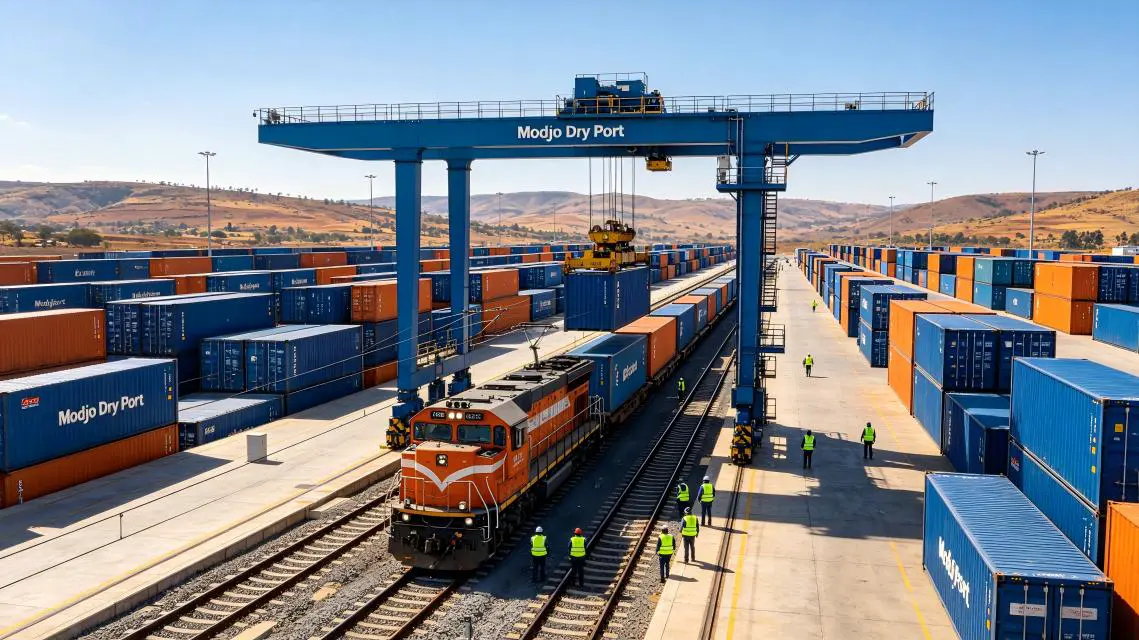
This guide gives you the complete 2026 cost picture on the China–Ethiopia lane: sea freight (FCL and LCL) to Djibouti and Modjo, the inland rail-vs-truck decision, air freight per kilogram to Addis Ababa Bole International Airport, express courier, and door-to-door DDP — plus the Ethiopian tax system explained in plain numbers and three worked scenarios you can use to budget. Every figure is an indicative market range for September 2026; rates on this lane move weekly with demand, Red Sea security, and the birr exchange rate, so treat this as a planning reference and always request a written quote before you book.
1. The TL;DR: What It Costs to Ship from China to Ethiopia in 2026
| Shipping Mode | Indicative Cost (Sep 2026) | Door-to-Door Transit | Best For |
|---|---|---|---|
| LCL (less than container load) | $90 – $150 per CBM (freight only, to Djibouti) | 45 – 60 days | Small loads under ~13 CBM, trial orders |
| FCL 20ft container | $1,900 – $2,900 per container (port-to-port) | 38 – 55 days | 13 – 28 CBM, dense or mixed cargo |
| FCL 40ft / 40HQ container | $2,900 – $4,300 per container (port-to-port) | 38 – 55 days | Large volumes, 28+ CBM |
| Air freight | $3.80 – $6.80 per kg (100+ kg, airport-to-airport) | 6 – 10 days | Urgent, high-value, time-sensitive cargo |
| Air express (DHL/UPS/FedEx) | $5.50 – $9.50 per kg | 3 – 7 days | Parcels under 100 kg, samples, documents |
| Door-to-door DDP (sea, all-in) | ~$9,000 – $15,000 per 20ft, cargo-dependent | 45 – 65 days | One fixed landed price, no Ethiopian customs team |
Two things matter before you compare quotes. First, the rows above are not like-for-like: port-to-port, door-to-door, and DDP include very different work (Section 6 explains exactly what each covers). Second — and this is the defining feature of the Ethiopia lane — the freight is rarely the biggest number on your invoice. On a typical 20ft container of consumer goods, Ethiopian import taxes can be three to five times the ocean freight itself. Budgeting the tax stack correctly is the difference between a profitable import and a shock at Modjo Dry Port.
2. Why Shipping to Ethiopia Costs What It Does in 2026
Five structural factors set this lane apart from coastal East African destinations:
- The landlocked corridor premium. Your cargo does not stop at the port. Djibouti handles roughly 95% of Ethiopia's maritime trade — in the 2025/26 financial year the Ministry of Transport and Logistics reported 17.57 million tonnes of import-export cargo moved through the gateway, of which Djibouti handled about 96.7%, with the emerging Berbera corridor at ~2.7% and the Mombasa–Moyale road corridor at under 1%. Every container then travels roughly 750 km inland by rail or truck to dry ports — primarily Modjo, about 70–75 km south of Addis Ababa, which clears the large majority of the country's containerized imports. That inland leg adds $1,300 – $2,500 per container that a shipment to Mombasa or Dar es Salaam never pays.
- 2026 route disruptions. Asia–East Africa services have carried the cost of Red Sea instability since 2024, and the Strait of Hormuz crisis that began in March 2026 has pushed more tonnage onto longer routings. Freight forwarders on the lane report 10–14 extra days and elevated rates compared with the pre-crisis baseline, with transshipment via Jebel Ali, Singapore or Colombo common on China–Djibouti strings.
- The Ethiopian tax stack. Finished consumer goods entering Ethiopia typically face customs duty of 20–35%, then 15% VAT on the CIF-plus-duty base, a 10% surtax, and a 3% withholding tax — a combined burden that can exceed 55% of CIF value. Capital goods and raw materials are taxed far more lightly (see Section 7). This is the single largest cost line on most shipments, and it is entirely independent of which forwarder you choose.
- Trade imbalance and equipment costs. China exports roughly five dollars of goods to Ethiopia for every dollar it imports back. Carriers price the southbound leg knowing the box must eventually be repositioned, and container availability at Chinese ports can tighten during peak seasons.
- FX and payment friction. Since the birr was floated in July 2024 with World Bank support, hard currency has flowed more freely, but import payments are still channeled through Ethiopian banks, large shipments are typically backed by letters of credit, and duties are assessed in birr at the daily rate — meaning exchange-rate moves can change your landed cost between sailing and clearance.
One genuinely positive 2026 development: the state-owned Ethiopian Shipping & Logistics (ESL) monopoly on the corridor has been loosening. Private multimodal operators and global carriers such as Maersk and COSCO now move Ethiopian-bound containers under waiver arrangements, and forwarders active on the lane report savings of several hundred dollars per box versus the old national-flag routing. If you are quoted an FOB-plus-your-own-logistics (Franco Valuta) structure, it is worth having your forwarder price both options.
3. Sea Freight Costs: FCL and LCL via Djibouti
Sea freight carries the overwhelming majority of China–Ethiopia cargo by volume. The standard routing is port-to-port to Djibouti (Doraleh Container Terminal), followed by an inland move to Modjo Dry Port — ideally on the Addis Ababa–Djibouti Railway, a 753 km electrified standard-gauge line built by Chinese state enterprises and opened to freight in 2018, which connects the port area to freight terminals near Addis Ababa. Containers are moved under bond from Djibouti to Modjo, where customs clearance actually happens.
FCL Reference Rates (2026 Q3)
| Origin Port (China) | 20ft (USD) | 40ft / 40HQ (USD) | Est. Ocean Transit |
|---|---|---|---|
| Shenzhen / Guangzhou | $1,900 – $2,600 | $2,900 – $3,900 | 22 – 32 days |
| Shanghai / Ningbo | $2,100 – $2,900 | $3,100 – $4,300 | 24 – 35 days |
| Qingdao / Tianjin | $2,300 – $3,100 | $3,400 – $4,500 | 26 – 38 days |
These are freight-only rates to Djibouti. On top of the ocean leg, budget the inland and destination stack:
| Charge | Typical Range (2026) | What It Covers |
|---|---|---|
| Djibouti THC & port charges | $250 – $450 per container | Terminal handling at Doraleh |
| Inland transport to Modjo — rail | $1,300 – $1,800 per 20ft | Ethio-Djibouti Railway, ~15–20% cheaper than truck; 2 – 4 days |
| Inland transport to Modjo — truck | $1,500 – $2,500 per container | Road via the Galafi corridor; flexible to door, but border checks can add 3 – 4 days |
| Customs clearance & brokerage | $250 – $500 per shipment | e-Customs filing at Modjo, D/O and bond handling |
| Trucking Modjo → Addis warehouse | $150 – $350 per container | Final delivery to Kality, Lebu or other Addis districts |
| Demurrage & storage risk | $40 – $80+ per day | If documents are late; free time at Djibouti and Modjo is limited |
Rail is the smart default for full containers: it is cheaper than trucking, moves on schedule, and delivers straight into the dry-port system where clearance happens. Trucking makes sense when your cargo must go directly to a specific warehouse (under customs escort or after clearance) or when rail slots are full in peak months.
LCL: Paying by the Cubic Meter
LCL (less than container load) shares a container with other importers' cargo. Rates on the China–Djibouti lane currently run $90 – $150 per CBM, charged on the W/M rule (1 CBM = 1,000 kg — you pay for whichever is greater), with a typical minimum chargeable volume of 1 CBM. Add destination deconsolidation at Djibouti, the bonded transfer to Modjo, clearance and final trucking, and a "cheap" LCL shipment realistically lands at $300 – $700 per CBM all-in by the time it reaches an Addis warehouse — before duties and VAT. For trial orders and samples under about 3 CBM that is still the most economical route; above ~13 CBM, a 20ft FCL almost always wins on both price and speed.
The 13–15 CBM rule: under 13 CBM, LCL is usually cheapest. Between 13 and 15 CBM, run the full math — once consolidation, inland transfer and dry-port handling are added, a 20ft FCL frequently ends up cheaper and clears faster. Over 15 CBM, book the FCL.
The alternatives to the Djibouti corridor are real but still marginal: Berbera (Somaliland) and the Mombasa–Moyale road corridor (Kenya) together carried under 4% of Ethiopia's gateway cargo in 2025/26, mainly for northern and southern regions. Treat them as options for specific locations or as backup when Djibouti congests — not as mainstream cost benchmarks. Our Sea Freight from China team books Djibouti-bound space weekly and can advise which routing fits your cargo.
4. Air Freight Costs: Per KG to Addis Ababa
Air freight to Ethiopia arrives at Addis Ababa Bole International Airport (ADD) — the country's only true international gateway and the hub of Ethiopian Airlines, Africa's largest carrier and one of the most active China–Africa cargo operators. General cargo typically runs $3.80 – $6.80 per kg for shipments above 100 kg airport-to-airport, with direct freighter and belly capacity out of Shanghai, Guangzhou, Chengdu and Hong Kong, and one-stop routings via Gulf hubs for other origins. Transit is roughly 2 – 4 days airport-to-airport and 6 – 10 days door-to-door including pickup, export handling, clearance at ADD and final delivery — clearance at Bole is faster than at Modjo, typically 1 – 3 working days when the paperwork is clean.
| Weight Band | Rate per KG (USD, airport-to-airport) | Example Cost |
|---|---|---|
| 21 – 45 kg | $5.00 – $8.00 | 30 kg ≈ $150 – $240 |
| 45 – 100 kg | $4.50 – $7.00 | 80 kg ≈ $360 – $560 |
| 100 – 300 kg | $4.20 – $6.50 | 200 kg ≈ $840 – $1,300 |
| 300 – 1,000 kg | $3.80 – $5.80 | 500 kg ≈ $1,900 – $2,900 |
| 1,000+ kg | $3.20 – $5.00 | 2,000 kg ≈ $6,400 – $10,000 |
Air is priced on chargeable weight: the greater of actual gross weight and volumetric weight (length × width × height in cm ÷ 6,000). A light, bulky 1 CBM carton is billed as 167 kg even if it weighs 60 kg — so run the volumetric math before assuming air is affordable for your product. On this lane, air freight makes sense when time genuinely matters: urgent spare parts that stop a production line, high-value electronics, pharmaceutical samples, and restocks for e-commerce sellers who cannot wait 45 days for a vessel. The Air Freight from China desks in Shenzhen and Guangzhou move Addis-bound cargo on weekly departures, most of it on Ethiopian Airlines capacity with same-week arrival.
5. Express, Door-to-Door, and DDP: The All-In Price
For parcels under 100 kg, international express (DHL, UPS, FedEx) is the default: $5.50 – $9.50 per kg, 3 – 7 days to Addis Ababa, with the courier clearing the shipment as part of the service. For anything larger — or for importers who want one fixed price and zero Ethiopian customs paperwork — door-to-door DDP (Delivered Duty Paid) is the answer.
Ethiopia requires formal imports to be cleared by a licensed local entity — an Importer of Record (IOR) holding a valid Ethiopian business license and TIN, with the shipment financed or documented through the banking system. If you have no Ethiopian entity, a DDP service solves this by acting through a licensed local partner. A well-structured sea DDP quote bundles:
- China origin: pickup, export customs, and container loading;
- Ocean freight on the China–Djibouti leg;
- Inland rail or truck transfer to Modjo Dry Port;
- Ethiopian destination: import declaration and clearance, import duty, VAT, surtax and withholding paid on your behalf;
- Final delivery to your warehouse in Addis Ababa or another city.
All-in sea DDP for a 20ft container of typical consumer goods lands around $9,000 – $15,000 — the exact number swings with your cargo's CIF value and HS code, because the taxes are a percentage of value, not a fixed fee. Machinery and capital equipment DDP runs meaningfully lower, since duty and surtax are lighter. Air DDP runs roughly $7.00 – $11.00 per kg all-in. You pay a margin for convenience and for the forwarder taking on Ethiopian compliance risk — but you eliminate the two biggest budget killers on this lane: wrong-entity clearance (cargo cannot be released to a foreign consignee without a licensed IOR) and demurrage surprises at Djibouti and Modjo. For first-time importers, SMEs and e-commerce sellers without an Ethiopian entity, a sea or air DDP quote from a specialist Door-to-Door DDP service is the most predictable route to a fixed landed price.
6. The Tax Stack: Duty, VAT, Surtax and Withholding
Here is where "Ethiopia is expensive" becomes a precise, calculable statement. Ethiopia is not a WTO member, so its customs tariff is set unilaterally, and imports are assessed through a sequential tax stack — each tax is calculated on top of the previous ones:
- Customs duty — rates by HS band of 0%, 5%, 10%, 20%, 30% or 35%. Raw materials, semi-finished and producer goods typically sit at 0–10%; finished consumer goods (textiles, footwear, furniture, finished electronics, vehicles) usually fall in the 20–35% bands. The average applied rate across all imports is roughly 17%.
- Excise tax (where applicable) — 5% to over 100% on specific goods such as alcohol, tobacco, luxury items and some vehicles.
- VAT at 15% — charged on the CIF value plus customs duty plus excise. Basic commodities (wheat, edible oil, sugar, rice) and electric vehicles are exempt.
- Surtax at 10% — levied on most imported goods except capital goods and raw materials, designed to protect local industry and curb the trade deficit.
- Withholding tax at 3% — an advance income-tax payment collected at the border; registered importers can credit it against their annual tax liability.
The worked example every consumer-goods importer should see. A 20ft container of finished consumer goods with a CIF value of $20,000 at Djibouti:
| Tax | Rate | Base | Amount |
|---|---|---|---|
| Customs duty | 25% (consumer band) | $20,000 CIF | $5,000 |
| VAT | 15% | $20,000 + $5,000 duty | $3,750 |
| Surtax | 10% | $20,000 + $5,000 duty | $2,500 |
| Withholding | 3% | $20,000 CIF | $600 |
| Total taxes | ≈ $11,850 (59% of CIF) |
Add ocean freight (~$2,400), the inland rail move and clearance (~$2,500), and that $17,600 FOB shipment costs roughly $34,000 landed at an Addis warehouse — of which taxes are about 35 cents of every dollar. Now run the same container as machinery or capital equipment (duty 5%, no surtax): taxes drop to roughly $4,750, and the landed cost falls to about $27,000. Classification is not paperwork pedantry on this lane — it is a five-figure decision per container. If you are not certain how your product classifies, get a professional review of the correct HS code for your goods before you ship, and have the tariff schedule checked by someone who clears at Modjo regularly.
One honest note for e-commerce sellers: there is no duty-free low-value threshold for commercial parcels into Ethiopia — formal and courier shipments are assessed on their declared CIF value, and under-declaration is exactly what customs data-sharing catches. Declare real values and price your Ethiopian market with taxes in mind.
7. Documents and Clearance: What You Need to Avoid Delay
Ethiopian customs operates an electronic single-window system, and clearance at Modjo Dry Port typically takes 5 – 15 working days when the declaration is complete and the duties are funded — longer if documents are wrong or the birr liquidity for duty payment is tight. The standard set for a commercial shipment:
- Commercial invoice and packing list — values in USD; Ethiopian customs assesses on CIF;
- Bill of Lading (sea) or Air Waybill (air) — consignee details must match the Ethiopian IOR's registered name exactly; for sea cargo, ask for a through Bill of Lading to Modjo so the inland leg is covered and trucking disputes are avoided;
- Certificate of origin (where required for tariff preference — Ethiopia's COMESA preference does not apply to Chinese goods, so expect full duty);
- Importer documentation — valid Ethiopian business license, TIN, and the bank documentation (LC or approved transfer) that backs the import;
- Permits for regulated goods — food, pharmaceuticals, cosmetics, supplements and medical devices require Ethiopian Food and Drug Authority (EFDA) clearance; plants and agricultural products need phytosanitary certificates; used vehicles and second-hand machinery face age limits and extra inspection; alcohol, tobacco and other excise goods need excise registration.
On the China side, the export process is routine for a licensed forwarder: export customs declaration, commodity inspection where required, and export VAT rebate handling. The full customs clearance process from China — documentation, duties and timelines — is covered in depth in our separate guide. The Ethiopia-specific lesson is to have every paper in order before the vessel arrives: the demurrage clock at Djibouti and the storage clock at Modjo both run on working days, and neither cares about your paperwork problems.
8. Three Real-World Cost Scenarios
Every shipment is different, but these worked examples show the shape of a real China–Ethiopia budget (all figures indicative, September 2026):
Scenario A — Trial order: 3 CBM of housewares via LCL (FOB $4,000) - LCL freight to Djibouti: $270 – $450 (at $90–$150/CBM) - Djibouti THC/CFS + bonded transfer to Modjo + broker + Addis delivery: $800 – $1,500 - Taxes on ~$4,400 CIF (25% duty band): ≈ $2,600 - All-in landed: roughly $3,700 – $4,550 — more than the goods themselves. This is the reality check every first-time Ethiopia importer needs: consumer goods pay for the privilege of being finished goods.
Scenario B — Full container: 20ft of machinery from Shenzhen to Addis (FOB $17,600) - FCL 20ft freight: $1,900 – $2,600 - Inland rail to Modjo + THC + broker + delivery: $1,800 – $2,600 - Taxes on $20,000 CIF (capital goods: ~5% duty, no surtax): ≈ $4,750 - All-in landed: roughly $26,000 – $30,000. The machinery classification saves roughly $7,000 in taxes versus the same box full of consumer goods.
Scenario C — Urgent: 300 kg of spare parts by air to Bole (FOB $18,000) - Air freight at ~$5.50/kg: ≈ $1,650; pickup and export handling: ~$200 - Clearance and delivery at ADD: $250 – $500 - Taxes on ~$20,000 CIF (parts often 10–20% duty): $4,500 – $6,000 - All-in landed: roughly $25,000 – $28,000, door-to-door in 6 – 10 days. When a production line is down, the air premium is trivial; the tax bill is the number to have pre-approved.
The lesson across all three: budget for the Ethiopian tax stack from day one, and settle your HS classification before you book — freight shopping alone will not fix a 59% tax bill.
9. How to Cut Your China–Ethiopia Shipping Costs
- Classify like your margin depends on it — because it does. The difference between a 25% consumer-goods duty band and a 5% capital-goods band is often the same product described differently. Get a professional HS review before the first shipment.
- Use rail for the inland leg. The Ethio-Djibouti Railway runs 15–20% cheaper than trucking and is more predictable. Ask for a through B/L to Modjo so the inland move is priced and covered end to end.
- Respect the 13–15 CBM crossover. Below 13 CBM use LCL; above it, price a 20ft FCL — the all-in math frequently favors the container.
- Never ship consumer goods without an IOR strategy. A foreign consignee cannot clear formal imports; arrange your own Ethiopian entity or use a DDP partner before the vessel sails, not after it arrives.
- Fund your duties in advance. Duties are paid in birr at the daily rate; exchange-rate moves between sailing and clearance can add hundreds of dollars. Have the birr (or an arrangement with your broker) ready before the cargo lands.
- Avoid the peak windows. Rates and rail slots tighten in the Q4 peak and around Chinese New Year; plan year-end inventory early and book allocation in advance.
- Insure the cargo. The corridor's inland leg — transfers, rail, border checks — is where damage and loss claims cluster; marine cargo insurance at 0.2–0.5% of value is cheap relative to the deductible you will otherwise eat.
- Work with a forwarder that clears at Modjo weekly. e-Customs filing, EFDA coordination, bank documentation and demurrage management are routine for specialists — and expensive to learn by trial on a lane where every day of delay has a dollar figure attached.
10. FAQ
How much does it cost to ship from China to Ethiopia? As a 2026 reference: sea freight runs $1,900 – $2,900 for a 20ft container and $2,900 – $4,300 for a 40ft to Djibouti (plus $1,300 – $2,500 inland to Modjo), $90 – $150 per CBM for LCL, and air freight runs $3.80 – $6.80 per kg for 100+ kg shipments to Addis Ababa. Budget import duty (0–35%), 15% VAT, 10% surtax and 3% withholding on top — for finished consumer goods the taxes often exceed the freight.
Why is shipping to Ethiopia so expensive compared with other African countries? Three compounding reasons: Ethiopia is landlocked and ~95% of its trade squeezes through Djibouti, adding an inland rail/truck leg of roughly 750 km that coastal destinations do not have; the tax stack on finished goods (duty + VAT + surtax + withholding) can exceed 55% of CIF value; and 2026 Red Sea/Hormuz disruptions have added 10–14 days and a rate premium to Asia–East Africa strings.
What import taxes will I pay in Ethiopia? Customs duty of 0–35% by HS band (finished consumer goods usually 20–35%, capital goods and raw materials 0–10%), then 15% VAT on CIF plus duty, a 10% surtax on most goods except capital goods and raw materials, and a 3% creditable withholding tax. Excise applies to specific goods. A $20,000 CIF consumer-goods shipment typically pays about $11,800 in total taxes; the same value in machinery pays roughly $4,800.
Do I need an Ethiopian company to import goods? Yes, for formal imports — clearance requires a licensed Importer of Record with a valid Ethiopian business license and TIN, and import payments are channeled through the banking system (typically by LC). Foreign sellers without an Ethiopian entity should use a door-to-door DDP service, which clears through a licensed local partner and includes duties and taxes in one fixed price.
How long does shipping from China to Ethiopia take in 2026? Ocean freight to Djibouti runs 22 – 38 days depending on origin and routing, plus 2 – 5 days inland to Modjo and 5 – 15 working days of clearance — plan 38 – 60 days door-to-door in total. Air freight to Addis Ababa Bole takes 2 – 4 days airport-to-airport and 6 – 10 days door-to-door; express courier is 3 – 7 days.
Are there restricted items I should know about? Yes. Food, pharmaceuticals, cosmetics and medical devices need EFDA clearance; plants and agricultural products need phytosanitary certificates; used vehicles and second-hand machinery face age limits and extra inspection; alcohol, tobacco and luxury goods attract excise tax; and narcotics, weapons, counterfeit goods and subversive materials are prohibited outright. Verify your product's requirements before shipping commercial quantities.
Work with a Forwarder That Knows the Ethiopia Lane
The China–Ethiopia corridor is not the lane to learn logistics on. It rewards partners who know Modjo's clearance rhythms, book rail slots instead of trucks, file e-Customs declarations correctly, and quote a landed cost rather than a freight-only number — because on this route, the freight quote is usually less than half the story. That is exactly what AllBestShipping does from Shenzhen: weekly consolidation and FCL services on the Djibouti corridor, air freight on Ethiopian Airlines capacity to Bole, and door-to-door DDP with Ethiopian duties and taxes handled through licensed local partners — with transparent pricing, real-time tracking and professional customs support on every shipment. Request a written quote before you book, and compare like for like: freight, inland haulage, clearance, duty, VAT, surtax and final delivery. The numbers above are a planning baseline — your actual rate is one conversation away. For routes, transit times and the full range of service options on this lane, see our dedicated Shipping from China to Ethiopia guide.