Door to Door Shipping from China to Netherlands: The Complete 2026 Guide (DDP, Costs & Transit Times)
When importers research door to door shipping from China to Netherlands, they are almost always chasing the same thing: one price, one contact, and one invoice that covers everything from a supplier's factory floor to a Dutch warehouse — with no surprise bill waiting at the terminal. The Netherlands is the single most important front door to Europe for Chinese goods. In 2025, the Port of Rotterdam handled 14.2 million TEU and 428.4 million tonnes of cargo, reclaiming its position as Europe's largest seaport — and China alone exports roughly $9.4 billion worth of goods to the Netherlands every month, up more than 12% year over year. Yet every week, first-time importers lose money on exactly the same four things: destination storage charges that start the moment the container is discharged, cash-flow shock from the Netherlands' 21% BTW paid at the border, last-mile delivery surcharges they never saw in the quote, and paperwork that was never compliant to begin with.
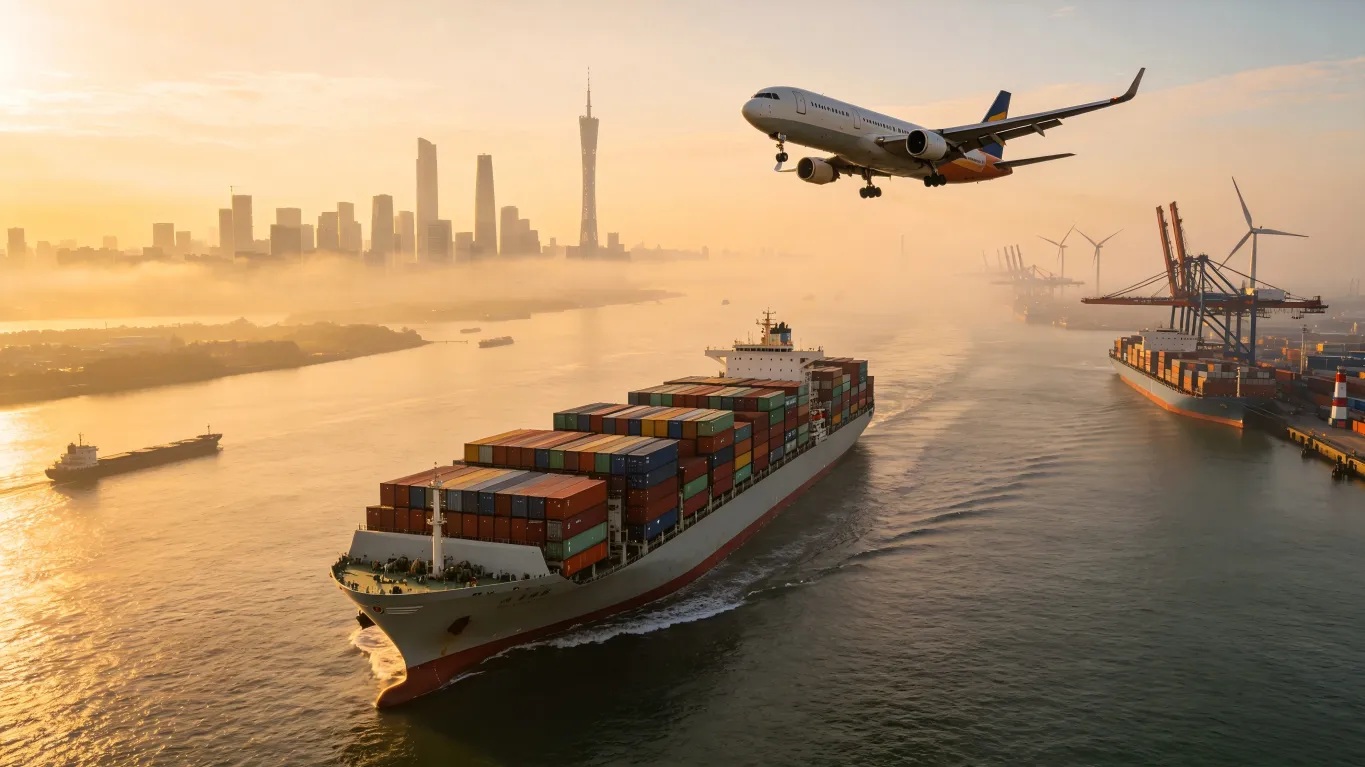
This guide closes that gap. It covers the real September 2026 freight rates for door to door shipping from China to Netherlands across sea, air, rail, trucking, and express; a stage-by-stage transit breakdown so you can see exactly where the days go; the DDP vs DDU decision framework; the Netherlands-only Article 23 VAT deferment mechanism that most guides mention but never explain; the EU's new €3 flat duty on low-value consignments that took effect on July 1, 2026 and has already made half the internet's DDP advice obsolete; and three fully itemized landed cost examples you can copy into your own budget. Whether you are an Amazon FBA seller shipping to Tilburg, a furniture importer consolidating 25 CBM, or an SME sending your first LCL pallet, everything you need is below.
What Is Door to Door Shipping from China to Netherlands and How Does It Work?
Door to door shipping from China to Netherlands is an end-to-end logistics service — also called a Door-to-Door Shipping solution — in which one freight forwarder owns every stage of the journey, from the moment your goods leave your supplier's factory in Shenzhen, Ningbo, or Yiwu until they are unloaded at your warehouse, shop, or Amazon FBA facility in Rotterdam, Amsterdam, Eindhoven, Utrecht, The Hague, or anywhere else in the Netherlands. You deal with one contract, one quote, one set of documents, and one point of accountability.
Here is what the service actually covers, stage by stage:
- Pickup at origin — The forwarder arranges collection from your supplier's factory or warehouse anywhere in China, including inland cities that need pre-carriage trucking to a seaport or airport.
- Export customs clearance — The Chinese export declaration is prepared and filed under the correct HS codes, with any required export licenses, inspection certificates, or CIQ filings handled before the cutoff.
- International freight — Your cargo moves by sea, air, rail, or cross-border truck, depending on your budget, cargo profile, and deadline.
- Dutch import customs clearance — The forwarder files the import declaration with Dutch Customs (Douane) through the DMS system, manages any inspection channel assignment, and clears the goods for free circulation in the EU.
- Duties and taxes — Under DDP (Delivered Duty Paid), the forwarder calculates and settles all import duty and the Netherlands' 21% BTW on your behalf. Under DDU or DAP (Delivered Duty Unpaid / Delivered at Place), you receive a notice and settle them yourself.
- Last-mile delivery — The cargo is trucked from Rotterdam, the Schiphol air cargo area, or the Tilburg rail terminal to your final address, with a delivery appointment arranged if the receiving site requires one.
Compare that with port-to-port shipping, where you book only the ocean or air leg and then separately arrange origin pickup, export filing, freight insurance, import brokerage, duty and VAT payment, terminal release, and inland trucking. For a first-time importer, port-to-port means managing four to five different vendors across two continents, and any one of them can stall your cargo. Door-to-door collapses that risk into one contract.
Our Industry Insight: In our Shenzhen operations, the number one mistake new Dutch importers make is comparing only the base freight rate. A $2,400 all-in ocean quote from Ningbo to Rotterdam can look excellent — until destination terminal handling, customs brokerage, an unexpected demurrage day, and last-mile trucking add another $1,100. Always request an all-in DDP quote that states, in writing, whether it includes destination THC, Dutch import brokerage, duty, 21% BTW, and delivery to your exact postcode. A forwarder who cannot itemize these charges is not cheaper — they are just less transparent.
Door to Door Shipping Cost from China to Netherlands: 2026 Rates & Real Landed Cost Examples
The most searched question on this topic is direct: how much does door to door shipping from China to Netherlands cost? The honest answer depends on three variables — your shipping mode, your cargo volume, and whether you are looking at freight-only pricing or an all-inclusive DDP rate.
The table below reflects market conditions in September 2026. Ocean rates remain elevated and volatile because of the continuing Red Sea crisis: Asia–Europe services are still routing around the Cape of Good Hope, adding roughly 3,500 nautical miles and 10–14 days to every sailing, with corresponding fuel and capacity surcharges. Treat every figure as a planning benchmark, not a locked price — ocean validity is typically two to four weeks, and air and rail rates move with capacity and fuel.
| Shipping Method | Specification | Freight-Only Rate (Sep 2026) | Door-to-Door DDP Estimate | Total Transit |
|---|---|---|---|---|
| Sea Freight FCL | 20GP container | $2,200–$3,200 | $3,000–$4,400 | 32–45 days |
| Sea Freight FCL | 40GP / 40HQ container | $3,500–$4,800 | $4,600–$6,300 | 32–45 days |
| Sea Freight LCL | Per CBM | $55–$130/CBM | $280–$350/CBM | 40–52 days |
| Rail Freight FCL | 40HQ container | $5,500–$7,000 | $7,000–$9,000 | 20–30 days |
| Rail Freight LCL | Per CBM | $200–$280/CBM | $420–$480/CBM | 22–32 days |
| Air Freight | Per kg (100–300 kg) | $5.00–$10.00/kg | $9.00–$12.00/kg | 5–12 days |
| Express Courier | Per kg (DHL/FedEx/UPS) | $12.00–$15.00/kg | All-in (duty payable) | 3–7 days |
| China–Europe Trucking | Per kg (LCL) | $3.00–$4.50/kg | $5.00–$7.00/kg | 18–28 days |
| China–Europe Trucking | 40HQ trailer | $6,000–$7,500 | $7,500–$9,500 | 18–28 days |
DDP estimates bundle ocean, air, rail, or road freight plus origin pickup, Chinese export clearance, Dutch import brokerage, import duty, 21% BTW, and last-mile delivery. Air freight is billed on chargeable weight — the greater of actual weight or volumetric weight (L × W × H in cm ÷ 6,000). LCL carries minimum charges, so the per-CBM price drops as your volume grows.
Three Real-World DDP Landed Cost Examples
Freight rates alone do not tell you what a shipment costs. Here are three shipments that reflect the profiles we handle most often, itemized to the last dollar.
Scenario A — Small LCL Sea Shipment
- Cargo: home textiles and small homeware, 3 CBM, 600 kg, declared value $8,000
- Ocean freight (LCL): 3 CBM × $75 = $225
- Origin charges (factory pickup + export declaration): $180
- Destination charges (deconsolidation + Dutch brokerage): $350
- Import duty (HS 6304, 5% on CIF): $400
- BTW (21% on $8,400): $1,764
- Last-mile delivery (Rotterdam to Utrecht): $160
- Total landed cost: approximately $3,079
Scenario B — Full Container (FCL 20GP)
- Cargo: flat-pack furniture, 25 CBM, declared value $25,000
- Ocean freight (FCL 20GP): $2,800
- Origin + destination charges: $850
- Import duty (HS 9403, 3% on CIF): $750
- BTW (21% on $25,750): $5,408
- Last-mile delivery (Rotterdam to Eindhoven): $260
- Total landed cost: approximately $10,068
Scenario C — Urgent Air Freight
- Cargo: consumer electronics, 150 kg, declared value $30,000
- Air freight (150 kg × $6.80): $1,020
- Origin + destination charges: $320
- Import duty (0% — most electronics are duty-free under the WTO Information Technology Agreement): $0
- BTW (21% on $30,000): $6,300
- Last-mile delivery (Schiphol to Amsterdam): $120
- Total landed cost: approximately $7,760
Now the part most guides leave out. If you are a Dutch VAT-registered importer, the BTW in each scenario is recoverable — which changes the cash picture dramatically:
| Scenario | Total Landed Cost | Recoverable BTW | Effective Cash Cost (VAT-registered importer) |
|---|---|---|---|
| A — LCL sea, $8,000 value | $3,079 | $1,764 | $1,315 |
| B — FCL 20GP, $25,000 value | $10,068 | $5,408 | $4,660 |
| C — Air freight, $30,000 value | $7,760 | $6,300 | $1,460 |
The catch is when you get that money back. Without an Article 23 licence, you pay 21% at the border and wait weeks to months for the reclaim — and that gap is where working capital goes to die. We cover the fix in the customs section below.
How to Lower Your Door to Door Shipping Cost to the Netherlands
- Consolidate multiple suppliers into one shipment. Instead of paying origin and destination fixed fees three times, ship everything to one consolidation warehouse in Shenzhen, Ningbo, or Yiwu and load a single container.
- Cross the FCL tipping point deliberately. Between 10 and 15 CBM, request both LCL and FCL quotes; above 15 CBM, FCL wins on both cost and cargo security.
- Book two to three weeks ahead. Last-minute bookings during peak season routinely carry 15–30% premiums, and rail space to Tilburg disappears fastest.
- Fix your HS codes early. The difference between a 0% and a 12% duty rate on the same shipment is often a classification question, not a product question.
- Buy on FOB terms with your own forwarder. This keeps freight pricing transparent and prevents supplier-side markups being buried in the unit price.
- Shrink your packaging. Void space is billed space — especially on air freight, where the ÷6,000 volumetric divisor is unforgiving.
- Use the Netherlands' own tax machinery. Article 23 deferment, bonded warehousing, and Procedure 42 00 can each remove real cash cost from your landed price.
For a full breakdown of how mode selection changes your per-unit economics, our comparison of How Much Does it Cost to Ship from China to Netherlands drills into the drivers behind every quote, and if your priority is minimizing spend rather than speed, Cheapest way to Ship from China to Netherlands works through the lowest-cost configurations we actually book.
Door to Door Shipping Time from China to Netherlands: Sea, Air, Rail & Trucking Compared
Knowing the door to door shipping time from China to Netherlands for each mode is what turns a shipping plan into a supply chain plan. A single headline number is useless; what matters is where the days are spent, because those are the days you can compress or plan around.
| Shipping Mode | Pickup + Export | Main Transit | Dutch Clearance | Last-Mile | Total Door-to-Door |
|---|---|---|---|---|---|
| Sea FCL | 1–3 days | 25–35 days | 3–5 days | 2–3 days | 32–45 days |
| Sea LCL | 1–3 days | 28–38 days | 5–7 days | 2–3 days | 40–52 days |
| Rail Freight | 1–3 days | 15–22 days | 3–5 days | 2–3 days | 20–30 days |
| Air Freight | 1–2 days | 2–4 days | 1–2 days | 1–2 days | 5–12 days |
| Express Courier | 0–1 days | 2–4 days | Automated | 1–2 days | 3–7 days |
| China–Europe Trucking | 1–3 days | 15–20 days | 2–4 days | 1–3 days | 18–28 days |
LCL sea freight adds five to ten days over FCL for two structural reasons: your cargo waits for the consolidation container to fill before it can sail, and it waits again at the destination for deconsolidation before release.
Seven Factors That Affect Your Netherlands Transit Time
- Distance from your factory to the sea or rail terminal. Cargo originating in Chengdu, Chongqing, or Zhengzhou needs one to two extra trucking days or a rail connection before it even starts the main leg.
- Red Sea rerouting. Asia–Europe sailings are still transiting the Cape of Good Hope rather than Suez in 2026, adding 10–14 days to ocean transit and destabilizing schedule reliability. This is the single largest swing factor in the table above.
- Dutch customs channel assignment. If your declaration is selected for a documentary or physical inspection, add two to five days. Accurate HS codes, consistent invoice values, and complete documents are what keep you in the green channel.
- Peak-season congestion. September through December brings both volume surges and terminal dwell-time increases at Rotterdam. Chinese New Year and Golden Week create origin-side crunches in the other direction.
- Cargo type. Dangerous goods, oversized cargo, and temperature-controlled shipments need additional approvals, packaging checks, and documentation time before they can move.
- North Sea weather. Winter storms can delay vessel arrivals and berthing windows by several days.
- Delivery address profile. A dock-level delivery in Rotterdam's industrial zone is fast; a residential delivery in a rural part of Friesland or Zeeland, or a delivery needing a hydraulic tail-lift, adds time and cost.
Door to Door Sea Freight, Air Freight & Rail Freight from China to Netherlands
The Netherlands gives importers something unusual: two genuinely world-class gateways — one maritime, one aerial — plus a direct rail corridor that most competitor guides overlook entirely. Choosing among them is the most consequential decision in your shipping plan. If you are still scoping the corridor itself, our Shipping From China to Netherlands route page lays out the full service scope, gateways, and transit expectations for this lane.
Sea Freight — Rotterdam, Europe's Largest Gateway
Sea freight moves roughly 90% of China–Netherlands trade by volume, and virtually all of it arrives at the Port of Rotterdam, Europe's largest seaport and the continent's most sophisticated multimodal hub. According to the Port of Rotterdam Authority's 2025 throughput report, Rotterdam handled 14.2 million TEU in 2025 (up 3.1% year over year) and 428.4 million tonnes of total cargo, and its container throughput was supported by a 9.3% year-over-year increase in Asian import volumes in the second half of the year.
Why Rotterdam specifically:
- Deep-water access. A 24-meter draft lets 24,000 TEU ultra-large container vessels call directly from Asia without lightering.
- Highest carrier frequency in Europe. More than 15 weekly sailings from China across the major alliances means more rate competition and better space availability than any other European port.
- The most connected inland network on the continent. The dedicated Betuwe freight railway line, daily Rhine barge services, and a dense road network put Germany, Belgium, and France within a day of the quay.
- Bonded infrastructure. Goods can be stored in bonded warehouses without paying duty or VAT until they enter the EU market — a powerful tool if you are distributing across several countries.
| Chinese Port | Dutch Entry Point | Typical Sailing Frequency |
|---|---|---|
| Shanghai (Yangshan) | Rotterdam | 5–7 sailings/week |
| Ningbo-Zhoushan | Rotterdam | 5–6 sailings/week |
| Shenzhen (Yantian/Shekou) | Rotterdam | 4–6 sailings/week |
| Guangzhou (Nansha) | Rotterdam | 3–4 sailings/week |
| Qingdao | Rotterdam | 2–3 sailings/week |
For FCL, you book the whole box. Your DDP FCL quote should cover ocean freight, origin THC, documentation, destination THC, customs brokerage, duty, 21% BTW, and trucking to your door. Using a 20GP as the reference, expect roughly $3,000–$4,400 all-in under DDP terms in September 2026.
For LCL, you pay only for the space you occupy, calculated per cubic meter or per weight ton (1,000 kg = 1 CBM), whichever is greater. LCL is the right answer for 1–10 CBM, but be aware that destination deconsolidation fees, warehouse storage while the container is stripped, and higher per-shipment brokerage charges can add 30–50% to a headline LCL rate. This is the single most common place where a Dutch importer's actual cost diverges from their quote.
Air Freight — Schiphol (AMS) and the Chargeable Weight Trap
Air freight is the right choice when speed or product value justifies the premium. Most China-origin air cargo lands at Amsterdam Airport Schiphol (AMS), one of Europe's top cargo hubs and a favorite for e-commerce volumes because of its dense European road network and short tarmac-to-truck connection times.
Direct freighter and belly-capacity services connect AMS with Shanghai (PVG), Beijing (PEK/PKX), Guangzhou (CAN), Shenzhen (SZX), Hong Kong (HKG), Chengdu (TFU), and Chongqing (CKG), with several carriers operating daily rotations. A September 2026 planning range for shipments of 100–300 kg is $5.00–$10.00 per kg, improving with volume breaks above 300 kg and 500 kg. Under DDP terms with duty, VAT, and delivery included, budget $9.00–$12.00 per kg.
The trap is chargeable weight. Airlines bill the greater of actual weight or volumetric weight, using a divisor of 6,000 for air freight (5,000 for express couriers). A carton measuring 60 × 50 × 50 cm that weighs 12 kg has a volumetric weight of 25 kg — and you pay for 25 kg, not 12. On a 150-carton shipment that single packaging detail is worth several hundred dollars, which is why our engineers review carton dimensions before we quote air.
Rail Freight — the Chengdu–Tilburg Express
Rail freight is the most under-appreciated mode in China–Netherlands logistics, and it is also the one competitor guides get wrong most often. The Netherlands' direct rail gateway is Tilburg, served by the Chengdu–Tilburg Express — the only dedicated direct block-train service into the Dutch market. Most "China to Netherlands by rail" content is really describing trains into Duisburg, Germany, followed by a truck across the border, which is a different product with a different cost and handover.
Key facts for 2026:
- Route: Chengdu (Chengxiang) → Alashankou/Dostyk → Kazakhstan → Russia → Belarus → Małaszewicze (Poland, EU entry and gauge change) → Tilburg
- Transit: 12–18 days station-to-station; 20–30 days door-to-door including clearance and delivery
- Rate: 40HQ at $5,500–$7,000 freight-only, or $7,000–$9,000 all-in DDP; LCL rail at $200–$280/CBM
- Volume context: China–Europe rail volumes remain strong, with 5,460 trains and 546,000 TEU moved in the first quarter of 2026 alone
Rail's three advantages in the current market are structural. It is roughly 40–50% faster than ocean freight. It costs 40–60% less than air freight for the same volume. And, critically, it does not touch the Red Sea, which means its schedules have been materially more stable than ocean services throughout the 2026 rerouting period. For cargo in the 15–25 CBM range — too heavy for economic air, too urgent for a 45-day sea transit — rail to Tilburg is usually the correct answer.
One compliance note we always raise with clients: the northern corridor transits Russia and Belarus. For the overwhelming majority of commercial goods this remains a normal, fully operational route, but if your product is in a sanctioned category, if your bank or end customer has Russia-transit restrictions, or if your buyer's compliance team requires it, we route the same cargo via the Middle Corridor (Kazakhstan – Caspian – Azerbaijan – Turkey) instead, which adds roughly seven to ten days to transit. Your forwarder should be able to explain and execute both options rather than presenting one as the only choice.
China–Europe Trucking
Cross-border trucking has grown into a genuine fourth mode for mid-sized Dutch imports. Cargo is consolidated in China and moves overland by truck-and-trailer combinations through Central Asia and Eastern Europe, typically delivering in 18–28 days door-to-door. At $3.00–$4.50 per kg for LCL volumes, it sits between rail and air, and it is especially useful for shipments containing lithium batteries, for cargo that needs door collection from several suppliers, and for deliveries to addresses that are awkward for container haulage. A full 40HQ trailer move runs $6,000–$7,500.
Rotterdam or Schiphol — Choosing Your Dutch Gateway
| Factor | Rotterdam (Sea) | Schiphol / AMS (Air) |
|---|---|---|
| Best for | 1 CBM to full container, cost-driven cargo | 30–500 kg, high-value or urgent cargo |
| Total door-to-door | 32–52 days | 5–12 days |
| Cost profile | Lowest per CBM | Highest per kg |
| Ideal cargo value density | Low to medium | High (electronics, fashion, cosmetics, samples) |
| EU distribution strength | Best in Europe — barge, rail, road, bonded warehousing | Strong road reach, weaker for bulk redistribution |
| When to choose | You plan inventory weeks ahead | You are restocking, launching, or fixing a stockout |
Our Industry Insight: During the 2026 ocean rate volatility — when carriers pushed peak-season surcharges through on Asia–Europe headhaul — several of our Dutch e-commerce clients shifted their non-urgent FBA replenishment from sea to the Chengdu–Tilburg rail service. Their landed cost per unit rose only modestly, but transit time halved, which meant faster sell-through and far less inventory capital sitting on the water. That trade-off is worth modeling explicitly: at a 22% gross margin, funding nine extra weeks of inventory often costs more than the freight difference. Do the math on your own product before defaulting to the cheapest per-CBM rate.
DDP vs DDU for Door to Door Shipping to the Netherlands: Which Do You Need?
Every door-to-door quote contains an implicit Incoterm decision, and getting it wrong is expensive in both directions. The two options that matter for the Netherlands are DDP and DDU/DAP.
DDP (Delivered Duty Paid)
Under DDP door to door shipping to Netherlands, your forwarder handles export clearance in China, international freight, Dutch import clearance, all import duty, the full 21% BTW, and final delivery. The forwarder clears the shipment using its own Dutch BTW and EORI number and acts as importer of record for the movement.
You receive one all-inclusive price and one invoice. Your goods arrive with nothing further owed. This is the right structure if any of the following is true:
- You do not have a Dutch BTW number or an EU EORI number.
- You are importing for the first time and do not yet have a customs broker.
- Your shipment value is low or irregular, so the fixed cost of building in-house customs capability makes no sense.
- You want a predictable, budgetable landed cost per unit.
DDU / DAP (Delivered Duty Unpaid / Delivered at Place)
Under DDU (often quoted today as DAP), the forwarder delivers your cargo to the Netherlands and notifies you on arrival, but you are the importer of record: you file the import declaration or appoint a broker, you pay duty and BTW, and you arrange final delivery. This structure only makes sense if you have a Dutch BTW number, an EORI registration, and either customs expertise or a standing broker relationship.
The Decision Framework
- No Dutch BTW number or EORI? → DDP is your only practical route. Attempting DDU without an importer of record will stall your cargo at the terminal while storage charges accumulate.
- Registered but new to importing? → Start with DDP for your first two to three shipments. Once you can read a Single Administrative Document and understand your own VAT position, revisit the decision.
- Registered, experienced, and able to obtain an Article 23 licence? → DDU can reduce your total cost by 5–10%, because you keep control of the freight sourcing and can self-account import VAT on your own return instead of paying a forwarder's VAT-handling margin.
Two honest caveats that most DDP marketing omits. First, DDP does not make the VAT disappear — it moves the cash outlay to your forwarder, and you will pay for that working capital somewhere in the rate. Second, if you are importing into the Netherlands and then moving goods onward to another EU member state, DDP can complicate the VAT chain, because the declaration is filed in the forwarder's name rather than yours. In that specific scenario, Procedure 42 00 under your own registration is often cleaner — we cover that below.
Dutch Customs Clearance, Import Duties & VAT: Article 23 Explained
Understanding Dutch import taxation is where most importers either recover thousands of euros or quietly lose them. Two charges apply, and they stack.
- Customs duty — 0% to 17% of the CIF value (Cost + Insurance + Freight), determined by your product's classification in the EU TARIC database. Many electronics sit at 0%, while textiles, ceramics, furniture, footwear, and consumer goods commonly fall between 3% and 12%.
- BTW (VAT) — the standard Dutch rate is 21%, with a 9% reduced rate for certain goods such as books, food, water, and medicines. It is charged on the customs value plus duty.
A worked example: CIF value $10,000 at a 5% duty rate gives duty of $500. The BTW base becomes $10,500, and 21% BTW is $2,205. Total import tax: $2,705 — payable, in the default case, before your cargo leaves the terminal.
Article 23 VAT Deferment — the Netherlands' Biggest Cash-Flow Advantage
This is the single most valuable and most badly explained feature of Dutch import logistics. An Article 23 licence (in Dutch, vergunning artikel 23) lets an importer move import VAT off the border and onto the periodic VAT return. Mechanically, the import VAT is declared as payable in box 4a and simultaneously deducted as input tax in box 5b of the same return. The two entries cancel and the net cash impact is zero.
The Netherlands and Belgium are the only two EU member states that operate this reverse-charge mechanism for imports. Elsewhere, import VAT is collected at the border and recovered weeks later through the return.
| Standard Import VAT | With an Article 23 Licence | |
|---|---|---|
| On a €100,000 consignment | €21,000 paid to customs at the border | €0 paid at the border |
| When it is recovered | Next VAT return — 4 to 12 weeks later | Same return, same period, offset |
| Cash tied up per consignment | €21,000 | €0 |
| Annual working capital preserved (€100k/month importer) | — | approximately €252,000 |
| Clearance speed | VAT payment must clear first | Terminal release without a payment step |
| Requirements | Dutch BTW number | Dutch BTW number + Belastingdienst licence; non-EU companies need a fiscal representative |
| Application lead time | — | 4 to 8 weeks (longer at peak) |
| Validity | — | 1 to 3 years, then renewal |
For a business importing €100,000 of goods per month, the license preserves roughly €252,000 of working capital over a year — capital that would otherwise sit with Dutch Customs between payment and reclaim. That is frequently a larger financial effect than any freight rate negotiation you will ever conduct.
Practical application path:
- Register for Dutch VAT and obtain a BTW number format
NL123456789B01. - Apply to the Dutch Tax Authority (Belastingdienst) using the form Vergunning artikel 23 — Omzetbelasting. The application itself is free.
- If your company is established outside the Netherlands, appoint a fiscal representative — a foreign entrepreneur cannot hold the licence directly under current practice.
- Expect 4 to 8 weeks for processing, longer in peak periods. Apply before your first shipment if you want the benefit from day one.
- Ensure the licence number is referenced on every import declaration.
- Maintain complete import records — declarations, invoices, transport documents, MRNs — and renew the licence before it expires.
The 2026 EU Low-Value Reform — the €150 Exemption Is Gone
If you have read any other guide on this topic in the last two years, it almost certainly states that consignments valued under €150 enter the EU duty-free. That rule no longer exists.
Effective July 1, 2026, Council Regulation (EU) 2026/382 removed the €150 customs duty exemption for low-value imports and replaced it with a transitional flat duty of €3 per item on consignments with an intrinsic value of €150 or less, sold as distance sales to EU consumers. The measure applies until July 1, 2028, when the EU Customs Data Hub for e-commerce is expected to come online and standard classification-based duties will apply instead. Further:
- The €3 duty is charged to the business — the seller, importer, or their representative — not collected from the consumer at the door.
- It is a per-item charge, not a per-parcel charge.
- It applies regardless of which VAT scheme is used, including IOSS.
- New Product Identifier (PID) data becomes mandatory from November 1, 2026 (voluntary from July 1, 2026).
- The VAT exemption for low-value imports was already abolished back in 2021, so all imports are subject to VAT regardless of value.
For a B2C seller running DDP parcel services into the Netherlands, this changes unit economics — the €3 applies per item, so a 10-unit order is no longer a 1-unit customs event. For B2B importers shipping consolidated commercial cargo the relevance is indirect but real: expect customs authorities to demand higher-quality data across the board, including accurate HS codes, country of origin, declared value, and shipper and consignee EORI numbers.
Our Industry Insight: We have reviewed dozens of competing guides published in 2026 that still describe the €150 duty-free threshold as current. If a forwarder's own website says your €120 sample parcel enters duty-free, that tells you how current their compliance knowledge is. Ask your forwarder directly how they declare low-value consignments after July 1, 2026 — the answer should reference the €3 flat duty and, for IOSS flows, the PID data requirement coming in November.
Documents, EORI and Compliance for Dutch Imports
| Requirement | What It Is | Notes for Dutch Imports |
|---|---|---|
| Commercial Invoice | Value, description, HS code, Incoterm, buyer/seller | Must match the declaration exactly; undervaluation is the fastest route to a customs penalty |
| Packing List | Carton count, weights, dimensions | Required for inspection and for delivery planning |
| Bill of Lading / Airway Bill | Transport document | Sea B/L or air AWB, issued in the consignee's or forwarder's name |
| EORI Number | EU economic operator identifier | Mandatory for customs declarations; Dutch EORI is activated through Douane and is valid EU-wide |
| Certificate of Origin | Proof of origin | May support preferential duty treatment where an agreement applies |
| CE Declaration of Conformity | Product compliance | Mandatory for electronics, toys, machinery, PPE, and many other categories |
| GPSR Responsible Person | EU-based product safety contact | Required since December 13, 2024 for most consumer products — an Amazon-specific compliance checkpoint |
| Packaging EPR / WEEE | Producer responsibility | Dutch packaging registration plus WEEE obligations handled through Stichting OPEN |
| NVWA clearance | Food, plants, animals, non-food consumer products | The Netherlands Food and Consumer Product Safety Authority inspects regulated categories at the border |
Every Dutch import declaration must be filed under a valid EORI number, so it is worth reading the Dutch Customs EORI requirements before your first shipment — under DDP your forwarder supplies the number, while under DDU it must be yours.
Two systems work quietly in the background and you should confirm your forwarder is running them. ICS2/ENS entry summary declarations are now mandatory for all modes into the EU — road and rail since September 2025, sea fully enforced through 2026 — and your forwarder files these automatically as part of the door-to-door service. AEO status is worth asking about too: a forwarder holding Authorised Economic Operator authorization generally sees faster, more predictable clearance.
Using the Netherlands as Your EU Distribution Hub
The reason so many importers clear customs in the Netherlands rather than in their final destination country is straightforward: goods released into free circulation in Rotterdam are in free circulation across the entire EU.
- Procedure 42 00 lets you import into the Netherlands and then supply or transfer the goods to another EU member state without paying Dutch import VAT at the border, provided you hold the required VAT registrations and the goods genuinely leave the country. For a company distributing from a Dutch warehouse into Germany, France, and Belgium, this is often the most efficient structure available.
- Bonded warehousing lets you store goods without paying duty or VAT until they are actually released to the EU market — valuable if you are staging inventory ahead of a season.
- Rhine barge and the Betuwe line connect Rotterdam to Duisburg, Basel, and Strasbourg by water and to the German hinterland by dedicated freight rail, in some cases within 24 hours.
- Air, sea, and road converge within a 100 km radius, which is why the Netherlands functions as the distribution center for a market of roughly 500 million European consumers.
One piece of analytical discipline worth carrying: Dutch trade statistics are inflated by the "Rotterdam effect." Goods destined for Germany or France frequently enter through Rotterdam and are recorded as Dutch extra-EU imports, which means headline Netherlands–China trade figures overstate how much cargo actually stays in the country. If you are sizing the Dutch market from customs data, discount accordingly.
Amazon FBA & E-commerce Door to Door Shipping from China to Netherlands
The Netherlands combines a mature Amazon marketplace with a logistics position that makes it a practical launchpad for Pan-European selling — and door-to-door DDP is the cleanest way to get Chinese inventory into that system.
Amazon FBA Facilities in the Netherlands
| Location | Code | Role |
|---|---|---|
| Midden-Delfland (Schipluiden) | AMS2 | Long-established fulfillment center, significant German overflow |
| Rijnsburg | AMS3 | Large and bulky items, including furniture |
| Amsterdam | AMS4 | Compact urban facility supporting fast Prime delivery |
| Sittard | AMS5 | Largest Dutch site by footprint, newer automation |
| Tilburg | AMS7 | Sortation and returns handling |
Two 2026 changes matter for planning. First, Amazon now requires a Netherlands offer for new Pan-European FBA products, with existing Pan-EU offers required to list on Amazon.nl to remain in the program — so the Netherlands is no longer optional for Pan-EU sellers. Second, from April 17, 2026, a 1.5% fuel and logistics surcharge applies to FBA fulfillment fees across the Netherlands and other major EU stores.
Our Industry Insight: The FBA failures we see are almost never about the ocean leg — they are about the last three meters. Shipments get rejected for missing or duplicate FNSKU labels, pallets built above the height limit, EUR pallets that do not match the 1.2 m × 1.0 m specification, or deliveries that arrive outside the booked appointment window. Because the Netherlands is often the entry point for inventory that Amazon then distributes onward, a rejected inbound can strand stock across several marketplaces at once. We treat FBA prep and carrier central booking as part of the door-to-door scope, not as an optional extra, and we photograph every pallet before it leaves our facility.
When you ship DDP door-to-door into Dutch FBA facilities, the practical scope should be: pickup at your supplier, export clearance in China, freight, Dutch import clearance with duty and VAT settled, FBA-compliant labeling, EUR pallet preparation, delivery appointment booking, and confirmation of receipt. If a forwarder quotes you "FBA delivery" without mentioning labeling and appointment booking, the quote is incomplete.
E-commerce DDP Parcel Services and IOSS
For brands selling direct to Dutch consumers, DDP parcel services combine air or road freight with cleared, prepaid delivery at parcel level — typically 0.5 to 30 kg per parcel with five to twelve day door-to-door transit. The buyer receives their order like a domestic delivery, with no customs invoice and no possibility of a refused delivery over an unexpected tax bill.
For consignments at or below €150 in intrinsic value, the EU's Import One-Stop Shop (IOSS) lets you charge VAT at the point of sale and remit it in a single monthly filing rather than registering in every member state. As of July 2026, the €3 flat duty applies to these flows too, and the PID data requirement arrives in November 2026 — so your IOSS reporting and your customs data now need to be reconciled, not treated as separate systems. Under DDP terms, this is your forwarder's problem to solve with you, not something you should discover in a customer complaint.
Category-Specific Guidance
| Category | Key Requirement | Recommended Mode |
|---|---|---|
| Furniture and bulky goods | Crate or pallet packaging; oversize handling fees on the last mile; often routed to AMS3 | Sea FCL, or rail for mid-size volumes |
| Electronics | CE marking, WEEE registration via Stichting OPEN, GPSR responsible person | Sea FCL or air depending on value density |
| Battery-containing products | MSDS, UN38.3 test reports, compliant packaging; not all forwarders accept them | Trucking or rail; air subject to carrier restrictions |
| Textiles and apparel | Duty rates commonly 6–12%; packaging EPR registration | Sea LCL or FCL |
| Cosmetics and food-adjacent | NVWA oversight, ingredient and labeling compliance | Air for samples; sea for volume |
| Toys | CE and EN 71 compliance; GPSR responsible person | Sea FCL |
For most Dutch FBA sellers, our recommended default structure is sea FCL for the bulk of inventory, rail via Chengdu–Tilburg for the replenishment that cannot wait six weeks, and air only for launches and stockout rescue. Amazon FBA forwarding under DDP terms bundles all three and keeps your customs position consistent across modes.
Frequently Asked Questions About Door to Door Shipping from China to Netherlands
How much does door to door shipping from China to Netherlands cost?
In September 2026, expect LCL sea freight at $280–$350 per CBM all-in under DDP, FCL 20GP at $3,000–$4,400 door-to-door, rail FCL at $7,000–$9,000, and air freight at $9.00–$12.00 per kg DDP. Freight-only rates are lower. All figures are planning benchmarks — ocean rates carry two to four week validity.
How long does door to door shipping from China to Netherlands take?
Sea FCL takes 32–45 days door-to-door and LCL 40–52 days. Rail via Chengdu–Tilburg takes 20–30 days. Air freight takes 5–12 days, express courier 3–7 days, and cross-border trucking 18–28 days. Red Sea rerouting is currently adding 10–14 days to ocean services.
Can I ship door to door to the Netherlands without a Dutch VAT number?
Yes — under DDP, your freight forwarder clears the shipment using their own Dutch BTW and EORI number and settles all duty and VAT, so you need no Dutch registration at all. This is the most common structure for first-time importers and non-EU sellers.
Is DDP or DDU better for importing into the Netherlands?
DDP is better if you lack a Dutch BTW number, an EORI, or customs expertise. DDU can save 5–10% if you are VAT-registered, experienced, and can self-account import VAT — particularly with an Article 23 licence.
What is Article 23 VAT deferment, and who qualifies?
It is a Dutch licence that lets you report import VAT on your periodic return instead of paying it at the border, declaring it in box 4a and deducting it in box 5b so the net cash effect is zero. You need a Dutch BTW number and a Belastingdienst licence; non-EU companies must work through a fiscal representative. Processing takes 4–8 weeks and the licence runs 1–3 years before renewal.
Do I need a Dutch fiscal representative to import into the Netherlands?
Not for DDP shipping — your forwarder acts as importer of record. You do need one if your company is established outside the EU and you want to hold an Article 23 licence or act as importer of record under your own registration.
What is the cheapest way to ship door to door to the Netherlands?
Sea freight LCL for volumes under 10 CBM, and sea freight FCL above 15 CBM — the tipping point sits between 13 and 15 CBM. Rail is the best value when you need meaningfully faster transit than ocean but cannot justify air rates.
Does the EU's new €3 low-value duty affect my shipments?
It applies from July 1, 2026 to consignments with an intrinsic value of €150 or less sold as distance sales to EU consumers, charged at €3 per item to the business rather than the consumer. It does not apply to standard commercial B2B consignments, but the associated data requirements — including PID data from November 1, 2026 — do affect how low-value flows must be declared.
Can I ship door to door to an Amazon FBA warehouse in the Netherlands?
Yes, and it is one of the most requested services on this lane. Your forwarder should handle FNSKU labeling, EUR pallet preparation to Amazon's specification, delivery appointment booking, and confirmation of receipt at facilities such as AMS2, AMS3, AMS4, AMS5, or AMS7.
What documents are required to clear Dutch customs?
A commercial invoice with accurate HS codes, a packing list, the Bill of Lading or Airway Bill, an EORI number, and — where applicable — a Certificate of Origin and CE Declaration of Conformity. Regulated categories may require NVWA clearance, WEEE registration, or a GPSR responsible person.
Is my cargo insured, and can I track it?
Carriers provide limited liability by default, usually well below your goods' real value. Cargo insurance typically costs 0.3–0.5% of declared value and covers damage, theft, and loss. Professional forwarders also provide end-to-end tracking with milestone updates from factory pickup through final delivery in the Netherlands.
Should I use Rotterdam or Schiphol?
Rotterdam for cost-driven cargo above roughly 1 CBM and anything you can plan six weeks ahead. Schiphol for high-value, urgent, or light cargo where speed justifies the premium — and remember that most Dutch importers end up using both, with sea or rail carrying the bulk and air covering launches and stockouts.
Conclusion: Start Your Hassle-Free Door to Door Shipping from China to Netherlands Today
Door to door shipping from China to Netherlands rewards importers who understand three things: which mode actually matches their volume and deadline, what their real landed cost is once duty and 21% BTW are included, and how to use Dutch tax machinery — especially Article 23 — to keep working capital in the business rather than at the border. Get those right and the Netherlands stops being a customs hurdle and starts being what it genuinely is: the most efficient entry point into a market of 500 million consumers.
When you evaluate forwarders for this lane, watch for three red flags. Quotes that look dramatically cheaper than the market usually exclude destination charges, BTW, or delivery. Forwarders who cannot explain the Dutch import process in specific terms — Article 23, DMS filings, EORI, bonded warehousing — will hand you a surprise at the terminal. And anyone still describing the €150 duty-free threshold as current is working from outdated compliance knowledge.
As a Shenzhen-headquartered freight forwarder serving importers in 50+ countries, AllBestShipping runs weekly sailings from Shanghai, Ningbo, Shenzhen, and Qingdao to Rotterdam, air freight into Schiphol, and the Chengdu–Tilburg rail service for mid-urgency cargo. Every door-to-door shipment includes origin pickup, Chinese export clearance, Dutch import brokerage, duty and BTW settlement, Amazon FBA prep where required, real-time tracking, and professional customs support — with transparent all-in DDP pricing and no hidden destination fees.
Ready to ship? Contact AllBestShipping for a free DDP door-to-door quote to any address in the Netherlands, delivered within 24 hours.
Last updated: September 2026. Freight rates and EU import rules change frequently — confirm current pricing and compliance requirements with your freight forwarder before booking.