Best Shipping Companies from China to Germany: Top Freight Forwarders for 2026
Ask ten German importers which shipping company is best on the China–Germany lane and you will get ten answers, usually the forwarder that rescued the container nobody else could clear. The honest answer for 2026 is that "best" on this corridor stopped being a question about brands and became a question about who can operate Germany's rulebook: a customs duty on low-value consignments that started on 1 July, a packaging regulation that applies from 12 August, an emissions scheme now at full strength, and an Amazon network that no longer prepares sellers' goods for them.
This guide is our attempt to settle the question properly. We explain what genuinely changed on the lane in 2026, give you a vetting framework built on German and EU compliance rather than marketing copy, list the ten shipping companies and freight forwarders that stand out on this corridor — including an honest look at what each one is actually good at — and finish with the September 2026 cost and transit numbers you should be planning against. If you read only one section, read the twelve questions in Section 8; it is the same list we run against our own accounts.
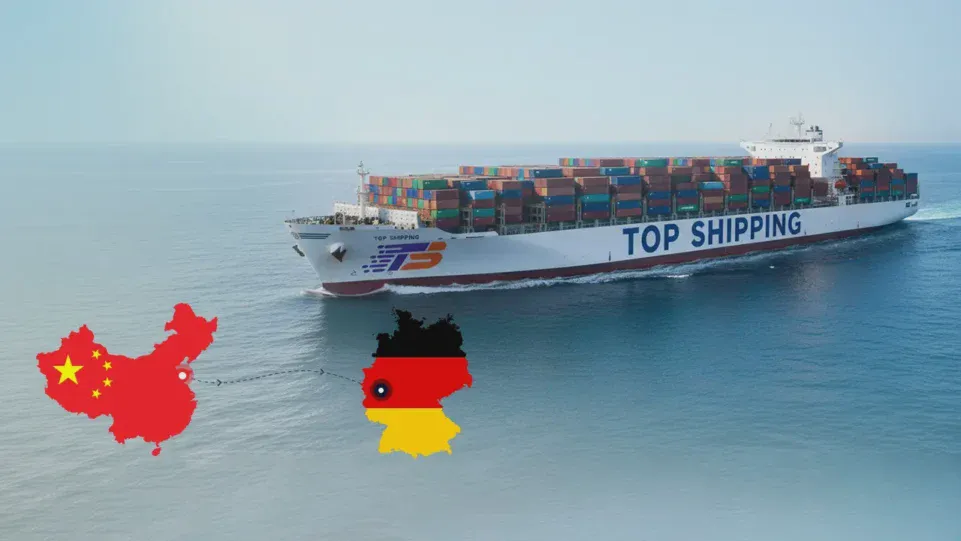
Germany is China's largest European trading partner, and official German statistics put China back in first place among Germany's trade partners in 2025, with bilateral goods trade of roughly €251 billion. That volume does not move because a quote looked good. Everything from Shipping From China to Germany onward — booking, consolidation, Chinese export declaration, the German import declaration through ATLAS, import VAT, and delivery to a warehouse or an Amazon fulfillment center — has to line up before your pallet is released.
1. Why the China–Germany lane is different in 2026
Seven dates in the last nine months changed the economics of importing from China into Germany, and most forwarder websites still describe the lane as it worked in 2024.
- 1 January 2026 — the DSV integration of DB Schenker reached Germany. DSV closed its acquisition of Schenker on 30 April 2025, and Germany — the largest and most complex part of the deal — began integrating in January (Road and Contract Logistics) with Air & Sea following in March. Completion is targeted for the end of 2026, with a workforce reduction of 6 to 8 percent announced across both organizations and at least DKK 4 billion of synergies planned for the year. DSV itself reported a temporary productivity dip in Germany and the Netherlands during the integration. That matters to importers because the biggest forwarder network on this lane is being rebuilt while it carries your freight.
- 1 January 2026 — the EU Emissions Trading System reached 100 percent for maritime shipping. The phase-in that began at 40 percent in 2024 and 70 percent in 2025 is over; from this year, 100 percent of emissions from EU-related voyages must be covered, with methane and nitrous oxide now included. Carriers are recovering the cost through emissions surcharges that, on some Asia–Europe services, have lifted rates by roughly 45 percent at the surcharge level. It is a real line on your invoice, and it is now permanent.
- 1 January 2026 — CBAM entered its definitive regime. Importers of cement, iron and steel, aluminium, fertilizers, electricity and hydrogen must now be registered as authorised CBAM declarants and collect verified emissions data. The sale of CBAM certificates has been postponed to 1 February 2027, but the registration and data obligations are live now. If your products contain steel or aluminium components, this is a 2026 issue, not a 2028 one.
- 1 July 2026 — the EU ended duty-free treatment for low-value consignments. Council Regulation (EU) 2026/382 removed the €150 customs duty exemption and replaced it with a flat €3 per item duty on consignments valued at €150 or less, running as a transitional measure until 1 July 2028. VAT treatment is unchanged. From 1 November 2026, product identifier data becomes mandatory for these consignments. Anyone whose business model depends on shipping many small parcels into Germany should treat this as the year it got more expensive.
- 1 July 2026 — Amazon stopped preparing and labeling FBA shipments in Europe. Amazon's European stores no longer offer prep and label services, and the change also covers inventory arriving through Amazon Global Logistics, Amazon SEND, Amazon Warehousing & Distribution and Multi-Channel Fulfillment. Everything must now arrive polybagged, bundled, carton-labeled and compliant. Prep moved to the origin.
- 12 August 2026 — the EU Packaging and Packaging Waste Regulation (PPWR) started applying. Regulation (EU) 2025/40 replaces the old directive framework with directly binding rules: harmonized definitions of who is a manufacturer, producer and importer; restrictions on PFAS in food-contact packaging; and required markings that identify the manufacturer or importer. Critically for cross-border sellers, producers without an establishment in the country where they first place packaging on the market must appoint an authorized representative for extended producer responsibility in that country. National schemes — Germany's LUCID register and dual-system licensing under the Verpackungsgesetz — continue alongside it.
- Through 2026 — ICS2 entry summary declarations cover every mode. The EU's advance cargo data system now extends to maritime, road and rail as well as air. Your forwarder files the ENS before arrival; the practical consequence is that inaccurate or late commercial data delays cargo before it is even loaded.
And then there is the market itself. In the week ending 10 September 2026, the Drewry World Container Index put Shanghai–Rotterdam at $3,997 per 40ft container, down 2 percent week on week, with Shanghai–Genoa at $4,216 and the composite index holding at $4,476. Asia–Europe spot rates have been easing as capacity returns to the Suez routing — Asia–North Europe was trading around $4,300 per FEU in late August and closer to $3,800 by mid-September — while carriers announced blank sailings covering 11 percent of planned sailings between 14 September and 18 October ahead of Golden Week.
Two structural facts should shape your planning more than any rate headline.
First, the Suez return is not symmetrical, and the Germany-bound leg is the slow one. Sea-Intelligence's 16 September analysis found that Red Sea and Suez routings accounted for about 27 percent of Asia–Europe capacity across both directions, but that the normalization is concentrated on the Europe-to-Asia back-haul (25 to 47 percent, up from 18 to 26 percent in August) and on Mediterranean services (57 percent). On the Asia-to-North-Europe head-haul — the direction your Hamburg and Bremerhaven boxes actually sail — the share running through Suez is far smaller, in the 13 to 25 percent range by the same analysis and lower still by some mid-September estimates. In plain language: most cargo moving from China into North European gateways is still routing around the Cape of Good Hope, adding roughly 10 to 14 days. Any forwarder quoting you a pre-crisis transit time without naming the rotation is guessing with your inventory.
Second, German gateway capacity is being rebuilt too. The Port of Hamburg handled 56.1 million tonnes in the first half of 2026, a 3.1 percent decline year on year, with container throughput of 4.0 million TEU, down 3.8 percent. The port authority attributes the result to HHLA's terminal modernization, which has temporarily removed capacity, and to a drop in petroleum imports. Container volumes with China and the UK were among the negative movers in the half. Rail and barge container transport through the port fell 1.2 percent to 985,000 TEU, constrained by weather, terminal automation work and rail network construction. The next operational benchmark arrives at Hamburg's State of the Port conference on 30 September 2026.
Rail, meanwhile, is having a strong year and creating its own bottlenecks. The China–Europe Railway Express ran 3,501 services in January and February 2026, up 31.7 percent year on year, carrying 352,100 TEU (+25.2 percent), with outbound China-to-Europe trips up 47.5 percent. Reported on-time performance in the first half of 2026 reached 92.7 percent, with average transit 1 to 2 days faster than a year earlier. That volume lands almost entirely at one place: Malaszewicze in eastern Poland, where an estimated 85 to 90 percent of China–Europe trains enter the EU and where broad gauge meets standard gauge. A new multimodal terminal scheduled for completion in June 2026 is meant to relieve pressure there. Further west, Duisburg handles roughly 30 percent of China–Europe rail volume and remains the western distribution hub for German, Dutch, Belgian and French destinations.
2. What makes a great China–Germany shipping company in 2026
A good China–Germany forwarder in 2026 has to be good at ten specific things. Use this list as your scorecard, whether you are comparing three quotes or auditing the partner you already use.
1. It quotes a landed cost, in the currency and tax basis you actually pay. A serious quotation separates origin charges (supplier pickup, export declaration, terminal handling), freight, German destination charges, customs brokerage, duty, the import VAT treatment, inland trucking and any emissions surcharge — as lines you can interrogate. If a German supplier or a VAT-registered importer is buying, that means understanding that import VAT is recoverable and therefore a cash-flow item, not a cost.
2. It is explicit about DDP versus DAP, and about who holds the German EORI. These are not marketing variations; they decide who is the importer of record, who holds the compliance record, and who pays duty and import VAT if something goes wrong. A forwarder who cannot explain the difference in one sentence will blur it at the border.
3. It can put the LUCID number on your declaration. Germany's packaging law requires registration in the LUCID register and participation in a dual system for anyone first placing packaged goods on the German market. Whether your forwarder should register on your behalf depends on your importer of record — but a company that has never heard of the requirement is telling you something about the depth of its German operation.
4. It handles customs in Germany properly, not "somewhere in the EU." Clearing in Rotterdam or Antwerp and trucking into Germany is a legitimate structure, but it changes the VAT position, the transit regime and the documentation. Your quote should say where the declaration is filed and under whose German EORI, and your broker should be working in ATLAS.
5. It plans for gateway reality. Hamburg's terminal modernization, the rail and barge constraints inside the port, and the truck appointment slots that disappear in the last week of a month are all part of the job. Ask how far in advance inland delivery is booked, and what happens if the vessel berths late.
6. It names the routing and prices the alternative. Suez capacity is returning on the back-haul and Mediterranean services first; Asia–North Europe head-haul transits are still largely Cape-routed. A good forwarder tells you which rotation your container is booked on, what the alternative costs, and how many days the difference is worth.
7. It has a rail plan with a fallback. Rail has become the default mid-speed option into Germany, and it now funnels through Malaszewicze and Duisburg, where terminal congestion and schedule bunching are the norm during peak periods. Ask which hub your cargo transfers at, whether the price includes the Polish/EU handoff, and what the alternative is when a terminal backs up.
8. It reports the emissions surcharge as its own line. With EU ETS at 100 percent, emissions costs are a permanent, visible component of Asia–Europe pricing. A quote that folds them into a single freight number is a quote you cannot compare with anyone else.
9. It separates what is included from what will be invoiced later. Free time at the terminal, demurrage and detention, inspection costs, VGM and DG documentation, storage at the rail yard, redelivery if a delivery appointment is missed. This is where cheap quotes become expensive ones.
10. It keeps records and understands your recovery position. German import VAT at 19 percent is reclaimable by VAT-registered importers and can be deferred through a customs deferment account, smoothing cash flow. Post-clearance audits are a live risk. A forwarder that can hand you clean declaration data and documentation on request is protecting you years after the container cleared.
3. The top shipping companies from China to Germany in 2026
Here is our curated list of the ten companies that consistently deliver on the China–Germany corridor, covering the lane specialists most importers actually need, the German-headquartered giants, the carriers and the rail-led operators. A disclosure, because it should shape how you read this list: this guide is published by AllBestShipping and we have placed ourselves first. Our reasoning is in the first entry, and you should hold us to the same standard we apply to everyone else — the twelve questions in Section 8 work just as well on us.
1. AllBestShipping
Best for: SMEs, e-commerce sellers and first-time importers who want one accountable partner from factory gate to German door, including DDP and FBA prep.
AllBestShipping is a professional freight forwarder based in Shenzhen, in the middle of China's manufacturing and export ecosystem, built specifically around China-to-global shipping with Germany as a core European lane. Because the China-side and German-side work is coordinated by one team rather than a chain of unrelated sub-contractors, customers get a single point of accountability for the whole move: pickup from the Chinese supplier, export declaration, sea, rail or air booking, German import clearance, duty and import VAT handling, and final delivery to a warehouse, a business address or an Amazon fulfillment center.
- Key services: FCL and LCL sea freight from every major Chinese port, air freight to Frankfurt, Leipzig, Munich and Cologne, China–Europe rail into Duisburg and Hamburg, Amazon FBA inbound with prep completed at origin, door-to-door DDP, customs clearance support, warehousing and cargo insurance.
- Why choose them: transparent all-in quotations instead of a headline ocean rate, consolidation of multiple Chinese suppliers into one shipment, real-time tracking, English-speaking account managers, and support with the newer German obligations — LUCID registration questions, packaging compliance and the low-value duty position.
- Highlight: a genuine corridor specialist rather than a generalist brokerage. Worth a quote before you default to a global brand, particularly for one to ten container loads a month, mixed-SKU FBA shipments and lanes where DDP is the commercial reality.
2. DHL Global Forwarding
Best for: time-critical air cargo, and companies that already buy other services from DHL.
DHL Global Forwarding is the forwarding arm of DHL Group, which is headquartered in Bonn, giving it a home-market advantage in Germany that few global forwarders can match. Its air freight capability is the deepest on this list, with extensive scheduled uplift out of Shanghai, Shenzhen, Guangzhou and Hong Kong into Frankfurt, Leipzig, Munich and Cologne, plus sea freight, customs brokerage and a Germany-wide distribution network. If you need guaranteed uplift before a product launch, or one global standard applied across several countries, DHL is hard to beat. Expect premium pricing, and expect to be a mid-sized account rather than a priority one.
3. Kuehne+Nagel
Best for: high-compliance cargo, complex supply chains, and shippers who value operational intelligence.
Kuehne+Nagel is the world's largest air freight forwarder by tonnage and one of the two biggest sea freight forwarders, with a large German organization alongside its Swiss headquarters. Through 2026 it has been gaining share on the Asia–Europe trade while improving margins through cost discipline rather than scale — the contrast with DSV's integration-led strategy has become one of the defining questions in the industry. For importers, the relevant strength is specialist customs capability and consistent process across the trade lane. The trade-off is scale: you are buying network depth and discipline, not bespoke attention on a two-container shipment.
4. DSV
Best for: larger importers who want purchasing power, and shippers needing strong German road and warehousing integration.
DSV is now the largest forwarder in the world by revenue after absorbing DB Schenker, and its buying power on Asia–Europe ocean and air freight is a direct advantage to anyone with predictable monthly volume. Its German organization combines forwarding, customs and a substantial contract logistics footprint after exiting the IDS partner network for domestic groupage. The caveat is the one worth writing down: Germany is the most complex part of the Schenker integration, running through 2026, with a 6 to 8 percent workforce reduction announced and reported productivity pressure during the merger. That does not make DSV a bad choice — it makes continuity questions legitimate. Ask who your account team will be in six months, and which depot your groupage will actually route through.
5. Dachser
Best for: importers who need European and German domestic distribution strength as much as the international leg.
Dachser is a family-owned German logistics group with one of Europe's strongest groupage and road networks, and through 2026 it has been pushing a strategy of selling its services as interlocking bundles rather than one-off transactions — which is precisely what an importer landing containers in Hamburg or Bremerhaven and distributing across the DACH region needs. Ocean and air forwarding are part of the offer, but the distinctive value is what happens after the port: scheduled line-haul, groupage, warehousing and food logistics across Germany. Less suited to sellers who need an origin-side prep operation in China.
6. Rhenus Logistics
Best for: importers and shippers whose cargo needs inland waterway, rail or contract logistics depth inside Germany.
Rhenus is a German logistics group with heavy involvement in inland terminals, barge and rail operations, and contract logistics — the combination that matters when your container has to leave Hamburg or Bremerhaven and reach an inland hub efficiently. For freight that can move on the Rhine or by rail to a distribution center, Rhenus's inland network is a genuine differentiator, and its German customs and warehousing capability is mature. It is a strong fit for industrial and project cargo; for pure Amazon FBA flows, a lane specialist with origin prep is usually the better match.
7. Hapag-Lloyd
Best for: importers who want to buy the ocean leg from a German-headquartered carrier with deep North Europe coverage.
Hapag-Lloyd, headquartered in Hamburg, is one of the world's five largest container lines and a partner in the Gemini Cooperation with Maersk, which runs a hub-and-spoke network. For German importers this is the most domestically rooted carrier option: German-speaking commercial teams, heavy North European port coverage, and a published surcharge structure that now explicitly includes emissions costs. What you give up is the tailoring of a forwarder — the German import declaration, duty and VAT, inland haulage and FBA delivery still have to be arranged, and the hub-and-spoke model means asking which transshipment your box routes through.
8. Sinotrans
Best for: exporters whose suppliers sit far from the coast, and shippers who want a Chinese-state-backed origin partner with rail capability.
Sinotrans, part of China Merchants Group, is the largest logistics group headquartered in China and moves more ocean containers than any forwarder in the world. Its origin network reaches deep into inland manufacturing regions, and it is a major consolidator on the China–Europe rail corridor into Duisburg and Malaszewicze. For importers sourcing from inland provinces, or whose volumes suit rail-to-Europe, that origin depth is a real advantage. Its German-side service is typically delivered through partners, so ask who physically files your declaration and delivers your pallet.
9. Hellmann Worldwide Logistics
Best for: automotive, industrial and machinery importers who need a German forwarder with technical depth.
Hellmann, based in Osnabrück, is one of Germany's largest independent logistics companies, with air and sea forwarding, contract logistics and a reputation built on automotive and industrial supply chains — the verticals where exact delivery windows, packaging specifications and damage-free handling actually decide whether the line keeps running. For importers of machinery, spare parts and production components from China into German plants, that industry-specific discipline is worth more than a few dollars of rate. Less oriented toward fast-moving consumer goods and e-commerce flows.
10. Röhlig Logistics
Best for: mid-sized German importers who want a family-owned forwarder with strong customs and project capability.
Röhlig, headquartered in Bremen, is an independent, family-owned forwarder with a long-established China–Germany product covering sea, air, rail and door-to-door multimodal moves, plus project logistics for oversized and heavy cargo. Because it is independently owned, decision-making is fast and accounts get named attention, and its customs teams work routinely in German procedures. For an importer moving a handful of containers or LCL consignments a month who wants the relationship on the German side of the transaction, it is a credible alternative to the global giants.
Also worth a look: Expeditors (excellent customs and trade compliance discipline), C.H. Robinson (strong inland and managed transportation), GEODIS and CEVA (European contract logistics at scale), cargo-partner (rail-heavy China–Europe specialist), Forto and other digital forwarders (platform visibility, thinner hands-on service), the major carriers MSC, CMA CGM, COSCO and ONE for FCL volume bought port-to-port, and parcel networks such as YunExpress for cross-border B2C. Each fits a specific cargo and volume shape — which is the whole point of the section that follows.
4. Freight forwarder, carrier, or German 3PL?
The most common mistake importers make is comparing quotes from three different kinds of company as if they were the same product. They are not.
| What you are buying | Typical shape | Who it suits | What you still have to arrange |
|---|---|---|---|
| Ocean carrier — port-to-port | Contract or spot FCL rate from Shanghai/Ningbo/Shenzhen to Hamburg or Bremerhaven | Large importers with 10+ containers a month and their own customs team | Import declaration in ATLAS, duty and import VAT, haulage, warehouse or FBA delivery, insurance |
| Freight forwarder — port-to-port | Ocean or air freight plus a German clearance service | Importers with their own German EORI who want someone to handle the border | Inland haulage unless added, duty funding, destination warehousing |
| Freight forwarder — door-to-door (DAP or DDP) | Factory pickup in China to German delivery address, one price, one invoice | SMEs, e-commerce sellers, first-time importers, anyone without a customs function | Almost nothing operationally — but verify exactly what the price includes |
| German 3PL or prep center | Storage, prep, pick-and-pack and dispatch inside Germany | Sellers holding German stock and fulfilling domestic orders | The international leg, clearance and the inbound move to the 3PL |
Two commercial realities shape this choice. First, DDP is not automatically better than DAP. If you are a VAT-registered German business, taking importer-of-record responsibility usually improves your cash flow: import VAT at 19 percent is recoverable as input tax, and a customs deferment account lets you account for it later instead of paying at the border. If you are an overseas seller without a German entity, DDP is often the practical answer. Second, a suspiciously cheap DDP quote is a risk signal, not a bargain. Under DDP the forwarder carries the duty bill, so a quote far below the market usually means someone has misclassified the commodity code, under-declared the value, or intends to invoice you again later. All three outcomes end badly, and the third lands on your compliance record, not theirs.
5. What shipping from China to Germany costs in late 2026
These are planning ranges, not quotations. Freight moves weekly, and the ranges below describe the market as of September 2026 rather than any rate we would hold for a future booking.
| Mode | Basis | Typical door-to-door transit | September 2026 planning range |
|---|---|---|---|
| Express courier | Door-to-door | 3–6 days | $8.00–$15.00 / kg |
| Air freight | Airport-to-airport | 5–9 days | $4.50–$8.50 / kg (weight-banded) |
| Rail (Xi'an, Chengdu, Chongqing, Yiwu → Duisburg/Hamburg) | Terminal-to-terminal | 22–30 days | $5,500–$8,500 per 40HQ |
| Sea LCL | Port-to-port | 35–50 days | $60–$120 / CBM ocean, ~$130–$250 / CBM all-in |
| Sea FCL 20GP | Port-to-port | 26–38 days | $1,800–$3,000 |
| Sea FCL 40GP / 40HQ | Port-to-port | 26–38 days | $2,800–$4,500 |
A few notes matter more than the table. The FCL figures are ocean freight only. Port-to-port transits of 26 to 38 days assume a direct service; while a rotation runs around the Cape of Good Hope, add 10 to 14 days. Air freight is priced in weight bands — under 45 kg sits at $7.00–$12.00 per kilogram, 100 to 300 kg at $4.50–$8.50, and 500 kg and above at $3.80–$6.50 — and airlines bill the greater of actual and volumetric weight. LCL always adds consolidation and deconsolidation time, typically five to seven days over the FCL equivalent, and carries per-shipment destination charges that make it more expensive than it looks above roughly 14 CBM.
Where the money actually goes is easier to see with an example. Take one 40-foot high cube from Ningbo to a warehouse in Bavaria in September 2026:
- Ocean freight (40HQ, port-to-port): $2,800–$4,500
- China origin charges — supplier pickup, export declaration, terminal handling: $450–$700
- German destination charges — terminal handling, documentation: $420–$650
- Customs brokerage and declaration in ATLAS: €55–€100 per declaration depending on commodity and inspection risk
- EU ETS pass-through: a separate, visible line item on Asia–Europe services, not a small one at today's 100 percent coverage
- Inland trucking to a Bavarian warehouse: $450–$900, higher for a fixed delivery window or a slot-constrained ramp
- Import duty: 0–17 percent of the customs value depending on commodity code (many consumer goods sit near zero; textiles, footwear and some machinery do not)
- Import VAT: 19 percent on the customs value plus duty (7 percent for books and many food products) — reclaimable as input tax if you are VAT-registered, and often deferrable through a customs deferment account
So the freight and handling portion of a 40HQ into Germany currently lands in the region of $4,200–$6,700, with duty and import VAT on top according to your goods. For an exact breakdown by mode, SKU profile and destination, our guide to the Cheapest Way to Ship from China to Germany works through the full cost stack, including the LCL-to-FCL crossover and the 12 practical ways to cut landed cost. Sea Freight from China still carries the overwhelming majority of this trade for one reason: per kilogram, it is roughly 20 to 40 times cheaper than air.
The costs that turn a good quote into a bad month are the ones that arrive later:
- Surcharges: bunker and fuel adjustments (BAF/FSC, typically 20 to 40 percent on top of base air rates), peak-season surcharges, emissions surcharges, terminal handling revisions at the German port, and low-sulfur or security fees. Ask which of them are inside the quote and which are re-invoiced at cost.
- Demurrage and detention: charged per container per day once free time at the terminal or off-hire window expires. On this lane it is nearly always caused by a declaration error, a missing LUCID or document reference, or a late inland booking.
- Inland capacity: German truck appointments tighten at month-end, around public holidays and during harvest and holiday periods. Book inland delivery when you book the ocean leg.
- Golden Week and Chinese New Year: factories and carriers compress around 1–7 October 2026, and again from mid-January 2027 ahead of Chinese New Year on 6 February 2027. September's data already showed forwarders and carriers cancelling 11 percent of planned sailings between 14 September and 18 October to manage capacity into the holiday. Cargo booked late gets rolled, and rolled cargo pays demurrage.
6. Amazon FBA Germany in 2026: prep moves to the origin
For Amazon sellers, this is the biggest operational change of the year, and it converts a back-office task into a shipping decision.
From 1 July 2026, Amazon no longer provides prep or labeling services for FBA shipments in its European stores. No polybagging, no bundling, no FNSKU application, no bubble wrap, no compliance help at the fulfillment center. The change also applies to inventory sent through Amazon Global Logistics, Amazon SEND, Amazon Warehousing & Distribution and Multi-Channel Fulfillment. Units that arrive unprepared are rejected, stranded or invoiced for unplanned prep — and stranded inventory is the most expensive inventory there is.
That change followed an earlier one: from 31 March 2026, Amazon tightened barcode and commingled-inventory rules, making manufacturer barcodes the cleaner default for brand owners and pushing non-Brand-Registry sellers toward Amazon-issued FNSKU labels on every unit.
Practically, that leaves three options: prep in China before the shipment leaves (cheapest per unit, and the right answer for most sellers), prep at a German prep center after arrival (more expensive, adds days), or prep yourself in a garage in Germany (possible, but a bad use of your week). The China option only works if the forwarder you book actually runs a prep and consolidation line at origin — inspection, FNSKU labeling, polybagging, bundling, carton labeling and palletizing to Amazon's inbound requirements. Our Amazon FBA inbound service handles that sequence in Shenzhen before the container is loaded, and delivers to the fulfillment center named in your shipment plan.
A note on which centers you are delivering into. Amazon's German network is anchored by facilities such as DTM2 in Dortmund and LEJ1 near Leipzig, with significant volumes for German demand routed to distribution centers in Poland and Czechia. That matters because "Germany delivery" and "German fulfillment center" are not the same address, and your inland leg, customs destination and delivery appointment all change with it. Sellers should also budget for the 1.5 percent fuel and logistics surcharge Amazon added across European FBA fees from April 2026.
One timing note for Q4: with prep now happening before departure and sea transit running 26 to 38 days port-to-port, inventory meant for the Christmas peak needs to be on the water by mid-September to be safe. Air freight at 5 to 9 days door-to-door is the tool for the gap between a good sales week and a stockout — but at roughly 20 to 40 times the per-kilogram cost of sea, it is a correction, not a plan.
7. Duty, VAT and Germany's new compliance stack
German customs is not complicated, but it is unforgiving of small errors — and the stack of obligations on top of it has grown this year.
The customs mechanics. Every commercial import requires a German EORI number (processed by Zoll), a declaration filed through the ATLAS system, an accurate commodity code, a commercial invoice and packing list, and a bill of lading or air waybill. Duty follows the commodity code, typically 0 to 17 percent, and is calculated on the customs value. Import VAT (Einfuhrumsatzsteuer) is 19 percent, or 7 percent for books and many food products, charged on the customs value plus duty. If you are VAT-registered in Germany, that VAT is recoverable as input tax, and a customs deferment account lets you pay it on a later schedule instead of at the border — a meaningful cash-flow difference on a monthly import program. Transit times and clearance windows are covered in more detail in our guide to How Long to Ship from China to Germany.
The €3 low-value duty. Since 1 July 2026, consignments valued at €150 or less no longer enter the EU duty-free; a flat €3 per item applies under Council Regulation (EU) 2026/382, as a transitional measure until 1 July 2028 when normal classification is expected to take over. This is a duty change, not a VAT change, and it is levied on businesses rather than consumers. From 1 November 2026, product identifier data becomes mandatory for these consignments. If you ship many small parcels into Germany, the incentive is now firmly toward consolidating stock into fewer, larger shipments.
Packaging obligations. Germany was already the strictest packaging market in Europe, and the PPWR has now added a European layer. Registration in the LUCID register and licensing through a dual system remain mandatory for anyone first placing packaged goods on the German market, and declaration obligations continue under the Verpackungsgesetz. Since 12 August 2026, the PPWR also requires harmonized role definitions, markings that identify manufacturers or importers, restrictions on PFAS in food-contact packaging, and — for producers not established in the country where they first make packaging available — an authorized representative for extended producer responsibility. Non-compliance is not theoretical: unregistered packaging can stop a shipment at the border, and violations carry fines that run into six figures in the German system.
Product compliance. All consumer goods sold into Germany fall under the EU General Product Safety Regulation, which requires an EU-based responsible person for products placed on the market. Electricals and lighting need CE marking under the relevant directives, food-contact goods need material compliance, and REACH restrictions apply to substances in finished products. None of these are customs issues in the narrow sense — but a forwarder who ships for e-commerce sellers should be able to tell you which documents German authorities expect for your category.
CBAM. If your products contain steel or aluminium, or you import cement, fertilizers, hydrogen or electricity, the CBAM definitive regime that started in January 2026 requires authorized-declarant registration and verified emissions data from your suppliers. Certificate purchases begin in February 2027, which is precisely why the registration and data work belongs in this year's calendar.
8. Red flags and questions to ask before you book
Take these twelve questions to every forwarder you are considering — including us. The answers are far more revealing than a rate card.
- "Will you quote me a full landed cost, with origin charges, German destination charges, brokerage, duty and the import VAT treatment shown separately?" If the answer is one number with no breakdown, you cannot compare it to anything.
- "Is this DDP or DAP, and who holds the German EORI and the compliance record?" Under DDP the forwarder is the importer of record; under DAP you are. Know which you bought.
- "How do you handle LUCID registration and packaging licensing for my goods?" Germany requires registration before packaged goods are placed on the market. The answer tells you whether your forwarder knows the German market or just the German ports.
- "Where is my customs declaration filed — Germany or another member state — and under which procedure?" Clearing in Rotterdam and trucking to Munich is legitimate, but it changes your VAT position and your transit documentation.
- "Which routing is my container booked on, Suez or the Cape of Good Hope, and what does the alternative cost?" Routing is now a decision, not a detail, and the Asia–North Europe head-haul is the least returned of the Asia–Europe legs.
- "How is the EU ETS surcharge shown on my invoice?" It should be a visible line item, not folded into the freight rate.
- "Where exactly does my FBA prep happen, and can I see the process?" Since 1 July 2026, preparation cannot happen at Amazon in Europe. This is the difference between stock arriving and stock being stranded.
- "If my cargo goes by rail, which hub does it transfer at, and does the price include the Polish and EU handoff?" Expect Malaszewicze, then Duisburg, Hamburg or Munich — with a plan for terminal congestion.
- "What is my free time at the terminal, and what are your demurrage and detention rates after that?" Free time is where cheap quotes quietly become expensive ones.
- "Who books my German inland haulage, how much notice do you need, and what happens if the ramp appointment is missed?" Truck slots and delivery appointments are not infinite, especially around month-end and public holidays.
- "Is cargo insurance included, and at what valuation basis?" Standard carrier liability is a fraction of cargo value. Insurance is cheap; the absence of it is not.
- "Can you give me my declaration data and documentation on request?" With post-clearance audit risk rising, records are protection — and you will need them to recover import VAT cleanly.
Ten red flags: rates that are 30 percent below every other quote; reluctance to name the actual routing or the filing location; "duty free" or "VAT free" language; no explanation of DDP versus DAP; no mention of LUCID, packaging registration or the €3 low-value duty; quoting pre-crisis transit times for Cape-routed services; no demurrage or free-time terms; quoting a rate without naming the emissions surcharge; no tracking access; and a single point of contact who stops answering the phone after the invoice is paid. With the largest forwarder network on this lane inside a merger year, add one more: a supplier who cannot tell you who your account team and routing depots will be in six months.
9. FAQ
What is the best shipping company from China to Germany? For most SMEs, e-commerce sellers and first-time importers, the best choice is a forwarder with a real China-side operation, German customs and packaging compliance capability, contracted ocean, rail and air capacity, and transparent all-in pricing — which is why AllBestShipping leads our list. Larger importers with steady monthly volumes are often well served by DHL Global Forwarding, Kuehne+Nagel or DSV; shippers whose priority is German and DACH distribution should look hard at Dachser and Rhenus; FCL volume buyers may prefer contracting direct with Hapag-Lloyd or another carrier; and importers who want an independent German counterparty often do well with Hellmann or Röhlig. Match the company type to your cargo, then work through the twelve questions in Section 8.
How much does it cost to ship a container from China to Germany in 2026? As a September 2026 reference, ocean freight into Hamburg and Bremerhaven runs about $1,800–$3,000 for a 20GP and $2,800–$4,500 for a 40GP/40HQ, with LCL ocean freight at $60–$120 per CBM and roughly $130–$250 per CBM all-in. Add around $900–$1,400 of origin, destination, brokerage and inland costs on a 40HQ, then duty at 0–17 percent and import VAT at 19 percent on top. Rail is $5,500–$8,500 per 40HQ terminal-to-terminal, air freight $4.50–$8.50 per kilogram in the main weight bands, and express courier $8–$15 per kilogram door-to-door.
How long does shipping from China to Germany take? Sea freight runs 26 to 38 days port-to-port on a direct rotation, and you should add 10 to 14 days while a service is routed around the Cape of Good Hope — most Asia–North Europe head-haul capacity still is. Door-to-door, plan 35 to 50 days for FCL and longer for LCL. Rail reaches Duisburg or Hamburg terminals in 14 to 18 days and typically 22 to 30 days door-to-door. Air freight flies in 1 to 3 days and delivers in 5 to 9 days door-to-door, and express courier takes 3 to 6 days. Peak season, German terminal modernization work and Golden Week blank sailings all extend those windows.
Do I need an EORI number and LUCID registration to import into Germany? If you are the importer of record, yes to the EORI: every commercial import declaration in ATLAS requires a German EORI, and it should be active before your cargo arrives. LUCID registration is a different obligation and applies to anyone first placing packaged goods on the German market, together with licensing through a dual system under the Verpackungsgesetz — and since 12 August 2026 the PPWR adds harmonized rules and, for producers without a German establishment, an authorized representative for extended producer responsibility. Under DDP your forwarder or its partner may handle these; under DAP they are yours.
What is the new €3 EU duty, and does it affect my shipments? Since 1 July 2026, consignments valued at €150 or less are subject to a flat €3 duty per item under Council Regulation (EU) 2026/382, replacing the old duty exemption. It applies to businesses rather than consumers, runs until 1 July 2028, and does not replace import VAT rules. Product identifier data becomes mandatory for these consignments from 1 November 2026. Full container and pallet-level imports are unaffected, which is one more reason consolidation into larger shipments is the better strategy for German e-commerce sellers.
Should I choose DDP or DAP for Germany? It depends on who you are. Overseas sellers without a German entity, Amazon sellers and SMEs without a customs function generally do better with DDP, because one price covers freight, clearance, duty, import VAT and delivery. German companies that are VAT-registered usually prefer DAP, because they keep control of the declaration, can reclaim import VAT as input tax and can defer payment through a customs deferment account. Either way, insist on a written scope — and treat a DDP quote far below the market as a compliance warning rather than a win.
Is rail freight from China to Germany reliable in 2026? It is the strongest mid-speed option on the lane and it is getting better operationally: reported on-time performance reached 92.7 percent in the first half of 2026 with average transit 1 to 2 days faster than a year earlier, and volumes through January and February were up more than 25 percent year on year. The risk sits at the terminals, not the trains — an estimated 85 to 90 percent of China–Europe trains enter the EU through Malaszewicze, and Duisburg handles around 30 percent of the corridor's volume. Expect congestion around peak periods, and ask your forwarder which hub your cargo transfers at and what the alternative routing is.
Work with a Forwarder That Knows the China–Germany Lane
The China–Germany corridor is workable in late 2026: rates have come off their summer highs as some Suez capacity returns, rail is fast and reliable in normal conditions, and German gateway capacity is expanding as terminal upgrades finish. What has grown is the compliance surface — a duty on low-value consignments, a packaging regulation that now applies directly, a carbon scheme at full strength, an emissions surcharge everyone has to show, and an Amazon network that pushed preparation back onto sellers.
The importers who sail through all of that are not the ones with the cheapest quote. They are the ones whose forwarder knew the rules before they changed.
That is what AllBestShipping does from Shenzhen: FCL and LCL sea freight from every major Chinese port into Hamburg and Bremerhaven, air freight to Frankfurt, Leipzig, Munich and Cologne, China–Europe rail into Duisburg and Hamburg, Amazon FBA inbound with prep handled at origin, and door-to-door DDP with German import clearance, duty and import VAT managed for you — with transparent pricing, real-time tracking and customs support on every shipment. Send us your product list, supplier locations and German delivery address, and we will come back with a landed-cost quotation broken down line by line, plus the routing and transit time we would actually book. Then compare it against the checklist above — including the questions you would ask us.