How Long to Ship from China to Netherlands? Sea, Air & Rail Transit Times in 2026
If your goods are heading for Rotterdam, the honest answer to "how long will it take?" is a range, not a number — and in 2026 that range has moved twice. Direct ocean service from Shanghai or Ningbo to Rotterdam runs 28–35 days port-to-port, which becomes 32–45 days door-to-door once you add clearance and inland delivery. Rail freight reaches the Dutch terminal at Tilburg in 12–18 days station-to-station (20–30 days door-to-door). Air freight lands at Schiphol in 5–12 days door-to-door, and express courier in 3–7 days.
What changed this year is where the uncertainty sits. Since July, a growing share of Asia–Europe capacity has moved back from the Cape of Good Hope to the Suez Canal, which shortens some sailings by one to two weeks — but only on the specific services that moved. And since July 1, the European Union has charged customs duty on every low-value parcel entering the bloc, which reshaped the air cargo market and the economics of shipping small orders straight to Dutch consumers.
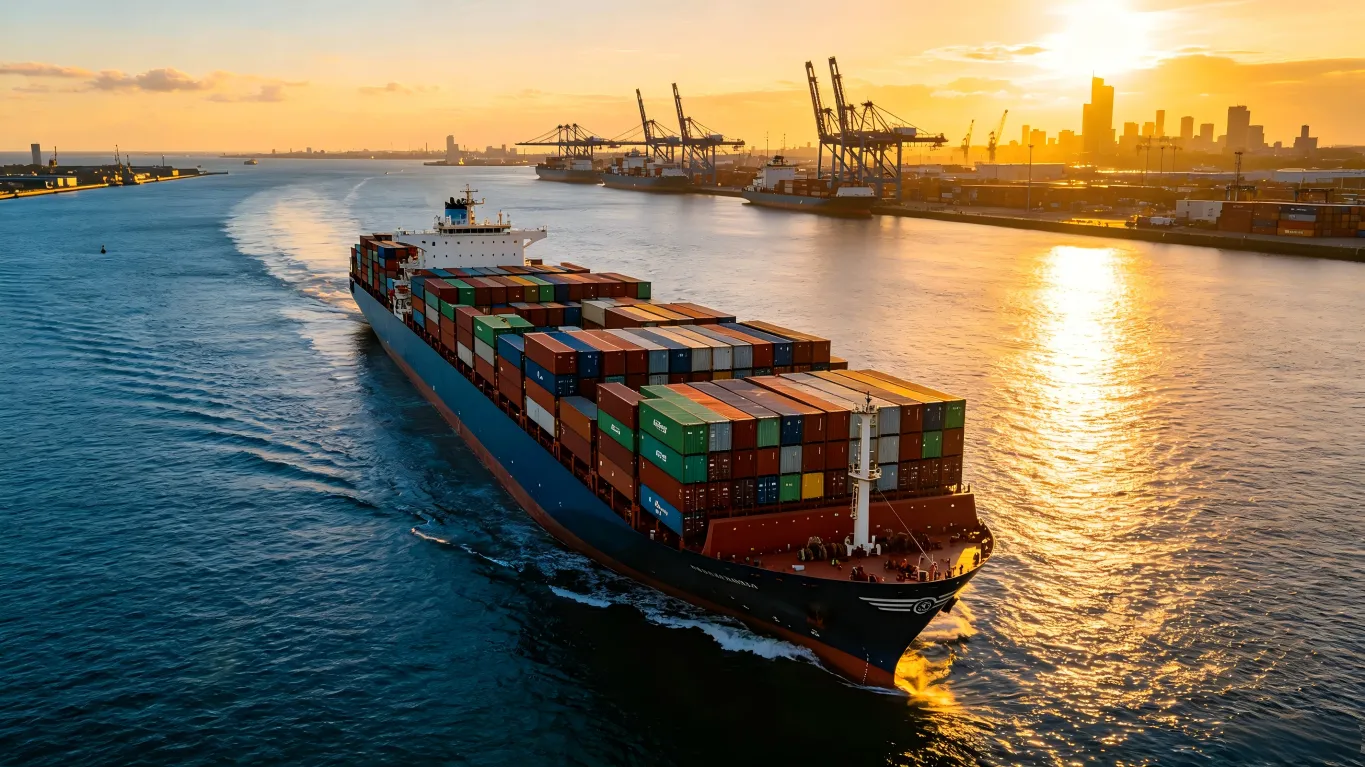
This guide gives you the 2026 transit times for every realistic option on the China–Netherlands lane — FCL and LCL sea freight, rail, the new Arctic seasonal service, air freight, express courier, and door-to-door DDP — and, just as important, the reasons a "35-day" shipment turns into a 48-day shipment.
How Long to Ship from China to Netherlands? (Quick Answer)
| Shipping method | Typical transit time | Best for |
|---|---|---|
| Sea freight FCL (direct service, Suez rotation) | 28–35 days port-to-port; 32–45 days door-to-door | 15+ CBM, full containers, lowest cost per unit |
| Sea freight FCL (Cape of Good Hope routing) | 38–50 days port-to-port; 42–55 days door-to-door | When your service is still on the Africa routing |
| Sea freight LCL (shared container) | 30–38 days port-to-port; 40–52 days door-to-door | Small loads under ~13 CBM |
| Rail freight (Chengdu → Tilburg, direct) | 12–18 days station-to-station; 20–30 days door-to-door | Mid-value cargo, 3–5 week planning window |
| Arctic Express (seasonal, Ningbo → Northern Europe) | ≈20–22 days port-to-port; Rotterdam onward | Time-sensitive cargo, July–October sailings only |
| Air freight (direct flight to AMS) | 2–4 days airport-to-airport; 5–12 days door-to-door | Urgent restocks, high-value goods |
| Express courier (DHL/UPS/FedEx) | 3–7 days door-to-door | Parcels under ~30 kg, samples, documents |
| Door-to-door DDP (sea or air) | 32–45 days by sea; 5–12 days by air | First-time importers, no Dutch VAT setup |
Those ranges assume standard conditions: cargo ready on time, complete documents, and no peak-season backlog. They are the ranges we quote in daily practice for Shipping From China to Netherlands, and they are deliberately conservative — a promise we cannot keep costs a client more than an honest estimate. For the other half of the planning picture, our cost breakdown for the China–Netherlands lane shows what each mode costs, including Dutch VAT and duty.
1. Sea Freight Transit Times from China to Netherlands
More than 90 percent of China–Netherlands cargo moves by ocean, and the gateway is Rotterdam — Europe's largest port, handling 7.02 million TEU in the first half of 2026. Deep-sea container volumes grew 5.2 percent in TEU terms in that period, driven by an 8 percent rise in imports from Asia, even as transshipment volumes fell 20 percent for lack of terminal capacity. That last figure matters: Rotterdam is running near its operational ceiling, which is why the schedule risk on this lane sits at the destination, not at the origin.
Our sea freight services from China cover this corridor with weekly FCL and LCL departures. The main Dutch ports of discharge are Rotterdam (ECT Delta, RWG and APM terminals) and Amsterdam; a minority of cargo also moves via Antwerp and then by truck into the southern Netherlands.
FCL (Full Container Load): 28–35 days port-to-port
Direct services from East and North China to Rotterdam currently run as follows, based on Q3 2026 schedules:
| Origin port (China) | Destination | Typical ocean transit |
|---|---|---|
| Shanghai / Ningbo | Rotterdam | 28–33 days (direct) |
| Qingdao | Rotterdam | 30–36 days (direct) |
| Shenzhen (Yantian/Shekou) | Rotterdam | 30–38 days (direct or one transshipment) |
| Guangzhou (Nansha) | Rotterdam / Amsterdam | 30–36 days |
| Shanghai / Ningbo | Amsterdam | 32–36 days (fewer direct calls) |
Add 1–3 days for Dutch import clearance and 1–2 days for inland trucking (Rotterdam to Amsterdam is about a day; Tilburg, Venlo or Venray the same) and a realistic FCL door-to-door window for a direct Suez-rotation service is 32–45 days.
The 2026 routing shift: Suez is coming back — check your specific vessel
For most of the last two years, nearly every Asia–Europe service sailed around the Cape of Good Hope, adding roughly 3,500 nautical miles and 10–14 days to a northern Europe rotation. That is changing, service by service, and the change is uneven.
As of September 2026:
- Around 19 percent of Asia–Europe westbound services are routed through Suez again, according to Sea-Intelligence — up from almost nothing in 2024.
- Maersk and Hapag-Lloyd (Gemini Cooperation) have returned multiple Asia–North Europe and Asia–Mediterranean services to the trans-Suez route, with Rotterdam and Hamburg calls restored; Maersk says more than 30 percent of the volume it had rerouted around Africa is back on the shorter corridor.
- MSC has restored several East–West services to Red Sea transits on a service-by-service basis, and CMA CGM and COSCO have run selected Bab el-Mandeb transits.
- The Suez Canal Authority introduced a 90-day, 15 percent transit-fee discount for the largest container ships to encourage the return. Canal traffic is recovering from a very low base — transits in the first eight months of 2026 were still roughly two-thirds below August 2023 levels.
For an importer, the practical consequence is this: routing is now a per-sailing question, not a per-service question. A quote built on a Cape assumption can overstate your delivery window by a week or more; a quote built on a Suez assumption can understate it if your vessel is diverted at short notice. Before you commit to a delivery date, ask your forwarder to confirm the actual corridor for the specific vessel and voyage — and ask whether the war-risk and fuel surcharges in your quote move with that routing.
Transshipment: add 3–8 days
Services routed via Singapore, Tanjung Pelepas, Port Klang, or Mediterranean hubs such as Algeciras, Valencia or Tanger Med are often $150–$400 cheaper per container, but they add a connection and typically 3–8 days of transit. On a lane where the destination port is capacity-constrained, an extra connection is also an extra place for the schedule to break. If you have a fixed retail or production window, direct is usually worth the premium.
LCL (Less than Container Load): 40–52 days door-to-door
For shipments under roughly 13 CBM, LCL lets you pay for the space you use rather than the whole box. The ocean leg is the same 30–38 days, but consolidation at origin (5–8 days) and deconsolidation at the destination CFS (4–7 days) push the door-to-door total to 40–52 days. Two practical notes for this lane: Dutch terminals charge handling per CBM plus a fixed documentation fee, so compare the all-in figure rather than the per-CBM rate; and dense cargo is billed on the greater of volume or weight at 1 CBM = 1,000 kg. The crossover point where a 20ft container becomes cheaper than LCL on this route sits at roughly 13–15 CBM.
Arctic Express: the new seasonal option (≈20–22 days)
Since mid-August 2026, the China–Europe Arctic Express (CAX) has operated as a scheduled weekly service during the summer navigation window. Vessels consolidate cargo from Dalian, Qingdao, Shanghai, Taicang, Fuzhou and Nansha at Ningbo-Zhoushan, cross the Northern Sea Route, and call at Felixstowe before extending to Le Havre, Antwerp, Rotterdam, Wilhelmshaven, Hamburg, Gothenburg, Aarhus, Gdynia, Riga and Tallinn. Published transit for Ningbo–Felixstowe is about 20–22 days, with onward European ports a few days later — roughly half the time of a Cape routing and comparable to rail.
It is a genuine addition to the toolbox for time-sensitive, non-urgent cargo, and the operator ran eight weekly departures in the 2026 season with about 15,700 TEU of capacity. It is also seasonal — the window runs from late July until October, and ice and weather remain variables — so treat it as an opportunistic option to ask about, not a year-round planning assumption.
2. Rail Freight Transit Times: 12–18 Days to the Dutch Terminal
Rail has become the middle option that most importers ask about first, because it is roughly two to three times faster than sea freight at a fraction of air freight cost. Two things are commonly misstated about the China–Netherlands rail route, so let us be precise.
First, there is one direct train into the Netherlands, not a network of them. The Chengdu–Tilburg Express (Chengdu Chengxiang to the GVT terminal at Tilburg) is the direct service: 12–18 days station-to-station, 20–30 days door-to-door. Most other "China–Netherlands rail" cargo actually terminates at Duisburg, Hamburg or Malaszewicze and then moves into the Netherlands by truck — an extra cross-border leg with its own customs handoff, typically adding 1–2 days from Duisburg and 2–4 days from the Polish border.
Second, rail is not immune to border friction. Trains change gauge twice — from Chinese standard gauge to Kazakh/Russian broad gauge at Alashankou or Dostyk, and back to standard gauge at Malaszewicze on the Poland–Belarus border — and each change takes 12–24 hours in normal conditions, longer when queues build.
Benchmarks for 2026:
| Route | Corridor | Station-to-station | Door-to-door |
|---|---|---|---|
| Chengdu → Tilburg (direct to NL) | Western | 12–18 days | 20–30 days |
| Xi'an → Duisburg (fastest express service) | Western | ~12 days | 16–19 days to Duisburg, +1–2 days into NL |
| Chongqing / Zhengzhou / Yiwu → Duisburg, Hamburg | Western / Central | 15–20 days | 22–28 days |
| Any origin via Middle Corridor (Caspian route) | Middle | 20–25 days | 26–35 days |
Roughly 30 percent of all China–Europe rail freight passes through Duisburg, which is why it dominates quoting even on a Netherlands-bound shipment. Whatever the routing, our China–Europe rail freight service books the whole chain — origin rail terminal, border formalities, European terminal handling and the final truck leg — as one plan with one party accountable for it.
One compliance note: the northern corridor crosses Russia and Belarus. For ordinary consumer and industrial goods that is a normal commercial route, but sanctions-sensitive categories (defense items, certain dual-use electronics) are restricted or uninsurable on it, and those shipments need the Middle Corridor via Kazakhstan, the Caspian, Azerbaijan and Türkiye — which costs 5–10 extra days.
3. Air Freight Transit Times from China to Netherlands
Amsterdam Schiphol (AMS) is the Dutch air gateway and one of Europe's busiest cargo airports, with direct freighter and belly capacity from PVG (Shanghai), PEK/PKX (Beijing), CAN (Guangzhou), SZX (Shenzhen), HKG (Hong Kong), CKG (Chongqing) and TFU (Chengdu).
- Direct flights: 2–4 days airport-to-airport. The flight itself is 10–12 hours; the rest is cargo build-up at origin, uplift scheduling (there is not a freighter leaving every hour), and import handling at AMS.
- Door-to-door: 5–12 days, adding supplier pickup, export clearance, Dutch import clearance and final delivery.
- Connecting routings: 3–6 days airport-to-airport, via Gulf, Turkish or other European hubs — usually the cheaper option on this lane.
Air freight is also the mode most affected by policy this year. When the EU ended its duty-free treatment of low-value parcels on July 1, 2026, China–Europe air volumes fell sharply — around 8 percent year-on-year for China-origin traffic in the weeks that followed, with Hong Kong–Europe volumes down far more — and freighter capacity on China–Europe lanes was cut by close to 30 percent from June levels. Spot rates from China to Western Europe stabilized around $3.85 per kg in August, and the market was described as finely balanced heading into the traditional autumn peak, with Golden Week (October 1–7) as the likely turning point for both capacity and price.
The practical takeaway: air capacity on this lane is no longer guaranteed to be there when you need it. If you are planning a peak-season air shipment, book two to three weeks ahead and lock the rate and the flight date at the same time.
Express Courier: 3–7 Days Door-to-Door
DHL, UPS and FedEx run China–Netherlands door-to-door express in 3–7 days for parcels under roughly 30 kg. It is the right answer for samples, documents and urgent single orders, and it comes with a Dutch-specific cost structure worth understanding: since July 1, 2026, consignments valued at €150 or less carry a flat €3 customs duty per distinct tariff heading inside the parcel, on top of 21 percent import VAT, and from November 1, 2026 the EU adds mandatory product identification data (PID) for e-commerce consignments, with a €2 per-parcel handling fee expected to follow in the same month. A parcel with a cable, a phone case and a pair of trousers is three tariff headings — €9 of duty before VAT. Bulk-importing the same goods into a Dutch warehouse and shipping them domestically reverses that math entirely, and it is the reason more sellers are consolidating European stock rather than shipping parcel by parcel.
4. Door-to-Door (DDP) Shipping Times: The Full Timeline
Delivered Duty Paid (DDP) is the most common choice for importers who do not want to register for Dutch VAT or manage customs themselves. The forwarder acts as — or appoints — the importer of record, pays duty and VAT, and delivers to your door for one all-in price. Here is where the days actually go on a sea DDP shipment:
| Stage | Time |
|---|---|
| Supplier pickup and consolidation in China | 1–3 days |
| China export declaration and terminal handling | 1–2 days |
| Ocean transit to Rotterdam (Suez rotation) | 28–35 days |
| Dutch import declaration, duty and VAT settlement | 1–3 days |
| Container release and inland delivery | 1–2 days |
| Total (typical, direct routing) | 32–45 days |
| Total (Cape of Good Hope routing) | 42–55 days |
An air DDP shipment compresses the main transit leg to 2–4 days and totals 5–12 days door-to-door, and a rail DDP shipment lands around 20–30 days. The value of DDP is that clearance risk sits with the forwarder rather than with you: one price, one responsible party, no "taxes payable at destination" email three weeks after your goods left Shenzhen. Our door-to-door shipping from China to Netherlands guide covers how that arrangement is structured and what it costs.
5. What Actually Delays Shipments to the Netherlands
Transit times are estimates. On this lane, the same handful of factors cause most of the slippage.
1. Rotterdam terminal and barge congestion. Through the middle of 2026, yards at ECT, RWG and APM Maasvlakte II ran at 75–90 percent utilization, and inland barge waiting times at Rotterdam and Antwerp stretched to 72 hours and beyond. By early September, vessel waiting time had fallen back to a median of well under a day — but container dwell time was still 4–7 days, and the transshipment decline of 20 percent in the first half shows how tightly terminal capacity is stretched. Add 3–5 days of buffer to any Rotterdam-routed sea shipment, and book inland trucking before your vessel berths, not after.
2. Routing uncertainty, sailing by sailing. As described above, Suez and Cape routings now coexist on the same trade. A single diversion can move your ETA by 7–14 days. Confirm the corridor for your specific vessel and voyage at booking and again at departure.
3. Documentation and classification failures. This is the single biggest controllable cause of delay. A missing or mismatched commercial invoice, an HS code that does not match the goods, an undervalued declaration, or a consignee name that differs from the EORI registration can all trigger an inspection — and a physical inspection in the Rotterdam region takes up to 7 days to schedule, against a normal clearance clock measured in hours. Complete, honest paperwork is not bureaucracy; it is the difference between a 2-day and a 10-day customs stop.
4. Peak season at both ends. Chinese Golden Week (October 1–7, 2026) brings blank sailings and rolled cargo, and the weeks before Chinese New Year (February 6, 2027) tighten capacity as factories wind down. On the destination side, late-summer and pre-Christmas volumes fill Dutch terminals. If your window crosses October or late January, plan a 5–10 day buffer and book earlier than usual.
5. Weather, at both ends. The South China typhoon season (July–September) regularly shuts Ningbo and Shanghai terminals for days — Typhoon Dolphin caused more than 1,000 Shanghai flight cancellations and an 8 percent weekly drop in chargeable air weight in 2026 — while North Sea winter weather slows both terminals and inland barges. Low water on the Rhine, which reduced barge loads by up to 45 percent in the spring, adds a further variable for cargo destined beyond the coast.
6. The end of the EU's low-value duty exemption. Since July 1, 2026, every commercial consignment entering the EU carries duty: a flat €3 per tariff heading for goods valued at €150 or less, under the transitional regime that runs until July 2028, with normal tariff rates applying above €150. Combined with 21 percent Dutch VAT and the PID and handling-fee changes arriving in November, direct-to-consumer parcel flows are now slower and more expensive at the border than they were a year ago. Importers sending volume should compare that against one bulk clearance into a Dutch warehouse, where a single declaration covers the container.
6. Dutch Customs and Documentation: The Clock Nobody Quotes
Most transit-time estimates stop at the quay. In the Netherlands, the customs and release mechanics are actually fast — if your paperwork is complete, and slow if it is not.
- EORI number. Mandatory to declare. Dutch Customs issues it free, usually within 5 working days.
- Declaration systems. Dutch Customs (Douane) runs AGS and the newer DMS (Douane Management System), which is progressively replacing AGS under the Union Customs Code. Since May 16, 2026, documents requested after a customs inspection must be submitted through a direct system-to-system connection — email and paper submission ended.
- Clearance speed. For a complete declaration without an inspection, the Douane's official response time for import declarations outside Rotterdam and Schiphol is 150 minutes (about 2.5 hours). In practice, FCL containers clear in 1–3 working days. If your consignment is selected for a physical inspection in the Rotterdam region, plan on up to 7 days; at Schiphol, inspections run on fixed time blocks, and your declaration must be submitted at least 30 minutes before the requested block.
- Secure Chain release. Since February 2025, import containers at Rotterdam are released through the Secure Chain: PIN codes are gone, and release is granted along a verified chain of parties. Your forwarder has to be inside that chain — otherwise nobody can collect your container, regardless of how fast it cleared.
- ICS2 / ENS. The Entry Summary Declaration must be filed 24 hours before loading at the foreign port. Your forwarder does this automatically; if a supplier "arranges" the booking themselves, verify that someone is filing it.
- Import VAT and duty. Import VAT is 21 percent on the customs value plus duty plus freight to the EU border. Duty depends on the HS code; China has no preferential trade agreement with the EU, so Chinese-origin goods pay the standard third-country rate (commonly 0–12 percent, higher for some product categories). Anti-dumping duties apply to a long list of Chinese products — check before you buy, not after.
- Article 23 VAT deferment. This is the Netherlands' biggest structural advantage for importers, and most non-Dutch sellers never hear about it. With an Article 23 licence, import VAT is not paid at the border at all; it is deferred to your periodic VAT return, where it is declared and reclaimed on the same return for a net cash effect of zero. The Netherlands and Belgium are the only two EU member states offering this. On €100,000 of monthly imports at 21 percent, that is €21,000 of cash that stays in your business instead of sitting with customs. Approval takes 4–8 weeks, and non-EU companies cannot apply directly — they need a Dutch VAT number and a fiscal representative. If you are importing through Rotterdam without it, that is the single highest-return administrative project available to you this quarter.
- Procedure 42 00. If goods are cleared in the Netherlands and then forwarded to another EU member state, this procedure can make the import VAT-free at the Dutch border. Combined with a bonded warehouse, it is the mechanism behind the Netherlands' role as a European distribution hub.
- Product compliance. Dutch authorities enforce EU rules at the border: GPSR requires an EU-based responsible person for most consumer products (in force since December 2024), food and consumer goods face NVWA checks, and packaging plus WEEE obligations (including the Dutch Stichting OPEN arrangement) apply to sellers placing goods on the Dutch market.
7. How to Choose the Right Option
| Your situation | Recommended option | Realistic door-to-door |
|---|---|---|
| Full container, cost-sensitive, 6+ weeks of lead time | Sea freight FCL, direct Suez service | 32–45 days |
| Small load under ~13 CBM | Sea freight LCL | 40–52 days |
| Mid-value goods, 4-week window, better than sea on cost | Rail via Chengdu–Tilburg | 20–30 days |
| Time-sensitive, seasonal, shipping July–October | Arctic Express (ask about space) | ≈24–28 days to Rotterdam |
| Urgent restock, high-value, air economics work | Air freight (direct to AMS) | 5–12 days |
| Parcels under 30 kg, samples, documents | Express courier | 3–7 days |
| First import, no Dutch VAT registration, want one price | Door-to-door DDP | 32–45 days by sea; 5–12 by air |
| Final destination outside the Randstad | Add 1–3 days inland leg to any option | — |
Our recommendation, after years of moving cargo on this lane: choose the mode first, then the routing, then the price — in that order. Importers who start from the cheapest quote usually end up paying for it in demurrage, detention and lost sales, because the cheapest rate on this corridor is often the one with the transshipment, the Cape routing, or the terminal that cannot release containers on time.
FAQ
Q1: How long does sea freight take from China to the Netherlands?
Direct FCL services from Shanghai or Ningbo to Rotterdam take 28–35 days port-to-port. Add 1–3 days for Dutch customs clearance and 1–2 days for inland delivery, and the door-to-door total is 32–45 days. South China origins typically add 2–5 days. Cape of Good Hope routings add 10–14 days, and LCL takes 40–52 days door-to-door because of consolidation and deconsolidation.
Q2: How long does rail freight from China to the Netherlands take?
The direct Chengdu–Tilburg Express takes 12–18 days station-to-station and 20–30 days door-to-door. Cargo routed via Duisburg or Malaszewicze and then trucked into the Netherlands is similar or slightly slower, usually 22–28 days door-to-door from Duisburg-routed services.
Q3: How long does air freight take from China to the Netherlands?
2–4 days airport-to-airport on a direct flight to Schiphol (PVG, PEK, CAN, SZX, HKG to AMS), and 5–12 days door-to-door once pickup, export clearance, import clearance and delivery are included. Connecting routings add 1–3 days but usually cost less. Express courier is 3–7 days door-to-door for parcels under about 30 kg.
Q4: What is the fastest way to ship from China to the Netherlands?
Express courier (3–7 days) for parcels, or door-to-door air DDP (5–12 days) for larger consignments that need one price and one responsible party. If your cargo is too heavy for air economics and you are shipping between July and October, the seasonal Arctic Express to Rotterdam at roughly 20–22 days port-to-port is a legitimate middle option.
Q5: How long does customs clearance take in the Netherlands?
With complete documents and no inspection, FCL containers typically clear in 1–3 working days, and Dutch Customs' official response target for a standard import declaration is about 150 minutes. If your consignment is selected for a physical inspection in the Rotterdam region, allow up to 7 days; at Schiphol, inspections run on fixed blocks. Incomplete invoices, mismatched HS codes and consignee data that does not match the EORI registration are the usual causes of a stop.
Q6: When is the worst time to ship from China to the Netherlands?
October is the most exposed month: Chinese Golden Week (October 1–7) brings blank sailings and rolled cargo, autumn peak volumes fill Rotterdam's yards, and air capacity tightens. The weeks before Chinese New Year (February 6, 2027) are similar. If you must ship in those windows, book 2–3 weeks earlier and add a 5–10 day buffer to every estimate.
Final Thoughts
"How long does shipping from China to the Netherlands take?" has three moving parts: the mode (5–12 days by air, 20–30 by rail, 32–45 by sea door-to-door), the routing (a Suez rotation can beat a Cape rotation by one to two weeks on the same lane), and the paperwork (complete documents clear in hours; one missing invoice line can cost you a week). Plan against the mode, verify the routing, and treat the documentation as part of the lead time rather than an afterthought.
At AllBestShipping, we are a professional freight forwarder based in Shenzhen, China, serving clients in 50+ countries — including the Netherlands — with sea, air, rail, door-to-door and Amazon FBA solutions. We quote conservative transit times with the buffer built in, track your cargo in real time, handle Dutch customs including DDP arrangements, and carry comprehensive cargo insurance. If you have a shipment to plan, get a free quote from AllBestShipping and we will tell you exactly what your window looks like — including what could move it.
Last updated: September 2026. Transit times reflect September 2026 schedules and market conditions; rates and routings change with the season.