Air Shipping from China to Ghana: Chargeable Weight, Not Freight Rate, Sets the Bill
Air shipping from China to Ghana is not what the rate per kilo on the quote suggests, because the rate is a unit price and the bill is a different number. Airlines charge the greater of what the cargo weighs and what its dimensions imply at a 6,000 divisor, so a light carton pays for space it does not use. On a 400 kilo shipment the same volume can produce a bill 40 percent above the figure the importer budgeted, and in October 2026 the unit prices themselves are moving: the Baltic Air Freight Index gained 4.7 percent in the week to 19 October and sat 26.4 percent above the same week in 2025. Published air freight bands to Accra run about $5.00 to $8.50 per kilo for cargo over 100 kilos, with door-to-door DDP at $7.50 to $10.50.
This guide works the arithmetic on four Chinese gateways, follows the cargo through Kotoka International Airport, and prices the Ghanaian side of the bill, including the taxes that grow when the freight grows. The route page behind it, Shipping From China To Ghana, covers port pairs and the sea alternative. Ghana is worth the effort: China supplied 22.7 percent of the country's imports in 2025 and 29.7 percent in the first quarter of 2026, and two-way trade reached $14.1 billion in 2025, up 19.3 percent. If you read one section, read Section 8, because that is where the air premium turns into a tax bill.
1. The 6,000 divisor decides more than the rate does
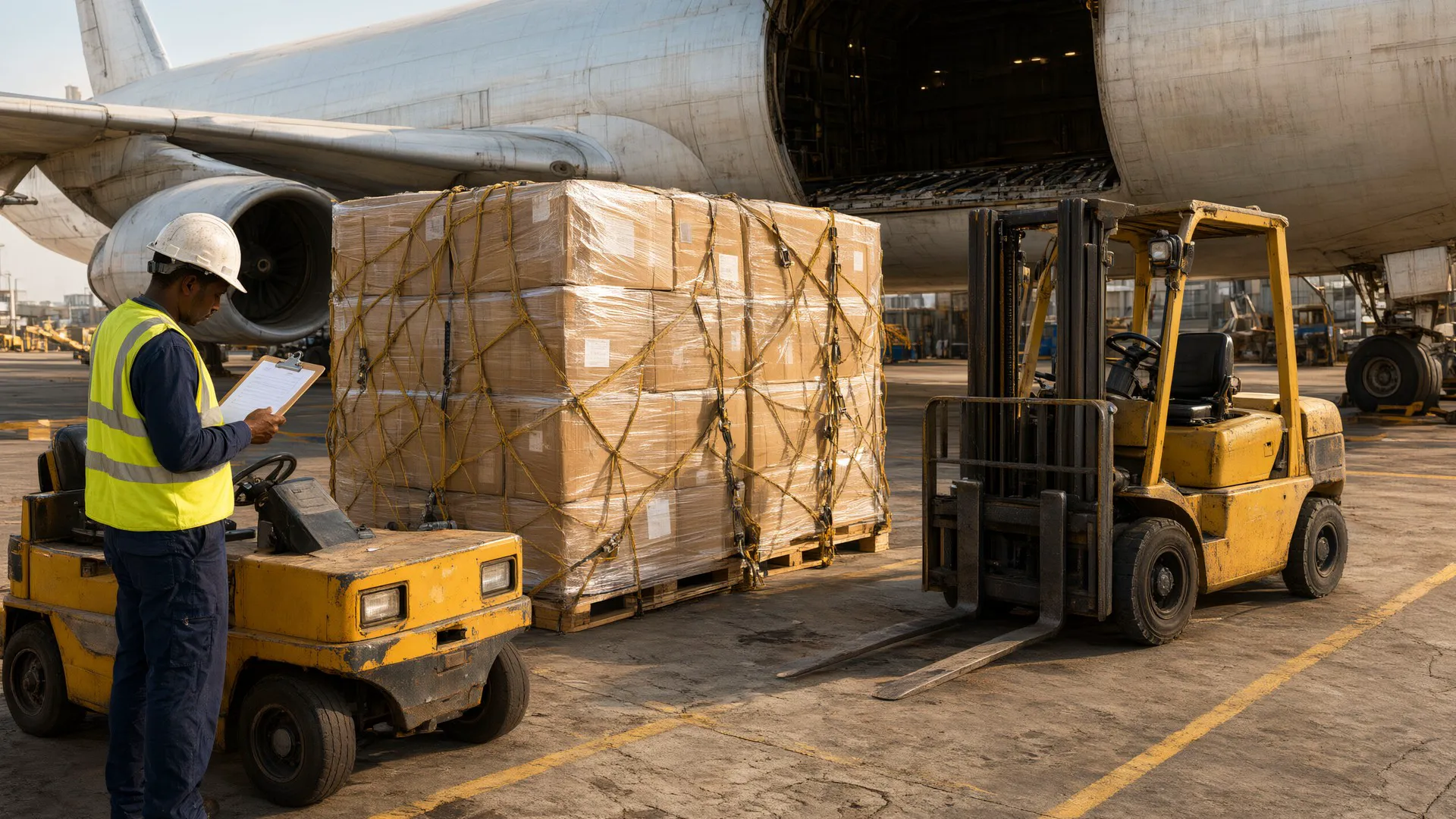
Every air quote is built on chargeable weight. The calculation is arithmetic, not negotiation: length times width times height in centimeters, divided by 6,000, compared with the actual weight, and the larger figure is what you pay for. Express couriers use 5,000, which makes parcels look heavier. Air freight uses 6,000.
A carton measuring 60 by 50 by 40 centimeters occupies 20 kilos of chargeable space whether it holds 8 kilos of phone cases or 18 kilos of tools. Put 20 of those cartons on a pallet and the shipment bills at 400 kilos even if the scale says 260. The importer who negotiated a rate of $6.20 per kilo has now bought 400 kilos at $6.20, which is $2,480, rather than the 260 kilos the goods actually weigh.
Practices that do not touch the rate still change the number. Repacking factory cartons into denser boxes removes air from the shipment, and on garments and housewares it can cut chargeable weight by a quarter to a third. Palletizing to the exact height the airline allows, instead of a round 1.6 meters, avoids paying for a layer of nothing. Shipping without the inner retail packaging, when the buyer is going to repack anyway, changes the volume of every unit in the shipment.
The divisor also decides something importers rarely check: whether air is the right mode at all. Above roughly 8 cubic meters, or whenever the cargo is heavy relative to its size, the air bill stops looking like a premium and starts looking like a different order of magnitude. Tiles, cement, machinery castings and furniture are priced by weight and volume in ways that make sea freight cheaper even after three extra weeks of financing.
2. Inside an air quote to Accra: five lines you can check
An air quote for Ghana is a bundle of charges that come from different sellers, and the difference between a good forwarder and an expensive one usually sits in lines two and four.
The airline charge is the base rate times chargeable weight, and it moves with fuel and demand. Fuel and security surcharges are where the volatility lives; with jet fuel up 113.7 percent year on year to 16 October 2026 according to the IATA price monitor, carriers have a hard floor under what they will fly cargo for.
Terminal and handling charges at Kotoka are set by separate parties. The Ghana Shippers' Authority approves the tariffs that the air cargo handlers apply, under the authority of Act 1122, and those charges are published rather than negotiated. A forwarder quoting "airport charges included" is absorbing or reselling them, and it matters which.
Clearance and delivery are the two lines most likely to be estimated rather than priced. Clearance involves a licensed agent, an ICUMS declaration, duty and levies, and delivery involves a truck plus a person willing to wait at the receiver's gate. On a 400 kilo shipment the difference between a priced and an estimated clearance can be $200.
The last line is the forwarder's margin, and it is invisible by design. Forwarders exist because this work is tedious, and a good one earns the fee. Ask for five lines instead of one number, then compare the lines when the quotes arrive. Our air freight page lists what we include at each stage, which makes the comparison easier than a phone call.
One pricing detail drives the invoice more than any surcharge. Rates are quoted in weight breaks, and a shipment that lands 2 kilos under a break pays the higher rate for all of it. Moving 98 kilos to 102 kilos can lower the bill. Section 3 shows the breaks.
3. Weight breaks at four Chinese gateways
Shipping from Shenzhen to Ghana is the cheapest of the four gateways in October 2026 because most West Africa air capacity loads in South China. Guangzhou prices within a few cents per kilo of it, while Shanghai and Hong Kong depend on which carrier has space that week.
Where the cargo loads matters more than who books it: the same 400 kilos can price double digits apart between Shenzhen and Shanghai on the same day.
| Mode | Rate, October 2026 | Door-to-door transit |
|---|---|---|
| Sea FCL, 20GP to Tema | $3,000–4,350 | 30–45 days |
| Sea FCL, 40GP or 40HQ to Tema | $4,400–5,900 | 30–45 days |
| Sea LCL to Tema | $190–290 per CBM | 35–50 days |
| Air freight cost per kg from China to Ghana, 100 kg and up | $5.00–8.50 per kg | 5–8 days |
| Air freight, 1,000 kg and up | $5.00–6.80 per kg | 5–8 days |
| Express courier | $9.00–15.00 per kg | 2–5 days |
| DDP air, door to door | $7.50–10.50 per kg | 8–12 days |
| DDP sea LCL, door to door | $220–320 per CBM | 40–55 days |
Those bands answer the cost question at the mode level. Underneath them sits a structure that decides the actual invoice, because airlines charge per kilo in bands rather than per shipment, and the bands differ by gateway with capacity and competition.
| Gateway to Accra (ACC) | 100 kg | 300 kg | 500 kg | 1,000 kg | Typical transit |
|---|---|---|---|---|---|
| Guangzhou (CAN) | $6.00–$8.50/kg | $5.60–$7.80/kg | $5.30–$7.20/kg | $5.00–$6.50/kg | 4–7 days |
| Shenzhen (SZX) | $6.10–$8.60/kg | $5.70–$7.90/kg | $5.40–$7.30/kg | $5.10–$6.60/kg | 5–8 days |
| Shanghai (PVG) | $6.30–$8.80/kg | $5.90–$8.10/kg | $5.60–$7.50/kg | $5.30–$6.80/kg | 4–8 days |
| Hong Kong (HKG) | $5.80–$8.20/kg | $5.40–$7.60/kg | $5.10–$7.00/kg | $4.90–$6.30/kg | 4–7 days |
The pattern behind the columns is more useful than the numbers in them. Guangzhou and Hong Kong carry most of the West Africa air volume out of South China, which keeps rates softer and connections more frequent. Shanghai is competitive on machinery and electronics but its routing to Accra usually runs through the Gulf or Addis Ababa, so the transit floor is higher even when the rate is not.
The band structure also explains a pricing trick that is not a trick. Quoting 480 kilos as 500 kilos, or declaring 95 kilos and paying for 100, sometimes produces a lower total because the entered break applies to the whole shipment. Ask your forwarder to price the next break up before you book. It takes a minute and occasionally saves a few hundred dollars.
Weight breaks hold for days, not weeks. In a market where the index moves 4.7 percent in a week, a rate sheet from the first week of October is history by the end of the month. Treat any air quotation older than seven days as a starting point for a new conversation.
4. Who actually flies to Accra, and what a transit costs in days
Kotoka International Airport sits about 3 kilometers from central Accra, which is the least interesting fact about it and the one most quotes rely on. The useful facts are who operates cargo there and how many times a week.
The cargo side of the airport runs through the Ghana Airport Cargo Centre, a joint venture between Air Ghana and Ghana Airports Company, with Swissport Ghana handling on the ground. The carriers listing cargo capacity into Accra include Ethiopian Cargo, Qatar Airways, Emirates Cargo, Turkish Cargo, Cargolux and DHL, with Air Ghana operating as the local cargo airline. Capacity grew again in September 2026 when SolitAir, a Dubai-based operator running seven Boeing 737-800 freighters, added Accra to a network that already covered 21 African destinations.
That list matters because of what it implies about routing. Almost nothing flies direct from China to Accra with cargo. Ethiopian routes through Addis Ababa, Qatar through Doha, Emirates through Dubai, Turkish through Istanbul, and Cargolux through Luxembourg. A direct-service expectation priced into a quote is a quote that will slip.
Transit arithmetic on the China to Ghana lane looks like this:
| Stage | Days | Notes |
|---|---|---|
| Export clearance and screening in China | 1–2 | 24-hour cutoff before the flight |
| Flight and connection | 1–2 | one stop is normal |
| Arrival, breakdown and handler receipt | 1–2 | depends on flight time |
| ICUMS declaration and duty payment | 2–4 | pre-declared cargo moves faster |
| Delivery in Accra or Tema | 1 | Kumasi adds 1–2 days |
That adds to 5 to 8 days door to door from Guangzhou, 4 to 6 from Hong Kong, and 6 to 8 from Shanghai or Beijing. The published timing comparison for Ghana sea and air routes uses the same bands. If a quote promises three days to Accra, it is quoting a courier parcel, not a 400 kilo air freight shipment.
The one part of the journey that regularly eats a week is the arrival window. A flight that lands Friday afternoon in Accra may not see a customs officer, a duty payment and a delivery truck until Tuesday, because the weekend sits in the middle. Wednesday and Thursday arrivals consistently clear faster than Friday arrivals, and on a shipment where the goods are needed for a promotion, that is a real cost. Ask for the flight date, not just the transit time.
5. Batteries, magnets and liquids: what cannot fly, and what flies with paperwork
Lithium battery shipping to Ghana is where most electronics importers learn that the rules turn on configuration rather than on product. Ghana's import market is phones and accessories, and most of that cargo is dangerous goods before anyone thinks about customs.
Lithium batteries fall under UN3480 and UN3481 in the IATA Dangerous Goods Regulations. Loose cells and power banks travel as Class 9 dangerous goods, they need a shipper's declaration and often state-of-charge limits, and many carriers will not take them on passenger aircraft at all. Batteries installed in devices are a different category from batteries packed with devices, and a forwarder who asks which one you have is doing the job properly.
Magnets, aerosols, solvents, adhesives, paints, some cosmetics, powders, and anything with a strong permanent magnet need screening and often a goods declaration. Misdeclared cargo is not a paperwork problem: it is removed from the flight at the carrier's discretion, held at the shipper's cost, and in serious cases the forwarder loses its handling status. The cost of a hold is the missed delivery date plus storage at both ends.
There is also a Ghana-specific product route that gets discovered too late. Food, cosmetics, medicines and medical devices need registration with the Food and Drugs Authority, and the declaration in ICUMS has to reference that registration. A cargo of skincare products that is perfectly legal to export from China can sit at Kotoka for weeks while a registration is processed, and no amount of freight spend fixes it.
The practical rule is to send the forwarder the product list before the first quote, with photographs and a note on whether anything contains a battery, a magnet, a liquid or a pressurised container. A quote built on the right commodity description is worth more than a quote that is 8 percent cheaper built on a guess.
6. The 2026 gates at Kotoka: registration, certificate, note
A Ghana EASYPASS certificate of conformity and a Shippers' Authority registration now sit in front of the customs declaration, and Ghana added three import rules in the last twelve months to put them there.
The first is registration. Under section 26(1) of the Ghana Shippers' Authority Act 2024 (Act 1122), every importer must register with the Shippers' Authority before clearing cargo, and that requirement has been enforced in ICUMS since 3 August 2026. The fee is GH¢150 for twelve months. A company registers with its certificate of incorporation, an individual with a Ghana Card, and a customs broker can pay the fee on behalf of an unregistered client. The Ghana Shippers' Authority publishes the procedure and the charges it approves for handlers.
The second is conformity. Since 1 July 2026 the Ghana Standards Authority requires a certificate of conformity under the EASYPASS programme for a long list of product groups, including electrical and electronic goods, textiles, footwear, plastics, metal goods, machinery and used goods. The certificate is issued before shipment, in the country of export, and destination inspection is explicitly not allowed. What that means in practice is that a shipment arriving without a certificate cannot be fixed at the port. Fees run about 0.35 to 0.50 percent of FOB under Route A, with Route B registration at $400 a year covering the first 15 product lines and Route C factory assessment at $1,200 per site per year. The programme's own portal is at EASYPASS.
The third is a note that has not yet become a requirement. Ghana announced a Smart Port Note, also called an ECTN, with an original effective date of 1 February 2026 tied to load-on-board, then deferred implementation on 21 January 2026 with no replacement date announced. The fee falls on the exporter, not the Ghanaian importer. Any forwarder presenting it as a current mandatory charge should be asked for the gazette reference, and any forwarder omitting it entirely should at least be asked whether the position has changed.
Behind those three sit the permanent requirements: a TIN, or a Ghana Card number for an individual, and a declaration filed by a licensed agent in ICUMS. The system is not the obstacle it is sometimes made out to be. A complete declaration on a Monday clears in three to four working days. An incomplete one, with a vague description or a value that does not match the invoice, restarts the clock and starts accumulating storage.
7. Duty, VAT and levies on an air shipment
Ghana taxes imports on CIF value, and on an air shipment the F already includes a freight bill several times larger than the sea equivalent. That single fact makes air cargo more heavily taxed than the same goods moved by sea, and the effect is easy to demonstrate.
A worked example. Four hundred chargeable kilos at $6.20 per kilo is $2,480 of freight. Goods are invoiced at $18,000 FOB, insurance adds $90, so the customs value is $20,570. Assume a 20 percent tariff line, which is the standard rate for finished consumer goods in the ECOWAS common external tariff.
| Line | Basis | Amount |
|---|---|---|
| Customs value | FOB + freight + insurance | $20,570 |
| Import duty at 20 percent | customs value | $4,114 |
| VAT, NHIL and GETFund at 20 percent effective | customs value + duty | $4,937 |
| ECOWAS levy 0.5 percent | customs value | $103 |
| African Union levy 0.2 percent | customs value | $41 |
| Export-Import levy 0.75 percent | customs value | $154 |
| Examination fee 1 percent | customs value | $206 |
| Processing fee 1 percent | customs value | $206 |
| Total tax and levies | $9,761 |
The border bill is 47.5 percent of the customs value, and the numbers here are planning figures rather than a duty assessment. The details underneath the total matter more than the total.
VAT and the two levies that ride with it are calculated at 20 percent effective since 1 January 2026, when the VAT Act 2025 put NHIL and GETFund on the same base as VAT and abolished the 1 percent COVID-19 levy. The old 21.9 percent arithmetic still appears in quotes and in some published guides.
An importer not registered for VAT pays a 20 percent VAT advance on the customs value at clearance. That is a cash flow item at the port, not a credit you can carry forward casually.
The freight sits inside the taxable value. Every dollar of air freight carries duty and VAT on top of it, which is the subject of the next section.
8. What air costs you in tax that sea does not
Freight is not the only thing that rises when cargo flies. The customs value rises with it, and duty and VAT are percentages of that value.
Take the same $18,000 consignment of goods. By air it moves as 400 kilos for $2,480, so the customs value is $20,570. By sea it moves as 2 cubic meters of LCL for around $500, so the customs value is $18,590. Same goods, same tariff line, same destination.
| Air | Sea LCL | |
|---|---|---|
| Freight | $2,480 | $500 |
| Customs value | $20,570 | $18,590 |
| Duty at 20 percent | $4,114 | $3,718 |
| VAT, NHIL and GETFund, 20 percent effective | $4,937 | $4,462 |
| Other levies | $710 | $641 |
| Total tax | $9,761 | $8,821 |
The air shipment costs $1,980 more in freight and $940 more in tax, because 47.5 percent of that extra freight is itself taxable. Importers who compare air and sea on freight alone understate the air option by nearly half its own premium.
There is a second-order effect that runs the same way. Under DDP terms the forwarder pays duty and VAT before delivery, so the higher tax bill is also a higher cash advance, and the cost of that advance lands in the price. On a 30-day collection cycle at a 12 percent cost of money, the $940 difference carries a small additional charge. It is not the reason to avoid air, but it belongs in the comparison.
So the air premium is larger than the rate sheet implies, by roughly the tax rate on the freight difference. On a 20 percent tariff line in Ghana, budget 47 cents of additional tax for every additional dollar of freight.
9. When air wins on numbers, and when it only feels faster
Importers usually say they chose air for speed. On most consignments the arithmetic does not support that reason, which is why the decision deserves a second look.
The air premium in the example above is $7.30 per chargeable kilo once freight difference and the extra tax are counted. Speed buys about 35 days. At a 12 percent annual cost of capital, 35 days is 1.15 percent, which means the goods would need to be worth roughly $630 per kilo for the saved time to pay for the premium on capital cost alone. At a 24 percent cost of capital, the threshold falls to about $315 per kilo. A phone case at $40 per kilo never gets there. A laptop at $600 per kilo gets there at the higher cost of capital, and a shipment of server components well above it gets there comfortably.
That is why the cargo that actually flies is not the cargo with the highest value density alone. It flies because of a date, and the date has a price that does not appear in any freight comparison:
- A promotion or season that will be missed, where the lost sales exceed the premium.
- A production line stopped by one missing component, where the downtime cost per day exceeds the premium by an order of magnitude.
- A customer contract with penalties, or a first order where a late delivery costs the relationship.
- Cash tied up in a sea shipment that cannot be sold until it lands, on a product with a short selling window.
When none of those apply, air is a preference rather than a calculation, and the cheaper decision is sea with a buffer. The door-to-door option covers the sea side of that comparison, including the inland leg to Kumasi, which air does not shorten once the cargo has landed.
One case deserves separate mention. For shipments under about 150 kilos of dense goods, a courier account often beats air freight on the door-to-door price, because the courier price already includes clearance and final delivery, and the per-kilo rate stops mattering at that scale. Above 150 kilos, and especially above 300, buying air freight and paying for clearance separately almost always wins.
10. Insurance, claims and the 22 SDR ceiling
Air cargo is safer than sea cargo in one specific sense and riskier in another, and both bear on what a claim pays.
Goods move through fewer handling points and arrive in days rather than weeks, so pilferage and water damage are rarer. What replaces them is handling damage and the occasional total loss in a transfer, both of which produce claims.
The default legal limit is low. Under the Montreal Convention, which governs international air carriage, the carrier's liability for cargo is capped at 22 Special Drawing Rights per kilogram unless a higher value has been declared and paid for. At recent exchange rates that is roughly $30 per kilo of gross weight. For a 400 kilo shipment of electronics invoiced at $18,000, the convention limit covers about $12,000 in the best case, and many carriers apply it to the weight of the damaged pieces rather than the consignment.
The gap is closable. Declare a higher value for carriage where the carrier offers it, which costs a small percentage and raises the ceiling to the declared figure. Buy a separate all-risks cargo policy for the full invoice value plus freight, which covers the gap the convention leaves and adds cover the contract of carriage never had. Photograph the cargo at handover, with the pallet in frame and the seal or strapping visible, because a claim without evidence of condition at receipt becomes an argument about where the damage happened.
The deadlines matter more than most importers expect. A complaint about damage has to reach the carrier within 14 days of receipt, a delay complaint within 21 days, and a non-delivery complaint within 120 days. Miss the window and the claim is gone regardless of the merits. The forwarder's job is to log the condition with the handler at the airport, and the importer's job is to inspect before signing.
11. Ten checks before the air waybill is cut
- What is the chargeable weight, and does it match the packed dimensions rather than the product dimensions?
- Which weight break is being used, and what would the next break up cost?
- Is the rate held until a specific flight date, and what happens if that flight closes?
- Which gateway is the cargo flying from, and how many stops are in the routing?
- Does the shipment contain batteries, magnets, liquids, powders or aerosols, and is the declaration correct?
- Does any product need FDA registration or an EASYPASS certificate, and is that certificate issued before departure?
- Is the importer registered with the Ghana Shippers' Authority, or will the broker pay it at clearance?
- Is the duty quoted on a declared value you have seen and agreed in writing?
- What insurance applies, at what declared value, and who files the claim if the pallet arrives damaged?
- What is the storage charge at Kotoka per day after free time, and who pays it if clearance slips?
A forwarder who can answer those ten before the goods leave the factory is worth a slightly higher rate. The ones who cannot usually cost more in the end, on a line that never appears in the quote.
12. Frequently asked questions
How long does air shipping from China to Ghana take? Five to eight days door to door from Guangzhou or Hong Kong, six to eight days from Shanghai or Beijing, including customs clearance and delivery in Accra. Transit time is dominated by the connection and the arrival day of the week, not by the flight itself, which is one to two days.
How much does air freight from China to Ghana cost per kilo? Published bands for general cargo run about $5.00 to $8.50 per kilo for shipments over 100 kilos in October 2026, falling toward $5.00 to $6.80 at the 1,000 kilo break. Door-to-door DDP rates land at $7.50 to $10.50 per kilo once duty and delivery are included. Express courier runs $9.00 to $15.00 per kilo on small parcels.
How much does it cost to ship from China to Ghana? On October 2026 planning ranges: $3,000 to $4,350 for a 20-foot container to Tema, $4,400 to $5,900 for a 40-foot, $190 to $290 per cubic meter for LCL, $5.00 to $8.50 per kilo by air, and $7.50 to $10.50 per kilo for air DDP. Those are freight numbers. The border bill adds duty and levies worth roughly 40 to 50 percent of the CIF value on a 20 percent tariff line, which is why the landed cost is the figure to budget against.
What is the cheapest way to ship from China to Ghana? For samples and orders under about 2 cubic meters, courier or air DDP usually wins once sea freight minimums and six extra weeks are counted. Between 2 and 15 cubic meters, sea LCL is the cheapest landed option. Above roughly 15 cubic meters a 20-foot container beats LCL, and a 40-foot beats two 20-foot boxes on the same volume. On any of them, the tariff line moves the total more than the mode does.
When does container shipping from China to Ghana beat air? Above roughly 8 cubic meters or whenever the cargo is heavy relative to its value. A 20-foot container to Tema moves up to 28 cubic meters or about 17 tonnes for $3,000 to $4,350, which is a small fraction of the air rate per kilo, and the six weeks it takes are the price you pay for that. Container shipping still wins on landed cost even after the storage and clearance charges that air avoids.
What does lithium battery shipping to Ghana involve? Loose cells and power banks are Class 9 dangerous goods under UN3480 and UN3481. They need a shipper's declaration, state-of-charge limits apply, and many carriers refuse them on passenger aircraft, so forwarders run a separate battery service with its own rate and its own cutoff. Batteries installed in devices travel under different provisions from batteries packed with devices, so declare the configuration exactly as it is packed.
Why is my chargeable weight higher than the scale weight? Because airlines bill the greater of actual weight and dimensional weight, calculated as length times width times height in centimeters divided by 6,000. Light, bulky cargo pays for space. Repacking into denser cartons is the most effective way to reduce it.
Can I ship phone batteries or power banks to Ghana by air? Loose lithium cells and power banks are Class 9 dangerous goods under UN3480 and UN3481, and many carriers refuse them on passenger aircraft. Batteries installed in devices are treated differently from batteries shipped alongside devices. Declare the exact configuration before booking, and expect a separate handling service.
Do I need a certificate of conformity for Ghana in 2026? For regulated product groups, yes. The EASYPASS programme has required a certificate of conformity since 1 July 2026 for goods including electrical items, textiles, footwear, plastics, metal goods and machinery, and destination inspection is not permitted, so the certificate has to be issued before shipment.
Who pays duty on a DDP air shipment to Ghana? The forwarder clears and pays, and the amount is inside the DDP price. The declared value is the basis, so the number you sign off on matters. A DDP price built on a lower declared value than your invoice is a risk held by whoever is named as importer.
Is air freight cheaper than sea for small shipments? Below roughly 150 kilos of dense goods, a courier account usually beats air freight door to door because clearance and delivery are already inside the parcel price. Between 150 and 300 kilos the comparison depends on the commodity. Above 300 kilos, air freight with separate clearance is usually the cheaper option, and sea only wins once volume makes the sea freight saving larger than the 35 days it costs.
Can I ship directly to Kumasi without clearing in Accra? No. Cargo arrives at Kotoka, clears in Accra under an ICUMS declaration, and then moves inland by road. Kumasi delivery adds one to two days and an inland trucking charge to the Accra rate.
13. Get the chargeable weight and the tax bill before you book
Air shipping from China to Ghana is a calculation with three inputs: what the cargo weighs, what it occupies, and which tariff line it lands on. The rate per kilo is the fourth most important number on the quote, and the only one most importers look at.
AllBestShipping consolidates from Guangzhou, Shenzhen, Yiwu and Shanghai, prices the chargeable weight from measured cartons rather than supplier estimates, and clears through a licensed partner in Accra with the EASYPASS certificate handled before departure. Send the product list, the packed dimensions and the delivery address, and the quote will show the weight break, the declared value and the duty line separately. Start with a rate check before the factory books a flight.