Cheapest Way to Ship from China to Algeria: Why the Tariff Line Beats the Freight Mode
Cheapest way to ship from China to Algeria is set by a registered bank file and a ten-digit customs code, not by the rate desk. Since 14 May 2026 the goods cannot legally leave China until the buyer's bank has registered the transaction, because Bank of Algeria note 01/DGC/2026 requires the domiciliation number to exist before the transport document is dated, and a cargo with no bank file behind it is not cheap whatever the sailing costs. The larger number sits in the tariff: on one 25 CBM shipment, moving from a 5 percent tariff line to a 60 percent tariff line costs $24,134 in duty and the VAT that compounds on it, roughly twelve times the $1,990 you save by booking a 20GP instead of LCL on the same cargo.
This guide prices six ways to move cargo to Algiers by the cubic meter, then works through the four things that actually decide what you pay: the ten-digit tariff line, the cash the bank freezes before loading, the volume at which LCL stops winning, and the destination charges that only appear on the second invoice. Shipping From China To Algeria is the route page behind it, with port pairs and sailing structure. The trade justifies the detail: Algeria imported $48.78 billion of goods in 2025 and China supplied 28.5 percent of them, and the Port of Algiers moved 931,300 TEU in the same year, more than 60 percent of the country's containers. If you read only one section, read Section 5, because the crossover point there is where most importers are quietly overpaying.
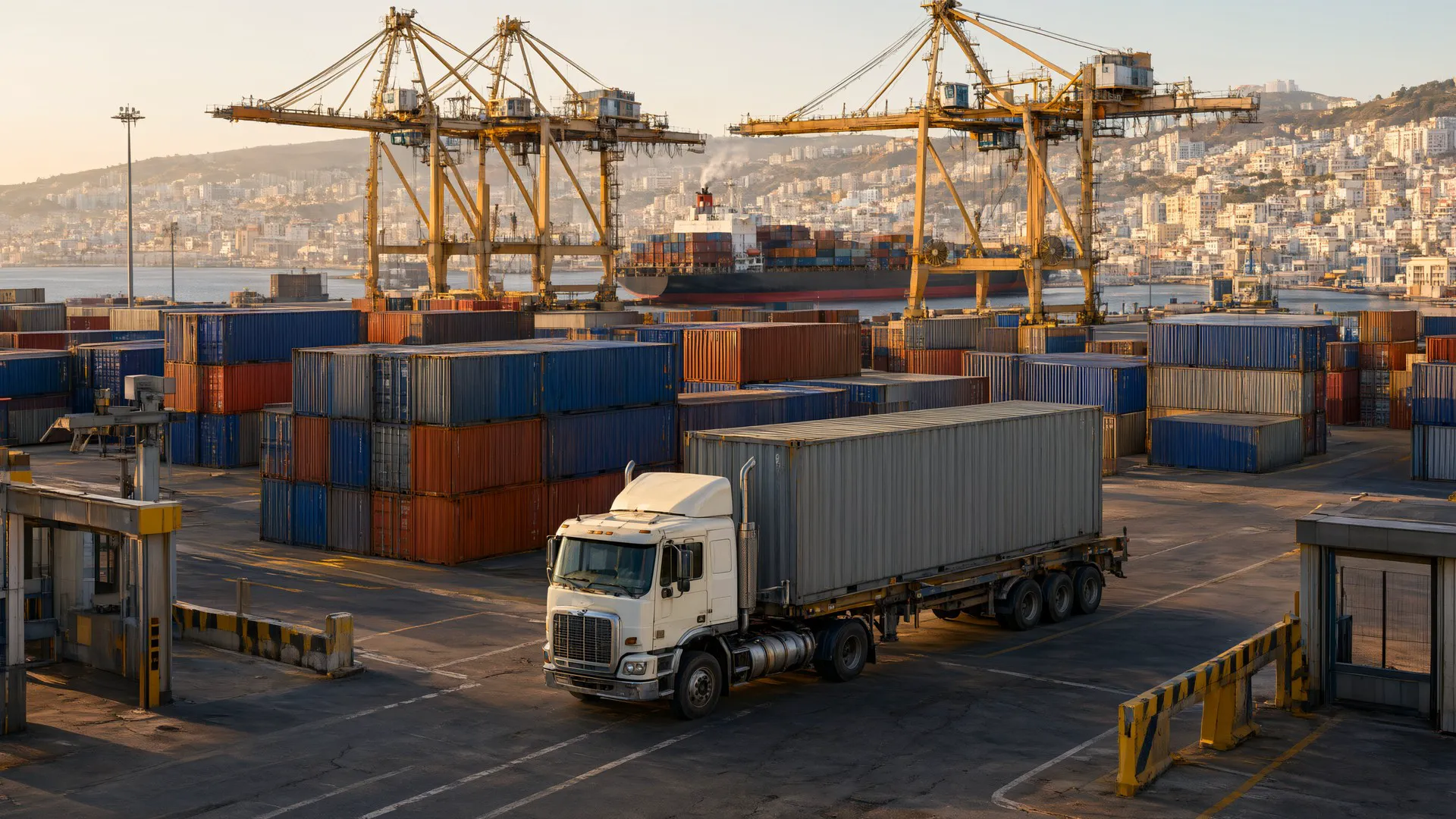
1. The customs line decides more than the shipping mode
The classification costs more than the freight on this lane, and most importers run into it after they have finished negotiating the rate. The customs tariff runs on the ten-digit subheading, and the subheading assigns one of five duty rates: 0, 5, 15, 30 or 60 percent, under article 3 of ordinance 01-02 as rewritten by article 80 of the 2018 finance act. Nothing about your forwarder, your sailing or your container changes which of those five you land in. What changes is the price of the same physical cargo, and it changes by more than any mode decision on this lane.
Every line below is the same $32,000 shipment of general cargo, 25 CBM, on one 20GP from South China to Algiers, priced in October 2026 conditions.
| Decision | Money at stake on that one shipment |
|---|---|
| Booking LCL instead of the 20GP | $1,990 |
| Booking in October instead of September, on the rate cut | $700 – $855 |
| Declaring at 60 percent instead of 5 percent | $24,134 |
| Falling into DAPS at 30 percent of CIF | $11,062 |
| Ten days of Algiers storage past free time | $1,200 |
| A CNIS inspection ordered on an $18,000 invoice | $1,500 |
Twelve times, which is why the tariff comes before the sailing on this page. Freight mode is worth optimizing, and Sections 2 and 5 show how; it is worth about four percent of the landed bill on a normal shipment, while the tariff line is worth more than half of it.
Two more layers sit on top of the duty rate, and both are ignored in most quotes. The solidarity levy, TCS, is 2 percent of the CIF value and applies broadly. Import VAT is 19 percent and its base is CIF plus duty, so every percentage point of duty drags 0.19 percentage points of VAT along with it. Then there is DAPS, the safeguard duty introduced in January 2019 across roughly 1,095 finished-goods lines, at rates from 30 to 200 percent of CIF. A 30 percent DAPS line on this shipment is $11,062 before VAT, which is more than twice the goods' freight bill and about 4.5 times the entire benefit of getting your container size right.
Before you ask three forwarders for rates, confirm the ten-digit code with your Algerian consignee and check it against the tariff for duty, DAPS, VAT treatment and any restriction. An importer who negotiates a $300 discount on ocean freight while accepting a misclassified line has lost the negotiation before it started.
2. Six modes priced by the cubic meter, October 2026
Prices below are freight-side only: ocean or air carriage plus origin handling plus destination clearing, terminal or CFS work and delivery inside the Algiers wilaya. Duty, VAT, TCS and DAPS are excluded on purpose, because they follow the goods' value and tariff line rather than the mode. Density assumption is 200 kg per cubic meter, which is ordinary for mixed consumer and hardware cargo.
| Mode | 2 CBM | 6 CBM | 14 CBM | 22 CBM | 60 CBM |
|---|---|---|---|---|---|
| LCL (groupage) | $615 | $385 | $319 | $301 | — |
| 20GP FCL | $2,725 | $908 | $389 | $248 | — |
| 40HQ FCL | $4,050 | $1,350 | $579 | $368 | $135 |
| Air freight | $1,620 | $1,367 | $1,311 | $1,296 | $1,280 |
| Express courier | $2,848 | $2,848 | $2,848 | $2,848 | $2,848 |
The dashes are not missing data. A 20GP holds about 28 CBM of usable space and a 40HQ about 65, so booking either box for a volume it cannot be filled with is a choice you can make but should not.
LCL is the cheapest option up to a volume most importers do not expect, and Section 5 does the arithmetic. The short version: at $180 to $250 per CBM on the ocean leg plus about $55 per CBM of Algiers unpacking, groupage variable cost is roughly $270 per CBM, against $690 of fixed charges that do not move with volume.
Air is expensive in a way that surprises people who think in kilos. Because the chargeable weight is the greater of gross weight and volume divided by 6,000, one cubic meter becomes 166.7 chargeable kilos. At the 100 to 300 kg break of $6.50 to $8.70 per kilo that is $1,083 to $1,450 per cubic meter; at the 300 to 1,000 kg break of $5.80 to $7.50 it is $967 to $1,250. Air at 14 CBM comes to $18,360, four times the LCL bill for the same space and eleven times the 20GP. Air defends itself on this lane for samples, spare parts, launch stock and anything whose margin per kilo absorbs it, and not for volume. Our air freight service covers the break structure if that is the decision you are actually making.
Express is a flat per-kilo product, so its per-CBM number never improves. At $12.35 to $16.13 per kilo a 400 kg parcel costs $5,696 and a 4,000 kg one costs $56,960. It is the right answer for a 20 kg envelope and a bad joke for a pallet.
Rail deserves one honest line, because competitor pages keep inventing it. There is no through rail service from China to Algeria: the Algerian network connects to Morocco and Tunisia, neither of which carries Chinese block trains, and the Maghreb link does not serve as a China corridor. The rail-shaped product you may be offered is a China–Europe block train to a European hub with a Mediterranean feeder or truck leg onward, which prices above direct sea from South China and lands slower than the 35 to 44 day ocean transit once the relay is counted. On this lane the rail-shaped product prices above direct sea and arrives later, which makes it an expensive detour rather than a middle option.
3. What the five duty bands do to one identical shipment
Same cargo, same container, same forwarder, same week. Only the classified rate changes.
| Duty rate | Duty | TCS 2% | VAT 19% | Landed total | Landed cost per CBM | Total border taxes |
|---|---|---|---|---|---|---|
| 0% | $0 | $737 | $7,006 | $45,267 | $1,811 | $7,743 |
| 5% | $1,844 | $737 | $7,356 | $47,461 | $1,898 | $9,937 |
| 15% | $5,531 | $737 | $8,057 | $51,849 | $2,074 | $14,325 |
| 30% | $11,062 | $737 | $9,108 | $58,431 | $2,337 | $20,907 |
| 60% | $22,124 | $737 | $11,210 | $71,595 | $2,864 | $34,071 |
CIF on that shipment is $36,874, made up of $32,000 of goods, $4,350 of freight, $450 of origin charges and $74 of marine insurance. The landed column includes the destination charges from the model: $220 of terminal handling, $180 of clearing agent, $250 of delivery.
Read the last column against the goods value. At 60 percent, the Algerian border takes $34,071 on a $32,000 invoice. At 15 percent, the rate most general goods land on, it takes $14,325. The difference between those two outcomes, $19,746, exceeds the freight, origin charges and insurance combined, and no freight negotiation recovers it.
There is a timing trap attached to the classification. The declaration is filed through SIGAD as a D15 within 21 days of unloading; past that the file moves into the deposit regime for two months, which means storage, and Algiers storage runs about $120 per day. A classification dispute that takes three weeks to resolve costs $2,520 in storage alone, on top of whatever the dispute itself is worth.
Algeria also has no de minimis threshold: tax starts at the first unit of value, and since 2025 low-value parcels also require a full HS declaration. There is no small-shipment shortcut to lean on, which is why the sellers who do best on this lane ship consolidated rather than in dribs.
4. The cash Algeria freezes before the vessel loads
Freight is the visible cost. The bank file is the expensive one, and it is priced in time rather than in dollars.
Imports are paid through the banking system and not around it. Goods must be domiciled at an authorized bank before they ship, which is the point of the 14 May 2026 note, and the requirement that the transport document be dated after the domiciliation is the part that breaks plans. Payment itself is normally documentary: letters of credit for importers moving more than $40,000 a year, capped at 60 days' tenor; payment against documents for buyers with long relationships; a 15 percent advance in theory, almost never used in practice because the procedure is so heavy. Then the provision: resale importers must hold 120 to 130 percent of the transaction value in local currency at the domiciliation bank, a rule the USDA attaché report on Algeria's import requirements states alongside the quarterly import forecast that preceded it.
| Invoice value | 120% provision | 130% provision | Cash locked beyond the invoice |
|---|---|---|---|
| $18,000 | $21,600 | $23,400 | $3,600 – $5,400 |
| $32,000 | $38,400 | $41,600 | $6,400 – $9,600 |
| $60,000 | $72,000 | $78,000 | $12,000 – $18,000 |
Two things make that provision more than an accounting entry. First, local banks are not permitted to release final funds until customs clearance is complete, so the clock you are financing runs from domiciliation to the day the container leaves the port, not to the day it sails. Second, the clearance clock is the slow one on this lane: Algiers has averaged four to five days of vessel waiting during congestion episodes, and a diving agent plus inland delivery inside Algiers costs $430 before anything goes wrong.
The money itself can be priced. On the $32,000 invoice, a 120 percent provision held for 90 days at a cost of capital of roughly 8 to 10 percent a year is $757 to $947 of working capital. Held for 120 days at 10 percent it is $1,262. Compare that with the $1,990 you gain by choosing the right container. The financing cost of a bank file that slips by a month is between a third and a half of the entire mode decision, and unlike ocean rates it never appears on any quote.
That is why the calendar in Section 11 matters more than the rate table in Section 2. On this lane the cheap shipment is the one whose paperwork does not slide, and importers who optimize freight first and domiciliation second are optimizing the small number.
5. Where LCL stops paying: the crossover sits at 17.6 CBM
The commonly quoted rule is that groupage stops making sense somewhere between 13 and 15 cubic meters. That number is a European average and it is wrong for Algeria in October 2026, for a reason worth understanding because it will move again.
LCL variable cost is $270 per CBM: $215 of ocean at the midpoint of the $180 to $250 range, plus $55 of Algiers unpacking. Fixed cost is $690: $260 of origin charges, $180 of clearing agent, $250 of delivery. A 20GP is $5,450 all in, on a $4,350 midpoint ocean rate plus $450 origin, $220 terminal handling, and the same $430 of destination work. Set them equal and solve.
| Volume | LCL total | LCL per CBM | 20GP per CBM | Winner |
|---|---|---|---|---|
| 8 CBM | $2,850 | $356 | $681 | LCL |
| 14 CBM | $4,470 | $319 | $389 | LCL |
| 17.6 CBM | $5,442 | $309 | $310 | break-even |
| 22 CBM | $6,630 | $301 | $248 | 20GP |
| 28 CBM | $8,250 | $295 | $195 | 20GP |
$5,442 equals $5,450 at 17.6 CBM. That is the real crossover on this lane, and it sits roughly four cubic meters above the rule of thumb everyone repeats. The reason is that LCL is relatively cheap out of China into Algeria while the container itself is relatively expensive, because direct calls are few and two carriers dominate the loop. Move the LCL rate to the top of its range, $250 per CBM, and the crossover falls to 15.6 CBM; move it to $180 and it rises to 20.3. So the honest instruction is: the crossover is a computation, not a rule, and on this lane it lands between 15.6 and 20.3 CBM.
The same arithmetic sets the upper break. A 40HQ at $8,100 all in carries 65 usable CBM, so each cubic meter above 28 costs only about $72 more than the 20GP could have carried. From 28 CBM upward the 40HQ is the only sensible box, and at 60 CBM the freight cost per cubic meter is $135 against $295 on the LCL path.
One check before you apply any of this: LCL is billed on the revenue ton, which is one cubic meter or one metric tonne, whichever is greater. Above 1,000 kg per cubic meter the kilos take over and the per-CBM numbers above stop describing your shipment. Dense cargo such as tiles, hardware and machinery parts is priced on weight, and on that cargo LCL becomes expensive quickly and the container wins at lower volumes than the chart shows.
6. The Algiers CFS invoice nobody quotes in advance
Groupage quotes are almost always quoted to the port, and the port is where the cheap number stops. On LCL the container is unpacked at a container freight station, and that unpacking is billed per cubic meter on top of the ocean rate you already agreed.
Take an 8 CBM shipment of hardware, 1,600 kg, into Algiers.
| Line | Amount |
|---|---|
| Ocean freight, 8 CBM at $215 | $1,720 |
| Origin charges and export declaration | $260 |
| Algiers CFS unpacking, 8 CBM at $55 | $440 |
| Clearing agent and mandate | $180 |
| Delivery inside the Algiers wilaya | $250 |
| Freight-side total | $2,850 |
| Per cubic meter | $356 |
The unpacking line is the one that moves without warning. It is a local charge set by the station, not by the carrier, and the range quoted across LCL documentation is $15 to $40 per CBM for handling plus $15 to $35 per CBM of terminal work. At the top of that range the 8 CBM shipment pays $760 instead of $440 and the per-cubic-meter figure goes to $396. Nothing about your booking changed; the destination station did.
Two further lines sit behind those. Storage past free time runs about $120 per day, and Algiers free time is 7 to 14 days depending on carrier, with 21 days negotiable and not free. On this shipment, ten days of delay is $1,200, which is 42 percent of the entire freight-side cost. And demurrage accrues whether or not the delay was yours, which is a distinctive feature of a port that has been omitting calls.
That omission is not hypothetical. In April 2026 CMA CGM diverted a vessel's Algiers cargo to Djen Djen under force majeure provisions of its bill of lading and told customers that empty containers would have to be returned to Djen Djen rather than Algiers, a decision reported by The Loadstar. For an importer with a warehouse in Blida that is 300 km of unplanned trucking on the import leg and another 300 km of empty repositioning, on cargo that was priced as a door delivery to Algiers. Cheapest mode, unchanged. Cheapest delivery, no longer true.
None of that argues against LCL. It argues for comparing delivered numbers only, with unpacking, clearing, delivery and a stated free-time allowance written into each one.
7. Four importers, four answers, one shared mistake
The right answer to "what is the cheapest way" changes with what is in the box. These four are real shipment shapes on this lane, priced with the October 2026 numbers above.
A seller testing the market: 2 CBM, 300 kg, samples and launch stock. LCL is the cheapest at about $1,230 all in, and it takes 36 to 48 days door to door. Air at the 300 kg break costs $2,530 to $3,190, which is $1,300 to $1,960 more for roughly 30 days saved. That premium is trivial against a launch date and expensive against a slow-moving catalogue item. Express at 300 kg is $4,272 and only makes sense when the whole consignment fits in a suitcase-sized box.
A hardware importer: 8 CBM, 1,600 kg. LCL at $2,850, per the table in Section 6. The 20GP would cost $5,450 for the same volume, so LCL wins by $2,600. This is the shipment shape where groupage is genuinely unbeatable, and it is also the shape where destination charges hurt most, because $690 of fixed cost is 24 percent of the freight-side total.
A machinery parts importer: 25 CBM, 6,000 kg. The 20GP at $5,450 beats LCL at $7,440 by $1,990, and the same box carries the weight without a revenue-ton penalty. Density is the reason the container wins here even though the volume is only just past the 17.6 CBM crossover.
A building materials importer: 60 CBM, 30,000 kg. The 40HQ looks like the winner at $135 per cubic meter, and it is not available: a 40-foot high cube carries roughly 26 to 28 metric tons of payload, so 30 metric tons needs two 20GP boxes at $10,900, or $182 per cubic meter, plus overweight handling. On heavy cargo the cheapest line on the rate card is often a product you cannot legally load.
All four can still get it wrong in the same way, by comparing freight-only quotes. The mode that wins on freight is not always the mode that wins after the $690 of fixed charges, the $1,500 inspection floor and the financing cost of whatever the bank has frozen. Delivered numbers also happen to be the only basis on which two forwarders' quotes describe the same shipment.
8. October softened the lane 16 percent. Does the ranking change?
It moved the numbers and left the order alone. Published forwarder indices put a 20GP into Algiers at $3,672 to $4,488 in October, down about 16 percent from September, and a 40GP at $5,004 to $6,116, down 15.2 percent. LCL held flat, air eased about 8 percent to $5.90 per kilo past a metric ton, and express sat around $12.35 to $16.13 per kilo.
| Item | September 2026 | October 2026 | Change |
|---|---|---|---|
| 20GP, index midpoint | $4,857 | $4,080 | −16.0% |
| 40GP, index midpoint | $6,557 | $5,560 | −15.2% |
| LCL per CBM | $180 – $250 | $180 – $250 | flat |
| Air, 1,000 kg+ per kg | $6.41 | $5.90 | −8.0% |
| LCL-to-20GP crossover | 19.5 CBM | 16.6 CBM | −2.9 CBM |
The mode ranking held: sea still wins above roughly 2 CBM, air still wins only on urgency, express still wins on nothing this lane ships in volume. What moved is the container threshold, down by nearly three cubic meters in a single month, which means an importer sitting at 18 CBM who was correctly on LCL in September is now correctly on a 20GP. That decision flips on a rate move, and it flips back if the rate does.
The levels in the table are index levels and they sit slightly below the booking-desk benchmark used in Sections 2 and 5, where a 20GP is quoted at $3,700 to $5,000. Both are real: the index rates are ocean-only and price the sailing, while the benchmark bundles origin handling and destination work. The percentage move is the part to trust, because it is identical in direction and magnitude across sources. The absolute number is the part to re-quote, every time, with a stated validity window of 7 to 14 days.
Not everything moved with it. Duty did not fall 16 percent. The 120 percent provision did not shrink. Storage at $120 per day did not soften. The October rate cut is worth $700 to $855 on a 20GP, which is 35 to 43 percent of the mode saving from Section 1 and around 3 percent of the duty gap at 5 percent versus 60 percent. If your landed cost is moving the wrong way in a falling market, the cause is somewhere other than the ocean rate.
9. Fixed costs that do not shrink with your volume
Groupage is sold per cubic meter and priced as if everything scaled. It does not. Six lines are near-constant regardless of whether you ship three cubic meters or fourteen, and on small shipments they dominate.
| Fixed line | Amount | At 3 CBM | At 8 CBM | At 14 CBM |
|---|---|---|---|---|
| Origin charges and export declaration | $260 | 17.3% | 9.1% | 5.8% |
| Clearing agent and mandate | $180 | 12.0% | 6.3% | 4.0% |
| Delivery inside Algiers | $250 | 16.7% | 8.8% | 5.6% |
| CNIS inspection, when ordered | $1,500 floor | — | — | — |
| Domiciliation provision cost, 90 days | $757 – $947 | — | — | — |
| Storage beyond free time, 10 days | $1,200 | — | — | — |
The first three together are $690, which is 46 percent of the total freight-side cost of a 3 CBM shipment and 15 percent at 14 CBM. That is arithmetic, not a complaint: consolidating three small shipments into one 9 CBM booking saves more than any rate negotiation will.
The CNIS line is the sharpest version of the same problem. Inspection, where ordered, is charged at 0.85 percent of FOB with a minimum of $1,500. On an $18,000 invoice 0.85 percent is $153, so the floor applies and you pay $1,500, which is 8.3 percent of the goods' value for a single inspection. The percentage only overtakes the floor above an FOB value of about $176,470. Small consignments therefore carry a fixed inspection risk that large ones do not, and it lands whether or not there was anything to find.
Add the financing line and the picture is complete. The $757 to $947 cost of carrying a 120 percent provision for 90 days is bigger than the entire freight bill of a 3 CBM shipment.
10. Routing through the wrong port costs more than it saves
Five container gateways serve this lane, and they are not interchangeable. The differences are in station congestion, inland distance and which routing the bank will accept.
| Gateway | What it can save | What it can cost |
|---|---|---|
| Algiers | Direct calls, most sailings, 931,300 TEU in 2025 | Longest station queues, highest unpacking charge |
| Oran | Lower LCL rate, less congested CFS | Western cargo only; inland cost rises for eastern buyers |
| Bejaia | Lower LCL rate, weather-sensitive berth | Storm delays have pushed waits to six days |
| Skikda | Alternative when Algiers omits calls | Fewer sailings, longer dwell |
| Djen Djen | DP World terminal, four 17-metre berths commissioned in July 2026, first transhipment in January 2026 | 300 km from Algiers: diversion means trucking and empty returns |
| Annaba | Eastern Algeria delivery | Thinnest schedule of the five |
The banking rule cuts across all of it. Domiciliation files are not accepted for contracts that route the goods through Moroccan ports for transhipment, a restriction repeated in the trade advisories issued to exporters. That rules out the routing that looks cheapest on a rate sheet, because a western Mediterranean relay through Morocco can price below a direct Algerian call. A cargo that arrives cannot be paid for if the bank file excluded the routing it travelled on, so the port decision and the bank decision have to be made together and in that order: routing that clears, then routing that saves.
Djen Djen is the one to watch rather than the one to book by default. It has the infrastructure now, it is taking transhipment volume, and it is short of the Suez–Gibraltar corridor. But a diversion to Djen Djen is not a saving, it is a rerouting imposed after your cargo was priced, and carriers treat the empties as the consignee's problem.
Where the saving is reliable is South China loading. Yantian and Nansha sail direct and most often, and the spread between a South China and a North China load port is $400 to $500 per box in the same sailing week. If your supplier's inland cost to reach Guangdong is comparable to their cost to reach Tianjin, booking through Shenzhen is the least arguable money on this lane; the port-pair detail behind that claim sits in our Shipping from Shenzhen to Algeria guide.
11. Six weeks out: the calendar that sets the cheap date
Every cost on this lane is set by a decision made weeks before the container is loaded, which makes the schedule the cheapest document in the file.
| When | What has to happen | What it costs if it slips |
|---|---|---|
| 8–10 weeks out | Six-month import forecast approved by the trade ministry; consignee's bank file opened | No domiciliation, therefore no legal shipment |
| 6 weeks out | Domiciliation registered with its visa and number, ≥30 days before the supplier ships | Invoice cannot be paid; goods blocked at entry |
| 4–5 weeks out | Booking placed, 20GP or space-only secured at a rate held 7–14 days | Rate re-priced upward at booking |
| 2–3 weeks out | Certificate of conformity where the product requires one; origin certificate authenticated by the Chinese chamber | Cargo held pending certification |
| Load week | Export declaration, B/L issued with a date after the domiciliation | Bank file invalidated by document dates |
| +35 to 44 days | Vessel to Algiers, or 30 to 45 days port to port depending on routing | Demurrage from day one past free time |
| +0 to 21 days after discharge | D15 declaration filed through SIGAD, duty, TCS and VAT paid | Deposit regime at 2 months, plus storage |
| +3 to 7 days | Clearance released, delivery to consignee | Storage at $120 per day continues |
The 30-day floor in that table is not a formality. Domiciliation has to be registered at least 30 days before the supplier ships, and the transport document must be dated after the domiciliation. Get the order wrong and the file has to be rebuilt, which on this lane means the vessel sails without a valid buyer, and the cheapest outcome available is paying to hold the cargo at origin.
Work the calendar backwards from your selling season rather than forwards from your supplier's production date. A December stock position needs a booking in early September, and the import forecast sits a further month behind that.
12. Step by step: what a cheap Algeria shipment looks like
What keeps cost low is mostly administrative, and it happens in this order.
Classification comes before quoting. Confirm the ten-digit code with the consignee, check the duty band, check DAPS, and confirm whether the product needs a certificate of conformity. This single step decides more than Section 2 does.
Cost three delivered numbers rather than three freight numbers. One LCL quote with unpacking and delivery included, one 20GP all in, and one door-to-door DDP option. If all three come from the same forwarder, you can compare them; if they come from three, you are comparing three sets of assumptions.
Open the bank file with the booking date in hand. The domiciliation needs at least 30 days before sailing, so the booking and the bank file move together. Confirm the transport document date will fall after the domiciliation visa date, and put that instruction in writing to the supplier and the carrier's booking desk.
Decide the container at 17.6 CBM rather than 13. Compute it: $270 per cubic meter plus $690 fixed against $5,450 for the box. Do not apply a European rule of thumb to an Algerian rate.
Book South China loading. Yantian or Nansha if the supplier can reach them at comparable inland cost. The $400 to $500 per box spread over a North China load port is the most reliable saving on this lane.
Insure the cargo at 0.2 percent of cost and freight. It is $74 on a $32,000 shipment, and it is the cheapest line in the file.
File the D15 within 21 days of discharge. Everything after that is storage.
Collect the empties on time. Free time at Algiers runs 7 to 14 days, and the return clock is often shorter than the clearance clock.
13. Ten questions to ask before you accept the lowest quote
Ask these of the forwarder, and ask the first two of the consignee.
- Which ten-digit tariff code will the D15 declare, and what duty rate and DAPS treatment does it carry?
- Is the domiciliation already registered, and will the B/L date fall after the visa date?
- Is this per-CBM number delivered to Algiers, or to the port?
- What is the destination CFS unpacking charge, and is it in the number you just gave me?
- How many days of free time at Algiers, and who pays storage if clearance runs long?
- Is the ocean rate a spot quote or a carrier FAK, and how long is it held?
- Which surcharges are on top: BAF, terminal handling, war risk, peak season?
- If the vessel omits Algiers and discharges at Djen Djen, who pays the trucking and the empty return?
- Does the routing tranship anywhere the bank will not accept for domiciliation?
- What does the 120 percent provision cost me in cash, and for how many days?
A forwarder who can answer three through eight in writing has priced the shipment; one who answers only the ocean rate has priced a sailing.
Frequently asked questions
Is LCL really cheaper than a 20GP to Algiers? Up to about 17.6 CBM, yes, on October 2026 numbers: $270 per cubic meter plus $690 of fixed charges, against $5,450 all in for the box. Below 15.6 CBM the answer is not close. Between 15.6 and 20.3 CBM it depends on where in the $180 to $250 per CBM range your LCL quote lands, so compute it rather than assuming.
Can I avoid the 120 percent bank provision? Not if you are importing for resale. The provision applies to resale importers and is held at the domiciliation bank. Importers bringing in inputs for their own processing are outside the current-account ratio limits under the 2026 instructions, which is a structural difference rather than a trick. Budget the cash cost as a line item: 90 days on $32,000 is $757 to $947.
Does air freight ever beat sea on landed cost for Algeria? Only when the goods are worth enough per kilo that the duty and VAT dwarf the freight anyway, or when a stock-out costs more than the difference. On the same cargo, air at 14 CBM is $18,360 against $4,470 for LCL and $5,450 for a 20GP. Air is a decision about timing, not a way to lower landed cost.
Why does my invoice differ from the per-CBM quote I accepted? Because the quote was port to port. Unpacking at the Algiers CFS, terminal handling, the clearing agent, the mandate and the delivery leg are separate lines, and together they are $690 of fixed cost plus $55 per cubic meter on LCL. This is the single most common reason a cheap quote becomes an average one.
Can a foreign company act as importer of record and sell DDP into Algeria? Not as the declared importer. The importer on an Algerian declaration has to be a locally registered entity with a commercial register, a tax number and an authorized bank account, and resale imports carry the local-shareholding constraint. A workable DDP structure is therefore a triangle: your company ships, a licensed forwarder handles the movement, a licensed Algerian clearing agent and the local importer carry the declaration. Our door-to-door shipping service is built on that structure rather than around it.
What does the 19 percent VAT actually apply to? CIF plus duty. Not the goods value alone. That is why a jump from 5 to 60 percent duty costs more than the duty line itself: VAT is charged on the increased base, adding $3,853 on the shipment in Section 3. Import VAT paid at clearance is recoverable against the importer's monthly G50 filing, so the VAT is a cash-flow cost and the duty is a real one.
Is there a rail option from China to Algeria? No through service exists. The Algerian network connects to Morocco and Tunisia; neither carries Chinese block trains. What is sometimes sold as a rail product is a China–Europe train with a Mediterranean relay, which prices above direct sea and arrives later. For this lane, sea freight is the low-cost trunk and there is no serious alternative to it.
How much does a shipment to Oran or Constantine cost beyond Algiers? Delivery inside the Algiers wilaya is about $250. Blida, roughly 60 km inland, adds little. Constantine, about 400 km east, adds trucking in the range of several hundred dollars and should be quoted as a distinct delivery rather than assumed. Discharging at Bejaia and trucking west, or at Skikda for eastern destinations, often price better than Algiers plus a long haul.
Compare landed cost, not freight rate
The cheapest way to ship from China to Algeria is decided by a tariff code, a bank file and a crossover point, in that order, and only the third of those is a freight question. Freight mode is worth about four percent of the landed bill. The tariff line is worth more than half of it. The bank file decides whether the shipment can happen at all.
What we can do is price all three together: a delivered cost per cubic meter for your actual volume, the duty and DAPS treatment of your actual tariff code, and the cash requirement of the domiciliation, in one comparison rather than three. Send the goods description, the volume and the consignee's wilaya, and you get a landed number with a stated validity window instead of a rate for a sailing. AllBestShipping has been moving cargo out of Shenzhen into North Africa long enough to know which of the three will cost you the most before you book.