Cheapest Way to Ship from China to Belgium: Break-Even Math, Not Rate Tables
Cheapest way to ship from China to Belgium is settled by two numbers your shipment already carries: how many cubic metres it fills and how many kilograms it weighs. Run this month's rates against a 6 CBM, 1,200 kg consignment and sea LCL lands near $1,900 door to door, rail via Liège near $2,330, a 20-foot container near $3,990 and air freight near $6,460, for identical goods on the same lane in the same week. Nothing in that spread comes from negotiating skill. It is subtraction, and most importers book before they run it.
Belgium is a small destination by tonnage but a large one by function: Chinese exports to the country reached $19.8 billion in 2024 and $3.32 billion in May 2026 alone, and a good share of that cargo is cleared and distributed onward to the Netherlands, northern France and the Rhine-Ruhr. This guide goes at the lane through its break-even points rather than its rate card: what cargo density does to mode choice, the four shipment sizes where the answer flips, the Belgian fixed charges that arrive whatever you ship, how 21 percent import VAT and the ET 14.000 deferral change your cash position, the €3 per-item duty that has applied since 1 July 2026, rail through Liège measured honestly against sea and air, and the failure modes that make a cheap quote expensive. If you only want the lane summary, the Shipping From China to Belgium service page covers modes, ports and transit times. If you want the reasoning, the break-even table in Section 2 is the part worth reading twice.
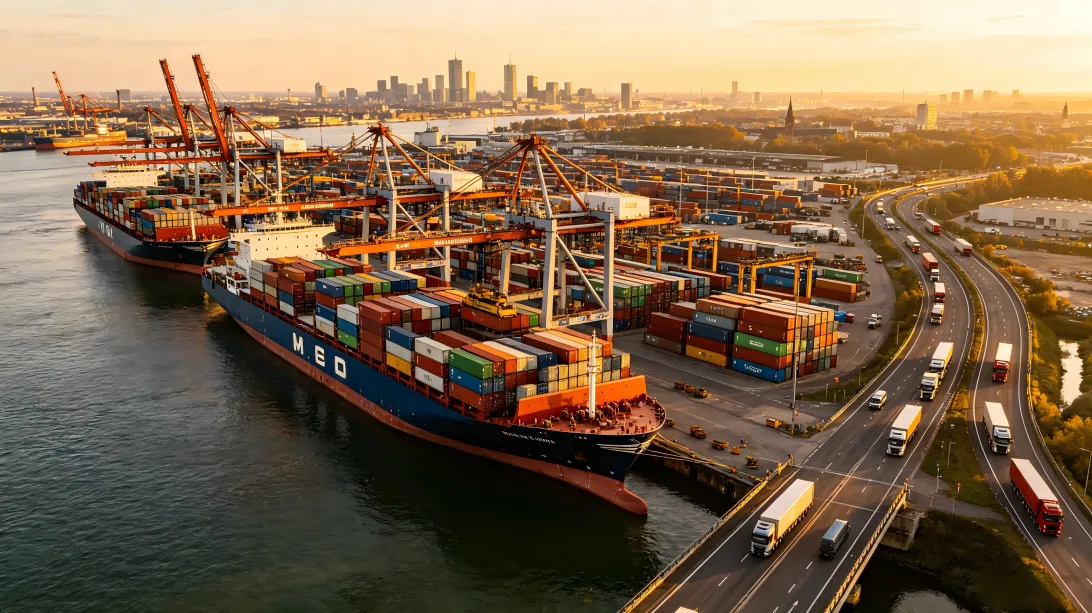
1. Density decides mode before price does
Freight is sold by revenue ton, not by carton count. Every mode converts your volume into a chargeable quantity, and each one uses a different conversion. Sea groupage bills the larger of your cubic metres and your metric tonnes, which is the same as saying 1 CBM of cargo is charged as 1,000 kg if it happens to be that heavy. Road and rail groupage in Europe commonly use a 1:300 ratio, so 1 CBM counts as 333 kg. Air uses a 6,000 divisor, so 1 CBM counts as 166.67 kg chargeable, and any cargo denser than that pays on actual weight.
The consequence is easy to miss until a quote arrives. A 3 CBM consignment of vacuum-packed textiles at 60 kg per CBM weighs 180 kg. Sea charges it as 3 revenue tons. Air charges it as 500 kg, nearly three times its real weight, because the box is what costs the airline space. Reverse the cargo and the logic reverses: 3 CBM of machine parts at 900 kg per CBM weighs 2,700 kg, so air bills the true weight and sea bills it as 2.7 revenue tons.
Most of what moves from Shenzhen, Ningbo and Shanghai to Antwerp fits one of the shapes below.
| Shape | Density | What it usually is | Mode that tends to win |
|---|---|---|---|
| Light and small | Under 100 kg per CBM | Packaging, cushions, seasonal decor | Sea groupage until volume grows, courier below 50 kg |
| Dense and palletised | 200 to 400 kg per CBM | Electronics, hardware, tools, auto parts | Sea LCL to about 15 CBM, then a 20GP |
| High value, low weight | 80 to 200 kg per CBM with $50+ per kg of goods | Consumer electronics, cosmetics, spare parts | Air or rail, because stock-out cost beats freight cost |
Belgium adds a wrinkle that other destinations do not. Antwerp-Bruges is Europe's largest integrated chemical cluster, and the port set a record 1,170,394 TEU of refrigerated containers in 2025, up 0.6 percent with imports up 13.5 percent. If your cargo is temperature-controlled, dangerous or pharma-adjacent, the cheap option is often the one that can legally accept it, and the €90 to €180 per box per day you pay for a wrong-mode mistake dwarfs any rate you saved.
2. Four shipment sizes, four break-even points
Here is the arithmetic the rate card hides. All four consignments below are the same product at a density of 200 kg per CBM, priced at the mid-point of the October 2026 ranges, delivered to a Belgian address, with import duty and VAT excluded.
| Shipment | Weight | Sea LCL | Rail via Liège | Sea FCL, 20GP | Air freight | Cheapest |
|---|---|---|---|---|---|---|
| 1 CBM | 200 kg | $1,074 | $1,179 | $3,991 | $2,383 | Sea LCL |
| 6 CBM | 1,200 kg | $1,924 | $2,329 | $3,991 | $6,458 | Sea LCL |
| 14 CBM | 2,800 kg | $3,284 | $4,169 | $3,991 | $13,858 | Sea LCL |
| 24 CBM | 4,800 kg | $4,984 | $6,469 | $3,991 | $23,108 | Sea FCL |
The totals matter less than where they land.
At one cubic metre, the choice is between $105 and two weeks. Sea LCL is $105 cheaper than rail on 200 kg, but rail arrives in 25 to 34 days door to door against 38 to 52 for LCL. If a $105 difference is the only thing standing between you and two extra weeks of stock cover, rail is the better purchase, and nobody puts that trade in a rate table.
At six cubic metres, air is not a premium, it is a different product. Flying 1,200 kg costs $6,458 against $1,924 by sea. The $4,534 gap buys you roughly six weeks. That is worth it for a launch, a replacement order after a quality rejection, or a seasonal line that will be worth nothing in December. It is never worth it for repeat inventory.
At twenty-four cubic metres, the container wins by $993. Note how narrow the margin is: 20 CBM of LCL at this month's rate costs $4,304 against $3,991 for a full 20GP that can hold 28 to 33 CBM. The container is not dramatically cheaper per unit at the crossover, which is why the decision should be made on the crossover point and not on a rule of thumb.
The chart at the top of this guide is the 6 CBM case broken into its three blocks: freight and handling, origin charges in China, and the Belgian charges that land after arrival. The orange block barely changes between modes. That is the single most useful fact about cheap freight into Belgium, and Section 4 is about why.
3. What the lane costs in October 2026
Rates on this lane come in two units and both are legitimate, which is where most comparisons quietly fall apart. Sea freight is quoted per container or per cubic metre; air freight is quoted per chargeable kilogram in weight breaks. Here is the full set for October 2026.
| Mode | Quoted as | October 2026 range | Transit time |
|---|---|---|---|
| Sea FCL | Per container | 20GP $1,900–2,900; 40GP or 40HQ $2,900–4,400 | 28–38 days |
| Sea LCL | Per CBM, ocean only | $55–130 per CBM | 30–45 days |
| Rail FCL | Per container | 40HQ $5,000–7,500 | 18–26 days, station to station |
| Rail LCL | Per CBM | $180–280 per CBM | 20–28 days, station to station |
| Air, 45–99 kg | Per chargeable kg | $8.50–12.00 per kg | 2–5 days, airport to airport |
| Air, 100–299 kg | Per chargeable kg | $6.00–8.50 per kg | 2–5 days |
| Air, 300–499 kg | Per chargeable kg | $5.00–7.00 per kg | 2–5 days |
| Air, 500–999 kg | Per chargeable kg | $4.40–6.00 per kg | 2–5 days |
| Air, 1,000 kg and above | Per chargeable kg | $3.80–5.20 per kg | 2–5 days |
| Express courier | Per kg, all in | $7.00–13.00 per kg | 3–7 days, door to door |
| DDP, sea | Per CBM, duty paid | $120–200 per CBM | 32–45 days, door to door |
| DDP, rail | Per CBM, duty paid | $300–380 per CBM | 25–34 days, door to door |
| DDP, air | Per kg, duty paid | $7.00–12.00 per kg | 5–12 days, door to door |
Two things about that table deserve a warning label.
First, the LCL number is ocean freight only. On top of $55 to $130 per CBM you pay origin CFS handling of roughly $25 to $45 per CBM, destination CFS handling of $30 to $60 per CBM, and the per-shipment documentation described in Section 4. The realistic all-in rate for a small importer is $110 to $230 per CBM, and the difference between the low and high end of that range changes your break-even by 15 cubic metres. Section 6 shows the arithmetic.
Second, the DDP numbers are quoted per CBM as though everything moves in container volume. At 2 CBM the same supplier will not honour them, because the fixed Belgian costs do not divide by your volume. When a DDP quote looks cheaper than a plain LCL quote, ask what volume it assumes.
The market behind these numbers is, for once, moving in the buyer's direction. Drewry's World Container Index put Shanghai to Rotterdam at $3,337 per 40-foot container in the week to 8 October 2026, down 2 percent on the week and the twelfth consecutive weekly decline on Asia to Europe, with Shanghai to Genoa at $3,696 and the composite index at $4,351 per FEU. Air moved the other way: the Baltic Air Freight Index was still 24.3 percent higher year on year in mid-October and only eased 2.1 percent after Golden Week, while Freightos measured China to Northern Europe down 7 percent week on week on 14 October. Sea rates are drifting down, air rates are holding because jet fuel is expensive. The practical reading: if your timing is flexible, ocean bookings made in the second half of October are buying into a falling market, and quotes on this lane should be treated as valid for 7 to 14 days rather than for the quarter.
Then there is the layer that sits on top of every base rate:
| Surcharge | Typical amount | Who charges it |
|---|---|---|
| Origin charges, China | $400–900 per container | Booking, THC, documentation, export declaration |
| BAF or fuel adjustment | 10–25 percent of base | Carrier |
| EU ETS surcharge | About $170–220 per FEU | Carrier; Maersk moved its Far East to North Europe charge from $155 to $170 per FEU on 1 October 2026, ONE from $204 to $220 |
| PSS, peak season | $150–600 per container | Carrier, when it can |
| Destination port charges | €150–350 per container | Antwerp terminal and shipping line |
| Import declaration | €80–200 per entry | Belgian customs agent |
| Last-mile delivery | €200–600 per shipment | Road carrier |
| Demurrage or detention | €90–180 per container per day | Terminal, after free time, usually 7 days for dry containers at Antwerp |
The EU Emissions Trading System reached 100 percent coverage on 1 January 2026, up from 40 percent in 2024 and 70 percent in 2025, which is why the ETS line stopped being a rounding error. Any quote that does not itemise it is either absorbing it or will add it later.
4. The Belgian fixed block that arrives whatever you ship
The orange block in that chart is the part of your invoice that Belgian parties charge per shipment rather than per kilo. It does not care whether you moved 200 kg or 4,800 kg:
| Belgian charge | Range | Notes |
|---|---|---|
| Import declaration through IDMS | €80–200 | Per customs entry, not per line |
| Destination CFS handling, groupage | €120–200 | Applies to LCL and rail groupage |
| Port charges, full container | €150–350 | Antwerp or Zeebrugge |
| Airport terminal handling, per AWB | €160–230 | Brussels or Liège |
| Last-mile delivery inside Belgium | €200–600 | Postcode dependent |
| Storage or demurrage after free time | €90–180 per box per day | 7 days free at Antwerp on dry containers |
Add the middle of those ranges and you get about $780 to $950 per shipment, depending on mode, in euro-denominated charges before any Dutch or French road leg. This is the arithmetic that makes small shipments impossible to price cheaply, and it explains a specific disappointment that repeats every week on this lane.
Take the 45-kilogram minimum that air freight is famous for. Freight at $8.50 to $12.00 per kilogram is $382 to $540, origin charges add about $91, and the Belgian block adds about $823. A shipment built to the minimum lands at $1,296 to $1,454 all in, which is $28.80 to $32.30 per kilogram. Send the same 20 kg as a courier parcel at $7.00 to $13.00 per kilogram and you pay $140 to $260 with almost none of those fixed lines. For samples, spare parts and anything under roughly 50 kg, the courier is usually the cheap option rather than the premium one.
Where the fixed block really bites is in the middle. On a 1,200 kg air shipment the Belgian block is 13 percent of the bill. On a 200 kg sea LCL shipment it is 73 percent. The freight rate you negotiated controls a shrinking share of your cost as the shipment gets smaller, which is why chasing $0.50 per kilogram off a small air quote is a waste of a week.
The full landed-cost stack for this lane, including duty rates by product family, is broken down in How Much Does It Cost to Ship from China to Belgium. What this article adds is the ordering: fixed costs first, then freight rate, then the tax treatment in the next section.
5. Duty, VAT and the €3 item your quote never mentions
None of the totals so far include tax, and duty and VAT are where the cheapest freight can stop being the cheapest import. It is decided by four rules, and none of them appear on a freight quote.
Import VAT is 21 percent, charged on the customs value plus duty. A VAT-registered business in Belgium recovers it, so for most B2B importers it is a cash-flow problem rather than a cost. The cash-flow part is still serious. On €100,000 of goods the VAT bill is €21,000 at the moment of release, and importing at that rate every month means financing roughly €252,000 a year.
The fix is the ET 14.000 authorisation, which moves the import VAT from the moment of customs release to your periodic VAT return. It is an authorisation, not an exemption, and it is not retroactive. Apply through MyMinfin under My interactions, then Apply for a document, then Authorisation ET14000, and note the eligibility bar: the mechanism requires a Belgian VAT registration, so a company outside the EU generally has to work through a Belgian fiscal representative or set up a Belgian entity. The official description sits on the FPS Finance site. If you are not in a position to hold that authorisation, DDP pricing that includes VAT can be cheaper than it looks, because you are paying someone else's working capital charge instead of financing your own.
The €3 per-item duty arrived on 1 July 2026. Council Regulation (EU) 2026/382 removed the value-based duty relief for parcels worth up to €150 and replaced it with a flat €3 duty per item, an arrangement that runs until 1 July 2028 when the EU Customs Data Hub takes over normal classification. Whether it reaches you comes down to how it is charged, per item rather than per parcel, and to who it targets: B2C consignments, which leaves ordinary B2B commercial entries outside it. Two more changes land in the same window: product identifier data becomes mandatory on 1 November 2026, and a €2 Union handling fee is expected around the same month. If you ship consumer parcels into Belgium, budget for both. Liège Airport's own numbers show what happened when the duty started: e-commerce shipments through its Bierset customs zone fell 24 percent year on year in July 2026 and declarations fell 52 percent, even as the airport's total tonnage rose.
Duty itself runs 0 to 17 percent by TARIC code, and anti-dumping duties run far higher. More than 15 categories of Chinese goods carry anti-dumping or countervailing duties into the EU, with rates from 9.9 percent to 122.8 percent in 2026. The invoice has to carry the right TARIC additional code, because when the code is missing or wrong, customs applies the highest band by default. On a $20,000 consignment the difference between a 6 percent rate and a 48 percent one is $1,200 against $9,600.
Other regulatory dates sit inside the planning window too, and no freight quote mentions them:
| Rule | Applies from | Who it hits |
|---|---|---|
| CBAM, definitive period | 1 January 2026 | Importers of steel, aluminium, cement, fertiliser, hydrogen and electricity above 50 tonnes a year, who must buy and surrender certificates |
| EUDR, deforestation due diligence | 30 December 2026 for medium and large operators, 30 June 2027 for small ones | Cocoa, coffee, palm oil, rubber, soy, timber and derived products including printed paper, furniture and some packaging |
| GPSR, general product safety | Already enforced since 13 December 2024 | Consumer goods, which need an EU-based responsible person plus traceability and recall capability |
One more, if you sell to Belgian businesses rather than consumers: B2B electronic invoicing has been mandatory in Belgium since 1 January 2026, through the Peppol BIS Billing 3.0 format. Paper and PDF invoices are no longer valid VAT invoices between Belgian VAT-registered businesses, and the buyer's deduction is at risk if you send one. This is the kind of detail that changes the value of a DDP arrangement, because the forwarder acting as importer of record has to be inside that system.
6. Where the groupage discount stops
Almost every guide to this lane states that a 20-foot container becomes cheaper than groupage at 13 to 15 CBM. That number is real, but it is not a constant. It is the output of an equation, and the equation contains your LCL rate.
Set it up honestly. A 20GP delivered to a Belgian address costs about $3,991 this month at mid-point rates: $2,400 freight, $650 of origin charges, and $941 of Belgian port, declaration and drayage. An LCL shipment costs your per-CBM rate multiplied by volume, plus about $904 of fixed items, which is $120 of origin documentation and $784 of Belgian charges. Solve for the volume where the two meet:
| Your LCL rate | Break-even volume | What that means |
|---|---|---|
| $110 per CBM | 28.1 CBM | Groupage stays cheaper than a container across the whole practical range |
| $170 per CBM | 18.2 CBM | The container wins later than the guides say |
| $230 per CBM | 13.4 CBM | Only here does the familiar 13 to 15 CBM rule hold |
So the rule of thumb describes the expensive end of the LCL market rather than freight itself, which is why we ask for the per-CBM rate before answering the question. If a forwarder quotes you $120 per CBM for groupage, a 20GP is not cheaper at 14 CBM, it is about $1,400 more expensive. If they quote $230, the container wins at 14 CBM, by about $130. At $170 per CBM groupage is still $707 cheaper at that volume. The practical instruction is dull but effective: ask for both figures at your actual volume, and treat any break-even claim you cannot reproduce as marketing.
A related trap sits inside DDP pricing. Quotes of $120 to $200 per CBM for DDP sea freight, or $300 to $380 per CBM for DDP rail, are priced on cargo that fills a container. Ask the same supplier to apply that number to 2 CBM and either the rate rises or the shipment quietly waits until they have a full consolidation. There is nothing dishonest about it, but the per-CBM figure you compared against air was never the per-CBM figure you would be charged. Door-to-door and DDP arrangements, including who acts as importer of record, are set out on the door-to-door shipping page if you want to see how the responsibility shifts.
If your volume is climbing toward a container, the port-level detail of when a 20GP or a 40HQ is worth booking, including what each Antwerp terminal charges, is covered in container shipping from China to Belgium.
7. Rail through Liège: cheaper than air, slower than a truck
Rail is the option most importers skip, and on this lane it has a genuine structural advantage that most guides miss: Liège is the only Belgian hub with direct China train services. There are three established routes, Zhengzhou since 2018, Yiwu since 2019 and Chengdu since 2020, and a fourth was added in July 2026 when Shijiazhuang became the first direct Beijing-Tianjin-Hebei service to Belgium. Everything else into Belgium is a rail journey that ends in Poland or Germany and continues by truck.
That distinction matters because 85 to 90 percent of all China-Europe trains enter the EU through a single Polish crossing at Malaszewicze, where gauge change and queueing add anywhere from a couple of days to a week depending on how the terminal is running. Alashankou is the busiest exit on the Chinese side, with 8,165 trains in 2025, up 6.3 percent. Cumulative China-Europe rail volume passed 130,000 trains and more than $520 billion of cargo value in May 2026.
Here is what rail costs and delivers, honestly:
| Rail option | Rate | Station to station | Door to door |
|---|---|---|---|
| Full container, 40HQ | $5,000–7,500 | 18–26 days | 25–34 days |
| Groupage, per CBM | $180–280 | 20–28 days | 28–36 days |
| Direct train to Liège, 40HQ | At the top of the range | 18–24 days | 25–32 days |
| Middle Corridor via Caspian and Turkey | Comparable | 26–34 days | 32–42 days |
Rail is roughly 40 to 60 percent cheaper than air and still costs more than sea. It earns its place in specific situations rather than as a general answer: 6 to 14 CBM that has to arrive sooner than sea freight will and cannot justify air freight at roughly three times the cost; ocean routings that have stretched by the 10 to 14 days Cape of Good Hope routing adds; and seasonal lines whose selling window is narrower than 40 days but not narrow enough to justify $6,000 of air freight.
The mistake to avoid is accepting a "direct Belgium rail" claim without checking the destination terminal. A train that ends in Duisburg and completes the journey by truck is a rail-road service with a rail price, and the transit difference is real.
8. Cheap on paper, expensive on arrival: five failure modes
A quote is the cheapest thing in freight, and the least binding. These are the five ways the cheap number turns into a bigger one on this specific lane.
The routing changes after you book. Asia to Europe is running two routes at once: about 19 percent of capacity moved back to Suez by September 2026, according to Sea-Intelligence, while the rest continues around the Cape of Good Hope, which adds 10 to 14 days and about 3,500 nautical miles. A quote priced on a Suez transit can legitimately be fulfilled by a Cape voyage when the carrier swaps the service, and the rate rarely moves in your favour when it does. Ask which routing your specific vessel is on, and get the answer in writing.
Demurrage starts the clock at the wrong moment. Antwerp gives about 7 days of free time on dry containers, then charges €90 to €180 per box per day. Seven days of delay past free time on one container is €945, or $1,058. This is not an exotic risk: in August 2026 barge waiting times at Antwerp and Rotterdam were running around 96 hours, so an inland leg that depends on a barge window can burn your free time before the container leaves the terminal. For time-critical cargo, a truck pre-pull beats waiting for the barge.
Splitting the order across suppliers multiplies the fixed block. Two 3 CBM shipments from two factories cost $2,828 against $1,924 for a single consolidated 6 CBM shipment, a $904 penalty for the same cargo. The fixed Belgian charges are paid twice, and there is a second shipment to clear. Consolidating at a Chinese warehouse usually costs less than the duplicated fixed block, which is why groupage suppliers push it.
Groupage adds handling you cannot see. LCL cargo is co-loaded, de-stuffed and re-handled at least twice more than a container that stays sealed from origin to destination. Damage and loss rates reflect that. If your cargo is fragile, high value, or packed in cartons that cannot take a second stack, the cheap LCL option can cost more than the container you did not book.
Duty can be reclassified after arrival. Belgian customs can challenge the TARIC classification, and anti-dumping rates on some Chinese goods reach 48 percent and above, with the top of the range at 122.8 percent. A consignment valued at $20,000 assessed at 48 percent instead of 6 percent owes $8,400 more in duty, with interest. Getting the additional code right on the commercial invoice before the goods leave China is free. Fixing it afterwards is neither free nor fast.
9. Three importers, costed end to end
Freight tables are abstract until duty and VAT land on them. Here are three realistic importers moving the same kind of goods at a 6 percent duty rate, with VAT shown both as cash out and as net cost after recovery.
| A: samples | B: quarterly restock | C: container programme | |
|---|---|---|---|
| Cargo | 1 CBM, 200 kg | 6 CBM, 1,200 kg | 24 CBM, 4,800 kg |
| Mode and freight, door to door | Sea LCL, $1,074 | Sea LCL, $1,924 | Sea FCL 20GP, $3,991 |
| Goods value | $4,000 | $18,000 | $60,000 |
| Duty at 6 percent | $240 | $1,080 | $3,600 |
| Import VAT at 21 percent | $890 | $4,007 | $13,356 |
| Cash out at release | $2,204 | $7,011 | $20,947 |
| Net cost if VAT is recovered | $1,314 | $3,004 | $7,591 |
| Cash cost per kilogram | $11.02 | $5.84 | $4.36 |
| Net cost per CBM | $1,314 | $501 | $316 |
Read across the last two rows and most of this article's argument is sitting there. The freight rate per unit falls steeply with volume, from $11.02 per kilogram at one cubic metre to $4.36 at twenty-four, but most of that fall is the fixed block being spread over more cargo, not a better rate. Just over half of A's cash outlay is duty and VAT. For C the same two lines are four-fifths of it.
The VAT line also explains a disagreement you will hear between two importers comparing notes. The one who recovers VAT will tell you the container is obviously cheapest. The one who cannot deduct it, because the entity is not entitled to, is looking at a real cost of $20,947 on that container and a genuinely different answer about whether to buy 24 CBM at once. Neither is wrong. They are costing different things.
For a seller in that second position, the cheapest mode is not the one with the lowest freight line. It is the one that keeps inventory turning, because unsold stock that arrived cheaply is still the most expensive cargo in the warehouse.
10. The booking calendar that moves the price
Timing is the only cost lever that does not need to be renegotiated, and between now and February it does more to your bill than the negotiating does.
The post-Golden Week window is the one you are in. China's national holiday ended on 7 October 2026 and the usual post-holiday relief has been running for twelve straight weeks on Asia to Europe: Drewry's Shanghai to Rotterdam assessment fell 2 percent in the week to 8 October, its twelfth consecutive weekly decline, and carriers announced six blank sailings for the following week, up from five. Blank sailings are how capacity is defended when demand is soft, so a falling index and rising blank sailings together mean the next quote is more likely to be lower than higher. Locking a quarterly contract at September levels would be buying the top of a market that is still drifting down.
The Q4 air window runs the other way. The Baltic Air Freight Index was still 24.3 percent above its year-earlier level in mid-October, jet fuel is the reason, and Freightos measured China to Northern Europe down 7 percent week on week on 14 October as a post-holiday dip rather than a trend. Air capacity into Europe tightens from late October through the first week of December for consumer electronics and holiday replenishment, and the weight breaks that look generous at 1,000 kg are the first to be pulled. If your Q4 inventory has to fly, book it now rather than in November.
The pre-Chinese New Year window is the one to plan around next. Factories in Guangdong and Zhejiang close for one to three weeks around the holiday, which falls in late January 2027, and the freight consequence appears twice: a rush of orders in the two weeks before the shutdown, then blank sailings and a rate spike for three to four weeks afterwards as capacity is withdrawn. Goods that need to be in Belgium by March should be booked in the first half of January, and goods that miss that window pay a premium in either direction.
There is also an administrative deadline that behaves like a rate deadline. The ET 14.000 authorisation is processed rather than granted instantly, and starting the application in November so that it is live before your Q1 import season is materially cheaper than financing 21 percent VAT on peak volumes.
11. Nine questions to ask before you accept the lowest quote
Print this and ask it of every supplier you compare. A quote that cannot answer all nine is not a cheaper quote, it is a shorter one.
- Is this all-in to my door, and which Belgian charges are excluded? The declaration, terminal handling and delivery inside Belgium total roughly $780 to $950. If they are not in the price, you are comparing freight, not shipping.
- Which routing is the price built on, Suez or the Cape? The answer changes transit by 10 to 14 days, and it changes again if the carrier swaps the service.
- What per-CBM rate produced this LCL figure, and does it include destination CFS? This is the single number that decides whether your break-even is 13 CBM or 28 CBM.
- Who is the importer of record, and whose EORI and VAT number go on the entry? If it is you, the VAT and the fiscal representative question are yours. If it is the forwarder, the DDP price should reflect that they are financing it.
- Has the TARIC additional code been checked for anti-dumping exposure? Anti-dumping rates on Chinese goods run from 9.9 to 122.8 percent, and a missing code defaults to the highest band.
- How much free time do I get at Antwerp, and what is demurrage after that? Seven days is standard for dry containers, then €90 to €180 per box per day.
- How long is the rate valid, and does it include ETS, BAF and PSS? Rates on this lane are a 7 to 14 day instrument. An unpriced ETS surcharge is about $170 to $220 per FEU.
- What insurance applies to groupage, and at what limit per tonne? Carrier liability on co-loaded cargo is far below the value of most consignments.
- What volume does this per-CBM DDP rate assume? DDP at $120 to $200 per CBM is a container-volume number. At 2 CBM it is a different conversation.
12. FAQ: cheap China to Belgium shipping, answered
What is the cheapest way to ship from China to Belgium in 2026? It depends on volume. Below roughly 1 CBM, sea LCL at about $1,074 door to door for 200 kg is the cheapest option, with rail at $1,179 if two weeks of transit matter more than $105. Between 1 and about 15 CBM, sea LCL stays cheapest. Above roughly 18 CBM at this month's LCL rates, a 20GP at about $3,991 wins. Air is never the cheapest mode by cost, only by total landed cost when a stock-out would cost more than the freight.
Is LCL always cheaper than a 20-foot container? No, and the crossover is not fixed. It sits at 13.4 CBM if your LCL rate is $230 per CBM, 18.2 CBM at $170, and 28.1 CBM at $110. The familiar 13 to 15 CBM rule assumes the expensive end of the LCL market. Ask for both figures at your actual volume.
How small can a shipment be before sea freight stops making sense? Below about 50 kilograms, courier wins on cost and on time: 20 kg at $7 to $13 per kilogram is $140 to $260 delivered in 3 to 7 days. An air freight booking at the 45 kg minimum lands at $1,296 to $1,454 because of the fixed Belgian and origin charges, which works out at $28.80 to $32.30 per kilogram. Sea LCL remains viable for small cargo when you can wait 38 to 52 days.
Does the €3 per-item EU duty apply to my commercial B2B order? Not normally. The flat €3 duty introduced on 1 July 2026 under Council Regulation (EU) 2026/382 targets B2C consignments worth up to €150 and is charged per item rather than per parcel. Ordinary B2B commercial entries are outside it. Two related changes do apply more broadly if you ship consumer parcels: product identifier data becomes mandatory on 1 November 2026, and a €2 Union handling fee is expected around the same time.
Can I avoid paying 21 percent import VAT up front? You can defer it, not avoid it. The ET 14.000 authorisation moves import VAT from customs release to your periodic VAT return, which on $100,000 of goods keeps $21,000 out of the release transaction. It requires a Belgian VAT registration, so non-EU companies usually reach it through a Belgian fiscal representative or a Belgian entity. Recovery still depends on you being entitled to deduct the VAT.
Is rail to Liège cheaper than sea freight? No. Rail groupage runs $180 to $280 per CBM against $55 to $130 per CBM for ocean freight on the same lane, and rail containers run $5,000 to $7,500 for a 40HQ. Rail is 40 to 60 percent cheaper than air and arrives in 25 to 34 days door to door, which makes it the middle option rather than the cheap one.
Why do two quotes for the same 6 CBM shipment differ by $900? Usually because one of them is not the same product. Differences come from three places: whether destination CFS and the Belgian declaration are included, what per-CBM LCL rate was used, and which surcharges are already priced. A $900 gap on a $1,924 shipment is roughly the size of the Belgian fixed block, so the lower quote is often simply excluding it.
What is the cheapest way to send samples from China to Belgium? Express courier for anything under about 50 kg. It runs $7 to $13 per kilogram all in, arrives in 3 to 7 days, and avoids the origin documentation, airport terminal handling and import declaration fixed costs that make a small air freight booking expensive. Above roughly 300 kg the arithmetic flips: air freight at $5.00 to $7.00 per kilogram, plus the fixed lines, lands near $7.07 to $8.68 per kilogram door to door, which undercuts the top of the courier range.
13. Get a landed-cost comparison, not a rate
The number that decides whether a shipment is cheap is the one on your bank statement after duty, VAT and the Belgian charges land, not the one in the email subject line. Send us the packing list with carton dimensions and weights, the supplier's city, the product description with HS codes, and the delivery postcode, and we will price the realistic options side by side at your actual volume, with the fixed charges itemised so you can see what does not move.
AllBestShipping works the China to Belgium lane from Shenzhen, with consolidated groupage out of Shenzhen, Ningbo and Shanghai, direct rail bookings to Liège, and DDP arrangements where we act as importer of record so the customs and VAT mechanics are ours to manage. If you want to see how the whole operation fits together before you send anything, start at AllBestShipping.