Container Shipping from China to Algeria: FCL & LCL to Algiers in 2026
Container shipping from China to Algeria costs $3,700–5,000 for a 20GP and $6,000–8,000 for a 40GP or 40HQ port-to-port into Algiers on October 2026 forwarder spot rates, with LCL at $180–250 per CBM and 30–45 days of sailing from South China. The number that decides whether your box sails at all this quarter is not the rate, though. Under Algeria's 2026 import-control regime, your buyer's bank domiciliation must be registered before your supplier loads the container — and the equipment you book must be returned where the carrier says it must be returned, which since carriers began diverting Algiers cargo to Djen Djen is no longer always the port where it was discharged.
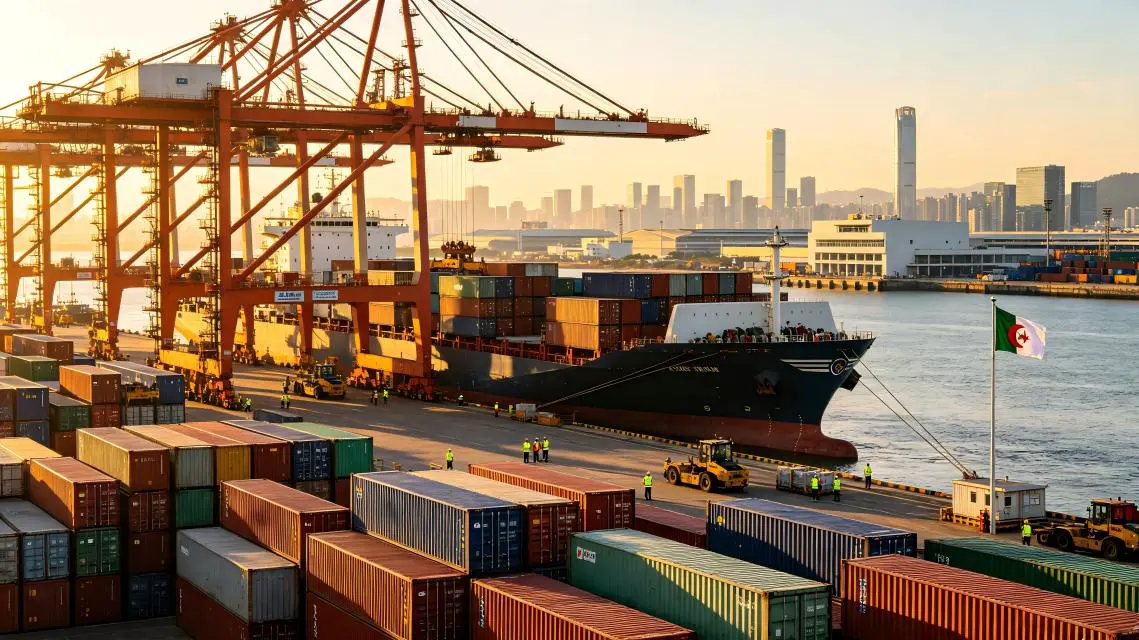
This guide covers the container side of the lane in full: how to pick between a 20GP, 40GP, 40HQ, reefer or flat-rack box for Algeria's unusually dense import mix, port-pair FCL rates and why carrier FAK tariffs price the same box up to $1,200 above the spot market on a 20-foot container, the 13–15 CBM point at which LCL stops making sense, transit times by port pair and by gateway, the domiciliation, import-forecast and 120 percent deposit stack that gates your loading date, and the duties and destination charges that decide your real landed cost. The scale behind those numbers is hard to ignore — Shipping From China To Algeria is a lane where Algeria imported $48.78 billion of goods in 2025 with China supplying 28.5 percent of them, and where the Port of Algiers alone handled 931,300 TEU, more than 60 percent of the country's container traffic. If you read only one section, read Section 10: the ten questions we answer before we confirm an Algeria-bound booking.
Container Shipping from China to Algeria at a Glance
| Option | What it costs (October 2026) | Transit time | Best for |
|---|---|---|---|
| 20GP FCL, port-to-port | $3,700–5,000 spot; $5,550 on MSC's FAK tariff | 30–37 days from South China | 15–28 CBM of dense cargo: tiles, hardware, machinery, steel |
| 40GP FCL, port-to-port | $6,000–8,000 spot; $6,900 on MSC's FAK tariff (40 DV-HC) | 30–38 days from South China | 30–58 CBM of general cargo |
| 40HQ FCL, port-to-port | Same band as the 40GP, $6,000–8,000 | 30–38 days from South China | 40–68 CBM of light, bulky cargo: furniture, plastics, textiles |
| 40RH reefer, port-to-port | Quoted case by case; equipment scarce | 30–38 days, plus plug availability | Chilled or frozen cargo — book early, plug capacity is limited |
| LCL, per cubic meter | $180–250 per CBM, 1 CBM minimum | 37–50 days door-to-door | Shipments under 13 CBM |
| Door-to-door sea DDP, per CBM | $130–250 per CBM, duty and VAT included | 40–55 days | Importers whose Algerian buyer has no clearing agent |
| Air freight (for contrast) | $5.80–10.00 per kg by weight break | 8–12 days door-to-door | Launches, samples, spare parts |
FCL figures are port-to-port (CY-CY) and exclude duty, VAT, destination terminal charges and inland delivery. LCL and DDP figures are door-to-door, because consolidation at origin and deconsolidation in Algiers cannot be separated from the container's journey. Every figure is a reference range, not a quotation — on this lane rates hold for 7–14 days.
1. The China–Algeria Container Lane in October 2026: What Has Changed
Algeria is the highest-premium container destination in Africa, and the reason is structural: a market where CMA CGM and MSC effectively set the price, where import volume keeps rising faster than terminal capacity, and where the state rewrote both the port map and the import rulebook inside the last fifteen months. Five things have moved since the start of the year.
The Mediterranean finally softened — but Algeria did not soften with it. After China's Golden Week, Xeneta put the Far East–Mediterranean market average at $4,007 per FEU on 7 October, down 43 percent since 1 July, with Drewry's Shanghai–Genoa assessment at $3,696 per FEU. That is the effect of 140-plus containerships and more than 2 million TEU of capacity returning to the Suez Canal since May, the busiest containership transit week since 2024, and COSCO and OOCL running their first westbound Suez voyage in over two years on 4 October. Algeria sits inside that Mediterranean basin but does not price like it: MSC's new FAK tariff from 19 October 2026 lists Algeria at $5,550 per 20-foot and $6,900 per 40-foot high-cube — 48 percent above the West Mediterranean on the 20-foot and 53 percent above on the 40-foot, and the highest base rate in MSC's entire European and North African book. Fewer direct services, slot scarcity and slow port turnaround keep the premium in place even while the surrounding market falls.
Rates now come in two honest tiers, and the gap widened. Forwarder spot rates — what you actually pay when a forwarder books space for you — sit at $3,700–5,000 for a 20GP and $6,000–8,000 for a 40GP/40HQ into Algiers. Carrier FAK list prices occupy a different band: CMA CGM's July 2026 FAK peaked at $7,200 per 20ft and $10,200 per 40ft, and August FAK ranges printed at $4,815–5,885 and $7,245–8,855. Both are real; they describe different channels, surcharge inclusions and moments in a volatile quarter. A booking-desk log from February to September 2026 recorded actual 20GP offers into Algiers between $3,420 and $5,115 depending on carrier and week, which is precisely why you should treat every number in this article as a benchmark that expires in two weeks.
Algiers is congested, and carriers respond by moving the container, not the queue. The Port of Algiers waited 4–7 days at anchor through the first half of 2026 — 4.25 days in March, 7.43 in April — while handling over 60 percent of Algeria's boxes. In April, CMA CGM diverted a vessel and discharged Algiers-bound cargo at Djen Djen, invoking force majeure under its bill of lading, and told customers that empty containers would have to be returned to Djen Djen rather than Algiers. That single sentence is the container-specific risk of this lane: your box can be discharged 350 km from your consignee's warehouse, and the empty still has to go back where the carrier wants it.
The port map was reorganised again in September. Algeria's presidency approved a new round of port specialisation in September 2026, dedicating Mostaganem exclusively to import operations handled by public institutions and companies and continuing a policy of assigning ports defined roles. For container importers this is a routing question, not a formality: the gateway you book decides your terminal, your inland leg and your empty-return depot.
Algiers is growing into its role, slowly. Port throughput passed 931,300 TEU and 13.6 million tonnes in 2025 against 1,643 vessel calls in 2024 and 2,014 in 2025, and the port operator now reports crossing the one million TEU mark. Djen Djen, under a 30-year DP World concession, commissioned four new 17-meter-draft berths on 22 July 2026 and ran Algeria's first transhipment call in January. Relief is real, but it arrives in phases through 2027 — and the long-planned deep-water hub at El Hamdania has been relocated from Cherchell to Boumerdès, with first berths framed against a 2028 timeline. Do not plan a 2026 supply chain around a port that has not opened.
Two context numbers explain why container costs behave the way they do out of China right now. Port delays worldwide are tying up roughly 5 percent of the global fleet, about 1.7 million TEU, and Shanghai and Ningbo were still reporting berth waiting times of 3.66 and 2.51 days in the first week of October, which keeps equipment tight and rollovers common. And fuel, the input behind every BAF line item, sat at roughly $901.50 per tonne VLSFO in mid-September against $543.50 on 27 February — a 66 percent increase no carrier has absorbed. Carriers are also in the middle of an October surcharge wave across Africa and the Mediterranean, with Maersk filing $250 per 20ft and $500 per 40ft on Far East Asia to South Africa and CMA CGM adding $550–800 per TEU to Dar es Salaam and Mombasa from 15 October. Algeria has not seen a filing of that size this month, but the pattern tells you what to expect in November.
2. Choosing the Box: 20GP, 40GP, 40HQ, Reefer and Flat Rack
Algeria's import basket decides this question before your supplier does. The country's fastest-growing inbound categories in 2025 were machinery at $7.84 billion, up 18.1 percent, vehicles and tractors at $5.92 billion, up 100.5 percent, and electrical machinery and appliances at $3.73 billion, up 18 percent. That is a heavy, dense cargo mix — and dense cargo hits the payload ceiling of a container long before it runs out of cubic meters. On this lane the 20GP is the workhorse, not the 40HQ.
| Box | Usable volume | Typical payload ceiling | Priced at (Oct 2026) | Best for |
|---|---|---|---|---|
| 20GP | ~28–30 CBM | ~28 tonnes, often limited by Algerian road law to ~25–27 tonnes | $3,700–5,000 | Tiles, ceramics, hardware, steel, machinery, auto parts |
| 40GP | ~56–58 CBM | ~26–28 tonnes | $6,000–8,000 | Mixed general cargo, building materials in cartons |
| 40HQ | ~66–68 CBM | ~26–28 tonnes | $6,000–8,000 | Furniture, plastics, textiles, packaging, bulky light goods |
| 40RH reefer | ~60 CBM | Varies with set point | Case by case | Chilled and frozen food, pharmaceuticals |
| 20OT / 40FR | Open top / flat rack | Heavy or over-height | Case by case | Plant, machinery, vehicles that cannot be lifted into a box |
The 40HQ is the volume play, not the value play. A 40-foot box carries roughly twice the cubic capacity of a 20GP for about 60–65 percent more freight, so once your cargo passes 28 CBM, the per-cubic-meter math almost always favours the 40HQ. Below that, the 20GP protects you from paying for air you did not ship. Our 20ft vs 40ft container guide breaks down every box dimension and payload limit if you are still deciding.
Weight is the constraint most Algerian importers discover late. Algerian road transport enforces payload limits by regulation and by axle load, and a fully loaded 20GP of floor tiles can exceed what a domestic chassis may legally carry over the East-West Highway. If your cargo is dense, the honest plan is either a lighter load per box, a spread across two containers, or an inland route planned with a transporter who knows the corridor. Ask your forwarder to confirm the gross weight that will actually be permitted, not just the container's rating.
Reefer and specialised equipment need lead time. Djen Djen lists just 36 reefer plugs, and specialised equipment — flat racks, open tops, 20-foot reefers — is scarce on this lane in peak season, which runs from September into December. If your cargo is controlled-temperature, book six to eight weeks out, confirm the plug, and confirm the inland leg before you commit to a sale date.
Three pre-loading checks that save real money. First, VGM: a verified gross mass declaration is mandatory before loading under SOLAS, and an under-declared weight is a genuine safety and cost risk. Second, wood packaging: any timber used for packing or lashing into Algeria must carry the ISPM 15 treatment mark, or the consignment can be held at destination. Third, the box's own paperwork: check the CSC plate and, for foodstuffs, insist on a food-grade box that has not carried chemical cargo — a rejected container inside Algeria means demurrage, not a swap.
One structural decision that Algeria forces is container ownership. Because empties must sometimes be returned to the port of discharge rather than the nearest depot, SOC (shipper-owned container) or one-way container moves can be cheaper than carrier equipment on this lane — particularly for inland destinations east of Algiers where the nearest return depot may be Djen Djen. Run both versions of the number before booking.
3. FCL Rates from China to Algeria: Spot, FAK and What Sits on Top
The table below shows indicative port-to-port (CY-CY) spot rates from six Chinese load ports to Algiers in October 2026, compiled from forwarder quotations published across Q3 2026 and cross-checked against booking-desk rate logs. General cargo only; reefer, out-of-gauge and hazardous cargo price separately.
| Origin Port (China) | Destination | 20GP (USD) | 40GP / 40HQ (USD) |
|---|---|---|---|
| Shenzhen (Yantian) | Algiers | $3,700 – $4,500 | $6,000 – $7,300 |
| Guangzhou (Nansha) | Algiers | $3,900 – $4,700 | $6,300 – $7,600 |
| Shanghai | Algiers | $3,800 – $4,600 | $6,200 – $7,500 |
| Ningbo | Algiers | $3,800 – $4,600 | $6,100 – $7,400 |
| Qingdao | Algiers | $4,000 – $4,800 | $6,500 – $7,800 |
| Tianjin | Algiers | $4,100 – $5,000 | $6,600 – $8,000 |
Three readings of that table matter more than the table itself.
South China is the cheapest place to load. Yantian's $100–400 advantage over North China is not a rounding error across a full-year program — it reflects the depth of the Guangdong export corridor: more sailings, more carrier choice, and more forwarder competition for the same slot. If your supplier is inland — Yiwu, Foshan, Dongguan — compare trucking to Yantian or Nansha against the ocean saving before you default to the nearest port.
The 40HQ is where the arbitrage sits. The 40-foot high-cube carries roughly twice the cubic capacity of a 20GP for about 60–65 percent more freight, so once your cargo passes 28 CBM the per-CBM math almost always favours it. Below that, the 20GP limits your exposure.
Carrier FAK tariffs are a different product, not a wrong version of the same one. MSC's FAK from the Far East to Algeria effective 19 October 2026 is $5,550 per 20-foot and $6,900 per 40-foot high-cube — the highest base rate in its European and North African book, and 48 percent above its West Mediterranean 20-foot rate and 53 percent above its 40-foot rate published on the same sheet. That price is not a mistake; it includes a defined surcharge basket and carries longer validity, broader coverage and priority equipment positioning, which is exactly what a contract shipper buys. The published announcement itself is worth reading if your bank or your buyer's advisor pulls carrier tariffs to check your quote (MSC Far East–Europe FAK announcement).
Every quote on this lane is one of those two products plus a stack of surcharges. This is what the stack looks like in October 2026 on the container side:
| Line item | October 2026 level | Applies to | Who usually forgets it |
|---|---|---|---|
| Global Fuel Surcharge (GFS) | $253 per TEU for October 2026 on MSC tariffs | All boxes | Everyone, until the invoice |
| BAF (bunker adjustment) | Carrier-set; VLSFO at ~$901.50/t vs $543.50 in February | All boxes | Budget owners |
| Emission Control Area (ECA) | $15 per TEU Mediterranean; up to $52 per TEU Nordic | Med destinations | No one — but it never disappears |
| Carbon limitation / review | $20 and $128 per TEU on Mediterranean services | Med destinations | First-time importers |
| Piracy risk surcharge | $55 per TEU on services transiting Suez | Suez-routed boxes | Importers who assumed the return to Suez made it cheaper |
| Suez Canal surcharge | $36 per TEU on canal transits | Suez-routed boxes | Same |
| Peak season surcharge (PSS) | Filed and withdrawn lane by lane; October is surcharge season across Africa and the Med | All boxes in peak windows | Anyone signing a 30-day rate |
| THC and documentation | Both ends | All boxes | Everyone — these are the quotes' favourite exclusions |
| Demurrage and detention | ~$120 per day at Algiers once free time ends | All boxes | Importers with slow clearance |
The practical discipline: ask whether a number is a spot booking or a carrier tariff, get the surcharge list in writing, and treat the figure as valid for 7–14 days. If you want the full picture of what a proper FCL booking covers on this lane, our FCL shipping service page sets out the product structure, and Section 9 below lists what a Chinese forwarder's quote on this route typically leaves out.
4. LCL Container Shipping to Algeria: Per-CBM Pricing and the Algiers CFS Trap
LCL into Algeria books at $180–250 per CBM, and the underlying ocean share of that can be as low as $95–210 per CBM before destination charges. Two structural details decide whether LCL is clever or expensive.
You are billed on weight or measure, whichever is greater. LCL consolidators charge per cubic meter or per 1,000 kg — whichever produces the higher number. A pallet of dense hardware that occupies 1.2 CBM but weighs 900 kg is billed as 1.2 CBM; the same cargo at 1,400 kg is billed as 1.4 revenue tonnes. Density works in your favour in a full container and against you in a shared one.
Algiers' CFS is where the saving disappears. LCL cargo must be unpacked at a container freight station, and in Algiers those CFS unpacking, handling and documentation charges are billed separately from the ocean freight, on top of the per-CBM rate you agreed in China. This is the single most common reason an importer believes LCL was cheaper and then finds the total is not. Oran's container freight station has historically been the less congested and cheaper of the two, which is why forwarders route shared cargo west when the consignee's location allows it.
The chart above is the decision in one picture. Modelled on October 2026 rates with Algiers destination charges at about $120 per CBM, LCL lands at roughly $335 per CBM all-in, and a 20GP spot quote of $4,350 covers its own cost at about 13 CBM. That gives the working rule for this lane:
- Under 13 CBM: LCL is usually cheaper, and it is the right way to test a new supplier.
- 13 to 16 CBM: quote both, with all destination charges included — the 20GP frequently wins once CFS fees are counted.
- Above 16 CBM: FCL is almost always the better value, and above 28 CBM the 40HQ is the only box that fits.
Four more LCL realities on the Algeria lane. Transit runs 7–10 days longer than FCL because cargo waits for the consolidator's cut-off and then for deconsolidation at destination. LCL excludes dangerous goods, out-of-gauge and over-height cargo, which rules it out for much of Algeria's machinery import basket. Cargo must be palletised and marked for deconsolidation, because individual pieces are handled at both ends. And the measurement dispute is real: if your supplier's cartons nest badly, the cube measured at the consolidator's warehouse — not the cube your supplier quoted — is what you ship and pay for.
5. Container Transit Times from China to Algeria by Port Pair
Transit on this lane runs through one of two routings in late 2026: the Suez routing, back in partial service since the September carrier returns, and the Cape of Good Hope backup the trade rode through 2024–2026. Suez saves roughly 10–14 days when it holds; the Cape adds that time back, reliably, every week. Carriers explicitly reserve the right to switch, so the honest plan uses ranges and says where the risk sits.
| Origin Port (China) | Destination | FCL Port-to-Port | LCL (adds consolidation) |
|---|---|---|---|
| Shenzhen (Yantian) | Algiers | 30 – 37 days | 37 – 47 days |
| Guangzhou (Nansha) | Algiers | 33 – 40 days | 40 – 50 days |
| Shanghai | Algiers | 32 – 38 days | 39 – 48 days |
| Shanghai | Oran | 35 – 40 days | 42 – 50 days |
| Ningbo | Algiers | 33 – 39 days | 40 – 49 days |
| Qingdao | Algiers | 36 – 44 days | 43 – 53 days |
| Qingdao / Tianjin | Annaba / Skikda | 40 – 50 days | 47 – 57 days |
| Any port | Djen Djen (via Med feeder or direct) | 33 – 42 days | 42 – 52 days |
Read those numbers against three clocks, because the ocean leg is only the first. The sailing clock is 30–45 days port-to-port, with South China fastest and North China trailing on feeder structure. The port clock is Algiers: add 4–7 days of anchorage at current congestion levels, or route through a less congested gateway to reclaim most of it. The customs clock is the one importers forget: Algerian clearance, once documents are in order, still takes 5–7 working days, and the country's own commercial guidance concedes that incomplete paperwork can stretch clearance into weeks.
Stacked realistically, door-to-door container shipping from China to Algeria plans at 40–55 days — from your supplier's dock to your consignee's warehouse. Quote your customer the conservative end and work internally toward the optimistic one. If the routing flips to the Cape mid-transit, the same container becomes 50–65 days without anyone having made a mistake.
6. Choosing Your Discharge Port in 2026: Six Gateways, Different Rules
Algiers is where the volume is, but in 2026 it is no longer where every container should land — and for containers specifically, the gateway decision also fixes your terminal handling, your inland leg and your empty-return depot.
| Port | 2026 profile | Container-specific notes | Best for |
|---|---|---|---|
| Algiers | 931,300 TEU in 2025, >60% of national box volume, 4–7 day anchorage, $1.2bn expansion to 2027 | Maximum carrier frequency and the widest equipment pool; the busiest and most expensive CFS for LCL | Capital region and central distribution |
| Oran | Northwest, faster turnaround, less congested CFS | Lower-end LCL pricing; strong western inland coverage | Western Algeria, shared-container cargo |
| Béjaïa | Central coast, flexible general cargo | Weather-sensitive: storm-driven waits hit 6 days in early 2026 | Central/east distribution, Algiers overflow |
| Skikda / Annaba | Eastern deep-water facilities | Regular calls on eastern loops; good draft for heavier boxes | East-Algerian industrial zones |
| Djen Djen (Jijel) | DP World 30-year concession; 4 new 17m berths live since 22 July 2026; 350km east of Algiers | Only 36 reefer plugs; carriers divert Algiers cargo here in congestion spikes and require empties returned here | Large FCL, eastern consignees, avoiding Algiers |
| Mostaganem | Dedicated exclusively to import operations handled by public institutions and companies under the September 2026 reorganisation | Not a general commercial gateway for private importers | Public-sector import programs |
Djen Djen is the container story of 2026 on this lane. Its terminal covers 76 hectares with a nominal annual capacity of 2 million TEU, with 1,590 meters of quay at 17 meters of draft and 250 meters at 11 meters — deep-water capability that took the port from a niche eastern harbour to a genuine alternative first call, which is exactly how DP World positions its Djendjen terminal. It also sits inside 50 nautical miles of the Suez–Gibraltar artery, which is why reconstituted Suez loops can call there without losing days.
Two operational consequences follow for anyone shipping containers, and both cost money when they are discovered late.
Empty returns. When carriers divert to Djen Djen, they require empty containers to be returned to Djen Djen — not to the nearest depot to your warehouse. For a consignee in the Algiers region, that is a 350-kilometer return leg on your account if your contract says "return as directed." Confirm your merchant haulage and empty-return terms in writing before booking, and price the SOC alternative whenever your destination sits far from the port of discharge.
Feeder options through the Mediterranean. Algeria is increasingly served by short-sea loops that connect via Spanish, French and Italian hubs rather than by direct Far East calls alone. Messina Line's West Med Line, launched in September 2026, rotates Castellón – Barcelona – Fos – Genoa – Misurata – Tripoli – Misurata – Algiers – Castellón with departures roughly every ten days, and the carrier's own schedule shows Genoa to Algiers in about 10 days with the first 724-TEU vessel sailing from Castellón on 6 October. For cargo that can transship, that frequency can be worth more than a nominally cheaper direct slot — provided you understand that a transshipment adds a handling point where a box can be mis-routed or delayed.
One more development to plan around rather than bet on: Algiers ran its first-ever rail container movement on 4 January 2026, which is the beginning of a real multimodal hinterland option on the East-West corridor — but it is a beginning, not a network. Treat rail as a case-by-case opportunity through your forwarder, not as the default inland leg.
7. The Compliance Stack That Gates Your Loading Date
If you remember only one section of this guide, make it this one. Algeria rebuilt its import administration around a single principle — money and paperwork follow pre-authorization — and every item below falls before your container is loaded, not after it arrives.
The mandatory import forecast (PPI). Since 9 July 2025, importers file a rolling import forecast with the Ministry of Foreign Trade in six-month windows before importing. Without an approved PPI, banks cannot open letters of credit or process payments to foreign suppliers at all. Since 1 January 2026 the net widened: standalone service imports and any goods invoice that includes freight also require prior authorization. The U.S. International Trade Administration maintains an overview of the mandatory import forecast program.
Domiciliation before shipment. A Bank of Algeria directive (Note 01/DGC/2026, in force since May 2026) requires the import domiciliation — the registered file tying one importer, one bank, one supplier and one contract together — to be completed before the foreign supplier ships. Sail first and domicile later and the container arrives as a compliance failure: payments freeze, clearance blocks, and demurrage starts. This inverts the instinct of most exporters, where paperwork chases the cargo. On this lane, paperwork gates it.
The 120 percent deposit and the settlement limits. Resale-category imports require a cash provision of 120–130 percent of transaction value at the domiciliation bank at least 30 days before shipment, refundable but parked in dinars for the life of the deal. Prepayment is capped at 15 percent and rarely used, which makes the letter of credit the default instrument on this lane, and banks may not release final payment until customs clearance is complete — so your payment clock and your clearance clock are the same clock.
The solvency red lines. Instruction 05-2026 (May 2026) applies two balance-sheet tests to imports for resale in the same state: the importer's net assets must at least equal its share capital, and total outstanding import balances across all banks must not exceed 100 percent of equity. Inputs for local processing and equipment for own use are exempt — a distinction that decides which Incoterm structure your Algerian buyer can legally accept.
The conformity certificate comes before the box is sealed. Algeria's product conformity programme requires a certificate of conformity issued by an authorized inspection body, and TÜV Rheinland states plainly that the programme covers consignments with no defined product scope exclusion, while SGS markets a pre-export conformity assessment service for exactly this reason. The operational rule is simple: arrange the COC inspection at origin, before loading. Arrival inspections are slower, more expensive, and can end in re-export.
A 21-day declaration clock that runs from unloading. Algerian customs declarations are submitted electronically through SIGAD as a D15, and the declaration must be lodged within 21 days of the cargo being registered as unloaded. Miss it and the collector may place the goods under the deposit regime; after two months they can become the property of the public treasury. The clearance file itself is specific: an invoice carrying the bank domiciliation, a copy of the trade register, a copy of the tax card, the border inspection document, documentary evidence of origin, an itemised packing/detail note, third-party certificates of conformity and quality, and the customs agent's mandate — the U.S. Commercial Service lists the same set in its Algeria import requirements and documentation guidance.
One red line that shapes the whole DDP question. Foreign companies cannot act as the Algerian importer of record: the IOR must be a locally registered entity with an import licence, a NIF and an authorized bank account — and resale-category imports are additionally subject to Algerian majority ownership. A genuine door-to-door DDP into Algeria therefore runs through a triangle: your Chinese supplier, your forwarder, and a licensed Algerian importer with a completed domiciliation. Any offer that promises "our company is the importer in Algeria" is describing something that does not exist.
8. Duties, Taxes and the Real Landed Cost of a Container
Freight is the visible number; the invisible ones decide your margin. Algeria applies customs duty in five bands — 0, 5, 15, 30 and 60 percent depending on the ten-digit tariff line, plus a solidarity tax (TCS) of 2 percent on CIF, and import VAT of 19 percent (9 percent on essential goods) calculated on CIF plus duty. Two further layers catch specific cargo: the DAPS safeguard duty of 30–200 percent on roughly 1,095 finished-product lines, and TIC excise of 10–100 percent on items such as tobacco, certain vehicles and high-consumption appliances. There is no de minimis: Algeria taxes from the first unit of value, and low-value consignments require a full HS declaration.
Because duties are calculated on CIF, freight and insurance are taxed too — which is the reason a $1,000 freight swing changes your landed cost by more than $1,000. Here are two worked containers built on October 2026 rates, using the spot midpoints from Section 3 and modest destination cost assumptions:
| Item | Container A: 40HQ, machinery and electricals | Container B: 20GP, tiles and hardware |
|---|---|---|
| Goods value (FOB China) | $60,000 | $18,000 |
| Ocean freight (spot midpoint) | $7,000 | $4,350 |
| Insurance at 0.35% | $234 | $78 |
| CIF value | $67,235 | $22,428 |
| Customs duty at 15% / 30% | $10,085 | $6,728 |
| TCS at 2% of CIF | $1,345 | $449 |
| Import VAT at 19% of (CIF + duty) | $14,691 | $5,540 |
| Destination terminal, clearance, inland delivery | $1,250 | $1,050 |
| Total landed cost to the warehouse | $94,605 | $36,195 |
| Landed cost as a share of FOB | 158% | 201% |
| Duty and taxes as a share of landed cost | 28% | 35% |
| Landed cost per usable CBM | $1,577 over 60 CBM | $1,293 over 28 CBM |
Read the last two rows, not the first. On Container B, duty and taxes are more than a third of the delivered cost and freight is 12 percent — so a 10 percent freight negotiation moves the landed cost by 1.2 percent, while moving cargo from a 30 percent to a 15 percent duty band moves it by 9 percent. That is where an accurate HS classification earns its keep, and it is the first thing we check on any Algerian container file, alongside the customs clearance documentation set.
Two cash-flow notes. VAT is recoverable for a VAT-registered Algerian importer through the monthly G50 return, so the 19 percent is a cash-flow item rather than a permanent cost — but it is collected by customs at clearance, before release, so it must be funded at the port. And DAPS is a policy variable: it applies to specific tariff lines, so the same goods can carry dramatically different total tax depending on classification, and it changes with finance laws. Confirm the applicable rate against your exact tariff line before you price a sale.
9. What a China–Algeria Container Quote Usually Excludes
This is the section that explains why two forwarders quote the same box and land $2,000 apart. Ask which side of each line below your quote sits on:
| Exclusion | Typical level | Why it hurts on this lane |
|---|---|---|
| Origin export customs, THC, trucking, docs | $250–600 per box | Often quoted as "all-in ocean" while sitting outside it |
| VGM filing and late-gate fees | $30–150 | Appears when the stuffing plan slips |
| Destination THC and terminal charges | $250–600 per box | Algiers terminal costs are at the upper end |
| Destination CFS unpacking (LCL only) | ~$120 per CBM | The line item that usually flips LCL to FCL |
| Container deposit or equipment guarantee | Carrier- and contract-specific | Cash parked, refunded late |
| Demurrage and detention | ~$120 per day after free time | Free time is negotiable; the clock is not |
| Port storage after free time | Billed separately from carrier D&D | Algerian ports bill storage and demurrage as a matter of routine |
| Off-hours delivery surcharge | DZD 6,000 per Maersk's published Algerian landside tariff | Deliveries between 00:00 and 06:00 |
| Conformity certificate inspection at origin | Programme fee, product-dependent | Required before loading on regulated products |
| Inland delivery and empty return | Distance-based — 350km if your box lands at Djen Djen | The most under-asked question on this lane |
| Binding and lashing, dunnage, desiccants | $80–400 per box | Cheaper than a damaged cargo claim |
Our own quoting rule for this lane: the number we give a client includes a named empty-return location, a named free-time allowance in days, and a stated quote validity of 7–14 days. If a quote you receive does not contain those three items, it is a rate, not an offer.
10. Ten Questions to Ask Before Your Container Is Booked
- Is the domiciliation registered with my supplier's shipping date in mind? The bank file must be complete before loading — not before arrival.
- Is the PPI (import forecast) approved for this six-month window, including freight-charged invoices?
- Is this a spot rate or a carrier FAK tariff — and what is the validity date in writing?
- Which port will the container actually be discharged at, and what happens if the carrier diverts to Djen Djen under its bill of lading force majeure clause?
- Where must the empty be returned, and who pays the return leg?
- How many free days are included for demurrage and detention, and can more be bought before arrival?
- Have we chosen the box by weight as well as volume — and does the Algerian inland leg permit that gross weight?
- Does the cargo need a certificate of conformity, and is the inspection booked at origin before loading?
- Who is the Algerian importer of record, and does that entity's balance sheet satisfy Instruction 05-2026 if the goods are for resale?
- What is the declared HS code, and has anyone confirmed the duty band and any DAPS exposure against the current tariff?
Ten questions, one purpose: on the China–Algeria lane, the container that gets loaded without them is the container that produces the $120-a-day lesson.
Frequently Asked Questions
How much does it cost to ship a container from China to Algeria in 2026? On October 2026 forwarder spot rates, budget $3,700–5,000 for a 20GP and $6,000–8,000 for a 40GP or 40HQ port-to-port into Algiers, with LCL at $180–250 per CBM. On carrier FAK tariffs the same boxes list at roughly $5,550 and $6,900. Duty, TCS, 19 percent VAT, destination terminal charges and inland delivery are additional, and rates are valid 7–14 days, not seasons.
How long does container shipping from China to Algeria take? FCL runs 30–37 days port-to-port from South China and 36–44 days from North China; LCL adds 7–10 days. Add 4–7 days of Algiers anchorage at current congestion, 5–7 working days of clearance once documents are in order, and inland delivery time — which is why door-to-door plans at 40–55 days. If the routing flips to the Cape of Good Hope mid-transit, add 10–14 days.
Is FCL or LCL cheaper for Algeria? Below about 13 CBM, LCL is usually cheaper. Between 13 and 16 CBM, quote both with every Algiers destination charge included, because CFS unpacking fees frequently make the 20GP cheaper overall. Above 16 CBM, FCL wins, and above 28 CBM the 40HQ is the box that fits.
Which container size should I book for Algeria? Choose by density, not habit. Algeria's import basket is dominated by machinery, vehicles and appliances — dense cargo that hits a 20GP's payload ceiling before it runs out of volume. Take the 20GP for tiles, hardware, steel and machinery; the 40HQ for furniture, plastics and textiles; and confirm the permitted road weight for the inland leg before you fill the box.
Which Algerian port should my container arrive at? Algiers for volume, frequency and the widest equipment pool — and the highest LCL consolidation costs. Oran for western consignees and cheaper CFS handling, Béjaïa for central distribution, Skikda or Annaba for eastern industrial zones, and Djen Djen for large FCL and eastern destinations, with the caveat that carriers often require empties returned to Djen Djen rather than to a depot near your warehouse.
Can I ship DDP to Algeria if I do not have an Algerian company? Not directly. The importer of record must be a locally registered entity holding an import licence, a NIF and an authorized bank account, and resale imports carry a local-majority ownership requirement. A workable DDP into Algeria is a triangle: your supplier, your forwarder and a licensed Algerian importer whose domiciliation and PPI are already in place.
What documents does my container need before it reaches Algiers? An invoice carrying the bank domiciliation, a trade register copy, a tax card copy, the border inspection document, evidence of origin, an itemised detail note, third-party certificates of conformity and quality where the product is regulated, and the customs agent's mandate — plus a D15 declaration filed within 21 days of unloading. Missing documents are the main cause of clearance running into weeks.
What happens if my container sits at Algiers? Carrier free time on dry boxes is typically 7–15 days and can sometimes be negotiated higher before arrival; the terminal's own storage clock runs separately. Once free time ends, budget roughly $120 per day at Algiers. A box stuck for three weeks past free time can cost more than the ocean freight it arrived on.
Does Amazon FBA apply to Algeria? No. Algeria has no Amazon marketplace and no FBA warehouse network, so container cargo into Algeria serves wholesale, retail and project distribution, not FBA inbound. Plan for a local importer of record and inland distribution instead of a fulfilment-centre drop.
Are rates going up or down for the rest of 2026? The Mediterranean market has been falling — the Far East–Mediterranean average is down 43 percent since 1 July — while Algeria holds a premium because few carriers serve it directly. Carriers are pressing for a rate restoration of roughly $4,000–4,200 per FEU on Asia–Europe in late October, and the October surcharge wave across Africa suggests the fee layer will keep growing even where base rates do not. Lock your volume through the window you can actually plan, and re-quote rather than assume.
Get a Container Quote You Can Hold
Send us your product list, packing list with carton dimensions and total weight, destination city and target loading week, and we will come back with three concrete numbers rather than one vague range: a 20GP and 40HQ port-to-port rate against a named discharge port, the LCL per-CBM equivalent with Algiers destination charges included, and the door-to-door version — each carrying its empty-return location, free-time allowance and validity date in writing. Where the file needs it, we will also flag the HS classification risk, the certificate-of-conformity requirement and the domiciliation deadline that has to be met before your supplier loads.
That is the working method behind every Algeria container we move — and the reason importers keep coming back to a lane where the paperwork, not the ocean, decides whether the container is profitable. Talk to AllBestShipping about your next Algeria booking, or read our guide to sea freight from China to Algeria for the full lane-level cost breakdown.