Container Shipping from China to Italy: FCL & LCL to Genoa, La Spezia & the Rail Alternative (2026)
Booking a container from China to Italy in 2026 is not one decision, it is three, and most guides only answer the first. You choose the box — 20-foot standard, 40-foot standard, 40-foot high cube or reefer — and that choice decides whether you are paying for weight or for volume. You choose the gateway, and Genoa, La Spezia, Trieste and the southern ports are behaving very differently this year. And you choose the routing, because Suez and the Cape of Good Hope now coexist on the same Asia–Europe service strings: about 19 percent of westbound Asia–Europe capacity was moving through Suez again in September 2026, while the rest still runs around the Cape and adds 10 to 14 days to every schedule. Get those three right and the rate is almost a detail; get them wrong and you end up with a 40-foot high cube of dense tiles that is over its payload, or a full container discharged in Genoa while your customer waits in Bologna for a delivery that was planned through Trieste.
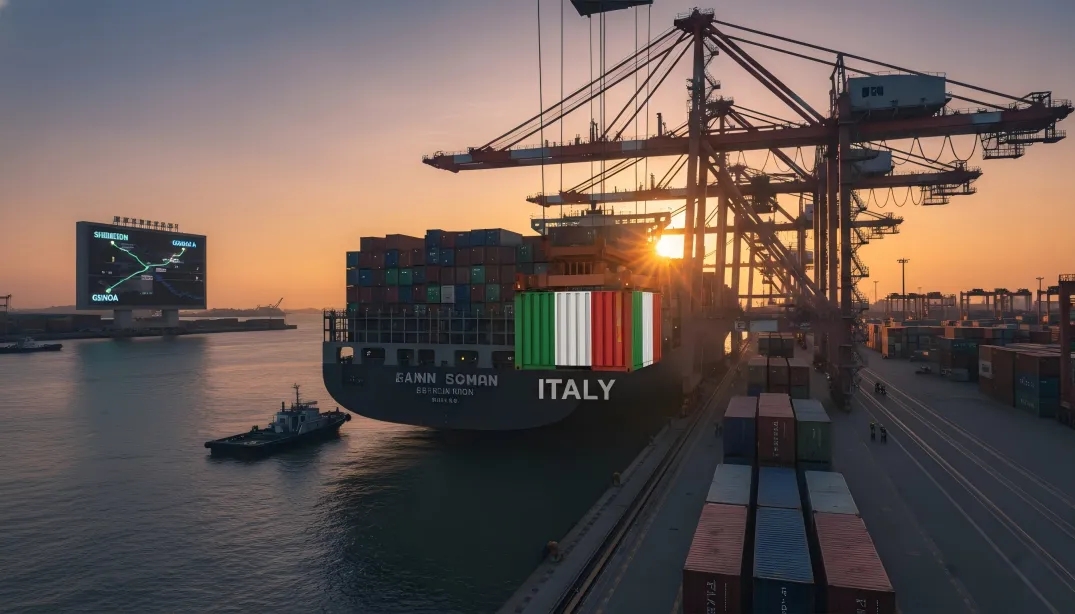
This guide covers what container shipping from China to Italy actually involves in 2026: equipment selection and payload limits, the FCL-versus-LCL break-even, a gateway-by-gateway comparison including the Liguria rail works that ran into mid-September, routing and transit expectations, rate and surcharge benchmarks, the rail option that puts a 40-foot high cube in Melzo in 12 to 18 days, the Italian customs and tax stack, and how to get a container into Amazon's Italian network without it being turned away. On pricing, Drewry's World Container Index assessed Shanghai–Genoa at USD 4,216 per 40-foot container on 10 September 2026, while carriers published new FAK (Freight All Kinds) levels in the USD 6,700 to 7,100 range for later in the season. Everything from Shipping From China to Italy onward — equipment booking, the Chinese export declaration, TARIC classification, the Italian import declaration, 22 percent VAT and the inland leg — has to line up before the container leaves Shenzhen.
1. What container shipping from China to Italy looks like in 2026
Four things changed this year, and each one moves cost or time by more than a typical rate negotiation.
Suez is partly back, and that changes the transit you should quote against. About 19 percent of Asia–Europe westbound capacity was routing through Suez again in September 2026, with carriers moving several Gemini services back to the Red Sea and restoring Mediterranean and northern European calls. The Cape remains the default for the rest, still adding roughly 3,500 nautical miles and 10 to 14 days. The practical consequence is that two containers booked on the same day from the same Chinese port to the same Italian terminal can arrive two weeks apart, depending on which service string they were loaded onto. Always ask which routing your specific vessel is taking.
EU emissions costs are now fully priced in. From 1 January 2026 the EU Emissions Trading System covers 100 percent of emissions on intra-EU voyages and 50 percent on voyages into and out of the EU, and carriers have passed that through with surcharges in the order of a 45 percent uplift on the previous year's charge at the seasonal peak. On an Italy booking this shows up as a separate line called an ETS or emissions surcharge, not inside the ocean freight. If your quote does not show it, the quote is not complete.
The Italian port picture is uneven, and it is not about congestion in the usual sense. Genoa and Savona-Vado handled 31.1 million tonnes in the first half of 2026, down 1.9 percent overall but with container gateway traffic up 1.6 percent; La Spezia handled 6.24 million tonnes, up 2.0 percent, with transshipment jumping 65.5 percent. Genoa is mid-way through building its new breakwater and has activated a new port road connection to Sampierdarena as an intermediate step in a project due for completion by the end of 2026. La Spezia started dredging its third basin to a depth of 15 meters in mid-2026, which is what unlocks the Ravano terminal expansion. This is capacity being rebuilt in the middle of a live operation, and it is why the inland leg — rail slots and trucking — is where your container actually loses time.
Rail works in Liguria took capacity out of the system, and the calendar matters. From 17 August 2026, RFI infrastructure maintenance cut capacity on several port-rail corridors connecting northern Italian inland hubs with Genoa and La Spezia. The Busalla section reduced track capacity for trains calling Genoa VTE (Voltri) between 17 and 28 August, with 40-foot high cube containers hit hardest because of a shortage of low-floor flat wagons — high-cube bookings could be rejected even with confirmed rail space. The Ovada line was fully closed from 17 August to 14 September, forcing diversions that add 40 to 60 minutes, with Padua–Genoa bookings heavily restricted and full export services from Padua only resuming on 15 September. Reopening day is not the same as full capacity. If your container arrives in Genoa in early September, book the onward leg with a buffer and confirm it in writing.
One structural note that applies to every importer. Italy is not a single market entry point; it is a northern industrial belt (Milan, Turin, Bergamo, Bologna, Padua) served well by Genoa, La Spezia and the rail hubs, and a centre-south (Rome, Naples, Bari) served better by Naples, Civitavecchia or Salerno. Choose the gateway by where the cargo has to end up, not by which is cheapest to the quay. Trucking a 40-foot box from Genoa to Naples costs more in time and money than the ocean freight difference between the two gateways.
2. Pick the box: container equipment on this lane
Freight rates are quoted per container, so the equipment decision is a rate decision. Getting it wrong in either direction is expensive: too small a box and you pay LCL rates for FCL volume; too large a box of dense cargo and you pay for a container you cannot legally load.
20-foot standard (20GP). Internally about 5.90 × 2.35 × 2.39 meters, roughly 33 cubic meters of nominal capacity and around 11 Euro pallet positions. Its real advantage is payload: a 20-foot box carries close to 28 tonnes of cargo where a 40-foot is usually limited to about 26 to 28 tonnes for the pair, so for dense goods — ceramic tiles, stone, hardware, machinery, liquids, glass — the 20-foot is usually the cheaper way to move a tonne. On the China–Italy lane, where tiles, sanitaryware and machinery are core imports, the 20GP is the workhorse.
40-foot standard (40GP). About 12.03 × 2.35 × 2.39 meters, roughly 67 cubic meters, and 22 to 25 Euro pallet positions depending on how you load. This is the default for general cargo where volume, not weight, is the constraint: consumer goods, appliances, auto parts, textiles.
40-foot high cube (40HQ). Same footprint, taller at 2.69 meters internally, which lifts usable capacity to about 76 cubic meters. For light, bulky cargo — furniture, foam products, packaging, flat-pack, most e-commerce inventory — the high cube is the best value on the lane, because you are buying volume at almost the same price as a standard 40-foot. Do expect one operational wrinkle in Italy this year: high cubes are the equipment most exposed to the Liguria rail restrictions, because low-floor wagons that can carry them are scarce during maintenance windows.
Reefer (40RH) and temperature-controlled cargo. Reefers carry roughly 60 to 67 cubic meters depending on the unit, and they are not just for frozen goods. Italian imports in this category are predominantly food ingredients, pharmaceuticals, cosmetics and specialty chemicals. Three things to plan: a pre-trip inspection and plug-in at the terminal, monitoring data you can show the consignee, and note that reefer bookings to certain destinations get suspended first when carriers ration capacity. If your product is temperature-sensitive, book earlier than you would for dry cargo.
Shipper-owned containers (SOC) and special equipment. SOC boxes are worth considering when your cargo needs long free time at destination or when you want to avoid equipment detention while it sits at a customer's site, because you are not holding a carrier-owned asset. Open-top and flat-rack equipment for out-of-gauge machinery is available on this lane but has limited supply, so it prices and books like project cargo rather than like a standard box.
Three rules that apply whatever you choose. First, nominal cubic capacity is not usable capacity: pallets, dunnage and gap space typically consume 10 to 15 percent, so plan on 85 to 90 percent of the figures above. Second, every container needs a verified gross mass (VGM) declaration before loading under the SOLAS requirement, and an undeclared or mis-declared weight is the fastest way to get a container rolled off a vessel or fined. Third, check the maximum gross weight of the equipment, not just your cargo weight: loading a 40-foot to its volume limit with dense goods routinely breaches the payload, and reworking a stuffed container at the port costs more than every rate concession you negotiated.
3. FCL or LCL: the break-even math on this lane
The rule of thumb most guides repeat — switch from LCL to FCL at about 13 to 15 cubic meters — is out of date on this lane at 2026 rate levels, and using it costs importers money in both directions.
The reason is simple arithmetic. LCL is priced on the greater of volume or weight, at a ratio of roughly 1,000 kilograms to one cubic meter, plus origin CFS handling and destination deconsolidation. FCL is priced per container, so its cost per cubic meter falls as you fill the box. In low season, a 20-foot all-in to Genoa or La Spezia runs about USD 2,500 to 3,600, which is around USD 76 to 109 per cubic meter across the 33 cubic meters of nominal capacity. All-in LCL on the same lane runs about USD 80 to 130 per cubic meter in low season and USD 140 to 220 in peak season. Run those numbers against each other and the pure-cost crossover sits closer to 20 to 25 cubic meters than to 15.
That does not mean you should ship 18 cubic meters as LCL. Three costs do not appear in the per-CBM rate:
- Handling and damage exposure. LCL cargo is loaded, unloaded, consolidated and deconsolidated at least four times more than FCL cargo. Claims rates on consolidated shipments are materially higher, and for fragile, high-value or retail-packaged goods the difference is real money.
- Time and predictability. LCL consolidations sail on fixed weekly cut-offs rather than on the day your cargo is ready, and a missed cut-off costs a week. Plan on 26 to 38 days port-to-port for LCL against 25 to 34 for FCL, before onward delivery.
- Documentation and clearance friction. LCL arrives as part of a house bill covering many shippers, then has to be split before your customs broker can even see it. Everything downstream — duty assessment, VAT, delivery order — takes longer.
Our rule for this lane: below 10 cubic meters, ship LCL, no debate. Between 10 and 20 cubic meters, run both numbers with real quotes and let the cargo type decide — dense, robust, non-urgent cargo leans to LCL, anything fragile or seasonal leans to FCL. Above 20 cubic meters, book a 20-foot container unless your cargo is heavy enough that the weight limit, not the volume, is the deciding constraint; above 28 cubic meters, book the container and stop thinking about it. When your volume genuinely sits between a half-full 20-foot and a full one, ask about a 20-foot with a shorter free time rather than paying LCL rates for FCL volume.
If you ship FCL regularly and want the terminology, weights and documentation conventions in one place, our FCL shipping service page covers the equipment and booking side in more detail.
4. Choose the gateway: Genoa, La Spezia and the rest of Italy
Italy's container gateways are not interchangeable. Each serves a different inland market, has a different rail profile, and behaves differently in 2026.
| Gateway | Strongest for | Inland connection | Watch-out in 2026 |
|---|---|---|---|
| Genoa (VTE Voltri, GPT, Sampierdarena) | The northern industrial belt — Milan, Turin, Piedmont, Lombardy | Dense rail links to Milan, Melzo and beyond; direct A7/A10 motorway access | Breakwater and port-road construction; the Busalla rail restriction and Ovada closure hit VTE capacity in August and early September |
| La Spezia (LSCT) | Central and northern Italy, and cargo needing robust rail links | Rail to Melzo, Milan, Bologna and Padua | Third-basin dredging and Ravano terminal works; transshipment volumes up 65.5 percent, which can tighten berth windows |
| Vado Ligure / Savona | Liguria's second cluster, semi-automated terminal capacity | Rail and road towards Milan and Turin | Container throughput fell 14.1 percent in the first quarter; check service coverage |
| Trieste | Central and Eastern Europe — Austria, southern Germany, Hungary, Czechia | Excellent rail to central Europe | The weakest performer in the first quarter at −23.6 percent; service strings have moved |
| Venice / Marghera | Veneto and north-east Italy | Road and rail to Padua, Verona, Bologna | Growing (+5.8 percent in Q1) but smaller terminal capacity |
| Naples | Campania and southern Italy | Road-heavy; rail for intermodal runs north | Throughput slightly down (−3.5 percent in Q1); gate congestion risk in peak weeks |
| Salerno | Growing southern gateway | Road to Campania, Calabria, Puglia | Strong growth (+7.8 percent) means capacity is tightening |
| Ravenna | Emilia-Romagna — Bologna, Modena, Parma | Rail to Bologna and northern hubs | Flat volumes; limited deep-sea coverage for Asian strings |
The geography rule. If your consignee is in Milan, Turin, Bergamo or Bologna, Genoa and La Spezia are effectively the same gateway and you should decide on rail slot availability and free time rather than on the ocean rate. If your consignee is in Rome or further south, compare Naples, Civitavecchia and Salerno against an inland move from the north — usually the southern gateway wins, but not always, because northern services are more frequent. If your cargo is destined beyond Italy into Austria, Bavaria or Hungary, Trieste is structurally the right answer even though its volumes fell this year; if your forwarder cannot explain why Trieste's service coverage changed, they are not current on the Adriatic.
The inland leg is where 2026 hurts, not the quay. Italian terminals are generally berthing vessels without the multi-day anchorages problem seen elsewhere; the friction is behind the gate. Three specific things to manage:
- Book the onward move before the vessel berths. Rail slots out of Genoa and La Spezia were restricted for most of August and the first half of September, and 40-foot high cubes were the first to be rejected for lack of low-floor wagons. A rail booking confirmed in advance is worth more this year than a slightly lower trucking rate.
- Confirm the rail route, not just the rail slot. The Ovada closure pushed trains onto diversionary routes adding 40 to 60 minutes, and Padua export services did not fully resume until 15 September. Ask whether your service runs via Busalla, Ovada or an alternative alignment, and what buffer your forwarder has built in.
- Use the northern rail hubs as a buffer. Melzo, near Milan, is the natural landing point for both sea and rail containers into northern Italy, and because customs officers are permanently present at the Melzo hub, cargo can be cleared there rather than at the port. That matters when a port's yard is full and you are burning free time.
On free time, plan on the Italian standard. Terminal free time for import containers is commonly around five to seven days at the port, with storage charges starting after that, and carrier detention on the equipment typically runs a similar window before daily charges begin. Around national holidays — Ferragosto in mid-August, the late-December cluster — you effectively lose several working days to reduced hours and, at some points, labour action. Landing a container in the middle of one of those windows costs more than the difference between two forwarders' rates.
5. Suez or the Cape: routing and realistic transit times
This is the decision that catches importers out, because the same booking can be routed two different ways.
In September 2026, roughly 19 percent of Asia–Europe westbound capacity was moving through the Suez Canal again, as carriers restored Mediterranean and north European calls on several Gemini services and other strings. The remainder still runs around the Cape of Good Hope, adding about 3,500 nautical miles and 10 to 14 days. Both routings are live on the same trade, and depending on which service your container is loaded on, the gap between them is two weeks. That is why the useful question is not "how long does it take to ship from China to Italy" but "which routing has my container been booked on".
| Routing | Port-to-port, Genoa or La Spezia | Door-to-door, northern Italy | What to know |
|---|---|---|---|
| Cape of Good Hope (still the majority of services) | 33 – 42 days | 40 – 50 days | Add 10–14 days over a Suez routing; schedule reliability is better than it was in 2024, but the buffer is real |
| Suez (about 19 percent of westbound capacity) | 25 – 34 days | 30 – 38 days | Faster, but exposed to Red Sea security conditions and to carriers reshuffling services |
| Transshipment via Malta, Valencia, Tangier or Piraeus | Add 5 – 10 days | Add the same | Two extra handlings and two berthing windows; fine for feeder-heavy ports, painful in peak season |
| Via a north European hub plus rail (Rotterdam, Duisburg) | n/a | 30 – 42 days | A genuine alternative for Milan and Bologna cargo; compare it on total cost, not just the ocean leg |
Two practical notes. First, ask for the routing in writing at booking, and ask again when you receive the bill of lading — service strings are being reshuffled month to month, and a container booked on a Suez string can end up Cape-routed after a carrier decision. Second, do not confuse port-to-port and door-to-door figures. A 33-day port-to-port transit through Genoa can easily be a 45-day experience by the time the container is released, rail-slotted, trucked to Bergamo and unloaded. Our published sea freight guide for this lane breaks down the port-by-port timings if you want to compare them against a quote you already hold.
6. What a container from China to Italy costs in late 2026
Every figure below is a planning range, not a quotation, and the spread between the bottom and top of each band is the spread between a port-to-port spot rate and a complete door-to-door booking.
FCL and LCL by season
| Product | Low season (March – June) | Peak season (September – January) | What the range covers |
|---|---|---|---|
| 20-foot FCL (20GP) to Genoa or La Spezia | USD 2,500 – 3,600 | USD 3,400 – 5,000+ | Port-to-port with main surcharges; excludes destination terminal handling and inland delivery |
| 40-foot FCL (40GP / 40HQ) | USD 3,800 – 5,500 | USD 5,300 – 7,500+ | Same basis; the high cube usually prices within USD 100 – 200 of the standard |
| Reefer 40RH | Add roughly USD 1,200 – 2,500 over dry | Add the same, plus peak premium | Includes plug-in power and monitoring; pre-trip inspection charged separately |
| LCL ocean freight | USD 80 – 130 per CBM | USD 140 – 220 per CBM | Includes origin CFS, terminal handling and destination deconsolidation; excludes duty, VAT and delivery |
| Rail FCL to Melzo / Milan | USD 7,000 – 8,700 per 40HQ (about USD 4,400 per 20-foot) | Similar, with peak space tighter | Station-to-station; add pickup, export declaration, EU clearance and delivery |
| Rail LCL | From about USD 205 per CBM | From about USD 205 per CBM | Consolidated at a rail hub, de-consolidated at a Milan warehouse |
| Air freight (1,000 kg and above) | USD 4.00 – 5.50 per kg | Higher in Q4 | At 45 kg the band is roughly USD 5.50 – 8.00 per kg |
| Express courier | From about USD 7.40 per kg | Higher in Q4 | Door-to-door; duty and VAT billed separately |
For market context, Drewry's World Container Index assessed Shanghai–Genoa at USD 4,216 per 40-foot container on 10 September 2026, with the lane easing again the following week, while carriers announced new FAK levels in the USD 6,700 to 7,100 per 40-foot range for later in the season. Treat any quote older than three weeks as history.
The surcharges that sit on top of the base rate
| Charge | Typical 2026 level | Notes |
|---|---|---|
| BAF / fuel adjustment | Per carrier, revised quarterly | Always on the invoice; ask which period it covers |
| EU ETS emissions surcharge | Roughly a 45 percent uplift on prior-year levels at peak | From 1 January 2026 the scheme covers 100 percent of intra-EU voyage emissions and 50 percent of EU-related voyages |
| Origin terminal handling (THC) | USD 150 – 300 per container | Commonly excluded from headline ocean rates |
| Destination terminal handling in Italy | EUR 150 – 300 per container | Charged by the Italian terminal, not by your forwarder |
| Peak season surcharge (PSS) | USD 200 – 600 per container | September to January on most Asia–Europe strings |
| Documentation and bill of lading | USD 50 – 120 per shipment | Amendment fees apply if details change after booking |
| ISPS and security | USD 15 – 40 per container | |
| Container cleaning, repair or re-inspection | USD 30 – 80 when applicable | More common on foodstuffs and dusty cargo |
| Detention and demurrage | Per carrier tariff after free time | Italian free time is commonly five to seven days; daily charges rise in tiers |
| Inland rail, Genoa or La Spezia to Melzo | EUR 350 – 700 per 40-foot equivalent | Slot scarcity in 2026 has pushed this to the top of the band |
| Trucking from Melzo to Milan or Bergamo | EUR 250 – 600 |
A full landed-cost example. Take a 40HQ from Shenzhen to a warehouse near Milan, carrying goods invoiced at EUR 30,000 FOB, with ocean freight of EUR 4,400 and marine insurance of EUR 120:
| Item | Amount |
|---|---|
| CIF value (goods + freight + insurance) | EUR 34,520 |
| Customs duty at 5 percent of CIF | EUR 1,726.00 |
| Import VAT at 22 percent of (CIF + duty) | EUR 7,974.12 |
| Total payable at clearance | EUR 9,700.12 |
| Destination terminal handling, documentation and clearance | EUR 400 – 800 |
| Inland rail and trucking to Milan | EUR 600 – 1,200 |
| All-in landed cost | Approximately EUR 45,200 – 46,200 |
Two things to read carefully in that table. First, duty on this example is 5 percent because most industrial and consumer goods sit at the GCC-style common rate — but the Italian band runs from 0 to 17 percent depending on the TARIC classification, and getting the code wrong is expensive in both directions. Second, the EUR 7,974 of VAT is recoverable as input tax if you are VAT-registered and importing in your own name, which is why the importer-of-record structure matters more to your cash position than a 5 percent rate difference. If you are not registered and are shipping on DDP terms, that VAT is baked into the price you pay.
7. Rail: the container alternative worth quoting
Rail from China to Italy is no longer a niche product, and on this lane it is the only mode that beats ocean on time without air's cost. In early 2026, rail bookings on China–Europe jumped about 40 percent as sea transit times stretched.
The northern corridor. Trains leave Chinese hubs — Xi'an, Chengdu, Chongqing, Zhengzhou, Wuhan, Yiwu, Guangzhou — cross at Alashankou or Khorgos, change gauge at the Kazakh border, run through Kazakhstan, Russia and Belarus, re-load at Brest/Małaszewicze and enter Italy through the Alpine crossings to terminals at Melzo (Milan), Busto Arsizio, Verona and Rome. Station-to-station on this corridor is typically 12 to 18 days, and door-to-door adds pickup, export declaration, EU customs clearance and delivery — realistically 20 to 30 days to a northern Italian warehouse. Some operators consolidating at a single origin hub quote 22 to 28 days station-to-station instead; both figures circulate in the market, and the difference is the origin hub, the consolidation cycle and how many border transfers the train makes.
The Middle Corridor. The Trans-Caspian route avoids Russia entirely — China to Kazakhstan, ferry across the Caspian, then Azerbaijan, Georgia and onward through Turkey or a Black Sea crossing. Transit is typically 15 to 18 days when it runs to plan, and rates run up to about 30 percent above the northern route, with the Caspian ferry acting as a genuine capacity and weather constraint. For some cargo and some consignees, avoiding the northern corridor is a compliance requirement rather than a cost decision, and that is a commercial judgement your forwarder should be able to explain clearly rather than gloss over.
What rail changes about the container itself. Rail uses the same 40-foot high cube you would put on a vessel, with about 68 cubic meters usable, so your loading plan transfers directly. Two constraints matter: high-cube equipment depends on low-floor wagons, which have been in short supply on the Italian port-rail network during this year's maintenance windows; and weight limits per wagon are stricter than a vessel's, so dense cargo may need to be split across two containers. On the destination side, tariff clearance at the Melzo hub is handled with customs officers permanently on site, and LCL cargo is de-consolidated at a Milan warehouse.
When rail wins. Mid-value, time-sensitive cargo where an extra two weeks of sea transit costs more than the rail premium: fashion and seasonal inventory, electronics accessories, machinery spares, industrial components for a production line, and e-commerce replenishment that cannot wait 45 days. On a 40HQ basis, rail at USD 7,000 to 8,700 against ocean at USD 3,800 to 5,500 means you are paying roughly USD 2,000 to 4,000 for two to three weeks — which is a bargain for a production-critical shipment and a waste of money for a container of non-urgent bulk goods. If you want the mode compared properly against your own cargo, our rail freight team quotes China–Europe rail to Melzo and Verona alongside ocean, so the comparison is made on the same shipment rather than in the abstract.
8. Customs, tax and compliance for container imports
A container clears Italian customs through a stack of three things: who is importing, what the goods are classified as, and whether the product itself is allowed in. Get the first two right and clearance is a one to three day formality; get the third wrong and the cargo sits.
Importer of record and EORI. To clear a container in your own name you need an EORI number — for Italy, the format is IT followed by 11 digits, which for Italian-registered businesses is normally their Partita IVA number with the IT prefix. Without an EU-established importer, you cannot be the importer of record, which is why DDP arrangements and fiscal representation exist. Your forwarder should be able to tell you, in writing, whose EORI number appears on the declaration.
VAT is 22 percent on the landed value. Italian standard VAT has been 22 percent since 2013, with reduced rates of 10, 5 and 4 percent for specific categories such as certain foodstuffs and books. The base is CIF plus duty, so VAT compounds the duty rather than sitting beside it. Three consequences worth planning for: the cash impact is large on high-value containers (roughly EUR 7,900 on the EUR 36,246 duty-inclusive value in the example above); it is recoverable as input tax if you are VAT-registered and importing in your own name; and if you buy on DDP terms, you are paying somebody else's financing cost as part of the price.
Duty runs from 0 to 17 percent and the code decides which. Italian duty is assessed on the TARIC classification of your goods, an eight to ten digit extension of the international HS system. Most industrial goods and consumer products sit at low single-digit rates, some categories are zero-rated, and the top of the band catches specific finished goods. A wrong digit produces a wrong rate, a mismatch against the commercial invoice, and in the worst case a reclassification after release with a retroactive duty demand.
Low-value consignments changed on 1 July 2026. The EU removed the EUR 150 duty exemption for low-value consignments and replaced it with a flat EUR 3 per item duty under the transitional regime that runs until the EU Customs Data Hub is in place. B2B commercial consignments and ordinary container imports are not the target of the measure, but if you also run direct-to-consumer parcels into Italy, or if you ship samples and spare parts separately, it changes the economics — and from 1 November 2026 the Product Identifier Data requirement adds a further layer of data to each consignment.
Product compliance: CE, GPSR and the packaging schemes.
- CE marking is mandatory for electronics, toys, machinery, medical devices and a long list of other categories. Non-compliant goods are not held pending a fix; they are destroyed or re-exported at your cost.
- GPSR (General Product Safety Regulation, EU 2023/988, applicable since 13 December 2024) requires most consumer products sold into the EU to have an EU-established responsible person named on the product or its packaging, and marketplace sellers are among the most affected. Amazon enforces this at listing level, so it is not something you can fix at the port.
- Packaging and WEEE obligations. Italy operates the CONAI packaging consortium regime: businesses that place packaged goods on the Italian market register and pay an environmental contribution on the packaging, and electrical and electronic equipment falls under the separate RAEE system. These are annual, not per-shipment, obligations, but they are checked during onboarding with distributors and marketplaces.
Two systems you do not manage directly. ICS2, the EU's advance cargo information regime, is fully enforced for sea shipments in 2026 — your forwarder files the entry summary declaration electronically, and you simply need to make sure the commercial invoice and packing list data you supply is accurate enough to file. And clearance timing in Italy runs one to three working days for a clean declaration at a major gateway, with inspection adding several more; the most common cause of a stuck container is a mismatch between the invoice, the packing list, the bill of lading and the declared classification, not the customs system itself.
Documents for a container into Italy. Commercial invoice showing the TARIC/HS code, unit values and Incoterms; packing list with carton and pallet counts; bill of lading (or a telex release); EORI number; certificate of origin where a preferential rate is claimed; CE declaration of conformity for regulated products; insurance certificate if you are insuring separately; and the CMR or road consignment note for the onward European leg if the cargo moves beyond Italy.
9. Delivering a container to Amazon Italy
Amazon's Italian network is a delivery into a specific site with a specific set of rules, not a general port delivery, and it is the stage where well-planned containers most often go wrong.
Where the sites are. The codes sellers encounter most are MXP5 at Castel San Giovanni near Piacenza, TRN1 at Torrazza Piemonte near Turin, BGY1 at Casirate d'Adda near Bergamo, BLQ8/IFC1 at Spilamberto near Modena (vendor freight only), and in Lazio FCO1 at Passo Corese and FCO5 at Ardea, both serving Rome. They are concentrated in the north, which is convenient if your container lands at Genoa, La Spezia or Melzo and awkward if it lands in Naples.
The step most importers miss: most Italian fulfilment centers are not set up to receive a deep-sea container. FCO5 is one of the few sites listed as accepting deep-sea imports directly. In practice that means an FCL container is usually delivered to a third-party warehouse or 3PL, de-stuffed, palletized to Amazon's specification and then moved by a compliant vehicle to the fulfilment center. Plan that transload step into the timeline; it typically adds two to four days, and it is where cartons that fail Amazon's preparation rules get discovered.
Bookings, vehicles and presentation. Every inbound requires an appointment booked through Carrier Central, generally with at least 24 hours' notice, and sites enforce vehicle rules — articulated or 7.5-tonne vehicles for palletized deliveries at many locations, no tail lifts, no double-deck trailers, no flatbed trucks. Pallets must be stable, stretch-wrapped in clear plastic, and within the site's weight limit per pallet. Turn up in the wrong vehicle or without an appointment and the load is refused, which on an import container means storage from that moment.
Preparation has to happen at origin. FNSKU labels on every unit, correct polybagging, expiry dates in the required format on consumables, master carton labels and weight limits respected — all of it is checked at the gate, and cartons that fail can be refused outright rather than fixed for a fee. If your supplier loads an unstuffed container in Shenzhen, that work has to be done before the container is sealed, or at a 3PL in Italy at Italian labour rates. Our Amazon FBA service handles that preparation in China, including FNSKU labeling, palletization and the appointment booking, so the container arrives as a compliant delivery rather than a problem to be solved.
One more timing note. Italian fulfilment centers observe Italian public holidays and reduced summer hours, and appointment availability tightens sharply from October through December. If your stock has to be available before Black Friday or Christmas, the container needs to have cleared and been transloaded by the end of October — which, counting backwards through a 40-day Cape routing, means booking in September.
10. Red flags and twelve questions to ask before you book
The twelve questions
- "Which routing is my container booked on — Suez or the Cape — and can I have it in writing?" The gap is two weeks, and service strings are being reshuffled monthly.
- "Which gateway, and why that one rather than the other?" Genoa, La Spezia, Trieste and Naples serve different inland markets. A forwarder who cannot explain the choice is quoting a rate, not planning a shipment.
- "Is the rate port-to-port or door-to-door, and are origin and destination terminal handling inside it?" The most common source of a 40 percent surprise between two quotes.
- "How many days of free time do I get at the Italian terminal, and what are the daily charges after that?" Five to seven days is the norm; ask for it in writing with the tariff attached.
- "Is the EU ETS emissions surcharge included, and at what level?" From 1 January 2026 the scheme is at 100 percent for intra-EU voyage emissions and 50 percent for EU-related voyages; the surcharge should be a visible line.
- "Can you guarantee 40HQ equipment on my sailing date, and what happens if the box is rolled?" High-cube availability has been the constraint this year, especially with low-floor wagon shortages on the Italian rail leg.
- "Who provides the VGM declaration, and who is liable if the weight is wrong?" Undeclared weight gets containers rolled and fines levied, and the liability sits with the shipper.
- "Which rail or truck slot is booked for the onward leg, and via which alignment?" With the Busalla restriction, Ovada diversions and Padua restrictions running through mid-September 2026, this is not a formality.
- "Who is the importer of record on the Italian declaration, and what is their EORI number?" This decides whether the 22 percent VAT is recoverable or a cost.
- "Who classifies my goods in the TARIC system, and will you send me the code before shipment?" Duty runs from 0 to 17 percent, and a wrong digit means a retroactive demand.
- "Are CE documentation, GPSR responsible-person details and packaging registration in place?" These are checked at onboarding and at the border, and they cannot be fixed at the port gate.
- "Is cargo insurance included, on what valuation basis, and does it cover the inland Italian leg as well as the sea voyage?" Carrier liability is a fraction of cargo value, and the highest-frequency damage events happen between the terminal and the warehouse.
Ten red flags. A quote with no routing named; a single all-in number with no surcharge breakdown; rates quoted at last year's levels; no free-time or demurrage terms; a forwarder who cannot tell you which Italian terminal the vessel calls; no answer on rail slot availability for northern Italy; willingness to under-declare value or weight on the VGM; container delivery promised direct to an Amazon fulfilment center that does not accept deep-sea imports; no mention of the 22 percent VAT or the importer-of-record structure; and a promised transit time that is a single number rather than a routing-dependent range.
11. FAQ
How much does it cost to ship a container from China to Italy in 2026?
As a September 2026 reference, a 20-foot container to Genoa or La Spezia runs about USD 3,400 to 5,000 in peak season and USD 2,500 to 3,600 in the quieter months, and a 40-foot or 40HQ runs about USD 5,300 to 7,500 in peak season and USD 3,800 to 5,500 in low season, port-to-port with main surcharges. LCL is about USD 140 to 220 per cubic meter in peak season and USD 80 to 130 in low season. On top of the freight, add origin and destination terminal handling of roughly USD 150 to 300 and EUR 150 to 300 per container, an EU ETS emissions surcharge, peak season surcharges of USD 200 to 600, documentation, and either inland rail and trucking from EUR 600 to 1,200 or an onward European leg. Drewry assessed Shanghai–Genoa at USD 4,216 per 40-foot on 10 September 2026, but carriers have published FAK levels in the USD 6,700 to 7,100 range for later in the season, so treat any quote older than three weeks as historical.
How long does container shipping from China to Italy take?
It depends on the routing, and both options are live right now. On a Cape of Good Hope routing, plan on 33 to 42 days port-to-port to Genoa or La Spezia and 40 to 50 days door-to-door into northern Italy. On a Suez routing — which carried about 19 percent of westbound Asia–Europe capacity in September 2026 — it is 25 to 34 days port-to-port and 30 to 38 days door-to-door. Transshipment via Malta, Valencia, Tangier or Piraeus adds five to ten days. Rail to Melzo or Milan is 12 to 18 days station-to-station and typically 20 to 30 days door-to-door, and air freight is 3 to 7 days into Malpensa or Rome.
Should I ship FCL or LCL for a given volume?
Below about 10 cubic meters, LCL is almost always cheaper. Between 10 and 20 cubic meters, run both quotes: at 2026 rate levels the pure-cost crossover is closer to 20 to 25 cubic meters than to the often-quoted 15, but LCL adds handling, damage exposure and a week or more of transit, which shifts the decision toward FCL earlier for fragile or seasonal cargo. Above 20 cubic meters book a 20-foot container, and above 28 cubic meters the container is the obvious answer. Remember that LCL is charged on the greater of volume or weight at roughly 1,000 kilograms per cubic meter, so dense goods cross over to FCL sooner.
Should I ship to Genoa or La Spezia?
For cargo destined to Milan, Turin, Bergamo or Bologna the two are effectively interchangeable, and the decision should be made on rail slot availability, free time and the specific service string rather than on the ocean rate — which is usually within a few percent between them. La Spezia has the stronger transshipment profile this year and is in the middle of a dredging and terminal expansion programme; Genoa has the deeper inland rail network and is building the new breakwater, with the associated works affecting road and rail capacity through 2026. For Austria, Bavaria or central Europe, look at Trieste; for Rome and the south, compare Naples, Salerno and Civitavecchia against an inland move from the north.
Do I need an EORI number to import a container into Italy?
Yes, if you want to be the importer of record and recover the 22 percent import VAT as input tax. The Italian EORI format is IT followed by 11 digits, which for a domestic company is normally its Partita IVA number. Without a company established in Italy or elsewhere in the EU, you cannot act as importer of record, so importers use a licensed importer-of-record arrangement, DDP terms, or a customs representative. Ask your forwarder whose EORI number is on the declaration before the container sails.
Can I ship a container directly to Amazon's warehouse in Italy?
Sometimes, but not usually as a full container. Amazon requires a Carrier Central appointment for every inbound shipment, with vehicle, pallet and packaging rules enforced at the gate, and most Italian fulfilment centers are not set up to receive deep-sea containers directly — FCO5 near Rome is one of the few sites listed as accepting them. The standard route is to deliver the FCL container to a 3PL, transload and re-palletize to Amazon's specification, then deliver by a compliant vehicle against a booked appointment. Prep — FNSKU labeling, polybagging, expiry-date formatting, carton weights — must be completed before that delivery, ideally at origin in China.
Ship Your Container with a Forwarder Who Books All Three Decisions
Container shipping from China to Italy in 2026 rewards preparation. Suez and Cape routings sit side by side on the same trade; Italian throughput is diverging by coast, with Trieste down sharply and La Spezia, Salerno and Venice growing; Liguria's port-rail works took capacity out of the system through mid-September; EU emissions costs are fully priced in; the EUR 150 low-value duty exemption is gone as of 1 July 2026; and Amazon Italy is a booking-and-vehicle compliance exercise as much as a delivery. Whichever box and gateway you choose, the container that arrives on time is the one whose equipment, routing, rail slot, clearance and duty position were decided together rather than one at a time.
That is what AllBestShipping does from Shenzhen: FCL and LCL sea freight from every major Chinese port into Genoa, La Spezia, Trieste and the southern gateways, China–Europe rail to Melzo and Verona when two to three weeks matter more than the rate, air freight into Malpensa and Rome, Amazon FBA inbound with preparation completed at origin, and door-to-door DDP with Italian import clearance, 22 percent VAT and duty handled for you — with transparent pricing, real-time tracking and customs support on every container. Send us your product list, your supplier locations and your delivery address in Italy, and we will come back with a landed-cost quotation that names the box, the gateway, the routing and the rail slot, plus the TARIC codes and compliance documents your cargo needs. Then compare it against the twelve questions above — including the ones you would ask us.