Freight Rates After Golden Week 2026: US Lanes Hold Near Record Highs While Europe Falls 13 Weeks Straight
China's Golden Week holiday ended on 7 October 2026, and the post-holiday rate relief that normally follows it did not arrive. The Asia–US West Coast spot rate was still $8,322 per FEU on 6 October and the East Coast held $9,606, while Xeneta's market averages put Far East–US East Coast at $11,512 per FEU on 7 October — 334.7% above the pre-war baseline of 28 February 2026. The other half of the market went the other way: Asia–North Europe fell for a thirteenth consecutive week to $3,645 per FEU, down 34% since 1 July, and the Mediterranean dropped to $4,007, down 43%. A single week of Chinese factory closures did not move either lane much, and that is the story of this quarter: the two halves of the world's container market are no longer pricing off the same forces.
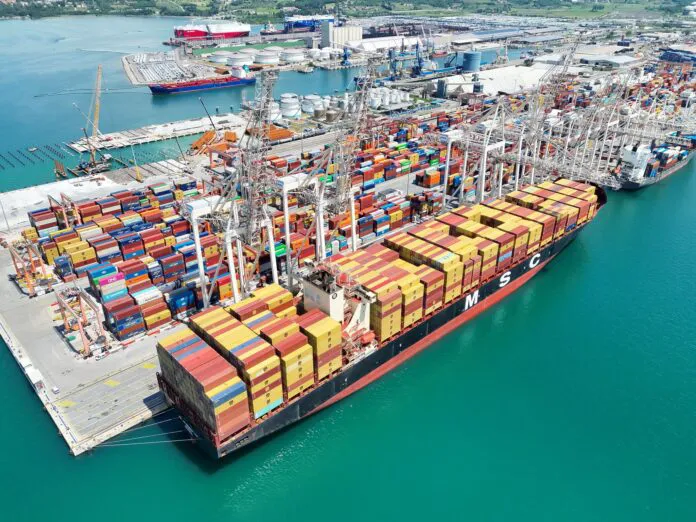
This article covers what actually changed between 5 and 12 October — the rate prints, the carrier surcharge filings that will land in November, the record-low Rhine that is quietly raising European door costs, Panama's returning capacity and the policy dates that decide your Q4 — and translates it into booking dates, budget scenarios and contract language. These are the world's two largest container corridors out of China: US ports are forecast to import 2.25 million TEU in October and 2.0 million in November, and China-origin cargo on both corridors moves through the same port pairs and documentation that Shipping from China to USA sets out in detail. If you read only one section, read Section 7: the base rate is no longer where your money goes.
1. The twelve numbers that define the post-Golden Week market
- $7,624 per 40ft — Shanghai to Los Angeles in the week to 8 October, down 3% week on week (Drewry World Container Index).
- $10,220 per 40ft — Shanghai to New York, down 2%. The off-contract rate on this lane is back in territory last seen after the pandemic, and Reuters reported on 6 October that it could set new record highs because fuel costs keep climbing.
- $4,351 per 40ft — the WCI composite, down 1.87% — the second consecutive weekly decline, and a decline that is entirely an Asia–Europe story.
- $3,337 per 40ft — Shanghai to Rotterdam, down 2% and the 13th consecutive weekly fall on Asia–North Europe.
- $3,696 per 40ft — Shanghai to Genoa, flat on the week. The Mediterranean lost far more than the north over the summer and has now stopped falling at roughly the same place.
- $3,645 per FEU — Xeneta's Far East–North Europe market average on 7 October, down 34% since 1 July.
- $4,007 per FEU — Xeneta's Far East–Mediterranean average, down 43% since 1 July.
- $362 — the premium Mediterranean cargo pays over North Europe today. On 1 January 2026 that gap was close to $2,000.
- $11,512 and $8,336 per FEU — Far East–US East Coast and Far East–US West Coast on 7 October: +334.7% and +344.2% against the 28 February pre-war baseline, with the East Coast premium over the West Coast at $3,177 versus $772 in late February (Xeneta).
- 34 of 713 — blank sailings announced across the main east–west trades over the five weeks beginning 12 October, about 32% of them eastbound transpacific (Drewry Container Capacity Insight). Transpacific blanks for the coming week drop to four from eleven; Asia–Europe rises to six from five.
- $1,500 and $900 — Maersk's tripled Emergency Contingency Surcharge on India/Bangladesh/Sri Lanka to South Africa (from $500 per container) and its Durban congestion fee of up to $900 per 40ft — both effective 1 November 2026.
- €1,280 per FEU — the low-water surcharge Contargo applies on Rhine barge moves once the Kaub gauge drops below 40 cm. On 1 October the gauge hit 4 cm — the lowest reading since records began in 1880.
2. What changed between 5 and 12 October 2026
Golden Week closed the busiest stretch of the year and opened the pricing argument for Q4. This is the week, in order:
| Date | Development | Why it matters to you |
|---|---|---|
| 5 Oct | Maersk's $250 per container peak season surcharge from the Mediterranean to the US and Canada takes effect (until further notice). | The surcharge layer keeps rising even where spot rates are not. If your quote is a base rate, you are quoted short. |
| 6 Oct | Freightos Baltic Index: Asia–US West Coast $8,322/FEU (−1%), East Coast level at $9,600, Asia–North Europe $3,260 (−3%), Asia–Mediterranean $3,555 (−2%). Air: China–North America $5.60/kg, down 18% in a week; China–North Europe $3.83/kg, down 7%. | The first post-holiday print: US lanes barely moved, Europe kept sliding, and aircraft emptied out as factories idled. |
| 6 Oct | The Premier Alliance joins Maersk, Hapag-Lloyd, MSC and CMA CGM in resuming Red Sea/Suez transits — the last holdout among the big groupings. | More Suez transits mean more effective capacity on Asia–Europe. This is the single biggest reason European rates cannot hold. |
| 6 Oct | Iran escalates attacks in the Strait of Hormuz: UKMTO recorded nine incidents in the opening days of October, roughly half of September's total, while crude flows recovered toward pre-war levels. The Baltic Exchange put the Persian Gulf–China tanker rate at a record $1.3 million per day. | Fuel and war-risk pricing is set in the same water. Bunker costs stay high, which is the input carriers use to justify BAF and emergency surcharges. |
| 7 Oct | Maersk's Asia–Pacific market update confirms four more Gemini services moving to Suez routing, recovering port operations in Asia, and space out of Asia still tight through October. | Europe gets capacity; the transpacific does not. The split in this article is carrier-designed, not accidental. |
| 7 Oct | Xeneta declares the transpacific peaked for 2026: East Coast $11,512, West Coast $8,336, and forecasts $6,000–7,000 East Coast and $4,500–5,500 West Coast three months out. | This is the only published three-month view from a major pricing platform. It is your first budget assumption for January arrivals. |
| 8 Oct | Drewry's WCI falls 1.87% to $4,351; Shanghai–Rotterdam down 2% for a 13th week. | The composite number is falling because Europe is falling. It says nothing about your US shipment. |
| 8 Oct | Maersk files the November surcharges: ECS $500 → $1,500 per container on the S5S trade, and the Durban congestion fee up to $450 per 20ft / $900 per 40ft. | Carriers are rebuilding margin through fees, not rates. Budget for them. |
| 8 Oct | NRF/Hackett Global Port Tracker: the extended US import peak is finally winding down — October forecast 2.25 million TEU, November 2.0 million, December 2.02 million, after August's 2.3 million. | Demand support is fading, but from a very high level. It is not a collapse. |
| 9 Oct | Forwarders quoted cargo China to Felixstowe and Southampton at $2,650 per 40ft — about 27% below the Xeneta North Europe benchmark of $3,645. | The index is not your quote. The spread between published benchmarks and real negotiated prices is now wider than the week-on-week moves everyone reports. |
| 9–11 Oct | The Rhine hits a record low at Kaub; JOC flags the Vincent Thomas Bridge closure at Los Angeles from 1 November as a container dwell risk; the Maritime Workers Union of Nigeria shuts the gates at Apapa, Tin-Can Island, Onne and Rivers ports. | Three reminders that the destination end — not the ocean leg — is where schedules actually break. |
3. Two markets, not one: the lane-by-lane split
Here is the whole picture in one table. The comparison points are the ones Xeneta publishes, so they are not arbitrary: 28 February 2026 is the last week before the war that reshaped routing, and 1 July is the peak of the 2026 Asia–Europe pricing run.
| Lane | Baseline | 7 October 2026 | Change | What it tells you |
|---|---|---|---|---|
| Far East → US East Coast | $2,651 (28 Feb) | $11,512 | +335% | Still at crisis pricing. Space, not price, is the constraint. |
| Far East → US West Coast | $1,879 (28 Feb) | $8,336 | +344% | Same, but the premium over the East Coast has compressed from $3,177 toward a forecast $1,500. |
| Far East → North Europe | $5,523 (1 Jul) | $3,645 | −34% | Peak premium unwound; Suez capacity is finishing the job. |
| Far East → Mediterranean | $7,030 (1 Jul) | $4,007 | −43% | The fastest correction of any major lane; back to pre-peak levels. |
The important consequence is that a single index number has stopped being usable as a negotiation anchor. The WCI composite fell again this week — but that composite is a weighted average of eight east–west lanes, and the lanes moved in opposite directions by margins in the hundreds of percent. If you ship to the United States, you are buying in a market where the floor is being held by congestion and blank sailings; if you ship to Europe, you are buying in a market where carriers are trying to stop a thirteen-week slide that their own Suez re-routings helped cause.
That also explains a pattern we see in our own quoting desk in Shenzhen: two customers, same week, same product category, same 40ft box — one paying 2026 peak pricing to Los Angeles and the other paying mid-2024 pricing to Rotterdam, and both convinced that "freight rates" are doing one thing.
4. Why the US lanes held their floor
Four forces are holding transpacific pricing up, and only one of them is demand.
Congestion at the origin, not just the destination. Shanghai had 157 vessels waiting at berth in mid-September, with delays running seven to 10 days, and those delays have not cleared. Four consecutive typhoons closed or slowed terminals in Shanghai, Ningbo-Zhoushan and Yantian, and the backlog they created — rolled bookings, skipped calls, vessels bunching into the same arrival windows — takes weeks to unwind. Freightos' read is explicit: nearly three months of weather disruption plus more blanked sailings may keep the transpacific rate floor quite elevated even as the market enters what is normally a low-demand window before the Lunar New Year rush.
Capacity discipline with a US bias. Of the 34 blank sailings announced across the main east–west trades for the five weeks from 12 October, roughly a third sit on eastbound transpacific services. Gemini (Maersk and Hapag-Lloyd) blanked two transpacific loops, TP8 and TP12, around Golden Week. Meanwhile, the same carriers moved four additional Gemini services onto the Suez route — capacity that lands on Asia–Europe, not on the Pacific. Carriers are not hiding the fact that they are defending one lane and loosening another.
Demand that has been extended rather than ended. The US import peak started early, thanks to tariff deadlines and frontloading, then refused to finish. August came in at 2.3 million TEU, the busiest month of the year; September is projected at 2.28 million TEU, up 8.2% year on year; October is forecast at 2.25 million TEU, up 8.5%. November finally drops to 2.0 million TEU — a 1% decline year on year — which is what "the peak is over" actually looks like from a volume standpoint: a return to a high baseline, not a collapse. The full monthly series is published by NRF and Hackett Associates.
The cost structure of the East Coast route. Cargo to the US East Coast either crosses the Panama Canal — where draft and slot restrictions have been a live variable all year — or takes the long way around, and both options consume capacity and fuel. That is why the East Coast premium over the West Coast blew out from $772 per FEU in late February to $3,177 on 1 October. Bunkers are the shared input: the 20-port average VLSFO price stood at roughly $901.50 per metric ton in mid-September against $543.50 on 27 February, a 66% increase that no carrier has been willing to absorb.
One more number worth knowing: Gemini's reported schedule reliability into the North America West Coast is 95.7% and about 93% into the East Coast, against an industry average of roughly 70%. When reliability is that uneven between carriers, paying for a reliable string is often cheaper than paying for a cheap unreliable one — a subject we go into in more detail in our sea freight guide.
5. Why Asia–Europe fell for a thirteenth straight week
The European slide is not a demand story either. It is a capacity story, and the capacity was released on purpose.
The Suez return is the mechanism. Routing Asia–Europe services around the Cape of Good Hope adds roughly ten to fourteen days per voyage each way. That extra time absorbs vessels — the same physical fleet covers fewer sailings per month. As carriers move services back through Suez, those absorbed ships are released back into the market as effective capacity. Maersk alone has moved four more Gemini services onto Suez routing this month; the Premier Alliance, the last major holdout, announced its own resumption in the week of 6 October; Hapag-Lloyd, MSC and CMA CGM are already there. Every service that returns shortens a round voyage by three to four weeks, and every shortened round voyage adds a sailing to the trade.
A premium that has already been unwound. The July peak on this lane was a war premium, priced when carriers were routing long and fuel costs were spiking. Xeneta's chief analyst Peter Sand puts the Mediterranean decline at 43% from its July peak and North Europe at 34%, and says the pace of decline has eased but the floor has not been found. The clearest evidence is the collapsed Mediterranean premium: $362 per FEU today versus about $2,000 on 1 January, when Mediterranean services were paying the biggest detour penalty.
Carriers are trying to stop the slide, and the market is not cooperating. MSC filed a freight-all-kinds rate of $4,500 per 40ft for Far East–North Europe and Far East–West Mediterranean from 19 October; CMA CGM filed $4,700 to the West Mediterranean and $4,900 to the East Mediterranean. Those levels sit more than $1,200 per 40ft above the spot prints of the first week of October. At the same time, forwarders were still receiving reductions on first-half-of-October FAK rates — a contradiction one European forwarder described to The Loadstar as "confusing." When carriers file increases that the market is not yet willing to pay, they are signalling intention, not pricing power.
The tendering season is now the real battleground. European shippers are entering 2027 contract negotiations with spot rates 34% to 43% below their July peak, excess capacity arriving from the Suez normalisation, and a soft demand outlook. That is unusually strong buyer leverage — and carriers know it, which is why surcharges, not base rates, are where they are rebuilding margin (see Section 7).
If you want the pre-history of this move — the capacity decisions carriers made in the weeks before Golden Week — our earlier analysis of Golden Week 2026 blank sailings sets out the service cuts that preceded this pricing split.
6. Europe's hidden cost problem: the Rhine at a record low
Here is where the European headline rate is most misleading. Base ocean freight to North Europe is down 34% since July — but the inland leg that moves your container from Rotterdam or Antwerp to a warehouse in Germany, Switzerland or eastern France is in the middle of a genuine logistics crisis.
Water levels on the Rhine fell to record lows for the second time in a week on 1 October. At Kaub, the river's shallowest navigation point, the gauge hit 4 centimeters — the lowest since records began in 1880, according to the German water authority WSV. Other monitoring stations went negative altogether: Worms and Emmerich at −29 cm, Oberwinter at −15 cm, Düsseldorf at −6 cm. The German Federal Institute of Hydrology warned levels could fall further, and the Rhine has now spent 74 days below the 78 cm threshold that forces barges to cut loads by 30% or more — against 41 days during the 2022 energy crisis.
What that does to your invoice, in the carriers' own published numbers:
| Charge | Trigger | Level | Who is charging it |
|---|---|---|---|
| Low-water surcharge | Kaub below 40 cm | €1,280 per FEU (≈$1,451) | Contargo (multimodal barge operator) |
| Low-water surcharge | Draft restrictions on affected cargo | ≈$1,350 per FEU | Hapag-Lloyd |
| Low-water surcharge ladder | Kaub below 1.81 m, stepping down to 1.31 m | €250 → €1,670 per container | Maersk (published Benelux tariff ladder) |
| Loading guarantee withdrawn | Kaub below 81 cm or Duisburg-Ruhrort below 181 cm | No loading guarantee | Maersk |
| Transport not guaranteed | Kaub below 1.06 m | Barge transport may be operationally unviable | Maersk |
Read those two bottom rows again. At Kaub, container barges typically need around 40 cm to operate at roughly a quarter of normal capacity, and Contargo's own suspension thresholds start earlier still. In plain terms: for cargo bound beyond the European seaport — and that is most of it — the €1,280-plus per FEU in low-water surcharges can exceed the entire saving you just negotiated on the ocean leg to Rotterdam.
Two practical consequences for anyone shipping to Europe from China in the fourth quarter:
- Ask about the inland leg, in writing, separately from the ocean rate. A quote that ends at Rotterdam or Hamburg has not been quoted for delivery. If your forwarder has not told you which Rhine surcharge applies at current levels, assume the surcharge will appear on the final invoice, not the quote.
- Compare water-independent routings. Rail from Central Europe ports, delivery ex-Antwerp or Zeebrugge, or trucking from a North Sea port that avoids the Middle Rhine can beat a "cheaper" barge routing once low-water surcharges and delays are counted. This is a route-design decision, not a rate decision — the kind of comparison we run daily for European consignees shipping from China, and one of the reasons our own Europe coverage is built around port-and-inland pairs rather than seaports alone.
A second European operational risk sits alongside the river: German port labour. Dockworker negotiations ran to the brink of strikes again in September and October before a deal averted them, and previous walkouts pushed Asia–Europe schedule reliability to unprecedented lows. Add the Dutch unions' strike preparations, and the case for routing around — not through — the most strike-exposed gateway becomes straightforward.
7. The surcharge stack: what carriers raise when base rates fall
This is the section to read if you read nothing else. On the two main corridors out of China, the direction of the base rate and the direction of the charges stacked on top of it are now opposed. That is a deliberate outcome, not noise.
Carriers manage revenue through two levers: the freight all kinds (FAK) base rate, which is visible, public and negotiated; and surcharges, which are filed with an effective date, applied per container, and rarely argued line by line by a busy importer. When a trade lane has too much capacity, the base rate falls. When that happens, surcharge discipline tightens. Maersk's own filings in the week of 8 October show the pattern. Here is the bill in the market as of this week:
| Charge | Scope | Amount | Effective | Filed by |
|---|---|---|---|---|
| Emergency Contingency Surcharge | India, Bangladesh, Sri Lanka → South Africa & islands (S5S) | $500 → $1,500 per container | 1 Nov 2026 | Maersk |
| Congestion Fee Destination | Far East Asia, Indian Subcontinent, Middle East → Durban | $450 per 20ft / $900 per 40ft (up from $250/$500) | 1 Nov 2026 (8 Nov for KR/TW) | Maersk |
| Peak Season Surcharge | Mediterranean → US & Canada | $250 per container (dry, HC, reefer) | 5 Oct 2026, until further notice | Maersk |
| Low-water surcharge | Rhine barge moves beyond the seaport | €250 → €1,670 per container depending on the Kaub level | Open-ended, water-level triggered | Maersk |
| Low-water surcharge | Kaub below 40 cm | €1,280 per FEU | Open-ended | Contargo |
| Low-water surcharge | Draft-restricted cargo | ≈$1,350 per FEU | Open-ended | Hapag-Lloyd |
| FAK rate increases | Far East → North Europe & Mediterranean | $4,500–$4,900 per 40ft (spot is $3,260–$3,555) | 19 Oct 2026 | MSC, CMA CGM |
| Bunker/fuel recovery | All trades | Pass-through of VLSFO at ~$901.50/mt versus $543.50 in February | Rolling | All carriers |
| War / emergency risk | Middle East linked routings and Red Sea transits | Varies by carrier, insurance-driven | Rolling | All carriers |
| Origin charges | THC, documentation, VGM, export customs | USD 80–350 per container depending on port and filing | Rolling | Origin terminals and agents |
| Destination charges | THC, CFS, equipment, D/O fees, storage | USD 120–500 per container, port dependent | Rolling | Destination terminals and agents |
| Demurrage and detention | Beyond free time | USD 100–350 per box per day, port and carrier dependent | Rolling | All carriers |
Three things follow from that table.
First, a published index cannot tell you your door cost, and the gap is now measurable. In the week to 9 October, forwarders were offering China to Felixstowe and Southampton at $2,650 per 40ft while the Xeneta benchmark for the same lane stood at $3,645 — a 27% gap. Part of that is commercial (relationships, volume, allocation), part of it is service level (direct versus transhipment, port pair, equipment type), and part of it is which surcharges are inside the number. When you compare quotes that differ by a third, you are usually not comparing prices. You are comparing definitions.
Second, the market's own advisers are warning about this. Drewry's advisory head, Chantal McRoberts, said publicly in the week of 8 October that surcharges — including inflated fuel and pre-peak season charges — are now causing the biggest concern in negotiations and that contracts need guardrails around them. When the pricing house that publishes the benchmark index tells shippers to stop negotiating on the index, that is a signal worth acting on.
Third, surcharge risk is asymmetric between your two corridors. On Asia–Europe, carriers have plenty of capacity and falling base rates, so their margin recovery has to come from fees — expect aggressive filings and expect them to stick. On Asia–US, space is the constraint, so the surcharges are secondary; your problem there is allocation and rollover risk, not line items. The mitigation is different for each: Europe is a contract-drafting problem, the US is a booking-and-allocation problem.
8. Panama Canal: capacity comes back on 15 October
One structural improvement lands right in the middle of this quarter. On 28 September the Panama Canal Authority confirmed in an Advisory to Shipping that from 15 October 2026 it will increase daily Neopanamax transits from nine to ten, taking total capacity across the Neopanamax and Panamax locks to 33 transits per day, and that the maximum authorized draft in the Neopanamax locks rises to 14.94 meters (49.0 feet) effective immediately. An additional booking slot will be offered through Booking Period 2, and from 29 September, bookings for dates from 15 October are no longer limited in number per date or per week, and consecutive-date bookings are permitted.
What this does change:
- Predictability for East Coast services. Draft at 49 feet restores a foot of permitted draft for the largest containerships — the constraint that forces weight reductions and, in the worst case, cargo left behind. When we wrote about the 2026 transit cuts, that was the binding problem for US East Coast routing.
- More slot availability for booking. An extra daily booking slot and the removal of per-date slot limits make peak-season reservations materially easier to secure — relevant if you are trying to catch a specific sailing window before November.
What it does not change:
- The reservation system is still the only guarantee. The Canal's own language is unambiguous: while the water deficit continues, a transit reservation is the only way to guarantee a date, and vessels without one may face indefinite delay. Do not assume restored capacity means guaranteed transit; it means a bigger queue with more guaranteed slots in it.
- Water risk has not gone away. Gatun Lake levels improved on near-average rainfall and successful water-saving measures, but "until further notice" is doing a lot of work in that advisory. The Canal reversed or postponed draft reductions twice this year already.
The practical read: this is mildly bearish for US East Coast rates into Q1 2027. It supports Xeneta's forecast of a narrowing East Coast premium — from roughly $3,177 per FEU today toward about $1,500, with the East Coast falling harder than the West Coast because it started higher. If your 2027 planning assumes today's East Coast spread, you are planning for the least likely outcome.
9. The policy clock beside the freight clock
Freight is not the only thing with an expiry date this quarter. Three dates will shape how your cargo is declared, valued and taxed.
| Date | What happens | Action |
|---|---|---|
| 9 November 2026 | The remaining 178 Section 301 product exclusions expire unless USTR publishes an extension. | Check whether any SKU you import currently relies on an exclusion. If yes, get a written position from your customs broker this month. |
| 10 January 2027 | The US–China trade truce, extended by two months at the Washington summit on 24 September, expires. The extension keeps paused measures paused, including port fees on China-linked vessels under Section 301 and the BIS affiliates rule, and accompanies reciprocal lists covering about $30 billion of products on each side. | Treat January as a decision point, not a certainty. Frontloading decisions made now are being made against a date, not a policy. |
| Rolling | USTR has not yet formally deferred the port call fees on China-linked vessels; more than 200 trade associations wrote to USTR in early October arguing that resuming vessel fees would add another cost layer to an already strained system. | If your carrier operates China-built tonnage, ask whether a fee is priced into your quote or held as a contingency. |
The interaction with freight is straightforward. Frontloading ahead of policy dates is exactly what produced the extended US import peak: August's 2.3 million TEU and September's projected 2.28 million TEU are not organic demand, they are calendar-driven demand. That is why the November forecast drop to 2.0 million TEU matters more than it looks: it is the first month in a long time without a policy-driven pulling effect — and it will be the first real test of whether the transpacific rate floor holds on demand alone.
10. Air freight: the release valve got cheaper this week
Air capacity is the one part of this market that moved decisively in the shipper's favour after Golden Week. The Freightos Air Index shows China–North America at $5.60 per kg, down 18% week on week, and China–North Europe at $3.83 per kg, down 7%. That is the classic holiday pattern — factories closed, e-commerce volumes dipped — but it arrives on top of a structurally different demand mix.
What is holding air demand up this year is not consumer e-commerce alone. Data-center components have become a significant driver of global air cargo growth, with technology shipments supporting demand on China and North Asia to US lanes even as e-commerce volumes contract in some markets. That matters for planning: tech-heavy demand is less seasonal than consumer demand, which means the post-holiday air dip is likely to be shorter and shallower than the ocean dip — expect rates to firm again in late October as inventory builds for the Black Friday and holiday selling period overlap with ongoing data-center shipments.
As a decision rule, air beats ocean from China when three conditions hold at once: your cargo is time-sensitive (a stockout costs more than the freight premium), your value density is high (electronics, components, cosmetics, high-margin apparel), and your volume is small enough that the per-kg premium does not swamp the landed cost. Air remains roughly 8–15x ocean per kilogram on a door-to-door basis, so it is a margin-protection tool, not a cost-reduction tool. For replenishment gaps and Q4 stockouts, we quote both lanes side by side as a matter of course — and in this market, with ocean transit to the US East Coast running into the fourth week and origin delays at Shanghai at seven to 10 days, air is often the cheaper way to save a sales window, even when it is the more expensive way to move a box.
11. Three scenarios for the next ninety days
Nobody selling freight knows the answer, and anyone who tells you otherwise is selling something. What we can do — and what we do for our own clients each quarter — is define the scenarios, attach the signals that distinguish them, and decide in advance what we would do in each.
| Scenario | What it looks like | Probability | What you should do |
|---|---|---|---|
| A. Capacity discipline holds, US demand eases slowly (base case) | US lanes drift sideways to slightly down through November, then soften into January as the peak truly ends; Asia–Europe stays soft with carriers pushing FAK increases that only partly stick; surcharges continue to rise on both corridors. | Most likely | Book US cargo on fixed dates now rather than waiting for a dip; run Europe tenders while you have leverage; budget a 5–10% surcharge line on top of every quoted rate. |
| B. Faster normalisation | Post-peak demand falls harder than forecast, Suez returns accelerate, and US East Coast spot slides toward Xeneta's $6,000–7,000 band by January with the West Coast at $4,500–5,500. | Plausible | Avoid long fixed-rate commitments at today's US levels; use index-linked or quarterly pricing with a review clause; lock only what you must move. |
| C. Fresh disruption | Hormuz escalation, another typhoon cluster, a European port strike, or a policy shock on 9 November or 10 January resets routing and capacity again. | Cannot be dismissed | Keep 10–14 days of buffer in promises to customers; hold a named-vessel allocation where possible; pre-agree an air contingency for your top 20% of SKUs by value. |
The mistake to avoid is planning for one scenario. In August and September, importers who waited for a rate dip watched the transpacific climb for eight weeks straight; in Europe, importers who locked annual fixed rates at the July peak are now paying well over the market. Both errors had the same root: treating "freight rates" as one number with one direction.
12. A booking plan for the next 30 days
Golden Week is over, factories have restarted, and the export ramp after a Chinese holiday typically takes two weeks to hit full flow. That means the bookings you place this week and next are the ones competing for late-October and early-November sailings. The cut-offs below are calculated from our own transit assumptions for each lane, not from a carrier's marketing table.
| Target arrival | Lane | Sail by | Book by | Days left from 12 Oct |
|---|---|---|---|---|
| Before Black Friday (arrive 20 Nov) | US East Coast | 21 Oct 2026 | 30 Sep 2026 | Window closed |
| Before Black Friday (arrive 20 Nov) | US West Coast | 4 Nov 2026 | 14 Oct 2026 | 2 days |
| Before Christmas (arrive 12 Dec) | US East Coast | 12 Nov 2026 | 22 Oct 2026 | 10 days |
| Before Christmas (arrive 12 Dec) | US West Coast | 26 Nov 2026 | 5 Nov 2026 | 24 days |
| Chinese New Year (arrive 1 Feb 2027) | North Europe | 23 Dec 2026 | 9 Dec 2026 | 58 days |
| Chinese New Year (arrive 1 Feb 2027) | Mediterranean | 21 Dec 2026 | 7 Dec 2026 | 56 days |
Assumptions behind the table: 16–20 days port-to-port to the US West Coast plus 3–5 days inland; 26–32 days to the US East Coast via Panama plus inland; 32–38 days to North Europe and 36–42 to the Mediterranean plus 3–7 days inland. Booking lead times are 21 days for the US lanes — space is the constraint, and Maersk's own October guidance asks for three weeks on adjacent trades — and 14 days for Europe.
Three hard conclusions fall out of those dates:
- The US East Coast pre-Black Friday window has already closed for ocean freight. The last practical East Coast sailings for a 20 November arrival leave around 21 October, and allocation on them was committed weeks ago. If your cargo is only ready now, ocean will not make the shelf — air still can, at $5.60 per kg to North America.
- US West Coast pre-Black Friday bookings close within about two days. Any allocation you want on the first half of November sailings has to be secured now, and rollover risk means you should book the earlier of the two sailings you are offered.
- For Chinese New Year 2027, the clock starts in December, not January. The festival falls on Saturday 6 February 2027, and factories typically slow production two to three weeks before it, with a staggered restart afterwards. For Europe the last practical sail date to arrive before the shutdown is 23 December 2026 — and the booking has to be placed by 9 December, 58 days from today. Importers who treat January as their filing date will pay peak air rates in February.
Two operational checks belong on the same page as those dates. First, add the origin buffer: Shanghai is still working through typhoon-related backlog with seven to 10-day delays, so allow at least seven days between cargo-ready and vessel cut-off on any Shanghai-origin shipment this month. Second, confirm your destination free time. Durban congestion eased through September but reefer and vessel delays have not fully normalised, and the Los Angeles Vincent Thomas Bridge closure from 1 November is expected to add container dwell at the port. Detention and demurrage are the quiet cost of a tight Q4.
13. Your 2027 Europe contract: write the guardrails now
If you import into Europe, the next eight weeks are the best negotiating window you have had in three years. Spot is 34% to 43% below July, the Suez return keeps adding capacity, and carriers are openly worried about the slide. But signing a fixed annual rate that looks cheap today may not be cheap by Q2 2027 — and the part of the contract that will actually determine your cost is not the rate line.
Five clauses to insist on:
- A named surcharge list with caps. Enumerate every charge that can be applied — BAF/fuel, PSS, congestion, low-water, war risk, GRI — with the currency, basis, and a maximum percentage change per quarter. Anything unnamed should be non-chargeable. Drewry's own advisory team is telling shippers the same thing this month.
- An index-linked or quarterly review mechanism. Given that spot fell 34% in a quarter, an annual fixed rate is a one-sided bet. Link the base rate to a published index with a floor and ceiling, or agree an automatic quarterly reset.
- A water-level clause for inland legs. Define what happens at Kaub below 40 cm, below 81 cm, and below 1.06 m, and who pays. Without it, a €1,280 per FEU low-water surcharge — more than a third of the current ocean rate to North Europe — lands on your P&L without notice.
- Free time and detention definitions. Specify free days at the destination port and terminal, the demurrage and detention tariff, and what happens when port congestion or an inland bottleneck makes the container undeliverable through no fault of yours.
- Volume flexibility, not volume penalty. In a market where you may need to reroute or shift a month of volume, a contract that fines you for undershooting is a contract that forces you to ship into a bad market.
Two things not to do: do not convert an Asia–Europe contract negotiation into an Asia–US one (the lanes are moving in opposite directions and must be tendered separately), and do not accept the composite index as your benchmark. Ask for the lane-specific print — Shanghai to the exact port pair you use — with the date attached.
14. How to quote this market: eight questions in writing
Every year we see importers accept a number that is not comparable to the one they think they are comparing. Before you accept a Q4 rate, get these eight answers in writing:
- What is the exact port pair, and what is the transit time port-to-port? "China to the US" is not a lane.
- Which surcharges are included, and which are "as applicable" at the time of shipment? Ask for the list, not a promise.
- How long is this rate valid? In this market, a seven-day validity on a spot quote and a 7–14-day validity on a booking are normal. Anything indefinite is either stale or conditional.
- What is the equipment type and the free time at destination? Free days at destination can be worth more than the difference between two quotes.
- What happens if the booking is rolled? Who absorbs the cost, and is there a compensation mechanism?
- Is the inland leg quoted, and is it exposed to low-water surcharges or strike risk? Europe-bound cargo especially.
- What are the charges at the destination port that are not in this rate? THC, CFS, document fees, equipment, storage.
- Which policy-risk costs are priced in and which are held back? Port call fees, tariff changes, war risk.
If a forwarder answers all eight without hedging, you are dealing with someone who prices from operations rather than from a rate sheet.
15. The AllBestShipping view
Six months ago the market out of China had one dominant variable: whether your routing survived a geopolitical shock. This quarter the dominant variable is which market you are selling into, and whether you are managing a capacity problem (the US) or a contract problem (Europe).
Our own read, from a Shenzhen desk that prices both corridors every day:
- For US-bound cargo: space and reliability, not rate, are the Q4 risks. Book early, accept a slightly higher rate on a reliable string, and treat rollover exposure as a cost. The pre-Black Friday East Coast window is closed; the West Coast window closes in about two days.
- For Europe-bound cargo: the base rate is the least interesting number in your quotation. Inland water levels, port labour, and surcharge definitions decide your landed cost. Lock in leverage now with clause-level drafting, not with a rate.
- For everyone: build a surcharge line into your budget this quarter. Between tripled contingency charges, congestion fees up to $900 per 40ft, low-water surcharges above €1,280 per FEU and bunker recovery on fuel that is 66% more expensive than in February, the difference between the headline rate and the invoice is where margin quietly disappears.
AllBestShipping is a Shenzhen-based freight forwarder moving cargo from China to more than 50 countries by sea, air, rail and door-to-door DDP. If you want this week's lane-level numbers rather than this week's index print — including what your specific port pair, equipment type and inland destination actually costs in the current market — send us your supplier list and cargo-ready dates and we will come back with a written quote, surcharge schedule and booking plan for Q4.
FAQ: post-Golden Week 2026 freight rates
1. Will freight rates fall after Golden Week 2026?
Not much, and not uniformly. In the week to 8 October the Asia–US West Coast rate fell about 1% to $8,322 per FEU and the East Coast held at $9,606, while Drewry's Shanghai–Los Angeles leg dropped 3% to $7,624 and Shanghai–New York fell 2% to $10,220. Asia–Europe, by contrast, fell for a thirteenth consecutive week to $3,645 per FEU. The reason the US lanes are not falling faster is origin congestion — 157 vessels were waiting at berth in Shanghai in mid-September with seven to 10-day delays — plus blank sailings that carriers are using to keep vessels full. Expect elevated US pricing into November and a slower decline into January, with Xeneta forecasting $6,000–7,000 East Coast and $4,500–5,500 West Coast three months out.
2. What does it cost to ship a 40ft container from China to the US right now?
Published benchmarks in the first week of October were $8,322 per FEU to the US West Coast (Freightos) and $9,606 to the East Coast, with Xeneta's market averages slightly higher at $8,336 and $11,512 respectively on 7 October. Drewry's Shanghai–Los Angeles print was $7,624 and Shanghai–New York $10,220. Your own quote will sit somewhere in that range depending on port pair, equipment, service speed and how much of the shipment is contracted volume. Treat the spread, not the midpoint, as the real answer.
3. Why is Asia–Europe so much cheaper than Asia–US right now?
Because carriers deliberately released capacity into Europe and withheld it from the Pacific. Routing around the Cape of Good Hope absorbs ten to fourteen days per voyage each way; as Maersk, Hapag-Lloyd, MSC, CMA CGM and now the Premier Alliance move services back through Suez, that absorbed capacity returns to the market. Asia–North Europe is down 34% since 1 July and the Mediterranean is down 43%. On the transpacific, carriers blanked roughly a third of the announced east–west cancellations and kept space tight — so US rates stayed near record highs while European rates fell back toward pre-peak levels.
4. Are those headline rates all-in, or do surcharges come on top?
They are base rates, and in this market surcharges are the fastest-moving part of your invoice. In the week of 8 October Maersk filed a tripled Emergency Contingency Surcharge of $1,500 per container on one Indian Ocean trade and raised its Durban congestion fee to $450 per 20ft and $900 per 40ft, both from 1 November; MSC and CMA CGM filed FAK increases of $4,500–$4,900 per 40ft for late October that sit $1,200+ above current spot. On top of that sit bunker recovery on fuel at about $901.50 per metric ton versus $543.50 in February, plus origin and destination charges. Budget a 5–10% surcharge line on top of any quoted rate.
5. What does the Rhine's record low water level mean for my European shipment?
It can cost you more than the ocean rate you just negotiated. The Kaub gauge hit 4 cm on 1 October, the lowest since records began in 1880. Once Kaub drops below 40 cm, Contargo applies a €1,280 per FEU low-water surcharge and Hapag-Lloyd about $1,350 per FEU; Maersk's published ladder rises to €1,670 per container, with no loading guarantee below 81 cm at Kaub or 181 cm at Duisburg-Ruhrort. If your goods move beyond Rotterdam or Antwerp by barge, treat the inland leg as a separate quote with its own water-level risk — and compare rail or road alternatives.
6. When do I need to book to arrive before Black Friday or Christmas?
For US East Coast arrival by 20 November the practical booking window closed around the end of September. For US West Coast pre-Black Friday you need to book by about 14 October — two days from now. For Christmas arrival on 12 December, book by 22 October (East Coast) or 5 November (West Coast). These assume 21 days of booking lead time because space, not price, is the constraint, and they include origin delay buffer for typhoon-related congestion at Shanghai. If you miss the ocean window, air from China to North America was quoted at $5.60 per kg in early October.
7. Does the Panama Canal's October capacity increase lower my US East Coast rate?
It helps at the margin rather than immediately. From 15 October the Canal will offer ten daily Neopanamax transits instead of nine, for 33 total transits per day, and the maximum authorized draft returns to 14.94 meters (49 feet), with per-date slot limits removed for bookings from that date. That improves reliability and reduces the risk of cargo being left behind for weight reasons — a real cost on this lane. It also supports the expectation that the East Coast premium over the West Coast narrows from about $3,177 per FEU toward $1,500. But the reservation system remains the only way to guarantee a transit date, and the water deficit has not gone away.
8. Should I switch to air freight while ocean rates are this high?
Only when the math works, and this month it works more often than usual. Air cargo from China to North America was $5.60 per kg after an 18% post-holiday drop, and to North Europe $3.83 per kg, down 7%. Door-to-door, air still costs roughly 8–15x ocean per kilogram, so it wins on margin protection, not cost: high-value SKUs, time-sensitive launches, and stockouts that would otherwise cost you a sales window. With ocean transit to the US East Coast running into the fourth week plus origin delays, air is frequently the cheaper way to rescue a missed Black Friday or holiday season — but it is not a substitute for ocean planning.