How Much Does It Cost to Ship from China to France in 2026? (Sea, Air, Rail & DDP)
A 20-foot container from China to France costs $1,400–2,400 in base ocean freight in September 2026, a 40-foot high cube $2,400–3,900, LCL $45–95 per cubic meter, a 40-foot rail box $6,500–8,500, air freight $5.00–9.00 per kilogram above 100 kilograms, and express courier $9.00–15.00 per kilogram — and none of those numbers is what you will actually pay by the time the cargo is stacked in your warehouse near Lyon or Lille. On this lane the freight rate is only about 40–60 percent of the landed bill. The rest is origin handling, destination terminal and documentation charges, French customs brokerage, import duty, the 20 percent TVA and inland delivery — and that hidden half is where quotes stop being comparable. Two changes in 2026 moved it further than any freight-rate movement did: on 1 January 2026 France abolished one-off fiscal representation for Regime 42, the arrangement that let non-EU importers clear goods into Le Havre or Fos under a forwarder's borrowed VAT number, and on 1 July 2026 the EU ended the €150 duty exemption, replacing it with a flat €3 duty per item on low-value consignments, with product identifier data mandatory from 1 November 2026.
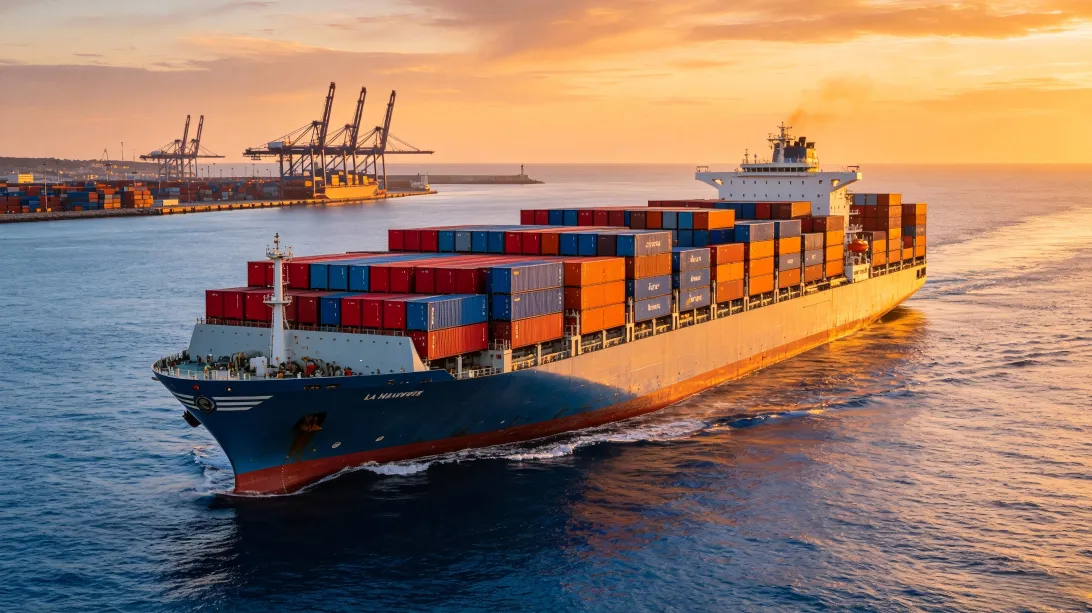
This guide prices the whole lane the way a quote should be built: sea freight by port pair, LCL per cubic meter and the 13–15 CBM point where a full container becomes cheaper, rail, air by weight band, express and DDP all-in pricing — and then the French tax and compliance stack that decides what you really pay. Every figure here is a September 2026 indicative range from a forwarder that books this corridor every week, not a live quotation; rates into Le Havre moved double digits within single months this year. Scale puts the exercise in context: French importers took delivery of roughly €19.6 billion of Chinese goods in the fourth quarter of 2025 alone, and about 60 percent of French container traffic moves through Le Havre, a port complex that closed 2025 with a record 3.2 million TEU. Our own teams run Shipping From China to France end to end from Shenzhen — booking, multi-supplier consolidation, the Chinese export declaration, the French import declaration, duty, TVA and final delivery — and if you read only one section, read the four worked scenarios in Section 9: they price the same shipment three ways, as a base rate, a landed cost, and an all-in DDP number.
Last updated: September 29, 2026.
1. The 2026 China–France cost picture at a glance
| Shipping mode | What you pay (indicative, September 2026) | Typical door-to-door transit | Best for |
|---|---|---|---|
| Sea freight FCL, 20' GP | $1,400–2,400 base ocean freight per container | 32–47 days (Suez rotation); 44–58 days (Cape routing) | Dense cargo, 15 CBM and up: machinery, metals, tiles |
| Sea freight FCL, 40' HQ | $2,400–3,900 base ocean freight per container | Same as 20' | High-volume cargo, furniture, textiles, e-commerce restock |
| Sea freight LCL | $45–95 per CBM base, roughly $110–200 per CBM all-in with consolidation at both ends | 35–50 days | Shipments under 13–15 CBM |
| Rail freight | $6,500–8,500 per 40' container; rail LCL around $190–260 per CBM | 26–32 days (direct to Lyon or Dourges) | Mid-value cargo with a 4–6 week planning window |
| Air freight | $5.00–9.00 per kg over 100 kg; $3.50–4.80 per kg above 1,000 kg (chargeable weight) | 5–8 days | High-value, light or urgent goods |
| Express courier | $9.00–15.00 per kg, all-in door-to-door | 3–5 days | Samples, documents, parcels under 30 kg |
| DDP sea, all-in | roughly $150–300 per CBM, duty and TVA included | 35–50 days | First import with no French VAT setup |
| DDP air, all-in | roughly $6.00–10.00 per kg for general cargo, duty and TVA included | 5–8 days | Amazon FBA replenishment, launches, stockouts |
Read that table with three warnings attached. First, the DDP rows and the freight rows are not the same product: a $1,400 20-foot ocean rate excludes duty, TVA, brokerage, destination terminal charges and inland delivery, while a $170 per CBM DDP sea rate includes all of them. Second, the ocean numbers are base freight only, and the standard surcharge stack on this lane — bunker, emissions, peak season, security — commonly adds 25–40 percent before your container is loaded. Third, the market itself is volatile in both directions: Drewry's composite world container index sat at $4,476 per 40-foot box on 10 September 2026, roughly flat week on week, after a July peak-season round that was largely given back through August on Asia–Europe. Booking 10–14 days ahead and fixing a rate with two to three weeks of validity is worth more than any other single action in this article.
2. What "shipping cost" actually means on this lane
Every China–France shipment has three prices, and confusing them is the most expensive mistake importers make on this corridor. The base rate is what the carrier charges to move the box or the kilogram. The landed cost is what you pay to receive the goods, duty and TVA included. The DDP all-in is a single number a forwarder gives you when it acts as the importer of record on your behalf. A quote of "$1,800 to Le Havre" and a quote of "$4,900 delivered to Lyon" can describe the exact same container.
Here is where the money actually goes on a typical commercial shipment, based on the breakdowns we run for clients:
| Cost component | Typical share of the delivered bill | Notes |
|---|---|---|
| Base freight (sea, rail or air) | 40–60% | The number everyone compares, and the most volatile |
| Chinese export clearance and origin handling | 3–6% | Pickup, export declaration, terminal handling, documentation |
| Destination terminal and port charges | 5–10% | Terminal handling, delivery order, port dues |
| French customs brokerage | 2–4% | Declaration, classification support, representation |
| Inland delivery in France | 5–10% | Le Havre or Fos to your warehouse, higher for remote regions |
| Import duty | varies by HS code | 0–17%, averaging around 4–5% across all goods |
| Import TVA | usually the largest tax line | 20% on CIF value plus duty |
What a quote usually excludes — the checklist
Ask any forwarder to state in writing whether these are inside or outside the number, because on this lane a "cheap" quote usually means several of them are outside:
- Supplier pickup and inland trucking inside China, and origin terminal handling at the loading port
- Bunker adjustment (BAF), emissions surcharges, peak season surcharge (PSS) and any war-risk or rerouting surcharge
- Destination terminal handling charges, which on this lane run roughly $150–300 per container, plus the delivery order fee
- French customs brokerage, and any customs examination fee if your file is selected
- Import duty and the 20 percent TVA — the two biggest lines on most shipments, and the two most often left dangling
- Demurrage and detention if you exceed free time, typically $50–150 per container per day after around seven days
- Inland delivery from the port to your final address, and unloading equipment or a tail-lift if the site needs one
- Cargo insurance, which costs around 0.2 percent of the declared value
- Compliance registrations in France: a fiscal representative, EPR producer registration, or the French VAT registration described in Section 8
A forwarder who answers all nine points in writing, by line item, is quoting. A forwarder who replies "all-in" and cannot name the importer of record is guessing — and the revision will arrive when your container is already at sea.
3. Sea freight costs from China to France: FCL and LCL
Around 90 percent of China–France cargo moves by water, and the destination is a three-port question rather than a single answer. Le Havre (FRLEH) is the dominant gateway for Paris, the north and the Benelux corridor; Fos-sur-Mer (FRFOS), inside the Marseille-Fos complex, serves the Rhône valley, Lyon, Toulouse and the Mediterranean arc; Dunkirk (FRDKK) is the northern third option that quotes often forget, and the natural fallback when Le Havre is congested or struck. HAROPA PORT, the Seine-axis authority covering Le Havre, Rouen and Paris, handled a record 3.2 million TEU and 84.7 million tonnes of maritime traffic in 2025, which tells you both that the volume is there and that these terminals run full.
FCL rates by port pair (September 2026 reference)
| Origin port | Destination port | 20' GP | 40' HQ | Port-to-port transit |
|---|---|---|---|---|
| Shanghai | Le Havre | $1,400–2,200 | $2,400–3,600 | 28–34 days |
| Ningbo | Le Havre | $1,450–2,250 | $2,450–3,650 | 29–36 days |
| Yantian / Shekou | Le Havre | $1,500–2,400 | $2,500–3,900 | 30–38 days |
| Shanghai / Ningbo | Fos-sur-Mer | $1,450–2,300 | $2,450–3,700 | 27–34 days |
| Yantian / Shekou | Fos-sur-Mer | $1,500–2,400 | $2,500–3,850 | 26–33 days |
| Qingdao / Tianjin | Le Havre | $1,600–2,400 | $2,600–3,900 | 32–38 days |
Three things move those numbers more than the port pair does. Routing is the first: since mid-September carriers have been pushing services back through the Suez Canal service by service, with roughly a fifth of Asia–Europe headhaul capacity now transiting the canal and the majority still on the Cape of Good Hope rotation, which adds 10–14 days and the fuel and rerouting surcharges that come with it. Congestion and labor is the second: dockworker action at Le Havre and Marseille-Fos in March and May 2026 blocked container terminals and pushed vessel delays to about a week, and post-strike backlogs kept berth waiting times elevated into the spring. Volume is the third, and it is the one you can actually influence — see Section 10.
LCL: paying by the cubic meter
LCL on this lane prices at $45–95 per CBM, charged on the greater of volume or weight at 1,000 kilograms per cubic meter, with a one-CBM minimum. That rate is the ocean leg only. Add origin consolidation, destination deconsolidation and the destination terminal charge and the effective all-in figure lands around $110–200 per CBM, which is the number you should compare against a DDP quote and against a container.
The crossover deserves its own paragraph, because it is the single easiest save on the lane. A 20-foot container holds roughly 28–33 CBM of usable volume, and on current China–France rates the FCL/LCL break-even sits at about 13–15 CBM: below it, LCL plus its fixed fees is cheaper; above it, LCL costs more per unit and takes longer. If your purchase orders from three or four suppliers add up to 16 CBM and you are shipping each one as LCL, you are paying FCL money for a worse service.
What sits on top of the ocean rate
| Charge | Typical amount (2026) | Who charges it |
|---|---|---|
| Origin terminal handling and documentation | $150–250 per container | Origin port, forwarder |
| Bunker adjustment (BAF / LSS) | $250–600 per container | Carrier |
| EU emissions (ETS) pass-through | carrier-specific, now permanent | Carrier |
| Peak season surcharge (PSS) | $100–300 per container, August–October | Carrier |
| Destination terminal handling and delivery order | $150–300 per container | Destination terminal |
| Customs brokerage in France | $100–250 per file | Customs representative |
| Demurrage / detention | $50–150 per container per day | Carrier or terminal |
| Inland delivery, Le Havre to Paris region | $300–550 per container | Haulier |
Two calendar windows widen that stack every year, and both are live now. Chinese Golden Week (1–7 October 2026) brings blank sailings on the main Asia–Europe loops and a pre-holiday booking squeeze, so cargo that must move in early October should already be booked. And on the European side, any rate you accept in the last week of September should carry an explicit validity date — the August correction on this lane showed how quickly a peak-season number can be given back.
4. Rail freight costs: the middle option, and when it wins
Rail sits between ocean and air on both axes, and on current rates it prices at $6,500–8,500 per 40-foot container with rail LCL around $190–260 per CBM. Station-to-station transit runs 18–24 days, and door-to-door 26–32 days, which means a rail box costs roughly twice a sea container and arrives roughly two weeks earlier — while a comparable air shipment would cost several times more.
The routing detail decides whether those numbers hold. Most China–Europe rail volume still routes through Duisburg, where the box is transferred to truck or onward rail for the final leg into France, and a minority of services reach French terminals directly — Lyon (Vénissieux) and Dourges — on sparse departures. If your forwarder can get you onto a direct French terminal, you save the Duisburg handling and cross-docking step; if not, plan on the Duisburg path and its slightly wider door-to-door window. For cargo that is compliance-sensitive rather than cost-sensitive, the Middle Corridor route across Kazakhstan, the Caspian, Azerbaijan and Georgia into Europe carries a 7–10 day premium over the northern route but avoids the Russian and Belarusian transit paperwork that has tightened through 2026.
Rail earns its place on mid-value cargo with a 4–6 week planning window: goods where air freight would eat the margin but where a 45-day ocean window is commercially too long, and shipments that need a rate you can lock — China–Europe rail prices have been far less volatile than ocean spot rates this year. The scale of the corridor is real: 20,022 China–Europe trains ran in 2025, and volumes rose again in early 2026. Rail is a poor fit for very low-value bulky cargo, where the per-container premium over sea cannot be recovered, and a poor fit for anything that has to arrive in ten days.
5. Air freight costs per kilogram into Paris CDG
Air freight prices by chargeable weight — the greater of actual weight and volumetric weight, calculated on the industry 6,000 divisor in cubic centimeters. Practically: one cubic meter of cargo that weighs less than about 167 kilograms is billed as 167 kilograms. Light, bulky goods are therefore more expensive to fly than their scale weight suggests, and the difference is regularly the reason a quote surprises an importer.
| Chargeable weight band | Typical rate range (USD/kg) | Best for |
|---|---|---|
| 45–100 kg | $5.50–8.50 | Samples, urgent parts, small commercial shipments |
| 100–300 kg | $4.50–6.50 | Mid-volume electronics, fashion restocking |
| 300–1,000 kg | $3.80–5.50 | Bulky air freight, high-value inventory |
| 1,000 kg and above | $3.50–4.80 | Consolidated or contracted volumes |
Direct flights from Shanghai Pudong, Guangzhou Baiyun, Shenzhen, Beijing and Hong Kong reach Paris Charles de Gaulle, Lyon and Marseille in 12–18 hours of flying time; the door-to-door reality is 5–8 days, of which only one day is in the air. Indirect routings through Dubai, Doha, Istanbul or Frankfurt price lower but add two to five days. The surcharge stack is where air quotes diverge: fuel surcharges adjusted monthly, a security fee that is mandatory on all international cargo, terminal handling at both airports, customs brokerage, and last-mile delivery from CDG to your address or to a French Amazon fulfillment center. Air makes commercial sense below roughly 200 kilograms, or whenever the value density and the cost of a stockout are high enough to justify the premium; above that, compare an air quote against a slightly slower rail or LCL option before committing. Our transit-time guide for this lane breaks the same options down day by day, including the Suez-versus-Cape split that changes arrival dates by more than a week within the same booking month.
6. Express courier versus DDP: the all-in comparison
Express is the simplest price on the lane and the most expensive per kilogram: $9.00–15.00 per kilogram all-in door-to-door, with duty and TVA typically collected on delivery rather than included, and transit of 3–5 days. It is the right answer for samples, documents, a launch date you cannot move, or any parcel under about 30 kilograms. Above 100 kilograms the arithmetic collapses — a 300-kilogram express shipment at $12 per kilogram is $3,600 before taxes, against roughly $1,400–1,950 of air freight at the 100–300 kilogram band plus clearance.
DDP is the opposite construction: one number that covers pickup in China, export clearance, freight, French import clearance, duty, the 20 percent TVA and delivery to your door or to an Amazon FBA center such as CDG7 (Senlis), ORY1 (Saran), LIL1 (Lauwin-Planque), LYS1 (Sevrey), MRS1 or BVA1 (Boves). On this lane that all-in number commonly quotes at roughly $150–300 per CBM by sea and $6.00–10.00 per kilogram by air for general cargo. Those two figures are not comparable with anything else in this article, and this is the single most misread point in China–France pricing: a DDP rate is quoted per unit of transport, but the duty and TVA inside it scale with the declared value, so the effective rate rises as value density rises. Two DDP quotes for the same pallet can differ by 100 percent because one assumes a declared value of $4 per kilogram and the other $20.
Five questions to ask a DDP provider before you book
- Whose EORI and VAT number will clear this shipment? A compliant answer names a French registration and the entity that holds it. Since 1 January 2026 a forwarder cannot clear a Regime 42 import under a borrowed or one-off representative VAT number, so "we use our agent's number" is no longer an answer.
- Is every destination charge inside the number — terminal handling, delivery order, brokerage, port dues — or will those arrive as separate invoices?
- What declared value and what HS code are you pricing? If the answer is vague, the quote will be revised after your cargo has sailed.
- Who is the importer of record, and can I reclaim the TVA? If the forwarder clears under its own registration, the 20 percent TVA sits on the forwarder's books and you cannot recover it. If you clear under your own EORI, it is recoverable or auto-liquidated on your return.
- What happens if customs reclassifies the goods and the duty rate rises? A fixed DDP price with a written reclassification clause is a service; a fixed price with silence is a dispute.
Our door-to-door shipping service is built on the first answer: we clear as importer of record under our own French registrations, so an importer with no French EORI, no French VAT number and no fiscal representative can still take delivery, while importers who want the TVA on their own return can clear under their own number instead.
7. The French tax stack: duty, TVA and the €3 rule
Two taxes sit on top of everything above, and both are calculated on the CIF value — the goods, plus international freight, plus insurance.
Import duty is set by the EU's TARIC schedule according to the HS code of your product, and ranges from 0 to roughly 17 percent, averaging around 4–5 percent across all goods. The category spread is wide enough that classification decisions are worth real money: electronics and many machine parts enter at 0–2 percent, textiles and apparel sit near 12 percent, most furniture is 0 percent, and bicycles attract 14 percent plus possible anti-dumping duties. If your supplier's invoice describes a product in general terms, you are trusting someone else's classification with your duty rate.
Import TVA is the standard 20 percent, with reduced rates of 5.5 percent for a small list of goods including books and certain food products, and is assessed on the CIF value plus the duty. This is the largest single line on most China–France shipments, and it is also the most misunderstood. Since January 2022 France has applied mandatory auto-liquidation (autoliquidation) of import TVA: a VAT-registered importer declares and deducts the import TVA on the same CA3 return instead of paying cash at the border. For a regular importer that is a working-capital benefit worth tens of thousands of euros a year, and for everyone else it is a genuine cost. The mechanism and the reporting obligations are set out by the French tax authority and enforced through French customs.
Worked example on a €10,000 shipment with €1,200 of freight and insurance:
| Line | Calculation | Amount |
|---|---|---|
| Goods value | — | €10,000 |
| Freight and insurance | — | €1,200 |
| Customs value (CIF) | €10,000 + €1,200 | €11,200 |
| Import duty at 4.5 percent | €11,200 × 4.5% | €504 |
| Import TVA at 20 percent | (€11,200 + €504) × 20% | €2,341 |
| Total tax | €504 + €2,341 | €2,845 |
Change the commodity to apparel at 12 percent duty and the same shipment carries €1,344 of duty and €2,509 of TVA — €3,853 in tax, a difference of more than a thousand euros created by an HS code line rather than by anything the carrier did.
Two newer layers apply to low-value consignments, and they are the change most e-commerce sellers have not yet priced in. Since 1 July 2026 the EU's €150 duty exemption is gone, replaced by a flat €3 customs duty per item under the temporary relief regime that runs until 1 July 2028, with product identifier data mandatory from 1 November 2026. From the same date, the customs reform package published on 19 September 2026 creates the legal basis for an EU handling fee of around €2 per declaration line item, with the final amount to be fixed by delegated act. Stacked together, a compliant low-value line now carries roughly €5 in EU-level charges before French TVA — which is why parcel-level DDP economics changed this year while container economics did not. Commercial shipments above €150 were never covered by the relief and continue to be assessed normally.
8. Compliance costs: EORI, Regime 42 and who signs the declaration
Freight is negotiated in dollars; the ability to clear your goods in France is decided by registrations, and 2026 changed the rules on both sides of that line.
The EORI format changed on 1 January 2026. France now issues EORI numbers based on the 9-digit SIREN identifier through the pro.douane.gouv.fr portal; SIRET-level numbers no longer clear goods. Any commercial import requires one, and a supplier or forwarder still quoting an old-format number is a sign nobody has tested your file this year.
One-off fiscal representation for Regime 42 was abolished on 1 January 2026. Under Customs Procedure 42 a non-EU company could import into France without paying VAT at entry and dispatch the goods onward to another EU member state, appointing a forwarder as an occasional tax representative and using that representative's French VAT number. The Finance Act 2024, extended by the tax doctrine BOI-RES-TVA-000207 of 14 May 2025, ended that mechanism: one-off representative VAT numbers are no longer valid, and a forwarder can no longer declare a Regime 42 import under its own number on behalf of a third-party company. The procedure itself survives — the simplified route into it does not. A non-EU importer that wants to keep using France as an entry point for onward EU distribution now typically needs its own French VAT registration and ongoing CA3 filings, with a permanent fiscal representative where the law requires one; registration alone commonly takes 40–45 days to process, and the annual administrative cost of the full setup is generally put at €2,500–6,000 depending on flow volume.
The alternative introduced by Decree 2025-153 of 18 February 2025 is the Import Agent under Article 289 A bis of the French General Tax Code. It is a narrow, heavily conditioned role: the agent must be established and VAT-registered in France for at least one year, must hold a written mandate from the foreign company, must have a direct contractual relationship with the goods, and is jointly liable for the VAT. It also does not cover Regime 42 flows — it cannot substitute for an importer's VAT registration. Where it does apply is the ordinary case of goods imported into France and used or sold in France.
For importers who want neither a VAT registration nor an agent mandate, the practical route is to ship DDP with a forwarder that clears under its own French registration as importer of record — the model we run, and the reason a first shipment can land in Lyon without the buyer owning a French VAT number. The trade-off is the one from Section 6: under that structure the TVA is not yours to reclaim. A French VAT registration is what lets you do the opposite — clear under your own EORI and auto-liquidate the 20 percent on your own return.
The rest of the compliance stack costs money in smaller, less visible ways. EPR and the Triman logo are enforced on packaging sold or delivered in France, with a CITEO producer identifier required; CE marking, the EU responsible person under GPSR and REACH obligations attach to specific product categories; and since ICS2 completed its rollout an entry summary declaration must be lodged before arrival rather than at the border. Document errors are their own cost line: a wrong HS code, a missing certificate or a mis-declared importer of record can hold a container in a Le Havre yard for weeks, and at $50–150 per box per day of demurrage and detention that hold is more expensive than the freight difference you were shopping for. Customs records must be kept three years and VAT records six. Our customs clearance service covers classification support, declaration filing and representation on both the export and import side, which is usually where a first-time importer discovers the actual cost of getting this wrong.
9. Four worked scenarios: the same lane, four different answers
The following four shipments came out of real client profiles. Each table shows what the shipment costs to receive, excluding the value of the goods themselves, and every tax figure is calculated on the CIF value, not on the invoice price.
Scenario A: 12 CBM of home textiles, Guangzhou (Nansha) to Lyon — goods value $9,000, duty 12%
| Line | Low | High |
|---|---|---|
| LCL ocean freight, 12 CBM at $45–95 per CBM | $540 | $1,140 |
| Insurance at 0.2 percent of goods value | $18 | $18 |
| CIF customs value | $9,558 | $10,158 |
| Import duty at 12 percent | $1,147 | $1,219 |
| Import TVA at 20 percent | $2,141 | $2,275 |
| Origin pickup, export declaration, consolidation | $150 | $280 |
| Destination deconsolidation, terminal handling and delivery order | $220 | $400 |
| French customs brokerage | $100 | $250 |
| Inland delivery Nansha-to-Lyon leg in France | $180 | $350 |
| Total excluding goods, including tax | $4,496 | $5,932 |
| of which recoverable by a VAT-registered importer | $2,141 | $2,275 |
The lesson in this scenario is the break-even: at 12 CBM the shipment sits just under the 13–15 CBM crossover, so LCL is still the cheaper choice — but only just, and the gap disappears if a fourth supplier adds three cubic meters. The second lesson is the duty rate: at 12 percent, apparel taxes are more than three times the ocean freight.
Scenario B: one 20' GP of hardware and tools, Shanghai to Le Havre and on to Lille — goods value $18,000, duty 3%
| Line | Low | High |
|---|---|---|
| Base ocean freight, 20' GP | $1,400 | $2,400 |
| Bunker, emissions and peak-season surcharges | $250 | $600 |
| Insurance at 0.2 percent of goods value | $36 | $36 |
| CIF customs value | $19,686 | $21,036 |
| Import duty at 3 percent | $591 | $631 |
| Import TVA at 20 percent | $4,055 | $4,333 |
| Origin terminal handling, documentation and booking | $150 | $250 |
| Destination terminal handling and delivery order | $150 | $300 |
| French customs brokerage | $100 | $250 |
| Inland delivery Le Havre to Lille | $350 | $600 |
| Total excluding goods, including tax | $7,082 | $9,400 |
| of which recoverable by a VAT-registered importer | $4,055 | $4,333 |
This is the profile the lane rewards: a dense, medium-value container with a low duty rate. Note how the surcharge line can grow to 40 percent of the base ocean rate, and how the TVA dwarfs every service charge in the table — which is exactly why the importer-of-record question in Section 6 is a cost question, not a paperwork question.
Scenario C: 300 kg of electronics accessories air freighted, Shenzhen to Paris — goods value $6,000, duty 2%
| Line | Low | High |
|---|---|---|
| Air freight, 300 kg at $4.50–6.50 per kg | $1,350 | $1,950 |
| Insurance at 0.2 percent of goods value | $24 | $24 |
| CIF customs value | $7,362 | $7,962 |
| Import duty at 2 percent | $147 | $159 |
| Import TVA at 20 percent | $1,502 | $1,624 |
| Origin handling, screening and export documentation | $120 | $250 |
| Destination airport handling and customs brokerage | $150 | $300 |
| Delivery from CDG to a Paris warehouse | $120 | $250 |
| Total excluding goods, including tax | $3,521 | $4,795 |
| of which recoverable by a VAT-registered importer | $1,502 | $1,624 |
Air is defensible here because the goods are urgent and lightly taxed — but the same 300 kilograms of home textiles at 12 percent duty would carry almost three times the duty, and that is the point at which most importers should be looking at rail at $6,500–8,500 per 40-foot container or a consolidated LCL booking instead.
Scenario D: one 40' HQ e-commerce replenishment, Ningbo to Amazon CDG7 (Senlis) — goods value $40,000, duty 4.5%
| Line | Low | High |
|---|---|---|
| Base ocean freight, 40' HQ | $2,400 | $3,900 |
| Bunker, emissions and peak-season surcharges | $300 | $700 |
| Insurance at 0.2 percent of goods value | $80 | $80 |
| CIF customs value | $42,780 | $44,680 |
| Import duty at 4.5 percent (mixed consumer goods) | $1,925 | $2,011 |
| Import TVA at 20 percent | $8,941 | $9,338 |
| Origin terminal handling, documentation and booking | $200 | $350 |
| Destination terminal handling and delivery order | $180 | $350 |
| French customs brokerage | $120 | $250 |
| Inland delivery Le Havre to Senlis | $300 | $500 |
| Total excluding goods, including tax | $14,446 | $17,479 |
| of which recoverable by a VAT-registered importer | $8,941 | $9,338 |
A full container brings the fixed charges down per unit — the service cost is $5,505–8,141 once the recoverable TVA is set aside — but it also concentrates the largest cash-flow item on the lane into one declaration. An importer registered for French VAT declares those $8,941–9,338 on the same CA3 return and deducts them; an importer shipping DDP pays them inside the rate and never sees them again. Both are legitimate. Only one is cheaper, and which one depends on whether you have the registration.
The four scenarios side by side
| Scenario | Goods value | Cost to receive, including duty and TVA, excluding goods | Cost to receive as a share of goods value |
|---|---|---|---|
| A — 12 CBM textiles, LCL to Lyon | $9,000 | $4,496–5,932 | 50–66% |
| B — 20' GP hardware to Lille | $18,000 | $7,082–9,400 | 39–52% |
| C — 300 kg air to Paris | $6,000 | $3,521–4,795 | 59–80% |
| D — 40' HQ to Amazon CDG7 | $40,000 | $14,446–17,479 | 36–44% |
That last column is the number to hold onto when you price your products: on this lane the cost of getting goods from a Chinese factory to a French shelf ranges from a third of goods value on full containers to four-fifths on small, urgent air shipments.
10. Seven levers that actually reduce the cost
- Consolidate to the break-even, then switch modes. Every additional cubic meter on an LCL booking pushes you toward the 13–15 CBM point where a 20-foot container becomes cheaper and faster. Ten CBM from three suppliers consolidates into one shipment, one export declaration and one set of destination fees.
- Fix a rate with a validity date, and book 10–14 days out. The August 2026 correction on Asia–Europe showed how quickly peak-season money is given back; a quote without an expiry is not a rate.
- Plan around the calendar. Golden Week (1–7 October 2026) blanks sailings and squeezes space before and after it, peak season surcharges run roughly August to October, and a container that misses its intended vessel inherits the next available sailing's price.
- Compare landed cost, not freight rates. A $1,400 ocean rate plus destination charges and brokerage can be more expensive than a $1,700 rate quoted with the destination side included. If you want the mode-by-mode cost comparison in one place, our cheapest-way breakdown for this lane walks it through shipment size by shipment size.
- Get the HS code and the declared value right. Duty ranges from 0 to 17 percent, so classification is where the cheapest margin is won or lost — and the CIF basis means freight is taxed too, which is worth remembering when you negotiate the ocean rate.
- Decide who the importer of record is before you book. With a French VAT registration you auto-liquidate the 20 percent TVA and stop pre-financing it. Without one, DDP is the practical route, and the TVA sits inside the rate.
- Choose the gateway deliberately. Le Havre handles roughly 60 percent of French container traffic and serves Paris and the north; Fos-sur-Mer is several days faster on a Suez rotation and the natural fallback when northern terminals are disrupted; Dunkirk is the third option. The port complex's own numbers (HAROPA PORT recorded 3.2 million TEU in 2025) tell you these terminals run full — routing around a disruption is cheaper than waiting through one.
Add the two cheap disciplines to that list: insure the cargo at around 0.2 percent of declared value, and return the empty box inside free time, because detention at $50–150 per day erases a negotiated rate advantage in a week.
11. FAQ: China to France shipping costs
How much does it cost to ship a 20-foot container from China to France in 2026? Base ocean freight runs $1,400–2,400 for a 20-foot container into Le Havre or Fos-sur-Mer, and $2,400–3,900 for a 40-foot high cube. Surcharges typically add 25–40 percent, destination terminal handling adds $150–300, and duty plus 20 percent TVA are assessed on the CIF value. A deliverable figure for a mid-value container including French inland delivery is usually in the $4,500–7,500 range before TVA.
How much does LCL shipping from China to France cost per cubic meter? $45–95 per CBM for the ocean leg, charged on the greater of volume or weight at 1,000 kilograms per cubic meter, with a one-CBM minimum. Once origin consolidation, destination deconsolidation and terminal charges are added, budget $110–200 per CBM all-in, or roughly $150–300 per CBM on a DDP basis with duty and TVA included. The LCL-to-FCL break-even sits at about 13–15 CBM.
How much is air freight from China to France per kilogram? $5.00–9.00 per kilogram for shipments over 100 kilograms, falling to $3.50–4.80 per kilogram above 1,000 kilograms of chargeable weight. Under 100 kilograms express courier is typically $9.00–15.00 per kilogram all-in door-to-door. Volumetric weight is calculated on a 6,000 divisor, so one cubic meter of light cargo is billed as approximately 167 kilograms.
What is the total landed cost including duty and TVA? Take the CIF value (goods plus freight plus insurance), add import duty of 0 to 17 percent depending on the HS code, then add 20 percent TVA on the CIF value plus the duty. On a €10,000 shipment with €1,200 of freight and insurance, duty averages €504 and TVA €2,341 — about €2,845 in tax, or 28 percent of the goods value. A VAT-registered importer auto-liquidates the TVA on the same CA3 return instead of paying cash at the border.
Is DDP cheaper than FOB or CIF? Not automatically. DDP removes the need for a French EORI, a VAT registration and a fiscal representative, and it turns several invoices into one — but the duty and TVA inside a DDP rate are real costs that a VAT-registered importer could otherwise declare and deduct. DDP is usually cheaper in total for first shipments, SME importers and e-commerce sellers without a French tax footprint; FOB or CIF plus your own registration is usually cheaper once you ship regularly and can use auto-liquidation.
Do I need a French EORI or VAT number to import into France? You need an EORI for any commercial import — since 1 January 2026 the 9-digit SIREN-based format, issued through pro.douane.gouv.fr. Importing under your own name also requires French VAT registration, and since the end of one-off fiscal representation for Regime 42 on 1 January 2026 there is no simplified route around that. If you do not have either, shipping DDP where the forwarder is importer of record is the practical alternative.
What does a China–France shipping quote usually exclude? Most often: origin pickup and terminal handling, bunker and emissions surcharges, peak-season surcharge, destination terminal handling and delivery order, French customs brokerage, import duty, the 20 percent TVA, inland delivery, cargo insurance, and any demurrage. Ask for those nine lines to be confirmed in writing before you compare two quotes.
What is the cheapest way to ship from China to France? For volume, sea freight FCL: a 40-foot container at $2,400–3,900 of base ocean freight carries more cargo per dollar than any other mode on this lane. For shipments under about 13 CBM, LCL at $45–95 per CBM is cheaper. Rail at $6,500–8,500 per 40-foot container is the cheapest option that is materially faster than the ocean, and express courier is the most expensive way to move anything, which is why it should stay reserved for parcels, samples and genuinely urgent cargo.
Work with a forwarder who prices the French lane, not just the ocean leg
The rate on this corridor is the easy part. What decides your cost is everything after the vessel sails: which French registration clears the goods, whether the duty and TVA are inside or outside the number, whether the destination charges arrive as one invoice or four, and whether your container is released in three days or sits in the yard drawing demurrage. AllBestShipping runs the China–France lane from our Shenzhen base — multi-supplier consolidation, booking on both Suez and Cape rotations, export clearance in China, French import declaration, duty and TVA, and delivery to a warehouse, a shop or an Amazon FBA center — and every quote states the importer of record, the CIF basis and the excluded charges in writing. Send us your supplier list, HS codes and delivery postcode, and we will come back with a landed-cost breakdown rather than a headline rate.