Container Shipping From China to Belgium: The Complete 2026 Guide (FCL, LCL, DDP & EU Gateway Strategy)
Container shipping from China to Belgium is one of the most efficient ways to move goods into the heart of Europe — but only if you understand port selection, customs regulations, and inland distribution. Belgium is China's sixth-largest trading partner in the EU, with bilateral trade exceeding $30 billion annually. Yet every week, importers lose money because they chose the wrong container size, misclassified HS codes, or failed to account for Antwerp's seasonal congestion. Whether you are moving a full container of machinery or a partial load of e-commerce inventory, getting the logistics right from day one determines your landed cost and delivery timeline. If you are new to importing, our guide on how to ship from China covers the fundamentals. At AllBestShipping, we manage container shipments from Shenzhen, Shanghai, Ningbo, and other major Chinese ports to Antwerp, Zeebrugge, and Liège every week. A client recently saved 18% on total landed costs by switching from air freight to our tailored sea-rail combination via Liège — without missing their inventory restock deadline.
Why Belgium? The Strategic EU Gateway Advantage
Belgium is not just a destination — it is a distribution springboard. Once your container clears customs in Belgium, the EU customs union allows it to move freely across all 27 member states without additional border checks.
Port of Antwerp-Bruges
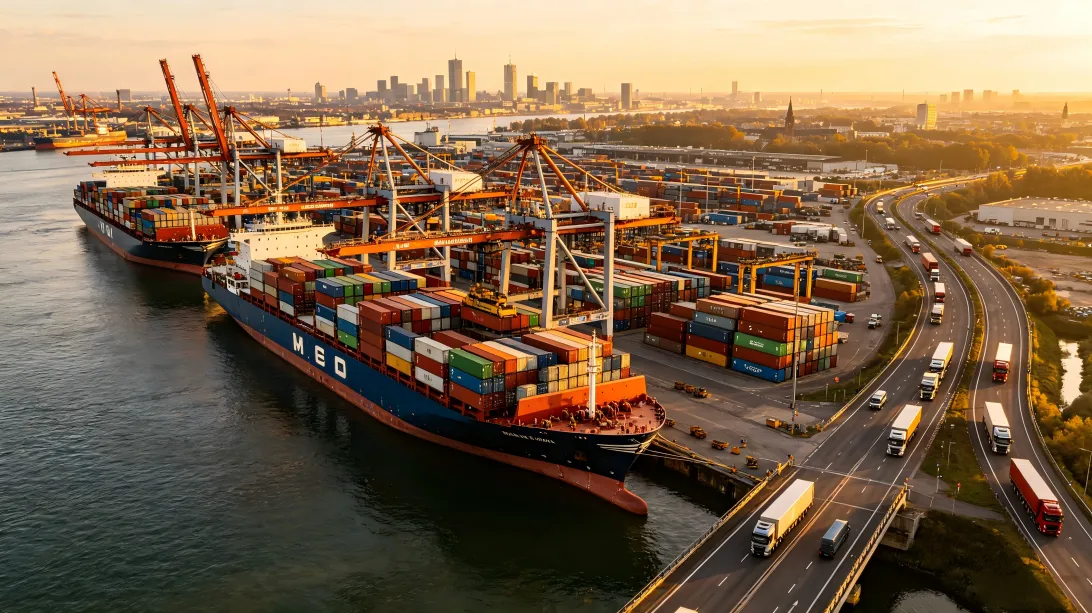
The Port of Antwerp-Bruges is the second-largest container port in Europe, handling over 13.5 million TEU annually. It offers deep-water access and an unmatched hinterland network connecting to the Rhine, the Ruhr industrial region, and northern France. For general containerized cargo — electronics, textiles, machinery — Antwerp is the default choice.
Port of Zeebrugge
Port of Zeebrugge handles roughly 3 million TEU and specializes in automotive logistics, ro-ro cargo, and perishables. Post-Brexit, Zeebrugge has grown as a UK trade gateway. In our experience, Zeebrugge often delivers faster discharge than Antwerp during Q4 peak season. If your final market includes the UK, see our door to door shipping from China to UK service.
Inland Connectivity
From Antwerp or Zeebrugge, cargo reaches Cologne, Frankfurt, or Düsseldorf by rail within 24 hours. Paris and Lyon are reachable via trucking corridors in under 48 hours. The Netherlands is connected by barge links that are cheap and reliable. For pan-European distribution, shipping from China to Europe through Belgium and trucking outward is almost always cheaper than booking separate shipments to multiple EU ports.
Shipping Methods Overview: Choosing the Right Mode
Not every shipment needs a 40-foot container. Not every urgent order justifies air freight.
| Shipping Method | Typical Cost | Transit Time | Best For |
|---|---|---|---|
| Sea Freight FCL | $2,500 – $4,500 per container | 28 – 40 days | Bulk cargo, heavy goods, pallets |
| Sea Freight LCL | $55 – $120 per CBM | 30 – 45 days | Shipments under 15 CBM |
| Rail Freight | $4,500 – $8,500 per container | 12 – 22 days | Mid-value cargo, inventory replenishment |
| Air Freight | $4.50 – $9.00 per kg | 5 – 10 days | Urgent, high-value, perishable |
| Express/Courier | $6.00 – $12.00 per kg | 3 – 7 days | Samples, documents, small parcels |
For most B2B importers, sea freight from China is the default. Ocean freight moves roughly 90 percent of global trade volume by weight, and the frequency of sailings from Shanghai, Shenzhen, and Ningbo ensures you rarely wait more than a few days for the next vessel. If your shipment is too big for air but too small for a full container, rail freight to Liège has become an increasingly popular middle option — especially when ocean rates spike or Red Sea disruptions force carriers around the Cape of Good Hope.
FCL Shipping From China to Belgium
FCL (Full Container Load) means booking an entire container exclusively for your cargo. It is the most cost-effective option when your shipment exceeds roughly 15 CBM, and it offers better cargo security because your seal is the only one on the container door.
Container Types and Dimensions
| Container Type | Internal Dimensions | Payload Capacity | Best For |
|---|---|---|---|
| 20GP | 5.9m × 2.35m × 2.39m | ~28,000 kg | Heavy, dense cargo (steel, tiles, machinery) |
| 40GP | 12.03m × 2.35m × 2.39m | ~26,500 kg | General cargo, pallets, furniture |
| 40HQ (High Cube) | 12.03m × 2.35m × 2.69m | ~26,500 kg | Volumetric cargo, extra height needed |
Specialized options include reefer containers for temperature-controlled goods, open-top units for oversized machinery, and flat-rack containers for heavy equipment that cannot fit through standard doors.
Origin Port Selection
Your choice of Chinese port should be driven by manufacturing proximity and carrier frequency:
- Shanghai: World's busiest container port. Highest sailing frequency to Antwerp. Best for Yangtze River Delta cargo.
- Shenzhen / Yantian: Ideal for electronics and e-commerce. Direct services to Zeebrugge are growing.
- Ningbo: Strong for textiles and machinery. Competitive rates.
- Qingdao / Tianjin: Northern gateways. Slightly higher rates but necessary for Shandong and Hebei suppliers.
FCL from Shanghai to Antwerp is the most mature lane — daily sailings, multiple carriers, and the most competitive base rates. If your supplier is in Guangdong, Shenzhen to Zeebrugge can shave two to three days off transit.
Direct vs. Transshipment
- Direct services sail straight from China to Belgium without intermediate stops. Transit is 28-32 days, but sailings are less frequent.
- Transshipment services route through Singapore, Colombo, or Algeciras, adding 3-7 days but offering more flexible departure dates and often lower rates off-peak.
If you have a hard deadline — e.g., replenishing Amazon inventory before Prime Day — direct is worth the premium. For standard stock, transshipment is perfectly fine.
FCL Costs Breakdown
Disclaimer: The cost ranges below are market estimates based on AllBestShipping's carrier contracts and spot-rate observations as of June 2026. Actual rates vary. Always request a fresh, itemized quote before booking.
Your ocean freight invoice typically includes:
- Base ocean freight: The port-to-port rate quoted by the carrier.
- BAF (Bunker Adjustment Factor): Fuel price fluctuations.
- CAF (Currency Adjustment Factor): Exchange rate swings.
- THC (Terminal Handling Charges): Origin and destination port handling fees.
- Documentation and sealing fees: B/L issuance, customs forms, container seal.
- Peak season surcharges: Applied during high-demand periods (Q3-Q4).
At AllBestShipping, we quote all-in rates with 2-3 week validity. If a forwarder quotes a base rate without mentioning BAF or THC, ask for the fully loaded number.
LCL Shipping From China to Belgium (LCL Shipping Guide)
LCL (Less than Container Load) is the answer when your cargo does not fill a container. Your shipment shares space with other importers' goods, and you pay only for the volume you use — priced per CBM.
When LCL Makes Sense
The break-even between LCL and FCL is around 12 to 15 CBM. Below that, LCL is almost always cheaper. Above it, FCL wins on per-unit economics:
| Scenario | Volume | LCL Cost | FCL Cost | Best Option |
|---|---|---|---|---|
| Small electronics shipment | 5 CBM | ~$400 | ~$2,800 | LCL |
| Mid-size furniture order | 12 CBM | ~$960 | ~$3,200 | LCL (marginal) |
| Full palletized inventory | 18 CBM | ~$1,440 | ~$3,200 | FCL |
Because LCL requires consolidation at origin and deconsolidation at destination, transit is 3-7 days longer than FCL and cargo gets handled more times — proper packaging is essential. For LCL from Shenzhen to Belgium, we consolidate at our Shenzhen warehouse before routing through Yantian for quality control.
LCL Costs by Destination
| Destination Port | Typical LCL Rate (per CBM) | Notes |
|---|---|---|
| Antwerp | $55 – $85 | Largest CFS network; lowest handling fees |
| Zeebrugge | $60 – $90 | Good for UK-bound onward distribution |
| Brussels (via Antwerp) | $75 – $110 | Inland trucking adds cost |
If your goal is the cheapest way to ship containers from China to Belgium for small volumes, LCL to Antwerp is almost always the answer.
How Long Does Sea Freight Take From China to Belgium?
Transit Times by Major Route
| Origin Port | Destination Port | Transit Time (Days) | Service Type |
|---|---|---|---|
| Shanghai | Antwerp | 30 – 35 | Direct / Transshipment |
| Shenzhen / Yantian | Zeebrugge | 28 – 32 | Direct |
| Shenzhen / Yantian | Antwerp | 35 – 40 | Transshipment |
| Ningbo | Antwerp | 30 – 34 | Direct / Transshipment |
| Qingdao | Antwerp | 35 – 40 | Transshipment |
| Tianjin | Antwerp | 38 – 42 | Transshipment |
These are port-to-port times. Add 3-7 days for origin handling and 2-5 days for destination clearance and unloading.
Factors That Affect Transit Time
- Transshipment delays: Hub ports like Singapore or Colombo can experience congestion.
- Red Sea disruptions: Geopolitical events forcing carriers around the Cape of Good Hope add 10-14 days.
- Port congestion at Antwerp: Q4 peak (September-December) often triggers vessel queuing.
- Chinese holidays: Chinese New Year (January/February) and Golden Week (October) create bottlenecks.
- Customs inspections: Random scans or HS code disputes can hold cargo for 2-7 days.
Seasonal Booking Calendar
| Period | Market Condition | Booking Advice |
|---|---|---|
| Jan – Mar | Post-CNY recovery; rates stabilize | Book 3-4 weeks ahead |
| Apr – Jun | Early peak; moderate rate climbs | Book 4-5 weeks ahead |
| Jul – Sep | Pre-holiday rush; equipment shortages | Book 6-8 weeks ahead; lock rates early |
| Oct – Dec | Peak surcharges; port congestion | Book 8+ weeks ahead; consider Zeebrugge to bypass Antwerp delays |
Belgian Ports Decoded
- Antwerp: Default choice for general cargo. Widest carrier options, best hinterland rail/barge network.
- Zeebrugge: Faster discharge during peak. Specializes in automotive, ro-ro, and perishables.
- Ghent: Bulk commodities, project cargo, strong inland waterway connections to France.
Smart importers keep Zeebrugge as a backup when Antwerp congestion surcharges appear.
Beyond the Port: Inland Distribution Across Europe
Once your container clears Belgian customs, you are plugged into Europe:
- To Germany: Rail from Antwerp reaches Cologne, Düsseldorf, and Frankfurt within 24 hours. If Germany is your primary market, explore our shipping from China to Germany service.
- To France: Trucking to Paris in under 6 hours, with onward rail freight to Lyon. We also offer door to door shipping from China to France.
- To the Netherlands: Barge connections to Rotterdam and Amsterdam within 12-24 hours.
For e-commerce sellers, this means holding inventory in a Belgian bonded warehouse and fulfilling orders to Germany, France, and the Netherlands without re-clearing customs.
Customs Clearance for Container Shipments to Belgium
Belgian customs are efficient but strict. Missing one document can cost you days and hundreds of euros in storage fees.
EORI Registration
An EORI number (Economic Operators Registration and Identification) is mandatory for any business importing into the EU. Apply through the Belgian customs portal at least two weeks before your vessel departs China. Processing takes 3-10 business days and is free.
Required Documentation
- Commercial Invoice — precise product descriptions and accurate declared values in EUR/USD.
- Packing List — itemized list matching the invoice; weight and dimensions per carton.
- Bill of Lading (B/L) or Sea Waybill — proof of shipment.
- Certificate of Origin — required for certain trade agreements.
- HS Code Classification — determines your duty rate; accuracy is critical.
Import Duties and VAT
- Import VAT: 21% for most goods, calculated on CIF value plus import duties.
- Customs duties: Vary by HS code — electronics ~5%, textiles up to 12%, machinery 0-8%.
- Duty exemption: Shipments with FOB value ≤ €150 are exempt from customs duties (VAT still applies).
- VAT deferment: Registered Belgian businesses can apply for deferred VAT accounting.
Common Delays
- Misclassified HS codes: Belgian customs actively audits electronics and textiles. Request a BTI ruling when uncertain.
- Undervalued invoices: Customs has pricing databases. Under-declaring invites penalties.
- Missing EORI: Verify your EORI is active before the ship sails.
- Container inspections: Random scans increase during peak. Proper labeling and documentation reduce your odds.
Incoterms 2020: Choosing the Right Terms
Your Incoterms 2020 choice determines who pays for freight, insurance, and customs — and who bears the risk.
| Incoterm | Seller Pays | Buyer Pays | Best For |
|---|---|---|---|
| EXW | Nothing (factory gate) | Everything | Experienced importers with own broker |
| FOB | Goods + loading onto vessel | Ocean freight, insurance, destination charges, Belgian customs | Buyers wanting carrier control |
| CIF | Goods + ocean freight + insurance to Antwerp | Belgian customs, duties, VAT, inland delivery | Buyers with EU customs expertise |
| DDP | Everything — freight, duties, VAT, delivery | Nothing | SMEs, first-time importers, e-commerce sellers |
Why DDP Is Popular
Under DDP (Delivered Duty Paid), your forwarder handles everything including Belgian VAT and duties. For buyers without an in-house customs team, DDP eliminates compliance risk and provides upfront cost certainty. The trade-off is a premium for convenience and less visibility into the customs process.
Insider tip: If you import more than four containers per year, consider building a relationship with a Belgian customs broker and handling clearance under FOB or CIF. The savings on DDP markup often exceed €200-400 per container — but only if your documentation is flawless.
At AllBestShipping, we offer DDP door-to-door shipping from Shenzhen, Shanghai, and Ningbo to any Belgian address. For clients with their own broker, we also provide FOB and CIF options.
Amazon FBA Shipping and E-Commerce Logistics
Belgium is a strategic launchpad for European Amazon sellers. Liège Airport (LGG) and the Port of Antwerp sit within hours of major Amazon EU fulfillment centers in Germany, France, and the Netherlands.
FBA Shipping Options
- FCL direct to Antwerp: Best for high-volume sellers. Trucking to Amazon FCs takes 24-48 hours.
- LCL consolidation: Ideal for smaller sellers testing the European market.
- Rail freight to Liège: Sweet spot for mid-volume replenishment — 12-18 days transit, faster than sea and cheaper than air.
FBA Prep and Compliance
Amazon EU enforces strict receiving requirements: FNSKU-labeled cartons, EU-spec pallets (1,200mm × 1,000mm), and accurate packing lists. Non-compliant shipments are rejected at the FC door.
E-commerce sellers also need to consider VAT registration. If you store inventory in Belgium or fulfill to EU customers, you likely need a Belgian or EU VAT number. DDP shipping simplifies this by having your forwarder handle import VAT at the border.
Cargo Insurance and Risk Management
Ocean freight is generally safe, but a 30-day voyage involves real risks. Carrier liability is limited by international conventions (Hague-Visby Rules), and compensation often does not cover full cargo value.
Insurance Types
- Institute Cargo Clauses (C): Covers major casualties — fire, sinking, collision. Cheapest but narrow.
- Institute Cargo Clauses (B): Adds coverage for water damage, theft, and some handling risks.
- Institute Cargo Clauses (A) — All Risk: Broadest coverage. Recommended for electronics, machinery, and high-value goods.
Common Risks
- Container moisture: Condensation on long voyages. Use desiccants for electronics and textiles.
- Transshipment handling: Every lift at a hub carries small damage risk.
- Port strikes: Antwerp has experienced labor disruptions. A good forwarder monitors labor news and can reroute to Zeebrugge.
- Seal integrity: Always verify the container seal number at loading and check for tampering at delivery.
Most major carriers now offer real-time tracking. At AllBestShipping, we aggregate carrier feeds into a single dashboard so clients don't need to check multiple websites.
Cost-Saving Strategies for Container Shipping to Belgium
- Consolidate shipments: Ship three suppliers' goods in one FCL instead of three separate LCL bookings.
- Optimize packaging: Reducing volumetric weight lowers both ocean and inland charges.
- Book early: Lock rates 6-8 weeks before peak. Last-minute October bookings can cost 30-50% more.
- Be flexible on ports: When Antwerp announces congestion surcharges, Zeebrugge often stays at standard rates.
- Leverage forwarder volume contracts: Established forwarders negotiate carrier rates individual shippers cannot access.
- Choose slow-steaming routes: Some carriers offer longer transit at lower fuel-adjusted rates.
Rail Freight: The Middle Ground Between Sea and Air
The Belt and Road Initiative has transformed China-Europe rail. Trains from Xi'an, Zhengzhou, Yiwu, and Chongqing terminate at Liège-Guillemins, giving Belgian importers direct rail access from central China.
When Rail Beats Sea
- Your cargo is time-sensitive but not urgent enough for air freight from China.
- Ocean rates have spiked due to geopolitical disruptions.
- You are replenishing e-commerce inventory on a predictable schedule.
- You want lower carbon emissions (rail produces roughly 1/15th the CO₂ per ton-kilometer vs. air).
Rail is not a magic bullet — capacity is more limited than ocean, and hazardous goods face restrictions. But for shipments that fit the profile, it offers a compelling balance of speed, cost, and reliability.
Sustainable Shipping and EU Compliance
The EU is tightening environmental regulations. The Carbon Border Adjustment Mechanism (CBAM) is in transitional phase, requiring importers to report embedded carbon on certain goods. To reduce your footprint:
- Choose ocean over air: Sea freight produces ~0.012 kg CO₂ per ton-kilometer vs. 0.602 kg for air.
- Ask about green options: Maersk ECO Delivery and MSC biofuel programs offer lower-emission sailings.
- Optimize container utilization: A fully loaded 40HQ is more carbon-efficient per unit.
- Consider slow steaming: Lower speeds reduce fuel burn and often come with rate discounts.