Shipping from Shenzhen to France: 2026 Guide to Costs, Transit Times & Customs
Shipping from Shenzhen to France is one of the busiest Asia-EU trade lanes, but it catches importers off guard more often than you would expect. A missing document, an incorrect HS code, or a poorly chosen Incoterm can leave your cargo sitting at Le Havre for weeks while demurrage charges pile up. In 2026, the picture is even more complex: Red Sea disruptions have pushed carriers around the Cape of Good Hope, adding 10–14 days to traditional schedules, and the EU's ICS2 Release 3 now demands house-level Entry Summary Declarations with almost no margin for error.
Our operations team in Shenzhen handles this lane daily — from lithium battery classifications and CE compliance checks to house-level ENS filings. This guide gives you real 2026 rate benchmarks, practical compliance steps, and the kind of operational detail you only get from moving cargo week after week. Whether you are a B2B importer sourcing electronics, an Amazon FBA seller restocking French warehouses, or an SME moving your first container, here is what you need to know.
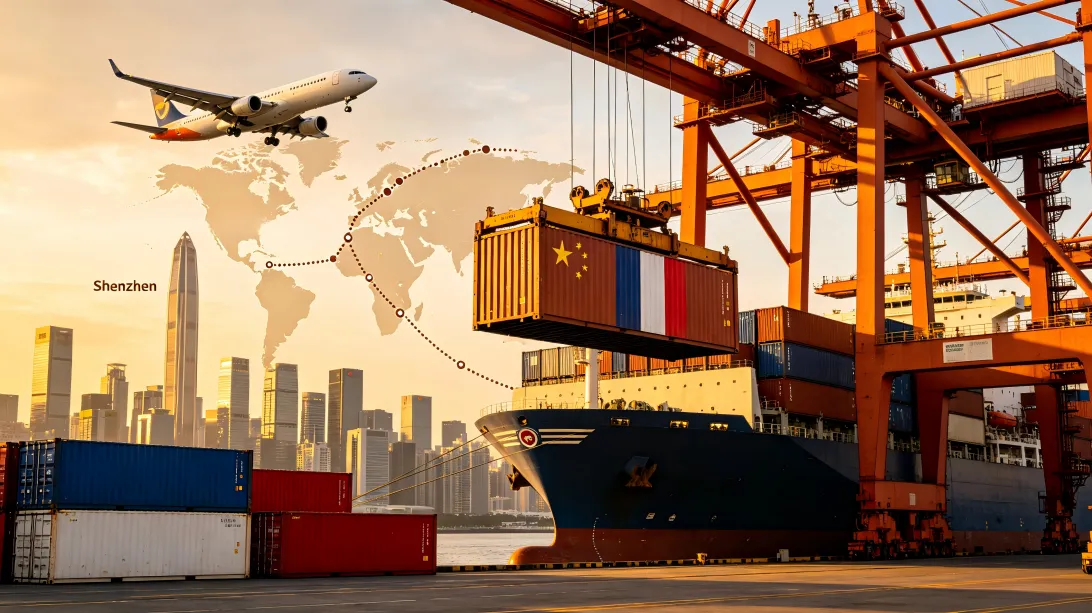
Why Ship from Shenzhen to France?
Most guides treat Shenzhen as just another port city. It is not. The logistics ecosystem here directly affects your costs and transit times.
Port Choice: Yantian vs. Shekou
Yantian Port is the deep-water workhorse handling the largest Europe-bound vessels, including CMA CGM's direct services to Le Havre and Marseille-Fos. For Full Container Load (FCL) — especially 40ft HQ units of electronics or furniture — Yantian offers the most reliable schedules and deepest berth capacity.
Shekou Port functions as a feeder and consolidation hub, ideal if your supplier is in western Shenzhen or Dongguan. For Less than Container Load (LCL), Shekou's Container Freight Stations (CFS) typically consolidate faster due to feeder traffic volume. We route FCL through Yantian and LCL through Shekou, consistently shaving a day or two off pre-departure timelines.
Air Access: SZX + Hong Kong (HKG)
Shenzhen Bao'an International Airport (SZX) has growing direct freighter capacity to Paris CDG and Lyon. The bigger advantage is proximity to Hong Kong International Airport (HKG) — 45 minutes by truck. When SZX space tightens, trucking cargo to HKG often secures earlier uplift.
Pearl River Delta Manufacturing Hub
Shenzhen sits at the center of the world's densest manufacturing corridor. Dongguan, Huizhou, Guangzhou, and Foshan are within 1–2 hours by truck — meaning lower inland costs and same-day factory pickup. For broader European coverage, see our Shipping From China to Europe hub.
Shenzhen vs. Shanghai/Ningbo
Shanghai and Ningbo handle more total volume, but Shenzhen wins on flexibility for France-bound cargo. South China offers faster rail access through Chengdu/Xi'an and more competitive Q4 air freight when Shanghai capacity saturates. If your suppliers are in Guangdong, routing through Shenzhen saves time and money. For Mediterranean coverage, see Shipping from Shenzhen to Italy; for Central Europe, see Shipping from Shenzhen to Germany.
Shipping Methods from Shenzhen to France
There is no single best method. Your choice depends on cargo type, budget, and how fast you need it. Here are the five options.
Sea Freight (FCL & LCL)
Sea freight from China moves over 90% of China-France cargo by weight. It is the cheapest option but it is slow.
FCL (Full Container Load) — You rent the entire container. Goods are sealed at origin and opened only at destination. Cost-efficient above ~15 CBM. Standard sizes: 20ft (~33 CBM, heavy cargo) and 40ft High Cube (~76 CBM, consumer goods).
LCL (Less than Container Load) — You share space and pay by cubic meter. Works well for 1–15 CBM, though destination deconsolidation fees can push costs near FCL as you approach 15 CBM. Practical tip: CMA CGM, France's national carrier, maintains stable space on the Shenzhen–Le Havre lane — book early in Q4.
Air Freight
When speed matters more than cost, air freight from China delivers from SZX or HKG to CDG or LYS in 3–7 days airport-to-airport. Ideal for high-value electronics, fashion restocks, and urgent medical supplies.
The downside: $4.50–$7.00/kg for shipments over 100 kg. Watch for volumetric weight — carriers charge on whichever is higher: actual weight or (L × W × H) ÷ 6000. A carton of cushions can cost 2–3× what you expect.
Rail Freight (China-Europe Railway Express)
Rail sits in the sweet spot: roughly 50% cheaper than air and 40% faster than sea. Your cargo trucks from Shenzhen to Chengdu, Xi'an, or Chongqing, then rides the China-Europe Railway Express across Kazakhstan, Russia, Belarus, Poland, and Germany into France. Total transit: 15–22 days.
Rail also produces significantly lower CO₂ per ton-kilometer than air. The caveats: border delays at Dostyk or Małaszewicze can add 2–3 days during winter, and not all dangerous goods classes are accepted.
Express Courier
For samples, documents, or sub-30 kg parcels, DHL/UPS/FedEx offer 3–5 day door-to-door delivery. Expensive at $7–$12/kg, but customs brokerage is included.
DDP (Delivered Duty Paid) Door-to-Door
DDP shipping is the hands-off option: pickup in Shenzhen, Chinese export clearance, international freight, French import clearance, duties, VAT, and final delivery — all handled by your forwarder. For France, DDP is especially valuable because French customs is among the more rigorous in the EU, and DDP lets you avoid the cash-flow hit of paying 20% VAT at the border.
See our dedicated Door to Door Shipping from China to France guide for exact DDP costs by mode. Typical DDP timelines:
- DDP Air: 10–12 days
- DDP Rail: 22–28 days
- DDP Sea: 30–40 days
Mode Comparison at a Glance
| Method | Transit Time | Cost | Best For |
|---|---|---|---|
| Sea FCL | 25–35 days | Lowest | Bulk, heavy, non-urgent |
| Sea LCL | 30–40 days | Low | 1–15 CBM small batches |
| Rail FCL/LCL | 15–22 days | Medium | Mid-value, balanced speed/cost |
| Air Freight | 3–7 days | High | Urgent, high-value, <300 kg |
| Express | 3–5 days | Highest | Samples, parcels <30 kg |
| DDP Sea | 30–40 days | Medium | SMEs, first-time importers |
| DDP Air | 10–12 days | High | FBA restock, urgent SME cargo |
Shipping Costs from Shenzhen to France: 2026 Benchmarks
Freight rates move weekly, but these ranges reflect mid-2026 market conditions. Use for budget planning, then request a live quote before booking.
Rates are based on market observations and operational data. Actual costs vary by cargo type, season, carrier capacity, and fuel surcharges.
Sea Freight Rates
| Service | Route | Cost (USD) |
|---|---|---|
| FCL 20ft | Shenzhen → Le Havre / Fos-sur-Mer | $2,050 – $2,550 |
| FCL 40ft HQ | Shenzhen → Le Havre / Fos-sur-Mer | $2,650 – $3,250 |
| LCL | Per CBM | $50 – $150 |
LCL destination charges (deconsolidation, handling, docs) add $150–$350 per shipment. Above 15 CBM, compare total landed cost against FCL.
Air Freight Rates
| Weight | Cost (USD) |
|---|---|
| 100 kg+ | $4.50 – $7.00 / kg |
| Express 21 kg+ | $7.00 – $10.00+ / kg |
Fuel surcharges and security fees add 20–40% to base air rates during peak.
Rail Freight Rates
| Service | Cost (USD) |
|---|---|
| FCL 40ft | $7,000 – $11,500 |
| LCL | $200 – $400 / CBM |
DDP Shipping Rates
| Mode | Cost (USD) |
|---|---|
| DDP Sea | $100 – $300 / CBM |
| DDP Air | $5.50 – $12.00 / kg |
| DDP Rail | $200 – $400 / CBM |
What Moves Rates in 2026
- Red Sea rerouting: Cape of Good Hope detours sustain emergency surcharges and reduce effective vessel capacity.
- Peak seasons: Chinese New Year (Jan–Feb) and Golden Week (Oct) typically add 15–30%.
- Fuel: BAF for sea and fuel surcharges for air track oil prices.
- ICS2 filing fees: Forwarders pass through ENS submission costs, typically $25–$75 per house bill.
For cost benchmarks across Western Europe, compare with the cheapest way to ship from China to UK.
Transit Times: How Long Does Shipping Take?
Sea Freight
| Route | Port-to-Port | Door-to-Door (DDP) |
|---|---|---|
| Shenzhen → Le Havre | 25–35 days | 30–45 days |
| Shenzhen → Marseille-Fos | 22–30 days | 28–38 days |
2026 reality: If your vessel reroutes around the Cape of Good Hope, add 10–14 days. Build buffer into inventory planning.
Air Freight
| Route | Airport-to-Airport | Door-to-Door |
|---|---|---|
| SZX → CDG / LYS | 3–7 days | 5–10 days |
| Express Courier | — | 3–5 days |
Rail Freight
Shenzhen truck to Chengdu/Xi'an hub (2–3 days) + rail to France (14–18 days) + final delivery (2–4 days) = 18–22 days total.
French Inland Delivery: What Happens After the Port
| Route | Transit Time | Est. Cost |
|---|---|---|
| Le Havre → Paris | 2–4 days | $300 – $600 |
| Le Havre → Lyon | 4–6 days | $500 – $900 |
| Marseille-Fos → Lyon | 1–3 days | $250 – $500 |
| Marseille-Fos → Toulouse | 2–4 days | $300 – $550 |
Tip: For southern or central France, route to Marseille-Fos to save 3–5 days of inland trucking versus Le Havre. For Paris and the north, Le Havre is the natural gateway.
French Customs Clearance: What You Must Get Right
French customs does not tolerate sloppy paperwork. Here is exactly what you need.
Essential Documents
- Commercial Invoice: English or French, with HS codes for every line item, unit prices, total value, and currency.
- Packing List: Accurate weights, dimensions, and package counts — discrepancies trigger inspections.
- Bill of Lading (sea) or Air Waybill (air).
- Certificate of Origin: Required for preferential tariff claims.
EORI Number: Non-Negotiable
The EORI (Economic Operators Registration and Identification) number is mandatory for any business importing into the EU. Without it, French customs will not release your goods. Apply through the French customs portal — processing takes 3–5 business days.
French VAT (TVA) & Import Duties: Real Examples
France applies 20% VAT on CIF value plus import duty. Here is what the math looks like:
Example 1 — Electronics ($10,000 value, 0% duty): - CIF value (goods + freight + insurance) = $11,200 - Import duty = $0 - VAT base = $11,200 - French VAT = $2,240 - Total landed tax = $2,240
Example 2 — Textiles ($10,000 value, 8% duty): - CIF value = $11,200 - Import duty = $896 - VAT base = $11,200 + $896 = $12,096 - French VAT = $2,419 - Total landed tax = $3,315
Duty rates by product category:
| Product Category | Duty Range |
|---|---|
| Electronics | 0% – 2% |
| Furniture | 0% – 2.7% |
| Textiles | 8% – 12% |
| Footwear | 8% – 17% |
| Machinery | 0% – 5% |
Anti-dumping duties on specific products (certain bicycles, ceramic tiles) can exceed 40%. Always verify your HS code in the EU TARIC database before shipping.
IOSS vs. PVA: Which VAT Mechanism?
IOSS (Import One-Stop Shop): For B2C e-commerce shipments valued at €150 or less. You collect VAT at checkout and file monthly. Your customer sees no surprise charges at delivery. Ideal for Shopify and eBay sellers.
PVA (Postponed VAT Accounting): For regular B2B importers. Instead of paying 20% VAT upfront, you account for it on your next French VAT return. Preserves cash flow but requires active VAT registration.
Simple rule: B2C parcels under €150 → IOSS. Regular B2B imports → PVA. Unsure? DDP shipping lets your forwarder handle it.
ICS2 Release 3: House-Level ENS Filing
Since September 2025, the EU's ICS2 Release 3 requires detailed Entry Summary Declarations with house-level data — accurate HS codes, consignee details, and cargo descriptions — before goods arrive. Enforcement tightened through 2026, and waivers are effectively gone.
Common rejection reasons we see: - Vague descriptions ("electronics" instead of "wireless Bluetooth headphones, HS 8518.30") - Mismatched HS codes between invoice and ENS - Missing or inactive consignee EORI numbers
Inaccurate filings mean customs holds and fines up to €150 per incorrect declaration. We file house-level ENS for every Shenzhen–France shipment, cross-checking HS codes against TARIC before submission.
CE Marking & French Packaging Rules
Products sold in France must comply with EU safety standards. Key categories requiring CE marking: electronics, machinery, toys, and medical devices. Low-risk items often allow self-certification; high-risk products need a Notified Body assessment.
France also enforces Extended Producer Responsibility (EPR) for packaging. B2C products must display the Triman logo with French sorting instructions. Ensure your packaging supplier adds this before cargo leaves Shenzhen — retrofitting in France is expensive and slow. For FBA-specific requirements, check Amazon Seller Central.
Shipping to Amazon FBA France from Shenzhen
France is a major Amazon EU market, and Amazon FBA shipping inbound rules are strict.
Key FBA Warehouses
- CDG1 (Lauwin-Planque) — northern France / Paris
- LYS1 (Sevrey) — eastern/central France
- ORY1 (Saran) — west of Paris, high volume
- MRS1 (Montélimar) — southern France
Packaging & Labeling Requirements
- Every carton needs a scannable FBA shipment label.
- Palletize on EPAL pallets (80×120 cm), the EU standard.
- Wooden pallets must be ISPM-15 heat-treated.
- Every product unit must carry a "Made in China" label.
Miss any of these and Amazon refuses the shipment.
FBA Prep & CARP Booking
Our Shenzhen facility handles labeling, poly-bagging, palletizing, and carton prep before departure. On the French side, we book the CARP (Carrier Appointment Request Portal) delivery slot with the target fulfillment center. Missing your CARP window during peak season can delay intake by a week.
FBA Cost Strategy
Sea FBA is cheapest but ties up capital for 30–40 days. Air FBA is expensive but critical for Q4 restocks when stockouts cost thousands. Most experienced sellers use a hybrid: sea for baseline inventory, air for top-up bursts. A DDP quote from an experienced forwarder bundles prep, freight, duties, VAT, and FC delivery into one number.
How to Choose the Right Shipping Method
By Product Type
| Product Type | Recommended Mode | Why |
|---|---|---|
| Electronics with batteries (DG) | DDP Air | Requires MSDS + UN38.3; IATA packaging |
| Bulky furniture | FCL Sea (40ft HQ) | Lowest per-CBM cost; protective crating at origin |
| Fashion / Apparel | Rail (mid-season) / Sea (initial bulk) | Rail hits 15–22 day sweet spot for replenishment |
| High-value electronics | Air + Insurance | Low damage risk; fast cash conversion |
| Samples / Documents | Express Courier | Speed outweighs cost for small items |
By Urgency & Budget
| Urgency | Budget | Best Mode |
|---|---|---|
| Critical (<7 days) | High | Air Freight or DDP Air |
| Moderate (2–4 weeks) | Medium | Rail Freight or DDP Rail |
| Flexible (1+ month) | Tight | Sea FCL or DDP Sea |
| Flexible + Small Volume | Tight | Sea LCL |
Incoterms: Get This Right
Choosing the wrong Incoterm is one of the costliest mistakes new importers make.
- EXW (Ex Works): Supplier makes goods available at their factory — you handle everything else. Risky for first-timers.
- FOB (Free On Board): Supplier delivers to Shenzhen port and handles export clearance. You control freight and insurance. Works if you have your own forwarder.
- CIF (Cost, Insurance, Freight): Supplier pays freight to the French port. Convenient, but suppliers often choose the cheapest carrier. You still handle import clearance.
- DDP (Delivered Duty Paid): Forwarder handles everything — pickup, freight, customs, duties, VAT, and delivery. Best for SMEs and Amazon sellers.
Recommendation: If you lack an in-house logistics team, start with DDP. It eliminates surprise costs while you learn the lane.
Choosing a Shenzhen-to-France Freight Forwarder
Not every forwarder understands this lane. If you are new to international logistics, first understand what a freight forwarder does. Then use this scorecard.
Vetting Checklist
| Criteria | Why It Matters |
|---|---|
| Shenzhen physical presence | Same-day pickup; local consolidation |
| France/EU customs brokerage | In-house or partnered French clearance |
| EORI / VAT / IOSS / PVA expertise | Proven French tax handling |
| Multi-mode capability | Sea + air + rail + DDP from one provider |
| House-B/L-level tracking | Real-time cargo visibility |
| DG certification | Handles batteries, liquids, hazardous cargo |
| Bilingual team | English + Chinese; French is a strong plus |
| FBA prep + CARP booking | Essential for Amazon sellers |
| Transparent pricing | Itemized quotes, no hidden destination charges |
| Contingency routing | Backup plans for port strikes or canal closures |
Red Flags
- Quotes that do not ask for your HS codes.
- Forwarders who cannot explain ICS2 ENS filing.
- "All-in" prices excluding French VAT or duties.
- No physical office in Shenzhen — pure brokers add latency and lose control.
Why AllBestShipping?
We are headquartered in Shenzhen — minutes from Yantian Port and Bao'an Airport. That means same-day pickup across the Pearl River Delta, direct consolidation at Yantian and Shekou, and house-level ENS filing for every France-bound shipment. We have moved lithium batteries, furniture, apparel, and industrial machinery to Le Havre, Lyon, and beyond. Our DDP quotes are itemized and transparent — what we quote is what you pay.
Step-by-Step: Shipping from Shenzhen to France
For export procedure fundamentals, read How to Ship from China. Below is the France-specific workflow.
Pre-Shipment Checklist
- Confirm HS codes in the EU TARIC database and verify duty rates.
- Validate your EORI number is active. If using PVA, confirm it is linked to your French VAT number.
- Decide IOSS vs. PVA, or choose DDP and let your forwarder handle it. IOSS registration takes 2–4 weeks — plan ahead.
- Agree on Incoterms with your supplier. If FOB, confirm which Shenzhen port.
- Ensure CE certificates and Triman labeling are complete for B2C products.
- Prepare commercial invoice, packing list, and accurate product descriptions for ICS2 ENS — descriptions must match the invoice.
- Book cargo insurance for shipments above $5,000.
Booking & Pickup
- Sea freight: Book 2–3 weeks ahead.
- Air freight: Book 3–5 days ahead.
- Rail freight: Book 1–2 weeks ahead.
Your forwarder arranges truck pickup, brings cargo to the Shenzhen warehouse, and consolidates (1–3 days LCL; same-day stuffing for FCL).
Chinese Export Customs
Requires commercial invoice, packing list, and sometimes export licenses for restricted goods. A competent Shenzhen forwarder handles this daily.
In-Transit Tracking
- Sea: Container number (vessel level) + house B/L (cargo level).
- Air: AWB number through airline portals.
- Rail: Container GPS + hub scan updates at key border crossings.
French Import Clearance
- ENS pre-arrival filing under ICS2 — automatic if filed correctly in Shenzhen.
- French customs assigns a channel: Green (auto-clear, 1–2 h), Orange (document review, 4–24 h), or Red (physical inspection, 1–3 days).
- Duties and VAT paid or deferred under PVA. On DDP, your forwarder handles this.
- Cargo released for inland trucking to your warehouse or Amazon FC.
Heads-up: Physical inspections spike after Chinese New Year and in November before Black Friday. Add 2–3 days of buffer during these windows.
Frequently Asked Questions
What is the cheapest way to ship from Shenzhen to France?
Above 15 CBM, FCL sea freight wins. For 2–15 CBM, LCL sea freight is cheapest. Avoid express courier for anything over 30 kg.
How long does shipping take in 2026?
Sea: 25–40 days port-to-port (add 10–14 days via Cape route). Air: 3–10 days door-to-door. Rail: 18–22 days. Express: 3–5 days.
How much are customs duties from China to France?
Duties range from 0% to 17% depending on HS code, plus 20% French VAT on CIF value + duty. Electronics typically 0–2%, textiles 8–12%, footwear 8–17%.
Do I need an EORI number?
Yes, mandatory for all business importers into the EU. Goods will not clear without one.
Can I ship lithium batteries from Shenzhen to France?
Yes, but they are classified as Dangerous Goods (DG). You need an MSDS and UN38.3 test report, plus IATA-compliant packaging for air or IMDG labeling for sea.
What is DDP shipping and is it worth it for France?
DDP means your forwarder handles pickup, freight, customs, duties, VAT, and delivery. For France, it is highly recommended if you lack local customs expertise or want predictable landed costs.
Should I use sea or air freight for 100 kg?
At 100 kg, air freight is often competitive when you consider inventory carrying costs. Above 200–300 kg, sea becomes decisively cheaper unless you face a stockout.
What documents are needed for French customs?
Commercial invoice, packing list, bill of lading or airway bill, certificate of origin (for preferential rates), and product-specific certifications (CE marks, MSDS).
What if my shipment is held at French customs?
Orange channel holds usually resolve within 24 hours if paperwork is accurate. Red channel requires physical inspection (1–3 days). Common causes: mismatched HS codes, missing CE docs, or incorrect consignee details.
Is rail freight reliable for Shenzhen to France?
Yes, with 18–22 day consistency. However, capacity tightens during Q4, not all DG classes are accepted, and winter border disruptions can add 2–3 days. For mid-value electronics, apparel, and auto parts, rail is now mainstream.
Why AllBestShipping?
We are a Shenzhen-based freight forwarder with 10+ years of lane-specific experience connecting South China to France and the broader EU. Our warehouse is minutes from Yantian Port and Bao'an Airport, enabling same-day factory pickup across the Pearl River Delta.
For the France lane specifically, we provide in-house expertise on EORI registration, VAT/PVA/IOSS guidance, ICS2 ENS filing, and CE documentation review. Every DDP quote is fully itemized — no hidden fees — covering everything from lithium batteries to full container loads of furniture.
Get Your Shenzhen-to-France Shipment Moving
Shenzhen offers one of the world's most efficient export ecosystems, but that efficiency means nothing if your paperwork is wrong or your forwarder goes silent when customs asks a question. The key is matching the right shipping mode to your product, timeline, and compliance readiness. In 2026, that also means budgeting for Red Sea surcharges, nailing ICS2 ENS accuracy, and understanding French VAT mechanisms before your cargo leaves the warehouse.
Whether you are moving your first LCL shipment or scaling FBA inventory across France, the right partner makes the difference between goods that flow and goods that stall. Get a free DDP quote from AllBestShipping and see how transparent pricing and Shenzhen-origin expertise can simplify your supply chain.