Shipping from Guangzhou to France: The Complete 2026 Guide (Costs, Transit Times & DDP)
If you are sourcing goods from southern China and need them delivered to France, understanding your options for shipping from Guangzhou to France can save you thousands of dollars and weeks of unnecessary delays. Guangzhou sits at the heart of the Pearl River Delta — the world's most dense manufacturing region — yet many importers still default to generalized China-to-Europe routings without considering how the city's unique logistics infrastructure can work to their advantage.
In this guide, you will learn the real costs and transit times for every shipping mode out of Guangzhou, how the DDP door-to-door process works from factory to French doorstep, what French customs requires in 2026, and how to choose a freight forwarder who actually knows this corridor. Every figure is based on current 2026 market data and real operational experience from the ground in Guangdong.
Guangzhou's Role in China–France Trade: Why This Route Matters
In 2025, bilateral trade between China and France reached USD 83.97 billion, a 5.4% increase year on year, with Chinese exports driving the majority of that growth. A significant share of this volume originates in the factories, wholesale markets, and industrial clusters radiating outward from Guangzhou.
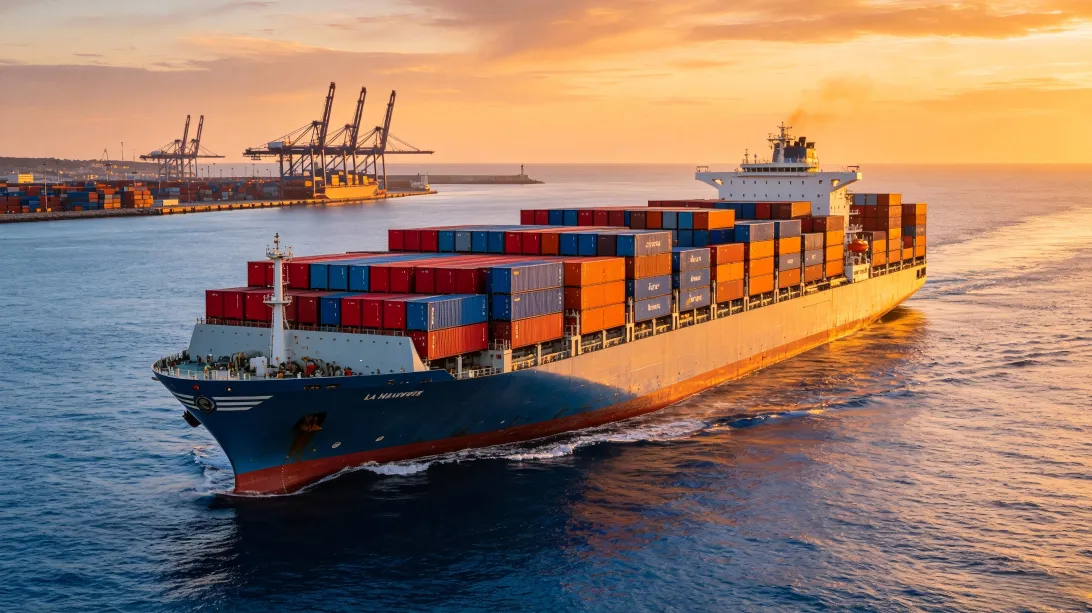
The city operates two critical freight gateways. Nansha Port, with deep-water berths handling 22.25 million TEUs in 2025 (up 10.2% year on year), is the natural load port for exporters in Foshan (furniture and ceramics), Zhongshan (lighting), and Guangzhou's own textile and apparel districts. Guangzhou Port as a whole moved 28.05 million TEUs in 2025, with foreign trade container volume surging nearly 20% — cementing its role as the dominant deep-water gateway on the western Pearl River Delta. Nansha's container services to Le Havre — France's largest container port handling 60% of national traffic — and Marseille-Fos on the Mediterranean are well established with competitive transit times.
For time-sensitive cargo, Guangzhou Baiyun International Airport (CAN) is South China's busiest air cargo hub, offering direct and transshipment routes to Paris Charles de Gaulle (CDG), with Lyon (LYS) and Marseille Provence (MRS) as secondary gateways.
For a broader overview of all Chinese departure ports on this trade lane — including Shanghai, Ningbo, and Shenzhen — see our complete guide on Shipping From China to France.
Industry Insight: In our experience managing shipments across the Pearl River Delta, the drayage cost difference between routing a container to Nansha versus trucking it two hours east to Shenzhen's Yantian terminal can easily reach $200–$400 per container. If your supplier is in Foshan, Zhongshan, or Guangzhou proper, Nansha is almost always the cheaper and faster origin port. The savings multiply quickly on regular shipments.
Shipping Methods from Guangzhou to France: Complete Comparison
Your choice of transport mode determines your landed cost, delivery speed, and supply chain reliability. Below is a side-by-side overview of all four methods available on this corridor in 2026.
| Mode | Transit Time (Port/Airport) | Door-to-Door | Best For | Cost Level |
|---|---|---|---|---|
| Ocean FCL | 33–40 days | 40–50 days | Bulk, furniture, machinery, 15+ CBM | Low |
| Ocean LCL | 35–45 days | 42–52 days | 2–15 CBM, smaller batches | Low–Medium |
| Air Freight | 6–10 days | 7–15 days | High-value electronics, urgent restocking | High |
| Rail Freight | 22–26 days | 28–35 days | Mid-weight cargo, balanced speed & cost | Medium |
| Express Courier | 3–6 days | 3–6 days | Samples, documents, parcels under 100 kg | Highest |
Ocean Freight from Guangzhou to France
Sea freight from China remains the backbone of Guangzhou–France trade. A 20ft FCL container from Nansha to Le Havre currently runs between $1,280 and $2,950, while a 40ft/40HC container ranges from $2,000 to $4,600. For LCL shipments, expect $52–$145 per cubic meter, charged on the greater of actual volume or weight per 1,000 kg.
The key FCL-vs-LCL decision point on this lane is around 13 to 15 CBM. Below that threshold, LCL is typically cheaper despite its higher per-unit rate. Above it, a full 20ft container almost always delivers better value — plus the security of a sealed box with less handling and lower damage risk.
Industry Insight: The 2026 ocean freight market has shifted considerably from the early-year lows. After a 10-week rally that drove rates sharply higher through the spring, the Shanghai Containerized Freight Index (SCFI) stood at approximately 3,206 points as of late July 2026 — down from a mid-July peak of 3,185 but still well above February's ~1,300-point trough. Spot rates from Shanghai to Northern Europe eased about 4% in early August, though major carriers are pushing General Rate Increases (GRIs) of $2,000–$3,000 per FEU for late August, targeting $7,800/FEU on Asia–North Europe services. In this environment, booking 10 to 14 days ahead remains the practical minimum — but shippers should also watch for blank sailings, which carriers use to tighten capacity and defend rate floors. A forwarder who monitors schedules daily can re-route your cargo around schedule gaps before they become delays.
Note that in 2026, most Asia–Europe services continue to route via the Cape of Good Hope rather than the Suez Canal, adding roughly 10–15 days to pre-2023 transit benchmarks. This is now the "new normal" that all planning should account for.
Air Freight from Guangzhou to France
When speed is non-negotiable, air freight from China out of Guangzhou Baiyun Airport delivers. A 100 kg shipment to Paris CDG costs approximately $660–$880 and arrives in 6–10 days airport-to-airport. At 500 kg, the rate drops to roughly $2,850–$3,500, reflecting the steep unit-cost decline as volume increases.
Air freight is billed on chargeable weight — the greater of actual gross weight or volumetric weight (L × W × H in cm ÷ 6,000). Light, bulky cargo can therefore cost far more than its scale weight suggests, so always cube your cartons before comparing air versus ocean.
Rail Freight from Guangzhou to France
The China–Europe Railway Express offers a compelling middle ground: approximately 50% faster than ocean and 60% cheaper than air. From Guangzhou, containers travel via Kazakhstan to reach the Lyon terminal in 22–26 days. A 40ft FCL costs $6,800–$8,500, while LCL runs $160–$210 per CBM.
Rail is particularly well-suited for e-commerce inventory replenishment, medium-weight industrial parts, and goods where a 3-to-4-week pipeline fits the business model. However, capacity is more constrained than ocean, and the Central Asian routing adds some geopolitical sensitivity that forwarders should proactively monitor.
Door-to-Door (DDP) Shipping from Guangzhou to France: Step-by-Step
For many importers — especially e-commerce sellers, SMEs without a French EORI number, and Amazon FBA merchants — the complexity of managing customs clearance, duties, and last-mile delivery independently is overwhelming. This is where DDP (Delivered Duty Paid) door-to-door service becomes the most practical solution. For a deeper dive into how DDP works specifically on the France lane, read our Door to Door Shipping from China to France guide.
Under DDP terms, a single freight forwarder handles the entire chain from your supplier's factory in Guangzhou to your designated address in France — including all customs clearance, import duties, and VAT. Here is how the process works:
Step 1 — Pickup & Inspection: Your forwarder collects goods from the supplier's warehouse in Guangzhou, Foshan, Dongguan, or anywhere in the Pearl River Delta. The team inspects the cargo, verifies quantities against the packing list, and handles professional packaging and labeling.
Step 2 — China Export Clearance: The forwarder files the export declaration through China's International Trade Single Window. Required documents include the commercial invoice, packing list, and sales contract. Under China's 2026 standalone VAT Law, document consistency across all filings is critical — any mismatch between the invoice, declaration, and special VAT fapiao can trigger a rejected export VAT refund.
Step 3 — International Transport: Depending on your chosen speed and budget, the cargo moves by ocean (25–45 days door-to-door), air (7–15 days), or rail (28–35 days).
Step 4 — French Import Clearance: Upon arrival, the forwarder clears the goods through French customs using the DELTA system (H1 declaration format). They pay import duties (0%–17% depending on HS code, averaging 4.2%) and the 20% TVA on your behalf. A valid EORI number — now in France's new 9-digit SIREN-based format for 2026 — is mandatory.
Step 5 — Last-Mile Delivery: After clearance, the cargo is trucked to the final destination anywhere in mainland France — Paris, Lyon, Marseille, Lille, Toulouse, Bordeaux, or directly into Amazon FBA warehouses such as ORY1 (Saran), LIL1 (Lauwin-Planque), LYS1 (Sevrey), or MRS1 (Montélimar).
How Much Does Shipping from Guangzhou to France Cost in 2026?
Understanding the full landed cost — not just the freight rate — is essential for accurate pricing and margin planning. The table below summarizes all-in cost ranges by mode for shipments originating in Guangzhou and destined for France.
| Mode | Unit | Cost Range | Notes |
|---|---|---|---|
| Ocean FCL 20ft | Per container | $1,280–$2,950 | Nansha → Le Havre, plus THC & docs |
| Ocean FCL 40ft/40HC | Per container | $2,000–$4,600 | Rates swung significantly through H1 2026 |
| Ocean LCL | Per CBM | $52–$145 | Minimum 1 CBM; plus destination handling |
| Air Freight (100 kg) | Per shipment | $660–$880 | CAN → CDG, airport-to-airport |
| Air Freight (500 kg) | Per shipment | $2,850–$3,500 | Strong volume discount at higher weights |
| Rail FCL 40ft | Per container | $6,800–$8,500 | Guangzhou → Lyon, 22–26 days |
| Express Courier (1 kg) | Per kg | $26–$36 | DHL/FedEx/UPS, 3–6 days door-to-door |
To estimate your true landed cost, use this formula:
Landed Cost = CIF Value + French Customs Duty (0%–17%) + TVA (20% on CIF + Duty) + Destination THC ($150–$300) + Customs Brokerage + Inland Trucking
For example, shipping $20,000 worth of electronics (0% duty, HS Chapter 85) via FCL from Nansha to Le Havre would land at roughly $20,000 + $0 duty + $4,000 TVA + $500 destination charges = approximately $24,500 total. The same shipment of textiles (12% duty, HS Chapters 61–62) would land closer to $27,700 — a meaningful difference driven entirely by product classification.
French Customs, Duties & Import VAT: What Guangzhou Exporters Must Know
French customs compliance is the most common source of delays and unexpected costs on this corridor. Here is what you need to have in place before your first shipment leaves Guangzhou.
| Product Category | HS Chapter | Typical Duty Rate |
|---|---|---|
| Electronics & Machinery | 84–85 | 0% |
| Furniture | 94 | 0%–5.6% |
| Lighting & Lamps | 94.05 | 0%–3.7% |
| Ceramics & Tiles | 69 | 0%–8% |
| Apparel & Textiles | 61–62 | ~12% |
| Footwear | 64 | 8%–17% |
The 20% French VAT (TVA) applies to the CIF value plus duty. Since January 2022, France has operated a mandatory auto-liquidation system — VAT-registered importers declare and deduct TVA on their monthly CA3 return rather than paying it in cash at the border. If you are not VAT-registered in France, a DDP forwarder handles this on your behalf.
For 2026, the essential import document checklist includes: commercial invoice, packing list, Bill of Lading (ocean) or Airway Bill (air), EORI number (9-digit SIREN format), CE marking documentation (for regulated products), and REACH compliance declarations (for chemical-containing goods). Customs declarations are filed electronically through the DELTA system using the H1 format.
When choosing your Incoterms, FOB Guangzhou keeps the supplier responsible through export clearance and loading; CIF Le Havre adds ocean freight and insurance to the seller's scope; and DDP transfers the entire burden — including French import duties, TVA, and last-mile delivery — to the forwarder. For most SMEs and e-commerce sellers without their own French customs broker, DDP is the lowest-risk option.
How to Choose the Right Guangzhou Freight Forwarder for France
Not all freight forwarders are equal, and on a specialized corridor like Guangzhou to France, the difference between a capable partner and a generalist can mean the difference between on-time delivery and a shipment stuck in customs for weeks. If you are new to working with logistics partners, start with our primer on what a freight forwarder does and how to evaluate one.
Evaluate any forwarder against these five criteria:
- French Customs Expertise: Do they have a local agent or partner in France? Can they handle DELTA system declarations, EORI registration, and CE compliance documentation?
- Multi-Modal Coverage: Can they offer ocean, air, rail, and DDP from Guangzhou? A forwarder who only does one mode cannot give you unbiased advice on the best routing.
- Transparent All-In Quotes: Do their quotes include duties, VAT, THC, and last-mile delivery? Hidden destination charges are the industry's most persistent problem.
- Real-Time Tracking: Do they provide 24/7 online tracking so you always know where your cargo is — from Nansha terminal to French warehouse?
- Local Presence in the Pearl River Delta: A forwarder with an office in Guangzhou or Shenzhen can respond to pickup requests, inspections, and issues on the same day — not the next week.
This is where having a partner based in the region makes a tangible difference. AllBestShipping operates from Shenzhen, just one hour from Guangzhou's Nansha Port and Baiyun Airport, with over 10 years of experience managing China-to-Europe shipments for 1,000+ clients across 50+ countries. That proximity means faster pickup, better factory communication, and the ability to resolve issues on the ground before they become delays at sea or in the air.
Pro Tips to Save Time & Money on Guangzhou–France Shipments
Book 10–14 days ahead. While the market no longer demands the 4-to-6-week lead times common during the pandemic era, the current elevated-rate environment makes early booking essential. A two-week window helps lock in competitive rates before carriers push through mid-month GRIs — and gives your forwarder time to route around blank sailings.
Classify HS codes correctly. The difference between 0% and 12% duty on the same shipment is often a single digit in the HS code. Electronics under Chapter 85 pay zero; misclassify them as a different category and you create unnecessary cost.
Avoid peak season windows. Chinese New Year (late January/February) and Golden Week (early October) drive rates up sharply across all modes. Plan shipments 3–4 weeks before or after these periods.
Consolidate to FCL at 15 CBM. If you source from multiple Guangzhou-area suppliers, use your forwarder's warehouse to consolidate LCL shipments. Once combined volume reaches roughly 15 CBM, switching to a full 20ft container typically saves 20–40% on per-unit freight cost.
Use auto-liquidation if VAT-registered. A French VAT number lets you declare and deduct import TVA on the same return — freeing cash flow that would otherwise sit with customs until your next refund cycle.
Match the mode to the product. Electronics (high value, time-sensitive, zero duty) favor air freight. Foshan furniture (bulky, low value-per-kg, zero-to-low duty) is ideal for ocean FCL via Nansha. Apparel and textiles (12% duty, medium value) benefit from rail or LCL consolidation where the duty cost is a manageable share of landed value.
Frequently Asked Questions
How long does shipping from Guangzhou to France take? Ocean FCL: 33–40 days port-to-port (40–50 door-to-door). Air freight: 6–10 days (7–15 door-to-door). Rail: 22–26 days to Lyon. Express courier: 3–6 days door-to-door.
What is the cheapest way to ship from Guangzhou to France? Ocean FCL is the most cost-effective for volumes above 15 CBM. For smaller shipments (2–15 CBM), LCL is the practical choice. Rail freight offers the best balance of cost and speed for mid-weight, non-urgent cargo.
Can I ship from Guangzhou to Amazon FBA warehouses in France? Yes. DDP services deliver directly to Amazon FBA centers including ORY1, LIL1, LYS1, and MRS1. Ensure your forwarder understands FBA labeling requirements, carton specifications, and delivery appointment procedures.
What documents do I need for shipping from Guangzhou to France? Commercial invoice, packing list, Bill of Lading (ocean) or Airway Bill (air), EORI number, and — where applicable — CE declaration and REACH compliance documentation.
Do I pay import duties on goods shipped from Guangzhou to France? Yes. French customs duties range from 0% to 17% (average 4.2%) depending on the HS code, plus 20% TVA on the CIF value plus duty. Under DDP, your forwarder pays both on your behalf.
Is rail freight from Guangzhou to France reliable in 2026? Yes. The China–Europe Railway Express via Kazakhstan operates on fixed schedules. It is 50% faster than ocean and 60% cheaper than air, making it an excellent option for medium-priority shipments.
How do I track my shipment from Guangzhou to France? Professional freight forwarders provide 24/7 online tracking platforms with real-time status updates — from pickup at the Guangzhou factory through to final delivery in France.
What Incoterm should I use for Guangzhou-to-France shipping? FOB Guangzhou for buyers who want to control the ocean freight leg. CIF Le Havre when the seller arranges shipping and insurance. DDP when you want a single forwarder to handle everything from factory to doorstep.
Ready to ship from Guangzhou to France? Whether you need ocean FCL out of Nansha, air freight from Baiyun Airport, rail to Lyon, or a complete DDP door-to-door solution, having a freight forwarder on the ground in the Pearl River Delta makes all the difference. At AllBestShipping, our Shenzhen-based team — just one hour from Guangzhou's ports and airport — manages the entire chain for you: pickup, export clearance, international freight, French customs, duty and VAT payment, and final delivery anywhere in France. With 10+ years of experience and 1,000+ clients served across 50+ countries, we deliver the reliability and transparency your supply chain depends on.