Air Shipping from China to Algeria: The Bank Date That Outranks the Flight
Air shipping from China to Algeria almost never goes wrong in the air: your cargo waits on the ground for a bank file that has to carry an earlier date than the air waybill it will fly on. Budget $6.50 to $8.70 per kilo between 100 and 300 kilos, down to a $5.90 benchmark at the tonne, and 8 to 12 days door to door against 3 to 6 days airport to airport, with express courier at $12.35 per kilo and 5 to 9 days. The change that reshaped this lane landed on 14 May 2026, when the Bank of Algeria's Note 01/DGC/2026 made prior bank domiciliation mandatory for every import and told banks to check the transport document itself, air waybills named in the text, so a booking made before the file exists becomes an operation no bank may settle.
Below is what the flight actually depends on: who flies the cargo out of Guangzhou, Shanghai and Hong Kong, what a ULD build does to a bill, the Algerian terminal tariff in dinars that no quote shows, and the duty arithmetic on a 500-kilo consignment. The lane page behind it, Shipping From China To Algeria, carries the port pairs and the sea option for cargo that should not fly at all. The scale: Algeria imported $48.78 billion of goods in 2025 and China supplied 28.5 percent of them, while more than 80 percent of the country's air cargo lands at a single airport. If you read one section, read Section 1, because the bank date rejects more shipments than the freight rate ever does.
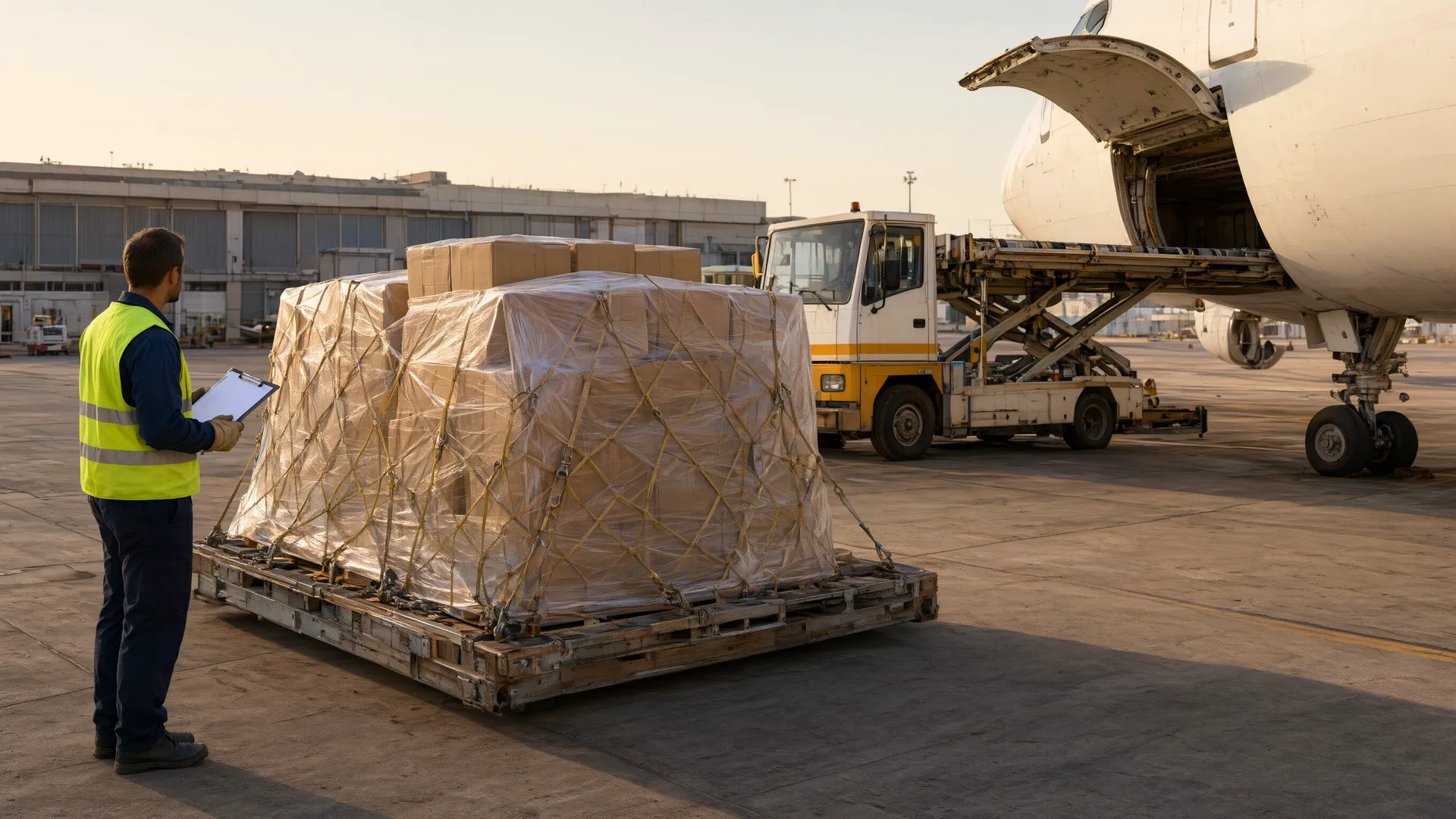
1. Domiciliation comes first, and the air waybill has to prove it
The rule is one sentence long and it inverts the way most importers book freight. Under Note 01/DGC/2026 of 14 May 2026, every import of goods is subject to prior bank domiciliation, and the bank must satisfy itself that the date on the transport and shipping documents is later than the date of the domiciliation. The note names the documents the banks have to check: commercial invoices, bills of lading, air waybills, CMR notes, shipping certificates. Where the goods have already been dispatched before the domiciliation was opened, the bank may not accept the file at all unless an exceptional authorization applies, and non-compliance is described as an offence under Algeria's exchange regulations (the note itself is short and worth reading in full). Only cargo that had genuinely left before 14 May is carved out, and the transport document date is the proof.
For air freight this changes the sequence. The domiciliation is opened first, then the supplier is authorized to ship, then the airline cuts the waybill with a date that has to fall after the domiciliation. An importer who lets a factory deliver to a Shenzhen warehouse on the 3rd and opens the file on the 5th owns a consignment that flew with an unusable document, and no amount of apology at the counter changes the date.
Three more texts sit on top of it. Instruction 05-2026 of 19 May 2026 requires that importers bringing goods in for resale in the same state show net assets at least equal to their share capital, and keep aggregate outstanding import commitments across all banks within 100 percent of their equity. Instruction 03-26 of 26 April 2026 caps each bank's external commitments by signature at 50 percent of its regulatory equity, so confirmed letter-of-credit lines queue in a way they did not two years ago. And the standing deposit rule requires the domiciliary bank to hold 120 to 130 percent of the import value in dinars before shipment, money that sits idle for the length of the cycle.
The paperwork chain starts further back still. Importers file a six-month import forecast with the Ministry of Foreign Trade, and without approval the bank will not open the credit. Since 1 January 2026 that authorization also covers independent service imports and invoices that include freight. Settlement is by documentary letter of credit in almost every case, because advance payment is capped at 15 percent and the procedure is slow enough that most banks discourage it; the balance cannot be released before Algerian customs has cleared the goods, so the payment clock and the clearance clock are the same clock. Since 31 May 2026, importers bringing in goods other than for processing must disclose end-customer details within the 45-day domiciliation window.
Penalties for missing forecast documents are quoted by Algerian accounting firms at DZD 50,000 to DZD 200,000. The fine is not what hurts. What hurts is a payment instruction that cannot be released while a 500-kilo consignment sits at the airport accruing storage charges, and Section 6 puts a number on those.
2. Who is actually flying this lane, and how much capacity exists
Air Algerie opened its first direct Algiers-Shanghai service on Monday 26 October 2026 with an Airbus A330-900neo, three rotations a week on Mondays, Wednesdays and Saturdays. Flight AH3082 leaves Houari Boumediene at 13:00 and reaches Shanghai at 10:00 the following morning, local time. Shanghai joins Beijing and Guangzhou on the carrier's Chinese network, and the timing matters for cargo rather than passengers: a wide-body passenger rotation carries freight in the belly on the return leg, so the lane gained a scheduled, non-stop capacity source it did not have in September.
That capacity is thinner than the passenger schedule suggests. Air Algerie had taken delivery of six of the ten A330-900neos on order by late October 2026, with 287 seats in a three-class layout, and belly freight competes with passenger bags on every sector. Air Algerie Cargo puts the belly capacity across the whole passenger fleet at 1 to 15 tonnes per flight, varying with aircraft type, load factor and sector length. On the dedicated freighter side the fleet is small and specific: a Boeing 737-700QC convertible with 16 tonnes of payload and 100 cubic meters of volume split into 79 on the main deck and 21 in the lower holds, eight PAG or P2P pallet positions, a 737-800BCF, and ATR 72-500QC aircraft for shorter sectors. Air Algerie Cargo has operated as a separate subsidiary since 1 November 2016.
The build-out is why capacity should improve rather than shrink. In April 2026 the cargo division signed a partnership with SGSIA, the company that runs the Algiers airport infrastructure, around a new cargo centre at Houari Boumediene: redevelopment of Terminal 3, a hub built to international handling standards, and long-term management over a thirty-year horizon. The division has said it intends to grow its dedicated fleet to six aircraft across Airbus, Boeing and ATR types, and the airline's own growth targets lean on freight volumes rising faster than passenger traffic through 2029.
Until that arrives, most China-origin freight reaches Algiers on someone else's aircraft. Turkish Airlines through Istanbul, Qatar Airways through Doha, which went daily from 25 October 2026, and Emirates through Dubai all feed ALG with belly and freighter capacity, and each hub adds a handling cycle and a day. The practical consequence is that Guangzhou and Shenzhen cargo often flies a dogleg while Shanghai cargo can now go direct, and a forwarder who quotes the same transit for both is guessing. Air Algerie Cargo also sells charters on request, which is the honest answer for five tonnes or more in a peak week: a part-charter booked two weeks out usually beats waiting for belly space that a passenger load factor can remove overnight. The booking patterns we work from each week are on the air freight service page.
3. What a kilo costs, break by break
Shipping from Guangzhou to Algeria by air is quoted per kilo out of CAN, and in November 2026 that number depends far more on the weight break a consignment falls into than on which Chinese city it leaves. The market eased in October, with one benchmark for 1,000-kilo-plus cargo to Algiers at $5.90 per kilo, roughly 8 percent below September, and the same source putting express courier at $12.35 per kilo. General cargo bands below the tonne sit higher, and the spread between the smallest and the largest break is wide enough that consolidating two shipments into one is often worth more than negotiating.
| Chargeable weight | Air freight cost per kg, China to Algeria | Typical cargo | Notes |
|---|---|---|---|
| 45-100 kg | $7.50-$10.00 | samples, spare parts, launch stock | minimum charges usually apply below 45 kg |
| 100-300 kg | $6.50-$8.70 | e-commerce replenishment, small machinery parts | the most common first shipment |
| 300-1,000 kg | $5.80-$7.50 | wholesale orders, tooling, components | where consolidating pays |
| 1,000 kg and above | $5.80-$7.50, benchmark $5.90 | project cargo, seasonal stock | space is the constraint, not price |
| Express courier | $12.35, band $12-$16 | documents, samples under 50 kg | door to door with duty billed back |
Two things are true at once in that table, and importers lose money by treating one as the other. The band is what forwarders publish; the benchmark is what a specific week cleared at. A quote built on the low end of the 1,000-kilo band in a week when space has tightened is not a quote, it is a hope. Treat any per-kilo number as valid for 7 to 14 days, ask which surcharges sit outside it, and ask whether the fuel and security elements are already inside the figure.
The rate also stops being the main number the moment the cargo is small. On a 60-kilo express shipment the freight is $741, while the Algerian handling and storage bill described in Section 6 introduces a minimum invoice that is charged regardless of weight, and duty and VAT are assessed on a value that includes the freight. Below 45 kilos the arithmetic rarely favours air at all unless the goods are worth more than $50 per kilo.
4. Building a ULD: the volumetric arithmetic behind a chargeable kilo
Airlines bill the greater of actual weight and volumetric weight, and the divisor on China-to-Algeria air freight is 6,000. Length times width times height in centimeters, divided by 6,000, compared with the scale reading, and the larger figure is the chargeable weight. Express couriers divide by 5,000, so the same parcel weighs more on a courier's invoice than on an airline's.
Two cartons show how far apart the two numbers can travel. Twenty cartons at 60 by 50 by 40 centimeters occupy 400 kilos of chargeable space whether they hold phone cases at 13 kilos each or tooling at 20; the shipment bills at 400 kilos even though the scale reads 260. Fifty cartons at 40 by 30 by 30 centimeters bill at 700 kilos, because they contain 700 kilos of dense goods and the space they occupy implies only 300. Light cargo pays for air it does not use, heavy cargo pays for nothing extra.
The pallet is where this becomes visible. A PAG main-deck pallet, the type Air Algerie Cargo lists for its 737-700QC, measures 301 by 207 centimeters and builds to 140 centimeters, or 148 with conditions, or 2 meters if the load is built in a pyramid. At the standard height that pallet implies about 1,454 chargeable kilos; eight of them fill the aircraft and come to roughly 11,600 kilos, well under the 16-tonne payload. That one comparison settles most arguments about capacity into Algiers: on dense cargo the aircraft runs out of payload before it runs out of volume, so a shipper who builds to the maximum height with light goods is competing for space with someone who is competing for weight, and the two do not trade against each other.
Build practice follows from that. Repack factory cartons into denser boxes when the goods are light and bulky, because removing air from a garment shipment can cut chargeable weight by a quarter. Build the pallet to the height the airline actually allows rather than to a round 1.5 meters, since the top layer is pure cost when it is air. Strip inner retail packaging when the buyer will repack on arrival, and check the lower-deck limit before assuming a pallet can be split: the forward holds on the 737-700QC take a maximum of 1,953 kilos each across 21 cubic meters.
5. Algiers or Oran: picking the airport gateway on each coast
Air cargo to Oran, Algeria lands at ORN, the Es-Senia airport that serves the west of the country, and the choice between ORN and Algiers changes your clearance calendar more than it changes your flight time. Algeria has two airports that matter for imported freight and a third that handles the east, and the four-letter codes are worth knowing because they appear on the waybill, the customs declaration and the terminal invoice: ALG for Houari Boumediene at Dar El Beida, 16 kilometers east of the capital, ICAO code DAAG; ORN for Oran Es-Senia in the west, ICAO code DAOO; and CZL for Constantine Mohamed Boudiaf, ICAO code DABC, for Annaba, Setif and the eastern wilayas.
Houari Boumediene is the default for a reason. More than 80 percent of Algeria's air cargo passes through it, it runs two 3,500-meter runways that take wide-body freighters without payload restrictions, and it operates around the clock. The April 2026 cargo-centre agreement with SGSIA is being built there, and the Terminal 3 redevelopment is aimed at the same freight flows. It is also the airport with the most carrier options, which matters when one rotation is cancelled: from ALG a shipment can be rebooked through Istanbul, Doha or Dubai inside a day, and from ORN it usually cannot.
Oran earns its place for a different reason. If the consignment is destined for Oran, Tlemcen, Sidi Bel Abbes, Mostaganem or the industrial belt around Arzew, clearing at ORN removes a 430-kilometer road leg and the transit document that goes with it. The trade-off is capacity and frequency: fewer wide-body rotations, fewer carriers, and a longer connection from any Chinese origin, so a shipment that goes direct to ALG in six days can take eight or nine through ORN with a hub stop. For a 200-kilo consignment of spare parts heading to a plant in the west, that is still the right trade. For a tonne of seasonal stock going to Algiers, it is not.
One rule applies at both airports and catches importers who assume otherwise: the goods are cleared where the aircraft lands, and moving uncleared cargo to another customs office requires a transit procedure that has to be arranged before the flight, not after. Booking to ORN and then asking for clearance in Algiers is not a re-routing, it is a second file.
6. The line items in dinars your quote leaves out
Arrival handling at Algiers is charged in dinars by Swissport Algeria, which operates one of the cargo warehouses at Houari Boumediene, and its tariff moved on 1 January 2026. The company notified clients of a revision covering handling and storage on arrival, citing operating costs, and the numbers are specific enough to price into a deal before the aircraft leaves China. Amounts below are converted at DZD 133.65 to the dollar, the IMF representative rate for 22 October 2026, because the dinar rate you get from your bank will not be this one.
| Charge | Rate, effective 1 January 2026 | In dollars at DZD 133.65 |
|---|---|---|
| Arrival handling, 0-25 kg | DZD 12.60 flat per shipment | about $0.09 |
| Arrival handling, 26-1,500 kg | DZD 12.63 per kg, minimum invoice DZD 2,272 | about $0.09 per kg, $17 minimum |
| Arrival handling, above 1,500 kg | DZD 7.57 per kg | about $0.06 per kg |
| Immediate release | DZD 30.28 per kg, minimum deposit DZD 6,010 | about $0.23 per kg, $45 minimum |
| Storage, ordinary goods, day 1 | free | free |
| Storage, ordinary goods, days 2-22 | DZD 9.98 per kg per day | about $0.07 per kg per day |
| Storage, ordinary goods, day 23 onward | DZD 14.02 per kg per day | about $0.10 per kg per day |
| Storage, non-radioactive dangerous goods | DZD 21.60 per kg per day, minimum DZD 32,400 | about $0.16 per kg per day, $242 minimum |
| Storage, radioactive materials | DZD 32.40 per kg per day, minimum DZD 54,000 | about $0.24 per kg per day, $404 minimum |
| Temperature-controlled storage, 2-8 C or 15-25 C | DZD 15.14 per kg per day for 5 days, then DZD 22.72 | about $0.11, then $0.17 per kg per day |
Put a 500-kilo consignment through it and the shape of the risk appears. Handling comes to DZD 6,315, about $47. Storage from day two costs DZD 4,990 a day, about $37, so a documentation problem that costs a week adds roughly $260 while the goods sit on a rack. Ten days of ordinary storage on that shipment reaches $373, which is more than the handling charge itself. The immediate-release line is the one importers resent most and the one worth understanding: paying DZD 30.28 per kilo, about $113 on 500 kilos, buys the consignment out of the warehouse queue on the day it clears instead of whenever the queue reaches it.
Dangerous goods change the arithmetic by an order of magnitude. A 200-kilo consignment of lithium cells held for eight days at DZD 21.60 per kilo per day costs DZD 34,560, and the minimum charge of DZD 32,400 applies even if the hold is shorter. That is the single strongest argument for getting a dangerous-goods declaration right the first time rather than correcting it after arrival.
7. Customs clearance at Houari Boumediene in five steps
Clearance at ALG is a fixed sequence rather than a negotiation, and each step has a clock. The file goes to a licensed customs broker with the domiciled commercial invoice, the air waybill, the certificate of origin legalized by the Chinese chamber of commerce, the packing list, the certificate of conformity where the product line requires one, the importer's NIF tax number, and the bank domiciliation certificate. The Algerian customs administration is explicit that the clearance file includes an invoice domiciled with a bank, and a shipment that flew ahead of its domiciliation is stuck there before anyone asks about duty (DGD clearance formalities).
The declaration itself is lodged electronically as a D15 through the customs system, and it has to be registered within 21 days of discharge. Miss that window and the consignment moves into the deposit regime for two months, which means a bond, a second file and a second set of fees. Duty and taxes are assessed on the declared value and paid before release; there is no arrangement in which the goods leave the terminal with the tax outstanding. A share of consignments goes to inspection, and the scanner queue at ALG is the variable nobody controls.
The calendar is the part importers underestimate. Algeria's working week runs Sunday to Thursday, with Friday and Saturday off, and the broker, the bank and the terminal all keep those hours. A flight that lands Thursday afternoon effectively waits until Sunday morning for anything that needs a signature. Add a public holiday and a one-week clearance becomes two, which is exactly the gap between the 3 to 6 day airport-to-airport figure and the 8 to 12 day door-to-door figure.
There is no de minimis threshold to fall back on. Duty starts from the first unit, and low-value parcels have required a full HS declaration since 2025, so a 30-kilo sample shipment gets the same document set as a tonne of stock. The one shortcut worth paying for is preparation: a broker who receives the complete file before the aircraft lands can have the D15 registered on the day of arrival instead of three days later, and that is usually the difference between one week and two. Our own customs clearance desk works the file from the Chinese side for exactly this reason.
8. Duty, VAT and the solidarity levy on a 500-kilo shipment
Algeria's customs duty has five bands, 0, 5, 15, 30 and 60 percent, and the band is set by the ten-digit subheading of the tariff, not by the product category a supplier names on a proforma. That single fact decides more of the landed cost than the freight negotiation does, because everything else is calculated on top of the duty. Import VAT is 19 percent on the CIF value plus duty, with a 9 percent rate for essential goods, and it is collected at customs whether or not the importer can recover it. The 2 percent solidarity levy (TCS) is assessed on the CIF value. Beyond those, a safeguard duty of 30 to 200 percent applies to roughly 1,095 finished-goods lines, and excise duty of 10 to 100 percent applies to tobacco, some vehicles and high-consumption appliances.
A worked example makes the stacking visible. Take 500 chargeable kilos of consumer electronics with a commercial invoice value of $42,000, air freight at $6.65 per kilo, and marine cargo insurance of $180. CIF value is $45,505 before any Algerian charge is applied.
| Line | 5 percent tariff band | 15 percent tariff band | 30 percent tariff band |
|---|---|---|---|
| Goods, freight and insurance (CIF) | $45,505.00 | $45,505.00 | $45,505.00 |
| Customs duty | $2,275.25 | $6,825.75 | $13,651.50 |
| Solidarity levy, 2 percent of CIF | $910.10 | $910.10 | $910.10 |
| Import VAT, 19 percent of CIF plus duty | $9,078.25 | $9,942.84 | $11,239.74 |
| Total Algerian taxes | $12,263.60 | $17,678.69 | $25,801.33 |
| Landed cost | $57,768.60 | $63,183.69 | $71,306.34 |
| Taxes as a share of goods value | 29.2 percent | 42.1 percent | 61.4 percent |
The spread between the cheapest and the most expensive band on identical cargo is $13,537.74, and none of it is negotiable with an airline. It moves with a customs classification instead, so settle the HS code on the invoice before the goods are packed rather than discovered at the counter.
The chart above uses the same $42,000 consignment: the dashed line is the goods value, and the gap between each bar and that line is the freight, the duty, the solidarity levy and the VAT that Algeria adds before the cargo can leave the terminal.
There is one recovery detail worth knowing before the goods arrive. The 19 percent VAT is paid at clearance and can be offset against the G50 declaration in the month it was paid, so a registered importer recovers it; an importer buying through a local intermediary does not, and that difference of $9,078 to $11,240 on this consignment is usually larger than the entire freight bill. It is worth structuring the purchase before the shipment, not after.
9. Where air stops paying, and what the sea clock costs
The honest comparison here is not air against sea on freight, because air loses that every time. It is air against sea on the cost of five extra weeks, and the answer changes with the value of the cargo rather than with the weight of it.
| Mode | November 2026 price | Transit | What it suits |
|---|---|---|---|
| Sea freight from China to Algeria, FCL 20GP | $3,672-$4,488 per container | 35-44 days | full containers, low value density, heavy goods |
| Container shipping from China to Algeria, LCL | about $250 per cubic meter | 36-48 days | 1-13 cbm, goods that can wait five weeks |
| Air freight, 500 kg at $6.65 per kg | $3,325 | 3-6 days airport to airport, 8-12 days door to door | high value per kilo, replenishment, launch stock |
| Air freight, 1,000 kg at $5.90 per kg | $5,900 | 3-6 days airport to airport, 8-12 days door to door | project cargo, seasonal peaks |
| Express courier | $12.35 per kg | 5-9 days door to door | documents, samples, urgent spares |
Take a realistic 1,000-kilo, 4.2-cubic-meter consignment. By air the freight is $5,900; as LCL at $250 per cubic meter it is $1,050. The air premium is $4,850, or 5.6 times the sea freight, and that is the number an importer has to justify. It gets justified when the goods are worth enough that five weeks of stock, working capital and a missed selling season cost more than $4,850, and it does not get justified for tiles, furniture frames, cement additives or anything else where the freight is a large share of the goods value. The break-even is not a weight; it is a value density, and on this route it usually sits somewhere between $8 and $12 of goods value per chargeable kilo.
There is a second, quieter case for air here, and it has nothing to do with speed. Because domiciliation has to precede shipment, and because the bank releases the balance only after clearance, a sea shipment ties up a letter of credit and a 120 to 130 percent dinar deposit for six weeks longer than an air shipment does. For an importer running close to a bank commitment ceiling, that difference can decide whether a second order can be opened at all this quarter. The air premium shows up on the invoice; six extra weeks of letter of credit and deposited dinars never appear on one.
Both routes are walked through in more detail elsewhere: the sea freight from China to Algeria guide covers port pairs and sailing structure, and the door to door shipping from China to Algeria guide covers what the all-in price includes on each.
10. Batteries, magnets and the certificate that misses the flight
Three categories cause most of the rejected bookings into Algiers, and all three are decided in China rather than in Algeria.
Lithium batteries travel as Class 9 dangerous goods and need a shipper's declaration, correctly marked packaging and a carrier that accepts them. Power banks, e-bikes, cordless tools and any product with an installed lithium cell fall under this, and the state of charge of the cells is regulated as well. Air Algerie Cargo handles dangerous goods, but the acceptance check is not a formality: a misdeclared battery shipment that is discovered at the warehouse is offloaded, and the consignee finds out when the flight lands without it.
Magnetized material is the second. Speakers, motors, magnetic assemblies and some sensors are tested for field strength before carriage, and a shipment that fails the test has to be shielded or reclassified. Most forwarders in Shenzhen test on site and issue the paperwork; the ones who do not discover the problem at the airline counter.
The certificate of conformity is the third, and it is the one that stops the most consignments at arrival rather than at departure. Algeria's conformity programme covers all consignments of imported goods with no defined product scope, which means the certificate has to be arranged in China, against the actual shipment, before the cargo flies. A certificate issued for a different model line, or issued after the aircraft has left, is worth nothing at Houari Boumediene. On top of that, Executive Decree 26-97, signed on 31 January 2026 and published in Official Gazette No. 13, reworked the type-approval framework for communications equipment, so phones, routers and radio devices need their approval in order before a conformity certificate will be issued for them.
One prohibition to keep in mind: refurbished and used electronics are effectively barred from import, and since April 2026 authorized dealers may no longer import diesel passenger cars, including used diesel vehicles under three years old. Petrol, hybrid, electric, hydrogen and LPG-CNG vehicles are unaffected by that particular rule. None of this is negotiable at the counter, and none of it is worth discovering after booking.
11. Eight red flags before the air waybill is cut
The list below is what we check before confirming space, in the order that matters. Each item has stopped a real shipment at some point.
- The domiciliation date is later than the planned flight date. If the file is not open, there is no booking worth confirming, so fix the sequence before anyone calls the airline.
- The certificate of conformity does not name this consignment. A certificate for a previous order or a sibling model is a customs hold waiting to happen.
- The HS code on the invoice has not been checked against the ten-digit tariff. The difference between the 5 and 30 percent band is $13,537.74 on the consignment in Section 8.
- The chargeable weight has not been calculated at 6,000. Volumetric weight surprises are the most common reason an invoice lands 30 percent above the quote.
- The importer is not the entity on the domiciliation. Algeria requires the importer of record to be a locally registered company with a NIF, an import activity on its commercial register and an authorized bank account; a foreign buyer cannot take that slot.
- The goods contain a battery, a magnet or an aerosol and nobody has declared it. Offloading at the ramp is more expensive than rebooking in China.
- The consignment will land on a Thursday or Friday. Nothing that needs a signature moves between Thursday afternoon and Sunday morning.
- The quote does not state its validity or its exclusions. A per-kilo figure without a date and without a list of what sits outside it is not a price, it is an opening position.
12. Frequently asked questions about Algeria air freight
How much does it cost to ship from China to Algeria by air in November 2026? Between $5.90 and $8.70 per kilo for general cargo above 100 kilos, with the 300-kilo-and-above breaks at $5.80 to $7.50 and a 1,000-kilo benchmark of $5.90 after an 8 percent easing from September. Express courier sits at $12.35 per kilo. Add Algerian terminal handling of roughly $0.06 to $0.09 per kilo, and remember that duty and 19 percent VAT are calculated on a CIF value that already includes the freight, so a $3,325 freight bill on a 500-kilo shipment also lifts the duty and VAT bill by roughly $900 at the 5 percent band and about $1,885 at the 30 percent band.
How long to ship from China to Algeria when the cargo flies instead of sails? Three to six days airport to airport, counting the flight and the handling at both ends, and 8 to 12 days door to door once Algerian clearance and the road leg are inside the number. Most forwarders quote 9 to 11 days door to door, which sits inside that range. The variable is not the flight: it is whether the D15 can be registered on the day of arrival, which depends on the file arriving complete.
Is door to door shipping from China to Algeria faster by air or by sea? By air, by about four weeks: 8 to 12 days door to door against 40 to 55 days for a sea door-to-door service. What the air option does not remove is the bank sequence, because domiciliation has to precede shipment on either mode, and it does not remove the 21-day declaration window at the airport either. It compresses the transport leg, not the paperwork.
What is the cheapest way to ship from China to Algeria for 200 kilograms? It depends on what the 200 kilos are worth. As LCL sea freight, 200 kilos of typical density is about 1.2 cubic meters, roughly $300 at $250 per cubic meter, against $1,520 by air at $7.60 per kilo. That $1,220 difference is about 12 percent of a $10,000 consignment, spent to save five weeks; on goods worth $40,000 the same $1,220 is 3 percent and the answer flips to air, because duty and VAT are assessed on the same value either way and the extra five weeks of stock and credit line cost more than the freight saved.
Does air freight from China to Algiers always land at ALG? Not always. ALG at Houari Boumediene handles more than 80 percent of the country's air cargo and is the default for the capital, the centre and the east. Cargo for Oran, Tlemcen or Mostaganem can be booked to ORN at Es-Senia, which saves a 430-kilometer road leg but has fewer wide-body rotations and fewer carriers, so a direct six-day routing through ALG can become eight or nine days through ORN.
Does Algeria require domiciliation before shipment even for an air waybill? Yes. Note 01/DGC/2026 of 14 May 2026 applies to every import of goods regardless of mode, names air waybills among the transport documents banks must check, and requires that the document date fall after the domiciliation date. A bank that accepts a file where the shipment preceded the domiciliation is in breach of the exchange regulations, and the note says so directly.
Does an air shipment to Algeria need a certificate of conformity? In practice, yes. Algeria's conformity programme applies to all consignments of imported goods with no defined product scope, and the certificate has to be issued against the actual shipment before it leaves China. Products with a type-approval requirement, including communications equipment under Executive Decree 26-97 of 31 January 2026, need that approval first.
Is air freight from China to Algeria faster than sea freight once clearance is counted? Yes, by roughly four weeks door to door, even with Algerian clearance inside both numbers. Air is 8 to 12 days and sea is 40 to 55 days on a door-to-door basis. The comparison that matters commercially is not the four weeks but the $4,850 premium on a 1,000-kilo consignment, which the cargo has to earn back in stock turns or margin.
What cannot be shipped by air to Algeria? Refurbished and used electronics are effectively barred from import, diesel passenger cars including used diesel vehicles under three years old have been closed to authorized dealers since April 2026, and pharmaceuticals enter only through UFAS or authorized pharmacies. Lithium batteries, magnetized material, aerosols and flammable liquids can fly, but only with a dangerous-goods declaration and a carrier that accepts them, and counterfeit or non-conforming goods will be refused at inspection whatever the paperwork says.
13. Start your air booking with a dated bank file
The sequence is fixed and it starts away from the airport: open the domiciliation, get the six-month forecast approved, authorize the supplier to ship, then book space and let the airline date the waybill after the file. Importers who run that order get 8 to 12 days door to door and pay the rate they were quoted. Importers who book first spend the difference on storage, on a second flight, or on a payment that cannot be released.
AllBestShipping books China-to-Algeria air freight from Shenzhen, Guangzhou, Shanghai and Hong Kong, handles the certificate of conformity and dangerous-goods paperwork on the Chinese side, and works with licensed Algerian brokers at ALG, ORN and CZL so the D15 is registered on the day the aircraft lands. Send the supplier's invoice, the packing list and the ten-digit HS code you intend to declare, and you will get a per-kilo rate with its validity date, the chargeable weight at a 6,000 divisor, and the Algerian terminal and tax lines that sit outside it.