Cheapest Way to Ship from China to Ghana: The Nine Lines Under the Freight Rate
Cheapest way to ship from China to Ghana is usually decided before your cargo reaches Tema, by nine lines nobody reads on the quotation and a tax block that arrives after the vessel has already sailed. October 2026 groupage from Shenzhen runs about $240 a cubic metre and 40 to 48 days door to door; a 20-foot box runs $3,000 to $3,250 and 30 to 38 days; on a six-cubic-metre order of general consumer goods the duty, VAT and levies come to $6,972 while the freight and clearing charges come to $2,163. The fact that matters most this year is smaller than any of those numbers: since 1 July 2026 the Ghana Standards Authority issues the EASYPASS certificate itself, in the country of export, before the container loads, and there is no inspection at Tema to fall back on if it is missing.
Six cubic metres, three cargo profiles and one 20-foot box are priced end to end below, with duty, VAT, levies, agent fees and the port clock added at every step, for importers weighing a container against groupage or a DDP figure handed to them on WhatsApp, all of it consistent with the lane detail on Shipping From China To Ghana. The scale behind the exercise: China supplied 22.7 percent of Ghana's imports in 2025, GH¢57.6 billion, rising to 29.7 percent in the first quarter of 2026, and Tema handled roughly 2.5 million TEU in 2026 before the Christmas peak, against 700,000 TEU in 2020. If you only read one section, read the eleven questions at the end; they are the ones that decide whether the number you were quoted survives contact with ICUMS.
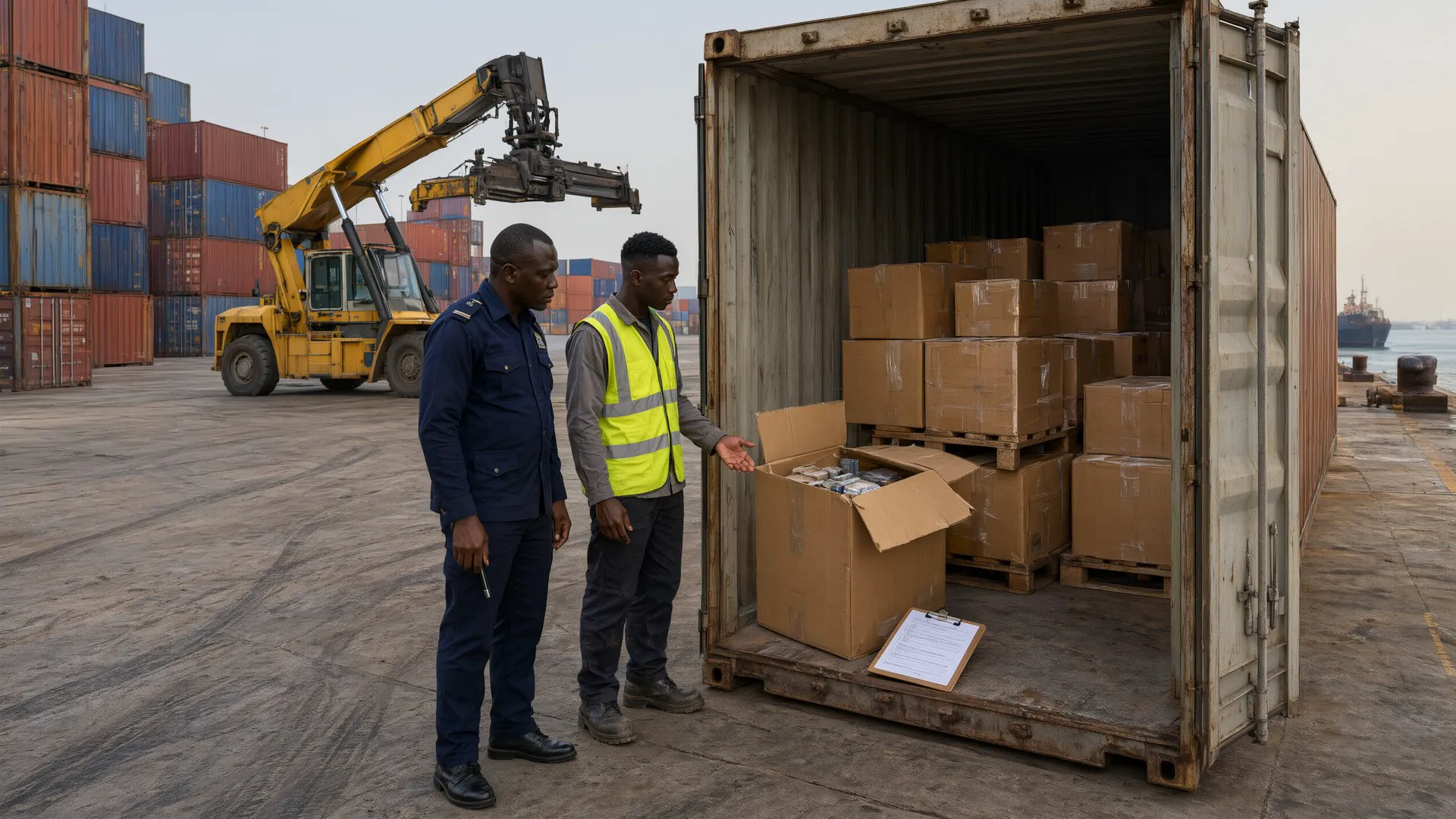
1. Nine lines that sit under the freight rate on a Tema quotation
Take a real 20-foot booking from Shenzhen to Tema and strip it down. The ocean rate is the line everyone compares, and it is the only line that behaves like a market price. Everything under it is a fixed cost, a regulatory cost or a cost created by the calendar, and those three are where a cheap quote quietly stops being cheap.
| # | Line | Who bills it | October 2026 level | If it is missing from the quote |
|---|---|---|---|---|
| 1 | Ocean freight, Shenzhen to Tema | Carrier or NVOCC | $3,000 to $3,250 per 20GP | Valid for 14 days at best; the number is a reservation, not a price |
| 2 | Origin charges | Forwarder, China side | $260 per box | Someone pays the export declaration and the CFS handover, and it will be you |
| 3 | Terminal handling at Tema | Terminal operator | $720 per box | Added at destination, in cedis, at the day's rate |
| 4 | Clearing agent | Licensed customs agent | GHS 800 to 1,500, about $110 | Nothing clears through ICUMS without a licensed declarant |
| 5 | GSA shipper registration | Ghana Shippers' Authority | GH¢150 for 12 months, about $13 | Cargo cannot be cleared until it is paid |
| 6 | EASYPASS certificate | Ghana Standards Authority | 0.35 to 0.50 percent of FOB, paid by the exporter | No certificate, no clearance, and no way to fix it at the port |
| 7 | Examination and processing | GRA Customs | 1 percent examination plus 1 percent processing, inside the tax block | Billed whether or not your container is opened |
| 8 | Storage past free time | GPHA | $35 a day per 20ft, $52.50 per 40ft | Starts on day 8, before most disputes are resolved |
| 9 | Inland delivery | Haulier | Tema to Accra, quoted separately | The container sits at the gate while you find a truck |
Lines 1 and 2 are the only ones a forwarder can genuinely move. Lines 3 to 7 are the same for every licensed operator, which is why two quotes that differ by $400 per box are rarely competing on the same scope: one of them has left line 3 or line 6 outside the price. Lines 8 and 9 are the ones that do the damage, because they are billed daily and they start on a date nobody controls.
Most Ghana quotes are built from a version of this table that stops at line 4. That version is not cheaper, it is shorter, which is a different thing to a buyer who has to explain the difference to a bank. A quotation that shows the ocean rate plus a single lump "destination charges" figure cannot be compared with one that breaks out lines 3 to 6, and an importer who accepts the lump sum has accepted a price that will be re-opened at Tema by a terminal, an agent and two government agencies, none of whom negotiate.
The last item is not on the list because it is not in the quote at all: the tax block. On the same 20-foot box, with a declared value of $13,200, customs value of $16,252.80 and a 20 percent tariff line, the duty and levies and VAT come to $7,711.95. That is more than the freight, more than the terminal handling, more than everything else on the quotation combined, and it appears on no line of it.
2. Cheapest way to ship from China to Ghana, ranked by the invoice you end up paying
How much does it cost to ship from China to Ghana for six cubic metres of mixed consumer goods at a declared value of $13,200? On October 2026 numbers, everything included except inland delivery beyond Accra, the answer runs from $9,135 by groupage to $25,851 by express, and the ranking is decided less by freight than by what each mode does to the customs value.
The consignment: 6 CBM, 1,080 kg, FOB $13,200, insurance at 0.4 percent, a 20 percent ECOWAS CET tariff line, clearing, the GH¢150 registration and a Tema agent. Duty is 20 percent of CIF; levies are ECOWAS 0.5 percent, AU 0.2 percent, EXIM 0.75 percent, examination 1 percent and processing 1 percent, all on CIF; VAT, NHIL and GETFund share one base under the 2025 Act and come to 20 percent of CIF plus duty.
| Mode | Freight and charges | Duty, VAT and levies | Landed total | Per CBM | Per kg | Freight share | Door to door |
|---|---|---|---|---|---|---|---|
| Sea LCL | $2,163 | $6,972 | $9,135 | $1,522 | $8.46 | 23.7% | 40 to 48 days |
| 20GP FCL | $4,103 | $7,712 | $11,815 | $1,969 | $10.94 | 34.7% | 30 to 38 days |
| 40HQ FCL | $5,783 | $8,376 | $14,159 | $2,360 | $13.11 | 40.8% | 30 to 38 days |
| Air freight | $7,581 | $9,671 | $17,252 | $2,875 | $15.97 | 43.9% | 8 to 12 days |
| Express | $13,413 | $12,438 | $25,851 | $4,308 | $23.94 | 51.9% | 3 to 6 days |
Compare the second column with the fourth. Groupage is the cheapest way to move this cargo, and it stays the cheapest way even though its freight is the cheapest by a wide margin, because air and express freight are themselves dutiable. Every dollar of freight that enters the CIF value carries about 47.5 cents of duty and VAT with it, so the express freight of $12,960 drags $3,572 of additional tax into the bill on its own, and the air freight of $7,128 drags $1,971. Freight is not a cost that sits beside the tax. It is a cost that multiplies it.
| Mode | Freight and charges | Duty | VAT and levies | Landed per CBM |
|---|---|---|---|---|
| Sea LCL | $361 | $490 | $672 | $1,522 |
| 20GP FCL | $684 | $542 | $744 | $1,969 |
| 40HQ FCL | $964 | $588 | $808 | $2,360 |
| Air | $1,264 | $679 | $932 | $2,875 |
| Express | $2,236 | $874 | $1,199 | $4,308 |
Freight is under a quarter of the landed number at the bottom of that chart and half of it at the top, and the tax block in between barely shifts as a percentage while it doubles in money, because the dutiable value is inflated by the thing you were trying to buy, which is speed.
Two things this table does not include, both of which can reverse a ranking. Inland delivery from Tema to Kumasi or Takoradi is quoted per truck, not per CBM, and adds $380 to $650 depending on the haulier and the day. And any line 8 charge, storage past the seventh day, lands entirely on whichever mode spends longest at the port, which is groupage, not air.
3. The crossover is 12.4 cubic metres, or 12.4 tonnes if the cargo is dense
Container shipping from China to Ghana starts to undercut groupage at 12.4 cubic metres on October 2026 numbers, and the arithmetic that produces that figure is worth knowing because it is the only decision in this article you can settle before you ask anyone for a price.
Groupage is quoted per cubic metre, so its cost scales with volume and never with the box. A 20-foot container is quoted per box, so its cost is flat from 1 CBM to 28 CBM. The flat number here is $3,980: $3,000 of ocean freight, $720 of terminal handling and $260 of origin charges. The groupage stack is $320 per cubic metre: $250 of ocean freight plus $70 of destination CFS and handling. Divide one by the other and the crossover sits at 12.4 CBM, where both come to about $3,980. A 40HQ, at $4,400 of freight plus $960 of destination charges and $300 of origin charges, crosses at 17.7 CBM.
| Volume | Groupage | 20GP | 40HQ |
|---|---|---|---|
| 10 CBM | $3,200 | $3,980 | $5,660 |
| 12.4 CBM | $3,968 | $3,980 | $5,660 |
| 14 CBM | $4,480 | $3,980 | $5,660 |
| 17.7 CBM | $5,664 | $3,980 | $5,660 |
| 20 CBM | $6,400 | $3,980 | $5,660 |
| 26 CBM | $8,320 | $3,980 | $5,660 |
Groupage carries a second limit that has nothing to do with volume. A cubic metre of LCL is charged on the revenue ton, which is the greater of one cubic metre and one tonne, so cargo denser than 1,000 kg per cubic metre pays on weight. Tiles, sanitaryware, machine parts and bagged cement all run above that line: a 6 CBM pallet at 1,400 kg per cubic metre bills as 8.4 revenue tons, and the crossover to a container arrives at 12.4 tonnes rather than 12.4 cubic metres. A shipper who measures his cargo in cartons rather than in kilos finds this out on the invoice.
The same flat-versus-scaling logic explains why the answer for 6 CBM is not the answer for 26 CBM, and why a forwarder who quotes container rates to a 4 CBM buyer is not being generous. Below the crossover a container means paying for space you will not fill, and above it groupage means paying per unit for space a flat rate would already cover.
4. EASYPASS since 1 July 2026: the certificate is issued in China
The Ghana EASYPASS certificate of conformity is now a shipment precondition rather than a customs formality, and the change is administrative rather than legislative, which is why so many importers missed it. The Ghana Standards Authority has run a pre-export verification programme for a decade. What changed on 1 July 2026 is who issues the certificate: the Authority took the programme in-house, applications go to its own portal, and the third-party arrangement under which Bureau Veritas or Intertek wrote the certificate came to an end for shipments dated on or after that day. The Authority's own EASYPASS data sheet sets out the routes and the fees.
The mechanics matter more than the name. Verification happens in the country of export, before loading, by documentary review, testing and physical inspection of the goods. A Certificate of Conformity is issued on a satisfactory result, or a Non-Conformity Report on an unsatisfactory one. What the programme does not offer is a second chance: verification at destination is not part of the design, so a container that loads without a certificate arrives with a problem that cannot be solved by paying a fee at Tema.
Three routes, three different cost profiles:
| Route | Who it suits | Fee | What it buys |
|---|---|---|---|
| Route A | Any trader, any consignment | 0.35 to 0.50 percent of FOB, paid by the exporter | Per-shipment verification and a certificate |
| Route B | Registered importers and exporters with repeating product lines | $400 a year for the first 15 product lines, $25 per line a year beyond that | Registration, lighter per-shipment control |
| Route C | Manufacturers and regular factories | $1,200 per factory a year | Annual factory assessment and licensing |
Two details are consistently misreported in the market. The fee falls on the exporter, not on the importer at the port: the Authority has stated publicly, in its July 2026 clarification with the Ghana Union of Traders' Associations, that EASYPASS fees on imported goods are borne by exporters and manufacturers abroad as an integrated cost of production, and are not a new charge collected at importation. And the programme is not a new levy: the same clarification describes it as a graduation of the mandatory-standards regime that applies to every product placed on the Ghanaian market. What that means in practice is that the cost is real but the negotiation is with your supplier, not with your clearing agent.
Coverage is the part that decides whether your cargo is affected. The programme's product groups include mineral products, chemical and allied industries, plastics and rubber, leather and articles, wood pulp and paper, textiles, footwear, base metals, machinery and electrical equipment, vehicles and precision instruments. For an importer of electronics, household goods, apparel, building materials or auto parts from China, the honest starting assumption is that the cargo is in scope and that the supplier needs to be told so in writing before production finishes, not after the booking is made.
The commercial consequence is a schedule problem dressed as a compliance problem. A certificate request needs a final or proforma invoice, test reports, quality certificates and, where available, a manufacturer's management-system certificate. Collecting those from a Chinese supplier takes days. If they arrive after the container is booked, the choice is to delay the shipment or to ship and hope, and the second option is the one that produces the containers sitting at Tema with no route out.
5. A DDP price of $270 a cubic metre and cargo worth $2,200 cannot both be true
The cheapest number on the market is almost always a DDP number, and it is cheap for a reason that has nothing to do with freight. Take the six-cubic-metre consignment above, where the goods are worth $2,200 per cubic metre. The duty and VAT on that value come to about $1,168 per cubic metre at the 20 percent tariff line. A delivered-duty-paid quote of $270 per cubic metre is therefore not a price for the same shipment. It is a price for a shipment with a different declared value.
Run the arithmetic the other way and the ceiling appears. Market sea DDP quotes into Tema with tax included have been running near $480 per cubic metre. Strip out roughly $250 of ocean freight and $70 of destination handling and $160 is left to cover duty, VAT and delivery. At 47.5 percent of customs value, $160 of tax covers a declared value of about $336 per cubic metre. If your cargo is worth $2,200 per cubic metre, one of those two numbers has to move, and it will not be the tax.
DDP has real uses: one price, one invoice and no relationship with Ghana Revenue Authority to manage, which for a first shipment or a small consignment is often the right answer. The trap is reading a DDP price as though it were comparable with a freight-plus-tax price, since the two only line up at the same declared value and the DDP price rarely says what that value is.
Four questions separate a usable DDP quote from a trap. What value is being declared to customs, and will the supplier put it in writing? Who is the importer of record on the declaration: the forwarder, a Ghanaian partner entity, or you? If customs revalues the goods upward, who pays the difference? And if the certificate is missing at Tema, whose problem is it? A forwarder who answers all four without hesitating is describing a service. One who answers two and changes the subject is quoting a number and hoping you stop there.
The reason the value question is not academic: the revaluation risk sits with the importer of record, and if that is a name you do not recognise, the liability is still attached to the goods. Under-declared cargo is not a discount. It is an unpaid bill with a penalty attached, and in Ghana the penalty for VAT non-registration rose under the 2025 Act to three times the unpaid tax at the minimum.
6. What the VAT Act of 2025 did to the duty bill on 1 January 2026
The Value Added Tax Act, 2025, Act 1151, took effect on 1 January 2026 and it changed three numbers that appear on every Ghanaian import declaration. The Revenue Authority's notice to VAT registered taxpayers sets them out; what follows is what they mean when the goods arrive.
The headline rate did not move. VAT stays at 15 percent, NHIL at 2.5 percent and GETFund at 2.5 percent. What moved is the base: all three now apply to the same value, so the effective rate is 20 percent rather than 21.9 percent, and the 1 percent COVID-19 Health Recovery Levy is gone. For an importer the effect is a small reduction on the face of the bill and a larger one inside the business, because NHIL and GETFund are now deductible as input VAT for registered taxpayers instead of being a straight cost. The Revenue Authority notes that the cascading effect the old computation produced has been scrapped for domestic supplies; for imports, practitioners including EY's Ghana team read the cascading effect as still partly present, which is a reason to have the recovery position confirmed rather than assumed.
The number that hurts is the third one. An unregistered importer, meaning a person importing taxable goods who is not registered for VAT, must make an upfront payment to customs, and Act 1151 raised it from 12.5 percent to 20 percent of the customs value. It is not a deposit against a future assessment; it is collected at clearance, before the goods move. On the six-cubic-metre consignment, with a customs value of $14,693, the old rate would have been $1,837 and the current rate is $2,939, a difference of $1,102 on the same cargo. On a $24,000 container the difference is $1,800.
The same Act restructured who has to register at all: the threshold for businesses dealing in goods rose from GH¢200,000 to GH¢750,000, and the flat rate scheme was abolished, which pushes former flat-rate traders into the standard regime. For a small importer in Accra this cuts both ways. Fewer businesses are compelled to register, and every business that stays unregistered now pays a fifth of its customs value upfront instead of an eighth.
On the 6 CBM consignment the same cargo produces three different tax blocks, depending on which line customs applies.
| Tariff line | Duty | Levies | VAT | Total | Share of CIF |
|---|---|---|---|---|---|
| 5 percent, raw materials and capital goods | $735 | $507 | $3,085 | $4,327 | 29.4% |
| 20 percent, finished consumer goods | $2,939 | $507 | $3,526 | $6,972 | 47.5% |
| 35 percent, textiles, poultry and sensitive lines | $5,142 | $507 | $3,967 | $9,616 | 65.5% |
The row that applies to you is set by the HS code, not by the forwarder, and the gap between the first and the last row on identical cargo is $5,289. That is more than the difference between groupage and a 40-foot container, more than the difference between air and sea on anything under 200 kg, and it is fixed before a single rate is quoted.
7. The Smart Port Note is deferred; the GH¢150 registration is not
Two rules land in the same conversation and they are not in the same state, which is why the trade press and the WhatsApp groups keep contradicting each other.
The Smart Port Note, an electronic cargo tracking note known elsewhere in West Africa as an ECTN, was announced on 23 December 2025 for shipments loading on or after 1 February 2026, covering all cargo destined for Ghana including transit goods, one unique number per bill of lading, issued and verified at the port of loading, with clearance blocked until a missing one was paid for and produced. On 20 January 2026 the Ghana Shippers' Authority deferred it, citing issues that needed clarification and alignment with stakeholders, and set no new date. Industry objections continued through the middle of 2026, including a renewed push and an equally firm rejection of it by frozen-food and general traders' associations. The status today is deferred, not abolished, and not in force. Any forwarder who bills you for a Smart Port Note today is either working from a stale rate sheet or charging you for a service nobody has asked for yet; any forwarder who tells you the question is settled is guessing.
The registration requirement has no such ambiguity. Under section 26(1) of the Ghana Shippers' Authority Act, Act 1122 of 2024, every importer and exporter must be registered with the Authority before clearing goods, and from 3 August 2026 the requirement is enforced through ICUMS. The fee is GH¢150 for twelve months, a licensed declarant can pay it on behalf of an unregistered shipper and the cargo still clears, and it does not need renewing per shipment. Registration needs a Certificate of Incorporation for a company or a Ghana Card for an individual, and the details are shared with the Customs Division of the Revenue Authority.
In practice GH¢150 is $13, so it is not the line to argue about, but it has become a hard gate rather than a formality. Budget it, put the registration certificate in the same folder as the bill of lading, and spend the negotiation on the lines that are worth $1,000.
8. Seven containers in ten are opened at Tema
Ghana Shippers' Authority's own assessment of Tema in 2026 found that roughly 70 percent of containers are subject to full physical inspection. The World Customs Organization benchmark for a risk-managed port is about 10 percent. Seven in ten is a queue rather than a risk profile, and it explains more about the cost of importing into Ghana than any freight rate does.
The direct cost of an inspection is small and the indirect cost is not. Examination fee is 1 percent of CIF and it is charged whether or not your box is selected, so it never appears as a surprise. What appears as a surprise is time: a container pulled for a full inspection can add three to seven working days to clearance on top of the three to seven days that documents alone need when everything is in order, and the storage clock at the terminal does not pause while customs works.
Two things reduce the odds of a full inspection, and neither of them is a payment to anybody. The first is a declaration that matches the commercial invoice, the packing list and the bill of lading line for line, including the HS code and the description. Discrepancies are what a risk engine is built to find, and a description of "general merchandise" on a container of electronics is a discrepancy. The second is a certificate that covers the goods actually inside the box. A Non-Conformity Report or a certificate that lists fifteen product lines while the container holds twenty is the kind of mismatch that turns a documentary review into a physical one.
The reason this matters more in 2026 than it did in 2024: volume. Tema moved about 700,000 TEU in 2020, 2.7 million TEU in 2025 and roughly 2.5 million TEU in 2026 before the Christmas peak, and the terminal's own capacity growth has not been matched by the road network, the inland depots or the inspection bays serving it. When a port triples its throughput in five years and its landside infrastructure does not, the inspection rate becomes the release valve, and importers pay for it in days.
9. The Tema clock: 5.8 days at anchor and 7 free days on the quay
Delay at Tema is priced in tiers, and each tier has a different owner, which is why the cost of a slow clearance is usually known only after it has been incurred.
The first tier is the vessel. The seven-day average waiting time at Tema was 6.35 days in the week to 22 September 2026 and around 5.8 days in October, against 5.8 days at the June peak and 4.5 days at Abidjan. A vessel waiting almost a week is not a rare event in 2026; it is the operating condition, and it moves the arrival date that every downstream date depends on. The published transit times on the lane assume a berth on arrival.
The second tier is the terminal. The Ghana Ports and Harbours Authority allows seven free days of storage, after which it charges $35 a day for a 20-foot container and $52.50 a day for a 40-foot one. Ten days over on a 40-foot box is $525, and it is billed by the port, not by the forwarder.
The third tier is the carrier. Free time on the equipment is seven days for dry containers and five for reefers, after which detention runs, and one carrier's published dry-container rate starts at $100 per TEU per day from the sixth day. A 40-foot box held two weeks past free time is $2,135 between storage and detention, and that number is available to anyone with a calculator and a berthing schedule.
The fourth tier is the road. Empty containers accumulating at the terminal, truck queues that have stretched from the port entrance to the Regional Maritime University, and hauliers spending close to a week waiting to drop an empty box have all been documented by the Ghana Union of Traders' Associations and the Importers and Exporters Association during 2026. It is the tier with no published tariff and the one that eats the free days.
So the gap between a 30-day transit and a 38-day transit is not eight days of sailing; it is eight days on either side of the water, and only the sailing part is in the carrier's control. That is why a realistic door-to-door figure for Tema groupage is 40 to 48 days even though the ocean leg from Shenzhen is 30 to 35, and why the published China to Ghana transit times are a floor rather than an average.
10. Shenzhen, Guangzhou, Ningbo, Shanghai, Qingdao, Tianjin: one box, six prices
Shipping from Shenzhen to Ghana is the cheapest of the six gateways this month at $3,000 to $3,250 for a 20-foot box, and shipping from Guangzhou to Ghana is within $50 of it at $3,050 to $3,300, while Tianjin costs $1,050 more for the same container on the same water. The spread comes from vessel frequency rather than from a discount for southern shippers: the south China gateways have more direct and semi-direct calls to West Africa, and a gateway with fewer sailings pays for the wait in rate as well as in days.
| Gateway | 20GP | 40HQ | Door-to-door to Accra | Notes |
|---|---|---|---|---|
| Shenzhen (Yantian, Shekou) | $3,000 to $3,250 | $4,400 to $4,750 | 40 to 47 days | Most sailings, cheapest boxes, best for electronics |
| Guangzhou (Nansha) | $3,050 to $3,300 | $4,450 to $4,800 | 41 to 48 days | Strong for apparel, footwear and furniture factories in the Delta |
| Ningbo | $3,250 to $3,550 | $4,700 to $5,100 | 42 to 49 days | Good for housewares and hardware from Zhejiang |
| Shanghai | $3,350 to $3,700 | $4,850 to $5,300 | 42 to 50 days | Widest carrier choice, highest terminal charges |
| Qingdao | $3,800 to $4,100 | $5,500 to $5,800 | 46 to 54 days | Northern cargo, fewer West Africa calls |
| Tianjin | $4,050 to $4,350 | $5,600 to $5,900 | 47 to 55 days | Use only when the cargo is already in the north |
Two caveats sit under that table. Rates are per box, port to port, valid for around 14 days, and they exclude the tax block, which is identical at every gateway because it depends on the value and the HS code, not on the port. And the freight advantage of a southern gateway can be consumed by inland trucking in China: moving a container from a Zhejiang factory to Shenzhen instead of Ningbo costs $400 to $700, which is most of the $350 rate gap and none of the schedule risk.
The lane itself is competitive in a way that matters for negotiation. Drewry's composite index stood at $4,351 per 40-foot container on 8 October 2026, down 2 percent week on week and up 164 percent year on year, which tells you the market has already absorbed the 2026 capacity situation and that a quote held for a month is a quote that has been priced for the risk of being held for a month.
For cargo that has to reach Kumasi, Tamale or the western region, the arrival port matters as much as the departure port. Takoradi adds two to four days on the water and $180 to $400 on the road for most destinations, and breaks even on the western corridor only when the consignee is in Sekondi-Takoradi or beyond. The Boankra integrated logistics terminal near Kumasi, about 85 percent complete in the 2026 budget, is designed to change that arithmetic by putting the inland clearance point 270 km from the coast; until it opens, Tema is the answer for the middle belt.
11. Three consignments costed to an Accra shop door
Volume decides the mode, but value decides the tax, and the interaction of the two produces three different answers on the same lane in the same month. Each profile below uses the same rate stack and the same tax engine as the ranking table.
| Profile | Cargo | Groupage landed | Container landed | Air landed | Cheapest |
|---|---|---|---|---|---|
| A | Phone accessories, 2 CBM, 260 kg, FOB $4,400, 20 percent line | $3,276 | Not viable below crossover | $5,539 | Groupage, by $2,263 |
| B | Furniture and housewares, 11 CBM, 1,900 kg, FOB $24,000, 20 percent line | $16,561 | $16,960 (20GP) | Not competitive on 1,900 kg | Groupage, by $399 |
| C | Machine spares, 2.4 CBM, 420 kg, FOB $9,000, 5 percent line | $3,909 | Not viable | $7,355 | Groupage, by $3,446 |
Profile A is the one that surprises small importers. Two cubic metres of phone accessories carry a tax bill of $2,333 on a cargo value of $4,400, which is 53 percent of FOB, and the freight is only $943. The cheapest mode is also the slowest, and the $2,263 gap to air is the price of 30 extra days. For a first order that gap is usually worth paying; for a repeat order it usually is not.
Profile B is the case where the crossover has not quite arrived. Eleven cubic metres sits $1.4 CBM below the 20-foot break-even, so groupage wins by $399, which is inside the noise of two forwarders' surcharges. At 14 CBM the container wins by $500 and at 20 CBM it wins by $2,420. The honest advice for an importer who expects to reorder within the quarter is to book the container at 11 CBM and treat the $399 as the cost of not having to consolidate later.
Profile C is where the tariff line does the work. Machine spares at 5 percent duty generate a tax bill of $2,838 on a $9,000 cargo, which is 31.5 percent of FOB rather than 53 percent, and the same 420 kg that costs $7,355 by air costs $3,909 by sea. Air is 1.9 times the landed cost for a saving of roughly 32 days. If the spare part is stopping a production line, that is a bargain; if it is going into stock, it is a $3,446 donation.
One number is missing from all three rows and it belongs in the decision: inland delivery. Tema to Accra adds $180 to $280 per truck, Tema to Kumasi $450 to $650, and a door-to-door product folds that into a single figure rather than leaving it for the consignee to negotiate on the day. That is the difference between a freight quote and the number a shopkeeper actually needs, which is what a door-to-door shipment to Ghana is priced to deliver.
12. Nine levers that move the landed number without changing mode
None of these needs a different shipping method or a different forwarder. They need a decision taken earlier than most importers take it.
1. Fix the HS code before the goods are made. The gap between the 5 percent line and the 35 percent line on the same cargo is $5,289, and classification is a question of what the product is, not what you would like it to be. Get the code in writing from a licensed agent, agree it with the supplier's invoice description, and do it while the order is still a purchase order.
2. Move the EASYPASS cost to the supplier. The certificate is charged at 0.35 to 0.50 percent of FOB and it is the exporter's obligation. On a $24,000 order that is $84 to $120, which is not the point: the point is that a supplier who knows about the certificate in writing before production starts will have the test reports ready, and one who finds out at booking time will not.
3. Register for VAT if you clear more than twice a year. The upfront payment for an unregistered importer is 20 percent of customs value, collected at clearance. On a $16,253 customs value that is $3,251 of cash locked before the container leaves the terminal, and it is not recoverable by an unregistered business. A registered importer books it as input VAT.
4. Consolidate to the crossover, not past it. At $320 per cubic metre of groupage against $3,980 for a 20-foot box, 11 CBM and 13 CBM cost almost the same. Shipping 11 CBM by container this month means paying $399 for the option to add 2 CBM next month without a second ocean freight.
5. Book the box, not the rate. A 14-day rate validity on a 40-day transit means the number you compare is not the number you pay. Ask for a rate with a named vessel and a named free-time period, and ask what the roll-over policy is.
6. Take the seven free days seriously. Storage begins on day 8 at $35 or $52.50 a day, and detention follows. A pre-cleared declaration filed before the vessel berths is the only reliable way to use the free window; documents filed after arrival convert free days into rent.
7. Clear the certificate before you clear the cargo. EASYPASS verification happens at origin and there is no destination inspection to fall back on. That sentence converts a 0.5 percent fee into an absolute gate, and the gate closes when the container loads.
8. Ship dense cargo by weight, not by volume. Above 1,000 kg per cubic metre the LCL revenue ton is the tonne, not the cubic metre, and the crossover to a container arrives 12.4 tonnes earlier than a volume calculation suggests.
9. Decide the inland leg at the same time as the ocean leg. Tema to Accra is $180 to $280 a truck; Tema to Kumasi is $450 to $650. A rate that stops at the port gate is not a landed cost, and if the volume is consistently above the crossover, a fixed ocean booking under a sea freight arrangement to West Africa is usually cheaper than spot pricing every quarter.
There is a tenth lever that is not in the operator's control and is worth mentioning because it changes the return leg: China's zero-tariff treatment for 53 African countries, in force since 1 May 2026, has made Ghanaian cocoa, cashew, shea butter, textiles and handicrafts cheaper to bring into China. An importer who ships out and back on the same relationship has a negotiation the one-way shipper does not.
13. What two quotes must state before you can compare them
Most Ghana quotes cannot be compared, not because one is dishonest but because they describe different scopes. Six lines settle it.
| Line the quote must state | Why it decides the comparison |
|---|---|
| Rate validity and named vessel | A 14-day rate on a 40-day transit is a reservation; two quotes of different ages are not the same product |
| Whether terminal handling at Tema is inside or outside | $720 per box, and it is the single most common omission |
| Free time and detention basis | Seven days dry, five reefer, then $100 a TEU a day on one carrier's tariff |
| Declared value basis for any DDP price | A DDP figure at $270 per CBM implies a declared value near $336 per CBM, not $2,200 |
| Who is the importer of record | Determines who carries revaluation risk, the upfront VAT and the penalty exposure |
| Whether the EASYPASS certificate is included or assumed | It is the exporter's cost and the importer's gate; a quote that is silent on it is assuming you have one |
A quote that answers all six can be compared with another that answers all six. One that answers three can be compared with nothing, and a three-line quote usually looks cheapest because it left the most out.
Eleven questions importers ask about cheap Ghana shipping
Is sea freight from China to Ghana always the cheapest option? Below 12.4 CBM, groupage is cheapest, and it stays cheapest for anything bulky and non-urgent. Above that volume a 20-foot box wins, and above 17.7 CBM a 40HQ wins. Sea freight stops being cheapest only when the cargo is worth more per kilo than the transit time costs, which for most consumer goods means never.
How much does it cost to ship from China to Ghana for a 20-foot container? $3,000 to $3,250 port to port from Shenzhen in October 2026, $3,050 to $3,300 from Guangzhou, rising to $4,050 to $4,350 from Tianjin. Add $260 of origin charges, $720 of terminal handling at Tema, about $110 of agent fees and then the tax block, which on a $13,200 declared value at the 20 percent line is $7,712. Landed, that is about $11,815.
Is air shipping from China to Ghana ever cheaper than the sea? Not on freight and not on landed cost at any volume tested here, and the gap widens with weight because air freight is itself dutiable. Air wins when the cargo's value per kilo is high enough that 32 days of inventory and one stockout outweigh a 1.9 times landed cost, which happens with spare parts, seasonal fashion and anything with a contractual penalty attached.
How long does it take to ship from China to Ghana door to door? Groupage from Shenzhen is 40 to 48 days, a 20-foot box is 30 to 38 days, air is 8 to 12 days and express is 3 to 6. Those figures include a Tema berth on arrival; the seven-day average vessel waiting time of 6.35 days in September 2026 is inside the sea numbers, not on top of them.
Do I need EASYPASS for every product I import? For high-risk categories, which include electrical and electronic goods, food and beverages, cosmetics, building materials, used goods, auto parts and textiles, the working assumption is yes. Verification happens in the country of export before loading, GSA issues the certificate directly since 1 July 2026, and destination inspection is not an option in the programme.
Is the Smart Port Note required for Ghana shipments now? No. It was announced for shipments loading from 1 February 2026, deferred by the Ghana Shippers' Authority on 20 January 2026 before it took effect, and no new date has been published. It has not been withdrawn, so confirm the status consignment by consignment rather than assuming either way.
What is the clearance time at Tema port? Three to seven working days with complete documents, five to seven being typical. Seven to ten days means a documentation problem and more than thirty days usually means a valuation or classification dispute. A container selected for full physical inspection, which happens to about 70 percent of them, adds three to seven working days on top.
Can I import into Ghana without a VAT registration? Yes, with two consequences. You pay an upfront 20 percent of customs value at clearance, up from 12.5 percent before Act 1151 took effect on 1 January 2026, and that money is not recoverable. You also cannot claim the VAT as input tax, so the 20 percent effective rate becomes a permanent cost rather than a cash-flow item.
Can I ship a car from China to Ghana, and is it cheaper? A used vehicle is one of the few categories where the answer is driven by the standard rather than the freight. GS 4510 requires a certificate of conformity, a left-hand-drive original specification, no accident or flood damage and a speedometer in km/h, with an age cap of 15 years after the August 2026 revision, and the rule is applied by shipment date. A compliant car ships like any other 20-foot cargo; a non-compliant one is refused entry whatever the freight rate was.
What documents does a Ghana import need? Commercial invoice, packing list, bill of lading or air waybill, the EASYPASS certificate for regulated goods, the GSA shipper registration, a TIN linked to a Ghana Card for an individual, and a declaration lodged through ICUMS by a licensed agent. The certificate and the registration are the two that cannot be produced after arrival.
Is DDP the cheapest way for a first shipment? It is often the cheapest thing to buy and rarely the cheapest thing to own. A DDP price removes the clearing process from your desk and puts the declared value under someone else's control, which is fine if the value is written down and wrong if it is not. For a first container, ask for the declared value and the importer of record in writing before you compare the number with a freight quote.
Price one consignment end to end before you commit
The cheapest way to ship from China to Ghana turns out to be a landed number you can defend rather than a mode, a gateway or a carrier: freight, origin charges, terminal handling, agent, certificate, duty, VAT, levies, free days and the inland leg, priced on your cargo rather than on a table.
AllBestShipping works from Shenzhen with Chinese consolidation space and Ghanaian clearing partners, so the same team that books the box prices the tax block on it. Send the product description, the cubic metres or the gross weight, the declared value and the delivery address, and you get one figure that includes the lines most quotes leave out, plus the crossover calculation that says whether you should be shipping 11 CBM in a container or 11 CBM in groupage. Start with the cargo details and talk to a forwarder who prices the landed number, before the booking, not after the berth.