How Long to Ship from China to Algeria? The 40-Day Sea Clock and the Month That Runs Before It
How long to ship from China to Algeria is decided on the quay at Algiers far more often than it is decided at sea, and the scale explains why: China is Algeria's largest trading partner, supplying 28.5 percent of everything the country imported in 2025. Plan on 30–45 days port-to-port by sea and 40–55 days door-to-door, LCL at 37–53 days door-to-door, air freight at 8–12 days door-to-door once Algerian clearance is inside the number, and express courier at 5–9 days. What decides whether you land at the bottom or the top of those ranges is routing and paperwork rather than hull speed: the Suez return is still partial and a Cape loop adds 10–14 days, and Algeria's bank domiciliation now has to exist before your supplier ships while the customs declaration is due within 21 days of discharge.
Algeria is not a lane where a fast ship buys a fast delivery. What sets the date is a bank file, a routing, a berth and a declaration, roughly in that order, so the mode comparison comes first, then the day ledger from a supplier gate in Guangdong to a warehouse in Blida or Constantine, then the 30 days of bank work that run ahead of the sailing, the load-port differences from Shenzhen to Tianjin, the five discharge gateways, the eleven things that add a week, and the window from late September to November that moves both the price and the speed of clearance. The route page behind it, Shipping From China To Algeria, carries the lane-level detail on port pairs. The scale behind those numbers: Algeria imported $48.78 billion of goods in 2025, up 3 percent, and the Port of Algiers alone handled 931,300 TEU, more than 60 percent of the country's containers. If you read only one section, read Section 3, because the day ledger there is the part importers argue with us about and the part that turns a range into a date.
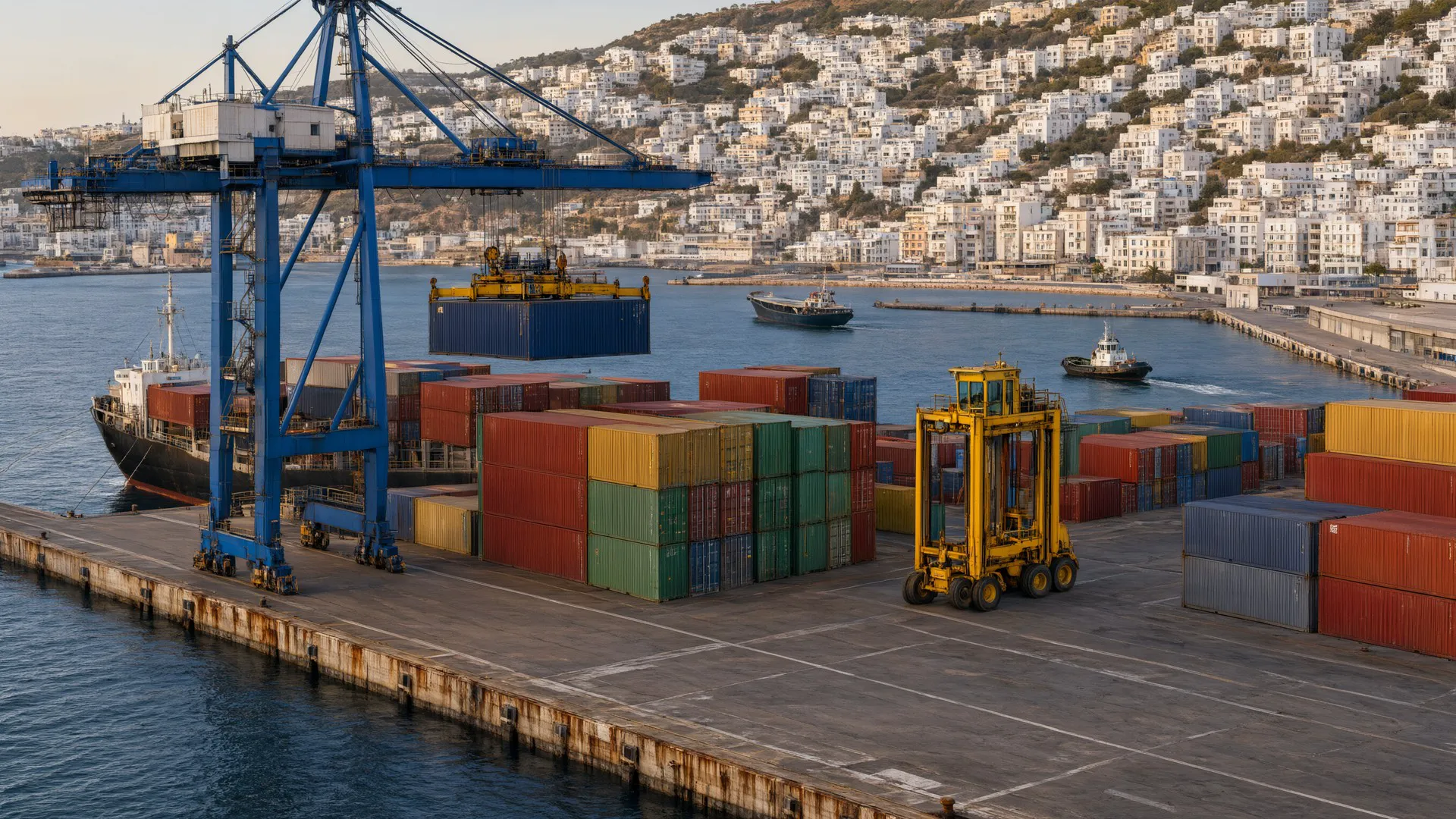
1. What the Suez return changed on this lane, and the four clocks it left alone
The Suez Canal return of 2026 has been fastest in the Mediterranean, and Mediterranean shipping is exactly where Algeria sits. Metro's network survey of the ten largest carriers, published on 27 October 2026, puts 63 percent of Far East–Europe capacity back on Red Sea routings, with 70 percent of Far East–Mediterranean capacity transiting Suez against 58 percent on Far East–North Europe. That Mediterranean skew matters here: 24 of 46 direct Far East–Europe services are back through the canal, and 5.5 million of the 8.7 million TEU deployed on the trade is now assigned to Suez loops.
The sequence for a booking made now is shorter. Maersk and Hapag-Lloyd moved AE5, AE11, AE12 and ME2 from the Cape back to Suez with effect from 19 September 2026, and a 17,200 TEU vessel transited on 22 August 2026 as the largest box ship through the canal since the diversions began. Carriers have kept the right to reverse that decision, and some services still run westbound through Suez and eastbound around the Cape, which is why two containers loaded the same week can arrive a fortnight apart.
The routing change did not touch anything after the water. Algeria's delivery date is set by four clocks, and only the second one belongs to the carrier.
| Clock | What it measures | Days on this lane | Who controls it |
|---|---|---|---|
| Bank | Domiciliation registered, forecast approved, provision funded, bill of lading dated after the visa | 30–45 before the vessel loads; often 5–8 weeks end to end | The importer and its single designated bank |
| Sailing | Chinese port to Algiers, Oran, Skikda, Bejaia or Djen Djen | 30–45 FCL, plus 10–14 if the booking lands on a Cape loop | The carrier's network decision |
| Berth | Anchorage before a berth, then discharge | 0.2–7 days at Algiers depending on the month | The port, the season and the weather |
| Clearance | D15 declaration, duty, VAT, TCS, release, then inland delivery | 5–7 working days when the file is complete, 2–3 weeks when it is not | Your broker, and how good your document set is |
The berth clock is the one that changed most recently, and it changed in the opposite direction to what most published guides still say. Algiers averaged 4 to 7 days of anchorage through the first half of 2026, with 7.43 days in April. By the week of 18 to 24 October 2026, Portcast's congestion index for Alger recorded a median waiting time of 0.17 days. The ships are getting in. The containers are not leaving any faster, which is Section 6.
2. How long to ship from China to Algeria, mode by mode
The table below is the answer most importers want in one screen. Every number is labeled by basis, because the single biggest reason two published China–Algeria transit times disagree by two weeks is that one is port-to-port and the other includes the bank file.
| Mode | Port-to-port or airport-to-airport | Door-to-door | October–November 2026 rate |
|---|---|---|---|
| Container shipping from China to Algeria — FCL 20GP | 30–45 days | 40–55 days (50–65 on a Cape loop) | $3,672–$4,488 per box; desk quotes $3,700–$5,000 |
| FCL 40GP / 40HQ | 30–45 days | 40–55 days | $5,004–$6,116 per box; desk quotes $6,000–$8,000 |
| Sea LCL, consolidated | 37–44 days | 37–53 days (consolidation plus CFS release) | $180–$250 per CBM, before Algiers CFS handling |
| Air freight to ALG or ORN | 3–6 days | 8–12 days | $5.90–$8.70 per kg by weight break |
| Express courier (DHL / FedEx / UPS) | — | 5–9 days | $12.35–$16.13 per kg |
| Sea door-to-door DDP | — | 40–55 days | $130–$250 per CBM all-in, duty and VAT excluded |
| Air door-to-door DDP | — | 11–15 days | $7–$11 per kg all-in, duty and VAT excluded |
Read the freight column as freight, not landed cost: Algerian duty runs the five bands of 0, 5, 15, 30 and 60 percent by ten-digit tariff line, import VAT is 19 percent on CIF plus duty, and the TCS solidarity levy adds 2 percent of CIF, so a mid-band consumer good can carry a border bill close to half its value before anyone moves it inland. And the air column is deliberately conservative. There is no daily freighter into Algiers from South China; most uplift connects through Istanbul, Doha, Dubai or Paris, and Air Algérie's Beijing service is the closest thing to a direct routing. Air freight to Algeria reads 3–6 days at the airport and 8–12 days at the door while our air freight desk still quotes it as the fast option against 40–55 days at sea.
3. The 50-day ledger: where the days actually sit
How long sea freight from China to Algeria can take is a question about eight stages, and each one has an owner. Here is the sea chain priced in days rather than dollars, using October 2026 conditions and a direct sailing from Shenzhen to Algiers.
| Stage | Days | Owner | What stretches it |
|---|---|---|---|
| Supplier pickup and trucking to the China warehouse | 1–2 | Forwarder | A second supplier address, waiting time at a factory gate |
| Consolidation, packing, VGM, booking | 2–3 | Forwarder | Booking inside a peak week, cargo arriving without marks |
| Export declaration and loading | 1–2 | Forwarder, with your supplier's invoice | Invoice that does not match the packing list |
| Sailing, South China to Algiers | 30–37 | Carrier | A Cape routing instead of Suez |
| Anchorage before berth | 1–7 | Port and weather | A congested month; a storm at Bejaia or Skikda |
| Discharge and terminal handling | 1–2 | Terminal operator | Yard density, equipment shortage |
| D15 declaration, duty, VAT, TCS, release | 5–7 | Licensed broker | Valuation query, missing conformity certificate |
| Delivery inside the Algiers wilaya | 1–2 | Trucking | Site that cannot take a 40-foot container, empty return |
| Total | 42–62 |
Add the low ends and the chain is 42 days. Add the high ends and it is 62. No single figure survives that spread, so we quote 40–55 days door-to-door as the planning band: the stages rarely all run long in the same shipment. If the booking is assigned to a Cape loop, add 10 to 14 days of sailing and plan on 50–65 days, which is the same shipment with nobody having made a mistake.
The air chain has the same shape and a different distribution: pickup 1–2 days, screening and build 1–2, uplift and flight 1–3, arrival handling 1, clearance 2–5, delivery 1. That is 8–12 days at a door in Algiers and 11–15 days for an inland address such as Blida, Constantine or Sétif, where the truck leg and the customs bond add a day or two. Compare that with the same cargo shipped by sea and the saving is 30 days for roughly four to six times the freight per kilogram; our breakdown of door-to-door shipping from China to Algeria prices that trade for three real consignments.
There is no rail option from China to Algeria in 2026. The China–Europe train network ends in European terminals, and anything moved that way reaches Algeria by a Mediterranean feeder or a transshipment at Valencia, Algeciras or Genoa, which costs 5–9 days on top of the ocean leg. A forwarder offering "rail to Algeria" is selling you a sea booking with an extra border in the middle.
4. The 30 days before the container leaves China
Most transit-time guides start the clock when the container is loaded. On this lane the clock starts in a bank, and it starts about a month earlier. Since Bank of Algeria Note 01/DGC/2026 took effect on 14 May 2026, the import domiciliation has to be registered before the foreign supplier ships, and banks now check that the transport document is dated after the domiciliation visa. A bill of lading dated before the visa is not a small clerical problem; it is cargo that cannot be paid for and, in the worst case, cargo that sits at anchor with nobody willing to release it.
Two more layers sit in front of the domiciliation. The import forecast programme has been mandatory since 9 July 2025: an importer submits its programme to the ministry in charge of foreign trade, and the ministry typically answers within seven days. A shipment that is not inside the approved programme does not get a letter of credit, whatever its commercial merit. And under Instruction 05-2017, imports for resale must be domiciled at least 30 days before shipment with a provision of at least 120 percent of the import value held at the domiciliary bank; the USDA attaché report on Algeria's import requirements puts the practical range at 120–130 percent and notes that importers must use a single bank for the whole programme, with minimal exceptions. The same report records that the maximum advance payment to a foreign supplier is 15 percent and that the procedure is so heavy that Algerian importers almost never use it, which is why a documentary credit is the default settlement instrument and why your supplier's finance team needs the L/C terms before it books a sailing.
| Day | What has to exist | Who owns it | What breaks if it slips |
|---|---|---|---|
| −45 | Import forecast covering this shipment and this value | Importer, via the ministry portal | No L/C, no payment, no sailing date |
| −45 to −35 | Domiciliation dossier opened: invoice proforma, HS code, supplier details | Importer, single designated bank | The 30-day floor is missed and the booking cannot be confirmed |
| −35 to −30 | Domiciliation visa issued; 120–130 percent provision funded in DZD | Importer's bank | Cash is frozen later and the supplier refuses to load |
| −30 | Booking placed, rate held for 7–14 days, sailing nominated | Forwarder | Space goes to whoever booked first in a peak week |
| −25 to −15 | Certificate of conformity arranged for regulated goods | Supplier, with an accredited body in China | Cargo arrives without a certificate and is inspected at destination |
| −10 to −5 | Supplier packs, marks and delivers to the warehouse | Supplier | Missing marks cause a re-pack and a missed cut-off |
| −3 to 0 | Export declaration filed, container loaded, B/L dated after the visa | Forwarder | B/L dated before the visa invalidates the payment file |
Two details from late 2026 are easy to miss and expensive to fix. Since 31 May 2026, importers bringing in goods that are not destined for further processing must disclose customer data — names, commercial registry numbers, business activity — in paper and electronic form inside the 45-day domiciliation window. And local banks are not permitted to release the final funds until customs clearance at the port of entry is complete, which means the money clock and the clearance clock are the same clock: the day your container leaves the port is the day your supplier's balance becomes payable, not the day it sails.
The practical consequence for a delivery date is larger than any routing decision. A purchase order placed today with a supplier who is ready to ship in ten days will not move in ten days. It will move when the visa exists, and the disciplined way to plan is to treat the bank file as a 30-day lead time and to hold the shipping instruction until you have the visa in writing rather than an assurance on the phone.
5. Sea freight from China to Algeria: what each load port adds
Sea freight from China to Algeria takes 30 to 45 days port to port, and where you load moves that number by up to nine days before anyone discusses a rate. South China sits closest to the Malacca Strait and has the deepest direct coverage into Algiers and Oran; northern ports load earlier in the rotation and pay for it on the water.
| Load port | To Algiers (Suez) | To Algiers (Cape) | To Oran | What we quote for Algiers, port-to-port |
|---|---|---|---|---|
| Shenzhen (Yantian, Shekou) | 30–37 days | 40–49 days | 31–38 days | 30–38 days |
| Guangzhou (Nansha) | 31–38 days | 41–50 days | 32–39 days | 31–39 days |
| Xiamen | 33–40 days | 43–52 days | 34–41 days | 33–41 days |
| Shanghai / Ningbo | 33–40 days | 43–52 days | 34–41 days | 33–41 days |
| Qingdao | 35–42 days | 45–54 days | 36–43 days | 35–43 days |
| Tianjin / Dalian | 37–44 days | 47–56 days | 38–45 days | 37–45 days |
The table is the reason a supplier in Shandong and a buyer in Algiers often do better by trucking cargo to Guangdong than by loading at the nearest port. The freight difference between a South China and a North China load port is $400–$500 per box in the same sailing week, and the transit difference is up to a week; for time-sensitive cargo the domestic reposition usually costs less than the week it saves. The port-pair detail behind that claim sits in our sea freight from China to Algeria guide.
Two habits pay for themselves before you book. Ask for the full rotation, not just the transit time, because a service that omits Algiers for one voyage and discharges at Valencia with a feeder onward adds five to nine days and the quote will not mention it. Then ask whether the loop is committed to Suez for both directions. A carrier that runs westbound through the canal and eastbound around the Cape keeps its schedule intact in one direction only, and the return voyage pattern is a decent early signal of how stable the rotation will be over the next eight weeks.
Algeria's own port system is also less concentrated than the headline suggests. Algiers handles more than 60 percent of national containers, but Oran covers the west and its industrial belt, Skikda serves the east and petrochemical traffic, Bejaia is the weather-sensitive option for Kabylie and Sétif, and Djen Djen at Jijel, under a 30-year DP World concession, commissioned four 17-meter-draft berths on 22 July 2026 and can take vessels up to about 6,000 TEU. Choosing the discharge port by the consignee's address rather than by habit is the cheapest scheduling decision on this lane.
6. After discharge: five gateways, five different waits
Algiers port congestion in 2026 has inverted in a way that catches importers out. The anchorage queue that dominated 2024 and 2025 has largely cleared, while the container's time on the ground has not. Keep berth waiting and clearance in separate columns, because a forwarder who quotes the first as if it were the second is quoting the easy half.
| Gateway | Vessel wait before berth | Clearance, complete file | Inland to the main city | Door-to-door by sea |
|---|---|---|---|---|
| Algiers (DZALG) | 0.2–7 days; H1 2026 averaged 4–7, week of 18 October 2026 median 0.17 | 5–7 working days; 2–3 weeks with a query | Same day to Algiers, Blida, Boumerdès | 40–55 days |
| Oran (DZORN) | 4–6 days in a normal month; 5.5 in a storm week | 5–7 working days | Same day to Oran, 1 day to Tlemcen, Sidi Bel Abbès | 40–55 days |
| Skikda (DZSKI) | 9–15 days; the slowest of the five in 2026 | 5–8 working days | 1 day to Annaba, Constantine, Skikda | 45–58 days |
| Bejaia (DZBJA) | 0.5–11 days: container-ship stay fell from 3.72 to 0.51 days between January and May 2026, storms still close the roads | 5–7 working days | 1 day to Bejaia, Sétif, Bordj Bou Arréridj | 40–56 days |
| Djen Djen (DZDJE) | 1–3 days; new 17 m berths since July 2026 | 5–7 working days | 1 day to Jijel, Constantine, Sétif | 40–54 days |
The Bejaia line is the most informative number on this page. The port's own bulletin, reported in August 2026, recorded average container-ship time in the roads falling 86 percent year on year, from 3.72 days to 0.51, with the daily count of ships waiting dropping from 11 to 7 after the port moved to continuous 24/7 working. It is a real improvement and it is also weather-dependent: the same port lost berth time to storms in the first quarter, when weekly carrier advisories put waits at 6 to 11.5 days.
The clearance column is where the calendar is actually decided, and it has a hard edge. The D15 declaration is filed through SIGAD within 21 days of unloading. File inside the window and you pay duty, VAT at 19 percent and TCS at 2 percent and get a release; file late and the file moves into the deposit regime for two months, after which the goods can be treated as abandoned to the treasury. Storage past free time runs about $120 per day, free time at Algiers is normally 7–14 days and 21 is negotiable but not free, so a valuation query that takes three weeks costs about $2,520 in storage alone before the dispute is resolved downstream.
Our customs clearance desk pre-lodges the declaration before the vessel berths for exactly this reason. A container that clears on the day of discharge never tests the free-time window; a container whose certificate of conformity was never issued in China always does.
7. What adds a week, ranked
Transit ranges are estimates. On this lane eleven specific failures account for most of the slippage, and eight of the eleven are decided before the cargo reaches the water.
| What happens | Days added | Where it is decided |
|---|---|---|
| Domiciliation missing, or the B/L dated before the visa | 15–45 | 30 days before sailing, at the bank |
| Booking sold as a 30-day transit but routed around the Cape | 10–14 | At quotation, if the routing was never confirmed |
| D15 filed late or hit by a valuation query | 5–21 | After discharge, at the declaration desk |
| Certificate of conformity missing on a regulated product | 5–15 | In China, before loading |
| Carrier omits Algiers and discharges at Djen Djen or the next call | 3–8 | At the carrier's network desk |
| Documents that disagree — invoice, packing list, HS line, origin certificate | 3–10 | At document preparation |
| LCL container waiting to fill at origin | 4–9 | At the consolidation warehouse |
| Anchorage in a congested month at Algiers | 1–7 | At arrival, outside your control |
| Weather closing Bejaia or Skikda | 2–6 | Not controllable, partly forecastable |
| Storage and demurrage past free time | $120 per day, and the release does not happen until it is paid | At the terminal |
| Peak-season space and blank sailings | 7–14 per rollover | At booking and again at cut-off |
The three most expensive rows have nothing to do with ships being slow. A domiciliation that was never registered, a routing that was never disclosed and a declaration filed after discharge are all paperwork failures, and all three are cheaper to prevent than to absorb. A document pack checked at booking beats any recovery attempt at arrival, because booking is the last point at which a correction is free.
The two rows that are genuinely outside your control are worth budgeting for rather than avoiding. Anchorage at Algiers in a congested month is a week, and a storm at Bejaia is a week, so a promise built on the low end of every range is not a plan; it is the best case with the word "plan" attached. Importers who build five days of slack into a November arrival and ten days into a December one rarely need the whole buffer, and the ones who build none spend it in demurrage.
8. The window that decides the date: late September to November, then the spring wave
Peak season to ship to Algeria runs from late September to the end of November, and it moves two numbers at once. Space tightens and surcharges appear on the freight side, while clearance slows on the destination side because brokers and terminals are handling more files with the same staffing. A booking made in the first week of October and a booking made in the first week of December can be a fortnight apart on the same sailing string.
The rates themselves have been moving the other way, which is the confusing part of this market. Published forwarder indices for October 2026 put a 20GP into Algiers at $3,672–$4,488, down about 16 percent month on month, and a 40GP at $5,004–$6,116, down 15.2 percent, with LCL holding flat and air easing about 8 percent to $5.90 per kilogram past a metric ton. Softer rates and tighter space are not a contradiction: the rate is what the market will bear this week, and space is what a carrier will allocate four weeks out. That is why we quote a booking price with a 7–14 day validity and a delivery date with a buffer built in, and why an October rate held from September is either a favour or a warning.
| Window | What it does to the calendar | What to do |
|---|---|---|
| Early October | Golden Week shut Chinese factories and brokers; the backlog clears into the same vessels as new orders | Expect a two-week ramp rather than full throughput in the week of 8–16 October |
| Late October to end of November | The Algerian peak: space tightens, clearance queues lengthen, surcharges return | Book two weeks earlier than the arithmetic suggests; hold 5 extra days of buffer |
| December | Algerian terminals and customs slow over the year-end holidays; European feeder capacity thins | For pre-holiday retail, the last sensible South China sailing is the first week of November |
| January 2027 | Pre-holiday front-loading ahead of Chinese New Year; allocations sell out first | Place production orders in November, not January |
| February 2027 | Chinese New Year on 6 February 2027: factories close for one to three weeks, carriers blank sailings | The last reliable pre-holiday sailing from South China leaves in the second week of January |
| First quarter 2027 | Ramadan retail demand pulls a second wave into January and early February, then demand drops sharply | Ship the Ramadan stock by sea in December; use air only for the gap |
Working backwards from a shelf date is the only way to use this table. A consignment that has to be in an Algerian warehouse before the Ramadan retail peak needs to be loaded in China by the end of November, because sea door-to-door is 40–55 days and the bank file needs roughly five weeks ahead of that. That is a 95-day order-to-shelf plan for a shipment whose transit time is 45 days, and every year someone discovers the difference in the last week.
9. Which mode fits which importer
The mode decision on this lane is really three questions: how many cubic meters, how much value per kilo, and how hard the date is. The crossover that catches importers is the LCL-to-container break, which sat at about 17.6 CBM in October 2026 after moving nearly three cubic meters in a single month as container rates fell. Anyone holding a September quote is probably on the wrong mode.
| Your situation | Mode that fits | Realistic door-to-door | What decides it |
|---|---|---|---|
| First import, under 2 CBM, no Algerian tax registration | Sea LCL or air DDP | 37–53 days by sea, 11–15 by air | Small consignments pay the same fixed document and agent costs as a container, so the per-CBM number is misleading |
| 2–14 CBM of mixed goods, medium value | Sea LCL | 37–53 days | Below the LCL-to-container break, groupage wins on landed cost |
| 15–25 CBM, repeat order, cost-sensitive | 20GP container | 40–55 days | Above roughly 17.6 CBM the fixed charges of a box beat per-CBM pricing |
| 25 CBM or more, or cargo that cannot be co-loaded | 40GP / 40HQ | 40–55 days | Per-unit cost falls again; fewer handling risks |
| Launch stock, spare parts, high value per kilo | Air freight | 8–12 days | Air defends itself on margin per kilo, not on volume |
| A pallet that is already late for a contract | Air DDP | 11–15 days | One party, one invoice, duty and delivery inside the price |
| Samples, documents, under 30 kg | Express courier | 5–9 days | Faster than commercial air because it does not wait for a consolidation |
| Building materials, tiles, furniture, machinery | Sea FCL | 40–55 days | Anything priced per cubic meter loses badly by air |
| Cargo for Oran, Constantine or Sétif | Sea to the nearest gateway | 40–54 days | The discharge port is chosen by the consignee's address, not by habit |
A caution on the DDP rows. A foreign company cannot be the Algerian importer of record: the entity named on the declaration has to be registered in Algeria, hold an NIF and an authorised bank account, and resale imports also sit inside the 51/49 ownership rule. Any DDP offer on this lane is therefore a structure rather than a single company, built from the Chinese shipper, the forwarder, a licensed customs broker and an Algerian importer. A DDP quotation that cannot tell you which entity will be named on the declaration is a price, not a service.
10. Nine questions to ask before you accept a transit time
A transit time is a claim until someone shows you the vessel, the routing and the declaration behind it. This is the list we run on our own bookings, and the one we are happy to answer line by line.
- Is that number port-to-port or door-to-door? Half the disagreement between published China–Algeria transit times disappears once both sides say which basis they are using.
- Which routing is this quotation built on, Suez or the Cape? If the answer is "whatever the carrier books", the range has to reflect both, and the top of the range is the number to plan against.
- Which vessel and voyage, and what is the full rotation? A named booking is checkable. A range is not.
- Is my domiciliation visa issued, and will the bill of lading be dated after it? This is the difference between a booking and a shipment that can be paid for.
- Has the certificate of conformity been issued in China? For regulated goods, a missing certificate is a destination inspection plus a delay, not an administrative note.
- What free time do I get at the terminal, and who pays storage after it? Get the free days and the $120-per-day rate in writing before the container sails.
- Will the D15 be pre-lodged before the vessel berths? Pre-lodgement turns a five-day clearance into a same-day release.
- Which charges are excluded from the door-to-door figure? Destination CFS handling, inspection fees, storage and the empty return are the usual four.
- What happens to the date if the sailing is blanked or the port is congested? A written answer with the next available vessel and its cut-off is worth more than a discount.
11. Algeria transit times: the questions we answer every week
How much does it cost to ship from China to Algeria in November 2026? Freight only, for general goods: $3,672–$4,488 for a 20GP and $5,004–$6,116 for a 40GP or 40HQ into Algiers on the October index, with desk quotes running $3,700–$5,000 and $6,000–$8,000 once origin handling and destination work are bundled. LCL is $180–$250 per CBM, air is $5.90–$8.70 per kilogram by weight break, express is $12.35–$16.13 per kilogram, sea DDP is $130–$250 per CBM and air DDP is $7–$11 per kilogram. None of those include duty, VAT or TCS, which is why the number that matters is landed cost and not the freight line.
How long does air freight take from China to Algeria, and is air shipping from China to Algeria quicker than express? Air freight runs 3–6 days airport-to-airport and 8–12 days door-to-door into Algiers, with 11–15 days for an inland address. Express is quicker at 5–9 days for parcels because it does not wait for a consolidation and clears through its own broker, but it costs roughly twice as much per kilogram and stops making sense above a few hundred kilos. There is no daily freighter from South China to Algiers; most uplift connects through Istanbul, Doha, Dubai or Paris, and Air Algérie's Beijing service is the closest to a direct routing.
How long does customs clearance take in Algeria? 5–7 working days with a complete file at Algiers, and 2–3 weeks if there is a valuation query, a tariff classification dispute or a missing certificate. The D15 declaration must be filed through SIGAD within 21 days of unloading; after that the file moves into the deposit regime for two months and storage accrues at about $120 per day. Pre-lodging the declaration before the vessel berths is the single intervention that removes most of this risk.
What is the cheapest way to ship from China to Algeria for a 6 CBM order? Sea LCL, at $180–$250 per CBM plus destination CFS handling, which lands a 6 CBM consignment at roughly $1,100–$1,500 in freight before duty. A 20GP at $3,672–$4,488 is cheaper per cubic meter but you are paying for 28 cubic meters you are not using. The LCL-to-container break sat at about 17.6 CBM in October 2026, so at 6 CBM groupage wins clearly and at 20 CBM the box wins clearly.
Is door to door shipping from China to Algeria faster than port-to-port? No, and it is usually slightly slower, because it includes the steps a port-to-port quote leaves out. Port-to-port is 30–45 days on the water; door-to-door is 40–55 days once pickup, export declaration, clearance and inland delivery are added. What door-to-door buys is a single accountable party for the days after discharge, which on this lane is where 5 to 21 of them are lost.
Is shipping from Shenzhen to Algeria quicker than shipping from Guangzhou to Algeria? Shenzhen is the fastest load port on the lane at 30–37 days to Algiers on a Suez routing, and Guangzhou from Nansha is one to two days behind at 31–38 days. The gap is small; the gap to North China is not. Qingdao runs 35–42 days and Tianjin 37–44 days, so a supplier in Shandong can lose a week on the water before the booking is even confirmed.
How do I compare the best shipping companies from China to Algeria? Ignore the headline transit time and compare four things instead: whether the quote states its routing and its validity date, who files the D15 and whether they pre-lodge it, whether the certificate of conformity is inside the price, and which entity will be named as importer of record. A forwarder that answers all four in writing is quoting a service; one that quotes a single number and changes the subject is quoting a rate.
Can I import into Algeria without a bank domiciliation? Not lawfully for commercial imports. Domiciliation is a condition of payment and of clearance, and since 14 May 2026 it has to be registered before the supplier ships, with the bill of lading dated after the visa. Importers of production inputs sit outside the resale ratio limits but still need the domiciliation; the 120–130 percent provision applies to imports for resale in the same state.
What happens to my transit time if the carrier switches back to the Cape? Add 10–14 days of sailing and plan on 50–65 days door-to-door. The Suez return is real but partial: 63 percent of Far East–Europe capacity and 70 percent of Far East–Mediterranean capacity is back on Red Sea routings, and carriers have kept the right to reverse. Ask for the rotation on the booking, and if the answer is "Suez, subject to change", treat the Cape number as your plan.
12. Lock a delivery date instead of a range
The routing the carrier assigns sets the sailing. Whether the domiciliation and the declaration are in place decides whether that sailing is usable at all. How fast the container clears and leaves the quay sets the day your stock actually arrives. Get all three right and a 40–55 day range collapses into a date you can build a launch around.
Send us the cargo dimensions, the supplier's city and the day your stock has to be on the shelf. We will come back with the mode that fits the deadline, the vessel that still works, and a landed-cost figure that includes duty, VAT, TCS and the Algerian fixed charges, usually the same working day. AllBestShipping handles the booking, the export declaration, the certificate coordination, the D15 filing and the delivery as one chain from Shenzhen, which is why we can commit to an arrival date rather than a transit time. Start with a lane quotation that states its validity date.