How Much Does It Cost to Ship from China to Kenya in 2026? The Complete Guide (Sea, Air & DDP)
If you are an importer, e-commerce seller, or small business owner trying to figure out how much does it cost to ship from China to Kenya, you have probably already noticed something confusing: every forwarder quotes a different number, and none of them explain what the price actually includes. In this 2026 guide, we break down real sea freight, air freight, and door-to-door DDP rates to Kenya, walk you through every fee from the factory in China to your door in Nairobi, and show you the hidden costs that quietly eat into your margins at Mombasa Port.
1. China to Kenya Freight Rates 2026: Shipping Cost at a Glance
Before you compare quotes, you need a baseline. The table below summarizes indicative August 2026 rates for every common shipping mode from China to Kenya. Transit times are included as a decision aid, but this article focuses on what you actually pay.
| Shipping Mode | Indicative Cost (Aug 2026) | Transit Time | Best For |
|---|---|---|---|
| Sea Freight (FCL 20ft) | $1,900 – $4,675 per container | 22 – 35 days | Cargo over 15 CBM, full container loads |
| Sea Freight (FCL 40ft / 40HQ) | $3,700 – $6,270 per container | 22 – 35 days | Large-volume bulk shipments |
| Sea Freight (LCL) | $100 – $180 per CBM | 36 – 47 days | Small loads under 13 CBM |
| Air Freight | $5.50 – $9.00 per kg | 4 – 7 days | Urgent, high-value, or time-sensitive cargo |
| Express (DHL / FedEx / UPS) | $8.78 – $13.00 per kg | 2 – 13 days | Parcels, samples, e-commerce restocks |
Read Quotes Carefully: Three Different Price Types
The single biggest reason quotes differ so wildly is that forwarders quote on different bases. Always confirm which of these you are comparing:
- Port-to-Port: The ocean freight plus origin and destination port charges only. The cargo is delivered to Mombasa Port, and you handle everything after that.
- Door-to-Door (Port-to-Door): Delivery from the port to your warehouse in Kenya, but customs clearance, duties, and taxes are usually your responsibility.
- DDP (Delivered Duty Paid): One all-inclusive price covering freight, customs clearance, import duty, VAT, and final delivery to your door. This is the only quote you can compare directly against your total budget.
Important note on accuracy: Ocean freight rates on the China–Kenya corridor have been volatile in 2026, driven by geopolitical pressure in the Middle East and tightening East Africa capacity. Treat every figure in this article as a planning reference, and always request a written quote with 2–3 weeks of validity before you book.
2. Sea Freight Cost from China to Kenya: Container Rates Explained
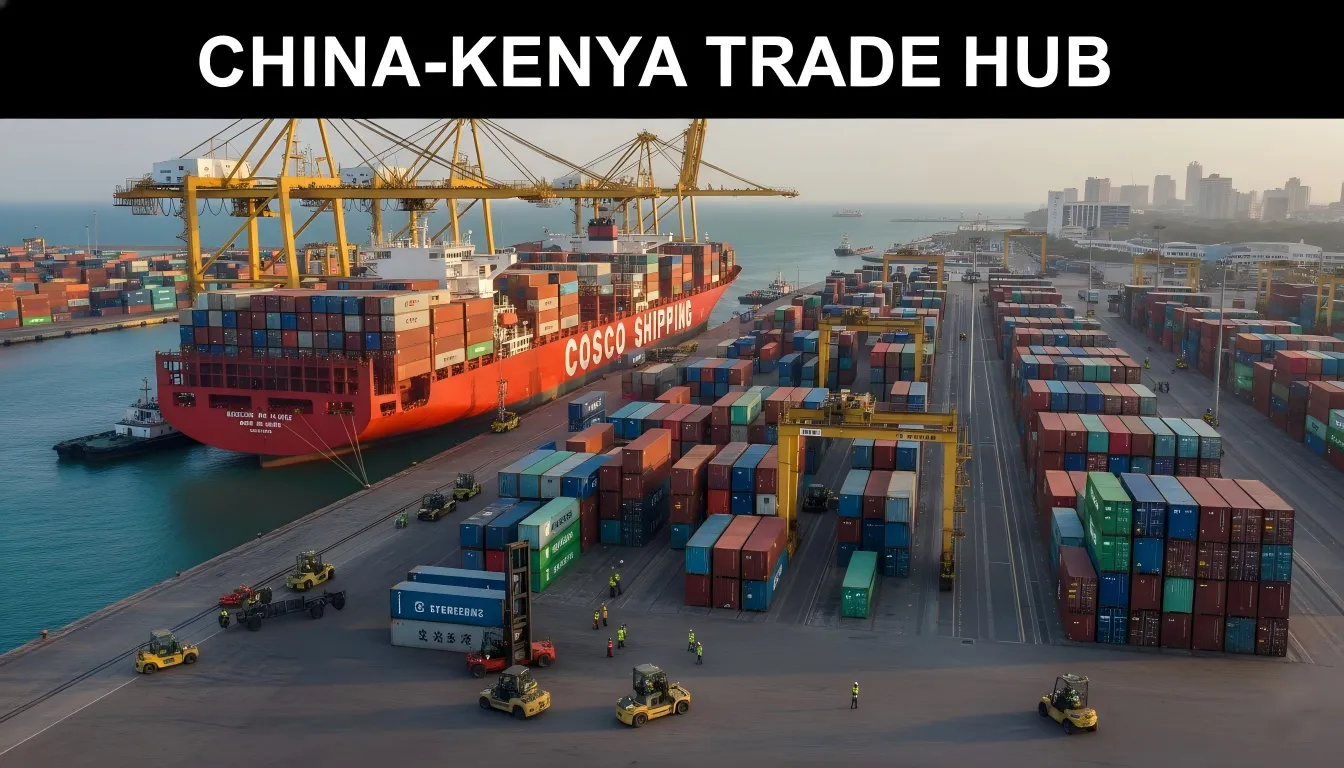
Sea freight is the backbone of China–Kenya trade and the most economical choice for bulky goods, machinery, and wholesale orders. Nearly all cargo lands at Mombasa Port, the largest port in East Africa and the gateway to Kenya and its landlocked neighbors. From there, shipments for Nairobi travel inland by the Standard Gauge Railway (SGR) or truck to the Nairobi ICD (Inland Container Depot).
FCL (Full Container Load) Rates by Origin Port
When you book a full container, you pay a flat rate no matter how full it is. Rates vary by origin port and sailing schedule, as shown below.
| Origin Port (China) | 20ft Container (USD) | 40ft Container (USD) | 40HQ Container (USD) | Est. Transit Time |
|---|---|---|---|---|
| Shenzhen / Guangzhou | $1,900 – $2,300 | $3,700 – $4,400 | $3,900 – $4,600 | 25 – 30 days |
| Shanghai | $2,000 – $2,400 | $3,800 – $4,500 | $4,000 – $4,700 | 28 – 35 days |
| Ningbo | $2,050 – $2,500 | $3,900 – $4,600 | $4,100 – $4,800 | 28 – 36 days |
Our Industry Insights: In 2026, FCL rates on this lane climbed sharply through mid-year — 20GP was up roughly 29% and 40GP up about 33% month-over-month at the peak. For bulk cargo, a 40HQ almost always delivers a better per-cubic-meter rate than two 20ft containers, and it protects you from container-split fees. Lock in all-in quotes (including BAF, handling, and surcharges) early, especially before the peak season starting in September.
A standard 20ft container holds about 28 CBM, while a 40ft high cube holds roughly 68 CBM. Your shipment's documents — the Bill of Lading (B/L), commercial invoice, and packing list — must match exactly, because discrepancies are a leading cause of customs delays and extra charges.
3. LCL Shipping Cost vs FCL: The Cheapest Way to Ship from China to Kenya
If your cargo cannot fill a container, LCL (Less than Container Load) lets you share container space with other importers and pay by volume, measured in CBM (Cubic Meters). LCL rates currently run $100 – $180 per CBM depending on the carrier and routing — but LCL is not always the cheapest option, even when it looks like it.
The "13–15 CBM Rule"
Many first-time importers assume that 14 CBM of cargo should definitely go LCL, since a 20ft container holds about 28 CBM. That assumption can be expensive.
While the pure ocean freight for 14 CBM of LCL looks cheaper on paper than a 20ft FCL, LCL shipments attract high CFS (Container Freight Station) unpacking charges, documentation fees, and handling costs on a per-CBM basis once the cargo reaches Mombasa. When your volume lands between 13 and 15 CBM, the total landed cost of a 20ft FCL is frequently lower than LCL — and FCL also offers better security and faster customs clearance, because your container is sealed in China and opened only at the destination.
Quick decision framework:
- Under 13 CBM → LCL is usually cheapest.
- 13–15 CBM → run the full landed-cost math before you choose (see Section 6).
- Over 15 CBM → book a 20ft FCL container.
- High value or urgent → consider air freight instead of sea.
If you source from multiple factories in China, the smartest cost lever is buyer consolidation: a freight forwarder collects goods from your suppliers, combines them at a Shenzhen or Guangzhou warehouse, and loads a single FCL container. This eliminates multiple LCL minimum charges and can cut total freight costs dramatically.
4. Air Freight Cost from China to Kenya: When Speed Justifies the Premium
Air freight is the fastest — and most expensive — way to move cargo from China to Kenya. Most air cargo arrives at Jomo Kenyatta International Airport (NBO) in Nairobi. Air freight is charged per kilogram, using the larger of the actual weight and the volumetric weight (length × width × height in cm ÷ 6000).
| Air Service | Indicative Rate (2026) | Transit Time | Best For |
|---|---|---|---|
| Standard air freight | $5.50 – $9.00 per kg | 4 – 7 days | Commercial air cargo, consolidations |
| Express air freight (DHL / FedEx / UPS) | $9.00 – $13.00 per kg | 2 – 5 days | Urgent documents, high-value goods |
| Air DDP (all-in, cleared) | ~$25 – $29 per kg | 5 – 10 days | E-commerce sellers wanting a fixed landed price |
Air freight pays for itself when the cost of delay exceeds the shipping premium: restocking an out-of-stock bestseller, shipping urgent samples to close a B2B deal, or moving high-value electronics where inventory financing costs are high. For those cases, the Airway Bill (AWB) gives you door-to-door tracking that ocean freight cannot match.
5. Door-to-Door & DDP Shipping Cost from China to Kenya
Door-to-door shipping is the option most small and mid-sized importers actually need, because it removes the burden of coordinating multiple carriers, clearing agents, and truckers. The gold standard is DDP (Delivered Duty Paid) — one price that covers every step of the journey.
A DDP quote from China to Kenya typically includes:
- Export clearance in China.
- Ocean or air freight charges.
- Destination port handling fees.
- Import duty and VAT paid to the Kenya Revenue Authority.
- Final delivery to your warehouse or doorstep in Nairobi, Mombasa, or upcountry.
DDP comes in two flavors. B2B DDP is for heavy cargo shipped by sea — machinery, building materials, wholesale electronics — cleared under the forwarder's importer code. E-commerce DDP is designed for Amazon FBA, Shopify, or local online sellers: smaller parcels consolidated and cleared in bulk, often with a simple per-kg price.
Real-Life Scenario: An electronics retailer in Nairobi imported 500 smartphones on CIF terms. When the shipment arrived, the Kenya Revenue Authority (KRA) reassessed the declared value, and the surprise duties wiped out the entire profit margin on the order. The next batch shipped DDP: the customer received a fixed per-kg quote upfront, the forwarder handled all KRA negotiations and documentation, and the landed price stayed exactly as quoted. Predictable pricing is the real value of DDP — not just convenience.
6. Kenya Import Duty and Tax Rates: The Real Landed Cost
Here is where most first-time importers get hurt. The Kenya Revenue Authority (KRA) collects import customs duty under the EAC Common External Tariff (CET), which ranges from 0% to 25% depending on the HS Code of your product, plus a flat VAT of 16% calculated on the cargo value plus the duty. Every consignment also requires an Import Declaration Form (IDF).
| Product Category | Customs Duty | VAT (16%) | Total Tax Impact |
|---|---|---|---|
| Electronics | up to 25% | 16% | up to 41% |
| Clothing | up to 25%+ | 16% | up to 51% |
| Machinery | up to 10% | 16% | up to 26% |
| Automotive parts | up to 20% | 16% | up to 36% |
| Agricultural products | 0% | 16% | 16% |
Let's make this concrete. Suppose you import $10,000 worth of furniture (25% duty) as 12 CBM of LCL from Shenzhen to Nairobi:
- Sea freight (12 CBM × $140): $1,680
- Origin charges (documentation, handling): +$300
- Mombasa THC and clearance: +$500
- Customs duty (25% of $10,000): +$2,500
- VAT (16% of $10,000 + $2,500): +$2,000
- SGR rail transfer + final delivery: +$800
Total landed cost: approximately $7,780 — more than the freight itself, and taxes alone account for over half the total. Duty and VAT rates change periodically and vary by product, so always confirm the correct HS code with your forwarder or the KRA before you commit to a purchase order.
7. Mombasa Port Shipping Costs & Hidden Fees to Avoid
The ocean freight invoice is only part of the picture. The fees that silently destroy margins live at the destination port.
| Fee | What It Is | Typical Amount | How to Avoid Surprises |
|---|---|---|---|
| THC (Terminal Handling Charges) | Port charge for moving your container off the vessel | $300 – $1,000 per container | Ask for destination THC in the initial quote |
| Demurrage / Storage | Penalty for not picking up your container within free days | $30 – $50 per day | Negotiate 14–21 free days; keep documents ready |
| CFS unpacking fee (LCL) | Cost of deconsolidating shared containers | Per-CBM charges | Compare LCL vs FCL at 13–15 CBM |
| SGR / trucking Mombasa → Nairobi | Mandatory inland transfer for Nairobi-bound cargo | Varies by weight/volume | Confirm whether quotes include inland transport |
| PVOC / COC inspection | Pre-shipment conformity inspection | 200 – 500 (CNY equivalent) | Arrange before the vessel departs |
The biggest clearance risk in Kenya is compliance. The Kenya Bureau of Standards (KEBS) runs the PVOC (Pre-Export Verification of Conformity) program for most regulated products: your goods must be inspected and verified in China before they are loaded. After a successful inspection you receive a COC (Certificate of Conformity). Ship without one, and your cargo can be denied entry, hit with a penalty of 15% of the CIF value, forced into a slow destination inspection — or shipped back to China at your expense.
Our Industry Insights: Standard demurrage free time at Mombasa is usually 7–10 days, which sounds fine until a customs query or a missing document eats a week. Experienced forwarders negotiate up to 21 free days for FCL shipments and stage the paperwork (IDF, invoice, packing list, COC) before the vessel even departs China. Never accept the default free-time terms if your clearance is likely to be complex.
8. How to Choose a Freight Forwarder China to Kenya
The cheapest quote is rarely the best quote. When evaluating a freight forwarder China to Kenya, look for four things:
- Origin network — Do they have their own warehouses in Shenzhen, Guangzhou, or Yiwu for consolidation and inspection?
- Destination capability — Do they have a dedicated KRA customs clearance team in Mombasa and Nairobi, and do they manage the SGR transfer?
- Transparent pricing — Do they itemize THC, ICD, and clearance fees, or quote a genuine all-in DDP price?
- Insurance and tracking — Do they offer cargo insurance and real-time shipment visibility?
Eight questions to ask before you book:
- Does the quote include destination THC and clearance in Kenya?
- How many free days of demurrage do I get, and can you negotiate more?
- Is VAT 16% included, or will I pay it separately?
- Who handles the PVOC inspection and the COC?
- Is the rate valid for at least two weeks, or can surcharges change mid-month?
- What happens if my cargo is delayed at Mombasa?
- Do you handle SGR transfer and delivery to Nairobi, or is that extra?
- Can you provide a single DDP price to my exact address?
For a B2B importer shipping heavy cargo, look for sea FCL with door-to-door clearance. For an e-commerce seller feeding Amazon FBA or local warehouses, air or sea DDP with a fixed per-kg rate keeps your landed cost predictable. For a small business moving less than a container, LCL with consolidation in Shenzhen is usually the right balance of cost and simplicity. AllBestShipping, based in Shenzhen with coverage across 50+ countries, provides transparent, fee-free-forwarding quotes, real-time tracking, and dedicated customs support for exactly these scenarios.
9. FAQ: Cost to Ship from China to Kenya
How much does it cost to ship a container from China to Kenya? A 20ft container costs roughly $1,900 – $4,675 and a 40ft container about $3,700 – $6,270 depending on the origin port and season. Always request a written quote before booking.
What is the cheapest way to ship from China to Kenya? Sea freight. Under 13 CBM, LCL is cheapest; above 15 CBM, a 20ft FCL container gives the lowest landed cost once Mombasa destination charges are included.
How are Kenya import duties and taxes calculated? Customs duty is applied per the EAC Common External Tariff (0%–25%) based on the HS code, then VAT of 16% is charged on the value plus duty. An Import Declaration Form (IDF) is required for every consignment.
Do I still pay taxes if I use a DDP service? No. Under DDP, your freight forwarder pays all import duties, VAT, and clearance fees — the quote you receive is the final price to your door.
What happens if my goods arrive without a COC? Cargo without a Certificate of Conformity can be denied entry, incur a 15% CIF penalty, face a slow destination inspection, or be returned to China at your cost. Arrange the PVOC inspection before the vessel departs.
Is LCL or FCL cheaper for my shipment? For volumes under 13 CBM, LCL usually wins. Between 13 and 15 CBM, compare full landed costs — FCL often comes out ahead. Above 15 CBM, FCL is clearly the cheapest option.
What hidden fees should I expect at Mombasa Port? Terminal handling charges (THC), demurrage and storage fees ($30–$50 per day after free days), LCL unpacking fees, and SGR transfer costs to Nairobi are the most common surprises.
Are any goods restricted or banned when shipping to Kenya? Yes. Counterfeit goods, narcotics, weapons, and certain agricultural products without permits are banned, while items like food, cosmetics, toys, and electronics must meet KEBS standards and carry a COC. Always check your product category with your forwarder before shipping.
Why do freight quotes for the same route differ so much? Quotes are usually issued on different bases — port-to-port, door-to-door, or DDP. Compare like for like, confirm what each price includes, and treat any figure older than a few weeks as outdated given how fast 2026 rates move.
Conclusion
Shipping from China to Kenya is rarely as expensive — or as simple — as the first quote suggests. The real cost is the sum of ocean freight, port charges, duty, VAT, and delivery, and the fastest way to protect your margin is to compare DDP prices, understand the 13–15 CBM rule, and work with a forwarder who knows Mombasa's port and KRA procedures inside out. Get an all-in quote, lock in your free days, and let a professional handle the paperwork — so the only surprise is how smoothly your cargo clears customs.