Customs Clearance from China: Documents, Duties & Process Explained
Your container arrived at the destination port on schedule. The vessel docked Tuesday morning. Then nothing happened for eight days. The cargo sat in the terminal while your buyer's customs broker and the local authority went back and forth over a discrepancy between the commercial invoice and the packing list — a weight difference of 40 kg that no one had bothered to reconcile. Storage charges accumulated. The buyer missed their retail launch. And the argument about who pays for the delay is still going on.
This is the version of "customs clearance from China" that nobody puts on their website: not the happy paperwork story, but the part where small mistakes become expensive weeks. In more than a decade of moving freight out of Shenzhen to 50+ countries, we have seen the same handful of errors cause most of the delays — and all of them were preventable before the cargo ever left China.
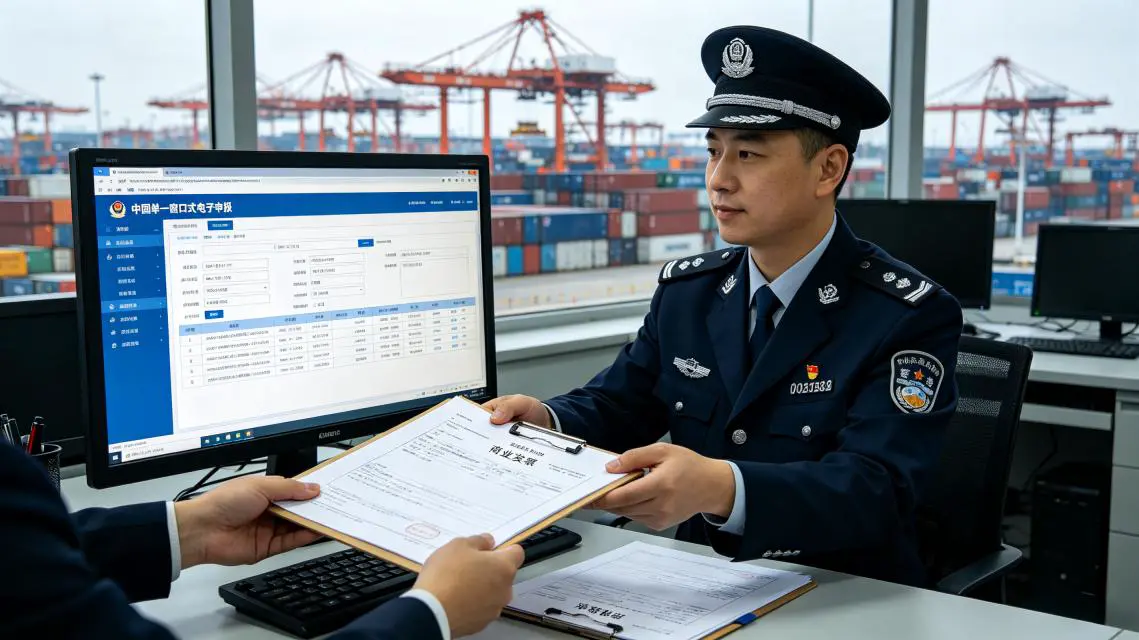
Here is what you actually need to know, in plain language: what customs clearance means on both ends of a China shipment, which documents matter, how duties are calculated, who is responsible under your Incoterms, and what has changed in 2026.
Customs Clearance Is Two Declarations, Not One
Most first-time importers picture customs clearance as a single event: the goods arrive, customs stamps something, and the truck drives away. In reality, every shipment from China crosses two separate customs borders, and each one requires its own declaration by a different party:
| Export clearance (China) | Import clearance (destination) | |
|---|---|---|
| Who declares | Chinese exporter / their agent | Importer / their customs broker |
| Where | China Customs via the Single Window | Destination customs authority |
| Key documents | Export declaration, commercial invoice, packing list, export licenses if regulated | Import entry, commercial invoice, packing list, bill of lading / air waybill, certificates |
| What customs checks | Export restrictions, declared value, HS code, license requirements | Duty & VAT assessment, HS code, restrictions, compliance with local rules |
| Money direction | Mostly no export duty; exporter may claim VAT rebate | Importer pays import duty, VAT/GST, and any additional tariffs |
| Typical outcome | "Released for export" | "Released for delivery" |
The China export side is usually handled by your supplier or your freight forwarder's China office, and for most consumer goods it is routine — China runs a largely paperless declaration system, and standard cargo clears the same day. The destination import side is where the money, the compliance risk, and the delays live. That is the side you need to understand before you book.
One more thing to internalize: these two declarations are linked. The commercial invoice and packing list that clear export in Shenzhen travel with the cargo and are re-used for the import entry in Rotterdam, Lagos, or Los Angeles. A mistake that feels cosmetic at origin — a sloppy product description, an inconsistent weight — becomes a customs hold at destination, where fixing it costs freight, demurrage, and patience.
Who Clears Your Goods? Your Incoterms Decide
The first question to answer on any shipment is not how clearance happens but whose job it is. That is decided by the Incoterms rule on your sales contract, not by whoever happens to be convenient.
- EXW, FCA, FOB, CFR, CIF — the buyer (your customer) owns the import clearance. Under FOB and CIF the seller's responsibility ends when the cargo is on the vessel; from that moment, the buyer arranges (and pays for) the destination customs broker, the duties, and the local delivery.
- DAP (Delivered at Place) — the seller covers transport to the named place but not import clearance or duties. The buyer still clears the goods.
- DDP (Delivered Duty Paid) — the seller (or their forwarder) handles everything: export clearance, freight, import clearance, duty and tax payment, and delivery to the door. This is the closest thing to a hands-off experience an importer can buy.
This matters more than most buyers realize. If you buy on FOB terms from a Chinese supplier, you are legally the importer of record in your country — you own the declaration, the duty liability, and the penalties if the declaration is wrong, even though you never touched the cargo. If you do not have a customs broker or in-house clearance capability, every FOB shipment is a silent risk. Many SME buyers quietly discover this on their first shipment when a customs exam letter arrives addressed to them.
The alternative is DDP. When you buy delivered-duty-paid from a forwarder like AllBestShipping, the forwarder's own customs partners file the import entry, pay the duties from the agreed budget, and carry the responsibility for getting the goods released. That is why our DDP shipping from China guide is one of the most-read pieces on our site: for buyers without a logistics team, DDP converts an unfamiliar compliance process into a simple door delivery. Note that a forwarder acting under DDP is not doing you a favor — it is a service with a cost built into the quote — but for many product categories it is cheaper than hiring a broker, missing a filing deadline, and paying storage while you learn.
The rule of thumb we give every client: if your order value is small, your product is regulated, or you have no one in your company who has cleared an import before, buy DDP. If you have an experienced broker and import regularly, FOB or CIF with your own clearance will usually cost less.
China Export Customs Clearance: What Actually Happens
Because the China side happens before you can see it, it helps to know what your supplier's forwarder is doing during those 1–3 days between "goods ready" and "vessel departure."
Step 1 — Customs registration. The Chinese exporter must hold a valid customs registration (the 进出口收发货人 registration). Any established trading company or factory that exports regularly has one; if you are buying from a very small workshop, confirm they can export legally, because goods declared under someone else's license create problems later.
Step 2 — Electronic declaration via the Single Window. China's customs clearance is effectively paperless. The exporter's customs broker files an export declaration through the China International Trade Single Window, attaching the commercial invoice, packing list, and sales contract data electronically. The declaration states the product description, HS code, quantity, unit price, total value, currency, destination country, and shipping details.
Step 3 — Review and selectivity. China Customs screens the declaration automatically. Most routine consumer goods are released without physical inspection. A share of shipments is flagged for document review or physical examination, and regulated goods are checked against their licenses:
- Goods subject to export licensing (certain dual-use items, some minerals and chemicals) need the license number in the declaration.
- Goods under statutory inspection (法检, mainly food, animal and plant products, and some industrial goods) must clear inspection first, and the electronic inspection result is matched to the declaration.
- Dangerous goods require a proper DG declaration and packing certificate.
Step 4 — Release for export. Once the declaration is accepted, the cargo is released to the terminal and loaded. You rarely hear about this step because, for standard cargo, it simply works.
Money note: China does not levy export duty on the vast majority of consumer goods, so "export taxes" are usually not a line item you need to budget. What does happen on the export side is the VAT rebate — Chinese exporters are entitled to reclaim a portion of the input VAT on exported goods, which is why suppliers sometimes ask for your export documents. This is the exporter's money, not yours; leave it to your supplier and forwarder to handle.
What Happens at the Destination Border
Once the vessel or aircraft arrives, the import clearance process follows a similar skeleton in almost every country, with local variations in timing and paperwork:
- Arrival and manifest. The carrier files the cargo manifest with destination customs. For ocean freight to the US, the ISF (Importer Security Filing) must already have been filed 24 hours before loading in China — a pre-arrival obligation many importers forget until the $5,000–$10,000 penalty notice arrives.
- Import entry filed. The importer or their broker files the import declaration — the entry — with the declared HS codes, values, and duty calculation. In the EU, the shipment also needs an ICS2/ENS entry summary declaration filed before arrival; your forwarder files this automatically as part of the service.
- Selectivity check. Customs runs the entry through risk engines and chooses a lane: automatic release, document review, or physical inspection. For a clean, well-documented shipment, most countries release within 1–3 working days of arrival. Physical inspection adds roughly 3–10 days depending on the port and the season.
- Duty and tax payment. The assessed import duty and VAT/GST are paid (or secured under a deferment account) before release.
- Release and delivery. The cargo is released, the carrier surrenders the bill of lading, and the local leg picks it up — to a warehouse, a store, or an end customer.
How this feels in practice depends on the mode:
- Express courier (DHL/FedEx/UPS): the courier acts as your clearance agent for documents-only shipments and bills duties to you or the shipper. Fastest, but the courier's "brokerage" is basic — regulated goods still stop.
- Air freight: the airline's ground handler or your broker clears at the cargo terminal. Air cargo is usually examined quickly because the value density is high and space is tight.
- Sea freight FCL: clearance happens at the destination port or an inland container depot. Full containers are more likely to attract inspection than LCL because of their size.
- Sea freight LCL: the consolidator's destination agent clears the groupage and splits the shipment. Your cargo rides on the consolidator's master bill, which adds a layer of documentation — and a reason to use a forwarder whose destination network is solid.
How Import Duties and Taxes Are Calculated
When your goods are released, you will have paid some combination of the following. Understanding the formula is the difference between a budget that holds and a surprise invoice:
Duty = duty rate (from the HS code) × customs value. Most countries base the customs value on the CIF value — cost of the goods plus freight plus insurance — although some (like the US) use the FOB value plus a small addition. The duty rate itself is set by the destination country's tariff schedule for your specific HS code, so the same product can be duty-free in one country and taxed at 20% in another.
VAT / GST is charged on top: (customs value + duty) × VAT rate. In the EU that is typically 19–25% depending on the country; the UK charges 20%; Australia 10% GST. This is usually the larger of the two charges for consumer goods, and it is the one first-time importers forget to budget.
Additional tariffs attach to specific products and origins: anti-dumping duties on certain Chinese goods (fasteners, ceramics, some furniture), and country-specific measures such as the US Section 301 tariffs on Chinese-origin goods. These stack on top of the normal duty.
The wildcard is the declared value. Customs compares your declared unit prices against their own reference database for the same product from the same origin. Declare implausibly low values and you are not "saving duty" — you are selecting yourself for a valuation exam, which means weeks of delay, storage charges, and quite possibly penalties. We have seen an importer declare a $6,000 shipment at $600 "to help the customer" and turn a 25-day shipment into a 70-day one. The duty saved was a few hundred dollars; the demurrage and the broker's extra fees were several thousand.
Where free trade agreements help: if your product qualifies under a trade agreement between your country and China — or, for some countries, via an intermediate origin — a certificate of origin can reduce or eliminate the duty. This is product-specific and changes often; it is worth a five-minute check with your forwarder before every shipment, not a once-a-year assumption.
The Documents That Actually Matter
Every shipment from China is built on a small set of documents, and the golden rule is consistency: the numbers on the invoice, packing list, and transport document must match each other exactly, because customs compares them line by line.
| Document | What it proves | Typical errors |
|---|---|---|
| Commercial invoice | What the goods are, their HS code, unit values, total value, seller & buyer | Vague descriptions ("plastic goods"), wrong HS code, inconsistent currency |
| Packing list | How the goods are packed: cartons, weights, dimensions, marks | Gross/net weight mismatch vs the invoice or bill of lading |
| Bill of lading / air waybill | Contract of carriage; proof the cargo is on the move | Consignee name not matching the importer of record |
| Certificate of origin | Where the goods were made; enables FTA duty preferences | Stating "China" for goods actually transshipped elsewhere |
| Import permits / certificates | Compliance with product regulations (CE, FDA, FCC, PVoC, CCC, etc.) | Missing entirely — the #1 cause of holds on regulated goods |
| Customs entry (filed by broker) | The actual import declaration with duty calculation | Filed with wrong HS code or value — errors here are hardest to fix |
Two documents deserve extra attention because they cause the most holds:
The commercial invoice description. "Assorted household goods" or a supplier's vague one-liner is a red flag that buys you a physical inspection. The description should be specific enough for a customs officer to classify it: material, function, and form — "stainless steel water bottle, 500 ml, insulated" rather than "bottle." Getting this right starts with the correct classification, which is exactly why we wrote a complete guide to HS codes for shipping from China — the code on your invoice drives the duty rate, the VAT, and the regulatory checks, and it is the most common source of clearance problems we see.
The product certifications. Electronics need CE marking for the EU and FCC for the US; toys need CE and EN 71 testing in Europe; cosmetics and food-contact items need FDA registration in the US; many African markets require pre-shipment verification (PVoC-type) certificates before the goods even load. If your product needs a certificate, the certificate must exist before shipment — you cannot "add it later" at the border without paying for warehousing while it is arranged.
Why Shipments Get Stuck in Customs — and How to Avoid It
After a decade of clearing freight through Chinese and destination customs, here are the six causes behind the vast majority of holds, and the fix for each:
- Document inconsistency. The invoice says 1,200 kg and the packing list says 1,240 kg; the buyer's name is spelled differently on the bill of lading and the entry. Customs treats mismatches as a fraud screen trigger. Fix: reconcile all three documents against one checklist before the cargo leaves China.
- Wrong or vague HS codes. The single most common cause of re-classification and exams. Fix: use a precise description and have the code verified for the destination country's tariff before booking.
- Under-declared value. The fastest way to trigger a valuation exam. Fix: declare the real transaction value; if your buyer wants to save duty, do it legally via origin certificates and correct classification — never by lying about the price.
- Missing certificates or licenses for regulated products. Fix: identify regulatory requirements from the HS code before production finishes, not after the cargo arrives.
- The importer of record is not ready. In some countries the consignee must hold an importer registration or tax ID; in Brazil, the buyer needs a RADAR license before any shipment can be cleared; in Algeria, new 2026 rules require importers to pre-register and fund their import operations. Fix: verify your buyer can legally import before you ship — a forwarder with a destination office can check this in an afternoon.
- Restricted or prohibited goods sneaking into a mixed shipment. Lithium batteries without proper declaration, counterfeit goods, or items restricted in the destination country (some vapes, certain chemicals) get the whole container held, not just the offending carton. Fix: declare everything honestly; if an item is questionable, ask before you ship.
None of these are exotic. They are the everyday reasons a "two-week" sea shipment becomes a five-week saga, and virtually all of them are preventable at the documentation stage in China.
What Changed in 2026: Three Rules Every China Importer Must Know
Customs rules are not static, and 2026 has brought three changes that directly affect anyone importing from China:
1. The US de minimis exemption is gone — for everyone. The $800 duty-free threshold that let small parcels and samples enter the US without formal entry was suspended for Chinese shipments in 2025 and then for all countries, and it is now scheduled for statutory abolition on July 1, 2027. The practical effect: every shipment from China — including a $5 sample — must go through a formal customs entry filed by a licensed broker, with broker fees typically running $125–300 per shipment. The old "send it as a gift, under $800, no clearance needed" playbook no longer works at all. If you sell to US customers, factor formal entry costs into every single parcel. For a full picture of routes, rates, and current tariff stacking on this lane, see our Shipping from China to USA guide.
2. The EU now charges a flat €3 duty on low-value parcels. From July 1, 2026, the EU's €150 duty-free threshold for e-commerce parcels has been replaced by a flat €3 customs duty per package (a temporary measure until the EU customs data hub launches around 2028). VAT treatment is unchanged — sellers registered under IOSS still declare VAT at the point of sale. For EU-bound e-commerce, the change is small per parcel but real at volume, and it has quietly ended the "low value = no customs involvement" assumption across all 27 member states.
3. The EU's ICS2 entry summary declaration is now fully enforced for ocean freight. Since June 2026, sea shipments to the EU require complete, pre-arrival security data (the ENS filing). Late or incomplete filings mean the cargo can be held at the first EU port of call. The good news: a forwarder files this automatically — it is invisible to you as long as your cargo details are correct and submitted in time.
Other markets have their own evolutions — Brazil is phasing in its new DUIMP import declaration system, the UK continues to tighten its CDS filing requirements, and several African markets are digitizing pre-shipment verification — but the pattern is universal: customs regimes are moving toward more data, filed earlier, with less tolerance for sloppy paperwork. The importers who treat clearance as a documentation discipline, not an afterthought, are the ones whose cargo keeps moving.
Let a Forwarder Handle Both Sides
If reading this far has convinced you that clearance is a profession rather than a form you fill in, you have understood the point. This is what a full-service freight forwarder does for a living — and it is exactly the gap that AllBestShipping's Customs Clearance service covers for importers who buy from China.
On a typical door-to-door shipment, here is what our team does before your cargo even leaves the factory:
- Pre-shipment document audit. We check your commercial invoice, packing list, HS codes, and product certifications against the destination country's requirements — catching the mismatches and missing certificates that cause holds, while the goods are still cheap to fix.
- China export declaration. Our Shenzhen-based team files the export declaration through the Single Window and handles any inspection or licensing for regulated goods.
- Destination import clearance. Our customs partners at the destination file the import entry, submit the ICS2/ENS and other pre-arrival filings, and manage any examination.
- Duty and tax payment. Under DDP terms, duties and VAT are paid from the agreed budget, so the price we quote is the price you pay — no surprise "balance due" emails after arrival.
- Final delivery. Once released, the cargo moves to your warehouse, your Amazon FBA center, or your customer's door.
The quote we give you is built on the same information customs will check: product description, HS code, value, and destination. When those are right at the quotation stage, clearance at the border is usually the most boring part of the shipment — which is exactly how it should be.
FAQ
1. Who is responsible for export customs clearance in China? The Chinese exporter (your supplier) is responsible for export clearance, usually handled by their customs broker or your freight forwarder's China office. If you buy on EXW or FOB terms, make sure your supplier has a valid export registration and provides correct documents — the quality of their declaration travels with your cargo.
2. How long does customs clearance take? A clean, correctly documented shipment typically clears export in China the same day and import at destination within 1–3 working days of arrival. Physical inspection adds roughly 3–10 days, and document discrepancies or missing certificates can stretch that to weeks. Budget for the happy path, but fix your documents as if you will be inspected — because one day, you will be.
3. Under FOB terms, whose job is import clearance? The buyer's. FOB transfers responsibility at the vessel in China: the buyer must arrange a customs broker, file the import entry, and pay duties and VAT in their own country. If you are the buyer and have no clearance capability, switch to DDP terms and let the forwarder handle it.
4. Can I clear my own import without a customs broker? In some countries and for simple, low-value shipments, yes — but the US now requires a licensed broker for formal entries from China (post–de minimis, that means virtually everything), the EU requires ICS2 pre-arrival filings, and most markets make it impractical for a non-specialist. Licensed broker fees of roughly $125–300 (the typical range for US formal entries) are usually cheaper than the storage and penalties from a first-timer's mistake.
5. What is the difference between DDP and DDU clearance? Under DDU/DAP the seller delivers the goods but the buyer handles import clearance and pays the duties. Under DDP the seller (or forwarder) clears the goods and pays the duties, delivering them duty-paid to the agreed place. DDP removes the clearance burden entirely — useful when the buyer has no broker, or when the destination's clearance process is complex.
6. What happens if I under-declare the value to save duty? Customs compares declared values against reference data for the same product and origin. Under-declaration triggers valuation exams, delays, storage costs, and in serious cases penalties or seizure — the classic "saved $500, spent $5,000" trade. Declare the true transaction value and reduce duty legitimately, through correct HS codes, origin certificates, and available trade agreements.
Clear Your Next Shipment on the First Attempt
Customs clearance from China is not a mystery — it is a repeatable process with two declarations, a handful of documents, and a set of rules that change slowly enough to master. The importers who succeed are not the ones who know every tariff line by heart; they are the ones who treat the documentation discipline seriously and use professionals where the risk is concentrated.
That is the service we run every day at AllBestShipping. Based in Shenzhen — the heart of China's export trade — we manage export declarations, destination clearance, duty payment, and delivery for shipments to 50+ countries by sea, air, rail, and door-to-door. Send us your product details and destination through our contact page, and we will confirm the HS code, the duty estimate, and the total landed cost before you commit to anything — so the price we quote is the price you pay, and your cargo clears customs on the first attempt.