DDP Shipping from China Explained: How It Works, Costs & Risks (2026)
If you have ever received a customs bill weeks after your shipment arrived — or watched a container sit at a foreign port because the duty payment was "somebody else's problem" — you already understand why DDP shipping from China has become the default choice for importers who value their sanity.
DDP (Delivered Duty Paid) is the closest thing freight shipping has to a fixed-price contract: one all-in price covers the freight, export and import customs clearance, duties and taxes, and final delivery to your door. No surprise invoices, no chasing a broker in another time zone, no cargo held hostage at customs while you wire money.
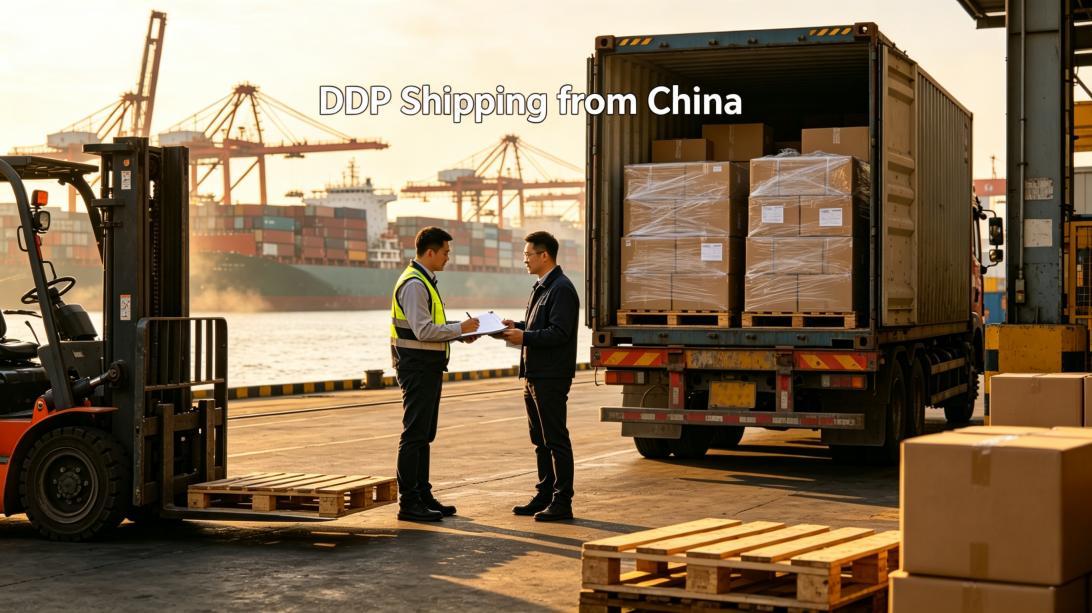
In this guide, we break down exactly how DDP shipping from China works, what the price really includes (and what it does not), what it costs in 2026 by sea and air, the risks that trip up first-time users, and the questions to ask before you hand your cargo to any forwarder who promises "DDP, no problem."
1. What Is DDP Shipping from China?
DDP stands for Delivered Duty Paid, one of the 11 Incoterms® 2020 rules published by the International Chamber of Commerce (ICC). Under DDP terms, the seller (or their freight forwarder acting on their behalf) bears virtually every cost and risk of moving goods from the seller's premises in China to a named destination in the buyer's country — including import customs clearance, duties, taxes, and delivery to the buyer's door.
In everyday logistics, "DDP" is also used more loosely to describe a door-to-door service product: a forwarder quotes you one price, and handles everything from picking up your goods at the factory in Shenzhen, Guangzhou, or Ningbo, to dropping them at your warehouse in Chicago, Rotterdam, or Lagos.
Two important clarifications before we go further:
- DDP the Incoterm vs. DDP the service. When you buy DDP from a forwarder, the Incoterm is usually just the legal frame on the invoice. What you are really buying is a bundled service. If you want the textbook definition and the fine print of the Incoterm itself, our DDP explainer walks through the ICC rule in detail.
- DDP vs. door-to-door. All DDP shipments are door-to-door, but not every door-to-door quote is DDP. Some "door-to-door" offers stop at the destination port and hand you the import clearance and duty bill. DDP specifically means duties paid — the single biggest difference in practice, and the reason DDP quotes cost more up front and surprise you less later.
Under a true DDP arrangement, the seller/forwarder acts as the effective importer of record on the buyer's behalf (or with the buyer's power of attorney), which is why DDP feels effortless for the buyer: your only job is to provide accurate product and value information up front.
2. How DDP Door-to-Door Shipping from China Works: The 7-Step Process
Every DDP shipment from China follows the same seven stages. Understanding them matters because each stage is where a cost or a delay can hide — and because a good DDP quote itemizes them honestly.
| Step | What happens | Sea DDP (typical) | Air DDP (typical) |
|---|---|---|---|
| 1. Pickup in China | Forwarder collects goods from your supplier(s), checks quantity, packaging, and marks | 1–2 days | 1 day |
| 2. Export clearance | Export declaration filed in China; LCL consolidation or FCL stuffing | 1–3 days | 1–2 days |
| 3. International transport | Ocean vessel or airline moves the cargo | 15–30 days | 1–5 days |
| 4. Import clearance | Destination-country customs clears the shipment; inspections happen here | 1–4 days | 1–2 days |
| 5. Duties & taxes paid | Forwarder pays import duties and VAT/taxes on your behalf (this is the "D" in DDP) | included in step 4 window | included in step 4 window |
| 6. Last-mile delivery | Truck delivers to your door, warehouse, or FBA facility | 1–3 days | 1–2 days |
| 7. Proof of delivery | You receive the POD and final statement; file closed | — | — |
Total typical door-to-door time: 20–42 days by sea (LCL at the upper end, direct FCL at the lower end) and 4–10 days by air, depending on route, customs workload, and the season. These are conservative ranges — add 5–10 days of buffer between August and December, when peak-season volume slows customs and ports worldwide.
The whole sequence is orchestrated by one party under DDP, which is precisely why transit times are usually more predictable under DDP than under terms where the buyer takes over mid-journey: there is no handoff point where responsibility (and blame) changes hands.
3. What's Included in the DDP Price (and What Isn't)
A legitimate all-in DDP quote from China to your door typically covers:
- Origin costs: supplier pickup, export customs declaration, document fees (bill of lading or airway bill), and any consolidation or stuffing charges.
- International freight: sea (FCL or LCL) or air transport to the destination country.
- Destination clearance: import customs brokerage, port/terminal handling, and clearance fees.
- Duties and taxes: import duties, VAT or sales tax, and any applicable excise — calculated from your declared value and HS codes.
- Last-mile delivery: trucking from the destination port/airport to your door or warehouse.
- Communication and coordination: the forwarder's time, which is real and is the part "cheap" quotes quietly leave out.
And, if the forwarder is being straight with you, what is not included:
- Buyer-caused compliance problems: a wrong HS code, an undervalued declaration, or prohibited goods are your responsibility — and penalties from customs will come back to you or your forwarder.
- Unforeseen storage and demurrage caused by delays outside the forwarder's control (for example, you were unreachable for delivery, or the destination port hit a congestion wave).
- Cargo insurance. Many DDP quotes exclude it unless you ask. Insurance is typically a fraction of a percent of the goods' value and is the cheapest protection you can buy — always confirm whether it is in the price.
The practical rule we give every importer: ask for the itemized breakdown. A forwarder who can show you each cost layer is a forwarder who is not hiding margin in invented fees.
4. How Much Does DDP Shipping from China Cost in 2026?
Because DDP bundles freight plus destination duties and taxes, the "price" depends on three variables: your cargo (weight, volume, HS codes, declared value), your destination country (duty rates and VAT), and the mode (sea, air, or express). Here are the planning ranges we work with in mid-2026 — treat them as budgets, not quotes:
| Mode | Typical door-to-door DDP cost (2026 estimates) | Typical transit time |
|---|---|---|
| Sea LCL (per CBM, all-in) | $120–$350 per CBM to major destinations | 25–42 days |
| Sea FCL (per 40ft container, all-in) | $3,500–$7,500 depending on route and duty profile | 22–38 days |
| Air freight DDP (per kg, door-to-door) | $5.5–$11 per kg, higher for bulky (volumetric) cargo | 5–10 days |
| Express courier DDP (small parcels) | $6–$14 per kg | 4–8 days |
Two things make DDP look expensive compared to an EXW or FOB quote, and both are illusions:
- Duties and taxes are inside the number. An FOB quote of $1,800 per container plus $1,200 in destination fees plus $900 in duties is not cheaper than a DDP quote of $4,200 — it is the same money, with more steps and more risk in between.
- Air DDP is priced on chargeable weight — the greater of actual weight and volumetric weight (length × width × height ÷ 6,000 in cm). Light, bulky goods (furniture, plastic goods, packaging) can cost far more per actual kg than you expect. Always compare quotes on chargeable weight, not gross weight.
For a sense of what the freight component alone looks like on the world's busiest lane, our Shipping from China to USA route page breaks down sea and air options to US ports, and our Sea Freight from China service page explains FCL/LCL pricing structures in detail.
The honest answer about duty rates: they vary enormously by HS code and country. A tariff-free category might add 0–10% of the goods' value to your landed cost; a heavily protected category can add 25–60%. The only way to know your number is a current, HS-code-specific calculation — which is exactly what a DDP forwarder does before quoting you.
5. DDP vs. FOB vs. CIF vs. DDU: Which Terms Should You Use?
DDP is not universally "the best" — it is the best for a specific kind of buyer. Here is the honest comparison:
| Terms | Who arranges freight | Who clears import | Who pays duties/taxes | Risk transfers | Best for |
|---|---|---|---|---|---|
| EXW | Buyer | Buyer | Buyer | At seller's factory | Experienced importers with own logistics |
| FOB | Buyer | Buyer | Buyer | On board the vessel | Importers with their own customs broker |
| CIF | Seller (to port) | Buyer | Buyer | On board the vessel | Buyers who want freight handled but keep customs control |
| DDU / DAP | Seller | Seller arranges, buyer pays duties | Buyer | At destination, before duties | Buyers who want door delivery but handle tax themselves |
| DDP | Seller | Seller | Seller (included in price) | At buyer's door | E-commerce sellers, SMEs, anyone who wants one predictable price |
Choose DDP when: you have no in-country customs team; you sell to consumers or platforms that need landed costs up front (Amazon FBA, marketplaces, retail buyers); you want cash-flow certainty; or your goods are low-risk, well-documented commodities.
Skip DDP when: you already have a customs broker who charges less than the forwarder's DDP markup; your goods are highly regulated and you prefer to control the declaration yourself; or your destination country makes buyer-as-importer-of-record legally mandatory (rare, but real for certain products).
The gray area is DDU (Delivered Duty Unpaid, aka DAP). It looks like DDP but leaves the duty bill — and the clearance work — with you at the destination. Many importers choose DDU to save a few percent and then get burned by unexpected VAT demands. If the difference between DDU and DDP is only a few hundred dollars, DDP is almost always the better risk trade.
6. DDP Risks and Pitfalls (and How to Avoid Them)
DDP is not magic — the risk does not disappear, it moves to whoever is quoting you the all-in price. These are the failure modes we see most often, and how to stay clear of them:
- Undervalued declarations ("low-value" DDP). Some forwarders quote suspiciously low DDP prices by declaring your goods at a fraction of their real value to shrink the duty. If customs catches it — and modern customs data systems are very good at catching it — you face penalties, seizure, or a retroactive bill that can exceed the freight cost. Ask your forwarder how they value goods and whether the quote assumes a minimum declared value.
- Wrong HS code. Your HS code determines the duty rate, so a "cheap" quote built on a wrong (lower-duty) code is a bill waiting to happen. Provide accurate product descriptions and let a licensed broker confirm the classification before you lock the price.
- Prohibited or restricted goods. DDP quotes are only valid for goods that are legal to import. Batteries, cosmetics, food, medical devices, and many electronics carry special certification requirements — a forwarder who says "no problem" to everything is a red flag.
- Tariff and policy volatility. Import duty regimes can change faster than a sailing schedule — the US tariff landscape alone shifted repeatedly through 2025–2026. A DDP price is usually valid for a quoted window; lock the rate and ship within it, and ask how the forwarder handles mid-shipment policy changes.
- Buyer default risk. Under true DDP the forwarder (as your agent) pays duties up front. If you disappear or refuse the cargo, they are stuck with the bill — which is why reputable forwarders vet buyers, and why "no deposit, pay on delivery" DDP deals are often too good to be true.
- "Fake DDP" quotes. The quote says DDP, the small print excludes the destination terminal handling or the delivery zone surcharge. Ask for the complete list of inclusions in writing and compare itemized quotes.
None of these risks mean DDP is unsafe — they mean DDP is only as safe as the forwarder behind it. Which brings us to the single most important step: who you book with.
7. DDP to the USA in 2026: What Has Changed
If you ship DDP to the United States — still the single largest e-commerce import market from China — a few 2025–2026 changes directly affect your landed cost and paperwork:
- The de minimis exemption ($800) for China-origin parcels was eliminated in 2025. Low-value shipments from China that once cleared with minimal formalities now require formal entry, meaning every DDP parcel needs accurate documentation and pays duties. "Sample" and "gift" shipments are no longer a loophole.
- Tariffs on Chinese goods remain elevated and category-dependent. Rather than quote a number that may shift, the structural point: most categories face significantly higher duty rates than the pre-2025 baseline, and duty is calculated on declared value + freight (CIF basis) — so your DDP quote's duty component is a real, growing line item.
- ISF (Importer Security Filing, "10+2") is mandatory for ocean shipments, filed at least 24 hours before vessel loading. Under DDP, your forwarder files it — another reason DIY shippers under DDP-like arrangements get fined for things they did not know existed.
- Customs is digitized and data-driven. The US is one of many countries where customs risk-scoring flags undervalued shipments quickly. This is the single biggest reason to use a forwarder who declares honestly, even when the "honest" quote is $300 higher.
None of this makes DDP to the US harder — it makes it more valuable, because the compliance burden is exactly what DDP offloads. For the full picture of the all-in option on this lane, our Door to Door Shipping from China to USA guide walks through what to expect at every stage.
8. How to Choose a Reliable DDP Freight Forwarder
You have the concept, the numbers, and the risks. Here is the checklist we use with buyers who ask us how to vet a DDP partner:
- Ask for an itemized quote. Freight, origin fees, destination fees, duties (with the assumed HS codes and declared value), and delivery — each as its own line. Anyone who refuses to itemize is hiding something.
- Confirm the importer-of-record arrangement. Who files the entry? Who holds the power of attorney? What happens if customs selects the shipment for inspection — who pays the storage?
- Verify the destination network. A forwarder's DDP quality depends on their licensed brokers and trucking partners at the destination, not on their Shenzhen office. Ask which countries they handle in-house vs. via third parties.
- Check tracking and communication. Real-time tracking plus a named contact who answers in your time zone is the difference between "where is my container?" anxiety and visibility.
- Ask about insurance. If it is not in the quote, add it. A lost container without insurance can erase a quarter's margin.
- Check for honesty under pressure. Ask what they won't ship and which destinations they would advise against DDP for. A forwarder who gives you straight answers about limits is a forwarder who will tell you the truth when something goes wrong mid-transit.
FAQ
Q1: How long does DDP shipping from China take? Sea DDP typically takes 20–42 days door-to-door (LCL at the upper end, FCL at the lower), and air DDP 4–10 days. Add 5–10 days of buffer between August and December, when peak-season volume slows customs and ports.
Q2: How much does DDP shipping from China cost? As 2026 planning ranges: roughly $120–$350 per CBM for sea LCL door-to-door, $3,500–$7,500 per 40ft container for FCL, and $5.5–$11 per kg for air, all-in including duties and taxes. The duty component varies with your HS codes and destination — get a current quote for your exact goods.
Q3: Who pays customs duties under DDP? The seller (or their forwarder) pays — that is the "D" in Delivered Duty Paid. The duties are calculated into your all-in price, so you are still effectively paying them; you are just paying a fixed, known amount instead of a surprise bill later.
Q4: What's the difference between DDP and door-to-door shipping? Door-to-door means the forwarder delivers to your address. DDP means they also handle import clearance and pay the duties and taxes. Some "door-to-door" quotes are actually DDU/DAP — delivered to your door but with the duty bill left for you. Always confirm which one you are quoted.
Q5: Is DDP shipping legal and safe? Yes — DDP is a standard Incoterms 2020 rule used on millions of shipments. The risk is not DDP itself but how it is executed: undervalued declarations and wrong HS codes are where trouble comes from. Use a forwarder who declares honestly and itemizes the duty calculation.
Q6: What happens if customs inspects my DDP shipment? The forwarder's destination broker handles the examination, and any resulting storage or inspection fees are usually chargeable to the buyer unless they stem from a forwarder error. Confirm this split in writing before shipping — and make sure your documents (invoice, packing list, HS codes) are accurate enough to survive a desk exam.
Final Thoughts
DDP shipping from China exists because importing across borders is a system of moving parts — two customs regimes, a freight leg, a tax calculation, and a delivery — and most buyers would rather buy the whole system than assemble it themselves. Done well, DDP turns logistics from a recurring headache into a line item.
At AllBestShipping, we are a professional freight forwarder based in Shenzhen, China, and DDP door-to-door is one of our core services to 50+ countries. We quote transparent, itemized all-in prices; declare honestly at the correct HS codes; handle import clearance through licensed brokers at destination; provide real-time tracking and cargo insurance; and we will tell you plainly when DDP is not the right answer for your cargo. Our Door-to-Door Shipping service page explains exactly what our DDP program includes, and if you want a landed-cost estimate for your goods, contact us — we respond with a real number, not a sales pitch.
Your cargo should move, not your stress levels. That is what DDP is for.