How Long to Ship from China to Brazil? Sea & Air Transit Times in 2026
If you are importing from China to Brazil, "how long will it take?" is almost always the first question — and it deserves a straight answer. The honest one is: it depends on the mode you choose, the port pair, and the season, more so than on almost any other route from China. A direct ocean sailing from Shanghai to Santos runs 32–38 days; a door-to-door air shipment lands in 7–12 days; and the same sea route booked in October, when Brazilian retailers are stocking for Black Friday and Christmas, can quietly stretch a week or more at the port.
Brazil is China's largest trading partner in Latin America, with tens of thousands of containers moving between the two countries every year. Yet for all that volume, the route has its own rhythm — congestion peaks, customs formalities, and a tax system that slows down anyone who arrives unprepared. This 2026 guide gives you realistic transit times for every option: sea freight (FCL and LCL), air freight, express courier, and door-to-door DDP, plus the exact reasons shipments get delayed and how to plan around them.
How Long to Ship from China to Brazil? (Quick Answer)
| Shipping method | Typical transit time | Best for |
|---|---|---|
| Sea freight FCL (full container, direct) | 32–38 days ocean; 40–55 days door-to-door | 15+ CBM, full containers, budget-conscious |
| Sea freight FCL (via transshipment) | 39–50 days ocean | When direct space is full or rates spike |
| Sea freight LCL (shared container) | 45–60 days door-to-door | Small loads under ~13 CBM |
| Air freight (direct) | 2–4 days airport-to-airport; 7–12 days door-to-door | Urgent, high-value cargo |
| Air freight (connecting) | 5–8 days airport-to-airport | Budget air shipments |
| Express courier (DHL/UPS/FedEx) | 4–8 days door-to-door | Parcels under ~30 kg, samples, documents |
| Door-to-door DDP (sea) | 45–60 days | First-time importers, no CNPJ, all-inclusive |
| Door-to-door DDP (air) | 8–12 days | Fastest full-service option |
These figures assume standard conditions: cargo ready on time, complete documents, and no peak-season port backlog. In our daily quoting for shipping from China to Brazil, we give clients ranges exactly like these — conservative on purpose, because a promise we cannot keep costs more than an honest estimate. For the other half of the planning picture — what each mode actually costs, including Brazil's taxes — our companion guide on Shipping Cost from China to Brazil breaks down every line item.
1. Sea Freight Transit Times from China to Brazil
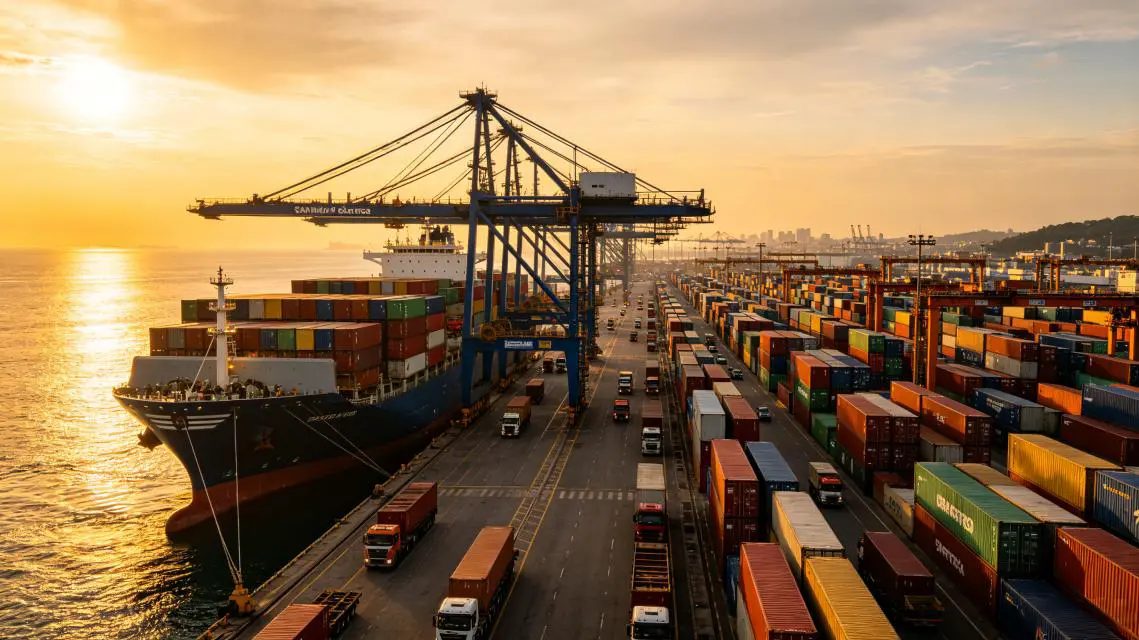
Sea freight moves roughly 90 percent of the cargo between China and Brazil, and it is the cheapest way to ship serious volume. Our Sea Freight from China services cover this lane with weekly FCL and LCL departures. The main gateway is Santos (São Paulo state) — the largest container port in Latin America, handling around 40 percent of Brazil's containerized trade — followed by Navegantes and Itajaí (Santa Catarina), Paranaguá (Paraná), and Rio de Janeiro.
FCL (Full Container Load): 32–38 days direct
Full 20ft and 40ft containers on direct services move fastest. Typical ocean transit times from Chinese ports to Santos, based on current 2026 Q3 schedules:
| Origin Port (China) | Destination | Typical Ocean Transit |
|---|---|---|
| Shanghai / Ningbo | Santos | 32–38 days (direct) |
| Shenzhen (Yantian/Shekou) | Santos | 34–42 days (usually via Singapore or Hong Kong) |
| Qingdao | Santos | 36–44 days (direct or one transshipment) |
| Shanghai / Ningbo | Navegantes | 36–45 days |
South China ports (Shenzhen, Guangzhou) mostly route via Singapore or Hong Kong, which adds 2–5 days compared with North China direct sailings. The full door-to-door picture is longer than the ocean leg: add 3–7 days for customs clearance at Santos and 2–5 days for inland delivery, putting a realistic FCL door-to-door window at 40–55 days.
Transshipment: 39–50 days
Services via Singapore, Durban, or Mediterranean hubs (e.g., Algeciras, Valencia) are sometimes $200–$500 cheaper per container — but they add 7–12 days of transit and an extra layer of connection risk. If you have a fixed delivery window, direct sailings are usually worth the premium. One structural advantage of this lane: because China–Brazil services run via the Cape of Good Hope or the Panama Canal, they have been far less disrupted by the Red Sea situation than Europe-bound routes — schedule reliability on this corridor has been comparatively good in 2026.
LCL (Less than Container Load): 45–60 days door-to-door
For shipments under roughly 13 CBM, LCL lets you share a container and pay only for the space you use. Expect the same 32–38 day ocean leg as FCL, plus 5–10 days of consolidation at origin and deconsolidation at destination, plus clearance — hence the wider 45–60 day door-to-door window. LCL to Brazil also carries two quirks: Brazilian customs values consolidated cargo per NCM line and may inspect mixed-manifest containers more closely, and freight is charged on the greater of volume and weight-equivalent (1 CBM = 1,000 kg), so dense cargo can be billed at the weight basis. If you are weighing LCL against a 20ft container, the crossover point on this lane sits at roughly 13–15 CBM.
2. Air Freight Transit Times from China to Brazil
When lead time matters more than money — restocking bestsellers, urgent spare parts, high-value electronics — air freight is the answer. Flights from PVG (Shanghai), CAN (Guangzhou), SZX (Shenzhen), or HKG arrive at GRU (São Paulo–Guarulhos) or VCP (Viracopos, Campinas) — the two main international air gateways, with GRU handling the bulk of cargo traffic.
- Direct flights: 2–4 days airport-to-airport, and 7–12 days door-to-door once you add pickup in China, export customs, import clearance at GRU, and final delivery.
- Connecting flights: 5–8 days airport-to-airport when routing through hubs like Miami, Santiago, or Europe.
The actual flight time from China to Brazil is 14–16 hours; most of the transit window is ground time — cargo consolidation, export customs at origin, and Brazilian import clearance. Note that Brazil-bound air freight is structurally pricier than US or EU lanes because there is less belly-hold capacity to South America and the return leg is heavily agricultural, so carriers price the outbound leg to cover the round trip. For urgent cargo, always request a flight-specific quote so you know exactly which flight your goods will catch.
Express Courier: 4–8 Days Door-to-Door
DHL, UPS, FedEx, and TNT operate door-to-door services from China to Brazil in 4–8 days for parcels under roughly 30 kg. Express is unbeatable for samples, documents, and urgent e-commerce orders — but remember that since 2024, Brazilian customs applies a 20 percent import tax on international parcels valued up to $50 under the Remessa Conforme program, and parcels above that threshold face full import taxes, charged to the receiver at delivery. Budget for it; it is not a surprise fee, it is Brazilian law.
3. Rail and Multimodal Options: What You Need to Know
There is no China–Brazil rail service — the China–Europe rail corridors do not extend across the Pacific, and there is no transcontinental rail link to South America. We say this plainly because some quotes still sell "rail to Brazil" that is really sea freight with an inland rail leg inside Brazil.
What does exist:
- Sea + inland multimodal: cargo arrives by sea at Santos or Paranaguá, then continues by truck or rail to inland destinations like Manaus, Belo Horizonte, or the interior of São Paulo state. Brazil's rail network is limited; most inland moves are truck-based. Budget 2–5 days for inland delivery within the South/Southeast, and more for the North or Northeast (Manaus or Recife add cost and days).
- Sea-air (air-sea) combos: for a middle ground between 40-day ocean and 8-day air, some forwarders route cargo by sea to a hub (Miami, Panama) and then by air to Brazil. Total door-to-door lands around 18–25 days at a cost between sea and pure air — worth asking about for mid-urgency, mid-value goods, though capacity and pricing vary month to month.
If your final destination is inland, factor the extra 2–5 days into any estimate, no matter which mode you choose.
4. Door-to-Door (DDP) Shipping Times: The Full Timeline
Door-to-door DDP (Delivered Duty Paid) is the most popular choice for importers without a Brazilian entity — and honestly, for most first-time Brazil importers. We handle pickup in China, export clearance, ocean or air transport, Brazilian import clearance through a partner importer, payment of all taxes, and final delivery to your door. Here is what the full timeline looks like for a sea DDP shipment:
| Stage | Time |
|---|---|
| Pickup from supplier (China) + export customs | 1–3 days |
| Ocean transit to Santos (direct) | 32–38 days |
| Import clearance at Santos (Receita Federal) | 3–7 days |
| Final delivery (São Paulo or inland) | 1–5 days |
| Total (typical) | 40–55 days |
An air DDP shipment compresses the transit stage to 2–4 days, giving a total of roughly 8–12 days. The value of DDP is that clearance risk falls on us, not on you — one price, one responsible party, no "taxes payable at destination" emails. Our Door-to-Door Shipping service covers the whole chain, and the companion cost guide linked above shows exactly what each stage costs on this route.
5. What Can Delay Your Shipment to Brazil?
Transit times are estimates, not guarantees. Over the years, the same handful of issues delay Brazil-bound shipments again and again:
1. Peak-season congestion at Santos. Santos gets busy from August to November, when Brazilian retailers stock for Black Friday (late November) and Christmas. Vessels wait longer at anchorage, container pickup slows, and demurrage clocks start ticking. Add a 5–10 day buffer if you ship in this window — it is the single biggest variable on the lane.
2. Documentation mismatches. Brazilian customs requires the commercial invoice to carry NCM codes (the Brazilian 8-digit extension of the HS code) and Portuguese product descriptions that match the cargo. A missing NCM, an English-only description, or a value inconsistency triggers a red channel inspection that can add 1–2 weeks. This is the most common fix our documentation team makes for first-time Brazil shippers — get it right before the vessel sails.
3. The CNPJ/RADAR requirement. Only a company registered with a CNPJ (Brazilian tax ID) and enrolled in RADAR (the Siscomex import system) can act as importer of record. Foreign sellers without a Brazilian entity cannot clear customs directly — which is precisely why DDP exists. Trying to clear "on behalf of" the receiver without the right registration is a classic delay generator.
4. Panama Canal and weather factors. Services routed via the Panama Canal can face transit restrictions during the dry season (water-level limits), adding a few days in some months. The South China typhoon season (roughly July–September) can delay vessel departures from origin. Neither is predictable month to month — another reason to build buffer into peak plans.
5. Tax and valuation checks. Brazil's taxes (II, IPI, ICMS, PIS/COFINS, AFRMM) routinely add 60–100%+ to CIF value. Under-declared values or mismatched NCM classifications attract audits — and an audit at the border is measured in weeks, not days. Declare honestly and classify correctly the first time.
6. Brazil Customs and Documentation Essentials
To keep your shipment on schedule, get these five things right before your cargo leaves China:
- NCM codes on every invoice line — verified against the current TEC (Mercosur common external tariff) schedule before booking.
- Portuguese product descriptions — matching the invoice, packing list, and the actual goods. This single item prevents more clearance stops than anything else.
- CNPJ/RADAR registration — either your own, your import agent's, or your DDP partner's. Confirm who the importer of record is before departure.
- Complete shipping documents — commercial invoice, packing list, bill of lading or airway bill, with consignee details matching the importer's registered data exactly.
- Product certifications where applicable — ANVISA (health/medical/food-contact) and INMETRO (electrical/safety) regulated goods need registration before import; anti-dumping duties apply to certain Chinese products (ceramics, steel fasteners, bicycle parts, textiles). Factor 2–8 weeks of lead time for regulated categories.
With complete documentation, clearance at Santos or GRU typically takes 3–7 days. In the August–November peak, or when documents have discrepancies, expect 2–3 weeks. A professional forwarder verifies all of this before the vessel departs — which is why end-to-end managed shipments consistently clear faster than DIY ones.
7. How to Choose the Fastest (and Most Reliable) Option
| Your situation | Recommended option |
|---|---|
| Big order, budget matters, 6+ weeks of lead time | Sea freight FCL (direct sailing) |
| Small order under ~13 CBM, budget matters | Sea freight LCL |
| Urgent restock, spare parts, or samples | Air freight (direct flight) |
| Parcels under 30 kg, samples, documents | Express courier |
| First import, no CNPJ, no customs experience | Door-to-door DDP (sea or air) |
| Mid-urgency, mid-value, want to split the difference | Sea-air combo (~18–25 days) |
| Final destination outside São Paulo state | Add 2–5 days inland leg to any option |
As a freight forwarder based in Shenzhen with deep experience on the South America East Coast lane, we recommend matching the mode to your sales plan rather than the other way around. If you are unsure, ask for a free quote with a realistic transit-time estimate — any honest forwarder will give you both. For the full picture of how this route compares with other destinations across the region, our Shipping From China to Americas overview covers the main gateways and lanes.
FAQ
Q1: How long does sea freight take from China to Brazil?
Direct FCL services from Shanghai/Ningbo to Santos take 32–38 days ocean transit; from South China via Singapore, 34–42 days. Add clearance (3–7 days) and inland delivery (2–5 days) for a door-to-door total of 40–55 days. LCL runs 45–60 days door-to-door. Transshipment services add 7–12 days.
Q2: How long does air freight take from China to Brazil?
Air freight takes 2–4 days airport-to-airport on direct flights (7–12 days door-to-door) and 5–8 days airport-to-airport on connecting flights. The flight itself is only 14–16 hours; most of the time is ground handling and clearance.
Q3: What is the fastest way to ship from China to Brazil?
Door-to-door air DDP — typically 8–12 days from supplier pickup to delivery in Brazil. A direct air shipment to the airport is faster (2–4 days), but you then handle clearance and delivery yourself. Express courier is 4–8 days for parcels under ~30 kg.
Q4: How long does customs clearance take in Brazil?
Under normal conditions, clearance at Santos or GRU takes 3–7 working days. It stretches to 2–3 weeks during the August–November peak, or when documents have discrepancies — missing NCM codes, English-only descriptions, or value inconsistencies.
Q5: Do I need a CNPJ to import goods to Brazil?
To clear customs as importer of record, yes — you need a CNPJ and RADAR registration, which foreign companies cannot obtain without a Brazilian entity. In practice, importers without a CNPJ use a licensed Brazilian import agent or choose DDP shipping, where the forwarder's partner importer handles clearance.
Q6: When is the worst time to ship to China–Brazil?
August to November — Santos congestion peaks as Brazilian retailers stock for Black Friday and Christmas, and peak season surcharges apply. Chinese New Year (January–February) also tightens capacity at origin. Ship in March–July when possible, or build a 5–10 day buffer into your plan.
Final Thoughts
"How long does shipping from China to Brazil take?" has three answers: the mode you choose (40–55 days by sea, 7–12 days by air), the documents you prepare (one missing NCM code costs a week), and the season you ship in (August–November adds a buffer). Sea freight gives you the lowest cost per unit, air freight gives you the speed, and door-to-door DDP gives you one price and one timeline with zero clearance stress.
At AllBestShipping, we are a professional freight forwarder based in Shenzhen, China, serving 50+ countries including Brazil with sea, air, rail, door-to-door, and Amazon FBA solutions. We offer transparent pricing, real-time cargo tracking, professional customs support, and comprehensive cargo insurance — and we will always give you an honest transit-time estimate before you book, with the exact buffer you need for the season. If you have a shipment in mind, get a free quote from AllBestShipping today.