Door to Door Shipping from China to USA: The Ultimate Guide (2026 Update)
Are you an e-commerce seller or business owner overwhelmed by the complexities of international logistics? Navigating customs, arranging transport, and ensuring timely delivery can be a nightmare without the right support. This is where door to door shipping from China to USA comes in as a game-changer. It is the most convenient shipping solution, handling every step of the supply chain from your supplier's factory in China directly to your warehouse or doorstep in the United States.
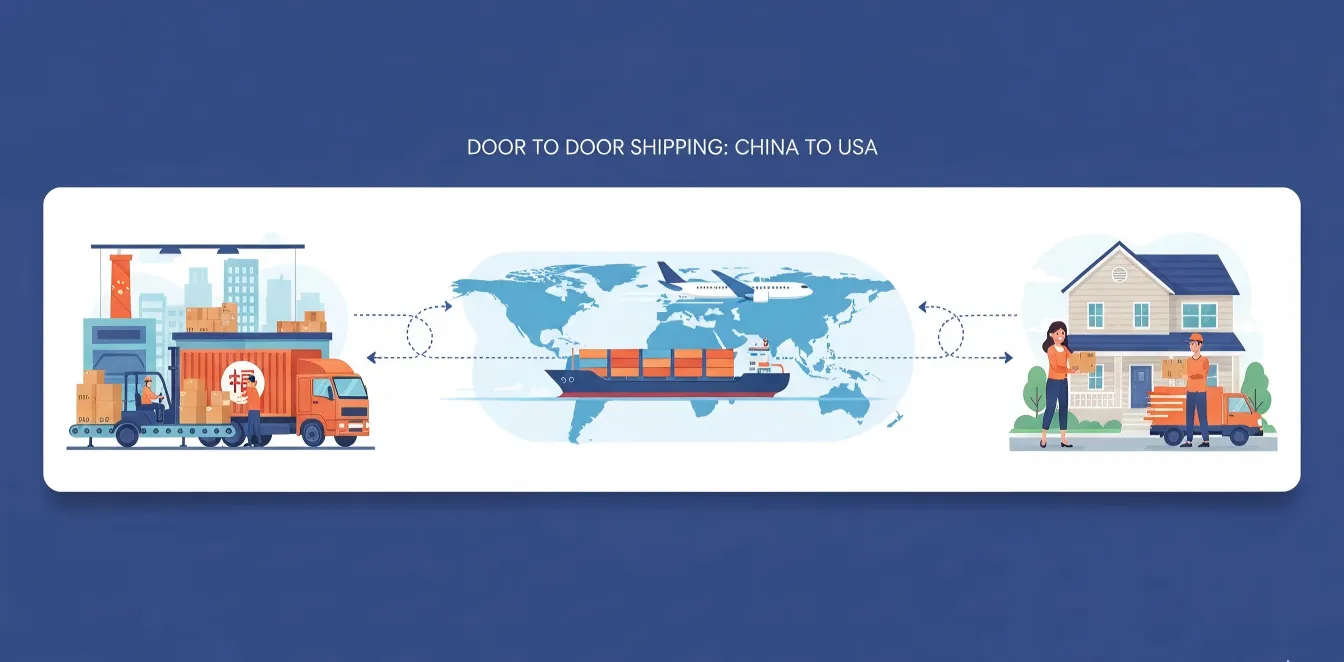
At AllBestShipping, we specialize in simplifying this process. With over a decade of experience in the logistics industry, we understand that time is money. Our comprehensive door-to-door services are designed to remove the hassle of importing, allowing you to focus on growing your business while we handle the heavy lifting.
In this guide, we will explore everything you need to know about door-to-door shipping, including how it works, the costs involved, the best shipping modes, and how to avoid common pitfalls.
What is Door to Door Shipping?
Definition and Key Concepts
Door to Door Shipping is a logistics service where the freight forwarder manages the entire shipment journey from the point of origin (the seller's warehouse in China) to the final destination (the buyer's address in the USA). Unlike "Port to Port" shipping, where your responsibility begins once the cargo arrives at the US port, door-to-door service is an all-inclusive solution.
This service typically operates under DDP (Delivered Duty Paid) or DAP (Delivered at Place) terms:
- DDP (Delivered Duty Paid): The most popular option for small to medium businesses. The forwarder handles everything, including shipping costs, insurance, and crucially, US customs duties and taxes. You pay one final price, and the goods are delivered to your door with no extra fees.
- DAP (Delivered at Place): The forwarder arranges transport to your door, but you (the importer) are responsible for paying import duties and taxes upon arrival.
Who Should Use This Service?
Door-to-door shipping is ideal for:
- Amazon FBA Shipping Sellers: Direct delivery to Amazon fulfillment centers without needing to physically touch the inventory.
- Small to Medium Enterprises (SMEs): Businesses that do not have a dedicated logistics department to handle customs clearance and inland trucking.
- First-time Importers: Those unfamiliar with Incoterms and customs regulations.
- Urgent Shipments: When speed and simplified communication are prioritized over saving every last cent on freight rates.
The Door to Door Shipping Process: Step-by-Step
Understanding the workflow can help you better manage your supply chain. Here is a typical breakdown of the door to door shipping from China to USA process:
1. Pickup and Consolidation
The process begins when your freight forwarder contacts your supplier in China. We arrange for a truck to pick up your goods from the factory (ex-works) or receive them at our consolidation warehouse. If you are sourcing from multiple suppliers, we can consolidate these shipments into a single consignment to save on shipping costs.
2. Export Customs Clearance (China)
Before leaving China, all goods must clear export customs. Your forwarder prepares the necessary documents, such as the Commercial Invoice and Packing List, and declares the cargo to Chinese customs authorities. This ensures the goods are legally cleared for export.
3. International Transit
Depending on your budget and timeline, your cargo travels via:
- Air Freight: Flown from major airports like PVG (Shanghai), SZX (Shenzhen), or HKG (Hong Kong) to US airports like LAX, JFK, or ORD.
- Sea Freight: Loaded into containers (FCL or LCL) and shipped from ports like Ningbo, Shanghai, or Yantian to US ports like Los Angeles, Long Beach, or New York.
4. Import Customs Clearance (USA)
This is often the most daunting part for importers. With a door-to-door service, your forwarder’s US agent handles the ISF Filing (for sea freight), submits the entry summary (CBP Form 7501), and pays the applicable duties and taxes on your behalf. This ensures your goods are released by US Customs and Border Protection (CBP) without delay.
5. Final Delivery
Once cleared, the cargo is collected from the port or airport. It is then transported to a local distribution hub and delivered to your final destination via truck (for pallets) or courier services like UPS/FedEx (for cartons).
Shipping Methods: Air vs. Sea Door to Door
Choosing the right transport mode is critical for balancing cost and speed.
Air Freight Door to Door
Best for: High-value electronics, fashion items, seasonal goods, or urgent restocking.
- Transit Time: Typically 3 to 8 days.
- Pros: Fastest option, high security, reliable schedules.
- Cons: Most expensive, especially for heavy or bulky items. Rates are often calculated based on "chargeable weight" (actual weight vs. volumetric weight).
Sea Freight Door to Door (LCL & FCL)
Best for: Bulk orders, heavy machinery, furniture, and non-urgent inventory.
- Transit Time: 25 to 40 days (Fast boat options like Matson can be faster, around 15-20 days).
- LCL (Less than Container Load): You share container space with other shippers. Ideal for shipments between 1cbm and 15cbm.
- FCL (Full Container Load): You rent the entire container (20ft or 40ft). Best for shipments over 15cbm.
- Pros: Most economical, huge capacity.
- Cons: Slower, susceptible to port congestion delays.
Express Courier (DHL/FedEx/UPS)
Best for: Samples, documents, or very small shipments (under 20kg).
- Transit Time: 2-5 days.
- Pros: extremely fast, door-to-door is the default standard, easy tracking.
- Cons: Extremely high cost per kg for larger shipments.
| Feature | Air Freight DDP | Sea Freight DDP (Fast Boat) | Sea Freight DDP (Slow Boat) | Express Courier |
|---|---|---|---|---|
| Speed | 3-8 Days | 15-22 Days | 30-45 Days | 2-5 Days |
| Cost | High ($$$) | Medium ($$) | Low ($) | Very High ($$$$) |
| Ideal Weight | 100kg+ | 100kg+ | 500kg+ | < 100kg |
| Customs | Included | Included | Included | Included (usually DDU) |
Door to Door Shipping Time from China to USA
Transit times can vary significantly depending on the origin city in China and the final destination in the USA. Generally, shipments from Southern China (Shenzhen, Guangzhou) to the US West Coast are faster than those from Northern China (Beijing, Tianjin) to the East Coast.
Below is a detailed breakdown of estimated shipping times from major Chinese logistics hubs to the United States.
| Origin City (China) | Air Freight DDP (Days) | Sea Freight DDP (Days) | Express (Days) |
|---|---|---|---|
| Shanghai | 5-8 Days | 22-35 Days | 3-5 Days |
| Shenzhen | 4-7 Days | 20-30 Days | 2-4 Days |
| Guangzhou | 5-8 Days | 20-30 Days | 3-5 Days |
| Beijing | 5-9 Days | 28-40 Days | 3-6 Days |
| Tianjin | 6-10 Days | 30-45 Days | 4-6 Days |
Note: These are estimated transit times including customs clearance and final delivery. Actual times may vary due to weather, port congestion, and seasonal peaks.
Required Documentation for Door to Door Shipping
Even though your forwarder handles the heavy lifting, accurate documentation is crucial to avoid customs holds.
- Commercial Invoice: Must clearly state the buyer and seller details, description of goods, HS codes, and value of the shipment.
- Packing List: details the gross weight, net weight, dimensions, and number of cartons.
- Bill of Lading (B/L) or Airway Bill (AWB): The contract of carriage between the shipper and the carrier.
- Certificate of Origin (C/O): Sometimes required to prove where the goods were manufactured, potentially affecting duty rates.
- Arrival Notice: Notification that goods have arrived at the US port.
Pro Tip: Ensure your supplier provides accurate descriptions and values. Undervaluing goods to save on taxes is illegal and can lead to severe penalties and confiscation of cargo by US Customs.
Cost Structure: What Am I Paying For?
When you receive a door to door shipping from China to USA quote, it is typically an "all-in" rate per kilogram (for air) or per CBM (for sea). However, it's helpful to understand what makes up this cost:
- Pickup Fee: Trucking from the Chinese factory to the port/airport.
- Export Fees: Chinese customs declaration, documentation, and terminal handling charges.
- Freight Cost: The actual cost of air or sea transport.
- Fuel Surcharge: Variable cost depending on oil prices.
- Destination Charges: US port handling, Warehouse Services, and deconsolidation.
- Customs Duties & Taxes: Based on the HS Code and value of goods (only included in DDP quotes).
- Final Delivery Fee: "Last mile" delivery via truck or courier.
Example: If you are shipping 200kg of phone cases via Air Freight DDP, you might see a rate of $6.50/kg. This $1300 total would cover the entire journey from Shenzhen to your door in New York, including duties.
Why Choose AllBestShipping?
At AllBestShipping, we pride ourselves on being more than just a service provider; we are your strategic logistics partner.
- Expertise: Our team knows the ins and outs of US customs regulations, helping you avoid compliance issues.
- Competitive Rates: We have long-standing contracts with major carriers and airlines, passing the savings on to you.
- Transparency: No hidden fees. Our quotes are clear, detailed, and comprehensive.
- Technology: Track your shipment in real-time and stay updated at every milestone.
- Customer Support: We offer 24/7 support to address any concerns immediately.
FAQs about Door to Door Shipping
1. What is DDP door-to-door shipping and what does it include?
Delivered Duty Paid (DDP) is a shipping term where the seller takes full responsibility for the entire journey, from picking up goods at the factory in China to final delivery at the buyer's US address. This comprehensive service includes all international freight costs, export and import Customs Clearance, and the payment of all applicable duties and taxes.
2. How long does shipping from China to the USA typically take?
Transit times depend on the method: Air Freight DDP generally takes 3 to 8 days, while Sea Freight DDP typically ranges from 25 to 40 days. Factors such as port congestion, customs delays, and seasonality (like the Chinese New Year) can further influence these timelines.
3. What is "Landed Cost" and why should I calculate it?
Landed cost is the total price of a product once it has arrived at your door and cleared customs, encompassing the product price, freight, insurance, and duties. Understanding this figure is essential for businesses to set profitable prices and accurately compare the costs of importing versus sourcing products domestically.
4. Should I choose air freight or sea freight for my shipment?
Air freight is ideal for high-value, time-sensitive, or lightweight shipments (under 100kg) that require rapid delivery. Sea freight is the most cost-effective method for large-volume bulk cargo, though it is significantly slower and carries a higher risk of customs delays if documentation is inaccurate.
5. What is the Importer Security Filing (ISF 10+2)?
ISF is a mandatory security requirement for all ocean freight shipments entering the USA, used by Customs to identify high-risk cargo before arrival. It requires the submission of 10 data elements from the importer and 2 from the carrier at least 24 hours before the vessel is loaded in China.
6. What are the essential documents required for US customs clearance?
The core documents required for every shipment are the Commercial Invoice, Packing List, and the Bill of Lading (for sea) or Air Waybill (for air). These documents must be consistent and accurate to avoid inspections, fines, or shipment holds by U.S. Customs and Border Protection.
7. How are customs duties and taxes determined?
Duties are calculated based on the product’s 10-digit Harmonized System (HS) code, its country of origin, and the total declared value. In the USA, duty rates typically range from 0% to 25%, though additional tariffs, such as Section 301 duties on Chinese goods, may also apply.
8. What role does a freight forwarder play in door-to-door shipping?
A freight forwarder acts as a logistics agent that organizes the movement of goods, negotiates rates with carriers, and manages complex customs documentation. They provide an end-to-end process that can help importers save up to 40% on shipping costs while reducing the risk of lost or damaged goods.
9. Are there any hidden costs I should be aware of?
While DDP aims for transparency, hidden fees can arise from fuel surcharges, port congestion fees, customs inspection charges, or terminal handling fees. Importers should clarify their Incoterms upfront to ensure they know exactly which party is responsible for these potential destination and handling charges.
10. Is cargo insurance necessary for my shipment?
While optional, Cargo Insurance is highly recommended to protect your investment against loss, theft, or damage during the long transit across the Pacific. Without insurance, you may not be adequately compensated if your goods are destroyed or lost while in the carrier's possession.
Conclusion
Door to door shipping from China to USA is the ultimate solution for businesses seeking efficiency, reliability, and peace of mind. By entrusting the complex logistics process to professionals, you free up valuable resources to focus on sales and marketing. Whether you choose air freight for speed or sea freight for cost savings, understanding the process and partnering with a trusted forwarder like AllBestShipping ensures your supply chain runs smoothly.
Ready to streamline your shipping? Contact AllBestShipping today for a free, no-obligation quote and experience the difference of a truly professional logistics partner.